Showing posts with label liminal space. Show all posts

Sunday, May 28, 2023

en plein air

“Adopt the pace of nature.
Her secret is patience.”


~ Ralph Waldo Emerson, Nature


With an extremely rare weekday off, I chose to stay in town and write outdoors. Not only that, I decided to write on the Eastern Promenade- a writing perch I’ve enjoyed for many years, long before having to move from my home in a suddenly-gentrified West End building. Indeed, last autumn- until it got too cold- I walked to the “Prom” as often as possible, getting away from the puny apartment, just to be able to look upward. Going outdoors to write allows me to transcend “addresses,” and their confinement. People travel to Portland from great distances, to be able to perch along Casco Bay. The scenery continues to be inspiring to me, just as it was for me last month in the Berkshires. Getting out gets me away from oppressive and bland spaces, as well as from the static recirculating air of the workplace. “Retreat” needn’t mean extensive travels; it’s really about stepping back and away from structure and demands. I could be from anywhere and come here to write, at the same time as being from here (which I am) and forget about annoying confines. The outdoors also provide an escape from alienation. Open, and accessible spaces strike a needed contrast from offices, phones, and lit screens- allowing me to listen to my thoughts and make some notes. Skies provide a taste of ceilinglessness (and how cooperative that my typewriter doesn’t redden or rewrite my made-up words).
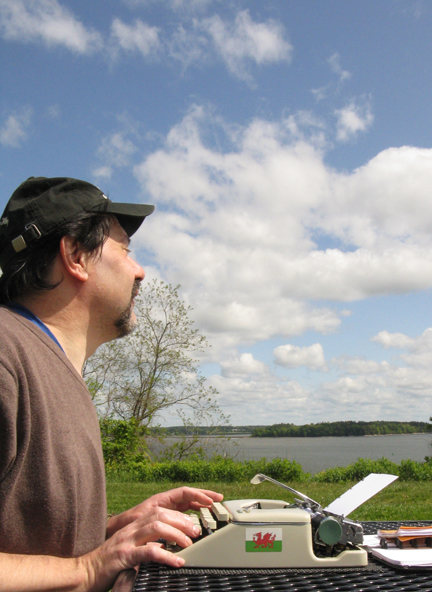

Writing at the Eastern Prom, which includes a busy playground, brings to mind the day camps that were lights to my adolescent summers in New York City. Asphalt jungle childhoods comprise scarce amounts of trees and clean grassy spaces for playing and perching. There was always a lot of broken glass to sidestep, along with other detritus I stopped seeing after moving here to Maine to begin college. No doubt, the air was a comparison I could immediately make, and since then has always been rolled into what I’ve come to know as “the outdoors.” But humble as it was, day camp gave me a taste of things easily taken for granted in northern New England. In the city, the change of context brought kids like me on long yellow school buses out to the lush and landscaped parks of Queens- namely Forest Park, and for a number of years Kissena Park. Hardly any of the other kids were from my neighborhood: the blighted and dangerous projects in Corona; they were from just about everywhere else. But we were all together, frolicking outside, jumping through sprinklers, and fanatically playing baseball every single day. We were easy to please, once we had time and space. Perhaps some of us retain those traits. There was no structure and no technology- even for the camp counselors that watched over us, also serving as our umpires through all those raucous ball games.

From my high school years:
Above: Greenway Terrace, Forest Hills, New York City
Below: High School of Art & Design cafeteria, as we all wondered what was really in those sandwiches.


I’m one of those adults that can still think very much as I did when I was ten. The ache to have time and space to muse, around those fettered and adversarial school days, resembles the ache to have time and space to muse between job tasks and inane meetings. Free time becomes increasingly costly. For most of us, liberation is rare and at best incremental. Reflecting back, childhood redemption arrived in an unwitting combination when I was 13. My year began as I completed rigorous and intense religious studies, thus declared an adult at that rather young age. In my naive determination, I survived my final year in what happened to be New York City’s most overcrowded public school, which went by the heartwarming name of I.S. 61. Its schoolyard was surrounded by housing projects and scrapyards. The city was a good 2 decades away from gentrifying, and my daily walks to school were imperiled by gangs and packs of feral dogs. Almost all the threatening and thrashing ended for me with the post-middle-school summer at a healthy summer camp in the mountains of Upstate New York, followed by my parents’ purchase of a house in a strikingly beautiful and safe neighborhood- still right in the city. And finally, still at age 13, I began my sojourn of secondary education at the High School of Art and Design, on the tony east side of Midtown Manhattan. A whole lot in a short year. My father gave me my first bicycle, enabling me to run a lot of errands, including grocery shopping. I explored all the streets of Forest Hills and contiguous neighborhoods, also toting my first camera- which had been a 13th birthday gift.

My Rudge-Whitworth bicycle, which I purchased used for $20 to replace the new bicycle robbed from me by muggers.
Above: Photo I took in 1981, in New York City.
Below: Photo I took (I still have the Rudge) recently at Acadia National Park, Maine.


The bicycle symbolized freedom and an enduring sense of self-propulsion. I would joke about drinking a glass of milk, then bicycling the length of Queens Boulevard and over the 59th Street Bridge en route to a library I frequented on East 38th Street. All on one glass of milk, as I’d say. One afternoon, while bicycling with a neighbor through Flushing Meadow Park, I was accosted and mugged at knifepoint, forced off my shining new bicycle. I still remember this well, and can recall the sheer powerlessness of that event. At my summer job in a supermarket, I saved my earnings to buy another bicycle- a used one that I defiantly considered to be too ugly to draw any thug’s attention. I still have it today, driving it throughout the Portland area, including all the carriage roads in Acadia National Park. Self-sufficiency continues to be its own brand of liberation. Alas, and as I’ve learned, childish and childlike are really two different traits. At best, that early spirit endures by adaptation. As well, self-sufficiency shows its hard limits, particularly in the powerlessness of housing searches, employment scavenging, and economics. Recalling Saint Augustine, “I do not know what I do not know,” and thus I want to know what I don’t know. If there’s any way to improve things, it must begin with avoiding prior mistakes.

Outdoors on the 2nd floor terrace at the Boston Athenaeum.


How much of a factor are our interpretations that are based upon our subjective perceptions? Obviously, something entirely subjective is my taste for perching outside to write and read in 40-degree temperatures, which I find perfectly comfortable. Then there’s the fascinating aspect of how syntax plays a role in how we view and depict our discoveries. For example, traveling to a location with a variety of cameras allows me to photograph similar motifs with different formats. The images will look distinct from one another, based upon the tools I’m using. Same with writing: pencils, pens of varied construct, typewriters, and computers will each lead to results reflecting the tools’ influences. Within this is the example of journaling with a dip pen, requiring many regular pauses to re-ink the pen, while the mind continues its train of thought. Those pauses surely reflect what is written. I’ll often switch writing instruments, when I notice aridity in my words. Varying the vantage point is also as effective with writing as it is in photography. Getting outside amidst the swirl of nature permits for an appreciation of Emerson’s description about the patient paces of nature. Light, skies, and horizons will surely affect how I interpret what I see, and how I interpret my thoughts. In a similar sense, I write during my mid-day breaks inside the Archives stacks, as well as aboard lurching city buses. What I notice and the ensuing words are affected by their situations of notation.


When I’m not on the job, and I turn away from doomscrolling online searches for apartments and employment, while the blaring and trampling from upstairs disturbs the peace, I know to go outside. Beneath the skies, there are no upstairs. Life gets to return to looking open-ended as it did when my friends and I would lie on our backs in green and sunny Kissena Park, just talking and looking up at airplanes going to and from LaGuardia. The paces of nature are surely not those of such humans as those among us who use the expression, hurry-up-and-wait. Coaxing the inertia out of the wheels of progress is exhausting. During the thick of childhood, time slogged like a schoolday. It felt endless. In retrospect, that was a brief period of time- its space on my timeline diminishes as the adventure continues. Looking back exclaims the necessity of looking ahead. My decades of tireless efforts have yet to pave ways to my profoundest wishes, to exercising and really seeing my best abilities coming to fruition. How close is success? Is it completely out of reach? I’m daring to believe it isn’t, notwithstanding my scarce resources and lack of influence or allies. Echoing Saint Anselm’s prayer in the Proslogion, “I have still to do that for which I was made.” Yet, the stuff of eternity does not include accolades or material. The moment and all subsequent time stands for me to redeem. Knowing how to redeem liminal time is a daily and constant challenge. Having little more than faith and gumption, I’m left to heeldigging trust, insisting upon finding the sacred in the ordinary. Such thin rations need the light and rain of the outdoors, for the vines of latent presence to proliferate and provide.


Thursday, July 21, 2022

where

“My Lord God,
I have no idea where I am going.
I do not see the road ahead of me.
I cannot know for certain where it will end,
nor do I really know myself,
and the fact that I think I am following your will
does not mean that I am actually doing so.
But I believe that the desire to please you
does in fact please you.
And I hope I have that desire in all that I am doing.
I hope that I will never do anything apart from that desire.
And I know that if I do this you will lead me by the right road,
though I may know nothing about it.
Therefore will I trust you always,
though I may seem to be lost and in the shadow of death.
I will not fear, for you are ever with me,
and you will never leave me to face my perils alone.”


~ Thomas Merton, Thoughts in Solitude


Atypical of my gender stereotype, I’ve always been one to ask for directions. At every age, both time and energy are precious, and I try to make the best of my resources. Recalling a day replete with irony, after hearing from two different potential employers that I was overqualified, I drove to an interview to talk about a job for which I truly was overqualified. I could not find the place. Certain that I’d overshot the address, I stopped to ask for directions in a grocery store. Having given myself plenty of time, I wasn’t in danger of being late. Speaking with the grocery clerk got me out of my bubble, and reminded me that I was surely awake. Indeed, I found the place, and what followed amounted to something absurdly depressing. Once again the outlier, these adventures return to my thoughts. As my housing uncertainty continues, metaphors become threatening realities. The brevity of time in this liminal present is exemplified in the apartment building which steadily empties of the lives who have called it home. Everyone knows what’s coming, and we are all being as proactive as possible in this forbiddingly stratified housing market. Being forced out of my home of many years is an experience that combines instability, heartbreak, and exasperation. Incredulity and reluctance have led to an impatience to join my fellow evacuees. Coexisting with packed boxes of all my worldly goods is conducive to imagining moving a lot farther away than across town. Varying degrees of unease occasionally manifest as sparks of adventurousness. What is next, and where is next?


Living, working, and having been actively part of this city for decades, I’m doing plenty of asking for directions and advice from among the legions of people I’ve befriended. It is as though I don’t really know anyone, and am a refugee in my home town. Some are willing to help, but are unable; some are able to help, but are unwilling. Under the weight of desolation, it is as vital to persevere as it is to resist holding grudges. This city kid was raised to know better than to be bitter and reticent. Perhaps some day I’ll be in the role of helping a neighbor find housing, and I will not stand afar and snub. For now, things need to be taken at face- even as “good luck” has come to translate as “glad I’m not you.” Strolls around town are now mournful, being under the shellshock cloud of crisis, noticing the haves and the have-nots. When answering ads, I ask about how these apartments are heated, and if they’re making residents pay for their hot water (which never used to be done before). It’s a landlords’ market, without doubt. On my way to work the other day, I saw a homeless person sleeping in the doorway of an upscale real estate office that brokers idyllic coastal hamlets. The two Maines, and people like me are somewhere in between. As long as I stay in this city, having neither wealth nor influence, a nice place to live will be out of reach. Along with so very many, I’ve been exploring where my prospects can be better- but without surrendering this part of the world. For the moment, the urgency is in finding stability. Perhaps in the grand scheme of things, we’re all renters. When we think we’re “buying time,” we’re actually renting something we cannot own, and can at best pay for it.


The impending loss of housing has generated its own measurement of time. In a broader sense, the pandemic has caused a change in how the world has been perceiving recent years. The change is signified in how we’ll say pre and post, as the stream of normal life is diverted- or derailed. Speaking for myself, this year’s spring and summer have been lost seasons due to urgency. It is as though there are constantly more and more and wider rivers to traverse, en route to a clearing as yet unseen. There remains writing, and indeed I have found ways to write through life-threatening trials before. If language really is the house of being, then ambition must be the basement of aspiration.

The erosive symptoms of hopelessness are difficult to stave off. When suppression burns too much energy, I’ll simply entertain the notions in my journals, stepping through the minefields of the usual patterned and condemning responses en route to writing about hopes. Creativity and imagination are potential instruments for doing battle with futility. Amidst this indefinite wilderness of not knowing the when or the where, it is as imperative as ever to keep on doing the next right thing. The humblest measures, those of intention, can still be forward movements. Recently, having another among dozens of apartment viewings, I needed to take time off from work, and chose to walk to the address. Making the crosstown trek and seeing an unfamiliar neighborhood, the novel occasion caused me to notice skies, trees, street repairers, and sundry individuals being about their respective business. The doings of life are in motion while I try to find traction for mine. Does hope require proof? What forms of proof are convincing enough? Are hope and trust reciprocal complements? Such virtues exist in time, yet are not confined to place. In essence, there is no where.


Wednesday, June 29, 2022

see beyond

“We must accept finite disappointment,
but never lose infinite hope.”


~ Dr. Martin Luther King, Jr., 1968

This time of the year is especially conducive for outdoor writing. Perching on the sunwarmed granite front stoop to write and read has been consoling for many years. But now with the inevitability of losing my housing, even benign routines have become tainted with mournful tones. Necessity and survival demand that I force myself to see beyond these liminal times. While I witness the steady evacuations of my neighbors, as we are all anticipating the “redevelopment” by the next landlords, I am also wildly scouring the grounds for a place to call home. Yet, still, the stately Victorian architecture remains, as do roses, leafy trees, and ants scurrying across the stone steps. Occasionally, an ant will run right at my book, realize it’s an obstruction, and either climb over it or scramble around it. Then I’ll stand the book up, to see how it tries to figure out how to navigate, determined to hold its direction. Not wanting to antagonize the poor thing, I remove the barrier and let it scamper on. Like these small creatures, I am also trying to make sense of setbacks. Most of us have them; sometimes the hardships are compounded. Job hunting, apartment searching, seeking grace- all look the same, all pursued with the same desperation. Perhaps it’s all too similar, and this will require some thoughtful parsing. In crisis mode, too many things seem alike. All the begging, scraping, and strenuous attempting to impress are amounting to levels of humiliation unusual even to me. Yet the fight must not cease, neither should the refinements of my pitches. There is surely much more to lose by clutching a status quo, than in making a move.


Another annual summer reminder is my memory of arriving in Portland. After my hardworked endurance of the New York City school system, I graduated from the High School of Art and Design. Commencement was at nearby Carnegie Hall, and the speaker was alumnus Ralph Bakshi. I had saved my money to travel back to Paris so that I could spend the summer with family. I had missed everyone very, very much- especially my grandmother- and there was nothing I wanted more than to be there. It was undoubtedly a great decision in every way. By Labor Day weekend, with a great many thoughts and ambitions, I arrived in Maine. The building containing my first apartment is down the street from the place I will have to leave. Through eight different apartments, I remained close the center of the city.

I remember very well how desolate it was to be a seventeen-year-old stranger in town- even after beginning at Maine College of Art. I’ve since been active in numerous community efforts- creating, befriending, giving, serving, teaching, and working- but this housing crisis has me no less on the ropes than when I first arrived. A stranger in my own town. Maine is a wilderness at multiple levels: Yes there are thick and endless woods, as the state is mostly rural, with beautiful landscape. But it is also a hard culture. Somehow I wound up fitting in among kindred spirits, especially as I got more involved in civic and artistic life. The cultural differences surface as I seek advice and help from among the hundreds of people I know. A city person like me prefers to communicate directly and unabashedly (but with the best of manners). The stereotypic Yankee mindset is to go about things indirectly and laconically. People tell me about this-and-that empty apartment across the street from them, but they can’t tell me who owns the place because they either never speak- or the owner is an “avowed enemy.” I’ve heard that latter expression many times. Social media is well suited for such personalities, because they can suspiciously snoop around without directly communicating. I’d like to think I’ve evolved over the years, but never into that. My purpose in life is to be a doer, not a spectator. As much as I inhabit this world, I am not of it. Still, try making any progress with housing or employment without help from others- especially those “in the know,” and the “gatekeepers.” Even if you ask politely. Even if they know you.


I’m reminded of a Maine College of Art memory; a very subtle one that I somehow remember. I had written a paper for a literature course, and my professor wrote an interesting reflection after my last paragraph. Professor Aldrich concluded his positive comments with confessing there was something he couldn’t quite agree with, and then wrote “but maybe it’s just the mood I’m in today.” His candor was commendable enough, but the admission also taught me something about context. We tend to perceive according to our circumstances. The covid era is now 29 months running. We can look back across 2½ years of world-altering plague. While we all heard daily about fatality numbers and immunization, both the housing and job markets spiraled into merciless stratification. Before realizing how different everything became, everything began to look different. Like many others, I kept on working- setting up a remote space at my dining table with an extra laptop computer I had purchased, when not pitching in for various departments on-site. The imperative has been to keep on working. While I witnessed furloughs, layoffs, and countless voluntary departures- I kept on working. Lunch hours became isolated twenty-minute breaks, and vacations became impossible. All was subsumed for the causes of relevance and productivity. And survival. The mood I’m in today is that I’ve kept on working, obstacles notwithstanding.


One of my colleagues recently said to me, while discussing what we’ve been able to accomplish in the past fiscal year, “We’ve all been through a lot.” Stopping and looking up, I replied, “We have, indeed.” The covid era has weatherbeaten and accelerated the aging of most of us across all the generations. Ambitions held so preciously in the depths of our lockets, tenaciously carried through our school years, collide at the compromising crossroads of plague. The imperative is to survive, but what are the rewards of survival? Like the ants on the front stoop, it would be good to know that I’m scurrying to something better in this life. I seem to have met many of the descendants of the friends of the biblical character Job; they like to tell me I’m being tested, and that my life is a trial. And it’s much more than being on the brink of losing my home. Well, if this is indeed a protracted spiritual test, there isn’t much else I can do but to stick to my scruples. It means to believe without seeing, to pray insistently into the opacity, and to forgive all the tin-eared people from whom I’ve asked for help. Speaking with a wise friend, I mentioned the weight of some kind of bewildering punishment. He told me to do all in my power “not to go there,” and to be reminded of Divine compassion. Going further, he told me to be sure of that. Perhaps if this is a test, it’s about how I perceive God. Purposes are often discovered amidst struggles.


Maybe I’m not being punished. Maybe I’ve heard the expressions no-cause and at-will a few too many times to be reminded of my own humanity. Everything looks very different now. But while I continue straining to perceive through cluttered apartments and dilapidated buildings, my self-prescribed imperative is to see beyond reticent neighbors, see beyond this smallminded culture, see beyond constant setbacks, see beyond roadblocks and rejections, see beyond exclusivity, and see beyond all that tells me to just give up. Seeing and proceeding beyond limits may lead to a clearing, a pasture, a wellspring. That inner locket is still where it has always been, with me since my school years when I was thrashed around by bullies who outweighed and outnumbered me. It’s still kept safe, and the preserved spirit of forgiveness and devotion will repel the tarnish of these times.


Wednesday, November 1, 2017

autumn


“In this quiet moment of a changing season,
we are called to remember:
Never stand still but move with one heart.

The colors of this hushed autumn morning
will all too quickly fade
into the still winter silence.”


~ Monks of Weston Priory, Move With One Heart.


Tuesday, May 2, 2017

spring hopes eternal


“Since nothing is so secret or hidden that it cannot be revealed,
everything depends on the discovery of those things
which manifest the hidden.”


~ Paracelsus, Inner and Outer Worlds.

The spring season has finally taken hold- even among the resistant crags of northern New England. Warmer temperatures and green-tipped ashen branches have emerged, having fought through winter’s last howls. Late-winter coincides with the liminal season of Lent, culminating with Passover and Easter. Suddenly, as though released into light, the days are lengthened. Enduring times of fortifying against the elements are best seen as temporal. If it’s a subzero cold-snap, I’ll say, “we’ll be out of this in a week or so.” An awareness of the movement of time provides something of an assurance, that in a short while, the hardships will pass; oppression will not have the last word. Traversing into milder weather and vivid horizons heightens hopes. Such anticipation is a subtle, nascent act of faith. But awaiting the fruition of hopes sown cannot be passive: the waiting is as faithful as it is impatient. Intensely looking forward can be both hopeful and painful, in a simultaneous tension that motivates. We may await transitions into better times, yet we cannot know the durations of those times. Still, with great anticipation, liminality expects the temporal.


In northern climes, changes of seasons- and between them- are impossible to overlook. Daylight extends into evenings, and ubiquitous snow mounds dissipate. Things do begin to look different, and we can even exchange those careful, tentative vertical steps in favor of broad, slanted strides. It is quite natural for me to take note of all that can be sensed, between earthen aromas, the ocean, wildlife, and how we continue to adapt. Spring snowstorms have been abundant, but their effects cannot last for long. When a foot of snow comes down in April, even in billows, there is an accompanying sense of assurance in its tentativeness. The advance of spring will resume. This season, when it’s been possible, I’ve been outside photographing as much as I can. As though pushed outdoors, I’ve taken different cameras and lenses out with me, through blizzards and to waterways. Nearby rivers and ocean are especially compelling. There is a consoling sort of solitude, sensing skies, colors, and hearing water currents alive under thick layers of ice. The transfiguring natural elements inspire evolvement.


Essential as it is, aspirations generally do not make things move. Vision must be put to action. But wishing and working are not assured successful results. Yet, still more, defeats and missed opportunities are fulfilled when followed by continued and refined effort. Spring is designed to succeed winter. Seasons of perseverance must spring forth from deadened dormancy. It is as though spring forces us to hope. We have to, especially at the confluence of lengthened days and determination.


As instrumental as it is to survive, longing- in itself- does not change a situation. For example, between this recent winter and at least the last three, my income has decreased, while living and working in the same flawed, unsettled places. But the emergence of the spring season manifests a mysterious sense of the slates having been wiped clear. There’s a resurgence of energy to do more than simply survive- more than to simply cope, wince, and bear with all that is far less than life-giving. The season is fluid and fleeting, and there is much to accomplish; the lasting lasts only so long. Renewed, by definition, is not new. Calendars do not compute in reverse; such measuring devices remind us to look forward and anticipate. Though more journeys imply more setbacks and scars, they can be overgrown by new grasses, green leaves, and perennial growth. Recently while out photographing, I looked at the Presumpscot River streaming into the Atlantic. Large rocks standing fast in the surrounding rapids are testaments to solidity and faithfulness. My thoughts mused, what is fair to expect? In response to my own question, I replied, I say it IS fair to expect! Spring hopes eternal. Let the season unfold.


See also: raw new season.

Tuesday, March 28, 2017

my steps


Stopped in my tracks, I marveled at my steps,
and wondered whether they were ever mine.
Looking down to the ground, my shadowed prints noted light and time.

We say we own;
we claim our paths and swaths and strides,
careers and conquests and empires.
But do we own our steps? Can paces be possessions?
I’ll say, “my footsteps;”
many days, “my weary way,”
and some days, “my strong stand.”
Steps are claimed, after they’ve been made.
But not before; not before some ground has been covered.
My steps are mine, because I tracked them;
they’ve made themselves known, after the fact, after impressions,
after I’ve looked back.

We say we take up space:
occupying, holding, amassing, grasping
that which is merely in motion, yet pulling rank.
Some of us are at will, in livelihood and home.
The provisional lingers, by our thoughts and steps remarked.
It is for journeying souls to note the jots and accents
of distances and times.
My steps are innumerable, in forms of trudges and slides,
tiptoes and leaps, tentative and bold,
minuscule and majuscule;
ever chasing traction, pushoff,
and sentences that run on and on and on.

Back and forth, uphill,
and so many stairs in office buildings,
treading the mills;
shall I consume the time to decide
whether or not my steps are squandered?
Well, I scribbled some words, walked and pondered,
finding that writing is the only retracing of steps
that cease to exist.
Backtracking is retracking, adding layers to buried steps.
What I own are my observations, not the places of their creation.
As with language, my place is to participate and alight,
but my ownership, my imprint
is to arrange and describe.

The ground of this momentary standing is borrowed.
Though my ground is not my own, I do know to remember.
A soul’s eternity endures beyond buildings, streets, and worlds.
I know not to claim the transitory for posterity,
yet I know to hold a thought and walk with it.

Memory enshrines the sweetness of the momentary,
the fondest steps among many,
from the missteps best released,
steps that are mine, so long as they are remembered.

A pilgrim’s steps so wisely know
direction and time:
it is forward, and at this moment.
Our feet as arrows edged to future paths,
are poorly designed for reversals and standing
as unused stanchions.

My road has no divided lanes
between sacred and profane,
as the sanctifying journey
distills all into the holy indirect,
meandering way.
My recollected words and pictures
are those of a voyager,
stopping in my tracks and marveling at my steps:
Looking down
to consecrated ground,
redeeming light and time.