Showing posts with label survival. Show all posts

Saturday, June 20, 2026

civilization

“We’re all mystics. That’s no observation.
It’s a demand placed on life.
No human being ought merely to spend the day...
For everyone, there ought to be places of free intentionality
where vision can happen...
The sentence, ‘we’re all mystics,’ contains in itself
the right of every human being to have beauty and vision.”


~ Dorothee Sölle, The Silent Cry: Mysticism and Resistance.


Unless you’ve been living an extremely uncommon worklife, you’ve surely come to know the perfunctory dysfunction that wafts through typical company meetings. Stiff and rarely efficiently or engagingly led, such experiences bring back indelible memories of school lunchrooms during adolescence. In some foundational ways, the sights, sounds, smells, and basic dynamics of the cavernous cafeteria in New York City’s Intermediate School Number 61 introduced me to what I’ve frequently encountered throughout professional life so far. Obviously, the cast of characters changes, but the patterns and archetypes became identifiable among cliques, rival gangs, bullies ringleaders, quiet followers, fighters, quitters, smirkers, comedians, caring personalities, rebels, competitors, self-destructives, arbiters of cool, and dreamers. Where I grew up, within the city, my friends and I would band together for safety- both physical and psychological. And we all either graduated or somehow transitioned out of these institutions. I saw all these types in summer camp, too, and surely thereafter in workplaces. Having been viciously bullied (always the youngest and easiest target), I’ve mused over the years about what those relentlessly malicious kids became in their adult lives. Age doesn’t automatically cure bullying. I know this. Did they wind up criminals? Politicians? Corporate executives? Maybe some repented of their cruelties? I guess it’s not for me to know. Inevitably, we all have to live with ourselves.


For the bulk of his career, my father worked as a principal in a major accounting firm with offices around the world. He was very well-liked and respected. As a kid, I couldn’t distinguish between his colleagues and his staff, seeing how collegial he was with everyone. I was deeply impressed by his egalitarianism, and I try to apply that as I’m able. Another trait I’ve inherited is Dad’s distaste for purposeless and protracted meetings. He used to tell me that “meetings are the most unproductive thing you can inflict on others.” I remember he had a wide ballpoint pen that had a digital clock built into the barrel- kind of a novelty. He called it his “meeting pen.” When he absolutely had to call a meeting, he kept them short, and would begin by apologizing to all present, while pointing to that pen-clock he’d perch on the conference table with, “Don’t worry; I’m watching the time.” He told me all of this, when I was about 16. Everyone, including me, found him inspiring and inevitably a leader worth following.

But that’s an exception to the usual. I’m among the too-many that know the ritual all too well: obsolete, aimless, self-congratulatory (reminiscent of the plights of Reginald Perrin of BBC fame), and anything memorable would be due to its egregiousness. In my supervisory roles, I copied something I’d picked up from a manager I had in a fast-paced photo lab. With a thick Boston accent, he’d say, “Keep talking with each othah, and do good work.” My version of that has been, “If we keep lines of communication open, we won’t need meetings.” This really works. I refer to how we innately wish to accomplish. And paths of least annoyance comprise brevity, purpose, the absence of jargon, and not forcing others to provide their “fun facts.” In my teaching capacity, I’ve developed the expression, “invited, but not obliged.” If there must be guiding attributes, let them be mutuality and informativeness. We do, after all, have work to do.


Workplaces that are also places of public service have to balance two general spheres: one is insular among staff, and the other is outward-facing toward recipients (customers). Distinct communities, with their respective, complex dynamics. Then there’s an off-duty life that occasionally sees the social circles converge. Admittedly, I’m hardly an exemplar, neither do I have any formulae, yet I attempt at consistency in all efforts. Among proving-grounds is the small city of the majority of my adult life, which includes a number of denizens that studied a variety of subjects with me, along with receiving research help from me, attended religious services I’ve led, and dined on pastries I’ve baked. And all have heard me cite “do unto others,” and the rest of the Golden Rule.

This G.E. Superadio has been with me since I was 19, pulling in broadcasts through concrete walls and steel structures.


In this world that encompasses the brutish culture through which many of us must navigate, I think a lot about civility and the disappearance of decorum. In my public-facing department at work, my portable radio is tuned to the region’s classical music station- at a subtly low volume. It keeps me company, and patrons tell me they like what they hear. There are even comments about the object itself: “Is that a real radio?” Collectors acknowledge that it’s a G.E. Superadio. I’ve mentioned how I’ve owned the radio since college, that it’s been with me, as accompaniment, in numerous art studios, archives, and apartments. Among my several, smaller radios is one that regularly travels with me. Even the nice hotels have ceased adorning rooms with anything other than large shrill flatscreen advertisement-players. And thus I bring my own version of civilization along with me. There are always public radio affiliates and soothing music for my listening. And I always bring my own coffee mug.

Productivity for the ages; careful and fast.
Radio in background; coffee thermos at lower right corner.


Maybe you have your own practices, determining your acceptable and portable civility, as you move through this world. As well, you might also carry various elements of your civilization with you. There are, indeed, the essentials of a workday, a schoolday, or an excursion: keys, phone (within which there may be some of your digital civilization), wallet, journal, laptop, et cetera. Don’t forget that elusive charging cable. It gets more complex with longer sojourns. In my example, the ubiquitous satchel includes extra writing materials, hand wipes, camera, granola bar, peppermints, rosary, and something to read on buses and trains. If a suitcase is involved, there’s a radio in it. And what about those aforementioned meetings? A memo pad and a pencil; ideas are hatching all the time, and I need to hold those thoughts for later elaboration. Time, precious as it is, needs to accommodate productive musing.


Tuesday, July 8, 2025

small

“Negations seem to say less,
but actually they say more... expressing transcendence.
The more intimate the ascending force, the more powerful the elevation;
the deeper the love, the more fruitful the rising. It is beneficial, therefore,
to practice in this manner.”


~ Saint Bonaventure, Love Enkindled


Perhaps, if there will be interest to someone far into the future, the telescopic truncation of time will reveal a dovetailing of present-day crises. From intensely economically recessed times, there followed a devastating global pandemic, giving way to this contracting and stratified era. What comes next remains to be seen. While the cultural and infrastructural scaling-back of the past decade seems yet to hit the bottom, contrasting and exclusive opulence has yet to crest. The view from my very modest perch is that of scaled-back times persisting and forcing ambitions into compromise. Reflecting upon the ancient prayer to be led away from temptation and delivered from evil, there really is no other wise choice but to persevere and to improve as possible. No turning back, and no stopping at this extremity of my hardworked tracks. This often comes to mind, sometimes when my daily commute includes a long stretch of shadeless barrens of broken pavement mildly recalling slivers of my junior high school trudges. The urgency of perseverance bites down on my work days. Keep going, I tell myself, even if just by modest increments. Big ideas may exemplify ambition, though progress may manifest by small measures. Reaching destinations, apparently, is the guiding big idea. Complex entities become intelligible, as Descartes posited, via analyses of the smaller components. This comes to mind as I process oceans of archival documents and images while keeping the broader entirety in view. Completing projects, of any extent, also carries metaphors about letting go, taking on new projects, and persisting in my belief that better will ensue.

Amidst a societal prevalence of necessary downsizing, terms such as small and humble have ceased being pejoratives. Basics being unaffordable for so much of the general population, frugality has taken on a self-defensive connotation. Economics and personal reach are obviously tied together. Many of us are brought to the challenge of whether and how less can be more. What happens to the scale of our hopes, as buying power dissipates? Shall we thrive in our smallness?

Such small things in a major accomplishment for the ages.


Living in a scenic, yet depressed region whose chief commerce is tourism reveals a juxtaposition of extremes which are impossible not to notice. For this essay’s occasion, my treatment of smallness is along the lines of making do- as necessary. Small pieces in an immense puzzle, such as one 35mm negative among 1.2 million- each that I examined while interpreting and processing an enormous archival collection. In context all those tiny parts find their greatest research and documental impact. Gem-like smallness, from artifacts to difference-making mechanical parts, are outsized in their importance. Think of ingredients. Years ago, when my mother taught me to bake bread, she showed me what a pinch of salt is, and how integral that is to the exponentially larger whole. When I’m binding books, I regularly see what a great difference a sixteenth-of-an-inch makes. Ponder the parabolic implications around grains of leaven and mustard seeds. Astonishingly simple things serve to form a reliable world around us. When I see ads and signs about “buying small” from a small and local business, building smart and small, companies and venues that publicize their personal attention, it is interesting to see the humble somehow exalted.


As we are compelled, for any of many reasons, to redefine what we mean by significance, we may also reconsider how we interpret importance, and what is trivial. In all spheres, it is critical for me to know what I’m overlooking and needs my careful attention. Difference-making, subtle factors can paradoxically become vital. Indeed, there are solutions found in correctly fitted fasteners and cogs- and surely how far-reaching are small acts of kindness? In keeping with the understated and humble, it’s not really for us to know- except for when we are recipient of such gestures. My best teachers could never have known the extent of all I learned from them. The expression, “pay it forward” is something a person can do, however modest that gesture might be. But of course I want to do great things! I’ve tenaciously cultivated myself to achieve and inspire. Preparation and endurance crave tangible fulfillment. How, when, and if that materializes continues to be a mystery. So does not knowing what to reasonably expect. But action and motion must move in a forward direction. Rather than to expect to solve sweeping problems in a fell swoop (few can do that), I can manage in measure with small steps. In this light, lowly attains great importance. There is discoverable divinity in the ordinary, and in this light we see light. Plainness can conceal complexities. Consider the needed effort to pare many disparate ideas down to a concept- and to be easily comprehended! The big work en route to humility, simplicity not to be mistaken for smallmindedness.


Monday, March 24, 2025

sprint the marathon

“Of itself, the light of the created intellect is not sufficient
for the certain comprehension of anything without the light
of the eternal word...
St. Augustine says in On The Trinity: “The eye of the human mind,
since it is weak, is dazzled in the presence of such excellent light,
unless is it purged through the justice of faith.”


~ Saint Bonaventure, Christ, The One Teacher of All.

1

Just as critical as it is to keep on productively working, it is equally essential to continue being ambitiously creative. I’ve been insistent upon this directive for myself. Maintaining perspective demands increasingly vigilant discipline, amidst these pervasively discouraging times. A soul is not wired to expend all its energies for merely holding one’s ground, but rather to aspire and grow. With such abundance of convenient and ready technology, learning and mental health should not be so intensely daunting- but the fray above which we live tends much more to the nightmarish than to dreamlike hopes. Many say, “life is short,” and “you only live once,” all of which resembles forbidden fruit while most of us tread the mill of survival mode. A well-meaning colleague of mine, as sympathetic as they are prone to offer solutions, likes to tell me, “life is a marathon, not a sprint.” All of these sayings serve as nice reminders, while not necessarily practical. Some of us are fulltime caregivers that are also fulltime workers, managing both scenarios single-handedly- even gratefully. With enough coffee and clever planning, I get to write and study. Sprinting the marathon must have a fixed duration, though I continue testing that theory.


Priorities and urgency determine the pace, along with instincts informing me what is needed to survive. For at least the past half-dozen years, and for the foreseeable future, it remains imperative to hold course- at least until it’s possible to adjust the pace. Atop all that perpetuates my insomnia, it’s easy to believe we’re all witnessing universal decline. But haven’t observers been saying this since time immemorial? Indeed, though each one of us experience our own times and trials. A recently introduced reader of these essays told me that my writing is dark. Well that’s fair enough, and it isn’t my place to contradict another’s insight. For my part, I mentioned something I’ve repeated to my writing students for years, which is to write true- in all subjects, whether favorable or not. In personal writing, one must commit to practicing the written word and to do so with authenticity. Another subject I’ve been teaching, now for a solid decade, is philosophy. My own studies have long been with medieval philosophy, and I’ve always been profoundly impressed by thinkers who insisted upon extolling light Divine immersed in extremely dark ages.

2

Being grounded in the reality of vigilant and multiple responsibilities, there is the beckoning balance struck in the gospel to navigate society without allowing one’s soul to be owned by this exploitive world. Exemplified by the overabundance of newsfeed salespitch lures, one would think all our decisions are made for us. But not entirely. And the temptations are not limited to consumer products; there are also peddled ideologies piped to our personal devices. As a longtime student of such beacons as Erasmus, Ruysbroeck, Scotus Eriugena, and Bonaventure, I know to be enlightened in the darkness. The conscientious choice for what is lifegiving also comprises choosing away from unhelpful idols and ideals. Doing so requires strong doses of discernment, especially as even our work and worship passively absorb seepage running off from prevailing brutish culture. This entails an intentional choosing away from disrespect, keeping constantly aware that our vocations are for the purposes of service to one another. In other words, choosing that which is honorable is to choose away from denigrating others. Choosing the high road means choosing away from the low blows. Kindness over quagmire. A life’s work, to be sure; easier to utter than to fully apply. The road less and less traveled (but no less worthy) is that of human genuineness. A decade ago, many of us were striking the contrast between real and “virtual.” A meeting at a real table, or in a physical classroom, became an “in-person meeting.” The covid pandemic accelerated the transition from videoconferencing to meetings- or visits. Of late, the world has waded into varying degrees of artificial intelligence, expanding the distance between manipulated appearance and actual physical experience. For the conscientious, we’ll integrate watchfulness about choosing and choosing-away-from, into our days.

Somehow, I’ve been able to make productive careers around sustaining the unsustainable. From my years in extremely frenetic, deadline-driven commercial graphic arts and photographic production- to my following couple of decades in painstaking archival work and public services- my solitary output has regularly outpaced much larger departments. More than “just by doing,” it’s meant constant and strategized work. In the photo field, I kept a sleeping bag and changes of clothes in my studio. Through my second career, my thirty-minute lunches comprise 15 for eating what I’ve packed with me, followed by another 15 for journaling. Doing free-lance contract work, I took on (and completed) projects nobody else would take. In all circumstances, it’s been about earning my keep, proving the value of the work, and tenaciously keeping strides ahead of demands and due dates. Private-sector businesses and nonprofits each have their own versions of anxiety, bottom-lines, and absurdities. With both sectors, a worker must derive their own sense of satisfaction, and both involve bringing people and purposes together with well-crafted presentations. The same levels of craftsmanship, thoroughness, and communication are essential in both fields. Alongside appreciation from clientele, both spheres require constant proof of the worker’s worth. And clever innovation. All of which entail a disciplined sense of confidence, and impassioned drive. Through tougher days and easier days, consistency is de rigueur.

3

Fortunately, sustaining the paces of production and service grew to become an ingrained instinct. Occasionally I’ll notice the cumulative effects when I stop for a portion of a weekend. Nothing makes itself known quite like contrast. A wise friend suggested creating a sustainable bridge, spanning between protracted strings of strenuousness and the rare day off. Being one who loves words, the imagery suggested in bridge is much more interesting to me than my customary puddle-jump. And a metaphorical bridge needn’t necessarily be a place or particular length of time- elusive as both are. A sustaining bridge can be as humbly accessible as a coffee break chaplet, a sidewalk saunter, or an evening spared of lit screens. And writing. My handwritten lines are stitches connecting hours, days, and years. All words, which I compose myself; and the intelligence, if any, is natural.


There’s a worthwhile thought exercise in the consideration of what sustains. Years ago, I re-translated the old “daily bread” into the encompassing “Give us our sustenance, today.” A logic that precedes grocery errands, by making shopping lists, can inspire listing sustaining principles and endeavors. Indeed, there’s writing and studying- both reflective and practical. A philosophical shopping list of sustaining provisions would continue with such vital inspirations as discovery, faith, exploration, and opportunities to cultivate projects. As I’m sustained by physical and metaphysical nutrients, there are such corresponding manifestations as sharing my abilities and experience, while accomplishing and motioning toward the future. As it implies, sprinting a marathon persists at vigilant full-throttle. What’s most needed doesn’t always scream loudest.


With my philosophy students, we recently had an animated discussion about how we define happiness. The general consensus was their interest in simplicity, far exceeding material abundance. We talked about utilitarian ethics and there were many comments about the word pursuit. Most of the youngest students emphasized their weariness with electronic tethers, shifting the discussion toward self-discipline and personal interaction. And all of this took place after we disengaged from our “hybrid” live/teleconferencing model which we had been using for the past five years, deciding that we favored meeting together in person. Admirable and hopeful. Committed to being a fit and inspiring educator, I’m reminded about self-care, with the unadorned simplicity we were extolling this week. Deep-seated learning manifests with contemplation, and that is essential for the praxis of compassion. The squeeze of multiple fulltime commitments has compressed me into reaching for the refuge of the written word. Years of contending with time deficits has caused me to savour the oases all the more. At work, I’ve long conditioned myself into refraining from metaphorically looking up at the mountain, ingraining myself to persevere. For example, this past December saw my completion of a 14-year project in which I processed eighty years of archival journalistic photographic negatives- from physically salvaging hundreds of thousands of pieces of largely uncaptioned film from a gutted office building, to their preservation, inventorying, and digital publication. All the work of one person, in the midst of managing my multifaceted department myself. It took intense determination, not just to defend the project and my vision, but also to refrain from looking up at those heaps of cellulose and avoid being overwhelmed. Indeed, I worked as quickly and efficiently as possible, sprinting the marathon. The even bigger picture comprises belief in the value and purpose of the opus- whether it’s archives, or teaching, or writing, or living. The tie that binds is the drive to be the Renaissance worthy of pursuit.


‘Yet a little while, light is among you. Be faithful to the light that you have, for fear darkness should overtake you; for a person who walks in the dark does not know where they are going.” ~ John 12:35

Wednesday, February 19, 2025

accompaniment

“I see at certain epochs of history what seems like an emergence,
an incursion, of the Divine Life.
It seems as though in a marked way
and to a peculiar degree the Life of God-
again humanly revealed- has broken, like a vernal equinox,
into the lives of humans and into the stream of history.
A new installment of life has burst into the world,
like a mutation, that changes the old level forever...
Divine wisdom, changing the line of march...
Not always was it a saint that did it,
but it was always a transmitter,
and always the trail was luminous.”


~ Rufus Jones, The Luminous Trail.


among others

As I proceed, the trails of my creating are as equally evident to me as the paths I’ve chosen to follow. Survival has required years of roadbuilding and provisioning, albeit through poor visibility. And this is said amidst constant, resourceful, and tireless work. There are countless souls in far lesser straits, visible daily in these stratified times. Having lived for decades in a small city that suddenly turned so radically and severely into gentrification, my continuum has been pushed to the margins. Among those who manage to stay for various reasons, we substantiate one another’s experiences. A significant portion of the pre-2020 Maine population has out-migrated for improved fortunes elsewhere. When a five-year resident looks like a seasoned doyen, community memory loses its depth. As local resources such as businesses and churches have continued closing, replaced- if at all- by big-box versions of both, the hunger for comforts intensifies. It is seen and heard. And the seeing and hearing are right at the surface at squalid inner-city bus stops. The bus line with which I commute to work is busier on occasional Thursday evenings when a city church offers free suppers. I know this because passengers talk to me, and I always respond. Many climb aboard and disembark with backpacks and plastic bags of belongings, en route to shelters. That’s not to mention the desperation along sidewalks. The wait for my return evening bus witnesses the banter among those turned out for the night. Some help one another haul their bundles. City officials really need to get out more. I could teach them how to be an observer and a participant at the same time.


When we recognize each other, we’re reciprocally bearing witness at the most basic level. From there, we can corroborate our stories. That is inspiration’s ground of being- every scenario from pavement filth to plush meeting offices. When U.S. Surgeon General Vivek Murthy published about the Epidemic of Loneliness, he emphasized the vitality of community connections and genuine, mutual care. I’ll add that when we acknowledge each other, we begin to give validity and respect to those in our midst. This is a way to broach an antidote to desolation. Students and colleagues tell me about how dauntingly difficult it has become to make friends. We all agree about how ironic this sounds, in light of abundant connectivity. Invariably we talk about how social media has redefined “friendship” into something virtual and unsustainable- especially without initiative and conscientiousness. “I’ve seen you here before,” a weathered bus stop standee said to me, followed by “You want some food?” She offered me something from her bag. I thanked her and politely declined, mentioning that I had groceries at home. “You should come to Thursday suppah,” she said, “it’s really good.” “I might just do that,” I replied. I used to serve similar suppers, at a crosstown East End ministry called The Root Cellar. Poverty takes multiple forms, including lack of provisions and shortages of human acknowledgment. Our needs for accompaniment are paralleled by that of mutual recognition. What happens when we are “strangers in town” (or even in our own town whose population abruptly shuffles)? How important is it to be recognized and known?


On a lighter side, I’ve taken to trading wisecracks with one of the grumpiest bus drivers, the fellow some of us call Lurch. I think he does pretty well to keep even-keeled, considering all he tolerates. Well, one morning, as Lurch’s bus approached the stop at which I was awaiting, I witnessed some strikingly reckless driving that included an illegal U-turn right in front of his crowded bus. Boarding and scanning my pass, I said to the grimacing Lurch, “Wow, I saw that red Rav-4,” to which he replied, “Yeah, you can’t make up this kinda stuff.” By sheer participation, we accompany those in our midst. Even Lurch. Among my closest friends is a social worker who is also a pastoral minister. I spoke with him recently about how I’ve especially noticed the value of accompanying others, even in subtle ways, both for others and myself. John understood what I was describing, calling what we can do “the ministry of presence.”


saints


Out of necessity, my recent 2½ years of daily commuting have been on public transit. That helps explain my numerous comments about the liminality of waiting under the elements and having to spend a lot of time doing that. For the previous 17 years, I had a few minutes’ walk to work- until downtown life became an impossible luxury. During my twice-daily waits and rides, there have been opportunities to be made, so that I can redeem the time. Choosing away from the ubiquitous phone-fiddling most everyone else does (“lead me not into temptation, but deliver me from evil”), I always have books with me that serve as companions. Being an unhurried reader that takes notes, requisite index cards are typically handy. My satchel is also provisioned with a prayer booklet for reflective pauses. These sources carry forth into my workday pauses, known in my journals as coffee canticles and bus-stop novenas. Long-known as scribbling and nibbling journaling and lunch breaks go together, one as everyday as the other.


My studies and spiritual practice have run juxtaposed lines for many years. Parallel to sacramental sources in ecclesiastical institutions are the wellsprings of inspiring troves found in libraries. Escrivá referred to his spiritual reading as building up a store of fuel. “It is from there,” he wrote, “that my memory spontaneously draws material which fills my prayer with life.” As it frequently happens with favorite authors, I discovered Escrivá’s work through footnotes printed in books. Most of my beloved authors and works have met my path via written references and by spoken recommendations. The incomparable and indispensable Cloud of Unknowing was first introduced to me by a bookstore owner. A late colleague and friend taught me an observation I’ve shared numerous times: The saints are always teaching us. I’ve long tended to latch onto brilliant thinkers of yore by starting with quotes and compelling portions of books, then their biographies, and finally their own works. An example is San Juan de la Cruz, who became profoundly dear to me. I read all the biographies of him that I could find, leading to contextual readings about his contemporaries in Spain and France, after which I revisited his poetry- and then, feeling prepared enough, The Ascent of Mount Carmel. Studying that great work, over a period of months, I created my own annotated index; it was as though I was navigating the mountain, too. After traveling with it, I had to rebind my copy of the book. His work and his life are inextricable and informative. There are many other saints, not necessarily canonized, and no less significantly- teaching me. Erasmus, Ruysbroeck, Kempis, Pascal, Merton, Tozer, Brother Roger of Taizé- naming just a few- ever accompany me. Faithful companions and their words make for a better provisioned voyage, always teaching me. Another saintly and Quaker companion, fellow Mainer Rufus Matthew Jones, teaches us through his enduring books to not limit our vision to proprietary denominational thinking, and rather to transcend societal fractiousness. From his applied wealth of learning and insight, Jones’ books The Luminous Trail, and Studies in Mystical Religion present vignettes of saints in his characteristic unvarnished eloquence. His descriptions of Saint Francis of Assisi stand alongside the similar reverent biography written by Saint Bonaventure. The latter’s life and works have been integral to my current focus of studies. These teaching saints accompany, and they always mention their accompanying portions of holy writ.


mentors and guides


Dovetailing the ancients are the guiding mentors I’ve personally known. As old friends and cherished teachers, I look to them all as beacons in the night. Earlier this week, after an especially arduous day, while waiting for an elusive outbound Number 9A, I noticed myself straining my eyes as far as possible for that rolling and heated transport. It was a brutal 7 degrees below zero, windchilled and pitch-dark. In that coarse half-hour, everything but a 9A passed by. Having memorized the Divine Mercy Chaplet, I focused on that, also adding to my intentions all those that are without homes. When it finally arrived, stepping up and in from the mound of rock ice, I told the driver he was a God-send. He liked that. Then I sat and thawed a bit, before descending for the last part of my pedestrian journey in the deep freeze, the Chaplet returning to me again. Sources and refuge often intertwine.

We strain into the distance for lighted trails, for game-changers leading to better days and paradigms. There are surely many others; in the search for accompaniment, we can each be accompaniment for one another, adding meaning to our shared continua. Perhaps ponder what and who accompanies you through your days. Who follows whom? What and where are the places and contexts of refuge? Amidst the overwhelm of contemporary culture, there remain lifegiving ideas and gestures to memorize.


Seeking the solidity of consolation, in the absence of accessible places of intellectual and spiritual nourishment, I’ve been seeing how many turn to libraries. People thirst for respectful and nonsectarian acknowledgment. And most may not even realize this. There isn’t a week during which I don’t hear, “You’re about the last familiar face I can find.” Who doesn’t want the assurance of familiar faces? Our vulnerabilities hinge upon mutual recognition, which is essentially validation. Whether patrons, or associates, or even donors, there is a common search for witnesses to our lives- for substantiating observers. “Do you remember that?” “Did you know so-and-so?” “Why don’t pictures of such-and-such exist anywhere?” We can only find what has been preserved, and what can be found is what can be preserved. Basic as that sounds, this must be expressed in the gentlest of ways. Interactions reveal food for thought- whether among students, casual visitors, patrons, or colleagues. An occasional researcher totes a large, antiquated computer“tower” with him, which he hefts in a canvas bag. It’s his memory- containing an untold amount of his work; I don’t dare to judge. And then there’s cultural memory. The almost-universal fascination with microfilm is remarkable. Most workers dislike it; I find it very interesting. I call the miles upon miles of filmed newspaper pages history in real-time. Often the queries boil down to people simply wanting to see a time they knew. Reminders. They love telling me about the advertisements they find, along with the long-ago prices. Personal references are often all that any of us can see, in our limited visibility- as with the lights of a homeward bus.


Saturday, April 20, 2024

healing takes time

“In remembering, there is always present to the soul
the result of some past operation, and the soul acts on that result,
as on a new object. The soul has its being in eternity, but lives in time;
and the ideas of past and future are not derived from the relation
of the facts of memory to the soul,
but from the relation of those facts among themselves.”


~ William Batchelder Greene, The Doctrine of Life (1843)

Three weeks ago, I made my second relocation in the last nineteen months, all the while working full time. The August 2022 move had to be made, under the duress of the evacuation of the abruptly sold building I’d lived in for 37 years. The recent move had to be made, under the duress of intensely oppressive conditions which were unaffordable. The region continues to be plagued by the misery of a protracted housing crisis. My search essentially took two years of scouring, answering ads, pleading for leads, and traipsing through dozens of hovels. I’ve also been trying to assist others in similar straits. I’ve seen for myself that southern Maine is replete with community leaders and officials who cannot (and will not) relate to the obvious crises reported every day in the news. It’s been a continuing adventure through a paralytic universe of tone-deafness. Now I’m trying to connect my better contacts into some sort of helpful and needed community network. I’ve learned how the able are unwilling and the willing are unable.

Above: The old place had a miniscule patch of outdoors, underneath exterior stairs.

Below: How a bookbinder relocates.

Amidst such anxious times, there’s a shelter in the storm for which to be grateful. Discovering a place and quickly moving in winter amounts to an unusual scenario for this area. My elation at finding a good way out of a bad situation generated its own traction gear, powering me through muscling the move and deep-cleaning both the newer and the former apartments. The season-that-was lasted nineteen excruciating months, devouring more than two-thirds of my earnings. There was nothing else to be found at the time. Now that episode is past; enough said here about numbers. Through the crucible, I could not have guessed at its duration, having to depend upon a housing market as feeble and fickle as the job outlook. But surely I know enough to be thankful. I mailed my first rent check in a thank-you note.

a new perch


All along, I knew enough and was determined to hasten the end of the previous tenure, and by grace I did it. Now in the aftermath, I’ve observed in my journal entries that healing takes time. It cannot be hurried, no matter the need and the eagerness. My tendency, especially with work projects, is to pursue conundrums and deadlines until appropriately vanquished and tested. Healing is quite a different matter: it must run a natural course. Acclimating to a different living space (is it presumptuously daring to say “home?”), the crosstown neighborhood, and a new commute, cause me to reconsider the meaning and worth of temporal things. The previous space was so forbiddingly cramped and loud, I unpacked only books and clothing, leaving the rest in transparent totes I carefully labeled that were stacked around me. Now, I’m gingerly unwrapping possessions I haven’t seen since packing them up two years ago in the West End. This is the unearthing of buried and migrated treasure.


Accompanying the nostalgia of again wearing knitted scarves made for me by my grandmother, and sipping coffee from bowls I’ve carried back from Paris, the new place is coincidentally around the corner from where I lived as an art college student. “Rejoined” with a familiar neighborhood which I’ve always appreciated, I’m amusingly making note of various items I’d had with me during those school years which have “returned” with me. As examples, my desk and my bicycle have “been here before.” Revisiting these streets, I’m effortlessly remembering people and places I knew back in the 1980s, with impressions that have lived on to this day. Indeed, “When I was a child, I spake as a child, I understood as a child, I thought as a child: but when I became a man, I put away childish things.” Yet, still, I speaketh much like I didst when I was eighteen years old. Out on a neighborhood stroll, one recent evening, I mused about what would transpire if my present-day self met my undergrad-student self on this shared intersection. Cause for great conversation, but it will have to suffice as journal entries across time.

“Are you really me, sir?”

“I think so, man. In fact, I think I still look like you.”


The new bus stop is canopied. No more being pelted while standing in mud and slush!


Oh, the trouble from which I could’ve saved myself. Continuing my walking, I remember businesses that used to be in some of these luxurified storefronts. The street patterns are as I left them. I’m now becoming acquainted with the No.9A and No.9B bus drivers, after a year-and-a-half with the Congress Street No.1 bus drivers. More new people I’m inviting to the library. “How you doin’, Mister Archivist? Find anything good today?” Always. Between the lurching bus rides and the work shifts, there are plenty of interesting reminders for me, right nearby. How temporal is this residency? I’m noticing myself shrugging off such thoughts, knowing how much effort and expense went into this move. Now out of the former place, it continues to astonish me to realize how egregious it was, and how thankful I am to have survived. There wasn’t a single evening of peace in there. But now it’s past. Let the healing really take effect.

Felix the Cat, warmed from the zero temps, gets to ride up front.


After moving all I could with my car and a rented van, I hired professional movers for the heavy boxes of books and the furniture, to complete the job. One of my former neighbors saw the big vehicle beeping its reverse motion, and asked me the obvious: “Moving day today?” “Better than that,” I replied, “it’s Liberation Day.” True to my word in these pages, my childhood Felix the Cat rode shotgun with me for one of the last carload runs across town. As promised, I found a better place. And I thanked my praying friends at the Saint Anthony Shrine, in Boston. The building here has a wide front porch that nobody else uses. It’s ideal for writing, studying, and fresh air; a great perch for increments of healing.


I’m reminded of the one episode, back in 2015, when I had to deal with a serious back injury. The severity of the pain was such that each motion I’d previously taken for granted was accompanied by wincing and gasping. I made as many medical and therapeutic appointments as possible, tenaciously intent to be done with pain so disruptive I had to tie my shoes while lying on my back. The healing process could not be hurried, so I was told, and took about two months. On the first day without any noticeable pain, I elatedly took a meandering bicycle ride. It was amazing to me. Naturally, I returned to taking my flexibility for granted, though since then I’ve become adept at healthful stretching- not to mention wise ways to move heavy objects! The new dwelling place is in an old, creaky building- but it’s tidy, quiet, and gets a lot of sunlight. My general sense is that of a restart. Between work commitments, I’m enjoying the porch as much as I can, and look forward to the more verdant months. Healing is taking time, but I know where all the totes are that house my writing materials. Everything is labeled and ready for use.

the final night in the compartment. of course I wrote about it.


Thursday, December 14, 2023

domine, ut videam

“When darkness falls; when nighttime is at its deepest,
and day seems far away; whenever we seem caught and blinded
by the powers and principalities of this present darkness,
there’s only one thing to do.
Turn on the light.

Many have said it across the years, in philosophy and stories,
in words of wisdom and song, and yet we are so quick to forget.
But there is a simple solution to the darkness of a room
in the middle of the night, of mind and heart,
of civilization and society. Reach for the flashlight,
for the word of hope, for the prayer.
Open the door to light, to grace, and to glory;
invite in the Light of the World, and allow that light
to chase away the shadows of nighttime fears.
Turn on the light.”


~ Carrie Gress, A Litany of Light


The paragraphs quoted above are reproduced with Dr. Gress’ permission; her text was given to me last April at the National Shrine of the Divine Mercy, when I spent a week there. That was my last significant time off from work. Such respite has not been possible since. Stresses and excessive fatigue have intensified my already longstanding insomnia. Not an easy topic, and I’ve been resisting any sort of permanency for a condition that must not last; just like a miserable housing situation. Let hardship generate needed motivation to transcend. Typical insomniac nights are restless. Imagine being at the conclusion of full and arduous workdays, yet unable to fall asleep- or remain asleep. None of the usual tactics help- from shutting down the lit screen early in the evening, to routines for bringing the day in for a landing, to reflective reading. I’ve always been told to walk around and have a glass of water, instead of tossing-and-turning in place. That doesn’t work, either. Listening to the radio is another repeatedly bad measure. The cast of culprits includes employment, housing, worries, regrets, frustrations, and other various obstacles. In this context, the Litany of Light I’ve quoted here offers a discipline to stem these daunting tides. “Turn on the light” is occasionally literal- so that I can write something down- and is more often metaphorical. As well, the discipline is not rigorous, but in forms of gentle reminders. Gentleness is surely not something experienced in daily life, not even in the boorishly cacophonous apartment building. Forms of gentleness worth my practicing include chaplets, prayers, and turning the light on- either by redirecting thoughts or by flashlight. This is to survive to see better days, and ahead of that to being open to seeing better. The biblical Bartimaeus miraculously received his sight by praying, Domine, ut videam, which means O God, help me to see!

The present state of my self-discipline is to refrain from fixating my sights far beyond the immediate. There is nothing easy about this, especially after pulling my own weight- and then some- for many, many vigilant years. But in rescinding my grasp, in modest increments, it becomes easier to sense the guiding consolations of saints and angels. It is essential for me to stay the course of good conscience, smart work, and responsibility- even though I’ve yet to see favorable results. I know enough not to expect favors, and I remember very well how my father would encourage me to keep at it: he’d say “Keep on stepping up and swinging the bat for the fences!” My wakeful and repeatedly fractured nights are riddled with reminders of how badly all my efforts are going, and I understand enough to consider my circumstances as an engulfing trial of as-yet-unknown duration. What I do know is the immediate, and the next right thing is what needs my attention; there’s nothing nebulous about that. Continuing to productively work is paralleled by continuing to network and search for better. Anguish serves to generate ambition.

Finding light in the darkness is a constant pursuit, yet paradoxically thinking about that very pursuit itself winds up helping me get back to sleep. I recently remembered something I’d do while on cherished travels such as pilgrimages: at the close of the day, I’d fall asleep while recalling the good things I experienced. With eyes closed, lying back, my thoughts would effortlessly return to the day’s scenery, people, sounds, tastes, and ideas. A grateful review of the day. Now under twin yokes of work duress and miserable housing, I try closing the day and gratefully asking, “what did I like today? What went well?” The temporary apartment is cramped, oppressive, and often invasively loud. When I’m wakefully clambering to look out from the windows, using a small flashlight to help me squeeze my way to pouring a glass of water during the midnight hours, I always notice the rare quiet. Working two careers that required the sharpest, clearest photo images, I marvel at the dusky, grainy, grey light of the hours long before dawn. My ache for better days and situations keeps me ambitiously working, and also keeps me awake at night.


During a recent sojourn at the Boston Athenaeum, I studied the 17th century text, Tender Counsel and Advice by way of Epistle, by pioneering Quaker William Penn. As always during my prized study days in the manuscripts room, I made numerous notes for my later reading. Providing his tender counsel, applying the Quaker emphasis to mind the Light, Penn bids the reader to walk in the holy Light of Christ, and thereby be preserved through all trials and difficulties on earthly life’s pilgrimage:

“For even Jesus was tempted and tried, and is therefore become our Captain, because he overcame. Neither be ye cast down, because the Lord sometimes seemeth to hide his Face from you, that you feel not always that Joy and Refreshment, that you sometimes enjoy. I know what work the Enemy maketh of these Withdrawings of the Lord. Perhaps he will insinuate, that God hath deserted you in his displeasure, that you must never expect to see him, that he will never come again: And by these and the like strategems, he will endeavour to shake your faith and hope, and distract you with fear, and to beget great jealousies and doubts in you; and by impatience and infidelity, frustrate your good beginnings.”


Reaching for light, along with recollecting positive experiences, help to uphold a sense of wonder to be able to look forward. As much as it runs against the grain of desolation, it is all the more essential to force the effort to stay hopeful. Trading consolations one morning with a colleague that is also a good friend, we compared how we wryly express our perseverance. In a comedic gruffness, looking up from a computer, my friend said, “I’m happy, dammit!” I replied with my sarcastic equalizer, “I’m being positive ‘til it kills me!” Even amidst austerity, there’s room for some kind of humor. Sarcasm, however, can detrimentally ingrain itself into one’s every perspective. I described catching and adjusting my own propensities as being similar to a car with misaligned wheels. With some focused consideration, I’ll steer my thoughts forward, preventing myself from swerving off the road. Balance and luminosity need one another, and all the more in dark and unmarked valleys. “For with you is the fountain of life,” wrote King David in the 36th Psalm; “In Your light we shall see light.” Philosophizing about the verse in the 5th century, Saint Augustine observed, “we are, and understand, because of divine illumination.” Have I got enough of this light of understanding, and do I obstruct the headlamps of guidance? As the matter of the heart is the heart of the matter, I try holding up my end of things with all I can provide. Sure, there’s grace, but typically it’s been costlier for me than it’s seemed to be for most everyone I know. Whether or not that’s true, with contrast being the mother of clarity, it honestly looks that way to me. Leaving such notions aside, and now insistently swerving away from them, the road ahead must include surrendering the failings and the incorrigibles. Living an ascended, resurrected life is needed for new beginnings. Let the way upward be lit by aspiration and gratitude.


Friday, September 29, 2023

more than this

“I'm hearing right and wrong so clearly
There must be more than this.
It's only in uncertainty
That we're naked and alive.
I hear it through the rattle of a streetcar;
Hear it through the things you said.
I can get so scared.
Listen to the wind.”


~ Peter Gabriel, That Voice Again


Major efforts are composed of small measures. This often occurs to me, when in the throes of processing large archival aggregates out of many thousands of single components. Years are made of days which comprise hours. A friend talked about their job search, comparing it to throwing big rocks at a wall until it crumbles. That’s the desired outcome. Thinking of the present as an indefinite trial, linking unresolved days, generates its own brand of exhaustion that only loads more upon existing burdens. I try to avoid doing this, but like any forward-moving driver, I must check all gauges and mirrors. Patience in tribulation is essential in these staggering times.


Now 13 months into housing displacement and its accompanying instability, there remains no rest for the weary. As my friend with the wall metaphor, there isn’t a day without searching and inquiring. And constant, earnest prayers. It’s how I push back against oppression and thwarted hopes. Other vital tactics are to persevere in my studies and writing; these are solid sources of inspiration and means to higher goals. Such things are extremely hard to find; if you find literary sources, forms of creative expression, and devotions that uplift (instead of “dumb down”), hold fast to these things and grow with them. Keeping vigil for better situations parallels my interests in learning and trying to understand the broader world. For many years, I’ve started each day with radio-accompanied ablutions and coffee. During my graduate school years, that routine would typically begin at about 5am. In high school, it was New York City’s Newsradio88; life in Boston and its orbit got me into 1030-WBZ. Invariably, the repetition of basics and ads sends me to the checkerboard realm of religious radio. At the tops of hours, I bounce back to WBZ for much less-stilted news. Within that minefield, however, are a few edifying and useful homilists. Most of the preachers are terrible orators, sounding to my New Englander’s ears like something between auctioneers and Huckleberry Hound. But this professional archivist can separate wheat from chaff. Radios can always be switched off, too, as much as I’m intrigued to hear what’s out there.


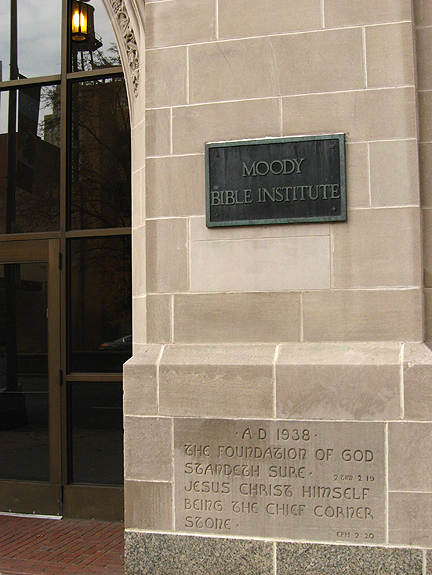
Among the more scholarly and nonsectarian Christian resources are the broadcasts from Chicago’s Moody Institute. Recordings of the late Rev.Weirsbe’s brilliance, delivered with his gentle Midwestern lilt, continue to outshine almost all of what proliferates. The successor to Weirsbe is Moody’s Rev. Lutzer, also with an academic and folksy yarnspinning style, though much more stoic than his predecessors. Well, on a recent workday morning with hot water running and coffee on the bathtub’s edge, I caught one of Lutzer’s installments on his theme, Making the Best of a Bad Decision. I’ll add that many of us must make the best of other people’s bad decisions. Can I get an Amen? Back to Lutzer. Through the noise of first-thing scrubbing, I heard the radio voice beckon, “If you’re still alive, God isn’t through with you.” Surely he wants to encourage his listeners, but considering my state of affairs of recent years, I can easily look at those words ambiguously and through my snowballed sarcasm. Sometimes I do, yet the resultant bad feeling makes me take it back. Reverting to a bleary-eyed positive, my leanings reach inward and upward, through my imagination. That’s my supplicatosphere, which is the stratum immediately beneath clouds of unknowing. “Through with me,” in the wrong context, sounds threatening; but in a healthier frame of reference, my wish really is for Divine intervention. Why is grace deferred? Did I misstep? How am I supposed to know, if nobody tells me? Have I overstayed my welcome? Perhaps I’m inhabiting the very attempt to comprehend the meaning of hope.


While trying to glean insights about things eternal, I’m also constantly reckoning with the ways of mortals. Recently with my philosophy students, I taught about the Golden Rule, framing this in the context of ethics. Our group discussion, probing the time-honored “do unto others as you would have them do unto you” went right into dilemmas about what happens when there isn’t any reciprocity for our respectful acts. Do we keep on being honorable and forbearing, or do we conform to the hardball tactics that confront us? You can imagine our very lively Socratic forum discourse. Whatever we do, we need to choose our reactions and responses. Generally, there’s the trigger end, and there’s the barrel end. Are you the issuer, or are you the inflicted? When so many critical factors are out of our control, what is within a person’s reach? With each day, questions arise in my thoughts as to whether landlords, employers, and community leaders should care about their inhabitants and “stakeholders;” in a word, neighbors. Perhaps it’s unrealistic to expect such people of influence to care, as I care. Ever the cockeyed idealist, I believe everyone should care. That’s how things stand a chance of changing for the better. A genuine sense of respect, even in simple transactions, runs against the currents of pessimism.

Just the other day, I helped a researcher with a query so complex we needed to go back and forth rather extensively in order to unearth the actual question. Having some specifics that mutually made sense, I set about producing what I could find to help this fellow. In the midst of my retrievals, the man frustratedly stormed out of the research room. While I began putting the materials away, he returned and apologized. “I’m sorry,” he said, “I think this world of instant gratification has gotten to me.” He pointed disdainfully at his smartphone. After expressing my understanding, he sat down to read through what I had found, and we talked about his projects. His initial and abrupt impatience was disappointing, but his later presence of mind was impressive. In a handful of minutes, I witnessed metanoia- on both our accounts. Reflecting upon this, later in the day, I was reminded about a barely-known spiritual exercise called examination of conscience. I use parts of my daily journal writing for this purpose, considering such writing as the safest space for articulating thoughts. “Make an appraisal of the entire situation,” wrote Francisco Fernandez Carvajal, adding that we must know what means are available to us, and how to be faithful and thorough. In addition, we must also contemplate how we can remove obstructions in our intentions, as “knowledge of self is the first step the soul must take in order to arrive at the knowledge of God.”


Collecting and digesting knowledge comes very naturally to me, always taking notes. My notebooks become reference sources themselves and they’re great for me to reread when distractions throw my studies off course. These many pages of annotated gleanings remind me of the philosophical texts I’ve been so carefully reading, while struggling to prosper above the fray. As it is with examining my conscience, there must be focused intention to transform head-knowledge into heart-knowledge. What is there for me to learn, from my experiences? “When a person accepts a great undertaking,” as Carvajal recommended, “they must consider various possibilities and look for the opportune means for bringing the work to successful completion,” adding that “we have to be aware of what is lacking so that we can ask God confidently.” In my repeated recoveries from rejected applications, trying to figure out my deficiencies (because reasons are never specified), while left to figure things out I remind myself that more attempts will be accompanied by more failures. More at-bats increase the odds of striking out. Yet still, and even now as the setbacks persist unabated, my efforts continue and amplify. It’s imperative. The here-and-now is at once stifling, uninviting, and tentative; it’s more than enough to keep the search coals stoked. As an extension of my certainty that all we see is not all there is, during the present drudgery I’m convinced there is more than this, and the accumulation of my being is meant for better and more conducive circumstances.