Showing posts with label study. Show all posts

Thursday, April 24, 2025

ideals and possibilities

“By judging the truth of things according to the divine measure,
we acquire wisdom; by embracing the supreme good,
we are liberated to enjoy and use the goods of creation
for the enrichment of human life.”


~ Zachary Hayes, O.F.M., The Hidden Center.

The lead quotation for this essay comes from a book written by a modern-day Franciscan, addressing Saint Bonaventure- a fellow Franciscan who lived in the 13th century. The consistency of insight to this reader is such that I have the impression of studying a philosophical writer reflecting upon his own esteemed ancestor. I read the sentence to my philosophy students, as an example of idealism- and good, lofty one, too: Acquire wisdom and improve the lives of others. Cultivate what is needed to practice the golden rule. We subsequently had a lively Socratic forum about such divisions of idealism as the subjective, the divine, the ontological, and the epistemological. These topics will be revisited in greater depth, seeing how strongly they’ve resonated with the group.


One of my colleagues added encouragement, having participated in my treatment about how happiness ("eudaemonia") is defined in philosophy, generating an enthusiastic discussion. “Keep doing these,” she added, “we all need this.” Admittedly, so do I. Perhaps the study of philosophy- or philosophizing, in itself- may be just a bit escapist? Well, that’s worth another group forum. For the moment, I’ll say it’s a combination of reckoning with the surrounding world, and consolation. All points lead to understanding, to making sense of perceptions. Beyond the abstraction of thought is the praxis of a physical sign. The illuminative and the literal riding in tandem, searching for signs. Spring began showing itself at least a month later than usual, in northern New England, with persistent cold temperatures clashing against lengthened daylight. Eager for new growth, both metaphorically and three-dimensionally, I have my camera close at hand to photograph what treasured signs can be found and savoured. Living to such ideals as Bonaventure’s, and the later Bergson’s “realization of what is yet to exist which will provide greater significance” relates well to the new promise of spring.


For a week of respite, my first in four months, I recently enjoyed a nourishing string of days in Boston. My studies at the Athenaeum were centered around encouragement and assurance, all penned by various theological thinkers. More philosophy for inspiration. I select the readings through bibliographies and lengthy catalogue searches, followed by submitting the requests several weeks before my arrival. Those e-mailed communications signify initial forward motions toward pilgrimage, choosing my direction immediately after having my time-off request delicately approved. As the swirls of preparation, packing, transportation, and logistics settled, the brilliance of great company and thoughtful studies emerged. A lingering thought occupying many musings was a suggestion to consider the possible as an antidote in the struggle against confining and incessant frustrations. What possibilities are available while swamped in recessed economics, undercapacity, and treadmill existence? Turning toward an ideal of possibilities brings me to the captivating word, potential. Convinced for many years of the underutilized potential for my skills and experience, my perseverance toward better days continues to be fueled by the prospect of future opportunities. Necessary components and energies are at the ready; but there needs to be a convinced and welcoming receiving end. Realized potential as an ideal is the stuff of daily and constant prayers, immersed in quotidian productivity and conscientious service. The magnitude and immediacy of responsibility eliminates the option of waiting around for the miraculous. But a state of readiness can still abide, seeking out the possible, despite the encroachment of negative limits.


While drafting this essay, and during my recent week of commuting, my reading included two new books by Pope Francis, one which included these words...

“Do not surrender to the night; remember that the first enemy to conquer is not outside: it is within you. Therefore, do not give space to bitter, obscure thoughts... Faith and hope go forward together.”
(Light in the Night, 2024)

...and the day after reading these sentences, I learned of his passing. Pope Francis wrote in gentle and direct tones, as a seasoned mentor. The surrender he wrote about refers to something familiar to me, and I absorb his exhortation as a warning against my habitual tendency toward immersing thoughts with impossibilities. Entirely unusual for his position, Pope Francis engaged with this world and its many humanitarian crises, sharply critical of injustice- yet his idealism remained solidly intact. As with Brother Roger of Taizé (whom I knew), living to a similar age, Pope Francis consistently wrote about hope. Both leaders approached the entirety of life as a pilgrimage of trust. Brother John, former prior of Weston Priory (whom I also knew), passed away last month at the age of 100. When an esteemed leader- especially an elder- passes from our lives, and we notice traits and turns-of-phrase attributable to them, we begin to realize a spiritual inheritance.


“In revealing the possibility of a life lived in the presence of God,” continued Zachary Hayes’ gloss of Saint Bonaventure, “it reveals what is in fact the original possibility of humanity, created from the beginning in the image of God.” We’re reminded that various possibilities are in our midst to be discovered, if the “big picture” isn’t lost, while struggling to create wider opportunities. During my recent studies at the Boston Athenaeum, I read the inspiring Life of God in the Soul of Man, written by Scotland’s Henry Scougal in 1677. His term for spirituality was the divine life, and his intention for the work was that his readers derive encouragement to stay the course through the challenges of hardship. His enjoinder to continue making progress in faith has the reminder that with wholehearted devotion, “we shall have all the saints on earth and all the angels in heaven” interceding for us. Readers are instructed to take heart, keep faith, and not be afraid. “Away with perplexing fears,” Scougal insisted, continuing with:

“We cannot excuse ourselves by the pretense of impossibility.”

... which is to say that we mustn’t be so quick to unquestioningly say “it can’t be done.” Indeed, we have yet more idealism, and I welcome strengthening words, relieved to discover such fine company. Studying written treasures is more than reason enough to travel. As I witness the passing of various visionary leaders that taught generations preceding and including mine, I’ve become increasingly aware of thinning ranks, in no less than these darkened times. Let us all consider our reception of torches passed into our hands, no matter our states of readiness. Many are already teaching others, unwittingly and by profession. There is little choice but to carry on. Now, how shall we find and flex our discovered possibilities?


Monday, October 7, 2024

forbearance

“The soul generates, nourishes, and increases:
generates as regards essence, nourishes as regards quality,
and increases as regards quantity.
By the sensitive power it apprehends sensible things,
retains what it has apprehended, combines and divides
what it has retained.”


~ Saint Bonaventure, The Breviloquium, ch. 9

Despite countless task-saving conveniences, we’re all navigating increasingly demanding paths. And it seems the manual projects and chores are made easier than before; the ramped-up, harder efforts involve the mind. Logistics and time-management require constantly adaptive abilities to rearrange priorities, even sharding away excesses. When it comes to intellectual and spiritual matters, the challenges of self-discipline only intensify.

The recent decade attests to a continuous barrage of violence, conflict, pandemic, recession, displacement, disaster, and fractiousness. That short list encompasses the daily experience for too many, enough to overwhelm. Much as the horrific school shootings of 25 years ago prompted sociologists and officials to finally regard bullying as something to take seriously (and as a badly-bullied adolescent, I remember the commonplace dismissiveness too well), current studies are informing us about how anxious and worried we are. As if we needed to be reminded. A new study ties rampant anxiety with equally rampant obsessions with smartphones- particularly among teens. I interpret this, in a broader generational sense, as being swept into ubiquitous, sensationalized, and constant newsmedia feeds tapped into by all our networked devices. Evidently, we need to know, during all our waking moments. I’ve had to create my own version of the proverbial ten-foot-pole, tempering my connectivity, reminding myself to get outdoors and experience life first-hand. Despite the cautious vigilance, I’m also amidst the pressure to be confident in hopeless surroundings. Trust and worry stand in opposition to each other. Many among the faithful commonly profess that we should not worry, as most of us do what we can to restrain ourselves. But is faith enough, and is that all I’ve got? Apparently, a mustard seed’s worth suffices.

I heard a preacher say that life is 10% what happens to you, and 90% what you do about it. We may propose, but very few of us can even begin to dispose. With my granule of gumption, there are learned instincts to help me contend with obstacles. If anything, there is the cultivated skill of noting the limits- whether they are related to economics, practical logistics, or the behaviors of others. The discretionary tacks between forcing back the constrictions and steering around the incorrigibles. Unraveling the implications emanating from trust, my thoughts bring me to the healthful version of surrender. Parallel to persistently believing in finding better situations to fulfill what I’ve been built to accomplish, I’m also aware of immovable barriers. Thus I return to the vitality of trust- albeit in clouds of unknowing- all of which amounts to perseverance.

Perseverance needs a purpose. For what, or whose sake, do we persist with our efforts? Perhaps it’s to gain respect, or peace of mind, or to make an impression; perhaps it’s the fight-or-flight impulse to survive. Many among us are naturally competitive, driven to exceed, hoping to improve our situations. As with that “ninety percent” of the preacher’s comment, hardship can pry forth our ambitions. Beyond motivations to survive with strength, work, and housing- is to be convinced there is tangible cause for hope. Josemaría Escrivá, whose books have been mainstays in my daily bus commutes for two years, helps right my ship with his exhortations about living for the causes of service to others and devotion to God. “Think of nothing but of divine compassion,” he advised in The Forge, instructing preference for the pursuit of a life of generosity, over and above fear. “The immediate future is full of worries, if we stop seeing things in a supernatural way,” Escrivá added. Worry and anxiety can be motivators as much as detriments, though both are inevitably exhausting.


While responding to audience questions after a recent lecture, someone asked me “where do you get all that energy?” Not entirely a technical or theoretical question, I heard myself say something like, “There’s a lot that still needs to be done!” Creating archives often borrows the metaphor of bringing out sculptures that are within large stone blocks. Preservation and access resemble the nurture and promotion of a botanical garden. Very simply put, the energy comes from caring, and my forbearance incorporates stewardship and vision. Commitment to the profession’s many aspects is supremely important, wherever I’m working- and my hope is to continue improving. Many thoughts- perhaps too many- while working and seeking better work, have to do with the concept of “success.” How have definitions of success changed in the past decade (or two)? For whom is success necessary? Impressing my elders- whether parents, grandparents, or teachers- always meant a great deal; impressing friends was less of a priority, but impressing managers and prospective employers has been a longstanding matter of anxiety. Is sufficient the same as success? Having endured two layoffs in my working life, along with forbearance-testing threats and economic conditions, anxiety has long been tied to fears of the impending. Or perhaps not impending! That sort of tension can be formidable, as though a solid barrier. Years and years of trying, and very rarely succeeding, lend too easily to discouragement which must not obstruct a good future. Remembering what I heard myself say to that audience a couple of weeks ago, essentially in light of things and in spite of things, I have to just keep productively working. One who surely knew a rough life of fits-and-starts, Paul taught those in his midst- as well as his later readers- to insist upon gratitude and graciousness, and to “ let your forbearing spirit be known among all.” Fully agreeing with St. Bonaventure as quoted above, the soul must be nourished in order to be renewed and encouraging to others. Carefully-selected studies fuel my forbearance abilities, amounting to the most critical of life skills.


Wednesday, June 19, 2024

collecting thoughts

“There are three principal means of acquiring knowledge available to us:
observation of nature, reflection, and experimentation.

Observation collects facts; reflection combines them;
experimentation verifies the result of that combination.
Our observation of nature must be diligent, our reflection profound,
and our experiments exact.
We rarely see these three means combined;
and for this reason, creative geniuses are not common”
.

~ Denis Diderot, On the Interpretation of Nature, no. 15 (1753).


1

With year after year of completed projects under the bridge, with more in progress and up ahead, there remain personal goals yet unfulfilled. Amidst achievements and recognition thus far, I particularly cherish a remark in the Comments section on my 2nd grade report card, from Public School Number 13, in New York City. Rating 6-year-old me, Mrs. Berger wrote: “He daydreams too much in class.” I think that comment was meant as a scolding, and certainly my parents were not impressed. I remember feeling embarrassed, but characteristically undeterred by the reproach. Gazing through windows is something compellingly natural to me, and whatever was interesting below on 94th Street was surely upstaging whatever was being taught at the front of the classroom. I’m actually proud of that remark. And I’ve grown to appreciate that, perhaps inadvertently, Mrs. Berger implied that a bit of requisite daydreaming was permissible- but not too much. For artists and all other creative thinkers, musing is essential. Untethered contemplation is a surer way to make sense of life, than to swish away at a smartphone.


By observation, we can really grapple and reckon with insights, in order to advance to our subsequent steps. Too much precious energy and time get squandered in wheelspinning ruts. Peaceful and uncluttered headspace is neither freely given, nor valued, in this culture of competitive perpetual motion. But the daunting side of an intermission is in the awkwardness of decompressing- worthwhile as it is- to be better able to recollect. Significant respite time away from the job continues to be practically impossible, so I cobble what I can when it’s possible, noticing the difficulty of turning my off-duty thoughts away from the workplace. Decades of diligence and industriousness have kept me employed, but a compounded effort is needed to remain artistically and intellectually fit for creativity. Good thing for daydreaming too much in class. I recommend it.

aperch at the window, College Club of Boston


2

Hopeful and constructive dreaming goes a very long way in the direction of bringing goodness to fruition. If you needed yet another reason to write daily in a journal, now you have this. And write manually, keeping in mind the untethered and focused aspects of musing and aspiring! While in the liminality of overburdened undercapacity, I’m egging on those musing traits with writing, photography, and dreaming of better days. If anything, this helps my frame of mind, dealing with the here-and-now. All such pursuits are enveloped in the all-comprising everyday life of the spirit, which also includes contemplative reading.


Pursuing my studies in philosophy is replete with discoveries, and I’m further encouraged as I teach some of these topics to students. The readings for my personal explorations are selected with personal development in mind. In turn, because I’m often studying such rare materials, I produce my own annotated indexes. These are very useful as references which I later share, and the notebooks themselves are great for me to read. Indeed, and true to my profession, I also digitize my indexes and notebooks; these are my “preservation backups,” as well as searchable. These personal studies are entirely fueled by my own interests and discerned needs; philosophy consoles, as Boethius knew very well. In Love Enkindled, Saint Bonaventure wrote about how contemplation brings us to the spark of discernment, which he called synderesis scintilla. This comes to mind, when I’m conscious about redirecting my thoughts. Conscience is awakened, Bonaventure wrote, by moving from error to consideration of the human condition, to meditating upon what is good. Finding ways through hardships, I’ve kept to these studies, as well as spiritual health, staying intellectually active and away from burning out.

a floricultural cabinet


Among the many ways to identify my full-time work, I most often think of day-to-day torchbearing and pouring-out; preserving and explicating. Essentially, this is the joining of words with readers. Visitors, researchers, and classes think of archives as cabinets of curiosity. In this sense, cabinet as a synthesizing, thematic compendium. Perhaps they are, increasingly standing out in contrast to the electronics that promote content over substance. And this isn’t to denounce literacy’s numerous formats; I use and present them all. Indeed, my preference continues for the reflective surfaces of imprints and manuscripts. The physical items themselves have stories. As a conservator I’m acquainted with how they’re made, and as an archivist I’m making comparative references and metadata for all manner of seekers. My role also takes the form of inadvertent confessor: patrons from teenage to old age tell me about how they favor real books and want to handwrite. Well, go ahead. Don’t let me stop you. I’ll often ask, “Do you keep a journal?” Muse away and expand your mind. Be that person getting seated on a bus with a book or a journal, instead of catatonically fiddling with a phone. As you glance between daydreaming out the window toward the streets and reading, notice the gawking expressions as the entranced stare into their devices. The side of me that is still a skeptical little kid at P.S. 13 says, “I don’t want to be like that.” If your musing and observing is bold enough, you’ll be better able to make fun of your self.


3

aboard a trawler, in winter


Integral to doing everything I can manage in order to stay mentally healthy is perseverance in seeking and exploring ideas. Yes, there’s the musing I’ve mentioned here. Plants need water and natural light to keep growing. My observing intuitively turns to words and imagery. Often, both turn up during a good stroll. An expression of mine from my teen years, which I still use when taking up a camera on the way out the door, is “I’m going out to look for photographs.” There are few things more sensible to me. Noticing the trawlers docked along the Portland waterfront reminds me of how I wind up pulling ideas from the depths. The nets on those boats drag down deep and far enough to bring up all kinds of shellfish and groundfish. Maybe our minds have their own microscopic versions of trawling pulleys. Similarly, I trawl for ideas- unforced and all quite naturally. Something seems always to remind me of something else. Moving through the day are gleanings of thoughts. Bus and train rides, lunch breaks, and laundromats provide scenarios for the culling and recording of ideas. Part of that is my making sense of changes, disappointed expectations, hopes, and things I witness. And ironies. As I’ve done for many years, the idea jottings are in pencil, and the elaborated thoughts get their due in pen-and-ink. Navigating by instinct implies a certain amount of individual roadbuilding. The voyage is not an end, but surely a means. Creativity, learning, and helping others learn broadly serves as an itinerary.

trawlers and ideas


Thursday, October 26, 2023

standpoint

“In the words of the psalm,
‘For with You is the fountain of life;
it is only in Your light that we see light.’

Human beings have no other secure standpoint
for being certain about anything at all.”


~ Douglas Dales, referencing Psalm 36 and Saint Bonaventure,
in Truth and Reality : The Wisdom of Saint Bonaventure.


My ongoing philosophical studies have continued to serve as healthful oases amidst chaos and setbacks. Such pursuits into contemplation also produce learning and constructive thoughts for me, as well as teaching material which I gladly share. With material needs as vital as housing and work in protracted fluidity, survival requires waystations in welcoming forms. As the Word is a lamp to my steps, so it is that in Divine light that I can discern light. Aspirations live in ethereal mists, and thus hopes are not always solid enough for my mortal self. A comfortable place to live and a really good job would do wonders to the morale, with all searches continuing as fibers in the general cord of the pursuit for improvement. This is not to say there aren’t present-moments to savour, because there are- both modest and grand. I’ve surely learned to constructively make do, under pared-down circumstances, throughout my working life. Yet I’ve never stopped hoping large and working ambitiously. It’s equal parts survival, fulfillment, and acknowledgment of the great teachers and mentors I’ve had.


Because my studies are self-directed, I’ll stay with a topic until I’ve covered enough ground to my satisfaction. This practice dates back to my beginnings with philosophy-teaching, in 2015, and intensified during the austerity of pandemic-era quarantining. Lifelines of learning and writing still stand as reliable constants and sources of mental strength. I chose to revisit Saint Bonaventure’s Itinerarium, which I had first studied as the severities of early 2020 set in. Now, following deep dives into the works and lives of Wyclif, Erasmus, Colet, and the Devotio Moderna, the 13th century Bonaventure appears to me as a proto-Renaissance thinker. He was also a university professor and a Franciscan, blending charism and pedagogy with “No one comes to wisdom except through grace... One does not come to contemplation except through perspicacious meditation, holy comportment, and devout prayer.” Bonaventure has some aspects of the scholasticism in his midst, balanced by his mysticism, with metaphysical statements such as, “We are led to re-enter ourselves, that is our mind... one cannot enter within, unless by means of Christ, who says I am the door... but we do not approach this door unless we believe...” Navigating thus far- from Bonaventure’s Itinerary, to some of his commentaries, to the Collations on the Hexaëmeron I continue finding more to nourish me, and will simply keep on reading. It’s as though I’m standing near The Seraphic Doctor himself, with reverent devotion.


Beginning in the middle of last year, I’ve had to function without a comforting home base- or as Dales observed (and quoted above), “a secure standpoint.” Between both work and housing instabilities, the vantage point is at once being between two dead-ends while also admitting that everything is up in the air. Thoughts of this reality at night are threatening. Thoughts of this at noon the next day almost seem exciting. But all thinking and activity take place amidst the din of instability and uncertainty; as much above it, as under it. Missing a physical, welcoming “home base,” that proverbial secure standpoint takes shape as a state of being during which I sense assurance. While frustratingly searching for a comfortable perch, I’ve thus far noticed ephemeral slivers of rest during times of study and writing: reading at bus stops, or sometimes late at night in the crunched hovel after the loud neighbors shut down, and writing during my thirty-minute lunch breaks, or outdoors any chance I get. Not terrible, making room for gratitude, but always too brief and just under the tension radar.

The Archives, 2023


For many years, I’ve called momentary intermissions tagging up which is a baseball expression describing a baserunner’s safely advancing amidst a play. During my 14 years of fulltime work in the pressured commercial photography field, I’d start days and find breathers “tagging up” at the counter of my studio darkroom. It was my base of operations, with two slick, imported Durst enlargers bolted to the surface, and filled with the tools of the custom photographic trade. To help me feel at ease during sickeningly stressful times, I decorated the place and had a small stereo system. Just about everyone I knew in the profession listened to music to keep up the pace of production; for me, it was new wave and opera. And I always had a thermos of coffee with me, as I do now. My memories of closing the darkroom door and gathering my wits for the next project come back to me when I do something similar- albeit in much shorter snippets, resetting during breaks in the archives. The building that housed my studio was torn down in 2016. Indeed, I photographed the demolition.

The Studio Darkroom, 1998


With the business and all the people who passed through the place as workers (many of whom I photographed), customers, friends, and vendors gone, I saw the large piles of debris frontloaded away in dump trucks. Six years later, I lost my home of nearly four decades, the building being converted into elite condos. These are now simply locations, their respective histories and lives syphoned out. They are past and gone, but here I am now and straining to look forward. Places such as cities or neighborhoods or buildings, I’ve learned, are stages. It’s about souls, more than about streets. Solid places to regroup thoughts and broaden perspectives are essentially replaced by points of reflection. My writing and reading are always with me, providing ready clefts of stability- lulls in the battle. Journaling affords the ability to write through trials and get them out of my system. Movements of conscience take time. In my journals, the term point de repère- which actually means a reference-point or a landmark- parallels how I’ve come to see moments as respite. And such metaphorical landmarks can be anywhere.


A better side of remembrance is to recollect what we’ve learned. An individual as vast and inspired as the Apostle Paul wrote of his occasional rearward glances coinciding with reminders to himself of graces along his arduous path. I call this stocktaking. What’s good? Even between two dead ends, a burgeoning life reaches heavenward. Managing to schedule my first weekday off in three months, I made it a reflective day. “What’s good” included appreciating the outdoors at midday, chatting with friends, putting something away in my savings account, getting a very long-overdue haircut. Simple and understated, yet somehow luxurious. Profoundly missing those twice-yearly retreats I’d make- before 2020- something I can do is to find bits of time on weekends to recollect and accentuate graces learned. Among numerous turns-of-phrases I’ve learned from the monks of Taizé (and I’ve written down many, as well as words from the monks of Weston Priory), is the expression almost nothing. In context, this is to say there is always something one can do, “even with very limited means, with almost nothing,” to progress on the voyage to sanctification, and to help others. “See what you can accomplish with almost nothing,” Brother Emile once said to me. I use this at work, always aware of the spiritual/material ambiguity. "With almost nothing, with very little,” Brother Roger taught, “we can live something beyond all our hopes, something that will never come to an end." A beautifully hopeful thought.


Another savoured expression I learned in Taizé is to “live in the dynamic of the provisional.” Consistent with the positive practicality of seeing what one can do with a lively spirit and almost nothing. Consider the fluidity of the present as the provisional challenges individuals to exercise the dynamism inherent amidst our temporal situations- which can be improved as we find ways to improve our perspectives and abilities. Perhaps our most enduring landmarks are within, away from heavy demolition vehicles and exploitive developers. When our points of reference tend from the physical to the spiritual, their properties do have a dynamic in our provisional reality. Hardly the seclusion of a studio, or the coziness of a Victorian livingroom, I await the daily workbound bus in the East End while looking to the skies. It rains a lot here, and I deal with the uncanopied bus stops by wrapping my books in plastic and using a lined water-resistant satchel. Looking up, I’ve taken to musing about how landmarks live in our spirits. If they’re real and important enough, I’ll write about them. The cutting-edge is whether to be constructive or to eat my heart out; that’s quite a choice. “I know both how to be abased, and I know how to abound,” Paul observed as he addressed the Philippians. This comes to mind as I’ve watched many colleagues over the years burn out, while I try sensing the boundaries and do all I can to avoid becoming damaged goods. Keeping in good energies is essential in the reach for better days. “Pray without ceasing, and in all things give thanks,” wrote Paul to the Thessalonians. What supports our hopes? Causes can find me unwittingly, even at weatherbeaten bus stops, wielding my umbrella and a book with this grounding paragraph by Francisco Fernandez-Carvajal:

“We mustn’t forget that our greatest happiness and our most authentic good are not always those which we dream of and long for. It is difficult for us to see things in their true perspective: we can only take in a very small part of complete reality. We only see a tiny piece of reality that is here, in front of us. We are inclined to feel that earthly existence is the only real one and often consider our time on earth to be the period in which all our longings for perfect happiness ought to be fulfilled.”


Commenting about the determination of the humbled Zacchaeus (Luke 19), Bonaventure wrote, “it is the nature of genuine eagerness, which draws the soul to Christ, that even if obstacles are thrown in the way, its desire is not broken, but is the more enkindled.” Referring to my current studies as the Bonaventure Adventure, complete with a monthly day at the Boston Athenaeum library for replenishment, I’ve also made various side studies of his fellow Franciscans Saint Anthony and Saint Francis of Assisi. Comparing notes with a correspondent, I now know of the Franciscan Fr. Dolindo Ruotolo, whose extraordinary life gave the world a very simple devotional practice of openness to completely trusting the Holy Spirit within, called the Surrender Novena. The latter word means nine, as in nine consecutive days of focused meditation upon surrendering one’s will to God’s will. For example, in day eight’s reading, Ruotolo wrote in reflection of the Divine voice, “Repose in me, believing in my goodness, and I promise you by my love that if you say, You take care of it, I will take care of it all; I will console you, liberate you, and guide you.” I’ve been journeying through the past month with this compelling discipline. An elder friend of mine says it best: “Surrendering is so inviting; It sounds so easy until you try. Almost immediately after surrendering, you take up the problem and start dragging it around with you.” I couldn’t have expressed it better.


Surrendering one’s personal will and mortal navigational abilities to the very force of Creation is a formidable discipline that requires its own vigilance. In the throes of intense searching and applying, there must be surrender of all the subsequent worries. And there are many. What will happen? Why can’t this or that be so? What wrongs must I correct? To add to my counterbalance exemplified in Ruotolo’s prayer are those of Brother Roger in his essay, From Doubt to Humble Trusting:“Let your anxiety be transformed into the trust of faith.” And there are thick, embedded layers of anxiety. Consciously implementing this spiritual practice is the adjustment of a way of thinking and being, trying to surrender my attempts to control what is out of my influence, and not to fret. That is a major challenge. I can just hold up my end of things, searching and presenting as well as my experiences inform, always looking to improve my pitch. A devotional practice emphasizing humility and surrender causes- even forces- me to entrust my efforts to God. All at once, struggles expose limits, and defeats ignite more rallying to transcend. To cease is to fall backwards. Yet here again, surrender exhorts that I release all the worries that tend to follow my best attempts. Submit those carefully-phrased credentials at uploaded attachments, and then detach. The same trusting confidence in attaching files must go with detaching from the appealing ads. The prayers of surrender are about confiding, entrusting, and releasing fears and worries. Plenty still for me to learn, as I attentively correct my missteps and continue seeking a secure standpoint.


Friday, September 29, 2023

more than this

“I'm hearing right and wrong so clearly
There must be more than this.
It's only in uncertainty
That we're naked and alive.
I hear it through the rattle of a streetcar;
Hear it through the things you said.
I can get so scared.
Listen to the wind.”


~ Peter Gabriel, That Voice Again


Major efforts are composed of small measures. This often occurs to me, when in the throes of processing large archival aggregates out of many thousands of single components. Years are made of days which comprise hours. A friend talked about their job search, comparing it to throwing big rocks at a wall until it crumbles. That’s the desired outcome. Thinking of the present as an indefinite trial, linking unresolved days, generates its own brand of exhaustion that only loads more upon existing burdens. I try to avoid doing this, but like any forward-moving driver, I must check all gauges and mirrors. Patience in tribulation is essential in these staggering times.


Now 13 months into housing displacement and its accompanying instability, there remains no rest for the weary. As my friend with the wall metaphor, there isn’t a day without searching and inquiring. And constant, earnest prayers. It’s how I push back against oppression and thwarted hopes. Other vital tactics are to persevere in my studies and writing; these are solid sources of inspiration and means to higher goals. Such things are extremely hard to find; if you find literary sources, forms of creative expression, and devotions that uplift (instead of “dumb down”), hold fast to these things and grow with them. Keeping vigil for better situations parallels my interests in learning and trying to understand the broader world. For many years, I’ve started each day with radio-accompanied ablutions and coffee. During my graduate school years, that routine would typically begin at about 5am. In high school, it was New York City’s Newsradio88; life in Boston and its orbit got me into 1030-WBZ. Invariably, the repetition of basics and ads sends me to the checkerboard realm of religious radio. At the tops of hours, I bounce back to WBZ for much less-stilted news. Within that minefield, however, are a few edifying and useful homilists. Most of the preachers are terrible orators, sounding to my New Englander’s ears like something between auctioneers and Huckleberry Hound. But this professional archivist can separate wheat from chaff. Radios can always be switched off, too, as much as I’m intrigued to hear what’s out there.


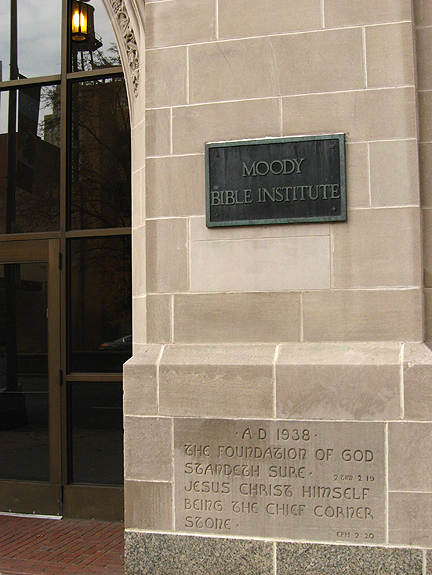
Among the more scholarly and nonsectarian Christian resources are the broadcasts from Chicago’s Moody Institute. Recordings of the late Rev.Weirsbe’s brilliance, delivered with his gentle Midwestern lilt, continue to outshine almost all of what proliferates. The successor to Weirsbe is Moody’s Rev. Lutzer, also with an academic and folksy yarnspinning style, though much more stoic than his predecessors. Well, on a recent workday morning with hot water running and coffee on the bathtub’s edge, I caught one of Lutzer’s installments on his theme, Making the Best of a Bad Decision. I’ll add that many of us must make the best of other people’s bad decisions. Can I get an Amen? Back to Lutzer. Through the noise of first-thing scrubbing, I heard the radio voice beckon, “If you’re still alive, God isn’t through with you.” Surely he wants to encourage his listeners, but considering my state of affairs of recent years, I can easily look at those words ambiguously and through my snowballed sarcasm. Sometimes I do, yet the resultant bad feeling makes me take it back. Reverting to a bleary-eyed positive, my leanings reach inward and upward, through my imagination. That’s my supplicatosphere, which is the stratum immediately beneath clouds of unknowing. “Through with me,” in the wrong context, sounds threatening; but in a healthier frame of reference, my wish really is for Divine intervention. Why is grace deferred? Did I misstep? How am I supposed to know, if nobody tells me? Have I overstayed my welcome? Perhaps I’m inhabiting the very attempt to comprehend the meaning of hope.


While trying to glean insights about things eternal, I’m also constantly reckoning with the ways of mortals. Recently with my philosophy students, I taught about the Golden Rule, framing this in the context of ethics. Our group discussion, probing the time-honored “do unto others as you would have them do unto you” went right into dilemmas about what happens when there isn’t any reciprocity for our respectful acts. Do we keep on being honorable and forbearing, or do we conform to the hardball tactics that confront us? You can imagine our very lively Socratic forum discourse. Whatever we do, we need to choose our reactions and responses. Generally, there’s the trigger end, and there’s the barrel end. Are you the issuer, or are you the inflicted? When so many critical factors are out of our control, what is within a person’s reach? With each day, questions arise in my thoughts as to whether landlords, employers, and community leaders should care about their inhabitants and “stakeholders;” in a word, neighbors. Perhaps it’s unrealistic to expect such people of influence to care, as I care. Ever the cockeyed idealist, I believe everyone should care. That’s how things stand a chance of changing for the better. A genuine sense of respect, even in simple transactions, runs against the currents of pessimism.

Just the other day, I helped a researcher with a query so complex we needed to go back and forth rather extensively in order to unearth the actual question. Having some specifics that mutually made sense, I set about producing what I could find to help this fellow. In the midst of my retrievals, the man frustratedly stormed out of the research room. While I began putting the materials away, he returned and apologized. “I’m sorry,” he said, “I think this world of instant gratification has gotten to me.” He pointed disdainfully at his smartphone. After expressing my understanding, he sat down to read through what I had found, and we talked about his projects. His initial and abrupt impatience was disappointing, but his later presence of mind was impressive. In a handful of minutes, I witnessed metanoia- on both our accounts. Reflecting upon this, later in the day, I was reminded about a barely-known spiritual exercise called examination of conscience. I use parts of my daily journal writing for this purpose, considering such writing as the safest space for articulating thoughts. “Make an appraisal of the entire situation,” wrote Francisco Fernandez Carvajal, adding that we must know what means are available to us, and how to be faithful and thorough. In addition, we must also contemplate how we can remove obstructions in our intentions, as “knowledge of self is the first step the soul must take in order to arrive at the knowledge of God.”


Collecting and digesting knowledge comes very naturally to me, always taking notes. My notebooks become reference sources themselves and they’re great for me to reread when distractions throw my studies off course. These many pages of annotated gleanings remind me of the philosophical texts I’ve been so carefully reading, while struggling to prosper above the fray. As it is with examining my conscience, there must be focused intention to transform head-knowledge into heart-knowledge. What is there for me to learn, from my experiences? “When a person accepts a great undertaking,” as Carvajal recommended, “they must consider various possibilities and look for the opportune means for bringing the work to successful completion,” adding that “we have to be aware of what is lacking so that we can ask God confidently.” In my repeated recoveries from rejected applications, trying to figure out my deficiencies (because reasons are never specified), while left to figure things out I remind myself that more attempts will be accompanied by more failures. More at-bats increase the odds of striking out. Yet still, and even now as the setbacks persist unabated, my efforts continue and amplify. It’s imperative. The here-and-now is at once stifling, uninviting, and tentative; it’s more than enough to keep the search coals stoked. As an extension of my certainty that all we see is not all there is, during the present drudgery I’m convinced there is more than this, and the accumulation of my being is meant for better and more conducive circumstances.


Sunday, March 26, 2023

pursuits

“Naturally, we desire knowledge, happiness, and peace;
knowledge, since we see our thoughts curiously investigating
the sources of things: happiness, since each person
and indeed each animal acts with a view to procuring good
or avoiding evil: peace since the pursuit of knowledge
or that of happiness are not followed simply for
the sake of the pursuit but in order that the desire
in which it is born may be appeased by calm and repose.”


~ Etienne Gilson, The Philosophy of Saint Bonaventure, p.87


1


During difficult winter months, more energy than usual is needed for the basics. Getting from place to place is impaired by weather conditions, and overcoming such variables requires added time for car excavation, window-scraping, and idling the engine. Indeed, all symbolic to this writer. Trying to find hope amidst instability and unease tests all systems. It’s been taking a real stretch of the imagination to stay creative, ambitious, and sharp. There’s plenty to dull the senses and wits, in this present situation. Often, while I’m defrosting my windshield, I stare beyond treelines and rooftops- much as my aspirations set sights beyond the bland anguish of this winter in the East End. Where are the sources of cheer? Certainly not in the news. As much as I want to know the currents, I’ll wade in just enough, avoiding the misery of immersion. Without more than a pertinent acknowledgment, as I want to focus these words upon pursuits that raise my sense of vision, I’ll mention how my housing displacement (and continuing search for a place to live) prompts me to monitor economic news. Well, upon the ground of living in a perpetually depressed and intensely stratified region, the term recession is hardly distant; it’s been here a painfully long time. Atop years of toiling and producing in educational nonprofits, last year shoved me to this present brink. When articles ask readers to compare now with 12 months ago, I needn’t look far to recall living in 40% more space at 30% less rent in a beautiful place that was in a better neighborhood. Alas, it was sold and everyone had to leave. I know to avoid dwelling upon this much further, as trauma runs its course. This type of thing has been happening all over this city. I’m daring for something even better, while as yet unaware of its location.


2


Survival is more than necessary in order to settle here-and-now responsibilities; it’s also the way to steer toward better horizons. Having to keep on working and contending with expenses, while making an emergency relocation, served to maintain focus. Fear, however, does little to nurture creative energy. Threatening, litigious language abounds- reminding me of how meanness can trickle all the way down to simple transactions and what could otherwise be good-faith agreements. Once more, it is vital to keep finding ways to be motivated by a vision of goodness, over and above the baser goading by impersonal threat. Some of us, even now, continue in our idealism. My previous landlord, may he rest in peace, was a dentist whose office was below my apartment. He was born in that building and my predecessor in “apartment 2" was his mother. When he handed the keys to my twenty year old self, he said to me: “We have one rule in this building; it’s the Golden Rule. You know what that is, right?” I quoted it to him, “Do unto others as you’d have them do unto you,” to which he responded, “that’s right, you know it,” patting my shoulder. That’s all that was needed, and in so many ways it’s the most essential of ethical rules.


A less-ancient saying goes as follows: “Everything is a teachable moment, if we’re willing to be taught.” Though it’s been a strain, dear readers, I’ve been wrenching myself through daily uncertainties, discomfort, and desolation at all hands to learn what I can in this. Revealing how relative these things can be, several months ago during a mid-workday cancellation my director told me I could go home any time I wanted. I replied that I preferred being at work. “The Compartment” is no home to me, and I described that to him. We had a good and relaxed conversation in the empty hallway, and I gratefully kept on working. Better things are surely ahead, and each day is a day closer. Even my mustard seed’s worth of faith is enough to convince me of that. Keep the pursuits in mind. I’m in this life to create, to inspire, to foster the Golden Rule. And that’s just for starters, just like persevering in my work and sanctifying each task and interaction.


3


As severely as the city of Portland has hollowed itself with its gentrification, I still manage to bump into friends on the streets. “Whatcha reading?” a fellow West End refugee asked, stopping to greet me at my spartan bus stop. Closing my book, I held it up, and my friend said “Philosophy. That’s heavy.” I defended my vice by saying, “Saint Bonaventure; he’s keeping me from jumping off the bridge.” There must be pursuits to raise sights and spirits. Creative projects are just about impossible in cramped and oppressive living quarters, not to mention the daily and nightly stomping and sound system racket penetrating ceilings and walls. But... during my coffee break in the middle of my 8-hour workdays I can scribble a few notes, and late at night when the stampeding herds cease I can steal a few more moments to write and read more philosophy. I’ve invested in a strange “white-noise” machine that has a setting that imitates the sounds of rainstorms. And this returns me to those windchilled bus stops. Just for now, I persist in my insistence. On better days, the wincing and cringing become pointers to remind me of the progress of time. This is surely transitional. I’m wagering my life on it, and my philosopher saints will ride shotgun with me.


Such pursuits as the arts and philosophical studies may appear as goals, but these are indeed means. Bonaventure’s responses to the Sentences of Peter Lombard include the observation that we will not find our fulfilling achievements in the finite. “Our desire tends beyond each finite goodness toward and beyond another finite goodness.” In his enduring Itinerarium, Bonaventure wrote, “To follow the way of the soul towards God means to strive with all one’s strength to live a human life as close as possible to that of the blessed in Heaven.” Reflecting upon Bonaventure, Etienne Gilson wrote of the itinerary’s road as illuminative, and the pilgrimage is adhered to by love of the destination. A brilliant member of my staff whom I mourned last year liked to say, the saints are always teaching us. And I like quoting how she used to tell me this, Elaine surely being among those saints. Submerged in an undefined and intensely anxious time of instability and discomfort, such means as writing, the study and teaching of philosophy, spiritual devotions, and productivity on the job serve to maintain my sanity. I meant what I’d said to my friend at the bus stop. The itinerary trims the undivided highway margin between humiliation and humility. The latter is necessary for the exploration of philosophical truths, admitting that reason alone cannot achieve its object unaided, submitting to the Light which irradiates and moves the conscience.


Sunday, February 13, 2022

envisage

“Too far for you to see
The moss and the mould on the cold chimneys,
The nettles growing through the cracked doors,
The houses stand empty at Nant-yr-Eira,
There are holes in the roofs that are thatched with sunlight,
And the fields are reverting to the bare moor.”


~ R.S. Thomas, The Welsh Hill Country

Do we each owe something to our personal journeys? This is a question which you may choose to evaluate in your own context. It is a new year, evidently. In these recent weeks, during my daily trudges amidst dead-of-winter throes, I’ve pondered this enough to make incidental notes in between obligations. Forward motion demands nothing less than a daring aspiration. Progress rises and falls on ambitious hope. As the pandemic wears on and distorts much of our perception, it’s been clear to me that applied hope is anything but passive. By applied, I refer to the day-to-day living application of hopefulness, as compared to an abstract theory. Such determination would consistently undergird attitudes and actions alike. In the face of relentlessly grim news, the insistence upon looking forward to better days is essentially beyond passive. Is daring to anticipate and stretch toward improvement, to envisage beyond the immediate and the visibly apparent, a kind of stubborn blind faith? Perhaps it is. And perhaps the combined forces of both fatigue and malaise in these times amount to a test.


One recent evening, after the sleetstorm crosstown trek home from work, I perched at my desk with dry change of clothes, and scribed this in my journal: What do I owe my voyage? My thoughts turn to sensing a motivating indebtedness to my pilgrimage, self-constructed since childhood. And this is quite different from owing something to the limits of my self. The full journey is inclusive of many other people, of institutions, and places. The pilgrimage is much more extensive than the adventurer. Pondering my indebtedness to years of countless miles, I think of the instances when I tell myself, “you’ve gone this far, don’t turn back.” To be fit for eternity, as it is written in the gospel, one that sets hand to plough must not stare in the opposite direction. Progress is forward motion. When the way ahead continues through daunting prohibitiveness, there are great temptations to give up my tireless pursuit of improved conditions. Settling into a status-quo, albeit unsustainable, is itself a temptation. Especially if it seems comfortably solid. But a diving board is no place to make a foundation. The path of least resistance appears in such forms as convincing me to give up and believe this is as far as I can go. There are so many legitimate and rational reasons to let up on the throttle and tune out. But my better sense, the one that annoys me with inconvenient truths, urges me against giving up the ship. Furthermore, that sense threatens me about what could happen if I were to give up the pilgrimage trail. Indeed, I’m indebted to the distance already covered and past hardships already endured. Despite the protracted barrage of rejections, with so many denied efforts, my consciousness of time invested and ground covered persuade me to carry on. And that is to carry on with wisdom derived from defeat. There remain significant goals; hard work and survival have yet to see fulfillment. Along with many of you, I’m also constructing a list of “after covid” plans.


Last month comprised the season of the Epiphany, reminding me to keep on unearthing embers beneath the detritus of these times. But as with hopeful aspirations for progress, foraging is far from passive. My enduring impression is one of coaxing possibilities out of elusive graces. The search for fulfilling opportunities finds an illustrative metaphor as I help neighbors move their stranded vehicles out of snowdrifts. As drive wheels spin and whine in quagmired desperation, the flailing car merely sinks further into the frozen ruts. In order for the car to advance onto tractioned terra firma, it needs to be repeatedly rocked and pushed, wheels positioned straight ahead. The motorized graces need forces of providence, so that the being can be shoved onto a passable way. Raw ingredients are ever wanting for an indefatigable iron will.


Bernard of Clairvaux, in the 12th century, left the world of contemplative thought a wealth of guidance. Monastic wisdom often strikes that assuring balance of the metaphysical and the practical. “That which was begun by grace,” wrote Bernard, “is accomplished by grace and free will, so that they work together simultaneously rather than selectively.” The statement has the ring of consolation, reminding the recipient of the prospect of not being left unaccompanied or thrown back solely upon their own reserves, having to try generating the graces of fortitude and providence. I’ve learned to better handle my end of things, which includes learning that my efforts are not occurring in a vacuum. What is immediately visible is not all there is.

Edgar Allison Peers, the Hispanist professor who translated and extensively wrote in the 20th century about San Juan de la Cruz, authored an anthology called “Behind that Wall.” In the book’s chapters, published in 1948, Peers presented how the inner life manifested among various Christian mystics. He prefaced the work by describing the drab veneer of walls that commonly surround colorful gardens. “Rough, ugly bricks, placed one upon another,” perhaps using his own vernacular in Liverpool. Then musing about workaday monotony of commuting “day upon day, the same dull routine... We sometimes ask, ‘what will it all lead to?’” Peers continued by referencing an experience during the time he lived and worked in Spain, walking a very steep and broken road that led to a house to which he had been invited. Noticing the dilapidated walls around the property, he imagined the house would look just as rough and run-down. To his astonishment, the orderly and colorful gardens surrounded a tidy, crisp villa- surprisingly encircled by the ramshackle walls of his first impression. Peers observed that people can be like gardens that are concealed behind ordinary and unremarkable structures. The inner life, Peers suggested, is a floral garden behind the ordinary wall. Appearances cannot accurately reveal substance.


The ability to envisage resurgence demands a full determination to look beyond the immediate. Full, and nothing less. As much as things are not looking good, these are things which must not receive permission to own anyone’s soul. And that is no small discipline. Remembering Bernard’s advice, a strong will is constantly needed to take up threads of grace as they are discovered. The old metaphor about the sculptor visualizing a completed work of art through the solid block of stone holds true in the mindset of applied hope. Having to thrive amidst too much sedentary time when not on the job, through the recent two years, I’ve been trying to redeem this pandemic era through my self-directed studies in philosophy. As always, my note-taking is for the purpose of sharing- for both writing and teaching; thankfully, there have been windows of time to do both. At the same time, I’ve been gradually bailing possessions out of my apartment, lightening the load for future forays as yet unknown. The cultivation of intellectual and spiritual fitness has far eclipsed the collecting of material, even for this curator. A sign of the times.


Along with keeping up the studies, journaling continues in various parts of every day. Noticing signs of these times, I’ve kept track of this era’s developing vocabulary and habits. “Keep well,” “Stay well,” and “Stay safe” have become mainstays in closures of conversations and written messages. I notice how greetings, even with strangers, include queries about physical health. I’ve even heard myself do this, along with the honestly caring, “how are your spirits?” Times of plague rooted the wishing of blessings upon those who sneeze. Conferring of blessings were noted during a 6th century pestilence in Rome, though the popularized “God Bless You” uttered for fear that someone might be falling ill dates from the bubonic plagues of the 14th century. I’ve also noticed hearing more of this in the recent two years.

It is obvious to see how we social creatures have sorely missed one another. Speaking with a small group of friends recently, we each had much to say about missing being parts of groups that would go to pubs, or cafés, or museums, or movies. “Movies!” exclaimed one of my friends, continuing with, “I can’t remember the last time I went to the movies!” We all miss hanging out, and unmuzzled no less. I’ll bet each one of us has taken up the habit of talking to ourselves- more than before. During some recent errands, driving by some triple-decker apartment houses on Portland’s High Street, I saw something that caused me to look again to see this wasn’t a statue: A man was standing still on his second-floor front porch, with one foot on a low crossbeam, holding a smoking briar, with the other hand parallel to his brow, gazing toward the distance. He looked every bit the ocean navigator aboard ship, but alas on a second-floor porch, gazing toward the streets. Alone in my car and indeed talking to myself, I said “aren’t we all at sea.”


Perhaps reflecting the wariness of these times, I’ve noticed recent circulation of the old saying, “It’s not enough to start well; one must end well.” My own abbreviated version of this, as I press on, has been don’t drop the ball. Keep going. Hold firm to the very end, and nothing short of the end. Undoubtedly easier said than done, in the unforgiving desert of the present economic and employment landscape. Added to the fluid lexicon of this era is The Great Resignation, though barely detectable in northern New England, the general effect is yet to be fully comprehended. But the determined insistence to press onward amounts to a restlessness which I consider a motivator. I owe it to everyone and everything that has encouraged me to get this far. There remains a long way to go.