Showing posts with label coronavirus. Show all posts

Tuesday, August 2, 2022

when

“They’re building a new gallows
For when You show up on the street.
Polishing the electric chair,
They're gonna give You a front row seat.
Heard a sneer outside the garden,
Salutation so well heeled;
‘final stop no points beyond struggleville.’”


~ Bill Mallonee and the Vigilantes of Love, Welcome to Struggleville


Humidity and thick, heavy, opaque clouds during a drought. The skies are remembering along with me, and they, too, want to weep yet somehow cannot. My notebook pages are weighted down with two rocks, as I perch to write in front of my desk fan during this heat wave. Neither fresh nor cold, the fanned air is at least moving. I’ve had a few months of living my farewell to the building that has been home for most of my adult life. Recollections and sadness are forcefully overshadowed by unrelenting, desperate searching for a place to live, as the building’s ownership changes. Equally unsure about the where, is the when. When do the multiple rows of dominos tip, with respect to the sale and dismembering of the apartment house, the finding of the next place, and the general big-picture future? Will the sequence of events permit for a dovetailing of addresses? Those multiple rows do not necessarily run in parallel formation, and surely not at identical paces. As for the professional work I’ve diligently cultivated and refined, the future is also unclear. When do the metaphorical yet solidly vital doors open? When do things tangibly improve, after so many hardworked years? When do the sown seeds come to fruition, and what has really been sown? How late is the hour?

My unceasing prayers are for Divine mercy, not solely for myself but for all. Where, and when? Indeed, persistent prayer meets its greatest adversity when there are no affirmative answers, when intentions and petitions remain ungranted. My own response to these perplexities is to soldier on; it is no passive matter. Long before and steadily throughout these pandemic times, the officium Divinum has been part of every day- especially the early mornings and at night. The movements of the day, regardless of quarantines, disruptions, isolation, and threats of displacement, can still be accentuated with the Psalms. Although I’ve seen this at four-week intervals, only last week I noticed this in the midday office: “Help us to be faithful to your word and to bravely endure our exile.” It takes strength to transcend passivity.
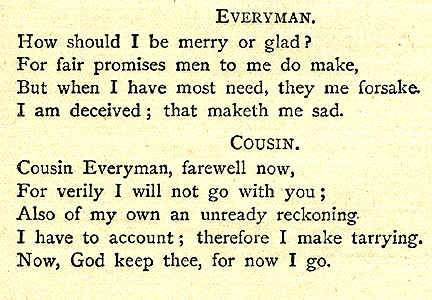

These recent three months have been much like the past thirty months of this pandemic era, annoyingly exemplifying the state of being at the mercies of too much and too many that are unmerciful. As the word empathy has come to be used in place of the more casual sympathy (or sympatico), the words mercy and pity are popularly interchanged. The pairings have their similarities, but each definition in their respective full strengths signify significant practical differences. Are you a watcher or a doer? The medieval morality play Everyman is about the journey of the character by the same name who is both tested and tests the intentions of his fairweather friends. After he is told that he must complete his life’s voyage to its destination, Everyman asks his various friends if they would accompany him. His old pal Fellowship starts out with pleasantries, but backs out at the prospect of a hard road. Even his familiar Cousin says his toe hurts, and adds he has an “unready reckoning” anyway, to which Everyman observes: “Fair promises men to me do make, but when I have most need, they me forsake.”

Everyman’s friends sound like Job’s, and like too many people all of us know, thus he falls upon his own stamina and spirit. Even his personal property failed him Adding insult to injury, his wavering buddy Good-Deeds may have just as well used a social media channel as he says, “Everyman, I am sorry of your fall, and fain would I help you, and I were able.” At last it is Knowledge who sticks with Everyman, introducing our protagonist to Strength, and Beauty, and the Angel. Upon reaching his hard-fought destination, Everyman stretches forth and says, “Here I cry God, mercy!” Having neither more nor less than his own soul to offer, Everyman affirms, “In manus tuas of might’s most; for ever commendo spiritum meum.”


“Hang in there” is something many of us hear quite a lot. Most of the time it reminds me of the desolate Everyman, but not always. When the manager of my local supermarket tells me this, after asking how the housing search is going, I can tell the wish is heartfelt. This morning I heard the words from my usual bank teller who also means it. She told me the story of her two years’ search for a house during the recession of circa 2000. Having endured the hardship illustrated her sense of understanding. The anxiety-laced dance of hypervigilant hunting for a place to live has removed relaxation from all parts of these months. My thirst is for the days I can go home to wherever my writing table will be, kick off my shoes, open the window for some fresh air, and just plain take the situation for granted. I believe many others do, as well. According to local news, southern Maine now has a shortage of at least 9,000 places to live. Not sure how that is measured, but I’m sure the number would be much smaller if not for the scourge of short-term rentals in residential neighborhoods. A recent local news article observed that “houses are no longer primarily thought of as homes, but as financial instruments and investment pieces.” In my neighborhood, I see town houses sold and resold and resold, without so much as a chair traversing a threshold. A major front-page article spotlighted an evicted family who live in a camper they park nightly at a Maine Turnpike rest stop. In response, concerned neighbors raised money to help, though the family’s search for a place to live continues. A social worker acknowledged the crisis conditions of the state’s housing shortage, adding, “If you’re on a limited income and have no other resources, you’re really at the mercy of the market.” Where is that mercy- and when?


This four-month tribulation which is embedded into the 2½ year pandemic is unresolved. At the still-unknown yet anticipated other side of these times, all of us will surely have tales to tell. In my daunted search for mercy, including my own Everyman experience, I wonder about misinterpreting life as transactional. Alas, mercy and respect cannot be purchased; you either have it or you don’t. A friend of mine who spent years trying to earn his tenure at an elite college talks about how “the good jobs get handed out” to cronies rather than to the most talented and accomplished. He said this even after he got his offer. Favors come to the privileged, to those who least need them. I’ve yet to figure out how to excavate good fortune, or to somehow generate it. Inevitably, all involved need to have their hearts in the game. I certainly do, but I’m not so naïve to assume that friendly territory abounds. Well, so does old Screwtape; I know. At the same time, I can choose to be merciful, and that comes through my willingness. Does that mean my pursuit of life and holiness continues independently of the Almighty? Or course not. Invoking the wagering philosopher Blaise Pascal, I don’t dare to do so. Like the character Everyman, the mind and soul are not to be compromised, even as the comforts of home and home itself are pulled away. In addition to holding fast to faith and mercy, another critical trajectory is openness to compassion- and even goodness. Openness means there may yet be good results. Lately, with an upward smirk, I refer to the rent-free realms of contemplation and devotion. I hear tell that parking and utilities are included.


Thursday, July 21, 2022

where

“My Lord God,
I have no idea where I am going.
I do not see the road ahead of me.
I cannot know for certain where it will end,
nor do I really know myself,
and the fact that I think I am following your will
does not mean that I am actually doing so.
But I believe that the desire to please you
does in fact please you.
And I hope I have that desire in all that I am doing.
I hope that I will never do anything apart from that desire.
And I know that if I do this you will lead me by the right road,
though I may know nothing about it.
Therefore will I trust you always,
though I may seem to be lost and in the shadow of death.
I will not fear, for you are ever with me,
and you will never leave me to face my perils alone.”


~ Thomas Merton, Thoughts in Solitude


Atypical of my gender stereotype, I’ve always been one to ask for directions. At every age, both time and energy are precious, and I try to make the best of my resources. Recalling a day replete with irony, after hearing from two different potential employers that I was overqualified, I drove to an interview to talk about a job for which I truly was overqualified. I could not find the place. Certain that I’d overshot the address, I stopped to ask for directions in a grocery store. Having given myself plenty of time, I wasn’t in danger of being late. Speaking with the grocery clerk got me out of my bubble, and reminded me that I was surely awake. Indeed, I found the place, and what followed amounted to something absurdly depressing. Once again the outlier, these adventures return to my thoughts. As my housing uncertainty continues, metaphors become threatening realities. The brevity of time in this liminal present is exemplified in the apartment building which steadily empties of the lives who have called it home. Everyone knows what’s coming, and we are all being as proactive as possible in this forbiddingly stratified housing market. Being forced out of my home of many years is an experience that combines instability, heartbreak, and exasperation. Incredulity and reluctance have led to an impatience to join my fellow evacuees. Coexisting with packed boxes of all my worldly goods is conducive to imagining moving a lot farther away than across town. Varying degrees of unease occasionally manifest as sparks of adventurousness. What is next, and where is next?


Living, working, and having been actively part of this city for decades, I’m doing plenty of asking for directions and advice from among the legions of people I’ve befriended. It is as though I don’t really know anyone, and am a refugee in my home town. Some are willing to help, but are unable; some are able to help, but are unwilling. Under the weight of desolation, it is as vital to persevere as it is to resist holding grudges. This city kid was raised to know better than to be bitter and reticent. Perhaps some day I’ll be in the role of helping a neighbor find housing, and I will not stand afar and snub. For now, things need to be taken at face- even as “good luck” has come to translate as “glad I’m not you.” Strolls around town are now mournful, being under the shellshock cloud of crisis, noticing the haves and the have-nots. When answering ads, I ask about how these apartments are heated, and if they’re making residents pay for their hot water (which never used to be done before). It’s a landlords’ market, without doubt. On my way to work the other day, I saw a homeless person sleeping in the doorway of an upscale real estate office that brokers idyllic coastal hamlets. The two Maines, and people like me are somewhere in between. As long as I stay in this city, having neither wealth nor influence, a nice place to live will be out of reach. Along with so very many, I’ve been exploring where my prospects can be better- but without surrendering this part of the world. For the moment, the urgency is in finding stability. Perhaps in the grand scheme of things, we’re all renters. When we think we’re “buying time,” we’re actually renting something we cannot own, and can at best pay for it.


The impending loss of housing has generated its own measurement of time. In a broader sense, the pandemic has caused a change in how the world has been perceiving recent years. The change is signified in how we’ll say pre and post, as the stream of normal life is diverted- or derailed. Speaking for myself, this year’s spring and summer have been lost seasons due to urgency. It is as though there are constantly more and more and wider rivers to traverse, en route to a clearing as yet unseen. There remains writing, and indeed I have found ways to write through life-threatening trials before. If language really is the house of being, then ambition must be the basement of aspiration.

The erosive symptoms of hopelessness are difficult to stave off. When suppression burns too much energy, I’ll simply entertain the notions in my journals, stepping through the minefields of the usual patterned and condemning responses en route to writing about hopes. Creativity and imagination are potential instruments for doing battle with futility. Amidst this indefinite wilderness of not knowing the when or the where, it is as imperative as ever to keep on doing the next right thing. The humblest measures, those of intention, can still be forward movements. Recently, having another among dozens of apartment viewings, I needed to take time off from work, and chose to walk to the address. Making the crosstown trek and seeing an unfamiliar neighborhood, the novel occasion caused me to notice skies, trees, street repairers, and sundry individuals being about their respective business. The doings of life are in motion while I try to find traction for mine. Does hope require proof? What forms of proof are convincing enough? Are hope and trust reciprocal complements? Such virtues exist in time, yet are not confined to place. In essence, there is no where.


Wednesday, June 29, 2022

see beyond

“We must accept finite disappointment,
but never lose infinite hope.”


~ Dr. Martin Luther King, Jr., 1968

This time of the year is especially conducive for outdoor writing. Perching on the sunwarmed granite front stoop to write and read has been consoling for many years. But now with the inevitability of losing my housing, even benign routines have become tainted with mournful tones. Necessity and survival demand that I force myself to see beyond these liminal times. While I witness the steady evacuations of my neighbors, as we are all anticipating the “redevelopment” by the next landlords, I am also wildly scouring the grounds for a place to call home. Yet, still, the stately Victorian architecture remains, as do roses, leafy trees, and ants scurrying across the stone steps. Occasionally, an ant will run right at my book, realize it’s an obstruction, and either climb over it or scramble around it. Then I’ll stand the book up, to see how it tries to figure out how to navigate, determined to hold its direction. Not wanting to antagonize the poor thing, I remove the barrier and let it scamper on. Like these small creatures, I am also trying to make sense of setbacks. Most of us have them; sometimes the hardships are compounded. Job hunting, apartment searching, seeking grace- all look the same, all pursued with the same desperation. Perhaps it’s all too similar, and this will require some thoughtful parsing. In crisis mode, too many things seem alike. All the begging, scraping, and strenuous attempting to impress are amounting to levels of humiliation unusual even to me. Yet the fight must not cease, neither should the refinements of my pitches. There is surely much more to lose by clutching a status quo, than in making a move.


Another annual summer reminder is my memory of arriving in Portland. After my hardworked endurance of the New York City school system, I graduated from the High School of Art and Design. Commencement was at nearby Carnegie Hall, and the speaker was alumnus Ralph Bakshi. I had saved my money to travel back to Paris so that I could spend the summer with family. I had missed everyone very, very much- especially my grandmother- and there was nothing I wanted more than to be there. It was undoubtedly a great decision in every way. By Labor Day weekend, with a great many thoughts and ambitions, I arrived in Maine. The building containing my first apartment is down the street from the place I will have to leave. Through eight different apartments, I remained close the center of the city.

I remember very well how desolate it was to be a seventeen-year-old stranger in town- even after beginning at Maine College of Art. I’ve since been active in numerous community efforts- creating, befriending, giving, serving, teaching, and working- but this housing crisis has me no less on the ropes than when I first arrived. A stranger in my own town. Maine is a wilderness at multiple levels: Yes there are thick and endless woods, as the state is mostly rural, with beautiful landscape. But it is also a hard culture. Somehow I wound up fitting in among kindred spirits, especially as I got more involved in civic and artistic life. The cultural differences surface as I seek advice and help from among the hundreds of people I know. A city person like me prefers to communicate directly and unabashedly (but with the best of manners). The stereotypic Yankee mindset is to go about things indirectly and laconically. People tell me about this-and-that empty apartment across the street from them, but they can’t tell me who owns the place because they either never speak- or the owner is an “avowed enemy.” I’ve heard that latter expression many times. Social media is well suited for such personalities, because they can suspiciously snoop around without directly communicating. I’d like to think I’ve evolved over the years, but never into that. My purpose in life is to be a doer, not a spectator. As much as I inhabit this world, I am not of it. Still, try making any progress with housing or employment without help from others- especially those “in the know,” and the “gatekeepers.” Even if you ask politely. Even if they know you.


I’m reminded of a Maine College of Art memory; a very subtle one that I somehow remember. I had written a paper for a literature course, and my professor wrote an interesting reflection after my last paragraph. Professor Aldrich concluded his positive comments with confessing there was something he couldn’t quite agree with, and then wrote “but maybe it’s just the mood I’m in today.” His candor was commendable enough, but the admission also taught me something about context. We tend to perceive according to our circumstances. The covid era is now 29 months running. We can look back across 2½ years of world-altering plague. While we all heard daily about fatality numbers and immunization, both the housing and job markets spiraled into merciless stratification. Before realizing how different everything became, everything began to look different. Like many others, I kept on working- setting up a remote space at my dining table with an extra laptop computer I had purchased, when not pitching in for various departments on-site. The imperative has been to keep on working. While I witnessed furloughs, layoffs, and countless voluntary departures- I kept on working. Lunch hours became isolated twenty-minute breaks, and vacations became impossible. All was subsumed for the causes of relevance and productivity. And survival. The mood I’m in today is that I’ve kept on working, obstacles notwithstanding.


One of my colleagues recently said to me, while discussing what we’ve been able to accomplish in the past fiscal year, “We’ve all been through a lot.” Stopping and looking up, I replied, “We have, indeed.” The covid era has weatherbeaten and accelerated the aging of most of us across all the generations. Ambitions held so preciously in the depths of our lockets, tenaciously carried through our school years, collide at the compromising crossroads of plague. The imperative is to survive, but what are the rewards of survival? Like the ants on the front stoop, it would be good to know that I’m scurrying to something better in this life. I seem to have met many of the descendants of the friends of the biblical character Job; they like to tell me I’m being tested, and that my life is a trial. And it’s much more than being on the brink of losing my home. Well, if this is indeed a protracted spiritual test, there isn’t much else I can do but to stick to my scruples. It means to believe without seeing, to pray insistently into the opacity, and to forgive all the tin-eared people from whom I’ve asked for help. Speaking with a wise friend, I mentioned the weight of some kind of bewildering punishment. He told me to do all in my power “not to go there,” and to be reminded of Divine compassion. Going further, he told me to be sure of that. Perhaps if this is a test, it’s about how I perceive God. Purposes are often discovered amidst struggles.


Maybe I’m not being punished. Maybe I’ve heard the expressions no-cause and at-will a few too many times to be reminded of my own humanity. Everything looks very different now. But while I continue straining to perceive through cluttered apartments and dilapidated buildings, my self-prescribed imperative is to see beyond reticent neighbors, see beyond this smallminded culture, see beyond constant setbacks, see beyond roadblocks and rejections, see beyond exclusivity, and see beyond all that tells me to just give up. Seeing and proceeding beyond limits may lead to a clearing, a pasture, a wellspring. That inner locket is still where it has always been, with me since my school years when I was thrashed around by bullies who outweighed and outnumbered me. It’s still kept safe, and the preserved spirit of forgiveness and devotion will repel the tarnish of these times.


Friday, May 20, 2022

unsettled

“There is to be action to accompany faith:
we are to struggle and fight on, but while we yield to the Spirit’s impulse,
it is God who works within us to do what is honorable.
If we will but resign ourselves, and no longer be obstacles in the divine way,
we will be carried to greater heights of grace,
and be transformed more fully into the likeness of Christ.”


~ Charles Haddon Spurgeon, Unconditional Surrender


1

My previous essay discreetly made reference to the impending loss of my housing of several decades. If functioning productively through the ongoing pandemic hadn’t been enough, my nightmarish fog is thickened by not knowing where home will be. Often through the years, my place of residence has been the steadfast sanctuary amidst turbulence and trials. Now, the very ground beneath my humble and reliable perch is being shaken away by the sale of the building amidst the city’s scourging gentrification. My neighbors and I talk about how frightened and frustrated we’ve been. And we are far from the only ones dealing with this sort of displacement in Maine, or throughout New England for that matter. I’ve reflected about the subject of pilgrimage throughout my years of writing; the whole of life is an earthly pilgrimage of trust. In the spiritual expression of making a journey, there is typically the journey home. Ordinarily there are intentional travels- sometimes quite arduous- to a place of communion and community, or solitude, or all aforementioned, during which there are heartening experiences followed by voyages of return. In my case, I have been returning to my same apartment through most of these years. But pilgrimage, being a physical form of contemplative enquiry, can surely tunnel into undefined darkness. Understood principles of the momentary are put to perilous manifestation.


2

My father used to say that hunting for housing is in that same category of horror as hunting for employment and hunting for a worthwhile automobile. I’ve known all three. The former two are more than both armsful, and the latter is something I stave off with the help of a good mechanic. As it has been for just about every aspect of life, short of the teleconferencing and remote-work software businesses, this is an egregious time to be hunting for a place to live. The pandemic economy has untethered workers from physical confines of large cities, prompting many to relocate to fresh-air places such as northern New England. Maine has been gutted by closures of local businesses, while the resort-style economy has exponentially inflated everyone’s costs of living. The outmigration of displaced and discouraged locals has been more than equaled by incoming remote workers and retirees; these factors, combined with successions of local officials who typically look the other way, serve to exacerbate the housing shortage. Having witnessed these phenomena through the decades, I have seen how constructed residences are either six to seven-figure condominiums, or compartments for the destitute. The rest of us claw for our lives and livelihoods. A good friend of mine manages a well-regarded downtown restaurant, and he recently told me that in spite of how he has helped his employees find housing, he constantly loses staff due to their losses of their homes. Now that I am forced into the battlefield, I’m experiencing what has happened to the process of searching for an apartment: much as it is with job-hunting, but acutely worse, it is a combination of lotteries and beauty pageants. On top of that, there is a disturbing prevalence of scamming and fraud, leading searchers to have to verify if the places in the online pictures are really those of the addresses listed. The days of cardboard “For Rent” signs in windows are long past.


3

Negotiating this uncertainty oscillates between trepidation and open horizons. Purging, packing, selling, and giving away things are all part of a protracted farewell. The load is lightened. I’ve seen some repulsively squalid apartments, and a couple of better and more liveable places. Determination and desperation drive the search forward. The behaviors and decisions of landlords, much as with workplace administrators, are out of the reach of an ordinary person of modest means. What is more within reach is to be prepared and ready to make that necessary move. Perseverance is running up against daunting odds. As yet, there are no conclusions.


The unsettling uncertainty is as intense as what I’ve begun referring to as The Glaze. For those of you who have had to force yourselves to sift through every single thing you own, at the most rapid pace you can manage, you know The Glaze. It is a kind of emotional and intellectual disorientation and exhaustion that results from the overwhelm of examining personal effects. Being a lifelong apartment-dweller, I don’t consider myself as having an enormous amount of things. I noticed it when I began purging paper-based material. The experience was such that I decided to categorize all my material by genre, as I do when I curate archival collections in professional life.


I made lists, based upon assessing my accumulations; in curatorial language, it would be series and subseries as the materials dictate. Going after my largest categories, photo-related material (prints and camera gear), papers, and books, I found that it was necessary to intersperse the work with smaller categories. That dizzying glaze was especially powerful and daunting, particularly on weekends when I was cramming in as much purging as I could. Eventually, I took time off from my job (“vacation time”) so that I could systematically march down my lists, adding in various intermissions so that I could back away from The Glaze as needed. Still, that stifling and stagnating stupor continued to slow my progress. After I packed all my music recordings, I kept the radio on, to help me keep going. I also took breathers to drive donations to charity shops. Inevitably, I collated all that I own, either for retention or for deaccessioning, in seven painstaking and restless weeks. On one particular Sunday night, I experienced a glazing that was so intense that I could neither write in my journal nor sleep. But the purging is done, and the packing is complete save for day-to-day necessities in anticipation of a thirty-day evacuation notice in the unknown near future.


Part of what made the covid era so life-altering was the forced change of all our perspectives. Lockdowns, social distancing, and wearing masks all became habits that worked their ways into unspoken daily life. My proactive readiness to be as mobile as possible is actually a preparedness to be reactive when my present housing comes to its inevitable end. My perspective of many years about the meaning of home has had to change. Another stark reminder of perspective occurred during a glazing day of purging last week. Down the street from my living room window there are several public benches which are mainly used by street people, and by smokers who cannot indulge in their buildings. Getting outside to divert my anxious glaze, I noticed the flashing lights of emergency vehicles and at least a dozen medics trying to revive a fallen man. They were rotating their administering of CPR for a long time, making great effort to rescue this unfortunate, ragged man who may have been homeless. I refrained from staring, but intermittently went outside joining some of my neighbors hoping to see that he would be all right. After what seemed close to an hour, the large group of first responders finally stopped. It was gut-wrenching to realize the man had passed away, and the valiant medics looked depleted. Then more city officials arrived on the scene of this unsettling sight. Someone like me being put out of my home still has a life and can at least find another place. I needed to get out and look at some different scenery, and the sky. It occurred to me that I hadn’t been out of town in nearly two months, because of this crisis. Rolling tape and tying string around boxes, one after another, marking the contents with a big squeaky marker that smells like shoe polish, I thought about how I will miss my crated prized possessions. To be sure, I left some selected writing materials and a few beloved books such as The Cloud of Unknowing unpacked, to be handy right up to crunch time. It’s the burying of treasure, with struggling hopes that I’ll be able to park, unpack, and regather in a better place.


Monday, March 14, 2022

observe

“Your eyes have only to behold”

~ Psalm 91


Having been an incessant and habitual worker through all my years, taking breaks requires an effort. Ironic as it seems, energy is needed to be able to wind down- especially now. And by winding-down, I mean being completely still. Without any background noise. Without cluttering and filling “leisure time” with strategized chores. Weekends can be made more strenuous than weekdays at work. Indeed, vigilance gets things done, but such unrelenting watchfulness feeds insomnia. The fires of the latter are fed all the more in these increasingly anxious times. Bewildered individuals everywhere wonder at “what can one person do?” Isolation only intensifies the sort of inertia that obstructs initiative and engagement. General advice many of us hear, outside of urgent fight-or-flight crises, is to gather at our breathing. Breathe and release the grip. Release the restraints, as much as possible, without deadlines or pressures. As a lifelong visual artist, another natural trait is to observe- noticing what is happening and memorizing the impressions. Bearing witness is not a straining effort. With this in mind, a standstill needn’t mean stagnation. I’ve learned that occasionally the way to stand my ground is to be still and observe.

Thoughtful observation can find lasting impressions in the understated. A recent travel, nearly two years in the waiting, was almost postponed some more due to a severe storm. I set forth anyway, clambering over felled trees with my luggage, en route to a bus terminal. As the Trailways vehicle merged onto the open highway, the torrential freezing rain worsened. Being a seasoned driver, I habitually looked toward the windshield, astonished at the blunt intrepidity of the bus. When I noticed my straining to watch the road ahead through the horizontally pelting storm, imagining the needed navigational maneuvers, I halted those thoughts. Exhaling, I reminded myself that I was not at the wheel this time; the driver was. Indeed, being freshly en route to a retreat, there was plenty of residual tension still stuck to me. As a passive passenger, I could enjoy the freedom to close my eyes- and even to look up at the heavy, ominous skies while anticipating some healthful respite.

We can learn a lot about ourselves by listening to those who know us well. An old friend with whom I used to take lunch breaks noticed my habit of stopping at the last few last bites of my meal, then finishing the repast right before heading back to work. On my part, this was subconscious, but I found the observation amusing. It’s similar to something I noticed myself, when occasionally pausing at highway rest-stops a few miles short of destinations to tidy up my car- then finishing the travel. Perhaps the protagonist can also be the observer. It certainly holds true for those of us who are journal writers. If our actions are insufficient when it comes to accomplishing our goals, our intentions leave room for more tries and ways to support others. Progress can take the form of reinforcing stillness, seemingly receding into the scenery. Writing about Saint Teresa of Ávila, Francisco Carvajal elaborated about how attentive listening and recollecting our thoughts can in themselves be forms of contemplative prayer. In quiet perseverance, the Holy Spirit is subtly discerned, “And when we are docile to those promptings and counsels, we find that our lives become fruitful.” Carvajal also referred to imperceptible graces, quoting another Spanish 16th century saint, San Pedro de Alcántara, who wrote that “our guardian angel is present to us, in our prayer, bearing our intentions and defending us.” I have no doubt that what we see at the surface is not all there is.


During this week, notwithstanding the world’s present hostilities, my thoughts turn to the pandemic’s beginnings two years ago. In 2020, on March 12th I taught classes throughout the day, at the end of which I taught my philosophy class in a pizzeria as planned. The next day, Friday the 13th, turned out to be the final normal business day for this part of the world. A national state of emergency was declared that day. As the proverbial curtain dropped over society, I witnessed a lot of panic hoarding and startling strangeness- avoiding all of this myself, though writing about the surreal experiences in my journal. There was no avoiding the upheaval, particularly involving my employment. I had to cancel all travel plans. Suddenly, it became impossible to simply visit with friends. The shock combined sudden desolation, silent city streets, and the boredom of confinement. There seemed little else but to witness the times, albeit while working remotely, reading, and writing letters to those I could not visit. As early as March 18th, I wrote in my journal about my intention to “adhere to my usual schedule, up early, coffee on the ledge of the tub, with the daily written wit-gathering and steeling for the workday- online or not.” Even now, two years on, isolation is the contemporary and indefinite continuum. It is also the context I’ve had to function against, maintaining what I can of the old familiar normality. Indeed, with increased immunization and reduced casualties, more socialization is possible than in the past two years. But the present lacks the social freedoms of 2019. As throughout the past two years, I continue to find some of the old familiarity when I perch outdoors with writing and reading- especially by the ocean. Outdoors and writing amidst the elements of nature, the moment is complete and unimpaired; now as before. As for the tentative future, “make definite plans,” Josemaría Escrivá once said, “not for the whole week, but just for the day ahead- for this moment and the next.” My eyes have only to observe.


Sunday, February 13, 2022

envisage

“Too far for you to see
The moss and the mould on the cold chimneys,
The nettles growing through the cracked doors,
The houses stand empty at Nant-yr-Eira,
There are holes in the roofs that are thatched with sunlight,
And the fields are reverting to the bare moor.”


~ R.S. Thomas, The Welsh Hill Country

Do we each owe something to our personal journeys? This is a question which you may choose to evaluate in your own context. It is a new year, evidently. In these recent weeks, during my daily trudges amidst dead-of-winter throes, I’ve pondered this enough to make incidental notes in between obligations. Forward motion demands nothing less than a daring aspiration. Progress rises and falls on ambitious hope. As the pandemic wears on and distorts much of our perception, it’s been clear to me that applied hope is anything but passive. By applied, I refer to the day-to-day living application of hopefulness, as compared to an abstract theory. Such determination would consistently undergird attitudes and actions alike. In the face of relentlessly grim news, the insistence upon looking forward to better days is essentially beyond passive. Is daring to anticipate and stretch toward improvement, to envisage beyond the immediate and the visibly apparent, a kind of stubborn blind faith? Perhaps it is. And perhaps the combined forces of both fatigue and malaise in these times amount to a test.


One recent evening, after the sleetstorm crosstown trek home from work, I perched at my desk with dry change of clothes, and scribed this in my journal: What do I owe my voyage? My thoughts turn to sensing a motivating indebtedness to my pilgrimage, self-constructed since childhood. And this is quite different from owing something to the limits of my self. The full journey is inclusive of many other people, of institutions, and places. The pilgrimage is much more extensive than the adventurer. Pondering my indebtedness to years of countless miles, I think of the instances when I tell myself, “you’ve gone this far, don’t turn back.” To be fit for eternity, as it is written in the gospel, one that sets hand to plough must not stare in the opposite direction. Progress is forward motion. When the way ahead continues through daunting prohibitiveness, there are great temptations to give up my tireless pursuit of improved conditions. Settling into a status-quo, albeit unsustainable, is itself a temptation. Especially if it seems comfortably solid. But a diving board is no place to make a foundation. The path of least resistance appears in such forms as convincing me to give up and believe this is as far as I can go. There are so many legitimate and rational reasons to let up on the throttle and tune out. But my better sense, the one that annoys me with inconvenient truths, urges me against giving up the ship. Furthermore, that sense threatens me about what could happen if I were to give up the pilgrimage trail. Indeed, I’m indebted to the distance already covered and past hardships already endured. Despite the protracted barrage of rejections, with so many denied efforts, my consciousness of time invested and ground covered persuade me to carry on. And that is to carry on with wisdom derived from defeat. There remain significant goals; hard work and survival have yet to see fulfillment. Along with many of you, I’m also constructing a list of “after covid” plans.


Last month comprised the season of the Epiphany, reminding me to keep on unearthing embers beneath the detritus of these times. But as with hopeful aspirations for progress, foraging is far from passive. My enduring impression is one of coaxing possibilities out of elusive graces. The search for fulfilling opportunities finds an illustrative metaphor as I help neighbors move their stranded vehicles out of snowdrifts. As drive wheels spin and whine in quagmired desperation, the flailing car merely sinks further into the frozen ruts. In order for the car to advance onto tractioned terra firma, it needs to be repeatedly rocked and pushed, wheels positioned straight ahead. The motorized graces need forces of providence, so that the being can be shoved onto a passable way. Raw ingredients are ever wanting for an indefatigable iron will.


Bernard of Clairvaux, in the 12th century, left the world of contemplative thought a wealth of guidance. Monastic wisdom often strikes that assuring balance of the metaphysical and the practical. “That which was begun by grace,” wrote Bernard, “is accomplished by grace and free will, so that they work together simultaneously rather than selectively.” The statement has the ring of consolation, reminding the recipient of the prospect of not being left unaccompanied or thrown back solely upon their own reserves, having to try generating the graces of fortitude and providence. I’ve learned to better handle my end of things, which includes learning that my efforts are not occurring in a vacuum. What is immediately visible is not all there is.

Edgar Allison Peers, the Hispanist professor who translated and extensively wrote in the 20th century about San Juan de la Cruz, authored an anthology called “Behind that Wall.” In the book’s chapters, published in 1948, Peers presented how the inner life manifested among various Christian mystics. He prefaced the work by describing the drab veneer of walls that commonly surround colorful gardens. “Rough, ugly bricks, placed one upon another,” perhaps using his own vernacular in Liverpool. Then musing about workaday monotony of commuting “day upon day, the same dull routine... We sometimes ask, ‘what will it all lead to?’” Peers continued by referencing an experience during the time he lived and worked in Spain, walking a very steep and broken road that led to a house to which he had been invited. Noticing the dilapidated walls around the property, he imagined the house would look just as rough and run-down. To his astonishment, the orderly and colorful gardens surrounded a tidy, crisp villa- surprisingly encircled by the ramshackle walls of his first impression. Peers observed that people can be like gardens that are concealed behind ordinary and unremarkable structures. The inner life, Peers suggested, is a floral garden behind the ordinary wall. Appearances cannot accurately reveal substance.


The ability to envisage resurgence demands a full determination to look beyond the immediate. Full, and nothing less. As much as things are not looking good, these are things which must not receive permission to own anyone’s soul. And that is no small discipline. Remembering Bernard’s advice, a strong will is constantly needed to take up threads of grace as they are discovered. The old metaphor about the sculptor visualizing a completed work of art through the solid block of stone holds true in the mindset of applied hope. Having to thrive amidst too much sedentary time when not on the job, through the recent two years, I’ve been trying to redeem this pandemic era through my self-directed studies in philosophy. As always, my note-taking is for the purpose of sharing- for both writing and teaching; thankfully, there have been windows of time to do both. At the same time, I’ve been gradually bailing possessions out of my apartment, lightening the load for future forays as yet unknown. The cultivation of intellectual and spiritual fitness has far eclipsed the collecting of material, even for this curator. A sign of the times.


Along with keeping up the studies, journaling continues in various parts of every day. Noticing signs of these times, I’ve kept track of this era’s developing vocabulary and habits. “Keep well,” “Stay well,” and “Stay safe” have become mainstays in closures of conversations and written messages. I notice how greetings, even with strangers, include queries about physical health. I’ve even heard myself do this, along with the honestly caring, “how are your spirits?” Times of plague rooted the wishing of blessings upon those who sneeze. Conferring of blessings were noted during a 6th century pestilence in Rome, though the popularized “God Bless You” uttered for fear that someone might be falling ill dates from the bubonic plagues of the 14th century. I’ve also noticed hearing more of this in the recent two years.

It is obvious to see how we social creatures have sorely missed one another. Speaking with a small group of friends recently, we each had much to say about missing being parts of groups that would go to pubs, or cafés, or museums, or movies. “Movies!” exclaimed one of my friends, continuing with, “I can’t remember the last time I went to the movies!” We all miss hanging out, and unmuzzled no less. I’ll bet each one of us has taken up the habit of talking to ourselves- more than before. During some recent errands, driving by some triple-decker apartment houses on Portland’s High Street, I saw something that caused me to look again to see this wasn’t a statue: A man was standing still on his second-floor front porch, with one foot on a low crossbeam, holding a smoking briar, with the other hand parallel to his brow, gazing toward the distance. He looked every bit the ocean navigator aboard ship, but alas on a second-floor porch, gazing toward the streets. Alone in my car and indeed talking to myself, I said “aren’t we all at sea.”


Perhaps reflecting the wariness of these times, I’ve noticed recent circulation of the old saying, “It’s not enough to start well; one must end well.” My own abbreviated version of this, as I press on, has been don’t drop the ball. Keep going. Hold firm to the very end, and nothing short of the end. Undoubtedly easier said than done, in the unforgiving desert of the present economic and employment landscape. Added to the fluid lexicon of this era is The Great Resignation, though barely detectable in northern New England, the general effect is yet to be fully comprehended. But the determined insistence to press onward amounts to a restlessness which I consider a motivator. I owe it to everyone and everything that has encouraged me to get this far. There remains a long way to go.


Thursday, December 30, 2021

newness

“Even so, we also should walk in newness of life.”
~ Romans 6:4


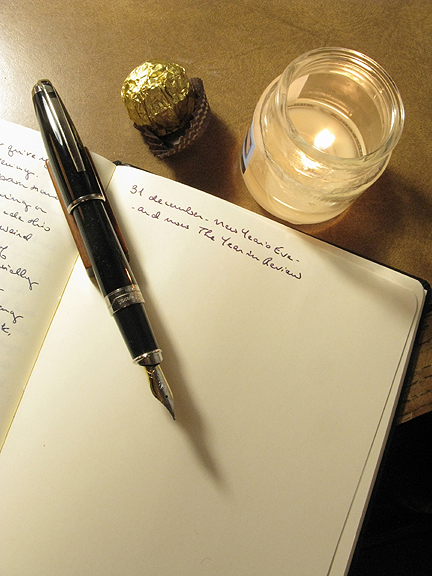
My voyage with journaling began in July 1994. Later on, graduate school caused my written entries to be regrettably intermittent. After 2000 I came to depend upon daily documentation and reflection, and the practice continues to this day. Throughout my years of writing, I’ve used the days leading up to New Year’s Eve to create retrospective “year in review” summaries. At first, I made the lengthy journal entries into Time Magazine- style features, as in “the year that was.” After a few years, these summaries became something I fashioned into several days of shorter journal entries, giving equal treatment both to events and to impressions. Without writing, telling the months and years apart would be even more difficult and surely blurred. The covid era surely represents this. It’s a snowball of largely dissimilar months, whose grip set in by the Ides of March 2020. Since then, living has been amidst minefields and restrictions. Thinking back to the world before that date, I remind myself that “everything was at least two years ago.” In keeping with my own custom, I’ve begun gathering my handwritten thoughts to recap the year which- if anything- feels as though it’s in Month 23. It is indeed a looking back, but always attempts at forward motion- traction or not.


The contrast is appropriate, connecting the establishing of winter and long nights with a season traditionally marked by newness. The Christmas holiday season has also long been relentlessly exploited commercially, with advertising beginning many weeks before Advent. Pandemic life has muted some of the competitive spending drives, forcing diminished budgets and smaller gatherings- if any. Yet the week between the western/Gregorian calendar Christmas and New Year’s Day continues to be a liminal span for various forms of reflection. The plague rages on. Will the coming year be an improvement over the one just past? How to look forward with anticipatory hope, in the bleak midwinter?

My self-determined directive is to continue seeking light in the darkness of these times, while trying to tangibly exemplify that light. For nearly two years, it has been impossible to travel or to even buy some weekdays off to rejuvenate. My semiannual pilgrimage retreats of many, many years have had to be compressed into a few occasional hours during a weekend so that I can continue being gainfully employed. Pushing back for the cause of spiritual health has also stretched nights into times of carved-out silence and study. Not doing this actually worsens the exhaustion. Admittedly, this is a trial that must be endured.


Newness begins with a thirst for promise, even for the haggard and worn. One recent midnight while preparing for the subsequent reveille that would return me to the same darkness, I methodically set up my coffeemaker and what I’d need to make next day’s entry as effortless as possible. Thinking of the combination of obligations and wishes while tidying my writing table, I remembered how an old friend used to call himself “a kid on Christmas morning,” and how that attitude helped him stay inspired. I wouldn’t describe myself as such, but there was something I liked about that sentiment. A soul’s renewal is as much a mystery as is the desire for newness. Do we inherently sense the hope of renewal? It is a fascinating thought how we seem to naturally find our own renewal- or at least the will to seek out our rejuvenation. Is this somehow built into our nature? I think we reflexively salvage the pieces we can find of our existence. The recent devastating natural disasters remind us of this. Victims who escape with their lives are looking for remnants from their households, their histories, and where their continua left off- at the times when their worlds were interrupted so they can recommence. In the less-cataclysmic scenarios, there somehow exists a natural drive to pick up and continue on. I believe this to be more than survival instinct, but the reinforcement of the holy spirit of new life. While more than enough reasons can be enumerated to give up hope, wondering about what is actually improving in our midst, we still tend to resume our searches for better and more meaningful lives.


During this year’s holiday season, I’ve noticed myself bristling more than usual at overused Christmas songs. They brought neither comfort nor joy, even to this believer. I fled to the consolations of Telemann, Bach, and how the occasion is quietly known as the feast of the incarnation. Yes, indeed, there is the commemoration of the Nativity. Not to be lost is the parallel aspect and infusion of the Divine within all whose lives return the embrace. Incarnation manifests to an ordinary human as transformation, and the latter builds an inner strength to be grateful while bearing up against hardship. Enduring the plagues in late 14th century Holland, Gerard Groote wrote, “May it never be that tribulation produce in us a faint heart; a faint heart, confusion; and confusion, the desperation that destroys.” Ancient texts accompanying this season include the name Immanuel, which in Hebrew means God is with us. Over the years, I’ve come to reverently refer to the So Near. As I’ve learned from the monks of Weston Priory whose doxology is to the Creator, Word, and Spirit of New Life, I understand the value of finding meaning beyond overused expressions.


The current provisional journey is embedded within an incalculable pilgrimage. Trying to take stock of the good that is, of the silent graces too easily overlooked, I try to be attuned to available inspiration. What is within my reach? What don’t I know that I need to know? Are we to search for newness, or enable renewal to find us? I wonder to what extent the spirit of rekindling is based upon unseen certitudes of which we could be innately aware. Perhaps there is a balance of proportion between a person’s determination, and a providence over which there is no control. And within that sense of resoluteness, does it begin with one’s desire to give rise to renewal, or are we brought to think about it from beyond ourselves? Do I procure the lamp and illuminate it, or is the already burning light catching my attention first? Unsure of what to make of the broader ailing world, as well as my own daunting setbacks, my thoughts turn to how all of this is about endurance. The transitory present is an impermanent trial. Distances and times between now and turns in my fortunes are impossible to tell. Opportunities remain out of reach, but hope remains available. Hopefulness increases the will to endure. When St. Paul wrote about how “hope maketh not ashamed,” he wanted his readers to confidently animate conscientious faith. Newness must ever be kept in mind. And kept in mind and practice with unwavering insistence.


Friday, December 17, 2021

perilous journeys

“Trusting faith is called a crystal well
because the waters of spiritual goodness flow
from it to the soul, although it is night.”


~ San Juan de la Cruz, The Spritual Canticle


advent wilderness

Generally speaking, we embark upon an adventure with expectations of resolve. We’ll invest in the engagement of a challenge, intending success. For the most part, one takes on a project with the idea of completion in mind. Beginnings are hopes exemplified. Our cultural experiences are replete with stories, novels, and films that travel an arc from launch through hardship and on to cathartic conclusion. Many dramatic biographies work as such. When I take on projects and pursuits, every provision and effort point toward thorough and sturdy completion. Some enterprises require more time than others; duration cannot always be ascertained at the start. But the important thing is to make progress, move in a forward direction, and maintain faith in the vision of fulfillment. Occasionally, courses of action need to be adjusted, informed by instinct and memory. I’ve often heard myself say within, “no- don’t do that again,” or “a version of this has worked well before.” I’ll work out dilemmas in my journal, like puzzles, allowing the written words to reflect back at me for some analysis.


But what happens when the craft is blown off course and both direction and destination become uncertain? Has forward motion been reduced to the plain progression of time? Do there remain chances to safely stop and recalibrate? How critical is the element of time? During this Advent season, amidst the second calendar round of the covid era, the end of the pandemic is out of view. The annual December weeks, commemorating movement through darkness toward light and nativity, historically direct observers to promise and assurance- and this continuum has persevered through millenia of plagues and wars. Upon my own trail of healthful contemplation, following the texts of the divine hours, these times bring me to notice a precariousness revolving around the signs of presence. The ancient readings describe the Advent voyage as being through a desert, even a howling wilderness. One very early pitch-black morning, with breviary and coffee, I noticed the prayer, “Watch over our welfare on this perilous journey, and keep our lives free of evil until the end.” The words “perilous journey” stayed with me throughout the day. Being a seasonal reading, I know I’ve read this before- but I notice it now.


Navigating through a sleet-spattered windshield yesterday, the phrase returned to me, recognizing the indefinite present as a protracted series of perilous journeys. The way forward is my best rendition of forward motion. Logistics have prevented me from taking respite time for two years and counting, confining reflection to the watches of night and an occasional weekend day. But I am holding course to the best of my abilities and resources. As usual for me, though appreciating the context of Advent season, I continue to be ceaselessly fascinated by the mysterious Magi. The written record leads to the Nativity, but the westward-voyaging astronomers disappear from the documentation. I’ve written about these three unusual yet anonymous individuals before, referring to them as the outside consultants, considering how they had been pressed by the court of Herod. The Magi may well have been diverted from their course, yet they knew enough of their senses of direction to keep on going. They most likely consulted with one another, determining not only what they would deliver to the place of the Nativity, but also that they would subsequently and compassionately slip away without reporting to Herod. And back into the unknown they went, keeping all of us wondering through all the centuries since then. They took their shared experiences with them, perhaps recounting the adventures to others in locations unknown to any documentation. Searching for assurance and advocacy is undoubtedly humbling, no matter how much experience one may have. The status of this perilous journey remains uncertain. My way of pushing back against the current of misery is by proceeding straight through the unknowing.


perspective


Navigating productively and healthfully requires both a sharp focus and a conscious sense of distraction, as I’ve been finding. This type of discipline balances proactive thinking with an ability to defensively drive away from fear-feeding stimuli. Choosing in favor of one is often a choosing away from the other. My longstanding curiosity about current events news has had to be tempered into much smaller, nontelevised doses; being informed needn’t mean overdosing. Listening to the car radio the other day, I noticed the patchwork of staccato reporting bounce between traffic updates and the worldwide scrambling for cures. The pandemic has surely intensified the already tough juggle for perspective. My long-usual preset bouncing away from news to music is now more frequently a turning-off of the sound system altogether.

For decades, I’ve made my livelihood using all sorts of computer technology and applications. Being a cradle visual artist, I’ve always kept a metaphorical ten-foot pole between myself and what I’ve long called “lit screens.” Nowadays this may look like a demonstration of creative independence and privacy, but actually keeping that safe distance is part of how I can maintain my footing in a reality whose vital means include handwritten media, real books, the outdoors, and personal interactions. As with a great many, the recent couple of years have forced me into living and working through lit screens. During the intensity and constancy of having to do this at the outset of the pandemic, I noticed how the pain of eyestrain would last far into the nights. I had to acclimate to the absorption of numerous consecutive hours online. Another vivid memory from the sudden quarantining of spring 2020 was my struggle with sedentary life and habitually looking out the windows for signs of life.

As tempting as it is to use the lit screens more as ends than means, especially in these alienating times, I’ve learned to be all the more selective and contextual. When browsing becomes a game of caroming between shrill news coverage and the enviably fortunate lives portrayed on social media, that’s when I turn off the lit screen. Imagine pinging and ponging from fearsome news to unattainable careers, back and forth; such joyful scenarios for thoughts to dwell upon! As a remedy, I’ve trained myself to look up from the lit screen, as I tell myself. Look up and around, even if means noticing dusty surfaces on the furniture. Looking up is a way to make note of your context- of where you are. It’s the equivalent of twisting that zoom lens back into a wide-angle, and try to get a bigger picture of the immediate. Looking up from a digital terminal is an indoor and admittedly modest version of being able to get outdoors to see horizons.
<


Perilous journeys cause us to cherish understated treasures we used to overlook. In this thinking, memory and hope converge. Remembrance helps us to look forward, while contending with present perils. While fine-tuning ways of waving off negatively distracting encroachments, I’m also deliberately creating distractions to send my thoughts into more positive directions. In yet another ancient text used for Advent, Saint Cyprian encouraged readers to “endure and persevere, if we are to be perfected in what we have begun to be, and if we are to receive from God what we hope for and believe.” He added that our acts of compassion must be united with patience and perseverance. “Do not grow weary, or be distracted, or be overwhelmed by the temptation to give up in the midst of the patient pilgrimage of life.” Endurance must be carried through to nothing short of the end.


staying sane


Eclipsed by the obvious urgency of fatalities in the millions, medical and economic crises, the mental toll of the pandemic is yet to be fully known. The latter is profoundly felt by many. I know this, albeit writing from my ledge on this planet, soldiering on in my employment. As with following health news, it has become impossible not to notice articles posted and published daily about the commonly-known Great Resignation. Also referred to at The Big Quit, workers have been leaving their jobs during the pandemic at rate unequaled by any previous U.S. Department of Labor statistics. In August 2021, 3% of the workforce resigned their jobs. 55% said they were job hunting. Adding yet another revealing statistic, 20% of the global workforce say they are “actively engaged” in their employment. This means eight out of ten workers say they are disengaged, for any of many reasons, amounting to a massive reaction to lingering exploitation. All the surveying and tabulating were evidently prompted by trends that are most likely nothing new, but surely accelerated by an overspreading societal malaise due to the pandemic.

Amidst the currents of these times is a popular realization about mortality. Life is short. We can’t be certain of how much time we have left to be able to inspire others, let alone to be able to accomplish our procrastinated wishes. The same employers that have been calling their workers “expendable” have begun to appear rather expendable themselves. Hence the unprecedented numbers of resigning workers who have not lined up subsequent jobs. Income and physical safety are often at odds. How will they pay their bills? It’s bewildering to watch, but entirely understandable. The weary world aches for the plagues and social conflicts to end. Few have the luxury of respite. Apparently, we are to soldier on, collecting our shots as we trek the contagion minefields. Survival always needs a purpose, and in this case I still envision being able to look back upon these present times whenever that critical corner is turned. Seeking signs of improvement runs parallel to the search for better opportunities. Perseverance and vigilance cannot be permitted to be ground down by fatigue. Meanwhile, redeeming the time between obligations, I continue finding consolations while studying philosophical works from the early-Renaissance era. Groote’s motivating words from the 14th century remind me that trials are proving-grounds. His students heard this while they struggled for equilibrium in the howling wilderness of the plague in late-medieval Holland.


Now having to launch again into the murky waters ahead, the need to continue being propelled from within constantly intensifies. Writing materials that include blank books for subsequent thoughts, along with my filled rapiaria volumes of collected wisdom, serve to hold course. The lights of my studies have led to gratitude throughout these recent two years of hardship. In the persisting face of unrelenting futility, my better reaction is to return to the words of Saint Cyprian which I quoted above, about not being tempted into losing hope. Trusting faith asserts that what is immediately visible is neither all there is, nor all there will be. Even the Magi continue to remind us about envisioning beyond the present. But upon the current, the ground of momentary being, San Juan de la Cruz always pointed to the wellspring of Spirit. Somehow he was able to instill and reinforce this awareness within himself during his wrongful incarceration. Before, through, and in his post-captivity life, San Juan poetically emphasized union with God as the purpose for survival through all times and trials. In his jail cell, he scribbled words on a sliver of paper begged from one of the guards; the scrawled notes became his Dark Night of the Soul, which he completed after his escape and remains in print to this day, nearly 450 years later. In the thick of what was supposed to be a death sentence, he discovered what he later called “the delight of contemplation and union with God,” finding “guidance in the night of faith.” The immersion he described demands that the soul must proceed by unknowing to unify with Divine wisdom. Surely speaking from indelibly physical and as well as spiritual experience, San Juan de la Cruz added, in The Ascent of Mount Carmel, that the soul has to...

“...proceed rather by unknowing than by knowing; and all the dominion and liberty of the world, compared with the liberty and dominion of the Spirit of God, is the most abject slavery, affliction and captivity.”