Showing posts with label Thomas Merton. Show all posts

Wednesday, October 12, 2022

temporal


“It is not in vain that the fires of this divine discontent
have been kindled within.”


~ Thomas Aquinas, Summa Theologica ch. 1


1

In an attempt to regain a sense of normal creativity, I’ve glanced back at the recent weeks of my journal entries en route to this essay. Indeed the apartment house which had been my home for many years was sold by the progeny whose family had owned the property for a century. All nine apartments had to be evacuated, and my household was the penultimate departure. For every person, the experience was emotional, as nobody wanted to leave the elegant old landmark, but it was necessary, and none of us wanted to face eventual eviction. The extreme stresses revolving around hunting for a place to live during this state’s worst-ever housing crisis was as intense as the trauma has been for me. In my determination to climb out of despair, I’ve kept on writing, along with going to work every day. The emergency move finally happened 4 days after the sale of the building closed, so I can say I outlasted the former landlords. Being gentrified out of one’s home is a woefully common plight in present-day southern Maine.

Four months of scouring the region for an apartment acquainted me with dozens of stories that remain with my thoughts. The picking being slimmer than nil, due to my income, I found a painfully small place- two neighborhoods away- unsurprisingly and absurdly expensive. Strain and exhaustion led to the current disappointment. Of course, the entire scenario would have been positively cathartic, had I found something really nice. There was no choice but to move, and despite having to sign a litigious 13-page lease, this can only be considered temporary. As for the old place, which is now being gutted as I write these words, I’m grateful for all I enjoyed there: all the dinner parties, guests, space, and general tranquility. At the same time, it is critically important to remember that I never owned a square inch of the edifice. Finally leaving an empty building, depleted of all my neighbors, revealed to me that it was merely a tired old shell. Settled and caring souls are what make for a home. The music of life had disappeared. A row house that comprised the lives of doctors’ offices, writers, a piano teacher, families, eccentrics, and artists is now an object of investment real estate. Like covid, the housing crisis has struck far too many people. I tried my best to desensitize for the move. I find that I cannot call the present apartment home; it is referred to as the place.


2

Amidst times that force countless among us to absorb increasingly greater expenses with decreasing resources, shall we permit ourselves the luxury of ambition? Is it unreasonable to expect advancement and stability during economic recessions and housing crises? How costly is hope? These recent months have shown me that housing is essentially for the affluent, and better employment is for insiders. From my diminished perch, the currently propagated logic that says inflation will slow down when there are fewer jobs looks terribly twisted. I know that I’d have found appropriate housing with a much better salary. For anyone, that would exceed the obvious. My own experience is the juxtaposition of fighting on through underemployment and inferior housing, upon the din of temporality and glaring imperfections at all hands. Indeed, I am very far from alone in such circumstances- yet speaking for myself, there must be improvement. The urgency is crippling, but my awareness of the temporal is oddly assuring. It is nothing particularly new or unique to have to get used to detestable things. In a place so cramped and unappealing, I’ve only unpacked clothing and books- along with kitchen and bathroom contents. From the boxes to my bookshelves (thus clearing some rarified patches of floor space), I reached for Thomas Merton’s Life and Holiness. In the book, he described how people and institutions tend to “cling to subtle forms of inertia and mental paralysis.” Merton challenges his readers to actively see to it that a consistent sense of sanctity must prevail, while facing truths of the imperfections in our situations. Having this is mind, I set about scrubbing the floors of the oppressive little apartment- which is more like a compartment- to make things as livable as possible, and so that I can begin the work of repacking for another move.


3

Temporary, for many, is a convenience- such as a rented car or a nice hotel room. In my present case, it’s painful and anguishing. As I try to figure out any useful divine purpose in this, when I write my daily journal entries that are equivalent to surfacing for air, I try to recall the value of the dynamic of the provisional. I remember well enough how the temporal used to be hopeful and exciting- or at times a kind of fear that something held dear was about to reach an unwelcome end. Now with a visegrip of a living space, immediately after losing my home, I am beyond eager for this captivity to be short-lived. The tote I had labeled “desk drawer” prior to moving is still next my empty writing table, which took weeks for me to unearth from beneath piles of boxes. It is unavoidably a hold-pattern kind of life which I am striving to redeem. Where is home, when one cannot go home? If anything, this is a difficult and protracted learning about attachments to places and things. At worst a prelude to mortality, and at best an opportunity to muse about an open-ended future.


For someone like me that instinctively looks for solutions to problems and routine conundrums, I want reasons, purposes, and strategies to get me out of wheelspinning ruts. Thinking about transcendence is a much better distraction than to let stomping elephantine upstairs neighbors hijack my wellbeing. I used go home for the peace and quiet; now I run away from the place to seek peace and quiet outdoors. Illegitimi non carborundum, as the pseudo-Latin goes. The name Hosea, in actual Hebrew, means salvation. Hosea the Prophet (8th century B.C.) famously wrote (chapter 10):

“Sow for yourselves righteousness; reap in mercy; break up your fallow ground, for it is time to seek the Lord, ‘til He comes to you raining righteousness.”


The imagery of fallow ground never leaves my inquisitive thoughts. What is its meaning? Well, the biblical prophetic voices have always had the purpose of turning people to the Light of life: to God and to vocations of being instruments of holiness for the benefit of others. Hosea essentially bids the reader to self-reform, though it requires a broken and contrite spirit. He used the agrarian language of the ancients, “plowing up the fallow ground” to make the foundation of life receptive to renewal. Cultivate the ground such that heart and soul are cleansed of all that corrupts, removing weeds and thorns impairing the causes of uprightness and good works of generosity. Then my thoughts were drawn to the portion in Jeremiah, warning against “sowing among thorns.”

Me being me, I want a meaning, a message, something I can implement like a marching order. And like the Psalmist, I contemplate the words and digest them like food. What’s this about unproductive, fallow ground and sowing among thorns? Maybe life in the comfortable old place in the West End (which I could afford) was fallow ground that needed to be tilled. Maybe the moneycraving landlords and their doings (and misdoings) were part of this casting away into the abyss. Perhaps I live in a city and a state that amount to fallow ground, complete with thornridden recipients of one well-composed cover letter and résumé after another. If this is true, I want to know right away, before any more life forces are wasted. I could look back and grind away more in persistent defeatedness, or strain to look ahead for the miraculous.


4

While disciplining my thoughts to steer away from the brink of tempting despondence, I write my determination to leverage the temporal toward promising horizons. The pandemic era got most people to internalize “making the best of a bad situation.” Trauma lingers and anxiety remains: the latter due to the expense and unsuitability of the place. There needs to be another move, a liberation from such an oppressively claustrophobic environment. Last month’s emergency move notwithstanding, precious resources were sown in the wrong kind of soil, thus any sort of harvest I can salvage is out-of-joint.

My better musings return to gathering some functional thoughts to try recognizing Divine purpose in this intense trial. As I transfer my personal effects from cardboard to reclosable plastic totes (since the place is too small for unpacking, and I want to be better prepared for the next move), I’m reacquainted with treasures I haven’t seen in four months. I get to see what I’ve missed and what I did not miss. From a box of childhood keepsakes, I unpacked my Felix the Cat- the sight of which brought me to tears, and I apologized to him for these crabby confines. Felix is a keeper, though I am finding other things to give away or sell, as I make yet another comprehensive purge. It’s all unsatisfactory, yet coping is necessary, reconciling without settling.


In the midst of this continuing crisis, as I’ve surely seen throughout the last six months, multitudes cannot even find small places to stack their treasures, and still more are homeless. Along with the health crisis which has claimed almost 7 million lives worldwide, maintaining a sense of context is critical. An impartial observer that notices the fortunate that get good jobs and have nice places to live, must also keep an awareness of the less-fortunate. My definition of home has become elusively fluid. The best thing said to me came from one of the wonderful librarians at the Boston Athenaeum, who compassionately wished that I’d find a sense of home at the library, and at any time I open my journal to write. Having made decades of pilgrimages, it’s easy to call to mind how writing is a movable feast- even with just a morsel, a notebook, and a pencil. Still, the pride of place I had for many years in a lofty Victorian row-house has been brought to something lowly, clenched, and yet overpriced. It’s nothing to be proud of, and will be easy to leave behind.

Boston Athenaeum terrace


If ambition really is a luxury, then I stand flagrantly overdrawn. Aspirations are pearls of great price and I intend to invest with them, rather than to hoard my credentials. Even in these harsh circumstances, I insist upon enriching myself with studies and knowledge. These pursuits long predate this year, and there have been plenty of rewarding adventures. Why not anticipate more? Living against the barricades of canned confinement and treadmill workdays must amount to a launch into something healthful and lifegiving. Several years ago, a counselor to whom I described my work situation replied with a memorable turn of phrase: “Well, that burns the platform hotter, doesn’t it?” It’s not to say I feel that I’m owed anything; it’s more like a marrowdeep desire to live and work in better environs. The perseverance muscles are flexed, as is the longing for the fulfilment of two careers’ worth of cultivated abilities.


Thursday, July 21, 2022

where

“My Lord God,
I have no idea where I am going.
I do not see the road ahead of me.
I cannot know for certain where it will end,
nor do I really know myself,
and the fact that I think I am following your will
does not mean that I am actually doing so.
But I believe that the desire to please you
does in fact please you.
And I hope I have that desire in all that I am doing.
I hope that I will never do anything apart from that desire.
And I know that if I do this you will lead me by the right road,
though I may know nothing about it.
Therefore will I trust you always,
though I may seem to be lost and in the shadow of death.
I will not fear, for you are ever with me,
and you will never leave me to face my perils alone.”


~ Thomas Merton, Thoughts in Solitude


Atypical of my gender stereotype, I’ve always been one to ask for directions. At every age, both time and energy are precious, and I try to make the best of my resources. Recalling a day replete with irony, after hearing from two different potential employers that I was overqualified, I drove to an interview to talk about a job for which I truly was overqualified. I could not find the place. Certain that I’d overshot the address, I stopped to ask for directions in a grocery store. Having given myself plenty of time, I wasn’t in danger of being late. Speaking with the grocery clerk got me out of my bubble, and reminded me that I was surely awake. Indeed, I found the place, and what followed amounted to something absurdly depressing. Once again the outlier, these adventures return to my thoughts. As my housing uncertainty continues, metaphors become threatening realities. The brevity of time in this liminal present is exemplified in the apartment building which steadily empties of the lives who have called it home. Everyone knows what’s coming, and we are all being as proactive as possible in this forbiddingly stratified housing market. Being forced out of my home of many years is an experience that combines instability, heartbreak, and exasperation. Incredulity and reluctance have led to an impatience to join my fellow evacuees. Coexisting with packed boxes of all my worldly goods is conducive to imagining moving a lot farther away than across town. Varying degrees of unease occasionally manifest as sparks of adventurousness. What is next, and where is next?


Living, working, and having been actively part of this city for decades, I’m doing plenty of asking for directions and advice from among the legions of people I’ve befriended. It is as though I don’t really know anyone, and am a refugee in my home town. Some are willing to help, but are unable; some are able to help, but are unwilling. Under the weight of desolation, it is as vital to persevere as it is to resist holding grudges. This city kid was raised to know better than to be bitter and reticent. Perhaps some day I’ll be in the role of helping a neighbor find housing, and I will not stand afar and snub. For now, things need to be taken at face- even as “good luck” has come to translate as “glad I’m not you.” Strolls around town are now mournful, being under the shellshock cloud of crisis, noticing the haves and the have-nots. When answering ads, I ask about how these apartments are heated, and if they’re making residents pay for their hot water (which never used to be done before). It’s a landlords’ market, without doubt. On my way to work the other day, I saw a homeless person sleeping in the doorway of an upscale real estate office that brokers idyllic coastal hamlets. The two Maines, and people like me are somewhere in between. As long as I stay in this city, having neither wealth nor influence, a nice place to live will be out of reach. Along with so very many, I’ve been exploring where my prospects can be better- but without surrendering this part of the world. For the moment, the urgency is in finding stability. Perhaps in the grand scheme of things, we’re all renters. When we think we’re “buying time,” we’re actually renting something we cannot own, and can at best pay for it.


The impending loss of housing has generated its own measurement of time. In a broader sense, the pandemic has caused a change in how the world has been perceiving recent years. The change is signified in how we’ll say pre and post, as the stream of normal life is diverted- or derailed. Speaking for myself, this year’s spring and summer have been lost seasons due to urgency. It is as though there are constantly more and more and wider rivers to traverse, en route to a clearing as yet unseen. There remains writing, and indeed I have found ways to write through life-threatening trials before. If language really is the house of being, then ambition must be the basement of aspiration.

The erosive symptoms of hopelessness are difficult to stave off. When suppression burns too much energy, I’ll simply entertain the notions in my journals, stepping through the minefields of the usual patterned and condemning responses en route to writing about hopes. Creativity and imagination are potential instruments for doing battle with futility. Amidst this indefinite wilderness of not knowing the when or the where, it is as imperative as ever to keep on doing the next right thing. The humblest measures, those of intention, can still be forward movements. Recently, having another among dozens of apartment viewings, I needed to take time off from work, and chose to walk to the address. Making the crosstown trek and seeing an unfamiliar neighborhood, the novel occasion caused me to notice skies, trees, street repairers, and sundry individuals being about their respective business. The doings of life are in motion while I try to find traction for mine. Does hope require proof? What forms of proof are convincing enough? Are hope and trust reciprocal complements? Such virtues exist in time, yet are not confined to place. In essence, there is no where.


Saturday, April 30, 2022

crises are opportunities

“You pass the doors of the library,
and the smell of thousands of well-kept books
makes your head swim with a clean and subtle pleasure.”


~ Thomas Merton, The Seven Storey Mountain


Recent weeks of this nascent spring reveal to me how the passage of time combines newness and anguish all at once. Amidst the ragged persistence of pandemic, there are crocuses along the sidewalks. Which of these do we deserve more? In the struggles of these times, it seems more consistent to live against turbulence than to abide alongside the bucolic. Crunching over the leftover detritus of winter, I recently made one of my routine sojourns to Boston. Alighting from the Red Line and emerging to a notably snowless Tremont Street, tangible signs of spring looked novel to me.


The pandemic-era Boston Athenaeum, as with all libraries, has had to apply varying degrees of public health restrictions. Following the changes in regulations, I’ve reacquainted myself with how I use the library as a place of study and writing- even adhering a laser copy of my immunization card to the flyleaf of my journal, for easy presentation. On my March visit, face masks were no longer required for the members-only upper floors, and once more the place that has been familiar to me for more than two decades looked new to me. Merton’s words about entering the splendor of imagination and potential in the library of his visiting came to mind. The Athenaeum’s collections, community, and physical spaces have never lost those aspects for me. For this particular visit, I carried my selections and writing material up through mazes of stairs to the quiet of the “third floor gallery” perch. There are times to be social, but this was a time to be silent. In this part of the world, the Lenten season parallels the austerity of late-winter. Looking up from my writing, out toward the Granary Yard and Tremont Street, the line from Psalm 51 came to mind, “renew a steadfast spirit within me.” So long as I live, fresh starts must be implicit. More often than not, these are as subtle and overlooked as morning routines of waking and washing.

Above: Boston Athenaeum


Above: View from seaport area & University of Massachusetts-Boston


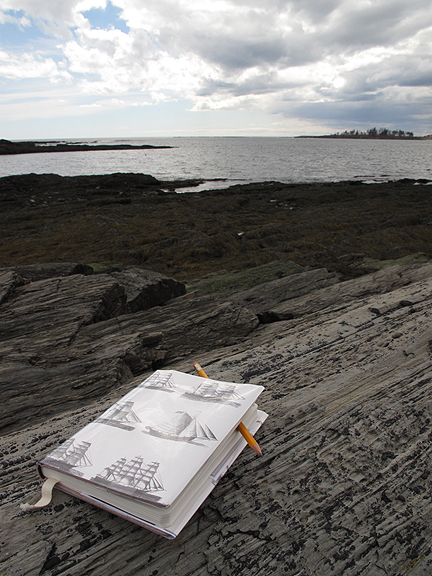
With the Maine temperatures vaulting into the forties and lengthened daylight, long walks and light clothing make for some welcome changes. My lifelong habit of strolling with a camera goes with my coined expression, “I’m going out to find photographs” sends me outdoors. Lately, it’s been sufficient to simply be outside, merely reacquainting with the milder elements, and absorbing what is good about being aperch outdoors. Another enduring memory which continues to educate me, comes from my year at UMass-Boston when I sought out the chaplain for desperately consoling advice. That was one of the most difficult and traumatizing years I’ve ever lived through. The chaplain evidently could see that, and in her wisdom and grasping for words she walked me outside. It happened to be a strikingly bright spring day, and we walked along Columbia Point, overlooking Boston harbor. The chaplain pointed heavenward and instructed me to notice. “Look up,” she said to me; “Look at that sky.” More than a clever directive to distract me from my miseries, looking up at the blue and the clouds above the sparkling water and city structures immediately expanded my perspective. We talked about the sky, and then about wishes for the future. A turning point I’ve never forgotten, and advice I have offered to others and applied to my own self many, many times since. The vast firmament can be as significant above cities as above any environment. The other day, I went out to find photographs at a spot I’ve long cherished here in Maine, and noticed the signs of the skies. There remains a raw chill in the air, and the landscape is invitingly unrefined. Writing outside in early spring is an early awakening with a sense of starting anew. Somehow, commonplace things can still make first impressions.


With time comes repetition, and with recurrence comes the question about whether there are limitations to fresh starts. How many resets are possible? It may not be knowable. What can one reasonably anticipate? Or perhaps it is not in the nature of forward-looking to think reasonably, while dreaming up to the skies. The will to continue has a faith in fresh starts built into it. We have all seen tragic imagery and heard about the Ukrainians’ anguish and ache for new beginnings amidst unimaginable ruins. War and destruction strike a terrible contrast against the burgeoning season of growth. Yet in the face of world events and economics, I notice people gardening, walking and dining together, creating art works. Who wouldn’t want to reset their lives, given the opportunity? I continue helping those around me with their work and their hopes for success. Of late, I am turning to my friends for their help. Quite suddenly, my landlords of many years are selling their building within which is my home. The eventuality of losing my steadfast home has launched a tireless marathon of purging and packing for the as yet unknown. The ache for new and solid beginnings has struck my little writing table, now precariously nestled at the center of numbered days.


My current journal book has an imprinted motto; though roughly translated from the original Chinese, it is poignantly appropriate. I’ve been paraphrasing the motto as, “everyone needs a sense of beginning.” Trying to keep on writing amidst working, the search for better work, and now downsizing and packing, I am striving to try to see opportunities in these crises. It is yet another Lenten season. Let there be fair skies.


Sunday, July 7, 2019

before us


“Therefore, surrounded as we are by such a vast cloud of witnesses,
let us fling aside every encumbrance and the sin that so readily entangles our feet.
And let us run with patient endurance
the race that lies before us.”


~ Hebrews 12:1


the indefinite temporal

Most of us, perhaps all of us, are creatures of habit. We like what we like, and we are consoled by what consoles us. There are several ways to specifically define our own creature comforts: one is to notice our preferences during times of leisure, another is to notice our reactions to distress, yet another includes what we’ll do to comfort another person. All are drawn from our experiences - at any age- of what has set us at ease. As workplace oppression presses, artistic pursuits and the worlds of imagination and scholarship can be medicinal sources. The wilderness ahead is as trackless as it was for me a year ago, five years ago, or ten years ago. In the grand scheme of things, this is nothing particularly new. Even as a high school student, I used to say that independence comes at a price. Well into adulthood, the basics of life continue in their uncertainty. The indefinite temporal forces an acute awareness and practice of spiritual consolations. The voyage can be desolate and undefended- granted there is occasional cheer and respite- yet throughout is the imperative to keep focused. For many years, I’ve admired the Greek title parakletos, referring to the Spirit of God, which translates to the advocate, the at one’s side, the consoler. This, in itself, is a poignant point of contemplation.


Icon of Saint Benedict, Weston Priory, Vermont.


the saints that have gone before us


Sources of consolation can also be as earthily human as we are. I believe each of us emulate those we hold in highest esteem, those who’ve set examples we comprehend as worth following. We couldn’t imagine perceiving without them. Such individuals surface throughout our lives. These are the saintly souls that have gone before us. And if we know them during our own lifetimes, they are presently before us. It may be the exception to the rule to not have a personal roster of saints and role-models that influence and encourage from their respective experiences and words. Our predecessor saints, upon our reflection, continue attending to us. I notice countless occasions at which perspectives and even the words I’ve learned come out of me. Often it’s the voice of common sense, particularly amidst situations that do not make sense. Hardly a day passes without my issuing forth my father’s “what do you mean by that?”- or “what’s the point?” To go with that are the conciliatory monastic words of “let’s find a way,” with the gems gentle, patient, and humble. Of the spiritual mind, Austin Farrer observed that it is...

“...incapable of proving faith in seventy years of imperfection, adds the years of others to its own and extends experiment by proxy. We live and feel through the friends we know, or through the saints and apostles we read. And now the balance swings the other way. Instead of valuing what we have received as a prescription for the experiments we may make, we begin to value our own experiences as clues to a labyrinth of spiritual history.”


As in the Johannine letters, that which we have seen and held lives within us as strongly as we can manifest such divine gifts. Our best learning really does provide clues to labyrinthine roads. One of my mentoring historic saints, San Juan de la Cruz, reminded his readers that “The light in this dark night is that which burns in the soul.” Among the 20th century minds long established in my pantheon of saints, Thomas Merton, saw many sides of contemporary life. He warned of the dangers of defining ourselves with our careers, obsessively looking in mirrors for reassurance. Activities that were meant to exalt, wind up reproaching and condemning us, Merton wrote in No Man is an Island. “The less he is able to bethe more he has to do. He becomes his own slave driver- a shadow whipping a shadow to death.” He added, “we must stop checking and verifying ourselves in the mirror of our own futility, and be content to be in God.” Merton was surely not advocating misery, but quite the opposite. Seeking peace within ourselves, we learn to commune with ourselves so that we can communicate with others and support their wellbeing: “We cannot achieve greatness unless we lose all interest in being great. For our own idea of greatness is illusory, and if we pay too much attention to it we will be lured out of the peace and stability of the being God gave us, and seek to live in a myth we have created for ourselves.” The accompanying wisdom of saints provides a guiding cloud by day, and light by night.


saints, heroes, and tangibles


Shrine of Saint Joseph the Worker, Lowell, Massachusetts.


Surely less austere and subtle- but surely evident in popular culture are the crossroads of patron saints and personal identity. The traditional idea of a patron saint relates to personally identifying with an exemplary historic personage. The devoted becomes something of a student of their chosen patron saint, following through by learning about that person’s life and observing the saint’s feast day- which may be their date of birth, or decease, or an anniversary of remark. The “popular” part enters the equation with our reasons for attaching to a patron saint: perhaps a trait, a surmounted adversity, something the saint was known for having accomplished, or a national saint. Saint Francis of Assisi is admired for his respectful attitude toward animals; students in France celebrate Charlemagne, who is believed to be the founder of public education. Saint Joseph is regarded as patron saint of Canada, among other countries, virtues, and workers. The converging of popular ideas and these historic mortals manifest in ways that can reflect our human gestures and aspirations more than anything else. We naturally ask for help; spiritual life brings us to be grateful for favors granted.

Remembering Thomas Merton’s words, how much of our selves are we pursuing? How do we express our allegiances and affinities? We all tend to need tangibles, looking for the sense of things, for hopefulness, for paths in the wilderness. Do we represent those we admire, or are they representing us? Perhaps it’s both, in varying degrees. Who identifies whom? Often the exhilaration of festivities- or the severity of solemnities- can subvert the questions. I diverted from my studies last fall, with a few lively strolls through Boston’s North End during the Feast of San Gennaro. Among the pleasant diversions are musical events and savoury Italian cuisine, centered around celebrating the patron saint of Naples. For the occasion, Hanover Street becomes a pedestrian mall, lined with dining tables and vendors. At the heart of the event is Saint Leonard’s Church, and a nearby year-round landmark on Battery Street called All Saints Way also draws enhanced attention. Being a reverent observer, I enjoyed colors, sounds, and impromptu sidewalk chats, with the prayerful silence inside Saint Leonard’s. From the muffled Baroque sanctuary, I could hear the outdoor animated festivities. Celebrations like this are replete with visual language and reminders of those before us.


All Saints Way, in the North End of Boston.


Above: Feast of San Gennaro.
Below: Saint Leonard's Church.


On one of my many visits to the Saint Anthony shrine in downtown Boston, a greeter gave me a holy card. A small, humble, printed treasure, picturing the decorated statue on Arch Street, there are some good and calming words printed on the verso side. It is a miniature reminder of the nearness of holiness that I keep with me at work. It is also something of an icon, representing how iconographic we are. Long before I’d ever seen a holy card, I knew plenty from my childhood about sports cards. The photos of athletes are backed with their respective statistics. They are collected and revered as objects by many, even at auction houses. The subjects of the cards have numerous fans who celebrate their heroes’ accomplishments. Sports genres honor their achievers and eras. There are halls of fame; the one for hockey, in Canada, has the less-subtle title of Le Temple de la Renommée. Athletes themselves often like to wear the same uniform numbers as their personal heroes- in some ways their patron saints. In reverence, Jackie Robinson’s number 42 is not worn by any major league baseball player. In other genres, buildings, campuses, and various locations often bear the names of saints, of benefactors, and the sundry famous. There’s always a reason and story for each person of note. And many of these individuals, with their imperfections, were endearingly normal people albeit of extraordinary achievement.


Shrine of Saint Anthony, Arch Street, Boston.


Indeed, there are many more examples of how we enshrine- whether globally or within our own hearts. But the degree of influence and personal proximity will be different for as many souls as encounter such things as landmarks. For this instance, let’s imagine the individual soul as a walking repository: an individual person to be sure; unique and unlike anyone else- but there are influences, sources, and mentors that make us who we are. They’ve preceded us: our saints that we have ever before us. Lives providing noble examples, as the lines of our roads give way to occasion. The way is not always a clearly-marked road with dividers, lanes, lighting, and directional signs. Amidst the wilderness immediately ahead and at all sides, I have little more than instincts and the words of saints for my navigational senses. In these scarce and oppressive times, it becomes necessary to lean heavily into the words and legacies of those who have been mentoring me- both in my lifetime and through their words handed down to me in written observations.


taught from within


Those souls most treasured are individuals that have taught me the most compassionately. That latter trait is decisive, as I’ve surely learned enduring lessons though hardships, and too many unkind situations and people. But to offset oppressions and bullying are all the lifegiving examples I’ve seen before me, and those that lived before my time. Before my eyes and ears have been family members, friends, mentors, and colleagues. Before my era are the subtle role models that have been teaching me from within, through my studies and travels. Sometimes my first impressions are through biographical writing, most other times the initial acquaintances are through their own written works or by trusted recommendations. Among the great benefits of studying physical books in well-stocked libraries are editorial and bibliographic notes. The way to find is to seek, and one of the best ways to seek new influences is to browse for the serendipitous. Another is to pinpoint specific sources by reading general treatments.


During a highly unusual weekday off from work, this past May, I made the opportunity to read in the Boston Athenaeum’s inner sanctum, the Vershbow Room. With time for just one item, I chose a 17th century imprint containing selections of Saint Anselm. The saint of the 11th century came to mind as I’d gotten tastes of his thought and work through studies of philosophical surveys by Paul Vignaux, and by D.J.B. Hawkins. The Athenaeum has just one tome of Anselm in English, albeit in the 1600s vernacular, and the delicate volume can only be viewed in the pencils-only room. Due to what I’d been reading through the winter, I expected speculative philosophy- perhaps some more of the Neoplatonist texts of my familiarity. Well, what I found was something more personal and quite captivating.


Considering the author’s time and the context of his writing, the stern and austere words were not surprising to read. Some of the tone of reformist writings 600 years later are detectable in the ways Anselm laments, “I cannot look upon my past life without horror.” He addresses his own self, as an observer, with: “Open thine eyes, my Soul, and let them overflow with tears of godly sorrow. Force yourself to see and hear the danger of thy Condition.” But as much as Anselm is unlike the puritanical authors of a half-millennium later, these writings were also unlike what I’d been reading thus far in his philosophical texts. Turning the fragile leaves of the book, I found an inviting tenderness. Anselm rhetorically asks, “Who will be my Defence? Is there not one, who is call’d the Angel of the Covenant?’ Then he speaks to the reader- to me- and implores:

“Look up, and sink not in despair.”

Right about there, I found my study submerging beneath the mere reading of words. As it often happens when I discover such sources, I became aware of the guidance before me. Continuing on, as I only had an afternoon in the rare books room that day, the book proceeded into Anselm’s Incentive to Holy Love. This turns out to be a set of meditations that Anselm based upon the Passion, which is also known as “the way of the cross.” I took many notes for my future reference, as the writing was intimately compelling. Though he tracks through the narrative, as with Saint Augustine, the fascinating “teachable moments” are in the tangential reflections and prayers. Anselm pauses along the way, with this:

“I, who invoke thee here as my Pilot, to conduct me through this rough and hazardous Sea of Life, may, by thy guidance be preserved from making Shipwreck of Faith and a good Conscience, and at length be safe landed at the Haven of eternal Rest.”


As with any effective instructor, the teaching is patient, respectful, and challenging. After completing my reading and signing out of the secure room, I went out to the Athenaeum’s terrace for a bit of transitional air. The words of Saint Anselm were so prominently in my thoughts, I could simply stand and look down toward the Granary Yard and Tremont Street- and then up toward the skyline. The saintly, brilliant minds that have gone before me, are ever before us, went my thoughts. The words, books, and their various manifestations await. Such guiding consolations are as directing clouds by day, and lights in the night.


Saturday, June 16, 2018

diversion


“The mind ought sometimes to be diverted that it may return to better thinking.”

~ Phaedrus (5th c., B.C.)

A nourishing fruit of spiritual life is the learned ability to adjust attention. Over the years, I’ve been making sure to retain useful knowledge, both by writing and by committing good advice to memory. When it comes to studies, I’ve been creating indices and writing in chapbooks, careful to cite what was found and where- so that I can retrace steps to sources. I’ve grown to consider cherished books as waystations, and the notes I create are essentially maps to the springs. A gem of spoken advice I’ve found unforgettable came from a wise elder who liked to say, “if you don’t like how you’re feeling, change what you’re doing.” There; now I’ve passed this along to you.


Distracting attention from hardships, or even just from plain and repetitious routines, may be viewed as escapist denial of reality. That reality depends, and it’s for the individual to self-examine and make that determination. Here, I’m thinking along the lines of healthy diversion. These are dark times and the general picture is bleak. A great many of us struggle just to maintain an even keel. Economics are less and less favorable to those who begin and proceed without privileged foundations. For my part, the pursuits of basic sustenance and a stable standard of living intensify by the month. It is something of a competition among large crowds seeking decreasing numbers of musical chairs. But to cease the struggle would be even costlier than to maintain momentum. When there’s a goal in sight, the last thing any competitor would do is give up the ship. In this context, healthy diversion amidst daunting struggles is especially vital.


Spicing up the doldrums, if anything, helps the cause of creativity. I may not be able to improve my lot anywhere close to as quickly as I’d prefer, but it is within my forces to find constructive avocations. I can’t imagine otherwise. Forging ahead in barren wilderness, nary an oasis, is as unappealing as an undecorated living space or a day without the textures of music. We have the facility to enjoy beauty and learning because we are innately aware of what edifies us, what motivates our progress. Between employment and housing, it is as though every moment must be “rented,” with puddlejumped weekdays en route to islands of less-constrained breathers, time and energy woefully reduced to units of commerce. All the more reason to clear away spaces to change the scenery- even if just for a few hours, igniting the soul that longs to flourish, thirsting for enduring sacredness.


Perhaps even the “healthiest” diversion might file under escapism. Well, so be it! Just like knowing when and what to eat, to stay nourished and alert, I take stock in knowing how to squeeze learning and creative expression into the narrowest confines. Particularly in the recent dozen years, writing has been my principal diversion. Journaling is an extension of such essential conduits as thought-processes, spiritual comprehension, analysis, and reflection. It is as critical to continue developing ways to write, as it is to simply continue writing every day. When I have more time, there is more time to write; when the immediate is a plethora of commitments and tasks, it’s a sentence here-and-there. However it may manifest, there is always writing material at the ready. Pencil and paper go along with me through other preferred diversions- such as photography, travels near and far, museums, hiking, visits with friends, sanctuaries, cafés.


Drafting this essay, at the Boston Athenaeum.


A wonderfully portable diversion is reading. When I was in graduate school, although inevitably earning a professional masters degree, before changing majors I was introduced to the horizonless wonders of philosophy. As soon as I submitted my thesis, I knew enough to return the philosophical books that had to be set aside in favor of the required reading of my curricula. Having the freedom to study as I wish is something I continue to cherish. The study of philosophy might be called a healthy diversion within a healthy diversion. It is fertile ground in which to immerse my imagination. It is also a subject I’ve added to my teaching array. As for imagination, I’ve found this to be its own form of cultivated diversion- all the while aware that its lesser aspects can be something of a minefield, rather than a healthy diversion for the cause of balance and growth.


Teaching philosophy (above); Absorbing philosophy (below).


Along this voyage, I’ve also grown to find that some of the temporary distractions, the “band-aids” needed to get through the more difficult spans have joined my arsenal of dependable diversions. For me, nothing quite fulfills the advice of “if you don’t like how you’re feeling, change what you’re doing” like a contemplative retreat. The first time I made such a journey, it was very much a spontaneous attempt to interrupt a terribly chaotic time, seeking out a quiet and welcoming refuge. There were no other expectations. Then I found myself returning to this type of experience, always with positive anticipation, always cherishing the prospect of hospitable shelter, meeting kindred spirits, always discovering new perspectives to fuel my spirit. Likewise, pilgrimage travels have been teaching me about diversions as adventures to be savoured. Thus far, it remains for me to fully apply this, but the simpler respites- even my commutes- are to benefit from the broader expeditions.


In his book, New Seeds of Contemplation, Thomas Merton famously said, “If you have never had any distractions, you don't know how to pray.” I’m sure he was not referring to the friendly, constructive kinds of distractions, but I’ll allude to the this in the sense that contemplative life- especially for postmoderns- must be able to grow increasingly sturdy and substantial amidst struggles and juggles. Often distractions are needed to interrupt an untenable din of distraction. Then, having stepped away from barrages of fragments and demands, the return can find strength of focus and drive- even improved clarity of thought. Diversion permits for observation, and knowing to divert is indeed a good result of having observed.


Monday, August 21, 2017

l'oraison


“Blessedness is no superficial joy or indolent repose,
but the opening vision of the Divine glory, the growing
insight into the mysteries of the fulfillment
of the Divine counsels.”


~ Origen, On First Principles ii:10.


paths and definitions

In this recent narrative exploration of the interior way, I’ve acknowledged the contemplative path as the avenue in my midst that is not barricaded from my reach. The first essay addresses the sustenance of the spirit, beginning with the contemplative path, as taught and lived by monastic communities. The second essay celebrates reading and the study of the written word as inspiring strength. Now we come to the most essential of ingredients...

Setting words to subjects as elusive and dauntingly personal as contemplation and prayer has challenged thinkers and practitioners through untold centuries. In my own ways, I suppose I have also been contributing to the ocean of words. As words go, I’ve long appreciated the French expression l’oraison, which covers the essential ground for those responding with their lives to a spiritual vocation. The Latin root, oratio, meaning “prayer,” does not suffice to define what l’oraison encompasses. In the simplest terms, this means a life-perspective that is immersed in reverent conscientiousness.

The Carmelite tradition, often looking to its own historic contemplatives St. Teresa of Avila and St. John of the Cross, frequently uses the term l’oraison. Soeur Marie-Laetitia refers to the personal call to live with one’s whole heart, “giving way to the Presence of the One who lives and prays within you.” To speak of mystery in what might appear to be arcane terms is surely not the intention; monastic teachers tend toward an assuring, plain-spoken style. In her book, Découvrir l’Oraison, Sr. Marie-Laetitia uses terms such as vivre pleinement, vraiment, intensément (living fully, truly, intensely), and that (translated) “too often we are living at the superficial surface of our being,” and “contemplation is an attentiveness to the Spirit, which is a matter of willingness and determination.” That seems pedestrian enough. But then she says contemplative life is “essentially situated in the domain of the unseen... in the face of the incomprehensible, we want to understand.” Contemplation is “not an intellectual work,” wrote another contemporary Carmelite, Pierre-Marie Salingardes; in the same essay he referred to l’orasion as a “schooling of affection and compassion.”

As every discipline has a practice, the applied life of l’oraison begins and lives in the current of silent reflection. In uninterrupted quiet times, thoughts can be reigned in, and the mind cleared. Being a clean (or clean enough) slate, it becomes possible to listen beneath and within the “surface” referred to by Sr. Marie-Laetitia. Quakers describe this regathering as “centering down.” Contemplation is more than something one “does” when an occasion arises. An anonymous monastic once wrote, “we make the time to be there for God.” In that recollective quiet, a soul can “enter” the interior environment of l’oraison. We express our longings and ask, perhaps, for greater understanding, or a more forgiving attitude. Another aspect is to slowly absorb a few words- or a text- and taste its meaning. The spirit of this practice is really that of dialogue. Not a desolate experience, but one of union.


personal


My own oraison comprises journal writing- even if the entries are fragments of sentences. The journal provides a place, as well, for reflections about readings. Lengths of time for quiet meditations vary with my scattered work schedule- but I manage to devote parts of early-mornings and lunch hours to contemplate and commune. This is merely a portion within the general context of l’oraison and journeying through life. Interior prayer is astonishingly accessible. Contemplation is transcendent of place, and does not require special words or intermediaries. It is as direct and proximate as a person’s own thoughts. Thinking and writing curve and dovetail easily into intentions and gratitude. The contemplative spirit does not separate prayer as an “activity” differentiated from ordinary thought processes. Prayer is an appeal, as much as a recognition (of things, of my limitations, of God’s magnitude). It isn’t even really an isolated “action,” as though I were to say, “at 2:30, I am going make sure to breathe, so that I’ll have a dose of oxygen.” All means of inspiration are integrated. After some time, distance, and experience, contemplation becomes quite involuntary and extemporaneous.

Once embarked upon the interior way, the commitment must be whole-hearted. Without a sustained, all-in attitude, contemplation too easily becomes extraneous and stagnant, instead of being as life-giving as its definition. It would be like cutting off the water supply from its wellspring. As the gospel passage declares, we would be unfit for the realm of the Divine if we continue looking backwards while setting our shoulders to plow forward. Simplest ways seem to demand the most discipline. Being committed to contemplation is much like my commitment to learning. The latter requires study, as faith requires the lifeline of prayer. Despite much of the cultural formalism that tends to moor prayer down, it’s really not a “religious” matter. The less fettered, the better, and the more dynamic. Having a sense of direction is far more consequential. Religiosity may be viewed as a scaffold, but it is not the building- neither are formulae. All if this is transcended by longing and perseverance. But in the context of l’oraison, this is not a one-way communication. Reaching up for a rope turns out to be the rope lowered within reach. A person’s seeking is not possible without help. Life in the Spirit invites a direct rapport with the forces of creation. In God: Creator, Word, and Spirit of New Life- the Logos is Christ who speaks directly to the human condition, and is the compelling Mentor to all that would be disciples. The frisson of taking up the yoke and beginning the pursuit invariably leads through wilderness temptations of unknown depths and durations. Along the trial roads are places of respite and validation. But it’s all very unpredictable, and thus l’oraison throughout these paces becomes even more vital. We cannot perceive vastness from inside hiding places.


experience and the invisible

Describing the boundless with the limitations of written language has challenged practitioners since the advent of narrative writing. But we do continue, somehow undaunted, knowing we are not alone. The important thing is to know the topic by first-hand experience. Dirt roads, sidewalks, and expressways dissolve into mystery, considering the Searcher of hearts. “Contemplation is essentially situated in the domain of the invisible,” wrote Sr. Marie-Laetitia, adding “l’oraison is the ground beyond our senses, and we more easily sense that which we can see. We face the incomprehensible, and we desire to understand.” Paradoxically, the unknowing can be less discouraging than the seen, and the absence of answers must not derail the prayers. Contemplation is surely not entirely of the individual’s will. We experience, as the Carmelite sister observed, “the Presence of the One living in us and praying in us.” For my very humble part, I’ve come to notice more recently, alongside how reflexively I’ll take notes while reading, how I also need no provocation to pray. Of course, in times of duress, prayer is at the front of my thoughts. It’s the first thing in my consciousness when I wake, bringing to mind the Mosaic meditate upon these words at home, on the road, wearing them in your thinking and doing.

Abstract as it may sound, the going forth into spiritual realms is much more solid than it sounds. All those petitioning words and emotions go somewhere. That is indeed blind faith, and a surrendering of holding on to the known and seen as the sum of all that is. It is a major stride to ascent to the acceptance that what we see is not all that is. In the context of contemplation, it means a loosened grip, giving over the struggles and even what appear to be their solutions. A wise friend made the daring suggestion of “offering one’s oppression” as a gift to God. This brings to mind the words of Marthe Robin, foundress of the Foyers de Charité, who was known to say, “Your life will be worth the sum of your prayer [ton oraison].”


the visible and the active


Lived experience may blend into contemplative reflection, turning toward the invisible. Conversely, the formless unseen may prompt the visibly tangible. The written word represents this, as we compose our insights and observations. From the long history of autobiographical writing is St. Augustine’s Confessions, written at the end of the 4th century. He even wrote about the action of writing poetry, within which he observed: “These things I then knew not, nor did I mark them; and they on every side beat about mine eyes, yet I did not see them.” Confessions is a large and kaleidoscopic work, by a complex and brilliant author. His philosophical analysis of life manifests as a work of prayer and thanksgiving.

Some sixteen-hundred twenty years after St. Augustine’s words, I inadvertently overheard an extraordinary conversation. I was in a crowded bookstore in Boston, and from the next aisle came the voice of an older man teaching a younger man to read. They were in the Judaica aisle; the younger man was learning to pronounce the words of the Kaddish prayer in Hebrew. The prayer is one of remembrance and praise, and it is also said when remembering the departed. Kaddish (which means holiness) is the ancient basis for the Lord’s Prayer taught to the disciples in the gospel. Since these two men were not speaking in hushed tones, it was easy to listen from where I was. Evidently, they had been complete strangers to each other. The younger man introduced himself as a military veteran to the older man, and called himself “damaged goods,” and that he was mourning someone who had been close to him. The older man helped the young veteran pronounce some more words. They repeated each other. By this time, I could see them both- the elder finally handing the book to the younger, wishing him “health and healing.” This was the most beautiful thing I have ever witnessed in a shop. Such lived experiences are part of l’oraison.

As the interior way is unconfined, contemplation physically manifests in the exterior. L’oraison is not removed from practical living; indeed, the one needs the other. In his book, Contemplation in a World of Action, Thomas Merton wrote, “the contemplative experience is in touch with what is most basic in human existence.” We become able to “join things together in such a way that they throw new light on each other and on everything around them.” From my vantage point, still very much in the weeds of the temporal, there remains the effort to direct myself to encouragement and being creative. Along the way, I’m able to encourage others toward creativity and inspiration. While there are hardly any successes to claim, and so many unfulfilled projects, perhaps in the context of contemplation these are not things to dwell upon. Perhaps the greater strides are in the unseen and hopeful motions exemplified as l’oraison. In his journal, Struggle and Contemplation, Brother Roger of Taizé remarked about the day he submitted his manuscript for his book Festival to be published. “Have I managed to say what I intended? No. Then why write? Because a boundary always remains, beyond which we are left alone with ourselves, whether we be writing or speaking.” A truly hopeful motion, whether visible or not, is what can transcend that boundary.


* Note: The black & white images in this essay were made and printed by me, when I was 19 years old.


Friday, January 13, 2017

outside


“The intellect is the instrument of wisdom,
the intelligence that of spiritual knowledge.
The natural sense of assurance common to both intellect and intelligence
is the instrument of the faith established in each of them,
while natural compassion is the instrument of the gift of healing.”


~ Saint Maximos the Confessor, from The Philokalia.