Showing posts with label Wales 2012. Show all posts

Sunday, October 14, 2012

six of one


“I will not be pushed, filed, stamped, indexed, briefed,
debriefed, classified, or numbered.
I am not a number; I am a person.”

~ Number Six, The Prisoner

With the occasion of this entry, I gratefully acknowledge the 6th anniversary of La Vie Graphite, and its embarkation upon year 7. The development and direction of this blog has been quite unexpected, yet much as it is with personal writing, ideas and words meander with the moment. Today, I wrote a bit about this blog, in my handwritten journal, and observed how it seems to continue- and gratefully so. Among typecasts, photo-essays, travels, monastic despatches, and the varied ordinary times of the long pilgrim road of a life of days, there remains a unifying continuum. The pace of publication fluctuates with the slices of time I can devote to these essays, but it hasn’t been for lack of interest. Blogging continues to be as much a worthwhile project as it is an enjoyable challenge. Because entries are date-stamped, there is an inherent motivation to follow through with additional and newer observations. Thus, as with journaling, thought processes, and steps in a long journey, there is continuity.


Six years, and just over three hundred essays along, there are enough reasons to keep going. Reflective writing can generate a sense of creative satisfaction. The encouragement of readers is something I’ve cherished very much. The blogosphere, however, is both ocean and desert. In the elusive vastness of web-based media, readers must forage for writing that speaks to them. That has been my continuing experience, as both reader and writer. Abundance and scarcity intertwine. Yet, somehow, many of us are able to make connections through these electronic means. In addition, digitized words and images can be formed and tailored into ways of transmitting personal ideas, yearnings of the soul, and methods of writing done by hand. As always and ever, my gratitude for readers of this blog continues. My hopes also continue that more readers seeking encouragement and the fellowship of written narrative will find this blog.


Seasons in transition provide an opportunity to reflect upon the adventure of writing. My days and years are trails trimmed in graphite lines. The many written marks and jottings loop and wind into responses, projections, and explorations that evolve with the advance of time. But then, as I’ve found, a writer’s present voice can venture into visitations of the past- as needed. Surely, my preference is to look forward, though I have known the discreet benefits of tracing steps from times long ago. Writing the grand voyage is both documentation and discovery. With conscientious writing comes learning. Thomas Merton acknowledged how writing brought depth to his monastic vocation, teaching him “to let go of my idea of myself, to take myself with more than one grain of salt.” He was certain of his vocation as a writer, affirming that writing was a spiritual gift given to him that he might in turn give it back through his work.


It is easy for me to coincide this 6th anniversary essay with my all-time favorite television serial The Prisoner. I’d have made the reference anyway with the protagonist’s name, “Citizen Number Six” in mind, but now can add photographs I recently took in Portmeirion, Wales. Patrick McGoohan chose to film The Prisoner in the Italianate peninsula village on the northwest coast of Wales, to add to the surrealism of his futuristic science-fiction drama. It was impossible not to recognize the sites of so many location shots when I finally saw the village in person.


The stories stem from a first episode that shows how Number Six had been abducted to a strange island of people with numbers as names, speaking in suspicious monotones, and dressing alike. The leadership (we never know if there is indeed a Number One) relentlessly tries to mentally break Number Six, but he is more than a match for the successions of Number Twos.


Above: This photo, bought at Cinemabilia in Greenwich Village, was framed over my desk when I was in high school.
Below: A few of the artifacts I brought back from Portmeirion.


The writing and filming are brilliant, as is McGoohan’s portrayal of a man who asserts his individuality, refuses to be confined, and repeats that he is not a number, but is a free man. When I first saw these episodes- repeatedly- as a fifteen-year-old, I was immediately captivated. The scenarios gave me plenty to think about, regarding the strength of an individual’s spirit. Number Six is just the sort of hero I’ve most preferred: wit and integrity defeating enemies, instead of cruelty and violence. Corporate tactlessness tends to live at the shallow end, and it does not last. Number Six, like Ray Bradbury’s Guy Montag, and other similar characters, must navigate higher roads- treacherous as they consistently are. And now comes year seven, with number six in its wake.


Monday, October 1, 2012

bringing it home


“Pedair llong wrth angor yn yr afon
Aros teit i fynd tan Gastell Caernarfon
Dacw bedwar goleu melyn
A rhyw gwch ar gychwyn
Clywed swn y rhwyfau wedyn.”

“Four ships at anchor in the river
Keeping close to pass Caernarfon castle
There are four yellow lights
And a boat is starting
Hear the sound of oars in water.”

~ Llongau Caernarfon, Welsh folk song


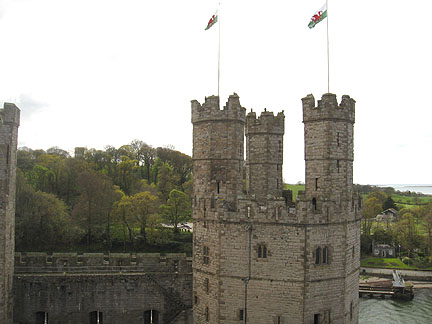
Caernarfon Castle and its town figured prominently during my travels in Wales. The massive 13th century coastal structure, which extends as a castellated town center preserves and presents centuries of history. Caernarfon (pronounced c’NAR’von) is in northwest Wales, facing the Isle of Anglesey, and its harbor is at the confluence of the Menai Straits and the Irish Sea. Bangor is a short bus ride away. When my mother was visiting Caernarfon, the castle was being spruced up for Prince Charles’ investiture as Prince of Wales. On my visits, I saw displays commemorating Queen Elizabeth’s Diamond Jubilee in June of this year. Climbing each of the towers, strolling the small streets, and exploring the medieval buildings and castle walls provided numerous vantage points.


Viewing the harbor from the tops of the castle reminded me of the folk song about this extraordinary and ancient place. Descending from the walls and narrow streets, walking along the docks, and taking pictures, the melody swirled through my impressions. “Llongau Caernarfon” (“The Ships of Caernarfon”), a song I’ve known for many years, is about someone admiring the vessels in port that reach faraway places (such as France and Ireland) and wishing to be able to ship out on one of them, too. I’ve often hummed the tune quietly while aperch on the Maine State Pier, in Portland. Walking along Caernarfon harbor, and glancing up at the castle, reminded me of being “on the other side” of the Atlantic from the ledges of my home on Casco Bay.


Caernarfon and the folk song returned to my thoughts as I prepared to participate in Maine’s first-ever Maker Faire, just a few weeks ago. I had volunteered to help present the large, public event, which went very successfully in a section of a renovated textile mill in Lewiston. The idea is to gather craftspeople and inventors with a spectrum of skills to offer instructional demonstrations and plenty of conversational interaction with all who attend. I taught and modeled calligraphy and bookbinding throughout a very full day- the former throughout the morning, and the latter during the afternoon. Preparation and the day itself demanded a great deal of energy, but indeed the finest reward of all was to see how many people of all ages want to know about these skills. It was a heartening experience for me. The calligraphy class I taught was full, with an overflow group.


The work I do, in both calligraphy and bookbinding, involves creating or restoring materials that ultimately leave my hands. With calligraphy, the inscriptions, certificates, invitations, and cards I’ve made have been by request. As a result, I have just a few examples I can teach with. For the occasion of the Maker Faire, I decided to add to the teaching portfolio of typestyle alphabets and illuminated letters. The Welsh sea song about Caernarfon came to mind, perhaps because I’d so recently been there, and so I chose a stanza to illuminate. I made additional pages, using Latin and French, so that viewers could concentrate more upon the letter forms in the different scripts and colors. In one of the countless serendipitous moments of that day, a Welsh-speaker stopped to compliment the piece.


Journeys that have tapped into all our senses, including personal family histories, along with artistic and spiritual pursuits, amount to multiple layers of enduring impressions. I did not bring back many objects, aside from shells and small stones from some of the places I was privileged to have visited. Now thinking retrospectively about my first sojourn in Wales, what have I brought home with me? Or perhaps I may rephrase it as what returned home with me, in terms of perspectives and ideas. Many songs returned with me, both literally and metaphorically. These combine with images, words, and messages of what is good and grand and ground for my being.


Wednesday, September 19, 2012

writing in wales


“And honoured among wagons I was prince of the apple towns
And once below a time I lordly had the trees and leaves
Trail with daisies and barley
Down the rivers of the windfall light.”


~ Dylan Thomas, Fern Hill


As my recent series of essays attest, sojourning in Wales has been thoroughly enjoyable and profoundly fulfilling. It is a destination I highly recommend, and I hope to return to continue exploring the country in the near future. Over the years, I’ve travelled many thousands of miles, with a number of these trips as a photographer, sometimes as a researcher, yet perpetually on pilgrimage. This time, I set forth as a writer. Choosing to visit Wales had been inspired by a lifetime of my mother’s enchanting recollections. Throughout my time on the north coast, I followed her advice and her footsteps, and inevitably found many directions and connections of my own. Indeed, it was an honor to bring tastes of North Wales back to her, through images, artifacts, and conveyed greetings.


Bangor University


Beyond and among these explorations, it had occurred to me during this recent journey that writing has come to inspire my travels. I found myself creating itineraries around places in which to write and to experience writing. As with visual media, the inner drive to write is greatly affected by physical places and their respective environments. The latter aspect comprises intangible qualities, though recognizable when they are sensed. Every region I visited in Wales encouraged me to continue writing and learning. How do places we visit become inspiring parts of our souls?


Rhossili


Great creative potential can be prompted by place; being from the Maine coast, I’m well aware of this. In my experience, though I may be looking toward trees, mountains, waterways, and skies, my written subjects may well be entirely unrelated. I recall once finding the perfect descriptive words for a silent monastic sojourn, while writing in the swirl of a loud and chaotic Boston train station. Words to describe what I craved most came to me first. Often, the imagery of a writing topic comes in clearly by its absence. Surely, in Wales I did often write directly about the landscapes and streets around me, and the writing- as usual- was never at the exclusion of my thoughts. Sights and imaginings are woven together.


Above: slate path in North Wales;
Below: coal path in South Wales.


Scenery becomes a factor, when it inspires clarity of mind, no matter the topic; the important thing is that writing is encouraged. What the writing concerns is less critical. One could write a parched poem about a dry desert, while on a salt-sprayed deck of a ship. The necessary ingredients are the ideas, words, and the will to assemble them to one’s satisfaction. Gratefully, the Welsh scenery gave me plenty to write about, being in itself a source of wonder.


When thinking of what makes Wales a great writer’s destination, the landscape and the general culture immediately come to mind. A lad from Maine finds assurance in the presence of seashores, highlands, and quiet country roads. I’m also undeterred by changeable weather. If your environment is beautiful, then it’s a beautiful day. Admittedly, precipitation does set some limitations upon outdoor writing. In Wales, I found a culture that cherishes being outside. Going for a walk can mean a stroll across town or a hike across mountains, and both are made very easy with paths and stopping places. All ages go walking; I saw groups walking together and I saw solitary hikers aperch on crags like musing poets. Happy the strolling thinkers who needn’t explain themselves.


A culture that treasures a good fresh-air outdoor walk, along with spirited conversation, amounts to a pleasant social context. Another smiling reminder of life in Maine happened each time I’d stop someplace in Wales long enough for an enjoyable give-and-take chat. I could recognize how conversation is something between a beloved pastime and an art form like, say, sculpture. When people meet and regale one another with insights and anecdotes, a harmonized summation is chiseled, filed, and formed into being. I found many words to record and ponder. Gwyn Thomas, a brilliant author from the coal-mining Rhondda valleys said it well:


“We talked endlessly. That was one way of keeping up our spirits in a universe that did not seem very encouraging. A cracked world and a love of the poets gave us all the spiritual incentive and mechanical facility we needed. If we lacked sixpence for the movies we could always float on a sea of metaphor in a session of high Socratic debate under a lamp-post.”


Coal to warm a writer's space.


Throughout my travels I witnessed how Wales is a country of the word. The words are spoken, written, composed, sung, preached, and preserved- all in two refined languages. As no explanations were needed for a pilgrim seeking holy sites, none were asked for a seeker of beautiful words. I heard countless poetic words and songs, saw them in art works, read them in printed and manuscript forms, and even recited my own words to audiences. Much as the ancient stone built structures, words delineate and fashion ideas into enduring memorials. Among treasured welcomes, living for a week in Dylan Thomas’ home brought me to greater appreciation of this man of words, as denoted by the landmark plaque on the house. His poetry reminds me of the value of sound in the assemblage of words. Sound and meaning directly affect one another.


Above: Dylan borrowing my journal, Swansea.


View from the study toward the back garden, Dylan Thomas' home, with his Imperial Good Companion typewriter.


Yet another feature I found to be favorable for a visiting writer is proximity. In Wales, no place is too far out of reach for travel within a day. As well, public buses and trains reach just about every peninsula and village. As transit itself is conducive to writing, so is the immediacy of contrasting scenery and setting. When depths of historicity and intrigue are so consistently prominent, excursions of any distance are replete with interest. In such a place of word and spirit as Wales, there is much for a writer to remark. The sounds, colors, and places are now part of me, and will all be thankfully held close to heart.


Above: Llandaff Cathedral.
Below: At Dylan Thomas' desk


While on pilgrimage in North Wales, my Olympia Splendid 33 (and I) received a blessing from a priest. He exclaimed, "this is all truly splendid!" The machine now sports the Welsh flag.


In Snowdonia (North Wales).