Showing posts with label Advent. Show all posts

Saturday, January 24, 2026

from here

“A great thing is the soul:
in the soul, the whole world can be delineated.
The human soul is a microcosm of reality,
a microcosm of the macrocosm, an image of the world.”


~ Saint Bonaventure, Hexaemeron 22,24


The proverbial barrier raises yet another notch, as we all step onto the new year’s playing field. In these times, consolation and refuge become more difficult for too many to find. We’re hard put to conjure up our basic needs. Somehow able to hold ground and persevere, I’ve witnessed losses of stability at all hands. And yet- as I hear myself say- I’m here. The daily choice persists, to live compassionately, and to pursue this with every transaction and endeavor. Occasionally, exhaustion can punctuate all the constant hard work, and I stave it off with slices of downtime and a periodical retreat. Scruples and strength must operate in even strength. Last year, having the good fortune of finding and studying two of the final published works by Pope Francis, I was naturally inspired by the idea of a year of intentional pilgrimages. I’ve made these, anyway, over the years, but this time my emphases came from his suggestion to shape my life as an ongoing pilgrim of hope. Being a fulltime worker, I found ways to fit these travels into weekends- some extended with my earned-time-off. All the while, as usual, my studies stitch the days together: during bus commutes, with my thirty-minute lunches (still referred to as “scribbles and nibbles”), and at night. Through the past half-dozen years, I’ve reviewed all the published works of Josemaría Escrivá- indexing and annotating them. These “digests” make for great on-the-go reading, especially while commuting, and for redirecting my thoughts away from detriments that threaten and persist.


At the start of the Advent season last year, I travelled to Mount Saint Mary’s Abbey, in southeast Massachusetts, for a week of healthful respite and reflection. I returned there last month- now a friend of the community- concluding the year which encompassed another half-dozen locations of sacred pilgrimage. In another essay, I’ll enumerate them. For the moment, it suffices to mention the balance that became vital for me to strike between general cultural and employment tensions- countered with prayer in peaceful settings. We all need to survive and progress, persevering intact. In the pursuit of spiritual health and intellectual increase, all for the cause of fulfilling service, in the midst of turmoil I noticed a whiplash effect making it daunting to relax and refocus. Indeed, this isn’t a self-inflicted hardship at all. Much as with my conscious practice of re-directing pre-occupations, I’m better able to identify ideas and ruminations that are best left in roadside trash bins. I’ll even veer away from thinking about what it took to get away from the grind. With the simple gratitude of here I am, subsequent thoughts are returned to the immediate: Look at the view! or- It smells so nice here! Arrivals are made of curiosities and the childlike hopes of open ends. My many years of retreats have all been unstructured, without rigidity or agenda. I always bring reading, writing, and photo materials- along with a small radio. The purpose is unstructured respite. That biblical still, small voice is too often diverted by the shrill and incessant. If there’s one thing (and there are many things) pop culture cannot handle, it’s silence. Even gas station pumps blare audio and sound systems. And thus, there’s some unlearning to do, when arriving at a place of retreat. And that should be the extent of the do-ing.


Naturally, some form of routine can assist long-overdue decompression. Most of us are so ingrained with time that gets scheduled away from ourselves, that finding a way amidst minimal restriction poses its own peculiar conundrum. As it can happen, after plenty of first-day journal entries, by day 3 of my recent sojourn, I noticed myself looking for things to do. But I reminded myself that retreats are essentially in a different “time zone,” including liturgical days in monastic communities- surely dissimilar from the typical day-to-day. Something that deeply impressed me during my early and lengthy stretches at the Weston Priory is how days are as much wrapped around prayer as prayer is wrapped around the days. The adjustment from feeling there is “nothing to do,” becomes the “plenty” of easing into walks, writing, photographing, reading- all at slower paces- enjoying the company of those present, and devotions. Prayers manifest patiently focused and in silence. As well, there is the music of the community’s collective chant.


Before I took to the road, an older and wiser soul told me that “we are not what we think we are,“ but rather, “we are what we think.” This was said in the context of self-awareness and humility. I responded with, “we’re not even our own best judges!” Many of my thoughts en route to my week in Wrentham and since returning included making healthful realignments of obsolete notions- as I find them- in favor of calming and constructive thinking. Thoughts actually do matter. Journal-writing is as much personal documentation as it provides a forum for something of a “dialogue” between thinker and thought. For us writers, journaling is a lot of other things, especially when handwritten. When students ask about the “best way to write,” I always encourage them with, “just write true,” honesty always being the best policy. In doing so, and reading back what I write, there are surely learning processes.


In the spirit of neuroplasticity, I’ve become increasingly attuned to identifying and reckoning with negative and fatalistic thoughts. Adjusting to my circumstances does not mean imitating the toxicities that pervade nearly every sphere within reach. When I write about this in my journal, the idea is to try making sense of what I’m intuiting, witnessing, and absorbing- negotiating with the world and the workplace- all the while persevering in my pursuits of progress. At the heart of the adjusting is my insistence upon aspiration and improvement. Knowing and calibrating to self, situation, and vocation is to keep a balance of both limitations and ambitions in mind. Not compromising high standards, and in words from my profession- best practices, but instead resisting the mediocrity syndrome that too often prevails. Having studied, among other things, the notoriously astonishing Peter Principle in postgrad management theory sensitized me to recognize it in action all too frequently. Why perpetuate avoidable brands of passableness that we ourselves dislike from the barrel-end? How does that serve to inspire stewardship and the souls in our midst? Seeing the brevity of life and its very precariousness, it pains me to squander energy and time. Life is short. On that redirected thought, my navigational choice is to cultivate the mind, along with strengthening and guarding the soul. In his book called Furrow, Escrivá, provides some affirming words in his inimitable style:

We must not remain at the level of the mediocre, refusing to come to terms with mediocrity. We must enter all kinds of environments with a sure step. We’re called to be fully human in our actions, and at the same time reflecting the renewal of eternal things. That is why the apostle has to be a soul who has undergone a long, patient, and heroic process of formation.


A few days after the New Year’s holiday, washing dishes and listening to the radio, I heard the talk show host shift the discussion topic away from the interchangeable subjects known as societal miseries and politics. The affable Dan Rea, of Boston’s WBZ, asked listeners to ponder the prospect of the new year. He invited his audience to divert from editorializing, and to call in with their personal hopes for the coming year. It was easy to imagine Dan leaning into the microphone with his query, “Do you have any plans?” The large listening audience- made exponentially larger by virtue of being a nighttime AM broadcast- got to hear about travels, family reunions, going to ball games, graduating, and about the Tall Ships event in July. Now that’s some forward-looking. Hearing such a diversity of voices chiming in with their positive and lively aspirations was essentially what everyone needed. For all of you, my wish from here is for our hopes to exceed the movements of time.


Tuesday, December 2, 2025

visible invisible

“I have turned around.
I’m walking back to join the choir.
Leaves are flying through the sky.

There’s a hidden life,
there’s a life that no one knows,
there are things that can’t be told.”


~ The Innocence Mission, I Left the Grounds.

Consider the meaning and significance around the idea of the non-monetary kind of credit. Getting the credit, taking the credit, denying the credit. If our memories serve us accurately, we can all remember how this thread plays through all the contexts of our days. It may have begun in the vicinity of a broken vase in a long-ago parental living room, if not in a grade-school classroom. There is credit that we want, and credit we don’t want. We want to be noticed at our best by team captains, teachers, and bosses- and by those we find attractive. But then we wish to be unnoticed by bullies, would-be muggers, and those casting blame- even if it’s justifiable. The attribution of credit, of notice, of credibility, is a great power that looms over our evolving years. Those whom we think own that power begin to look like interchangeable versions of the same few people. The quest for validation is something to be outgrown, despite ways our institutions tend to perpetuate their own versions of reward and blame. This meditation is not about the rights and wrongs of law, ethics, or decorum. Rather, it is about the human mystery that views survival as something between visibility and invisibility.

From childhood, we hunger to be noticed, but we also want to hide. Wishing for glory and credit fuels many a drive in the direction of self-preservation at any cost. Self-distinction may be a primal impulse, and thus one for which an individual must come to terms. But then, when notice comes upon us, we are often unprepared.

In my habit of closing a book or shutting off a media source when the loss of a vital thought seems imminent, one night while driving the roads, I turned off the car radio to save an idea. A radio preacher, whose delivery resembled that of a country auctioneer, asked the rhetorical question; “what would you do if you suddenly got everything you’ve wished for?” I cut him off then and there, because the thought was worth saving. I could predict he was leading up to something about ingratitude or our insatiable material appetites. Aloud in the car, I thought about payed-off student loans, perfect health, and a really good job. Afterwards I imagined walking through such idyllic settings, pinching my own arm in outright incredulity. Then I thought about being noticed. What do we expect- and when we are acknowledged, will we shrink back in disbelief? We long to be known, as much as we long to know. At the same time, wishing is more familiar than seeing a wish come to pass. If this is true, what is really expected? Perhaps the vital acknowledgment has already been made, and if this is so, there is no time to back away.

In the conflict between desiring recognition and anonymity, possessing the one, the other becomes more appealing. Thirsting to capture everything merges with the also very human trait of overwhelm. Imaginations are drawn by mystery and elusiveness, yet discovery can throw us off. Either we are diverted by expectation, or overwhelmed at the challenges of our findings. A nature accustomed to striving wants what it used to have, as well as what it cannot reach- yet rarely what is already accessible. Emergence and disappearance long for one another. Even the ancient Psalmist knew the exuberance of overt rejoicing, as much as the Divine presence as sheltering hiding place. Often, I hope for significance to my days and recognition- at about as many times as solitude, my steps drawn to concealing places that permit me to banish my troubles.


We do need our times of invisibility. An old friend for whom I once worked refers to the the jobs I have as my “tent-making” work. He reminds me of how the Apostle Paul made his living. Our paychecks help provide what we need so we can pursue our passions. I still believe in the juxtaposition of vocation and avocation. Indeed it was Paul of Tarsus who described with astonishing detachment how he observed another disposition in his baser self which waged war against the disposition of his conscience. Coming to terms with the inner conflict of striving with ignominy- while athirst for concealed space- begins by admitting too much of either is damaging. Means and ends mustn’t be confused.

In an understanding of the spectrum of living, knowing to be both abased and abound, the equilibrium of holiness is discovered. The realm of God manifests silently and discretely as grains of ferment that cause the leavening of bread. The Advent is gradual, at times difficult. Invisibility comes into being. But as with the magi, the Divine is perceptible to those who are sensitive to the signs. Yet still, there is little that we mortals can actually hasten.

Perhaps the elusiveness- even the hiddenness- of the sublime attests to the eternal as incorruptible and boundless. The Unseen Companion who briefly appeared to the Emmaus pilgrims, known to Paul as “the image of the invisible God,” taught his listeners to express their prayers in shuttered solitude to the One who knows the innermost heart. In this, invisibility is a necessary precursor to visibility. The tent-maker toiling in a deserted place, as all hard-workers enduring anguished isolation, must see such labors as preparatory ground from which to capably bear the gospel of compassion. Blessed are the overlooked, for they are lovingly recognized by their Creator.


Invisible though apparent, God’s presence is treasured deep within. Earthbound as we are, the cravings remain for the visible and for visibility. While scribing some notes the other day, the newspaper under my journal revealed one of the society pages. Those celebrities of fathomless abundance cannot blend into subways and restaurants as I can. Perhaps they wish they could. Many non-celebrities among us make efforts to be “seen.” A local paper used to poll readers about the “best places to be seen” in this small city with a “scene” of its own. A school friend used to say, “maintaining façades is too much work.” Many of us do wind up deciding what’s necessary and what’s worth our energies and time. And that brings us to consider what is of greatest value to the inherent, invisible self. And in that consideration, reinforcement is found.


Do we ever really know our strengths? It is easy to forget the powers and potential we have. That intrinsic fortitude is often threatened by what a lot of us have had to endure en route to and through adulthood. We brave through exclusions, judgments, and threats long before we can ascribe clear and forceful words to our attempted refutations. But indeed those who survive must never forget their voiceless crucible times. Today is for potentials to unfold, even if portions will remain invisible.


Now a reckoning. Conflicts may be identified and explored, but without some resolve, the terms remain barely more than if they stayed unspoken. Recording a life as it develops, my thoughts begin by taking stock in the learning experiences, being able to apply some retrospect while looking ahead. Come to think of it, the idea of blogging a personal journal is in itself a paradox of seen and unseen. Definitions of “visibility” evolve away from preoccupations with crowds and myself. I see the extremes a bit more reconciled, more content to stand apart from self. Part of that unification is in reckoning with the value of both recognition and retreat, along with a realization that reward is less and less a driving force. Outdated self-views become stale and burdensome. Possessions I no longer use are only good to give away or throw out, resembling old, recurrent, and outgrown frustrations. As with perspectives, tastes evolve. Back in high school, my father once told me that tastes change as we get older, “you’ll see,” he said; we start craving more salted and bitter things than sugary sweets. It’s a great metaphor, but he was comparing an adult’s beer with a child’s strawberry soda. Indeed, I see, as I often relish obscurity. But I innately know that I’ve also been very gradually called forth out of that obscurity. Venturing to predict the future’s details would not be worth the trouble. There are things that can’t be told. It seems wiser to temper the striving against prohibitive currents, and gratefully engage the settings I’ve got to work with- however modest the results. The hidden life takes root, and living roots are rarely visible at the surface.


Thursday, December 14, 2023

domine, ut videam

“When darkness falls; when nighttime is at its deepest,
and day seems far away; whenever we seem caught and blinded
by the powers and principalities of this present darkness,
there’s only one thing to do.
Turn on the light.

Many have said it across the years, in philosophy and stories,
in words of wisdom and song, and yet we are so quick to forget.
But there is a simple solution to the darkness of a room
in the middle of the night, of mind and heart,
of civilization and society. Reach for the flashlight,
for the word of hope, for the prayer.
Open the door to light, to grace, and to glory;
invite in the Light of the World, and allow that light
to chase away the shadows of nighttime fears.
Turn on the light.”


~ Carrie Gress, A Litany of Light


The paragraphs quoted above are reproduced with Dr. Gress’ permission; her text was given to me last April at the National Shrine of the Divine Mercy, when I spent a week there. That was my last significant time off from work. Such respite has not been possible since. Stresses and excessive fatigue have intensified my already longstanding insomnia. Not an easy topic, and I’ve been resisting any sort of permanency for a condition that must not last; just like a miserable housing situation. Let hardship generate needed motivation to transcend. Typical insomniac nights are restless. Imagine being at the conclusion of full and arduous workdays, yet unable to fall asleep- or remain asleep. None of the usual tactics help- from shutting down the lit screen early in the evening, to routines for bringing the day in for a landing, to reflective reading. I’ve always been told to walk around and have a glass of water, instead of tossing-and-turning in place. That doesn’t work, either. Listening to the radio is another repeatedly bad measure. The cast of culprits includes employment, housing, worries, regrets, frustrations, and other various obstacles. In this context, the Litany of Light I’ve quoted here offers a discipline to stem these daunting tides. “Turn on the light” is occasionally literal- so that I can write something down- and is more often metaphorical. As well, the discipline is not rigorous, but in forms of gentle reminders. Gentleness is surely not something experienced in daily life, not even in the boorishly cacophonous apartment building. Forms of gentleness worth my practicing include chaplets, prayers, and turning the light on- either by redirecting thoughts or by flashlight. This is to survive to see better days, and ahead of that to being open to seeing better. The biblical Bartimaeus miraculously received his sight by praying, Domine, ut videam, which means O God, help me to see!

The present state of my self-discipline is to refrain from fixating my sights far beyond the immediate. There is nothing easy about this, especially after pulling my own weight- and then some- for many, many vigilant years. But in rescinding my grasp, in modest increments, it becomes easier to sense the guiding consolations of saints and angels. It is essential for me to stay the course of good conscience, smart work, and responsibility- even though I’ve yet to see favorable results. I know enough not to expect favors, and I remember very well how my father would encourage me to keep at it: he’d say “Keep on stepping up and swinging the bat for the fences!” My wakeful and repeatedly fractured nights are riddled with reminders of how badly all my efforts are going, and I understand enough to consider my circumstances as an engulfing trial of as-yet-unknown duration. What I do know is the immediate, and the next right thing is what needs my attention; there’s nothing nebulous about that. Continuing to productively work is paralleled by continuing to network and search for better. Anguish serves to generate ambition.

Finding light in the darkness is a constant pursuit, yet paradoxically thinking about that very pursuit itself winds up helping me get back to sleep. I recently remembered something I’d do while on cherished travels such as pilgrimages: at the close of the day, I’d fall asleep while recalling the good things I experienced. With eyes closed, lying back, my thoughts would effortlessly return to the day’s scenery, people, sounds, tastes, and ideas. A grateful review of the day. Now under twin yokes of work duress and miserable housing, I try closing the day and gratefully asking, “what did I like today? What went well?” The temporary apartment is cramped, oppressive, and often invasively loud. When I’m wakefully clambering to look out from the windows, using a small flashlight to help me squeeze my way to pouring a glass of water during the midnight hours, I always notice the rare quiet. Working two careers that required the sharpest, clearest photo images, I marvel at the dusky, grainy, grey light of the hours long before dawn. My ache for better days and situations keeps me ambitiously working, and also keeps me awake at night.


During a recent sojourn at the Boston Athenaeum, I studied the 17th century text, Tender Counsel and Advice by way of Epistle, by pioneering Quaker William Penn. As always during my prized study days in the manuscripts room, I made numerous notes for my later reading. Providing his tender counsel, applying the Quaker emphasis to mind the Light, Penn bids the reader to walk in the holy Light of Christ, and thereby be preserved through all trials and difficulties on earthly life’s pilgrimage:

“For even Jesus was tempted and tried, and is therefore become our Captain, because he overcame. Neither be ye cast down, because the Lord sometimes seemeth to hide his Face from you, that you feel not always that Joy and Refreshment, that you sometimes enjoy. I know what work the Enemy maketh of these Withdrawings of the Lord. Perhaps he will insinuate, that God hath deserted you in his displeasure, that you must never expect to see him, that he will never come again: And by these and the like strategems, he will endeavour to shake your faith and hope, and distract you with fear, and to beget great jealousies and doubts in you; and by impatience and infidelity, frustrate your good beginnings.”


Reaching for light, along with recollecting positive experiences, help to uphold a sense of wonder to be able to look forward. As much as it runs against the grain of desolation, it is all the more essential to force the effort to stay hopeful. Trading consolations one morning with a colleague that is also a good friend, we compared how we wryly express our perseverance. In a comedic gruffness, looking up from a computer, my friend said, “I’m happy, dammit!” I replied with my sarcastic equalizer, “I’m being positive ‘til it kills me!” Even amidst austerity, there’s room for some kind of humor. Sarcasm, however, can detrimentally ingrain itself into one’s every perspective. I described catching and adjusting my own propensities as being similar to a car with misaligned wheels. With some focused consideration, I’ll steer my thoughts forward, preventing myself from swerving off the road. Balance and luminosity need one another, and all the more in dark and unmarked valleys. “For with you is the fountain of life,” wrote King David in the 36th Psalm; “In Your light we shall see light.” Philosophizing about the verse in the 5th century, Saint Augustine observed, “we are, and understand, because of divine illumination.” Have I got enough of this light of understanding, and do I obstruct the headlamps of guidance? As the matter of the heart is the heart of the matter, I try holding up my end of things with all I can provide. Sure, there’s grace, but typically it’s been costlier for me than it’s seemed to be for most everyone I know. Whether or not that’s true, with contrast being the mother of clarity, it honestly looks that way to me. Leaving such notions aside, and now insistently swerving away from them, the road ahead must include surrendering the failings and the incorrigibles. Living an ascended, resurrected life is needed for new beginnings. Let the way upward be lit by aspiration and gratitude.


Friday, December 23, 2022

unseen visible

“Blessed is that nothingness,
and blessed the secret depths of the heart
that possess everything. It desires to have nothing for itself,
casting away all cares so that it may burn more brightly
with compassion.
Live in faith and hope even though you are in darkness,
for in this darkness God enfolds the soul.”


~ San Juan de la Cruz, Letters XV, XX


1

It has now been four months since my displacement from the sold apartment building within which I had my home of many years. Though each day slogs across quagmires of unease, the work weeks capably string together larger parcels of time. Responsibilities along with demands connected to semblances of normal life force an equilibrium to meet each day. Adaptation, in this case, does not mean enjoyment. If anything, the whiplash effect of diminished conditions has sharpened my senses in pursuit of better living space- of a real home. Perceptions have also sharpened in the direction of transcendence. With merely my thoughts to shelter, while freezing beneath the elements at bus stops, I often gaze skyward. The expanse of distance strikes a contrast against the oppressive apartment which is transitional at best. I also read during my waiting, choosing anthologies portable enough for the transitory. So as not to endanger my rations of inspirational words, I’ve cultivated a knack for page-turning with winter gloves. Routines, in their varied forms, are necessary for many of us to accomplish things in sequential order, such as being prepared for the day’s demands. But memory devices must last only as long as they’re needed, until improvements change relevance. Recently while gazing up at the night sky, from the pavement at the corner of Congress Street and Exchange Street, I considered how we all adapt to survive. After some time and trial, the temporal status quo begins masquerading as a foundation; it’s a temptation for which I refuse to fall. All that I found constricting and objectionable four months ago is no less now. The most solid foundation during a provisional situation is that of the spirit, standing unadorned on frozen streetcorners. The Author and Perfecter of my faith will lead me to better and healthful conditions. When housing and daily life humiliate, the fires of ambition can only burn hotter.


2

Beneath the temptation of acquiescence to an objectionable status quo is the notion that efforts at improvement are worthless and in vain. They are not, no matter how high the defeats stack up. Good and intelligent efforts must amount to positive results. What does keep me guessing is whether intensity and thoroughness meet their reciprocal forms of fruition. I’ve had to painfully learn that hard work is far from the recipe for success I’d been led to believe. Following that was being told that “working smart” needed to go with “working hard.” Granted, efficiency is a cultivated craft, and true to self I’ve mastered every methodology I’ve taken on. Though my results have amounted to numerous completed projects, what might be tangibly considered success remains elusive. Also dauntingly elusive is assurance. By this, I refer to a strongly assuring sense of validation that I’m on the right track. Where is the open door? Where is the welcoming place? Where and when may I unpack boxes that have been sealed since last spring? Liberation from the oppressive little hovel and the overhead circus cannot happen soon enough. Things are not looking good, although faith insists there will be open doors and a good future. I’m putting in my honest eight hours every weekday and I’m paying all my bills. The Advent season is about preparing the way, awaiting with expectant hope for the road to finally crest. Exhaustion, frequently made into a badge of accomplishment and survival, is more than anything a manifestation of overwork. Perhaps my efforts needn’t be overdone, and maybe success can happen on less-severe levels of outpouring. It is my nature to strive to make the best impression in all situations, but contemplative wisdom asserts how the most communicative language is silent affection.


3

With Saint Bonaventure, I’ll cultivate reason upon the foundation of belief. At the same time, I’ll echo the unabashed Psalmist whose very depths called to the deeps of everlasting. A withdrawal of the Consoler’s presence challenges that aforementioned stabilizing foundation. As any of the best of us, the anguished Psalmist incredulously cries, “why am I forgotten?” He needs an assuring spring of water for the desert of his life. Nicknamed the weeping prophet, Jeremiah persevered and cultivated through deprivation and even exile. But he held against desolation, clutching the message, “if you seek Me wholeheartedly, I will be found by you.” The imperative in this testing is to believe without seeing. In this case, there are no reciprocal proportions: in order to see, there must be complete belief.

But divine mercy is invisible and cannot be grasped. And the more persistently out-of-view, the more critical it is to press forward. This is neither passive, nor for the weak-hearted, because visualizing the unseen requires reveling in the lacking. Grace and mercy may yet be present to us, without our knowing. Mysteriously, these things are absent right up until the moment of discovery, yet we are called before we can know to reach. I’m reminded of instances during which I’m looking for an object I had set down moments before, such as on my workbench while binding books. A frequent culprit is a transparent measuring triangle. In its pursuit, I’ll say, “it’s in front of me, but I can’t see it.” My eyes scan the work surface and my hands palm the tabletop, while trying to recall when I last saw it. Eventually, I find these kinds of objects, at times in exasperation. Too often, the certain is not apparent.


4

Reveling while lacking is followed by yet another notch for the raised bar, and that’s an honest gratitude amidst hardships. Thankfulness while wishing for leisure, favor, and fortune. The present moment requires my meditation upon divine mercy. These alienating trials of unknown duration demand the confidence Saint Augustine had when he said:

“All my hope lies solely in Your great mercy. Solely in that, Lord. On Your mercy rests all my hope. Not my merits, but on Your mercy.”


My ancient namesake not only embraced an unseen promise, Abraham had only perceptive faith to sustain and light his way to the end of his complex life: “By faith he dwelt in the land of promise as in a foreign country, dwelling in tents...” His very, very distant descendant in Sephardic Spain, San Juan de la Cruz, taught and wrote about embracing the nothingness that holds everything. Sounding like our common ancestor, Fray Juan’s The Ascent of Mount Carmel includes the enjoinder, “hope in detachment and emptiness. The good that you desire will find you before too long.” He went so far as to discipline his temperament to renounce seeking consolations. Such depletion becomes a clear slate- a lens cleaner for the heavenward gaze. Frozen and overcast night skies conceal brightness yet to be revealed. Grace is at hand, without seeing or otherwise sensing its imminence.


This year has been an extremely difficult year which followed one of loss and sadness. I can merely manage as possible, within very tight limitations. While flailing to rectify a regrettable relocation by scouring for something better, admittedly the biggest mistakes are the ones not learned from. The recent move was surely under duress with few choices, but it stands out as a terrible mistake. Needless to say, the painful learning experience continues, and I know much more about what to really avoid. Yet another temptation is that of setting up shop in the wheelrutted inventories of my failings. An old reflex of mine is to turn away from distasteful things- things that are gaudy, unappealing, cruel, dissonant, and unwelcoming. I’ve always turned my camera toward eloquent simplicity and compelling motifs that inspire. That newer reflex I’ve noticed, looking to skies and horizons, counteracting my confinements, is the pull of contemplating the transcendent. This has been my closest way of looking toward home and being enfolded by hope.

Thursday, December 30, 2021

newness

“Even so, we also should walk in newness of life.”
~ Romans 6:4


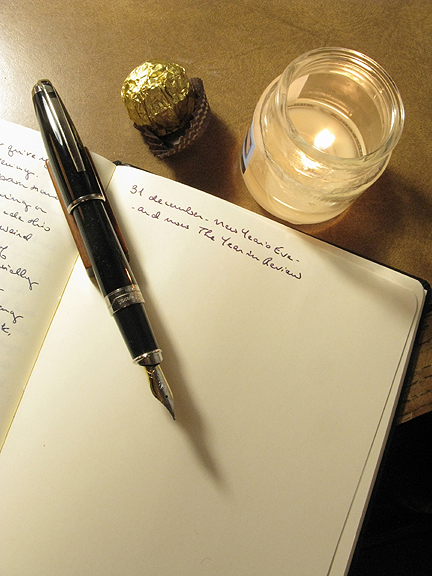
My voyage with journaling began in July 1994. Later on, graduate school caused my written entries to be regrettably intermittent. After 2000 I came to depend upon daily documentation and reflection, and the practice continues to this day. Throughout my years of writing, I’ve used the days leading up to New Year’s Eve to create retrospective “year in review” summaries. At first, I made the lengthy journal entries into Time Magazine- style features, as in “the year that was.” After a few years, these summaries became something I fashioned into several days of shorter journal entries, giving equal treatment both to events and to impressions. Without writing, telling the months and years apart would be even more difficult and surely blurred. The covid era surely represents this. It’s a snowball of largely dissimilar months, whose grip set in by the Ides of March 2020. Since then, living has been amidst minefields and restrictions. Thinking back to the world before that date, I remind myself that “everything was at least two years ago.” In keeping with my own custom, I’ve begun gathering my handwritten thoughts to recap the year which- if anything- feels as though it’s in Month 23. It is indeed a looking back, but always attempts at forward motion- traction or not.


The contrast is appropriate, connecting the establishing of winter and long nights with a season traditionally marked by newness. The Christmas holiday season has also long been relentlessly exploited commercially, with advertising beginning many weeks before Advent. Pandemic life has muted some of the competitive spending drives, forcing diminished budgets and smaller gatherings- if any. Yet the week between the western/Gregorian calendar Christmas and New Year’s Day continues to be a liminal span for various forms of reflection. The plague rages on. Will the coming year be an improvement over the one just past? How to look forward with anticipatory hope, in the bleak midwinter?

My self-determined directive is to continue seeking light in the darkness of these times, while trying to tangibly exemplify that light. For nearly two years, it has been impossible to travel or to even buy some weekdays off to rejuvenate. My semiannual pilgrimage retreats of many, many years have had to be compressed into a few occasional hours during a weekend so that I can continue being gainfully employed. Pushing back for the cause of spiritual health has also stretched nights into times of carved-out silence and study. Not doing this actually worsens the exhaustion. Admittedly, this is a trial that must be endured.


Newness begins with a thirst for promise, even for the haggard and worn. One recent midnight while preparing for the subsequent reveille that would return me to the same darkness, I methodically set up my coffeemaker and what I’d need to make next day’s entry as effortless as possible. Thinking of the combination of obligations and wishes while tidying my writing table, I remembered how an old friend used to call himself “a kid on Christmas morning,” and how that attitude helped him stay inspired. I wouldn’t describe myself as such, but there was something I liked about that sentiment. A soul’s renewal is as much a mystery as is the desire for newness. Do we inherently sense the hope of renewal? It is a fascinating thought how we seem to naturally find our own renewal- or at least the will to seek out our rejuvenation. Is this somehow built into our nature? I think we reflexively salvage the pieces we can find of our existence. The recent devastating natural disasters remind us of this. Victims who escape with their lives are looking for remnants from their households, their histories, and where their continua left off- at the times when their worlds were interrupted so they can recommence. In the less-cataclysmic scenarios, there somehow exists a natural drive to pick up and continue on. I believe this to be more than survival instinct, but the reinforcement of the holy spirit of new life. While more than enough reasons can be enumerated to give up hope, wondering about what is actually improving in our midst, we still tend to resume our searches for better and more meaningful lives.


During this year’s holiday season, I’ve noticed myself bristling more than usual at overused Christmas songs. They brought neither comfort nor joy, even to this believer. I fled to the consolations of Telemann, Bach, and how the occasion is quietly known as the feast of the incarnation. Yes, indeed, there is the commemoration of the Nativity. Not to be lost is the parallel aspect and infusion of the Divine within all whose lives return the embrace. Incarnation manifests to an ordinary human as transformation, and the latter builds an inner strength to be grateful while bearing up against hardship. Enduring the plagues in late 14th century Holland, Gerard Groote wrote, “May it never be that tribulation produce in us a faint heart; a faint heart, confusion; and confusion, the desperation that destroys.” Ancient texts accompanying this season include the name Immanuel, which in Hebrew means God is with us. Over the years, I’ve come to reverently refer to the So Near. As I’ve learned from the monks of Weston Priory whose doxology is to the Creator, Word, and Spirit of New Life, I understand the value of finding meaning beyond overused expressions.


The current provisional journey is embedded within an incalculable pilgrimage. Trying to take stock of the good that is, of the silent graces too easily overlooked, I try to be attuned to available inspiration. What is within my reach? What don’t I know that I need to know? Are we to search for newness, or enable renewal to find us? I wonder to what extent the spirit of rekindling is based upon unseen certitudes of which we could be innately aware. Perhaps there is a balance of proportion between a person’s determination, and a providence over which there is no control. And within that sense of resoluteness, does it begin with one’s desire to give rise to renewal, or are we brought to think about it from beyond ourselves? Do I procure the lamp and illuminate it, or is the already burning light catching my attention first? Unsure of what to make of the broader ailing world, as well as my own daunting setbacks, my thoughts turn to how all of this is about endurance. The transitory present is an impermanent trial. Distances and times between now and turns in my fortunes are impossible to tell. Opportunities remain out of reach, but hope remains available. Hopefulness increases the will to endure. When St. Paul wrote about how “hope maketh not ashamed,” he wanted his readers to confidently animate conscientious faith. Newness must ever be kept in mind. And kept in mind and practice with unwavering insistence.


Friday, December 17, 2021

perilous journeys

“Trusting faith is called a crystal well
because the waters of spiritual goodness flow
from it to the soul, although it is night.”


~ San Juan de la Cruz, The Spritual Canticle


advent wilderness

Generally speaking, we embark upon an adventure with expectations of resolve. We’ll invest in the engagement of a challenge, intending success. For the most part, one takes on a project with the idea of completion in mind. Beginnings are hopes exemplified. Our cultural experiences are replete with stories, novels, and films that travel an arc from launch through hardship and on to cathartic conclusion. Many dramatic biographies work as such. When I take on projects and pursuits, every provision and effort point toward thorough and sturdy completion. Some enterprises require more time than others; duration cannot always be ascertained at the start. But the important thing is to make progress, move in a forward direction, and maintain faith in the vision of fulfillment. Occasionally, courses of action need to be adjusted, informed by instinct and memory. I’ve often heard myself say within, “no- don’t do that again,” or “a version of this has worked well before.” I’ll work out dilemmas in my journal, like puzzles, allowing the written words to reflect back at me for some analysis.


But what happens when the craft is blown off course and both direction and destination become uncertain? Has forward motion been reduced to the plain progression of time? Do there remain chances to safely stop and recalibrate? How critical is the element of time? During this Advent season, amidst the second calendar round of the covid era, the end of the pandemic is out of view. The annual December weeks, commemorating movement through darkness toward light and nativity, historically direct observers to promise and assurance- and this continuum has persevered through millenia of plagues and wars. Upon my own trail of healthful contemplation, following the texts of the divine hours, these times bring me to notice a precariousness revolving around the signs of presence. The ancient readings describe the Advent voyage as being through a desert, even a howling wilderness. One very early pitch-black morning, with breviary and coffee, I noticed the prayer, “Watch over our welfare on this perilous journey, and keep our lives free of evil until the end.” The words “perilous journey” stayed with me throughout the day. Being a seasonal reading, I know I’ve read this before- but I notice it now.


Navigating through a sleet-spattered windshield yesterday, the phrase returned to me, recognizing the indefinite present as a protracted series of perilous journeys. The way forward is my best rendition of forward motion. Logistics have prevented me from taking respite time for two years and counting, confining reflection to the watches of night and an occasional weekend day. But I am holding course to the best of my abilities and resources. As usual for me, though appreciating the context of Advent season, I continue to be ceaselessly fascinated by the mysterious Magi. The written record leads to the Nativity, but the westward-voyaging astronomers disappear from the documentation. I’ve written about these three unusual yet anonymous individuals before, referring to them as the outside consultants, considering how they had been pressed by the court of Herod. The Magi may well have been diverted from their course, yet they knew enough of their senses of direction to keep on going. They most likely consulted with one another, determining not only what they would deliver to the place of the Nativity, but also that they would subsequently and compassionately slip away without reporting to Herod. And back into the unknown they went, keeping all of us wondering through all the centuries since then. They took their shared experiences with them, perhaps recounting the adventures to others in locations unknown to any documentation. Searching for assurance and advocacy is undoubtedly humbling, no matter how much experience one may have. The status of this perilous journey remains uncertain. My way of pushing back against the current of misery is by proceeding straight through the unknowing.


perspective


Navigating productively and healthfully requires both a sharp focus and a conscious sense of distraction, as I’ve been finding. This type of discipline balances proactive thinking with an ability to defensively drive away from fear-feeding stimuli. Choosing in favor of one is often a choosing away from the other. My longstanding curiosity about current events news has had to be tempered into much smaller, nontelevised doses; being informed needn’t mean overdosing. Listening to the car radio the other day, I noticed the patchwork of staccato reporting bounce between traffic updates and the worldwide scrambling for cures. The pandemic has surely intensified the already tough juggle for perspective. My long-usual preset bouncing away from news to music is now more frequently a turning-off of the sound system altogether.

For decades, I’ve made my livelihood using all sorts of computer technology and applications. Being a cradle visual artist, I’ve always kept a metaphorical ten-foot pole between myself and what I’ve long called “lit screens.” Nowadays this may look like a demonstration of creative independence and privacy, but actually keeping that safe distance is part of how I can maintain my footing in a reality whose vital means include handwritten media, real books, the outdoors, and personal interactions. As with a great many, the recent couple of years have forced me into living and working through lit screens. During the intensity and constancy of having to do this at the outset of the pandemic, I noticed how the pain of eyestrain would last far into the nights. I had to acclimate to the absorption of numerous consecutive hours online. Another vivid memory from the sudden quarantining of spring 2020 was my struggle with sedentary life and habitually looking out the windows for signs of life.

As tempting as it is to use the lit screens more as ends than means, especially in these alienating times, I’ve learned to be all the more selective and contextual. When browsing becomes a game of caroming between shrill news coverage and the enviably fortunate lives portrayed on social media, that’s when I turn off the lit screen. Imagine pinging and ponging from fearsome news to unattainable careers, back and forth; such joyful scenarios for thoughts to dwell upon! As a remedy, I’ve trained myself to look up from the lit screen, as I tell myself. Look up and around, even if means noticing dusty surfaces on the furniture. Looking up is a way to make note of your context- of where you are. It’s the equivalent of twisting that zoom lens back into a wide-angle, and try to get a bigger picture of the immediate. Looking up from a digital terminal is an indoor and admittedly modest version of being able to get outdoors to see horizons.
<


Perilous journeys cause us to cherish understated treasures we used to overlook. In this thinking, memory and hope converge. Remembrance helps us to look forward, while contending with present perils. While fine-tuning ways of waving off negatively distracting encroachments, I’m also deliberately creating distractions to send my thoughts into more positive directions. In yet another ancient text used for Advent, Saint Cyprian encouraged readers to “endure and persevere, if we are to be perfected in what we have begun to be, and if we are to receive from God what we hope for and believe.” He added that our acts of compassion must be united with patience and perseverance. “Do not grow weary, or be distracted, or be overwhelmed by the temptation to give up in the midst of the patient pilgrimage of life.” Endurance must be carried through to nothing short of the end.


staying sane


Eclipsed by the obvious urgency of fatalities in the millions, medical and economic crises, the mental toll of the pandemic is yet to be fully known. The latter is profoundly felt by many. I know this, albeit writing from my ledge on this planet, soldiering on in my employment. As with following health news, it has become impossible not to notice articles posted and published daily about the commonly-known Great Resignation. Also referred to at The Big Quit, workers have been leaving their jobs during the pandemic at rate unequaled by any previous U.S. Department of Labor statistics. In August 2021, 3% of the workforce resigned their jobs. 55% said they were job hunting. Adding yet another revealing statistic, 20% of the global workforce say they are “actively engaged” in their employment. This means eight out of ten workers say they are disengaged, for any of many reasons, amounting to a massive reaction to lingering exploitation. All the surveying and tabulating were evidently prompted by trends that are most likely nothing new, but surely accelerated by an overspreading societal malaise due to the pandemic.

Amidst the currents of these times is a popular realization about mortality. Life is short. We can’t be certain of how much time we have left to be able to inspire others, let alone to be able to accomplish our procrastinated wishes. The same employers that have been calling their workers “expendable” have begun to appear rather expendable themselves. Hence the unprecedented numbers of resigning workers who have not lined up subsequent jobs. Income and physical safety are often at odds. How will they pay their bills? It’s bewildering to watch, but entirely understandable. The weary world aches for the plagues and social conflicts to end. Few have the luxury of respite. Apparently, we are to soldier on, collecting our shots as we trek the contagion minefields. Survival always needs a purpose, and in this case I still envision being able to look back upon these present times whenever that critical corner is turned. Seeking signs of improvement runs parallel to the search for better opportunities. Perseverance and vigilance cannot be permitted to be ground down by fatigue. Meanwhile, redeeming the time between obligations, I continue finding consolations while studying philosophical works from the early-Renaissance era. Groote’s motivating words from the 14th century remind me that trials are proving-grounds. His students heard this while they struggled for equilibrium in the howling wilderness of the plague in late-medieval Holland.


Now having to launch again into the murky waters ahead, the need to continue being propelled from within constantly intensifies. Writing materials that include blank books for subsequent thoughts, along with my filled rapiaria volumes of collected wisdom, serve to hold course. The lights of my studies have led to gratitude throughout these recent two years of hardship. In the persisting face of unrelenting futility, my better reaction is to return to the words of Saint Cyprian which I quoted above, about not being tempted into losing hope. Trusting faith asserts that what is immediately visible is neither all there is, nor all there will be. Even the Magi continue to remind us about envisioning beyond the present. But upon the current, the ground of momentary being, San Juan de la Cruz always pointed to the wellspring of Spirit. Somehow he was able to instill and reinforce this awareness within himself during his wrongful incarceration. Before, through, and in his post-captivity life, San Juan poetically emphasized union with God as the purpose for survival through all times and trials. In his jail cell, he scribbled words on a sliver of paper begged from one of the guards; the scrawled notes became his Dark Night of the Soul, which he completed after his escape and remains in print to this day, nearly 450 years later. In the thick of what was supposed to be a death sentence, he discovered what he later called “the delight of contemplation and union with God,” finding “guidance in the night of faith.” The immersion he described demands that the soul must proceed by unknowing to unify with Divine wisdom. Surely speaking from indelibly physical and as well as spiritual experience, San Juan de la Cruz added, in The Ascent of Mount Carmel, that the soul has to...

“...proceed rather by unknowing than by knowing; and all the dominion and liberty of the world, compared with the liberty and dominion of the Spirit of God, is the most abject slavery, affliction and captivity.”


Monday, December 30, 2019

expectation


"My library is an archive of longings.”

~ Susan Sontag, As Consciousness is Harnessed to Flesh: Journals and Notebooks, 1964-1980.

At the beginning of this month, perhaps to parallel the start of winter, a number of wire news services published an article* about disruptive discontent. A study based upon the responses of two thousand survey participants reported that nearly three-quarters of this group sleep poorly and awaken unhappily. Referring to “morning madness” and a general sense of irritation among respondents, a third of the surveyed group cited anxiety and stress disturbing both sleep and awakening. Indeed, the article caught my attention, as I’ve been an insomnia combatant for over a dozen years. Had I been surveyed, my responses would’ve looked similar to those of the article. Having become so accustomed to fractured nights of semi-sleep, portions of these silent hours are offset by journal writing, radio listening, and reading. Penciling ideas on notepads. Not necessarily solutions, but accompaniment.


So many thoughts to assuage. The canvasses elasticize between present, past, and the unknown future, projects and words, stability in the tentative, should’ve and could’ve, then and when. Just what a mind needs to relax! Walking around my darkened apartment, the clatter silences as I look at the books and papers on my desk- the open satchel at ease. The still-life calms, as my thoughts are diverted by the quieted tethers and tools. What is normally animate has become inanimate. There is scant ambient light and no traffic noise, in the liminal between night and morning.


Through the window, it is good to see the nearly motionless outside world. Thoughts turn to expectations. Do you ask yourself about what you’re expecting? I’ve always expected great things: dreams, fruition, breakthroughs, open doors. From as far back as I can remember, I’ve wished to live up to my potential, putting all I’ve learned to real use. It’s a longlived emotion that has haunted me all through the years of schooling and employment, toiling in the concealment of stockrooms, basements, warehouses, darkrooms, and clenched stacks. Beyond thirsting for natural light, fresh air, and artistic freedom is a wish for opportunities to fully apply my skills for the greater purpose that other souls can be inspired. Hopes, attempts, and denials seem to repeat a leapfrog-playing pattern. But there remains the not-yet, a spirit solid enough to support ideals and ambitions. Even now.


In Citadelle, Antoine de Saint-Exupéry observed, “Nothing have you to hope for if yours is the misfortune of being blind to that light which emanates not from things but from the meaning of things.” How things look and how things are- can be at contrasting ends. Blended in with clear-eyed expectations is an accompanying awareness of mirages. It is very easy to be fooled, a narrow margin dividing notions and facts. Social media certainly enhances the challenge to make these distinctions. About the first ten times I’d seen commercial articles, decorated with tropical seascapes, about “following your bliss,” my reactions were those of sarcastically looking on as an outsider and an unlucky have-not. These sorts of proliferating short pieces look like they emanate from people who can afford to blithely walk away from disappointing jobs. What about the rest of us that have to bite the metaphorical bullet? From a perspective that resists both cynicism and irresponsibility, I try to keep common sense in mind. Comprehension and aspiration are both highly complex dynamics. Turning away from self-defeat, and reaching for transcendence, Quaker author Rufus Jones wrote:

Every case of sense-perception is a case of self-transcendence. If we could not leap forward and grasp an object from beyond us, and know it as beyond us, all our experience would be doomed to be shut up in an inner subjective mirage. We could never have dealings and commerce with a real world beyond our inward seemings. We should forever remain victims of the ‘egocentric predicament.’ In a trembling flash, when we perceive things, we manage to leap beyond ourselves and know a reality that is not of us, but of a world beyond us. Nobody knows how we do it. It is another mystery- like sweetness and redness- but it is none the less a fact. The moment we know anything whatsoever we prove to be self-transcendent beings.
(Pathways to the Reality of God)


Another conundrum is the relationship between potential and fortune. Is one needed for the other? Can they exist independently of one another? I’m inclined to believe the latter: potential can be driven on the steel wheels of will. Good fortune is welcome, we can do plenty to draw it, but waiting around too long wastes precious time. Everyone has the potential to add positive significance to their places and times- perhaps beyond these contexts. I’ve always admired “unsung heroes” as I’ve made note of them in many spheres. They’re the ones who are consistently present, performing their good works away from spotlights and newsfeeds- or as it’s said in sports: doing the little things that contribute and make a difference. At hockey games, I like watching what’s going on at the defensive end- where the puck isn’t; this teaches me a lot about how the players work together in the flow of regulation time. I admire the ability of turning missed opportunities into fuel, and instances of tireless daring in order to realize potential.


At this season, the month of Advent leads to the threshold of a new year. Lighting is needed earlier in the day. The anticipation in Advent’s shadowed steps is essentially an expectation. I still expect great things- even in the night watches of wakeful insomnia. The turn toward lengthened days begins during the longest nights. Years ago, when I made my living in the complete darkness of color-printing photo studios, I had a wise, older friend who managed the film department. A true artisan. To this day, I’m thankful for all our long talks in the damp, lightless film-developing room. From twenty feet away, with the benefit of the slight echo, his voice sounded three feet away. Above the sounds of the E-6 processor, he would say, “Don’t forget that God’s hand is always opening to you, always opening for you. You’re meant for way better than this.” My coworker had a terminal illness and passed away, much too young. His words and wit live on with me. They are filed with care, in my spiritual archives, with the treasures poised for future use. The past, admittedly, needn’t determine the future, but it can provide a useful repository of references. I fully expect to tap into the best of all that has been cultivated. It would be, in itself, a living gratitude for the gifts received and knowledge retained. More than an expectation, a goal.


*Article here.


Sunday, January 1, 2017

inclinate aurem vestram


“Preserve the watch, make way for the glorious operations of the Spirit.”

~ Richard Phillips (Quaker, 18th c.), On Watchfulness and Silence.


On a recent raw-cold morning, while paying for the day’s newspaper, the cashier said to me, “stay in a while and warm up; it’s a frozen wasteland out there.” Pocketing my change and bunching up my gloves with the folded paper, I repeated, “frozen wasteland? It’s not that bad.” From there, I heard more about how forbidding the way to work had been, and how this is just the beginning of a helplessly interminable winter. In short, I was reminded to brace myself. It’s easy to understand this view of the world, and even easier to be governed by it. Building upon a chassis of apprehension is as tempting as it is stifling. Bad news is abundant and free for the taking; a dish of victuals that never empties. Problems are more visible than solutions. Focus naturally fixes itself on the foreground. Somehow, I’m slow to be swayed by these offerings; still instinctively straining forward. Insistently, somehow, always with ear and eye inclined to listen and read for wisdom.


The pursuing love of wisdom is known as philosophia. Bernard of Chartres (12th c.) described wisdom as “the comprehension of the truth of things as they are.” If any things are to be gained in this pursuit, they may be clarity of thought and perception, along with some degree of peace of mind. This quest is a form of watchfulness. It takes cultivated readiness to be able to discern the true and the good amidst slag heaps. To be watchful is to be studiously prepared while navigating somber obscurity, ever alert for signs of graces.


Several days after traversing the frozen wasteland, as described by the store clerk, I was sauntering along Charles Street in Boston, admiring the shopwindow Christmas decorations. The colorful street was funneling a cold wind. In the middle of tinsel, glitter, red ribbons, and gift displays, I saw a crate of flower bulbs for sale in front of a small hardware store. The sight of these brown, dry, onionlike bulbs caused me to stop and look closer. A couple of pedestrians also stopped, perhaps to look at what drew my attention. “You know what these are,” I said to my fellow browsers; “these are signs of hope. There will be spring again.”


Those dormant, dessicated bulbs were my favorite decorations, perhaps because of the way I encountered them. Wind tunnels and frozen wastelands are valid descriptions for realities of northern winters that might be expressed with different imagery. But harsh conditions are real, and we live amidst increasingly hostile times. How things are perceived doesn’t alter them, and we cannot always, or easily, change situations. If transformation is from within, then an individual can adjust to circumstances, repositioning sight and listening ear, en route to action. As the Lenten season is dedicated to reckoning, so the Advent season is one of expectation and inquiry. Both traditions are expressions of pilgrimage and the succession of a soul’s development. Rather than dwell upon one day, we proceed along strings of unfolding weeks as portions of the year. The Advent is a hungered waiting, the kind that aches to the brink of giving up- like an indefinite winter’s darkness. At its depth is a fine line between the certitude that something good will come to pass, and desolation that the good is but forgotten futility. The comfort ye my people of Isaiah is a declaration of assurance in the desert that verdant heights await.


Not having grown up with Christmas customs, they were quite new to me as a young adult. My way into the narrative, and still most fascinating to me, are the mysterious Magi. They are known as the scholars- or the Wise Men- in the biblical text. Some commentators have called them astronomers, as they made note of the night skies. They also demonstrated knowledge of the Torah. Their place of origin was no more specific than east of the land of Israel- which could have been as far away as India. Evidently, they were extraordinary enough as visiting strangers to be summoned by Herod. Little else was recorded, aside from having reached the stable in Bethlehem, and that came to be commemorated later as the Epiphany. These unusual pilgrim scholars were also clever and perceptive enough not to report back to Herod, and to slip away instead. They had been convinced to do so through warnings they had dreamt about. Where did they go afterward, and did they recount their voyage to anyone? The scholars were integral to the Adventus, which is also to say, proceeding to the arrival.


For those of us postdating the Magi, postdating Easter, Pentecost, and many other events, the Advent season continues to be one of awaiting. The earthly journey is perilous and unstable; it is a tremendous test of faith, and its duration is unknown. The search for guidance and assurance is continuous, often a weary awaiting while persisting ahead. Perhaps those scholars and Israelite peasants were also haggard with hard times, emperors, and the longing to see better days and tangible justice. Looking up at the night skies, whether from the window near my writing table, or from across the lot in front of a neighborhood convenience store, the vigil is upheld with an ache for improvement and peaceful respite. There remain too many unfulfilled aspirations; too many squandered efforts. Yet, even now, keeping faith means collecting my wits over and again, at times with fumes for fuel, and tell myself to hold course and look forward. It also means a determination of heading in the right direction. On overcast starless winter nights, it’s blind faith. But senses are ever inclined with expectation.