Showing posts with label Antoine de Saint-Exupéry. Show all posts

Monday, December 30, 2019

expectation


"My library is an archive of longings.”

~ Susan Sontag, As Consciousness is Harnessed to Flesh: Journals and Notebooks, 1964-1980.

At the beginning of this month, perhaps to parallel the start of winter, a number of wire news services published an article* about disruptive discontent. A study based upon the responses of two thousand survey participants reported that nearly three-quarters of this group sleep poorly and awaken unhappily. Referring to “morning madness” and a general sense of irritation among respondents, a third of the surveyed group cited anxiety and stress disturbing both sleep and awakening. Indeed, the article caught my attention, as I’ve been an insomnia combatant for over a dozen years. Had I been surveyed, my responses would’ve looked similar to those of the article. Having become so accustomed to fractured nights of semi-sleep, portions of these silent hours are offset by journal writing, radio listening, and reading. Penciling ideas on notepads. Not necessarily solutions, but accompaniment.


So many thoughts to assuage. The canvasses elasticize between present, past, and the unknown future, projects and words, stability in the tentative, should’ve and could’ve, then and when. Just what a mind needs to relax! Walking around my darkened apartment, the clatter silences as I look at the books and papers on my desk- the open satchel at ease. The still-life calms, as my thoughts are diverted by the quieted tethers and tools. What is normally animate has become inanimate. There is scant ambient light and no traffic noise, in the liminal between night and morning.


Through the window, it is good to see the nearly motionless outside world. Thoughts turn to expectations. Do you ask yourself about what you’re expecting? I’ve always expected great things: dreams, fruition, breakthroughs, open doors. From as far back as I can remember, I’ve wished to live up to my potential, putting all I’ve learned to real use. It’s a longlived emotion that has haunted me all through the years of schooling and employment, toiling in the concealment of stockrooms, basements, warehouses, darkrooms, and clenched stacks. Beyond thirsting for natural light, fresh air, and artistic freedom is a wish for opportunities to fully apply my skills for the greater purpose that other souls can be inspired. Hopes, attempts, and denials seem to repeat a leapfrog-playing pattern. But there remains the not-yet, a spirit solid enough to support ideals and ambitions. Even now.


In Citadelle, Antoine de Saint-Exupéry observed, “Nothing have you to hope for if yours is the misfortune of being blind to that light which emanates not from things but from the meaning of things.” How things look and how things are- can be at contrasting ends. Blended in with clear-eyed expectations is an accompanying awareness of mirages. It is very easy to be fooled, a narrow margin dividing notions and facts. Social media certainly enhances the challenge to make these distinctions. About the first ten times I’d seen commercial articles, decorated with tropical seascapes, about “following your bliss,” my reactions were those of sarcastically looking on as an outsider and an unlucky have-not. These sorts of proliferating short pieces look like they emanate from people who can afford to blithely walk away from disappointing jobs. What about the rest of us that have to bite the metaphorical bullet? From a perspective that resists both cynicism and irresponsibility, I try to keep common sense in mind. Comprehension and aspiration are both highly complex dynamics. Turning away from self-defeat, and reaching for transcendence, Quaker author Rufus Jones wrote:

Every case of sense-perception is a case of self-transcendence. If we could not leap forward and grasp an object from beyond us, and know it as beyond us, all our experience would be doomed to be shut up in an inner subjective mirage. We could never have dealings and commerce with a real world beyond our inward seemings. We should forever remain victims of the ‘egocentric predicament.’ In a trembling flash, when we perceive things, we manage to leap beyond ourselves and know a reality that is not of us, but of a world beyond us. Nobody knows how we do it. It is another mystery- like sweetness and redness- but it is none the less a fact. The moment we know anything whatsoever we prove to be self-transcendent beings.
(Pathways to the Reality of God)


Another conundrum is the relationship between potential and fortune. Is one needed for the other? Can they exist independently of one another? I’m inclined to believe the latter: potential can be driven on the steel wheels of will. Good fortune is welcome, we can do plenty to draw it, but waiting around too long wastes precious time. Everyone has the potential to add positive significance to their places and times- perhaps beyond these contexts. I’ve always admired “unsung heroes” as I’ve made note of them in many spheres. They’re the ones who are consistently present, performing their good works away from spotlights and newsfeeds- or as it’s said in sports: doing the little things that contribute and make a difference. At hockey games, I like watching what’s going on at the defensive end- where the puck isn’t; this teaches me a lot about how the players work together in the flow of regulation time. I admire the ability of turning missed opportunities into fuel, and instances of tireless daring in order to realize potential.


At this season, the month of Advent leads to the threshold of a new year. Lighting is needed earlier in the day. The anticipation in Advent’s shadowed steps is essentially an expectation. I still expect great things- even in the night watches of wakeful insomnia. The turn toward lengthened days begins during the longest nights. Years ago, when I made my living in the complete darkness of color-printing photo studios, I had a wise, older friend who managed the film department. A true artisan. To this day, I’m thankful for all our long talks in the damp, lightless film-developing room. From twenty feet away, with the benefit of the slight echo, his voice sounded three feet away. Above the sounds of the E-6 processor, he would say, “Don’t forget that God’s hand is always opening to you, always opening for you. You’re meant for way better than this.” My coworker had a terminal illness and passed away, much too young. His words and wit live on with me. They are filed with care, in my spiritual archives, with the treasures poised for future use. The past, admittedly, needn’t determine the future, but it can provide a useful repository of references. I fully expect to tap into the best of all that has been cultivated. It would be, in itself, a living gratitude for the gifts received and knowledge retained. More than an expectation, a goal.


*Article here.


Wednesday, May 1, 2013

reward and recognition


“The one thing needful for a person is to become-
to be, at last, and to die in the fullness of their being...
and happy is he who puts forth to see, with treasure freighted.”


~ Antoine de Saint-Exupéry, Citadelle, ch.38


understanding accolades


Many of us earn some measure of recognition, but many more of us watch the awarding of others. Competitions and rewards accompany our days for our earliest interactions with this world. From elementary school, to summer camps, workplaces, and community life, alluring merits and prizes abound. Generally, fame and notoriety, in their varied manifestations, find recipients among those with the highest grade-point averages, the most sales, the lowest earned-run-average, and the largest pumpkin at the fair. These are the more statistical awards. Then there are the more subjective accolades, such as the best-tasting apple pies, beauty contests, grammys, oscars, and the Most Valuable Player. While we can fairly well figure out the necessary attributes for the gaining of an award, we are also left to marvel at the more subjective awarding criteria. Why does fortune smile on one, and not another? I’ve wondered at such strange examples of selectivity, both as frequent witness and as infrequent recipient. Singling-out and exclusion are two sides of the same question.


When I look at the scattered commendations I’ve received over the years, reminders of herculean work efforts and those fleeting moments of bestowal come to thought. Then they dissolve. And then I marvel at how so many others that expend significantly less effort than I do, receive exponentially greater fortunes and rewards. It is easy to be left to wonder whether less done means greater rewards. Nothing, then, must be worth inestimable fortunes! Postmodern culture, expressed by its peculiar language, finds this context in the application of win. “With this product, everybody wins.” Using such-and-such strategy, the company wins.” “As we follow this course, goodness wins.” Has somebody actually won something? Who lost? Is there a second prize? How about a victory banner? Surely, winning is advisable over being defeated. In attempting to distinguish between the two apparently contesting sides, it becomes necessary to articulate the meanings of reward and recognition.


halls of fame


If recognition belongs to the finite moment, questions about enduring value come to mind. We may consider how many hard-driven and decorated athletes pawn off their medals and rings for the artifactual worth and precious metal content. Has the value of the award as an object outpaced that of the victory itself? Perhaps time depreciates accolades, especially as contexts disconnect and evaporate. Yet tokens and statements of recognition are somehow as dear to us as they are ephemeral. Such memorials are fleeting, and persistent will is needed to keep recognition in active memory. It may be that the inherent ephemeral nature within rewards is what fuels the human craving for acknowledgment. For each of us, there will be a scale of importance, as it concerns awards and those who issue them. For many, a parent’s or an employer’s tangible approval has greater worth than gold watches or sums of money. Beyond amnesic popular culture, each one of us can determine the awards that endure.


As recipients have their definitions, so do those who bestow recognition. In a broad sense, most rewards are used as incentives. If a quota is met, or some goal achieved, a reward may follow. It’s the old carrot-and-stick idea we knew in grade school, and it seems to keep the wheels of progress in perpetual motion. By parallel contrast, the less-productive have cause to fear. But at all hands, rewards are prominently at the center. “If you do this, you may very well qualify to get that,” but there are no promises. Alas, hard work and success are not inextricable.


Consumer culture propagates its own definitions of rewards. Even plastic charge cards named after precious metals. Premiums and property are promised, but earning the elusive requisite points demands greater cost than the monetary value of the rewards themselves. It has become an exception to find businesses without affinity programmes and purchase cards, promoted as customer benefits, yet surely advantageous as marketing and demographic devices. “Loss-lead” is the term used when an item is priced unusually low, for the purpose of drawing the attention of customers to engage and buy more. Every coffeehouse in town wants me to punch a card; it’s as though I’m continually on the job. The tenth cup free, after paying for nine, continues to look like a good deal for my loyalty.


What are the enduring awards? Which ones are worth the invested time, energy, and expense? Looking at collected diplomas, certificates, honor pins, trophies, and reference letters, I see how quickly they fall silent. Their respective moments move farther away from the present, with each day that passes. The human hunger for applause demands new tokens in constant succession. But do such ephemeral items really advance us through life? Recently, I was asked to organize the archives and artifacts of a journalist who had passed away several years ago. Unpacking the cardboard boxes, I found certificates and medals among the stacks of papers. Examining such personal documents as passports and correspondence, I wondered about this man’s attachments to these things, and whether their value to him had changed through the years. Walking by a trophy store the other day, all the pedestal-mounted memorials, plaques, glass objects, and ribbons grouped together on display suddenly looked like expendable merchandise. In theory, anyone can have a personalized award made for any reason at all. “First-Place in the Squandered-Talent Show, awarded to...,” and be sure to enter that middle-name, to make it look official. Looking away from the veneered trophies, a good and effective effort should stand on its own without material recognition.


status update


A greater work than any career, that may or may not exist, is a conversion of mind that conscientiously eschews reward. It is a death to oneself, and quite contrary to so many of this culture’s motivating forces. What liberation awaits, after letting competitions barrel down their divergent highways, while choosing country roads instead? Where was that mechanical racetrack rabbit going, anyway? But, alas, most of us must compete for better employment, and must navigate the narrow channel that passes between serpentine cleverness and dovelike innocence.


Lately, I’ve been referring to myself as “the prodigal’s brother.” As in the famous biblical parable, contrasting the hard-crashing and dramatically-repenting prodigal, is his brother: the one who loyally stayed, responsibly working in his backwater town. The brother watches the returning prodigal’s festivities with incredulity, unable to comprehend his own uncelebrity. Readers are left to wonder if he ever learned to recognize the good in his perseverance, and if his steadfastness was ever rewarded to his satisfaction. In his philosophic Citadelle, Saint-Exupéry wrote, “Strive to break the bonds that tie you to worldly goods- trade yourself in exchange for something greater than yourself.” When considering disentangling from the chasing of rewards and notoriety, I realize my own vulnerability to such pursuits. Can an ambitious soul in this world be dissuaded from the driving desire for recognition and material comfort?


It is a test of faith, rather than a challenge of belief. With a solidly bare faith, it would be a matter of assuredly looking forward without bitter strain to better days and prospects. Belief in God’s presence is a far easier reckoning. The oft-used figure of speech about “the left hand not knowing what the right hand does,” in its origin was a compliment wrapped in a reproach. Jesus used this imagery to illustrate the virtue of not broadcasting our charitable works, not trumpeting what we think our virtues are. Choose well, but do so in quiet confidence. In the fluidity and fickleness of time, the rewards of status seekers are temporal at best. Indeed, many among us have known of such subtle truths for a long time, easily agreeing and sympathizing with the rarified road of covert holiness. But the unspoken underside asks us to cultivate a disinterested regard for public recognition. Once more, belief prompts agreement, but trusting faith holds the soul to realigning and developing an unreluctant understanding of reward and recognition.


Sunday, March 25, 2012

lettered trails


“You must write throughout the whole of your intellectual life.
In the first place one writes for oneself, to see clearly
into one’s personal position and problems, to give definition to one’s thoughts, to keep up and stimulate attention which sometimes flags
if not kept on the alert by activity- to make a beginning on lines of investigation which prove to be necessary as one writes,
to encourage oneself in an effort that would be wearisome
in the absence of some visible result, lastly to form one’s style
and acquire that possession which puts the seal on all the others,
the writer’s art.”


~ A.G. Sertillanges, The Intellectual Life, p.199.


After considering the draw of physical pilgrimage, inward lettered paths provide the complement. By this I refer to the rewards of reading pursuits. Imagine the roads, air lanes, and waterways finding equivalents among library aisles, pages, and sketched images. Learning is implicit to discovery. Seeking to find is essentially a venturing forth to comprehend. Foraging through written words, books, conversations, even active listening, can mark paths to our own written words. As with geographic travel, voyages through ideas and words must be purposefully sought. In my experience, the lure of promising landscapes is akin to the drive for insight. The latter is a continuing search for practical knowledge and perspective, so that I can take to the trails more skillfully.


During a meandering walk, I noticed how thoughts naturally distill into ideas. In their own intangible ways, untethered musings become fruitful. Though not visibly productive, an adventure is in progress. Words, images, and aspirations are forming with each step. Consequently, thirsting for wisdom and insight proceeds as a continuing pursuit. One might not consider such studies necessary, but I’ve found learning to be vital, satisfying, and useful. As pilgrimage travels are beyond the perfunctory, so contemplative reading is far too compelling to be burdensome. Essentially, the whole of life’s advancement comprises different forms of research. Enjoyable reading and inquiry generates momentum, and I am able to find the narrow passages through thinly-sliced schedules. Such pilgrimage is a worthwhile continuum of construction and refinement.

Reflective reading and writing permit for the recording and charting of journeys past and upcoming. When ideas are in short supply, it generally means I’m not reading or observing enough. Inspiring written words, along with landscapes and skies, bring souls to pose questions. If not for inquiries into worlds of knowledge and Spirit, I’d be pulled into whirlpools turbid with time’s undertow. Yet indeed, the research passion is discreet by nature; thought processes not for their own sakes, but with hopes for application.


Ordinarily, elementary and secondary school experiences enforce study specifically toward the goals of passing exams. With fear and hope as tandem motivating factors, the shame of failure combines with the drive for timely completion. Between Chaucerian “fear fled with fury,” and Coleridge’s “work without hope draws nectar in a sieve,” potential joys in studies suffocate. Then, in the post-survival, comes the challenge of finding one’s own delight in learning that will last beyond time. For me, the steadily sweeter tastes evolved alongside my increased abilities to choose my own coursework- especially in graduate school.


A decade on since thesis-writing, the momentum remains, even intensifying with each exploration. I still recall how in my solitary jubilation at completing the heavy, source-cited, footnoted, field-tested document, I took that printed pack of paper out for a steak dinner. Raising a toast to the achievement was simultaneously a celebration of more freedom to read anything I want. And freedom to do more writing (albeit with less free time). That mixture of gratitude and exhilaration has not died away. It is surely reignited during sojourns in extraordinary libraries such as the Boston Athenaeum.


As a thirsting pilgrim, I seek the words of experienced narratives from times other than my own. For such forays, I’m “reading with a pencil,” slowly savoring turns of phrases and making notes. Often these notations become indexes for subsequent references which I’m able to use and share. Stored wisdom, like a cupboard’s ingredients, can find value in its uses. These mined gems are in themselves good reads. Not unlike journaling, the indexes are written and referred to, for memory and future navigation. The assembling of thoughts and words can be as gratifying as active reading. Maps drawn during one journey can inform explorations that follow.

(Below: How I've indexed Antoine de Saint-Exupéry's Citadelle.)


Recently, I attended a lecture given by a social commentator. It was entertaining, and I could see how the speaker draws remuneration from these sorts of presentations. About midway though the talk, it became obvious to me (and perhaps to others) how the speaker was far more an observer than a practitioner. There are significant differences between speaking about expressive processes evidently as an outside observer, compared to providing a practitioner’s experience while describing creative processes. Spectators that also participate on the playing field can attest to the ways both reading and writing complete a nourishing cycle of absorption and manifestation. The twin endeavors of reading and writing intertwine, being ways of inquiry and understanding.

The speaker’s words stumbled whenever it came to describing materials and processes, despite the implication that we were all to believe the speaker knew these things from the inside out. With respect, I hope there are chances for future projects that will bring the presenter into personal pursuits of applied process. Sertillanges once advised that:

“We must always be more than we are;
the philosopher must be something of a poet, the poet
something of a philosopher; the craftsman must be poet
and philosopher on occasion,
and the people recognize this fact.”


Perhaps the great “published work” is a self that develops an improving sense of perspective and of the sacred. Thus, reading, studying, and writing are components in a construction project. Aspiring to be at once observer and practitioner causes us to “be more than we are.” An invaluable pursuit, at many levels, and the type of path worthy of plotting, mapping, and travelling.


Thursday, January 12, 2012

january territory


“Behind all seen things
lies something vaster;
everything is but a path,
a portal, or a window opening
on something other than itself.”


~ Antoine de Saint-Exupéry, Citadelle, ch.19


Thursday, July 7, 2011

sparing


“Loneliness is bred of a mind that has grown earthbound.
For the spirit has its homeland,
which is the realm of the meaning of things.”


~ Antoine de Saint-Exupéry, The Wisdom of the Sands, ch. 79.


Every once in a while, I drive along the street of my residence when I was eighteen. I’d rented a room in a small apartment house, after my freshman year in art college, and wound up staying in that living situation for a year- being nearly broke. Since that year, my home has been in the West End of downtown Portland. While parts of the city have gone through major changes, the Rosemont area remains very much as it looked in the 1980s. It was one of my life-crossroads, and those occasional traversals of Woodford Street rarely fail to bring back such references. We all have these: pivotal places as playing fields for pivotal times in a life that is far more complex than it is simple. Occasionally, my paths will glance alongside the campuses which had been forums for my learning, practica, and teaching. These places of development all remain quite recognizable, albeit immersed in time’s air currents, with corresponding successions of souls passing through.


Sites trigger thoughts, transporting our spirits through time, and for us the buildings and streets are suddenly repopulated. But the seeker is the only one that sees depth. And advancing away from reminiscence requires a collocation of meaning from beneath surface. Indeed, I’ve learned the necessity of setting aside habitations in which there is no recognizably relevant life. Sharpness of memory is a two-edged sword. Vivid accuracy can haunt. It begins with musing about personal progress and potential, then memory lanes wind into wondering about missed chances and wrong turns. Tree-lined streets and tidy buildings recede into dark woods as the mulling melts into grousing about unsuccessful efforts, missed opportunities, and bad decisions. Wasted time, unrequited relationships, misbegotten employment, and fears of being out of chances can cloud and divert reality. Am I just a low-rent version of my best aspirations? As with a fine instrument, the wielding of memory must be refined so that the historic positively informs lit paths. A sense of present context identifies the good that is. Turns taken are inevitably less tormenting than wrong ones- or better ones; these are the trails we chose at our crossroads. What might’ve been becomes what we’ve been spared.


From composing replays that could never be staged, my attention is distracted by the living, breathing immediate. The intact wonderer is the spared. I’ll trust that what should have been wasn’t so great after all. This follows some seeking of logic for why things are as present- the madness to the method, the reason for the rhyme. With Pascal, “I see no reason why I should be here and not there, now and not then,” yet have a sneaking conviction that I will yet see a grander and more purposeful view. Perhaps I’ve been spared of plans that fell through, and my absences and failures may have spared others of my self! Then there are the more tangible sparings. During one of many bicycled crossings of New York’s 59th Street Bridge, I had been so nearly grazed by a large truck that a sharp gust of air tilted my balance. When I got to my destination in Manhattan, I said that an angel must have flattened itself into a thin shield. There are countless near-miss experiences to recall from the distant and recent pasts alike. There are the instances in which we know we’ve been spared, but we’ll never know what unmanifested dangers hadn’t reached us.


Between why things hadn’t been and what did materialize, I must inevitably accept a large measure of unknowing. And such acceptance provides the place to set this bewilderment free. Mystery isn’t something to simply tolerate, one must thrive with its possession. “How is this so,” and “why is this so,” becomes this is so, and with that there is life to be tasted and seen. The urgency of the immediate upstages focusing upon what might have been. The latter, whether near or distant past, cannot be known. Questions about how and why must evolve into is statements. Rather than to discouragingly resign to not knowing inner workings, hoping to have altered paths long past, consider that a soul can flourish in accepting things that are, at least as a basis. Today would not be possible if not for what is, even after all the preceding wrong turns. What did not materialize is bygone and long since out of reach. Thus, what clearly is may truly be for some definitive purpose.


In his Enchiridion, Erasmus suggested that we make our present state our chief motivating factor. I can accept that I’ve been spared from circumstances of which I’ll never know. At the same time I must also be convinced of the prospect of being preserved for summits as yet unseen. There is little reason, however, to expect that my tendency will go away that coaxes what won’t sway to my persistence. Being informed and perceptive means identifying which doors to keep trying to open and which ones to simply appreciate from the outside. Human ambition desires the brass rings that will compensate for the missed attempts. From whence come obstacles that conceal our fortunes? Yet it is an unknown measure of good fortune- of providence- to accept having been spared. As this comes to mind, I think of being cared for in excess of my assumptions. An awareness of grace encourages me to look forward. Being attuned to promise awakens me to the immediate, effectively diverting any backward brooding.


This past weekend, I parked near some personal crossroads, deciding to do some walking instead of windshield-musing. A better idea. Just as thoughts can exhume and enshrine, conscious consideration can bury with full civilian honors. And even after the phantoms are ushered away, there remains a knowledge of meaning beneath the surfaces of streets, buildings, and establishments. Perception blended with remembrance does not torment, but is a dignifying blessing. All has purpose and potential to contribute depth to living. In The Wisdom of the Sands, Saint-Exupéry wrote, “Nothing have you to hope for if yours is the misfortune of being blind to that light which emanates not from things but from the meaning of things.” Indeed, it serves us well to make sense and peace with our days and adventures. We become our own discerning historians and archivists. Though we are our own best-qualified rememberers, some light treading is needed to keep things accurate and in context. Inevitably the immediate is sufficient. Of course there is plenty of room for improvement. But living implies an openness to people I will meet who will describe things as yet unknown to me- perhaps providing a key I would not have otherwise found. Such gains represent treasures along the way, advancing from thoughts of what I missed (or what may have missed me). So long as one lives, summations are incomplete at best; the reach of significance still incalculable.


Friday, May 20, 2011

like a river to the sea


“I asked not the reason for this grief,
understanding well that it was unknown.
For grief is ever begotten of Time that, flowing,
has not shaped its fruit.
Grief is there for the mere flux of empty days.”

~ Antoine de Saint-Exupéry, The Wisdom of the Sands.


Thursday, February 10, 2011

collecting points


“If I try to describe him here, it’s so I won’t forget him.

It’s sad to forget a friend. Not everyone has had a friend.
And I might become like the grown-ups who are no longer
interested in anything but numbers.
Which is still another reason why
I’ve bought a box of paints
and some pencils.”

~ Antoine de Saint-Exupéry, The Little Prince


a few collected places.


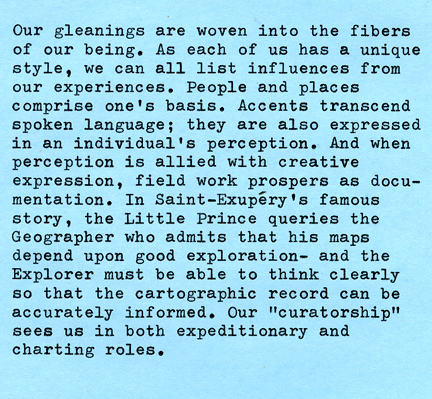
a point of recollection.