Showing posts with label recognition. Show all posts

Wednesday, July 9, 2014

return journey


“...the wind cut up the street with a soft sea-noise hanging on its arm...

...here and around here it was that the journey had begun
of the one I was pursuing...”


~ Dylan Thomas, Return Journey.


journeys and returns
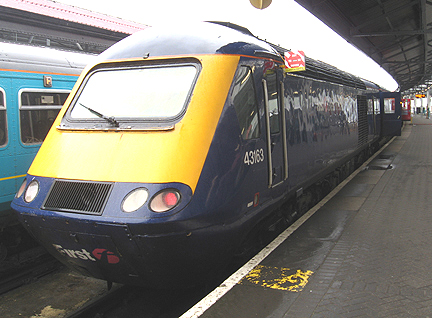

Above: First Great Western train, from England;
Below: Arriva train in Wales.


On a weekday, still with books and papers in my arms, I walked to the Oxford railway station to buy my ticket for North Wales. One sojourn leading to another. Not realizing an explanation was needed, I blithely requested a one-way ticket for Penmaenmawr. Then, after helping the ticket agent spell and pronounce “pen-mine-maOW-rr,” I helped him locate the town on his computer monitor. For the record, he was very nice about everything, and perhaps in an apologetic spirit he reserved “table seats” for me aboard each of the 3 trains I needed to get across the English Midlands, to northwestern Wales. Well this Oxford scholar with a New England accent, heading for the “Fortress Gwynedd,” was certainly grateful to look forward to a day’s train travel with reserved perches that included writing surfaces.


Above: Looking to the mountains.
Below: Looking to the sea, minutes later.


Packing to leave Oxford and the goodbyes (with plenty of see-you-laters) were offset by the anticipation of a return to Wales. No longer the first-ever visit, which I experienced in the previous year, but this time a return journey. The distinction is significant, as the mystery of travelling to a place charted solely by maternal recollections and childhood dreams is augmented by the prospect of returning to places remembered in personal experience. This time, I could visualize the destinations. Places, sounds, and countenances joined the stream of expectation. There were tastes I wanted to be sure not to miss, such as bakery-warm Welsh cakes, and S.A. Brains Ale with seafood. There were photo angles to retry on this visit, and opportunities to see more places for which there hadn’t been sufficient time on the first sojourn.


Bangor, Wales.


returns and impressions


All journeys are to be savoured, as no two impressions are alike. Return journeys are as unique as initial discoveries. The differences are in the imageries that inform the going forth. In all our journeys, we blend together the known and the unknowing. As well, we are uniquely able to synthesize the composite experience of multiple memories, landmarks, and projected hopes when we return to places of our choosing.


The aspect of returning to a place already visited- or in the case of my monthly travels to Boston, something almost errand-like, the visits are colored by the weather, the tasks-at-hand (if any aside from strolling), and indeed the kind of mood I’m in. But it is a return nonetheless, and one I elect to make. The great distinction is that a choice was made; this is not perfunctory. The dynamic, being one of choice, means that I am just where I want to be, notwithstanding how I feel, where I just came from, and any other baggage that may have come with me. Returning to a place, and wanting to be there, is actually in response to the place calling you to come back. Thoughts become enlivened by the prospects of the object of your wanderlust, of your longing for a very specific place with lanes, skies, handshakes, houses, and aromas.


The train travel took an entire day, with transfers in Birmingham, Shrewsbury, and Chester. The transition into something very different from urban and suburban Midlands to rural mountain country became clearly pronounced as my last train reached the sea. Shoreline was immediately at the starboard side, with the mountains of North Wales above the port side. Skies alternated between stark brightness and overcast spatter. The weather of the Welsh coast, which is so similar to that of the Maine coast, one place now reminds me of the other.
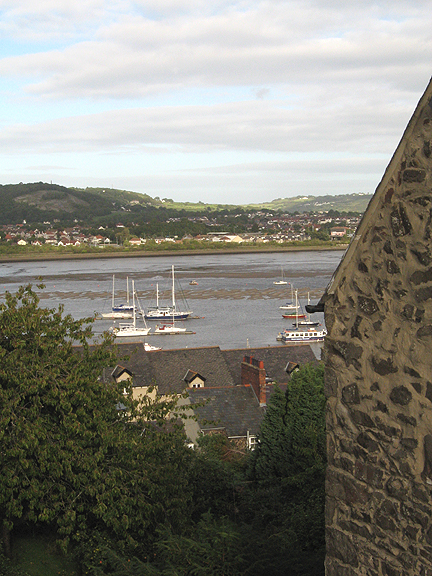


The return to North Wales came a year after my emotional first visit, having had a year to convey stories from the month of Welsh travels to my parents at Thanksgiving, and keeping in touch with new friends, anticipating the return. The arrival this time was directly from a long sojourn at Oxford. Thus, I instantly noticed the Oxford House in the small village of Penmaenmawr- even how the storefront is painted navy blue.

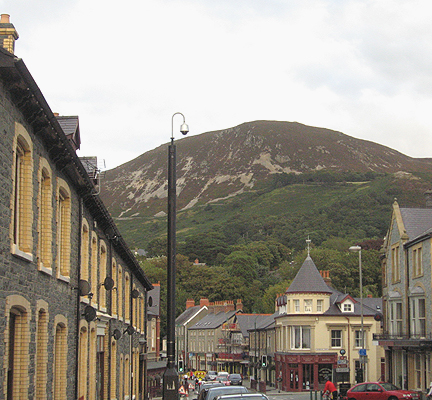


In Bangor, I could notice the progress of construction projects I had seen in the prior year, and how these things (the University arts centre, and some housing complexes) had changed. Before making the trip, during the planning, I realized there wouldn’t be enough time to visit places and friends in South Wales; I could only choose one direction, and chose north. I was gratefully able to welcome the restorer of the Dylan Thomas home, in Swansea, to The Kilns (C. S. Lewis’ home- which had been my home in Oxford), as a sweet reunion. While explaining my choice to Annie Haden, she very matter-of-factly said, “well that’s your Mam’s place,” giving me the impression that if I had chosen to go south, she would’ve said. “Why didn’t you go back to Bangor, child?” I could just picture it. Indeed, I did gratefully go back to the north, following my wishes and remembrances from the past year.


Same gates, but 54 years apart: My mother and me, in Bangor.


the call of place


Consider the phenomenon of a place returning to you. Not as with unpleasant histories, but the opposite, life-giving kind of haunting. These are dreams we welcome, reminders of the flowering amidst our struggling thorns, gratitude as fruit of survival. When a place calls and colors our dreams, the impression is more than of the place itself. Surely, streets and squares, with addresses, can be physically visited. When a place joins the geographic arrangement of our dreams, we are included as inhabitants of such reveries. These places include our selves as resident travellers. When I revisit Paris and New York, I am there as an infant, an adolescent, a teenager, and as I am today. All the lenses are kept polished. My images of Wales evolved from retold stories and postcards to enquiries and, finally, my own footsteps. Places we hold dear to our hearts and thoughts are in our eyes. They go with us, they return with us, and cultivate our life experiences.


Below: The Welsh house blessing from my mother's time in Bangor, which she has recently given to me. I remember this from childhood in New York.


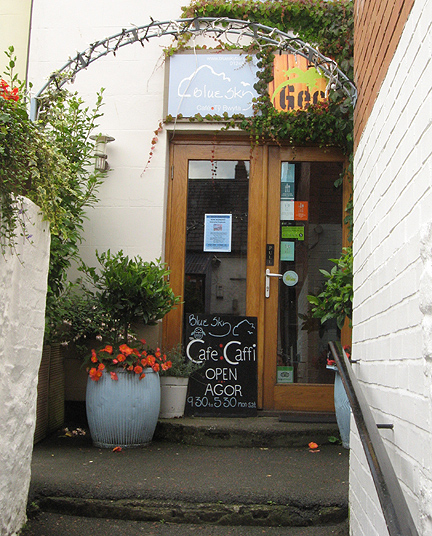
The places and vistas I enjoyed most in Bangor are still favorites of mine. My urban penchant for strolling and browsing draws my attention to High Street, Deiniol Road, and Holyhead Road. The latter is near Bangor University, where my mother studied. At frequent intervals, among shopwindows, are cafés and bakeries. My very favorite is the Blue Sky Café, which is in a high-raftered skylit loft at the center of Bangor.


Bangor Pier.


A meditative stroll along the Garth Road continues onto the Victorian scenic Bangor Pier. On one evening’s visit, the winds whipped through the Menai Strait with such force that pedestrians on the pier were holding on to the boardwalk’s railings. With this return, I was better able to appreciate Bangor Cathedral- both in its general ambience and its architectural details. One of my recent visits was on a pouring rainy day, and somehow the exterior conditions caused the interior to feel much more intimate. The return journey reminded me of the sanctuary, whose foundation dates back to the 7th century, as a place of prayer. Having developed warm friendships through- and with- the Bangor Public Library, that is undoubtedly one of my favorite places in town.


Bangor Cathedral.


Bangor Library.


Indeed, I did see places I had not seen before, and made new acquaintances, but that’s to be expected. Return visits are new experiences, as today is distinct from yesterday. Now it occurs to me how often I peruse the same favorite districts in Boston, noting changes, discovering new things, and visiting old favorite points of reference. When it comes to hospitable and beloved settings, familiarity breeds endearment. As for Bangor, its environs, and Wales, I am thankful for places of grateful returns. There is no honor quite as sublime as being warmly anticipated. A living sign of mutual recognition, the gift of welcome is a gesture of both extension and inclusion. As our times appear fragile and temporal, embraces represent treasured belonging and the sense of home. Thoughts that console, soothe, and endure. Sights, voices, and days return to me with the effortless prompt of atmosphere. Wafting weather and aromatic air bring words to mind and paper, collated to the volumes of a life.




Wednesday, May 1, 2013

reward and recognition


“The one thing needful for a person is to become-
to be, at last, and to die in the fullness of their being...
and happy is he who puts forth to see, with treasure freighted.”


~ Antoine de Saint-Exupéry, Citadelle, ch.38


understanding accolades


Many of us earn some measure of recognition, but many more of us watch the awarding of others. Competitions and rewards accompany our days for our earliest interactions with this world. From elementary school, to summer camps, workplaces, and community life, alluring merits and prizes abound. Generally, fame and notoriety, in their varied manifestations, find recipients among those with the highest grade-point averages, the most sales, the lowest earned-run-average, and the largest pumpkin at the fair. These are the more statistical awards. Then there are the more subjective accolades, such as the best-tasting apple pies, beauty contests, grammys, oscars, and the Most Valuable Player. While we can fairly well figure out the necessary attributes for the gaining of an award, we are also left to marvel at the more subjective awarding criteria. Why does fortune smile on one, and not another? I’ve wondered at such strange examples of selectivity, both as frequent witness and as infrequent recipient. Singling-out and exclusion are two sides of the same question.


When I look at the scattered commendations I’ve received over the years, reminders of herculean work efforts and those fleeting moments of bestowal come to thought. Then they dissolve. And then I marvel at how so many others that expend significantly less effort than I do, receive exponentially greater fortunes and rewards. It is easy to be left to wonder whether less done means greater rewards. Nothing, then, must be worth inestimable fortunes! Postmodern culture, expressed by its peculiar language, finds this context in the application of win. “With this product, everybody wins.” Using such-and-such strategy, the company wins.” “As we follow this course, goodness wins.” Has somebody actually won something? Who lost? Is there a second prize? How about a victory banner? Surely, winning is advisable over being defeated. In attempting to distinguish between the two apparently contesting sides, it becomes necessary to articulate the meanings of reward and recognition.


halls of fame


If recognition belongs to the finite moment, questions about enduring value come to mind. We may consider how many hard-driven and decorated athletes pawn off their medals and rings for the artifactual worth and precious metal content. Has the value of the award as an object outpaced that of the victory itself? Perhaps time depreciates accolades, especially as contexts disconnect and evaporate. Yet tokens and statements of recognition are somehow as dear to us as they are ephemeral. Such memorials are fleeting, and persistent will is needed to keep recognition in active memory. It may be that the inherent ephemeral nature within rewards is what fuels the human craving for acknowledgment. For each of us, there will be a scale of importance, as it concerns awards and those who issue them. For many, a parent’s or an employer’s tangible approval has greater worth than gold watches or sums of money. Beyond amnesic popular culture, each one of us can determine the awards that endure.


As recipients have their definitions, so do those who bestow recognition. In a broad sense, most rewards are used as incentives. If a quota is met, or some goal achieved, a reward may follow. It’s the old carrot-and-stick idea we knew in grade school, and it seems to keep the wheels of progress in perpetual motion. By parallel contrast, the less-productive have cause to fear. But at all hands, rewards are prominently at the center. “If you do this, you may very well qualify to get that,” but there are no promises. Alas, hard work and success are not inextricable.


Consumer culture propagates its own definitions of rewards. Even plastic charge cards named after precious metals. Premiums and property are promised, but earning the elusive requisite points demands greater cost than the monetary value of the rewards themselves. It has become an exception to find businesses without affinity programmes and purchase cards, promoted as customer benefits, yet surely advantageous as marketing and demographic devices. “Loss-lead” is the term used when an item is priced unusually low, for the purpose of drawing the attention of customers to engage and buy more. Every coffeehouse in town wants me to punch a card; it’s as though I’m continually on the job. The tenth cup free, after paying for nine, continues to look like a good deal for my loyalty.


What are the enduring awards? Which ones are worth the invested time, energy, and expense? Looking at collected diplomas, certificates, honor pins, trophies, and reference letters, I see how quickly they fall silent. Their respective moments move farther away from the present, with each day that passes. The human hunger for applause demands new tokens in constant succession. But do such ephemeral items really advance us through life? Recently, I was asked to organize the archives and artifacts of a journalist who had passed away several years ago. Unpacking the cardboard boxes, I found certificates and medals among the stacks of papers. Examining such personal documents as passports and correspondence, I wondered about this man’s attachments to these things, and whether their value to him had changed through the years. Walking by a trophy store the other day, all the pedestal-mounted memorials, plaques, glass objects, and ribbons grouped together on display suddenly looked like expendable merchandise. In theory, anyone can have a personalized award made for any reason at all. “First-Place in the Squandered-Talent Show, awarded to...,” and be sure to enter that middle-name, to make it look official. Looking away from the veneered trophies, a good and effective effort should stand on its own without material recognition.


status update


A greater work than any career, that may or may not exist, is a conversion of mind that conscientiously eschews reward. It is a death to oneself, and quite contrary to so many of this culture’s motivating forces. What liberation awaits, after letting competitions barrel down their divergent highways, while choosing country roads instead? Where was that mechanical racetrack rabbit going, anyway? But, alas, most of us must compete for better employment, and must navigate the narrow channel that passes between serpentine cleverness and dovelike innocence.


Lately, I’ve been referring to myself as “the prodigal’s brother.” As in the famous biblical parable, contrasting the hard-crashing and dramatically-repenting prodigal, is his brother: the one who loyally stayed, responsibly working in his backwater town. The brother watches the returning prodigal’s festivities with incredulity, unable to comprehend his own uncelebrity. Readers are left to wonder if he ever learned to recognize the good in his perseverance, and if his steadfastness was ever rewarded to his satisfaction. In his philosophic Citadelle, Saint-Exupéry wrote, “Strive to break the bonds that tie you to worldly goods- trade yourself in exchange for something greater than yourself.” When considering disentangling from the chasing of rewards and notoriety, I realize my own vulnerability to such pursuits. Can an ambitious soul in this world be dissuaded from the driving desire for recognition and material comfort?


It is a test of faith, rather than a challenge of belief. With a solidly bare faith, it would be a matter of assuredly looking forward without bitter strain to better days and prospects. Belief in God’s presence is a far easier reckoning. The oft-used figure of speech about “the left hand not knowing what the right hand does,” in its origin was a compliment wrapped in a reproach. Jesus used this imagery to illustrate the virtue of not broadcasting our charitable works, not trumpeting what we think our virtues are. Choose well, but do so in quiet confidence. In the fluidity and fickleness of time, the rewards of status seekers are temporal at best. Indeed, many among us have known of such subtle truths for a long time, easily agreeing and sympathizing with the rarified road of covert holiness. But the unspoken underside asks us to cultivate a disinterested regard for public recognition. Once more, belief prompts agreement, but trusting faith holds the soul to realigning and developing an unreluctant understanding of reward and recognition.


Friday, September 18, 2009

blog award


“Try to remember
that to some extent
you’re just the typist.
A good typist listens.”

~ Anne Lamott, Bird by Bird


A surprising and splendid acknowledgment has come my way, and I am very grateful. For my part, blogging grew out of journaling, and for the past 3 years has paralleled my daily handwritten journals. For years, I’ve been maintaining a kind of tandem journal: fleeting thoughts jotted in pocketable notebooks in pencil, and larger tomes for developing thoughts as time permits in ink. Carnets and cahiers. The nickname for the little penciled jottings has been my “life in graphite,” La Vie Graphite. The words and themes- even the tools I am fortunate to use- are open-ended means. The real subject is this life’s voyage, the pilgrimage of trust.

The award requires that I post a presentation- and very happily involves a celebration of other writers whose work I respect. The presenter of my award is the esteemed Olivander, author of Collapsing World. And here is the Kreativ Bloggers award:


I am very pleased now to present this award to 7 creative bloggers.
First, here are the rules for the recipients:

1. Thank the person who nominated you for this award.
2. Copy the logo (above) and place it on your blog.
3. Link to the person who nominated you for this award.
4. List 7 things about yourself that people might find interesting. (see below)
5. Nominate 7 Kreativ Bloggers.
6. Post links to the 7 blogs you nominate.
7. Leave a comment on each of the blogs letting them know they have been nominated.


And here are the winning blogs:

Lissa: Scenes From a Slow-Moving Life - http://www.justwritingwords.com/
For poetry and poetic fiction, with imagery, with consistency and tenacity.

maxxgrl: Ottavox - http://ottavox.blogspot.com/
Encouragement for a new blog of personal expression and exploration.

Sarah Rachel: Lie Down and Sleep- http://liedownandsleep.blogspot.com/
For eloquent and candid narratives of a woman’s spiritual journey.

Br. Richard: A Capuchin Journey- http://acapuchinjourney.blogspot.com/
For his down-to-earth observations, poignancy, and humor.

Chris Routledge: Chris Routledge blog- http://chrisroutledge.co.uk/
A many-faceted and very well-presented blog- from a fellow Olympia typist!

Donald: Writing Cabin- http://writingcabin.blogspot.com/
For thoughtfully and subtly writing his journeys.

James Watterson: OlympiaMan’s Typecast - http://olympiaman1010.blogspot.com/
James also wields a couple of typewriters, and enthusiastically writes his musings.


To all of you: Congratulations!
Bon Courage et Bonne Écriture!


Finally, 7 random things:

1. I commute to work with the bicycle I’ve had since I was 16.
2. My career in the visual arts began when as an 8 year old I saw the Chagall production of The Magic Flute at the Met.
3. I taught Benedictine monks to sing in Hebrew.
4. On formal occasions I wear real bow ties.
5. I have been published as a photographer, an illustrator, a historian, a book conservator, and a philosopher.
6. My first language is French.
7. My favorite food in the world is steamed and spiced kasha.