Showing posts with label childhood. Show all posts

Sunday, May 28, 2023

en plein air

“Adopt the pace of nature.
Her secret is patience.”


~ Ralph Waldo Emerson, Nature


With an extremely rare weekday off, I chose to stay in town and write outdoors. Not only that, I decided to write on the Eastern Promenade- a writing perch I’ve enjoyed for many years, long before having to move from my home in a suddenly-gentrified West End building. Indeed, last autumn- until it got too cold- I walked to the “Prom” as often as possible, getting away from the puny apartment, just to be able to look upward. Going outdoors to write allows me to transcend “addresses,” and their confinement. People travel to Portland from great distances, to be able to perch along Casco Bay. The scenery continues to be inspiring to me, just as it was for me last month in the Berkshires. Getting out gets me away from oppressive and bland spaces, as well as from the static recirculating air of the workplace. “Retreat” needn’t mean extensive travels; it’s really about stepping back and away from structure and demands. I could be from anywhere and come here to write, at the same time as being from here (which I am) and forget about annoying confines. The outdoors also provide an escape from alienation. Open, and accessible spaces strike a needed contrast from offices, phones, and lit screens- allowing me to listen to my thoughts and make some notes. Skies provide a taste of ceilinglessness (and how cooperative that my typewriter doesn’t redden or rewrite my made-up words).
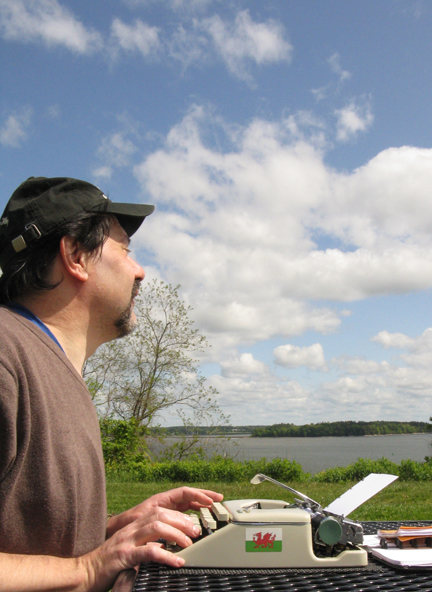

Writing at the Eastern Prom, which includes a busy playground, brings to mind the day camps that were lights to my adolescent summers in New York City. Asphalt jungle childhoods comprise scarce amounts of trees and clean grassy spaces for playing and perching. There was always a lot of broken glass to sidestep, along with other detritus I stopped seeing after moving here to Maine to begin college. No doubt, the air was a comparison I could immediately make, and since then has always been rolled into what I’ve come to know as “the outdoors.” But humble as it was, day camp gave me a taste of things easily taken for granted in northern New England. In the city, the change of context brought kids like me on long yellow school buses out to the lush and landscaped parks of Queens- namely Forest Park, and for a number of years Kissena Park. Hardly any of the other kids were from my neighborhood: the blighted and dangerous projects in Corona; they were from just about everywhere else. But we were all together, frolicking outside, jumping through sprinklers, and fanatically playing baseball every single day. We were easy to please, once we had time and space. Perhaps some of us retain those traits. There was no structure and no technology- even for the camp counselors that watched over us, also serving as our umpires through all those raucous ball games.

From my high school years:
Above: Greenway Terrace, Forest Hills, New York City
Below: High School of Art & Design cafeteria, as we all wondered what was really in those sandwiches.


I’m one of those adults that can still think very much as I did when I was ten. The ache to have time and space to muse, around those fettered and adversarial school days, resembles the ache to have time and space to muse between job tasks and inane meetings. Free time becomes increasingly costly. For most of us, liberation is rare and at best incremental. Reflecting back, childhood redemption arrived in an unwitting combination when I was 13. My year began as I completed rigorous and intense religious studies, thus declared an adult at that rather young age. In my naive determination, I survived my final year in what happened to be New York City’s most overcrowded public school, which went by the heartwarming name of I.S. 61. Its schoolyard was surrounded by housing projects and scrapyards. The city was a good 2 decades away from gentrifying, and my daily walks to school were imperiled by gangs and packs of feral dogs. Almost all the threatening and thrashing ended for me with the post-middle-school summer at a healthy summer camp in the mountains of Upstate New York, followed by my parents’ purchase of a house in a strikingly beautiful and safe neighborhood- still right in the city. And finally, still at age 13, I began my sojourn of secondary education at the High School of Art and Design, on the tony east side of Midtown Manhattan. A whole lot in a short year. My father gave me my first bicycle, enabling me to run a lot of errands, including grocery shopping. I explored all the streets of Forest Hills and contiguous neighborhoods, also toting my first camera- which had been a 13th birthday gift.

My Rudge-Whitworth bicycle, which I purchased used for $20 to replace the new bicycle robbed from me by muggers.
Above: Photo I took in 1981, in New York City.
Below: Photo I took (I still have the Rudge) recently at Acadia National Park, Maine.


The bicycle symbolized freedom and an enduring sense of self-propulsion. I would joke about drinking a glass of milk, then bicycling the length of Queens Boulevard and over the 59th Street Bridge en route to a library I frequented on East 38th Street. All on one glass of milk, as I’d say. One afternoon, while bicycling with a neighbor through Flushing Meadow Park, I was accosted and mugged at knifepoint, forced off my shining new bicycle. I still remember this well, and can recall the sheer powerlessness of that event. At my summer job in a supermarket, I saved my earnings to buy another bicycle- a used one that I defiantly considered to be too ugly to draw any thug’s attention. I still have it today, driving it throughout the Portland area, including all the carriage roads in Acadia National Park. Self-sufficiency continues to be its own brand of liberation. Alas, and as I’ve learned, childish and childlike are really two different traits. At best, that early spirit endures by adaptation. As well, self-sufficiency shows its hard limits, particularly in the powerlessness of housing searches, employment scavenging, and economics. Recalling Saint Augustine, “I do not know what I do not know,” and thus I want to know what I don’t know. If there’s any way to improve things, it must begin with avoiding prior mistakes.

Outdoors on the 2nd floor terrace at the Boston Athenaeum.


How much of a factor are our interpretations that are based upon our subjective perceptions? Obviously, something entirely subjective is my taste for perching outside to write and read in 40-degree temperatures, which I find perfectly comfortable. Then there’s the fascinating aspect of how syntax plays a role in how we view and depict our discoveries. For example, traveling to a location with a variety of cameras allows me to photograph similar motifs with different formats. The images will look distinct from one another, based upon the tools I’m using. Same with writing: pencils, pens of varied construct, typewriters, and computers will each lead to results reflecting the tools’ influences. Within this is the example of journaling with a dip pen, requiring many regular pauses to re-ink the pen, while the mind continues its train of thought. Those pauses surely reflect what is written. I’ll often switch writing instruments, when I notice aridity in my words. Varying the vantage point is also as effective with writing as it is in photography. Getting outside amidst the swirl of nature permits for an appreciation of Emerson’s description about the patient paces of nature. Light, skies, and horizons will surely affect how I interpret what I see, and how I interpret my thoughts. In a similar sense, I write during my mid-day breaks inside the Archives stacks, as well as aboard lurching city buses. What I notice and the ensuing words are affected by their situations of notation.


When I’m not on the job, and I turn away from doomscrolling online searches for apartments and employment, while the blaring and trampling from upstairs disturbs the peace, I know to go outside. Beneath the skies, there are no upstairs. Life gets to return to looking open-ended as it did when my friends and I would lie on our backs in green and sunny Kissena Park, just talking and looking up at airplanes going to and from LaGuardia. The paces of nature are surely not those of such humans as those among us who use the expression, hurry-up-and-wait. Coaxing the inertia out of the wheels of progress is exhausting. During the thick of childhood, time slogged like a schoolday. It felt endless. In retrospect, that was a brief period of time- its space on my timeline diminishes as the adventure continues. Looking back exclaims the necessity of looking ahead. My decades of tireless efforts have yet to pave ways to my profoundest wishes, to exercising and really seeing my best abilities coming to fruition. How close is success? Is it completely out of reach? I’m daring to believe it isn’t, notwithstanding my scarce resources and lack of influence or allies. Echoing Saint Anselm’s prayer in the Proslogion, “I have still to do that for which I was made.” Yet, the stuff of eternity does not include accolades or material. The moment and all subsequent time stands for me to redeem. Knowing how to redeem liminal time is a daily and constant challenge. Having little more than faith and gumption, I’m left to heeldigging trust, insisting upon finding the sacred in the ordinary. Such thin rations need the light and rain of the outdoors, for the vines of latent presence to proliferate and provide.


Wednesday, August 10, 2016

solidity in the liminal


“The greatest forces lie in the region of the uncomprehended.”

~ George MacDonald, A Dish of Orts.


1

We are constantly reminded about the persistent certainty of change. This is a subject manifesting in such popular forms as our music and our aphorisms. All of that acknowledged wisdom still cannot completely convince us to count on the reliability of transition. A living human, body and soul, is in perpetual motion. As we live, we dwell upon moving surfaces. With a corner-of-the eye awareness, daily routines are repeated in a temporal context. The fluidity of time occurs to us when our continuities are disrupted. A building we always knew is torn down, a business we counted upon for years dissolves, people we long valued are suddenly absent, a protracted succession of work days or schooldays conclude. The passage of time bewilders and shocks. It’s as though time suddenly lurched forward, after a lengthy spell of stillness. But the hours and days have always been moving, all in the same increments. Yet there is ever an insistence upon solidity, upon predictability in the acknowledged provisional. The trick is to live a wise dynamic, even a comfortable one, in temporal conditions. The length and breadth of liminal space cannot be determined. Temporary can last a long time.


2

As technologies continue evolving, more conveniences and tabulations are connected to our tasks. The mundane and transitory aspects of communication, travel, and commerce become increasingly easier, as well as increasingly monitored and measured. Popular corporate culture obsesses about fickle figures known as metrics. Ease and access are as phenomenal as they are potentially impersonal. The universality of immediacy is really incredible, such that a few undercurrents counteract, by seeking to “unplug” the pace. Recently, on a Boston-bound train, I sat across the aisle from a passenger with two restless young children. Trying to calm down the squirmier among them, the woman spoke in impressively adult tones, “now you need to be patient.” The child replied with a memorable, “but I don’ waaaaanna be patient!” Who does? But we have to be.


If only the cherished could be held in place, and only the detriments be discarded. We would rather not view things and people we love as temporal. At the same time, we wince and want the things we dislike to go away fast- as in right now (this takes patience). All reside in the same time measurement, and unfortunately what we love is moving along and potentially away from us at the same rate as the unwelcome abiding of what we dislike. But then, we are each in motion, too. Evidently, I have something in common with the reluctant child on the train.


A fond memory recalls a simple, yet memorably savory meal I had when I was 17. It was in Paris, and I had spent a day on one of my many photographing ventures. Realizing how hungry I was, I looked for an appealing eatery that I could afford. Stumbling into a little cavern appropriately called Le Clos des Bernardins, I saw that I had just enough money for a salad. Well, the waiter brought me a wide plate that was richly adorned with tomatoes, cucumbers, peppers, and vinaigrette on palm-like chicory greens arranged to point outward like sun rays. At the center of the salad was a warmed morsel of goat cheese. The colors, textures, and tastes were immediately striking, and I did all I could to eat civilly and slowly- albeit through tenacious hunger. I remember telling myself to savor this special food, and that I would momentarily stop to put down the silverware and look around the arched little dining room. I treasured every bite, and after gratefully paying the waiter what I had, I equally savored my slowed steps across the Latin Quarter. Even back then, I knew this was something to remember. What is purposed to last about a beautiful event cannot be the perishable ingredients, but rather the complete impression. Like flowers, a delectable meal is not meant to last.


3


Amidst the temporal, there abides a universal thirst for permanence. I strongly doubt there is anyone that doesn’t wish for something in life to last forever. It could be a beloved person, a situation or place, or a slice of time preserved only by memory. I remember my 13-year-old self at the end of the summer camp season, being very sad at the prospect of leaving many new friends, and returning to the bad old city. A bigger kid put an arm on my shoulder, trying to console me. He was probably a ripe old 15, and he said, “come on, good times don’t last forever.” In retrospect, that’s a rather grim pronouncement for an adolescent to utter to another. But it’s also an acknowledgment of impermanence. Summers do inevitably wind down. We begin school so that we can graduate. The optimist’s comprehension is that there will be more good times to follow, and it’s good to expect them.


Because of the work I’ve been doing for the better part of two decades, the word preservation is in my daily parlance. Archivists also want things to last forever. In my field, we use terms like permanence, longterm keeping, and conservation grade. We confer at length about best practices, formatted backups, and disaster preparedness. Of course, we must work to these ends; that is central to our professional stewardship and the common mission to preserve and provide access. We look ahead and we look back. Consider the historic materials and landmarks reaching us today from great spans of time ago. I type these words from atop the Boston Athenaeum, whose foundation dates back to the late 1600s. How will these places look, three centuries from now? Many of us, regardless of our work, have a personal awareness of preservation. The mindset says, “good things should last forever.” But we are striving to make things permanently endure in a temporal context. Our predecessors have passed their torches to us, and they may have also thought of the paradox of permanence in the provisional. We know that we do and see things that are momentary, but we proceed with a confident sense of preservation.


4

How can there be rootedness in temporal times and places? Ideally, it begins with a sturdy sense of daring and a powerful imagination. It demands faith, the evidence of things unseen. There is a popular biblical passage about the dogged and daunted life of Jeremiah the Prophet. Perhaps he had an inkling that his was among the lives that would be associated with metaphors. There have been many such individuals across the centuries. The ancient Jeremiah was enjoined to invest all his personal resources into the purchase of property in enemy territory which was embroiled in conflict. It was a volatile war zone. But he did it, despite his second thoughts, because what loomed even more powerfully was that he needed to buy that field and make it bloom. There was a holy calling that haunted his thoughts that he follow his vocation. The alternative would have been even more costly to him, and those who knew him. There had to be solidity in the liminal. We say that we make permanent decisions, and that we establish ourselves and our investments. But at the same time, many of us keenly know that we are digging into moving platforms. Perhaps what we must do, in order to maintain sanity, is to prosper between the temporal and the permanent. What is substantial, to the point of solidity, is our treatment of the transitory.


Wednesday, July 9, 2014

return journey


“...the wind cut up the street with a soft sea-noise hanging on its arm...

...here and around here it was that the journey had begun
of the one I was pursuing...”


~ Dylan Thomas, Return Journey.


journeys and returns


Above: First Great Western train, from England;
Below: Arriva train in Wales.


On a weekday, still with books and papers in my arms, I walked to the Oxford railway station to buy my ticket for North Wales. One sojourn leading to another. Not realizing an explanation was needed, I blithely requested a one-way ticket for Penmaenmawr. Then, after helping the ticket agent spell and pronounce “pen-mine-maOW-rr,” I helped him locate the town on his computer monitor. For the record, he was very nice about everything, and perhaps in an apologetic spirit he reserved “table seats” for me aboard each of the 3 trains I needed to get across the English Midlands, to northwestern Wales. Well this Oxford scholar with a New England accent, heading for the “Fortress Gwynedd,” was certainly grateful to look forward to a day’s train travel with reserved perches that included writing surfaces.


Above: Looking to the mountains.
Below: Looking to the sea, minutes later.


Packing to leave Oxford and the goodbyes (with plenty of see-you-laters) were offset by the anticipation of a return to Wales. No longer the first-ever visit, which I experienced in the previous year, but this time a return journey. The distinction is significant, as the mystery of travelling to a place charted solely by maternal recollections and childhood dreams is augmented by the prospect of returning to places remembered in personal experience. This time, I could visualize the destinations. Places, sounds, and countenances joined the stream of expectation. There were tastes I wanted to be sure not to miss, such as bakery-warm Welsh cakes, and S.A. Brains Ale with seafood. There were photo angles to retry on this visit, and opportunities to see more places for which there hadn’t been sufficient time on the first sojourn.


Bangor, Wales.


returns and impressions


All journeys are to be savoured, as no two impressions are alike. Return journeys are as unique as initial discoveries. The differences are in the imageries that inform the going forth. In all our journeys, we blend together the known and the unknowing. As well, we are uniquely able to synthesize the composite experience of multiple memories, landmarks, and projected hopes when we return to places of our choosing.


The aspect of returning to a place already visited- or in the case of my monthly travels to Boston, something almost errand-like, the visits are colored by the weather, the tasks-at-hand (if any aside from strolling), and indeed the kind of mood I’m in. But it is a return nonetheless, and one I elect to make. The great distinction is that a choice was made; this is not perfunctory. The dynamic, being one of choice, means that I am just where I want to be, notwithstanding how I feel, where I just came from, and any other baggage that may have come with me. Returning to a place, and wanting to be there, is actually in response to the place calling you to come back. Thoughts become enlivened by the prospects of the object of your wanderlust, of your longing for a very specific place with lanes, skies, handshakes, houses, and aromas.


The train travel took an entire day, with transfers in Birmingham, Shrewsbury, and Chester. The transition into something very different from urban and suburban Midlands to rural mountain country became clearly pronounced as my last train reached the sea. Shoreline was immediately at the starboard side, with the mountains of North Wales above the port side. Skies alternated between stark brightness and overcast spatter. The weather of the Welsh coast, which is so similar to that of the Maine coast, one place now reminds me of the other.


The return to North Wales came a year after my emotional first visit, having had a year to convey stories from the month of Welsh travels to my parents at Thanksgiving, and keeping in touch with new friends, anticipating the return. The arrival this time was directly from a long sojourn at Oxford. Thus, I instantly noticed the Oxford House in the small village of Penmaenmawr- even how the storefront is painted navy blue.


In Bangor, I could notice the progress of construction projects I had seen in the prior year, and how these things (the University arts centre, and some housing complexes) had changed. Before making the trip, during the planning, I realized there wouldn’t be enough time to visit places and friends in South Wales; I could only choose one direction, and chose north. I was gratefully able to welcome the restorer of the Dylan Thomas home, in Swansea, to The Kilns (C. S. Lewis’ home- which had been my home in Oxford), as a sweet reunion. While explaining my choice to Annie Haden, she very matter-of-factly said, “well that’s your Mam’s place,” giving me the impression that if I had chosen to go south, she would’ve said. “Why didn’t you go back to Bangor, child?” I could just picture it. Indeed, I did gratefully go back to the north, following my wishes and remembrances from the past year.


Same gates, but 54 years apart: My mother and me, in Bangor.


the call of place


Consider the phenomenon of a place returning to you. Not as with unpleasant histories, but the opposite, life-giving kind of haunting. These are dreams we welcome, reminders of the flowering amidst our struggling thorns, gratitude as fruit of survival. When a place calls and colors our dreams, the impression is more than of the place itself. Surely, streets and squares, with addresses, can be physically visited. When a place joins the geographic arrangement of our dreams, we are included as inhabitants of such reveries. These places include our selves as resident travellers. When I revisit Paris and New York, I am there as an infant, an adolescent, a teenager, and as I am today. All the lenses are kept polished. My images of Wales evolved from retold stories and postcards to enquiries and, finally, my own footsteps. Places we hold dear to our hearts and thoughts are in our eyes. They go with us, they return with us, and cultivate our life experiences.


Below: The Welsh house blessing from my mother's time in Bangor, which she has recently given to me. I remember this from childhood in New York.


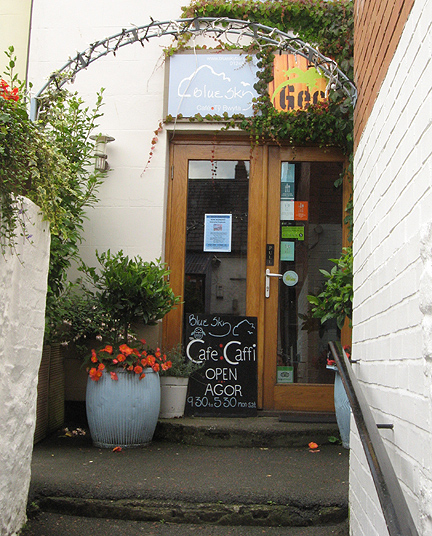
The places and vistas I enjoyed most in Bangor are still favorites of mine. My urban penchant for strolling and browsing draws my attention to High Street, Deiniol Road, and Holyhead Road. The latter is near Bangor University, where my mother studied. At frequent intervals, among shopwindows, are cafés and bakeries. My very favorite is the Blue Sky Café, which is in a high-raftered skylit loft at the center of Bangor.


Bangor Pier.


A meditative stroll along the Garth Road continues onto the Victorian scenic Bangor Pier. On one evening’s visit, the winds whipped through the Menai Strait with such force that pedestrians on the pier were holding on to the boardwalk’s railings. With this return, I was better able to appreciate Bangor Cathedral- both in its general ambience and its architectural details. One of my recent visits was on a pouring rainy day, and somehow the exterior conditions caused the interior to feel much more intimate. The return journey reminded me of the sanctuary, whose foundation dates back to the 7th century, as a place of prayer. Having developed warm friendships through- and with- the Bangor Public Library, that is undoubtedly one of my favorite places in town.


Bangor Cathedral.


Bangor Library.


Indeed, I did see places I had not seen before, and made new acquaintances, but that’s to be expected. Return visits are new experiences, as today is distinct from yesterday. Now it occurs to me how often I peruse the same favorite districts in Boston, noting changes, discovering new things, and visiting old favorite points of reference. When it comes to hospitable and beloved settings, familiarity breeds endearment. As for Bangor, its environs, and Wales, I am thankful for places of grateful returns. There is no honor quite as sublime as being warmly anticipated. A living sign of mutual recognition, the gift of welcome is a gesture of both extension and inclusion. As our times appear fragile and temporal, embraces represent treasured belonging and the sense of home. Thoughts that console, soothe, and endure. Sights, voices, and days return to me with the effortless prompt of atmosphere. Wafting weather and aromatic air bring words to mind and paper, collated to the volumes of a life.