Showing posts with label time. Show all posts

Wednesday, January 22, 2025

forging ahead

“I am still following, still forging ahead, still walking,
still on the road, still extending myself; I haven’t yet arrived.
So if you, too, are walking, if you are extending yourself,
if you are thinking about the things that are to come,
forget what’s past, don’t look back at it...
You ask, ‘What does walking mean? I’ll tell you very briefly;
it means forging ahead, in case you should possibly not understand.”


~ Saint Augustine, Sermon 169.


As the new year began, five years into what has come to be known at the covid era, I was able to make two very long-awaited monastic pilgrimages. Part of my respite time scarcity corresponds with the nearly two years of quarantining, as well as closures to the public of retreat lodgings. All measures taken for the causes of safety and stabilization. In addition, since February 2020, at my workplace I’ve been a department of one, having to adapt into being an especially productive jack-of-all-trades. True to the adage, all work indeed means no play. No complaints. I get everything done, well and fast- and I’ve been gratefully employed the whole way. Forging ahead remains paramount. Over the years, banking up enormous quantities of largely unusable earned hours caused me to squelch hopes for those vital spiritual and artistic retreats that have provided nourishment throughout my adult life. It’s a trial of absorption and adaptation. Absorbing the constraints, while adapting to the tenable. A Saturday once a month at the Boston Athenaeum, combined with an interspersed holy hour at local sanctuaries, help to patch me along.


Several weeks ago, I had the time and space to fulfill a thwarted sojourn from a year ago. Last Christmas, I exhaustedly stole away to Mount Saint Mary’s Abbey only to arrive during the approach of weather so severe it forced all retreatants to evacuate. I’d been only a day as guest in their wonderful community, and they encouraged me to come back. And recently I did just that. My return to Wrentham Massachusetts was in clear weather, and the only storm was a manageable half-a-foot which added photogenic spice to the already peaceful landscape. With a spacious room complete with study table and a soft bed, my only real effort was to try slowing down to a restful pace. Disentangling from the compounded intensity of constant toil, housing crises, and vigilant caregiving, is no simple matter. Rest has to materialize in bits and pieces. Having a few days in beautiful environs with healthful helpings of contemplative silence and soothing sung liturgies made for a salubrious step in the right direction. Bringing both writing and reading material for the sojourn, reflectively studying philosophy seemed to be my natural course, in rotation with community prayers- and journaling. I had just taught my class before taking to the road, and was eager to complete reading material that needed undivided attention. Through experience I’ve learned that spiritual development mustn’t be forced, unstructured time is something to cherish, and thus both aspects counteract contemporary culture. As I had written in the previous essay, Pope Francis’ fortuitous theme for 2025 as a year to be undaunted pilgrims of hope immediately drew my attention. My nineteen years of published essays attest to how this theme superimposes with my own path. Indeed, it was all in mind during this recent pilgrimage, as well as during November’s sojourn to Weston Priory.


As I’ve noticed how my trail’s ingredients are constructed from my own steps combined with unwitting patterns of grace, I’ve also grown to recognize time as increments of significance. And the increments can be as long as seasons, years, and eras. I’ve held this perspective for a long time- dating back to measuring life in summers, grade school levels, semesters, jobs, and projects. Single-day holidays always seemed too short, and mostly about their buildups. Chronicling time with journal-writing provides a natural setting for marking various anniversaries- and of course describing their importance. For example, the Labor Day weekend during which I moved to Maine became known as Arrival Weekend (and I've numbered them since). Others are the closing weeks of my different graduation years- still commemorated. I’ve always much preferred Advent more than a stand-alone Christmas Day, and I grew to love the Lenten season. The latter provides plenty of time to inhabit, explore, and reflect upon during a forty-day period. Pilgrimage is as much about the coverage of physical distance as about spans of time. I regard my lunch-break novenas as spiritual journeys. Journaling provides personal space for incremental reflections. Among many things I learned during years of experience in the Taizé monastery and on the road with some of the Brothers, is to view all of life as a pilgrimage of trust on earth. On one occasion, after a week of supporting a large gathering as a liturgical musician (playing classical guitar), Frère Emile thanked me- hands on my shoulders- wished me peaceful travels, and said, “Now go make your life a pilgrimage of trust on earth.” Those unforgettable words have never, ever left me. That represents the grand view of a lifetime. The briefer and equally vital stages, such as several weeks ago in Wrentham, are to recalibrate and hold course.


Lest we romanticize pilgrimage, appropriating the stuff of novels and misty imagery, pilgrimage might occasionally be quite majestic, alas it’s more often than not pedestrian and gritty. Pilgrimage waits in traffic, rides lurching and odoriferous buses, and holds doors for strangers. It’s carefully shoveling snow. Pilgrimage is also noticing the queues of walking feet ahead, patiently pacing en route to the sacraments; it’s noticing my own. Commuting on public transit requires a lot of waiting and standing. There are also opportunities to read and to reflect; that’s surely more interesting than phone-fiddling. While taking in the sub-zero raw scenery at a bus stop, manipulating book pages with gloved fingers, I thought of how the dilapidated roads and sidewalks are not pristine or groomed, but they are all sunlit during the day. The voyage is not new, though it can be renewed. The dry docks of my start are far out of view, there is no better choice than to forge ahead.


Looking forward and staying the course are infinitely more appealing than giving up the ship. Stagnation is reversal. Maintaining awareness of the imperative to continue is enough of a challenge, particularly amidst setbacks, but what to do when the grinding trail threatens a loss of critical savour? Maintaining the furrow, because it’s what I know and it solves the immediate, fills my days. But is this progress? Not knowing how close at hand fulfillment might be, tests the fibers of hope. The saints of old are always teaching us and none of them ask us to drop the torch. It’s consistently about looking ahead, even if it means discarding all that is past- especially when it takes the form of a millstone. Perhaps beating the winter is no more effective than to check off the chores as they are accomplished. But there are no plans to cease walking forward. Yet another aspect exemplified in pilgrimage life is to affirmatively aspire when hoping looks absurdly irrational. Pope Francis recently said, “faith is a road to be traveled, without ever losing the goal.” Forging ahead, one next-right-thing at a time, is all this pilgrim of trust can do, for now.


Wednesday, October 30, 2024

fragments

“Truth comes from things, and our senses uncover it there...
There is no body, however small that cannot be broken up into countless parts.
But to know that any given body is multiple,
I must already have the notion of unity before I perceive it.
Neither bodies nor the senses can give me such an idea.
We cannot expect to find beneath reason
the source of the truths apprehended by reason.”


~ Etienne Gilson, The Christian Philosophy of Saint Augustine, p.16


1

Evidently, we’re informed by commentators that on the average, each of us processes about 55 gigabytes of data on a daily basis. Some reports refer to 74 gigabytes, others mention 8200 words, per day. We can barely imagine the equivalent in photo images. Ironically, the information is conveyed to us via digital media platforms. And those informational morsels are among hundreds of millions of terrabytes which are generated every day. That’s a daunting amount of rapid-fire fragments through which to navigate. Our days do not grow in their duration. When it comes to academic research, I’ve observed how the additive aspects of manual source-gathering gave way to the subtractive aspects of sharding away digital abundance- all to hopefully arrive at the substantial. Focus has become a disciplined effort in itself- nearly impossible for many.


But there can surely be fascination in a nurturing wholeness made of intricate fragments. Complex ideas and projects incorporate mosaics of modules. Getting away from the artifice that dominates our world of lit screens, I’m making sure to savour the season’s faceted colors. The chilled air is much more to my liking, and the autumn foliage strikes great contrasts against greying skies and ground. With enough wind gusts, leaves take flight as airborne confetti, serving as three-dimensional distractions from shrill newsfeeds. Spectra, from pale yellow to velvet red, change within the day in their intensities and textures. These fragments serve as time increments.


2

Shuffling through both newly-fallen and dry leaves up the street to the bus stop, all the more, fragments are the stuff of my work days. The driest and most embrittled foliage crackle as crumpled papers under pedestrians’ feet, and the sounds remain in mind while reading en route to the job. Archival collections are sums-of-parts, structured hierarchically into groupings and subgroupings- referred to as series. I’ve occasionally organized highly complex collections into sub-sub-subseries- as the substance, formats, and sources of the records warrant. The basis for arrangement may be how the documents and manuscripts were initially made and configured. Otherwise, this must be ascertained through analysis, understanding both sources and uses of the materials. Inevitably, the fragments are to be sensibly and consistently laid out and listed so each “branch” and “leaf” can be easily found for future uses. During early stages of configuration- especially with large and disparate documentation- critical sifting, research, and “boiling-down” must be done (archivists call this appraisal) to advance what emerges from the heaps into cohesive series and subseries. When it comes to making sense of thousands (sometimes exponentially more) of fragmented components, and interpreting them as needed, we use terms such as establishing order over the archives.

My discoveries occasionally reveal how documents were inventively brought together by their creators.

Applying such principles and their many practical derivatives, my thoughts turn to how Scholastic philosophers considered “order” as an indication for understanding divinity. Comprehending creation and knowledge may not be the same as arranging and describing archives, but the spirit is not far away. Generating compendia and indices for the sharing of information do connect philosophy and curation. In the analyses, I get to see how people value what they’ve produced, and how institutions structure (or don’t structure) themselves.

These items may not look alike, but they are part of a unified subseries.


3

“Everything is in everything, and partitions are only possible by abstractions,” wrote the French Dominican philosopher Antonin-Gilbert Sertillanges in The Intellectual Life. Vaster and more complex than archival groupings are the pieces and thoughts of our days and years. Woven among physical formats that comprise pictures, words, and artifacts- are those of sense and recollection. Wafting leaves and their propelling air currents amount to a unity of form and counterform. Life fragments are in our midst, and buoyant. Like curators and readers, we can choose to comprehend our findings. Our accessions, random and scattered as they are, require our reckoning and processing, in our pursuits of understanding. Persevering intact through turbulent times demands more than continuity. One must have the metaphorical “ears to hear,” to prevent from becoming insensitive. Our unique individual contexts join together our experiential fragments. As we cultivate instincts and perspectives, our contexts become more discernible to us. Pondering these things on a day off, attending a church service, the liturgical sequence brought to mind collated fragments reverently brought together as commemoration and observance. Each portion held holy, but all in cohesive union. And my walked paces amidst the hues of autumn fragments continued through narthex, nave, and sanctuary- returning again albeit transformed to the outdoors.


Sunday, February 26, 2023

accidental and transitory

“At the very moment when everything seems to be collapsing
before our eyes, we realize that quite the opposite is true,
‘because you, Lord are my strength.’
If God is dwelling in your soul, everything else,
no matter how important it may seem,
is accidental and transitory,
whereas we, in God, stand permanent and firm.”


~ Josemaría Escrivá, Friends of God, 92

1

Until at least this past decade- with refinements in wireless communications- those who appeared to talk to themselves were generally regarded with suspicion. Urban streets being arenas of assessment, stereotypic self-talkers tended to be written off as rumpled shufflers conversing with the air. Now, stereotypic bluetoothers tend to obliviously stride around, conversing with the air- except for the occasional crackling voice in response. For an observing pedestrian, I’ve gotten used to seeing individuals sauntering around to their own speaking voices. Negatively, the loud talkers in public spaces are intrusive. Positively, I get a great excuse to keep on talking to myself as I might while driving or working. Journaling gives me space to preserve ideas and experiences, as well as making sense of observations and ideas in writing. Speaking to my thoughts while in transit or at work also helps me distill observations and decisions. Thematically, my self-talk and most of my journaling -and photography- are parallel strands along the same streams of absorption, reflection, and creativity. These are extensions of consciousness. But like expression and the life of thought, self-talk wields enough influence to determine how we operate within as well as outwardly. Working alone as a self-propelled and consistently accountable one-person department for 36 months and counting, I’ve been my own voice of assurance. That’s a formidable discipline for me, unceasingly working through the depths of pandemic, personal loss, desolation, and gentrifying displacement, while rarely able to dispel my longrunning streams of verbal self-condemnation. Indeed, surviving present hardships only becomes more difficult amidst harsh self-criticism.


2

Small devotional booklets I've made which also hold my transit pass.


Gesturing with thumb and pointer finger about an eighth-inch apart, I hear myself exclaim, “I’ve got this much margin for error.” Unreasonable as it may sound, there are deepseated reasons beneath this, with a lengthy catalogue of failures, missed opportunities, and comparisons. And yet the hard-driven efforts and persistent hopes continue. Self-talk clashes against the challenge of faith. The equation of oppressive conditions at all hands has forced a necessary straightening out in the form of “Let’s get through this,” and “We’ll get there.” (Oddly enough, I naturally default to the plural- but only interiorly. It reminds me of King David asking his own soul why it was downcast.) In recent months while standing at city bus stops in subzero cold as part of my daily commute, I’ve been reading the wise homilies of Josemariá Escrivá. His essays join my special category of books that seem to have been written for me. I think every reader has their own equivalent bibliography.


A captivating reading, like going out photographing, really gets me out of my own way. Escrivá’s words are notably welcoming. Between the lines of his theological reflections are plenty of his personal anecdotes about his poverty during the Spanish Civil War, and especially his experiences as a university chaplain. As it was for college students in midcentury Spain, present-day individuals struggle with existential angst. It is dangerously easy to believe that what we see is all there is, and that each setback is an unrecoverable blow. But Escrivá asked his listeners and readers to question the perspective that considers denied opportunities to be earth-shattering and perilous. Such things, as he said, should be viewed as “accidental and transitory,” which is to say incidental and temporal. He emphasized keeping in mind an all-essential thirst for the eternal, for the Living God. Escrivá wrote in his essay called Humility, “Why do we become dejected? It is because life on earth does not go the way we had hoped, or because obstacles arise which prevent us from satisfying our personal ambitions.” Of course this speaks to my ill-fitting and uneasy predicament. “Don’t be frightened; don’t fear any harm,” he insisted, “even though the circumstances in which you work are terrible, worse even than those of Daniel in the pit with all those ferocious beasts. God’s hand is as powerful as ever and, if necessary God will work miracles. Be faithful!” Sanctifying the everyday is a theme that manifests throughout his writing.


3


I wonder how many of us, when we graduate from school- brimming with catharsis and ambition- say, “my life’s goal is to be humble and lowly.” Who does this? Not me. Academic and professional work are pointed toward achievement, success, and prominence. As many of us commendably aim high, many of us are frustratingly brought low. The former is in our nature, the latter makes us chafe. And the rub is in the transcendence of setbacks; not once or twice, but persistently countless times. Indeed, it is humbling to consider standing straight in defeat as a measure of success. With my philosophy students, we regularly take up topics in axiology. In one of our Socratic forums my question to the class about the definition of value became a discussion of how we determine value. It was a great discussion, and a parallel thread about the widespread societal concern called success led to how each person defined stability. Engaging in philosophy, we balanced such concepts as implied in material and moral ideas. As we step back to see the fluidity of the present as incidental and temporal, borrowing from Escrivá, an antidote for dramatic devastation is found in the sanctification of understated tasks.


If we regard the present as provisional, rather than as helplessly irreparable, we can freely admit that everything is subject to improvement. That ubiquitous self-talk (for those among us who care to listen to their own thoughts) is also worth improving. Proofreading the inner script is a form of healthful detachment, essentially an untethering from living as though momentary deficiency is some kind of life sentence. Even if momentary amounts to years, and even if the years are saturated with rejections. Resilience has an upturned chin, an affirmative step, and conscientious manners. Things won’t always be like this, I tell myself, even at this late stage of the game. The pearl of great price is the open door in the wilderness labyrinth of barricaded passages. It is imperative to trust enough to hold with insistent certitude that supplications are not spoken into an unattended void. Prayers are surely not self-talk; whether or not they are granted does not mean they are not heard. Grace must be met with courage, and trials must not have the last word. I’m holding to this, as I navigate this throwaway here-today-forgotten-tomorrow culture. It’s easy to believe the immediate is everything. But it really isn’t, and such tempting mirages must be bypassed and resisted at all turns. There is much for me to learn these days about the fine differences between humility and humiliation. Fulfilling the daily obligations, under miserable living conditions, it consoles me to confidently keep its very temporariness in mind and to interpolate dashes of creativity when possible. And continually telling myself to keep faith, look upwards, and never cease searching for better conditions. No doubt, I daily join my praying voice with all who struggle with housing and employment. Fortitudo et spes.


Tuesday, May 11, 2021

il dolce far niente

“I'm going nowhere
And I'm going to take my time;
All the questions in the world
I can leave in my mind.
I'm waiting on the sunshine;
The sunshine.”


~ Sixpence None the Richer, Waiting on the Sun

1

Writing daily in a journal as I’ve been doing for many years, I’ve come to use my dated entries as an archival chronicle. As with most any manuscript archive, the journal entries are first-person and in real time, bit by bit amounting to something encyclopedic. Surely I’m doing more writing than reviewing with my journals, though milestone anniversaries are what send me back into my own words past. Often, they are very interesting to read. I’ve used journaling to write through events in order to try making sense of what I witness and experience. The more descriptive, the better. The arrival of the spring season reminded me that the pandemic has cycled into its second year. I re-read what I wrote in February 2020 and because the writing was in real-time, I was using terminology used back then, when many thought of this as a passing “flu panic,” along with describing the intense uncertainty of the extent of things to come. My entry on March 13th describes the national state-of-emergency and the frenzied supermarket-ransacking that followed. That was last spring.

11 March 2020 : "It's as though horizons are closing."


Now a year later, I’m comparing then and now, remembering my first weeks of working from home (which has become much smoother, quite normal, and remarkably productive). Throughout these times, I’ve become aware of the accompanying pandemic inertia that has also become part of life. Last year, because I was struggling to describe it, I referred to my sudden, reluctant, and stifling boredom produced by quarantining, curfews, closures, and no-travel regulations. The overpowering boredom was something as unexpected as it was unfamiliar. Obviously during my on-the-clock workplace hours, I’ve never had to scrounge for projects and duties, and I’ve been grateful to have that constructive framework to stay focused. But outside of those hours, the old compulsion to redeem the time combined with contending with uncharacteristic confinement. After the Philosophical Society conference to which I had been invited last year at Oxford University was cancelled, I had to cancel my travel plans along with scores of people like me around the world having to cancel all kinds of plans of their own. The conference seminars were later held via Zoom- and I did “attend” and participate, albeit beginning the days at 3am Eastern Time. Having that connection gave me needed energy to continue my own studies at home, fueling my insistence upon getting through the pandemic with more knowledge and insight to share than before. I have also continued teaching. Studying has been more of a nourishing means than ever, during these times.


All the while, these times have forced self-confrontations of varying degrees with the incidental aspects of doing nothing. It’s easier for some than for others. Descriptions of that state of being which Italian-speakers call “the sweetness of nothing-doing” has found its way (ironically) to more computer newsfeeds lately. I remember how when someone would ask me, “whatcha doin’?” and I’d answer with “Oh, nothing, really,” the connotation was one of embarrassment at the admission of not being constantly constructive in every sphere of life. The covid era has everyone reckoning with the passage and the uses of time. A culture that increasingly celebrated “extreme” sports, raising the bar with every physical fad, has quieted the quarantined to consider simpler pastimes- including baking, sewing, puzzles, writing, absorbing the outdoors safely. And doing nothing- just being. Simplicity, for many, has become as much choice as necessity. I spoke by phone with a colleague and friend about the recognized value of not-doing. Her response included the merits of simply sitting outside, and that “doing nothing is all right.” It’s a reckoning for my friends, too, as another said, “you know, it’s ok to be bored.” This was journal-worthy, as I’ve never heard anything like this before.

One of the last places I’d expect to see a celebration of nothing-doing is the industrially high-minded Wall Street Journal. This recent March 16th the WSJ published an article about the connections between accomplishment and doing nothing. “Giving your brain a rest” means giving yourself unstructured time to regroup, gather thoughts, and rejuvenate. Admitting that too easily we turn everything into some kind of competitive task, the author suggests doing something essentially mindless, such as taking solitary walks and just sitting down. “Absorb the scenery in silence,” wrote the journalist Annemarie Dooling. I am now more aware of this, and have taken to recollecting with my books closed- or in my own combined way, writing slower in my journal. In appreciation, I’ve become less berating and remorseful about puttering at my writing table and taking aimless bicycle rides. The mind and spirit need to do their own versions of breathing, especially amidst stress. The article quoted a neuroscientist who said, “Rest is one of the most important ways to enhance the neurological flexibility to build the kind of conceptual understanding that is related to identity and purpose.”


2

A cursory online search reveals an abundance of new articles endorsing a “practice” of nothing-doing. The benefits of doing nothing, published by the Erlanger Health Institute, advocates unplugging from technology and “sitting alone in silence” for a while. They also cite the Swedish expression, lagom, which is to say “moderate” oneself (sounding like the way I intersperse some “nothing” with writing). The health institute lures readers by saying that integrating nothingness into our days can reduce stress and boost creativity. I agree, though it would be a conflict in terms to say “I’m going to immerse myself in a state of nothing-doing, in order to be productive.” On a practical level, there are also short “time out” periods, though I’ve never found regulated time-outs to offer enough space for mental meandering. One true and leisurely luxury is to not think about what time it is.


The quotable business school aggregate IvyExec also published an article about the benefits of doing nothing. A more universal appreciation of the Italian “il dolce far niente,” translated as “the pleasantness of doing nothing,” is portrayed as helping multitasking individuals maintain a sustainable pace in their lives. The pandemic has clearly forced reconsideration of how we’ve been doing things, constantly “being busy” to the extent of avoiding healthful stillness and extraneous “screen time.” “Unplugging is difficult,” the article states. “In many ways, it is easier to stay busy than to do nothing.” We are left to wonder about the qualitative aspects of the “busy” of our pre-pandemic compulsions. Further, the article admits how “this culture exalts workaholism,” and that “people feel guilty when they are idle,’ reminding me that I’m far from alone in suddenly having had to deconstruct my breakneck paces. Allowing oneself to do nothing and not feel embarrassed about it, the mind has opportunities to process experiences, make sense of memories, and derive the learning. By our very nature, our imaginations will find ideas and inspirations that may have been smothered under the busyness that we intentionally interrupted.

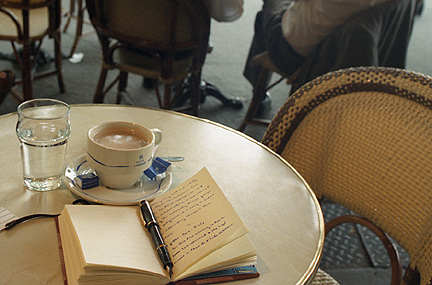
Lao Tse famously reflected about how a person can accomplish much by not overdoing. His quote is often loosely paraphrased as: “Doing nothing is better than being busy doing nothing.” Having grown up and formed in both European (French) and American (Northeast) cultures, I’ve had my own interior ways of observing the differences and the common points as I found them, amalgamating what I’ve admired along the way. In the U.S., hyperproductivity is the stuff of heroism, and we are identified first by our job titles. Evidently, we are the tasks we do. In western Europe, relaxation is essential- even if it’s simply sitting outside. The articles I’ve found about the merits of stillness point out how the time-honored European custom of “just being idle” is an event in itself that needs nothing else. I’ve always admired how Parisian cafés stay open until late hours, filled with people just sitting with their small coffees (and not in “grab and go” thermal cups) and facing out toward the streets, just being. This is also one of my favorite journaling settings. On this side of the pond, having no utilitarian purpose makes Americans uneasy. Generally speaking, our puritanical selves need to have our dithering tendencies condoned. If constructively doing nothing sounds ironic, so does the idea of not being able to hide from ourselves during our pandemic quarantining. Under the limitations of these times, I’ve been using my paid-time-off to give my musing as much perimeter as I can provide. As weather permits or deters, I’ll choose to perch on a rock along the ocean, the front stoop, or my candlelit desk, and simply be.


3

This time last year, many of us at our jobs and schools heard about a hiatus of a couple of weeks. Then a month. Then more. Then it became realistically impossible to predict a duration. Then the word “hiatus” ceased being used. Much of this world has had to move with moving targets, while we no longer hear about the novel virus and the new normal. Everything has had to change, and it remains to be seen whether there can be any reverting back to “before.” How will our societies be affected in the long term? We are yet to see whether our forced “idling” will permanently become part of how we live our lives, and how the adapting we’ve had to do for our survival will alter us.

Photographic paper processor- with the lights on and doors open.


The other day, I was explaining to a friend that I saw a metaphor in something from my days in the custom photofinishing industry. Handmade color prints were individually imprinted in darkrooms with enlargers, lenses, and easels. The paper had to be carefully carried in a lightproof passthrough box into another completely dark room that included the entry for the paper into a roller-transport developing machine. These machines had two modes: Constant Run, and Automatic Standby. We always used the standby mode, to be energy efficient: when there was no paper in the machine, the rollers would go into an idling standby while the chemicals continued to pump at the regulated temperature. As soon a sheet of photographic paper was fed into the machine, the drives would start roaring at full-tilt, taking the machine out of standby, and running the print all the way through the process- as we used to say- “dry to dry.” This present odyssey has taken many people from constant run to automatic standby, and I’ve been in a state of preparedness to have to return to full perpetual motion as needed.


Stillness also becomes an unlikely way to find solutions and even resolve. “Sitting with one’s fears,” means ceasing the flailing and to visualize better outcomes. It doesn’t have to be quite as rarified as it sounds. I had a neighbor on my block who regularly sat out on the front stoop of her building with a cup of coffee and her everpresent cigarette. Of the latter she would say, “they’re what I’ve got.” This was shorthand for describing how she needed to just think, simply sit with her thoughts, and the cigarettes bought her some time and airspace to be able to ponder. Nowadays it may be easier to find this sort of time, yet the stresses of pandemic life can clutter the sanctified stillness right out of the day. Inhabiting a “holding pattern” is very different from reflective time. And these days demand a distinction between hypervigilance and wise caution. Somewhere, in between rocks and hard places, living and looking forward have to continue reaching up. I’m among very many that have had to acclimate to “bubble” work environments for safety’s sake, stricter physical boundaries, leaning heavily into my creative imagination to positively persist. Off-duty hours have had to comprise healthful idleness, and at best the time spent in solitude becomes an investment toward well-being.


Tuesday, March 28, 2017

my steps


Stopped in my tracks, I marveled at my steps,
and wondered whether they were ever mine.
Looking down to the ground, my shadowed prints noted light and time.

We say we own;
we claim our paths and swaths and strides,
careers and conquests and empires.
But do we own our steps? Can paces be possessions?
I’ll say, “my footsteps;”
many days, “my weary way,”
and some days, “my strong stand.”
Steps are claimed, after they’ve been made.
But not before; not before some ground has been covered.
My steps are mine, because I tracked them;
they’ve made themselves known, after the fact, after impressions,
after I’ve looked back.

We say we take up space:
occupying, holding, amassing, grasping
that which is merely in motion, yet pulling rank.
Some of us are at will, in livelihood and home.
The provisional lingers, by our thoughts and steps remarked.
It is for journeying souls to note the jots and accents
of distances and times.
My steps are innumerable, in forms of trudges and slides,
tiptoes and leaps, tentative and bold,
minuscule and majuscule;
ever chasing traction, pushoff,
and sentences that run on and on and on.

Back and forth, uphill,
and so many stairs in office buildings,
treading the mills;
shall I consume the time to decide
whether or not my steps are squandered?
Well, I scribbled some words, walked and pondered,
finding that writing is the only retracing of steps
that cease to exist.
Backtracking is retracking, adding layers to buried steps.
What I own are my observations, not the places of their creation.
As with language, my place is to participate and alight,
but my ownership, my imprint
is to arrange and describe.

The ground of this momentary standing is borrowed.
Though my ground is not my own, I do know to remember.
A soul’s eternity endures beyond buildings, streets, and worlds.
I know not to claim the transitory for posterity,
yet I know to hold a thought and walk with it.

Memory enshrines the sweetness of the momentary,
the fondest steps among many,
from the missteps best released,
steps that are mine, so long as they are remembered.

A pilgrim’s steps so wisely know
direction and time:
it is forward, and at this moment.
Our feet as arrows edged to future paths,
are poorly designed for reversals and standing
as unused stanchions.

My road has no divided lanes
between sacred and profane,
as the sanctifying journey
distills all into the holy indirect,
meandering way.
My recollected words and pictures
are those of a voyager,
stopping in my tracks and marveling at my steps:
Looking down
to consecrated ground,
redeeming light and time.


Wednesday, August 10, 2016

solidity in the liminal


“The greatest forces lie in the region of the uncomprehended.”

~ George MacDonald, A Dish of Orts.


1

We are constantly reminded about the persistent certainty of change. This is a subject manifesting in such popular forms as our music and our aphorisms. All of that acknowledged wisdom still cannot completely convince us to count on the reliability of transition. A living human, body and soul, is in perpetual motion. As we live, we dwell upon moving surfaces. With a corner-of-the eye awareness, daily routines are repeated in a temporal context. The fluidity of time occurs to us when our continuities are disrupted. A building we always knew is torn down, a business we counted upon for years dissolves, people we long valued are suddenly absent, a protracted succession of work days or schooldays conclude. The passage of time bewilders and shocks. It’s as though time suddenly lurched forward, after a lengthy spell of stillness. But the hours and days have always been moving, all in the same increments. Yet there is ever an insistence upon solidity, upon predictability in the acknowledged provisional. The trick is to live a wise dynamic, even a comfortable one, in temporal conditions. The length and breadth of liminal space cannot be determined. Temporary can last a long time.


2

As technologies continue evolving, more conveniences and tabulations are connected to our tasks. The mundane and transitory aspects of communication, travel, and commerce become increasingly easier, as well as increasingly monitored and measured. Popular corporate culture obsesses about fickle figures known as metrics. Ease and access are as phenomenal as they are potentially impersonal. The universality of immediacy is really incredible, such that a few undercurrents counteract, by seeking to “unplug” the pace. Recently, on a Boston-bound train, I sat across the aisle from a passenger with two restless young children. Trying to calm down the squirmier among them, the woman spoke in impressively adult tones, “now you need to be patient.” The child replied with a memorable, “but I don’ waaaaanna be patient!” Who does? But we have to be.


If only the cherished could be held in place, and only the detriments be discarded. We would rather not view things and people we love as temporal. At the same time, we wince and want the things we dislike to go away fast- as in right now (this takes patience). All reside in the same time measurement, and unfortunately what we love is moving along and potentially away from us at the same rate as the unwelcome abiding of what we dislike. But then, we are each in motion, too. Evidently, I have something in common with the reluctant child on the train.


A fond memory recalls a simple, yet memorably savory meal I had when I was 17. It was in Paris, and I had spent a day on one of my many photographing ventures. Realizing how hungry I was, I looked for an appealing eatery that I could afford. Stumbling into a little cavern appropriately called Le Clos des Bernardins, I saw that I had just enough money for a salad. Well, the waiter brought me a wide plate that was richly adorned with tomatoes, cucumbers, peppers, and vinaigrette on palm-like chicory greens arranged to point outward like sun rays. At the center of the salad was a warmed morsel of goat cheese. The colors, textures, and tastes were immediately striking, and I did all I could to eat civilly and slowly- albeit through tenacious hunger. I remember telling myself to savor this special food, and that I would momentarily stop to put down the silverware and look around the arched little dining room. I treasured every bite, and after gratefully paying the waiter what I had, I equally savored my slowed steps across the Latin Quarter. Even back then, I knew this was something to remember. What is purposed to last about a beautiful event cannot be the perishable ingredients, but rather the complete impression. Like flowers, a delectable meal is not meant to last.


3


Amidst the temporal, there abides a universal thirst for permanence. I strongly doubt there is anyone that doesn’t wish for something in life to last forever. It could be a beloved person, a situation or place, or a slice of time preserved only by memory. I remember my 13-year-old self at the end of the summer camp season, being very sad at the prospect of leaving many new friends, and returning to the bad old city. A bigger kid put an arm on my shoulder, trying to console me. He was probably a ripe old 15, and he said, “come on, good times don’t last forever.” In retrospect, that’s a rather grim pronouncement for an adolescent to utter to another. But it’s also an acknowledgment of impermanence. Summers do inevitably wind down. We begin school so that we can graduate. The optimist’s comprehension is that there will be more good times to follow, and it’s good to expect them.


Because of the work I’ve been doing for the better part of two decades, the word preservation is in my daily parlance. Archivists also want things to last forever. In my field, we use terms like permanence, longterm keeping, and conservation grade. We confer at length about best practices, formatted backups, and disaster preparedness. Of course, we must work to these ends; that is central to our professional stewardship and the common mission to preserve and provide access. We look ahead and we look back. Consider the historic materials and landmarks reaching us today from great spans of time ago. I type these words from atop the Boston Athenaeum, whose foundation dates back to the late 1600s. How will these places look, three centuries from now? Many of us, regardless of our work, have a personal awareness of preservation. The mindset says, “good things should last forever.” But we are striving to make things permanently endure in a temporal context. Our predecessors have passed their torches to us, and they may have also thought of the paradox of permanence in the provisional. We know that we do and see things that are momentary, but we proceed with a confident sense of preservation.


4

How can there be rootedness in temporal times and places? Ideally, it begins with a sturdy sense of daring and a powerful imagination. It demands faith, the evidence of things unseen. There is a popular biblical passage about the dogged and daunted life of Jeremiah the Prophet. Perhaps he had an inkling that his was among the lives that would be associated with metaphors. There have been many such individuals across the centuries. The ancient Jeremiah was enjoined to invest all his personal resources into the purchase of property in enemy territory which was embroiled in conflict. It was a volatile war zone. But he did it, despite his second thoughts, because what loomed even more powerfully was that he needed to buy that field and make it bloom. There was a holy calling that haunted his thoughts that he follow his vocation. The alternative would have been even more costly to him, and those who knew him. There had to be solidity in the liminal. We say that we make permanent decisions, and that we establish ourselves and our investments. But at the same time, many of us keenly know that we are digging into moving platforms. Perhaps what we must do, in order to maintain sanity, is to prosper between the temporal and the permanent. What is substantial, to the point of solidity, is our treatment of the transitory.


Tuesday, February 23, 2016

change of pace


“If you don’t like how you’re feeling,
change what you’re doing.”


~ Fr. John Tokaz, Capuchin Franciscan friar, from Boston.

Over the years, I’ve absorbed friendly jabs for making round-trip journeys using two different routes. As an example, the outbound trip using highways is complemented by an inbound return trip using country roads. I do these worthwhile things without much thought. Another recurrent set of curiosities has to do with all those solitary retreats and pilgrimages I’ve made through the years. I use hard-earned vacation time for these travels, which continue to be very worthwhile to me.


But it is good to change the pace. This culture incorporates more than enough unquestioned repetition, especially the endurance-contest life of multiple and full-time work situations. The better employment settings allow for some healthful variety. When it does not, the sanity factor depends upon what can be done during time-slivers between shifts. Early mornings, earned-time breaks, and late-nights offer some opportunities for diversions. These have taken shape among the simple forms of writing, reading, observing by camera, and thoughtful reflection. Routines repeated over a protracted period of time cause things in general to lose their tastes and stagnate. Stagnation is the enemy of creativity. The long-haul challenge is to blend changes of perspective into the desert stretches that dangerously devour precious time. It can’t all be about punching the clock with time cards. And though it may seem counterproductive, when it comes to fitting activities in between blocks of obligations, my preference is to slow the pace that I’ve interrupted. Reflective quiet is a replenishing change of pace. Silence and savour actually help me re-enter the frenetic fray. Though the passage of time cannot be slowed, our tempi can be changed.


While I was working my way through art college, one of my jobs was a graveyard shift from 8pm to 8am in a newspaper printing pressroom. The best part about that job, aside from all the free blank newsprint paper I’d use in my drawing classes, were my benchmates. I worked with a father and son, both named Tony. Tony senior, a military veteran and single parent, was a walking trove of wise aphorisms. With Tony junior, the three of us had a lot of laughs, even amidst the roughcut brutishness of the factory-like workplace. We kept each other sane. I’ve committed some of Tony senior’s wisdom to memory, such as his advice to walk to and from work different ways. He would tell me to change sides of the street, just to shake up the daily routine. The spice of life is found in variety. My grandmother used to tell me to vary my diet, lest- as she said- my “intestines would get bored.” Those little reminding shreds are road signs that I continue to see in my mind’s eye. A memorable colleague used to tell me that, “hardship is inevitable, but misery is optional.” This is to say there are some margins for choice, even under limitations.


Baseball uses the term “change-of-pace,” to describe a kind of throw designed to confuse an opposing batter’s expectation. As a pitcher, you would throw a change-up, making a slower pitch seem like it’s advancing faster and straighter to the batter. But, by surprise, the ball’s velocity slows and its path curves, thus amounting to a changed pace. Diversion has the element of surprise; even the force behind the decision to divert will experience the unexpected. A collegial friend, with whom I keep in touch, likes to refer to his innovations as “troublemaking.” Essentially, he’s a creative thinker among bureaucrats, and he says that stirring the waters keeps him motivated. “I get up in the morning,” he once told me, “and think of what kind of trouble I can cause. Otherwise, it’s not worth it.” This fellow is something of a bureaucrat himself, and when he says “trouble,” he really means something more like changing the paces and perspectives of entrenched ideas.


We know how the elements in our midst can cause us to change our pace. An obvious example is the weather. Simple errands on frigid winter days require armor made of improvised clothing layers and heavy footwear. Vehicles must be exhumed, chiseled, and warmed for use. As spring sets in, the novelty returns which allows us to skip outdoors in shirtsleeves, start the car, and just go. More subtly, our social environments and influences weave into our paces. How about the other way around? Can our interior evolvement effect exterior change? Can an individual’s response to an unsatisfactory status quo hasten tangible, positive change?


Contemplative and active dimensions intertwine, in the expansion and acceleration of our paces. The liminal season between winter and spring provides some reminders. Appropriately, A.W. Tozer offered a description of the human challenge in keeping spiritually alive and what he called “personal renaissance.” In Winter Experiences, he wrote of the flagging soul as “going under for a winter.”

“In other words, something happens to you, little by little, until you get snowed under and frozen over. There is life down there, covered up by the frost and ice. It may be hidden; it is there somewhere.”

How can interior affect exterior, bringing the forces up through our frozen ground? Still further, what happens when new growth joins with old routines, after changes of pace? After all, neither dimension exists in isolation from the other. Far beneath the metaphorical frost-line is Ruysbroeck’s Vale of the Soul. The 14th-century contemplative exhorted his readers not to think too highly of themselves, but rather to see themselves as reflecting vessels. Ruysbroeck’s vale, stark and austere, is lit by the sun at its apex, as well as light cast from surrounding mountains. Implicit here is the necessity of the snowcapped heights as means by which we navigate the recesses. In this recognition, a person recognizes their own humility, “marking their own lowliness,” and “making of themselves a valley of humility.” Proceeding forward,

“This valley, the humble heart, receives three things: it becomes more radiant and enlightened by grace, it becomes more ardent in charity, and it becomes more fruitful in perfect virtues and in good works.”

Knowing to change the pace is a more complex discipline than mere vigilance. This is more about cultivating ways to intuit the need to vary one’s vantage point. Shutting out external noise is one matter, but it’s quite another, and more transcendent still, to keep from generating one’s own interior noise. Being right where you are, is already a way to change things up. Regarding the as yet unknown, the view might be more interesting from a country road, or the other side of the street.


See also: Valley Street.