Showing posts with label archival theory. Show all posts

Wednesday, October 30, 2024

fragments

“Truth comes from things, and our senses uncover it there...
There is no body, however small that cannot be broken up into countless parts.
But to know that any given body is multiple,
I must already have the notion of unity before I perceive it.
Neither bodies nor the senses can give me such an idea.
We cannot expect to find beneath reason
the source of the truths apprehended by reason.”


~ Etienne Gilson, The Christian Philosophy of Saint Augustine, p.16


1

Evidently, we’re informed by commentators that on the average, each of us processes about 55 gigabytes of data on a daily basis. Some reports refer to 74 gigabytes, others mention 8200 words, per day. We can barely imagine the equivalent in photo images. Ironically, the information is conveyed to us via digital media platforms. And those informational morsels are among hundreds of millions of terrabytes which are generated every day. That’s a daunting amount of rapid-fire fragments through which to navigate. Our days do not grow in their duration. When it comes to academic research, I’ve observed how the additive aspects of manual source-gathering gave way to the subtractive aspects of sharding away digital abundance- all to hopefully arrive at the substantial. Focus has become a disciplined effort in itself- nearly impossible for many.


But there can surely be fascination in a nurturing wholeness made of intricate fragments. Complex ideas and projects incorporate mosaics of modules. Getting away from the artifice that dominates our world of lit screens, I’m making sure to savour the season’s faceted colors. The chilled air is much more to my liking, and the autumn foliage strikes great contrasts against greying skies and ground. With enough wind gusts, leaves take flight as airborne confetti, serving as three-dimensional distractions from shrill newsfeeds. Spectra, from pale yellow to velvet red, change within the day in their intensities and textures. These fragments serve as time increments.


2

Shuffling through both newly-fallen and dry leaves up the street to the bus stop, all the more, fragments are the stuff of my work days. The driest and most embrittled foliage crackle as crumpled papers under pedestrians’ feet, and the sounds remain in mind while reading en route to the job. Archival collections are sums-of-parts, structured hierarchically into groupings and subgroupings- referred to as series. I’ve occasionally organized highly complex collections into sub-sub-subseries- as the substance, formats, and sources of the records warrant. The basis for arrangement may be how the documents and manuscripts were initially made and configured. Otherwise, this must be ascertained through analysis, understanding both sources and uses of the materials. Inevitably, the fragments are to be sensibly and consistently laid out and listed so each “branch” and “leaf” can be easily found for future uses. During early stages of configuration- especially with large and disparate documentation- critical sifting, research, and “boiling-down” must be done (archivists call this appraisal) to advance what emerges from the heaps into cohesive series and subseries. When it comes to making sense of thousands (sometimes exponentially more) of fragmented components, and interpreting them as needed, we use terms such as establishing order over the archives.

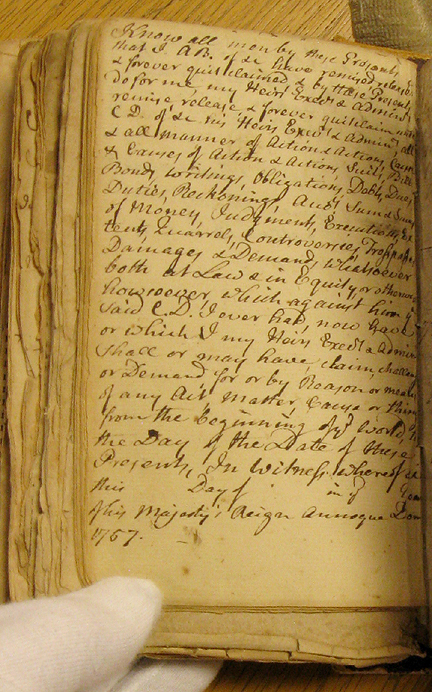
My discoveries occasionally reveal how documents were inventively brought together by their creators.

Applying such principles and their many practical derivatives, my thoughts turn to how Scholastic philosophers considered “order” as an indication for understanding divinity. Comprehending creation and knowledge may not be the same as arranging and describing archives, but the spirit is not far away. Generating compendia and indices for the sharing of information do connect philosophy and curation. In the analyses, I get to see how people value what they’ve produced, and how institutions structure (or don’t structure) themselves.

These items may not look alike, but they are part of a unified subseries.


3

“Everything is in everything, and partitions are only possible by abstractions,” wrote the French Dominican philosopher Antonin-Gilbert Sertillanges in The Intellectual Life. Vaster and more complex than archival groupings are the pieces and thoughts of our days and years. Woven among physical formats that comprise pictures, words, and artifacts- are those of sense and recollection. Wafting leaves and their propelling air currents amount to a unity of form and counterform. Life fragments are in our midst, and buoyant. Like curators and readers, we can choose to comprehend our findings. Our accessions, random and scattered as they are, require our reckoning and processing, in our pursuits of understanding. Persevering intact through turbulent times demands more than continuity. One must have the metaphorical “ears to hear,” to prevent from becoming insensitive. Our unique individual contexts join together our experiential fragments. As we cultivate instincts and perspectives, our contexts become more discernible to us. Pondering these things on a day off, attending a church service, the liturgical sequence brought to mind collated fragments reverently brought together as commemoration and observance. Each portion held holy, but all in cohesive union. And my walked paces amidst the hues of autumn fragments continued through narthex, nave, and sanctuary- returning again albeit transformed to the outdoors.


Sunday, February 11, 2024

imagination

“For me, reason is the natural organ of truth;
but imagination is the organ of meaning.
Imagination, producing new metaphors or revivifying old,
is not the cause of truth, but its condition.
It is, I confess, undeniable that such a view indirectly
implies a kind of truth or rightness in the imagination itself.”


~ C.S. Lewis, Bluspels and Flalansferes


Giving lectures and reading to audiences have evolved into very comfortable and pleasant experiences. My teaching background certainly helps, but knowing my topics frees me from excessive rigidity. Obviously, it all depends upon the audience, and no two groups are ever alike. A recent presentation about archives lent itself especially well to some storytelling. On that particular afternoon, during a dreary winter day, I had brought out examples of treasures such as rare books, maps, prints, and city directories. These types of artifacts are especially conducive to time-traveling musings. I’m surely with the patrons, students, and all the curious- as we all marvel at photographs of specific places then-and-now, noticing the changes.


To do justice to my occupation, I taught myself about when certain various prominent buildings were built, extended, or demolished. Such facts continue to be invaluable for identifying undated imagery and supporting researchers. Years ago while sleuthing out the sites of extinct streets, writing narrative essays with an expression I coined: “ghost streets.” This is to say buried thoroughfares that are gone without a trace. These have been very popular. In a juxtaposition of past and present, cheering an audience on an especially damp day, I made reference to how the local art college is currently in a former department store building constructed in 1904. The store was called Porteous, Mitchell, and Braun (that first name is pronounced “POHR-tchuss”).

now that's a proper pen department


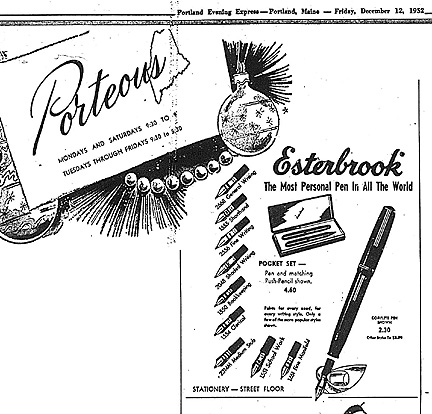
“Now imagine,” I offered to the group, pointing to my left, “walking up Congress Street, stepping inside that big building at number 522, and suddenly noticing bright chandeliers, colorful merchandise, the din of chatting salespeople and customers above the muffled piano music, and the aromas of cosmetics and perfumes.” There followed memories of people among my audience, chiming in with their own recollections. I held up a Porteous ad for Esterbrook fountain pens, printed from a 1952 Christmas season issue of the Portland Evening Express (which gave me a chance to explain the microfilmed newspaper collection). I am often in the role of informing patrons about what was, en route to explaining what is.


somehow, all I needed was the advertisement, and look what I brought back from my time travel errand.


Early 20th century archival theorist Sir Hilary Jenkinson taught that archivists do best to read the documents in their care, and to be acquainted with the contents. I’ve personally seen this to be an extremely useful idea, especially when it comes to the level of service I can provide, and how I draw together sources and researchers. It’s really about recognition and making connections. Like compassion, these are uniquely human abilities. I’ve been studying the materials, making notes, and committing many things to practical memory. Indeed, this has become the less-traveled road, but the relational touch is surely the most meaningful. Just as people are souls, archives are recorded activities that attest. Through the years of preserving and providing public access to archival material, by default I’ve also had innumerable occasions to be acquainted with many of the people who inquire and use these artifacts. Often, there are patrons who will show up daily for a stretch of time, feverishly nibbling away pursuing evidence of parts of their personal histories. I witness all ages seeking the past, looking for understanding and purpose. I’m no different. Each request is respected, never derided. So many among us simply want to know, then let the witnessing archivist be an eloquent accompanist. With the philosopher Blaise Pascal who pondered in writing: “I am astonished at being here rather than there; for there is no reason why here rather than there, why now rather than then.” Inevitably, archives are facts that can enchant the imagination. Once again, and along with my students and patrons, I’m affected, too. Frankly, I could never figure out why other archivists don’t write about their metaphysical experiences. Manuscripts, images, maps, ships’ logs, and even ledgers present much more than what superficially meets the eye. And then there are the interactive discoveries for researchers interpreting the records.


The preservation of the documental record is meant to inform the panoramas between planning ahead, as well as the fleshing out of historiography. Narratives abound in manuscripts, revealing human activities and communications. Indeed, we can understand the popularity of historic novels! And then there is reverie. Serving the public for many years, once in a while I’m asked by patrons marveling over century-old photographs of streets crowded with pedestrians and trolley cars, “Why can’t things go back to the way they were?” Many, many more people wish this without admitting so much. We imagine with our hopes; speaking as a New Englander in the local parlance: “So don’t I.”

From pinched and barricaded confines, imagination insistently pries at the horizons. Ambition is vital. Don’t expect anyone to remind you to flex your hopeful imaginings; we must know to exhort ourselves. Speaking for myself, I write my wishes and prayers as journal entries, often scribing them amidst woeful environments. Remember to dream forward: observe and read between the lines. What we see is not all there is. Our conditioned and compromised cultures reduce our palates to bland, surface bluntness. It is for us to challenge ourselves to think beyond what is “at face,” and cultivate our intellects. We navigate societies of documented hard numbers and literal databases, but the human-voiced manuscripts invite us into the poetry of metaphor. When I managed and facilitated the reference library in a Catholic college, I read the memoir of St. John XXIII in which he wrote of himself, “I am a songbird perched in thorns.” Such a powerful metaphor has never left my thoughts, and I’ve invoked it numerous times since.


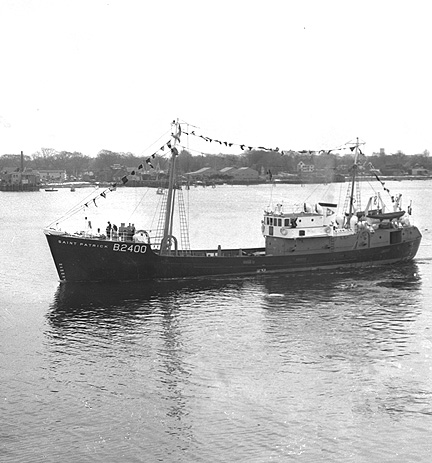
The spheres of metaphor and allegory have always provided places of habitation for me, though perceiving through these lexicons can be a two-edged sword when I have to creatively translate for those who cannot interpret subtlety. Fulton Sheen once said, “Introspection requires a lot of humility;” helpful words for speaker and listener alike. I’ll occasionally use archives as metaphor with my philosophy students. Wonderfully diverse as they’ve always been, they refreshingly think and speak at multiple levels. Archival work is entwined with axiological applications- as principles of origin, function, and value are integral to stewardship. Examples help provide crossroads for abstraction and practicality to meet. These also provide runways for metaphysical flights of fancy. Pointing to historic maps and photographs, I’ll ask, “Do places have intrinsic memories?” We’d like to think so. In my helpless insomnia, I imagine being cradled on the waves, aboard a peaceful vessel. In my curatorial adventures, I found documentation from 1948 about a Friend Ship that was sponsored by the Maine Rotary, which brought 107 cargo tons of food and clothing to France. The ship, built in Maine, was called the Saint Patrick, and it crossed the Atlantic in eleven days. Pleasant thoughts of calm seas and noble ambitions. Keep on visualizing better times. As confining situations constrict, my imaginings of comforts, vastness, and possibilities intensify as antidotes. I’d like to think there is still time for improvement.

the Saint Patrick sailing from Portland, Maine to Nantes, France


Friday, January 1, 2016

equipped for the new


"My pipe is out, my glass is dry;
My fire is almost ashes too;
But once again, before you go,
And I prepare to meet the New:
Old Year! a parting word that’s true,
For we’ve been comrades, you and I --
I thank God for each day of you;
There! bless you now! Old Year, good-bye!"


~ Robert W. Service, "The Passing of the Year."


An arduous year has concluded, making way for a new one. Although I speak in relation to the Western calendar, with weeks and months appearing as the dotted lines of municipal peripheries, there remains a sense of new frontiers. We may each mark the anniversaries of our personal milestones, ascribing meanings of our own. But with the prospect of a new year, I noticed time thresholds while routinely re-inking my pen. In this context, some of my everyday routines absorbed the marking of time passing.

In recent years, I have been profoundly engaged in a large project resulting from my rescuing of seventy years of newspaper photographic negatives, which I’ve been organizing and conserving into an exhaustive documentary archive. The trove of many hundreds of thousands of pieces of film had been destined for disposal- but that has surely been prevented. In the almost-daily pursuit of identification and indexing, I’ve been examining- and in a metaphorical sense, inhabiting- each of these images, one at a time, marking their eras, and travelling through the decades from the 1930s to the mid-2000s. As New Year’s Eve approached the present threshold of 2016, I catalogued June of 1954. Amidst descriptive work to index Memorial Day of 1954, the back of my thoughts began to perceive the close of 2015. Yesterday, while identifying the photo (below), of a Mr. Sampson opening his new grocery store in 1954, I mused at my light-table, and noticed the radiating pride of a family businessman. He was surely looking confidently toward the future.


With my 4x magnifier, I looked closer, and remarked at a gesture of eager preparedness: Mr. Sampson had no less than eight sharpened pencils in his tweed suit pocket, pointed up and at the ready. Hope sprung eternal in Mr. Sampson’s spring of 1954, and I am burrowing through the winter of 2015-2016 determined to be undaunted. It’s a new year. Sharpen the pencils, ink the pen, oil the typewriter carriage, take some deep fresh-air breaths, and persevere. Out with old; be equipped for the new.


Along with the grocery store photo, and numerous sundry group pictures from the society pages, I identified a Mr. Jacobsen (below) at his desk. It seemed insufficient to leave it at that; I enriched the finding aid (the archival term for a collections inventory) with an additional line about the table radio behind him, as well as the pencil. This is more than a portrait for a news item: he is assiduously at work. There are tasks to be completed, and he is ready!


Today, more than 61 years after the above photos were taken (and they haven’t seen the light of day since), I am gathering my forces to venture into 2016. Indeed, as I write this, I hope to encourage you in your future constructive pursuits. Remaining encouraged is essential.


Here’s to a New Year of growth and life-giving ventures.
Thank you to each of you, for reading and your encouragement!


~~~~~~~~~~~~~~~~~~~~

See also : Graphite Archive;

and Typosphere Cheer.


Friday, November 26, 2010

vermont field notes


"The miracles in fact are a retelling in small letters
of the very same story which is written across the whole world

in letters too large for some of us to see."


~ C.S. Lewis, Miracles, essay from God in the Dock.


New beginnings are discovered in many shapes and forms. As varied as our individual tastes can be addressed, so are we each inspired such that our souls are spoken to directly. Upon taking to the roads for long-awaited time off, I packed the usual provisions for two weeks away. Among the clothing, provisions, and reading, I added a blank notebook. A small, pocketable, single-signature memo book, appropriately commemorating my westerly destination: the State of Vermont. I’ve made two trips there, in the recent six weeks. My change of scenery from my home on the Maine coast is to sojourn to the Green Mountains of Vermont. And pristine new pages indicate travels to be engaged. There will be something to write about, something new to begin. I try remembering the wisdom of seeing the wider journey as a trusting motion, humble as it is, that advances from one beginning to another.


The action of taking to the road has its own connotations as a new beginning. Weather and surface conditions are more ingredients than detriments. The retreat begins by celebrating open roads that lead to hearts’ desires. If daily doldrums warrant writing, how much more are adventures means for documentation. I’d brought the larger journal with me which I’d been writing in since the middle of the summer, along with my typewriter. With the small Field Notes book, I began by dropping in slips of paper and jotting notes at stopping places along roads, forest trails, and the Weston Priory.


The little book began to look like something of a scrapbook, then as a kind of handbook with needed maps and itineraries. Adding it into pictures, the book resembled a passport. The working, unfinished document en route to becoming an archival document. Archival records begin with their “useful lives,” when the documents are needed in a person’s or organization’s daily operations- until the records become “noncurrent,” and thus “evidence” of that which they document. Now I see my document as artifact, and through the pages I can recall the mountains, rivers, and skies that surrounded my steps.


A gather of fresh pages provides a clean slate. New canvasses are neutral until we begin to make them our own. It is up to our creativity to discover and add meaning to the life given and its resources. Perhaps you, too, made picture albums and decorated your notebooks with stickers, back in school. We make things our own by adapting and altering materials of daily life. Look at how many motor vehicles are intriguing rolling scrapbooks. The manufactured car becomes “my car,” as a wooden table with a drawer becomes “my desk.” Then there are living, breathing places. If you live in New York, what is “your New York?” It will be distinct from the millions of others who might say, “my New York.” A great topic for your journals could be a list of what your (fill in the place name) is, in your own words through your own experience.


As for me, I would need far more than only one Maine memo book! I daresay my “Maine field notes” threads together all my journals since I began writing. But that’s no deterrent to trying. My Vermont begins with mountain roads, rolling landscape, the Long Trail, friendly towns, and pine air. Places that inspire writing. The outdoors in all seasons. Looking back sixteen years and to the present, the heart of “my” Vermont remains the Weston Priory, the Benedictine monastic community that is never far from my thoughts.


.
Above: I make sure to note the times of prayer at the Priory.


Below: Inadvertently, I unusually marked the location of the Priory

with an appropriate non-cartographic symbol...


If it isn’t their stewardship of their environment, or their wise and inspiring words, or the countless friends I’ve met there, it’s their melodies that accompany my steps wherever I travel in this world.


Place can transcend physical space, when it becomes our “own.” We experience the places we write about, and our recorded interactions go forth with us. When I reached Weston this recent time, I gave one of the brothers- who writes beautiful poetry- a Maine Field Notes memo book. We had a good laugh about writing in books that represent the other person’s home. Brother Augustine immediately recognized the motifs of old-fashioned agricultural notebooks, later stopping to talk about how it conveniently fits in his jacket pocket. This got us talking about how writing is integral to our work days. A great many of us do this, applying ideas from one facet of life to another. Pencils shorten in succession, as strings of words extend their trails. I completed the notebook, shortly after getting home from a second trip to Vermont- this time to help a close friend who is a college chaplain with a community event.


Winter now at our doorsteps, my little autumn chronicle is complete. The writing exercise is something I’d do again and highly recommend. Completing so compact a project, closing this small loop, has been surprisingly gratifying. I’ll remember Brother Augustine encouraging me to keep on writing, “with a good sharp pencil!” It’s all grist for the graphite mill. Indeed, the sums of our sojourns are subsumed by our inner odometers.


Wednesday, October 15, 2008

archives


“The sheer bulk of modern records
makes their destruction inescapable.
The difficulty is to decide wisely and well
what shall be destroyed
and what shall be retained.”

~ William Kaye Lamb, The Fine Art of Destruction


One of those things only I would be able to recognize and laugh at, is noticing that whenever I tenaciously clean my desk area at home, I’ll do the same sort of cleaning at work- or vice-versa. It seems that if I want to clarify my thinking, the effort manifests across the boards. Years ago, when my office-studio included a darkroom, one evening while at home it occurred to me how my kitchen resembled the photo lab. Right down to the little bulletin board above the light switch. Organizing baking utensils seamlessly mirrored how I kept printing and developing tools at the ready. One of the downsides to having many avocations mixed with vocations is how each involve accumulations.


And I’ve had to focus my pursuits, prioritize how I can try dividing the time I have, and then make space by giving away what is no longer useful. In the progress of living, we invariably learn that we can’t keep everything. I’ve found that I can do many things- but surely not everything. And would I want to, anyway? More than proving multi-tasking prowess, there is greater sublimity in selectivity and simplicity. Accumulations and collecting manifest in many forms, including the tools and results of our crafts, mementos, and assemblages of our thoughts. And equally, we can bury ourselves with both material and mental agglomerations, especially without some boundaries. Aspirations are not to be bound, not as we might exercise the confines of schedule and space. Limiting personal aggregations are separate from the detriment of limiting one’s perspective and aspirations. But how else to know one’s figurative limits, aside from lived realities? Being always younger than the majority of my colleagues, over the years, I’ve seen how many establish their limits. I’m also aware not to resign myself to limiting my sense of exploration and anticipation- choosing not to be sunk by cynicism. Doing this seems to require a vigilance similar to that of cultivating a body of work, or a craft. Looking at the work I do so intently, it has been occurring to me how there are theoretical connections between the different skills I practice and the spiritual vocation I’m called to express and pursue with my life.


Theory and practice: what we say and what we do; one can evaluate the other- and surely this is inevitably how we are evaluated. Momentarily speaking from the standpoint of a fulltime working archivist, it seems that archival theory has some application to this double-theme of managing excess. It seemed ironic to me, that while I’ve been organizing major historic collections, having the charge of one such department, and even traveling the region instructing the curatorship of archives, that my life apart from work should occasionally find itself in disarrays of paper heaps and jumbled thoughts! Why keep what neither serves nor informs? If simplicity helps me think more clearly, than it’s worth the effort to assiduously keep things simple and purposeful. For a curator of the soul, there are “collections management” issues that are really the same as those affecting document archives.

In graduate school, we studied texts by Sir Hilary Jenkinson, one of modern archival theory’s innovative minds. Jenkinson entered the field in the aftermath of World War I, when the antiquated profession found itself unprepared to deal with a massive proliferation of manufactured documents. A bit like today. Suddenly, the profession had to engage in the unprecedented obligations of selecting materials for preservation- and for disposal. Jenkinson posed the question, “What is the criterion for destruction?” “There,” he added, “is the starting-point of criticism.” The crossroads, in any matter, are what get us thinking. From there, we join a continuum of advocacy for the historic record, while also evaluating documentation against context. At the prospect of reaching his archival terra incognita, Jenkinson suggested keeping “destruction diaries,” that would inventory and thus represent what had been deemed documentary chaff. Decades later, with tested records-management policies long in place, W. Kaye Lamb added that while controlling quantity, archivists needed to keep open minds regarding future potential uses of the documents in our spheres of stewardship and carefully focus preservation energies on unique and informative collections. We all have only so much space and time- for an institution it may be shelves and laborers, and for a human soul there are limits on what we “give place” to, in our hearts and thoughts*.


Now consider what archival methodology has to teach about managing the extraneous. How to minimize and dispose of things and thoughts that obstruct my vision of sources that have actually strengthened me through struggles and false starts in this life. When I’m in the role of archival consultant, seemingly “parachuted” into incorrigible messes of heaped volumes, deteriorated ledgers, and rolled up embrittled maps, documents, and pictures... I begin with a survey. Resisting the impulse to stand still in overwhelm, surrounded by dusty and unlabeled piles in acidic boxes and bags (paper and plastic), I simply list what types of materials I can find- by format- getting a sense of what I’m dealing with. On such a cursory pass, I only move the stuff so I can see what there is, and to do some quick measuring. Each area and wall gets a name, like “3rd floor, north wall,” for example, so I can at least retrace my steps. All the complex strategies, labor-intensive processes, and researching follows. During those surveys, I make myself able to visualize the whole mess as a trim, finished, and indexed collection. Subsequently there are all the procedures for developing, presenting, and maintaining these collections, always looking for what may need additional conservation.


Likewise, for the archives of the soul, there will always be collections to manage, to groom, to verify, so they can be referenced well. A constant method, if you will, is that of maintenance: the tending of the soul. We are ever collecting information and impressions, and discarding them. Being our own curators implies an assessment of the vitality and value of our own inner archives of anecdotal thoughts, attitudes, and perspectives. After the type of triage I’ve described, which is needed when organizing a neglected corpus of unfocused accumulation, the follow-through comes in the forms of careful upkeep and watchful acquisition. Subsequent accessions are to be considered in light of the integrity of existing collections, their context, and pertinence. To appropriate again from Jenkinson, what you uphold must warrant your “physical and moral defence.” It may be an influence, an affiliation, a demand, an accumulation held too long after its records life-cycle, or some other burdensome digression. Here is where it becomes easier to shard away what can’t be used, by comparing whatever that is, to what is needed in order to progress to a wholeness that is a benefit to others, self, and true to a sacred vocation.

In this context, it makes a world of sense to dispose of these types of space-consuming inner archives, or even to make the effort to remove a pervading destructive consciousness of collected thoughts. But that is far easier said than done, and if what remains for a while is a Jenkinsonian “destruction diary,” then so be it- but let it be inconveniently shelved. In a spirit of trust, the obsolete and useless collections will ultimately be vanquished. The anonymous author of The Cloud of Unknowing observed how daunting distractions can get for those who “take up the contemplative work of love.” He advocated a healthy detachment from things material and even spiritual, from situations and projects both good and ill. “To put it briefly, during this work you must abandon them all beneath a cloud of forgetting.” In so bold an effort, repressive hindrances are effectively neutralized. A mindset of hopelessness leads nowhere and the antidote is trust in the Immutable, realizing how the Divine indeed manifests in our lives. This kind of mindfulness keeps us aware of the strength needed to artfully de-accession the records we don’t need. And in the yield there will be space for newer and more relevant archives.


* Ephesians 4 : 25-27