Showing posts with label archivist's life. Show all posts

Tuesday, July 8, 2025

small

“Negations seem to say less,
but actually they say more... expressing transcendence.
The more intimate the ascending force, the more powerful the elevation;
the deeper the love, the more fruitful the rising. It is beneficial, therefore,
to practice in this manner.”


~ Saint Bonaventure, Love Enkindled


Perhaps, if there will be interest to someone far into the future, the telescopic truncation of time will reveal a dovetailing of present-day crises. From intensely economically recessed times, there followed a devastating global pandemic, giving way to this contracting and stratified era. What comes next remains to be seen. While the cultural and infrastructural scaling-back of the past decade seems yet to hit the bottom, contrasting and exclusive opulence has yet to crest. The view from my very modest perch is that of scaled-back times persisting and forcing ambitions into compromise. Reflecting upon the ancient prayer to be led away from temptation and delivered from evil, there really is no other wise choice but to persevere and to improve as possible. No turning back, and no stopping at this extremity of my hardworked tracks. This often comes to mind, sometimes when my daily commute includes a long stretch of shadeless barrens of broken pavement mildly recalling slivers of my junior high school trudges. The urgency of perseverance bites down on my work days. Keep going, I tell myself, even if just by modest increments. Big ideas may exemplify ambition, though progress may manifest by small measures. Reaching destinations, apparently, is the guiding big idea. Complex entities become intelligible, as Descartes posited, via analyses of the smaller components. This comes to mind as I process oceans of archival documents and images while keeping the broader entirety in view. Completing projects, of any extent, also carries metaphors about letting go, taking on new projects, and persisting in my belief that better will ensue.

Amidst a societal prevalence of necessary downsizing, terms such as small and humble have ceased being pejoratives. Basics being unaffordable for so much of the general population, frugality has taken on a self-defensive connotation. Economics and personal reach are obviously tied together. Many of us are brought to the challenge of whether and how less can be more. What happens to the scale of our hopes, as buying power dissipates? Shall we thrive in our smallness?

Such small things in a major accomplishment for the ages.


Living in a scenic, yet depressed region whose chief commerce is tourism reveals a juxtaposition of extremes which are impossible not to notice. For this essay’s occasion, my treatment of smallness is along the lines of making do- as necessary. Small pieces in an immense puzzle, such as one 35mm negative among 1.2 million- each that I examined while interpreting and processing an enormous archival collection. In context all those tiny parts find their greatest research and documental impact. Gem-like smallness, from artifacts to difference-making mechanical parts, are outsized in their importance. Think of ingredients. Years ago, when my mother taught me to bake bread, she showed me what a pinch of salt is, and how integral that is to the exponentially larger whole. When I’m binding books, I regularly see what a great difference a sixteenth-of-an-inch makes. Ponder the parabolic implications around grains of leaven and mustard seeds. Astonishingly simple things serve to form a reliable world around us. When I see ads and signs about “buying small” from a small and local business, building smart and small, companies and venues that publicize their personal attention, it is interesting to see the humble somehow exalted.


As we are compelled, for any of many reasons, to redefine what we mean by significance, we may also reconsider how we interpret importance, and what is trivial. In all spheres, it is critical for me to know what I’m overlooking and needs my careful attention. Difference-making, subtle factors can paradoxically become vital. Indeed, there are solutions found in correctly fitted fasteners and cogs- and surely how far-reaching are small acts of kindness? In keeping with the understated and humble, it’s not really for us to know- except for when we are recipient of such gestures. My best teachers could never have known the extent of all I learned from them. The expression, “pay it forward” is something a person can do, however modest that gesture might be. But of course I want to do great things! I’ve tenaciously cultivated myself to achieve and inspire. Preparation and endurance crave tangible fulfillment. How, when, and if that materializes continues to be a mystery. So does not knowing what to reasonably expect. But action and motion must move in a forward direction. Rather than to expect to solve sweeping problems in a fell swoop (few can do that), I can manage in measure with small steps. In this light, lowly attains great importance. There is discoverable divinity in the ordinary, and in this light we see light. Plainness can conceal complexities. Consider the needed effort to pare many disparate ideas down to a concept- and to be easily comprehended! The big work en route to humility, simplicity not to be mistaken for smallmindedness.


Wednesday, June 19, 2024

collecting thoughts

“There are three principal means of acquiring knowledge available to us:
observation of nature, reflection, and experimentation.

Observation collects facts; reflection combines them;
experimentation verifies the result of that combination.
Our observation of nature must be diligent, our reflection profound,
and our experiments exact.
We rarely see these three means combined;
and for this reason, creative geniuses are not common”
.

~ Denis Diderot, On the Interpretation of Nature, no. 15 (1753).


1

With year after year of completed projects under the bridge, with more in progress and up ahead, there remain personal goals yet unfulfilled. Amidst achievements and recognition thus far, I particularly cherish a remark in the Comments section on my 2nd grade report card, from Public School Number 13, in New York City. Rating 6-year-old me, Mrs. Berger wrote: “He daydreams too much in class.” I think that comment was meant as a scolding, and certainly my parents were not impressed. I remember feeling embarrassed, but characteristically undeterred by the reproach. Gazing through windows is something compellingly natural to me, and whatever was interesting below on 94th Street was surely upstaging whatever was being taught at the front of the classroom. I’m actually proud of that remark. And I’ve grown to appreciate that, perhaps inadvertently, Mrs. Berger implied that a bit of requisite daydreaming was permissible- but not too much. For artists and all other creative thinkers, musing is essential. Untethered contemplation is a surer way to make sense of life, than to swish away at a smartphone.


By observation, we can really grapple and reckon with insights, in order to advance to our subsequent steps. Too much precious energy and time get squandered in wheelspinning ruts. Peaceful and uncluttered headspace is neither freely given, nor valued, in this culture of competitive perpetual motion. But the daunting side of an intermission is in the awkwardness of decompressing- worthwhile as it is- to be better able to recollect. Significant respite time away from the job continues to be practically impossible, so I cobble what I can when it’s possible, noticing the difficulty of turning my off-duty thoughts away from the workplace. Decades of diligence and industriousness have kept me employed, but a compounded effort is needed to remain artistically and intellectually fit for creativity. Good thing for daydreaming too much in class. I recommend it.

aperch at the window, College Club of Boston


2

Hopeful and constructive dreaming goes a very long way in the direction of bringing goodness to fruition. If you needed yet another reason to write daily in a journal, now you have this. And write manually, keeping in mind the untethered and focused aspects of musing and aspiring! While in the liminality of overburdened undercapacity, I’m egging on those musing traits with writing, photography, and dreaming of better days. If anything, this helps my frame of mind, dealing with the here-and-now. All such pursuits are enveloped in the all-comprising everyday life of the spirit, which also includes contemplative reading.


Pursuing my studies in philosophy is replete with discoveries, and I’m further encouraged as I teach some of these topics to students. The readings for my personal explorations are selected with personal development in mind. In turn, because I’m often studying such rare materials, I produce my own annotated indexes. These are very useful as references which I later share, and the notebooks themselves are great for me to read. Indeed, and true to my profession, I also digitize my indexes and notebooks; these are my “preservation backups,” as well as searchable. These personal studies are entirely fueled by my own interests and discerned needs; philosophy consoles, as Boethius knew very well. In Love Enkindled, Saint Bonaventure wrote about how contemplation brings us to the spark of discernment, which he called synderesis scintilla. This comes to mind, when I’m conscious about redirecting my thoughts. Conscience is awakened, Bonaventure wrote, by moving from error to consideration of the human condition, to meditating upon what is good. Finding ways through hardships, I’ve kept to these studies, as well as spiritual health, staying intellectually active and away from burning out.

a floricultural cabinet


Among the many ways to identify my full-time work, I most often think of day-to-day torchbearing and pouring-out; preserving and explicating. Essentially, this is the joining of words with readers. Visitors, researchers, and classes think of archives as cabinets of curiosity. In this sense, cabinet as a synthesizing, thematic compendium. Perhaps they are, increasingly standing out in contrast to the electronics that promote content over substance. And this isn’t to denounce literacy’s numerous formats; I use and present them all. Indeed, my preference continues for the reflective surfaces of imprints and manuscripts. The physical items themselves have stories. As a conservator I’m acquainted with how they’re made, and as an archivist I’m making comparative references and metadata for all manner of seekers. My role also takes the form of inadvertent confessor: patrons from teenage to old age tell me about how they favor real books and want to handwrite. Well, go ahead. Don’t let me stop you. I’ll often ask, “Do you keep a journal?” Muse away and expand your mind. Be that person getting seated on a bus with a book or a journal, instead of catatonically fiddling with a phone. As you glance between daydreaming out the window toward the streets and reading, notice the gawking expressions as the entranced stare into their devices. The side of me that is still a skeptical little kid at P.S. 13 says, “I don’t want to be like that.” If your musing and observing is bold enough, you’ll be better able to make fun of your self.


3

aboard a trawler, in winter


Integral to doing everything I can manage in order to stay mentally healthy is perseverance in seeking and exploring ideas. Yes, there’s the musing I’ve mentioned here. Plants need water and natural light to keep growing. My observing intuitively turns to words and imagery. Often, both turn up during a good stroll. An expression of mine from my teen years, which I still use when taking up a camera on the way out the door, is “I’m going out to look for photographs.” There are few things more sensible to me. Noticing the trawlers docked along the Portland waterfront reminds me of how I wind up pulling ideas from the depths. The nets on those boats drag down deep and far enough to bring up all kinds of shellfish and groundfish. Maybe our minds have their own microscopic versions of trawling pulleys. Similarly, I trawl for ideas- unforced and all quite naturally. Something seems always to remind me of something else. Moving through the day are gleanings of thoughts. Bus and train rides, lunch breaks, and laundromats provide scenarios for the culling and recording of ideas. Part of that is my making sense of changes, disappointed expectations, hopes, and things I witness. And ironies. As I’ve done for many years, the idea jottings are in pencil, and the elaborated thoughts get their due in pen-and-ink. Navigating by instinct implies a certain amount of individual roadbuilding. The voyage is not an end, but surely a means. Creativity, learning, and helping others learn broadly serves as an itinerary.

trawlers and ideas


Sunday, February 11, 2024

imagination

“For me, reason is the natural organ of truth;
but imagination is the organ of meaning.
Imagination, producing new metaphors or revivifying old,
is not the cause of truth, but its condition.
It is, I confess, undeniable that such a view indirectly
implies a kind of truth or rightness in the imagination itself.”


~ C.S. Lewis, Bluspels and Flalansferes


Giving lectures and reading to audiences have evolved into very comfortable and pleasant experiences. My teaching background certainly helps, but knowing my topics frees me from excessive rigidity. Obviously, it all depends upon the audience, and no two groups are ever alike. A recent presentation about archives lent itself especially well to some storytelling. On that particular afternoon, during a dreary winter day, I had brought out examples of treasures such as rare books, maps, prints, and city directories. These types of artifacts are especially conducive to time-traveling musings. I’m surely with the patrons, students, and all the curious- as we all marvel at photographs of specific places then-and-now, noticing the changes.


To do justice to my occupation, I taught myself about when certain various prominent buildings were built, extended, or demolished. Such facts continue to be invaluable for identifying undated imagery and supporting researchers. Years ago while sleuthing out the sites of extinct streets, writing narrative essays with an expression I coined: “ghost streets.” This is to say buried thoroughfares that are gone without a trace. These have been very popular. In a juxtaposition of past and present, cheering an audience on an especially damp day, I made reference to how the local art college is currently in a former department store building constructed in 1904. The store was called Porteous, Mitchell, and Braun (that first name is pronounced “POHR-tchuss”).

now that's a proper pen department


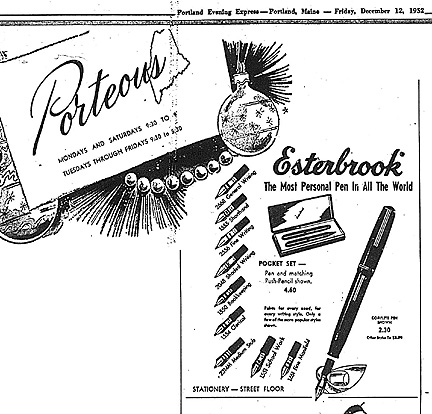
“Now imagine,” I offered to the group, pointing to my left, “walking up Congress Street, stepping inside that big building at number 522, and suddenly noticing bright chandeliers, colorful merchandise, the din of chatting salespeople and customers above the muffled piano music, and the aromas of cosmetics and perfumes.” There followed memories of people among my audience, chiming in with their own recollections. I held up a Porteous ad for Esterbrook fountain pens, printed from a 1952 Christmas season issue of the Portland Evening Express (which gave me a chance to explain the microfilmed newspaper collection). I am often in the role of informing patrons about what was, en route to explaining what is.


somehow, all I needed was the advertisement, and look what I brought back from my time travel errand.


Early 20th century archival theorist Sir Hilary Jenkinson taught that archivists do best to read the documents in their care, and to be acquainted with the contents. I’ve personally seen this to be an extremely useful idea, especially when it comes to the level of service I can provide, and how I draw together sources and researchers. It’s really about recognition and making connections. Like compassion, these are uniquely human abilities. I’ve been studying the materials, making notes, and committing many things to practical memory. Indeed, this has become the less-traveled road, but the relational touch is surely the most meaningful. Just as people are souls, archives are recorded activities that attest. Through the years of preserving and providing public access to archival material, by default I’ve also had innumerable occasions to be acquainted with many of the people who inquire and use these artifacts. Often, there are patrons who will show up daily for a stretch of time, feverishly nibbling away pursuing evidence of parts of their personal histories. I witness all ages seeking the past, looking for understanding and purpose. I’m no different. Each request is respected, never derided. So many among us simply want to know, then let the witnessing archivist be an eloquent accompanist. With the philosopher Blaise Pascal who pondered in writing: “I am astonished at being here rather than there; for there is no reason why here rather than there, why now rather than then.” Inevitably, archives are facts that can enchant the imagination. Once again, and along with my students and patrons, I’m affected, too. Frankly, I could never figure out why other archivists don’t write about their metaphysical experiences. Manuscripts, images, maps, ships’ logs, and even ledgers present much more than what superficially meets the eye. And then there are the interactive discoveries for researchers interpreting the records.


The preservation of the documental record is meant to inform the panoramas between planning ahead, as well as the fleshing out of historiography. Narratives abound in manuscripts, revealing human activities and communications. Indeed, we can understand the popularity of historic novels! And then there is reverie. Serving the public for many years, once in a while I’m asked by patrons marveling over century-old photographs of streets crowded with pedestrians and trolley cars, “Why can’t things go back to the way they were?” Many, many more people wish this without admitting so much. We imagine with our hopes; speaking as a New Englander in the local parlance: “So don’t I.”

From pinched and barricaded confines, imagination insistently pries at the horizons. Ambition is vital. Don’t expect anyone to remind you to flex your hopeful imaginings; we must know to exhort ourselves. Speaking for myself, I write my wishes and prayers as journal entries, often scribing them amidst woeful environments. Remember to dream forward: observe and read between the lines. What we see is not all there is. Our conditioned and compromised cultures reduce our palates to bland, surface bluntness. It is for us to challenge ourselves to think beyond what is “at face,” and cultivate our intellects. We navigate societies of documented hard numbers and literal databases, but the human-voiced manuscripts invite us into the poetry of metaphor. When I managed and facilitated the reference library in a Catholic college, I read the memoir of St. John XXIII in which he wrote of himself, “I am a songbird perched in thorns.” Such a powerful metaphor has never left my thoughts, and I’ve invoked it numerous times since.


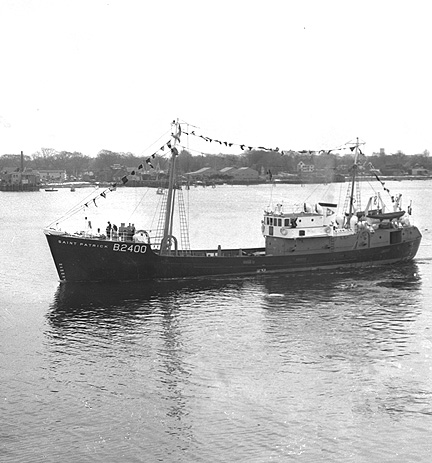
The spheres of metaphor and allegory have always provided places of habitation for me, though perceiving through these lexicons can be a two-edged sword when I have to creatively translate for those who cannot interpret subtlety. Fulton Sheen once said, “Introspection requires a lot of humility;” helpful words for speaker and listener alike. I’ll occasionally use archives as metaphor with my philosophy students. Wonderfully diverse as they’ve always been, they refreshingly think and speak at multiple levels. Archival work is entwined with axiological applications- as principles of origin, function, and value are integral to stewardship. Examples help provide crossroads for abstraction and practicality to meet. These also provide runways for metaphysical flights of fancy. Pointing to historic maps and photographs, I’ll ask, “Do places have intrinsic memories?” We’d like to think so. In my helpless insomnia, I imagine being cradled on the waves, aboard a peaceful vessel. In my curatorial adventures, I found documentation from 1948 about a Friend Ship that was sponsored by the Maine Rotary, which brought 107 cargo tons of food and clothing to France. The ship, built in Maine, was called the Saint Patrick, and it crossed the Atlantic in eleven days. Pleasant thoughts of calm seas and noble ambitions. Keep on visualizing better times. As confining situations constrict, my imaginings of comforts, vastness, and possibilities intensify as antidotes. I’d like to think there is still time for improvement.

the Saint Patrick sailing from Portland, Maine to Nantes, France