Showing posts with label archives of the soul. Show all posts

Sunday, August 11, 2024

past and future

“How can the past and future be,
when the past no longer is,
and the future is not yet?
As for the present, if it were always present
and never moved on to become the past,
it would not be time, but eternity.”


~ Saint Augustine, Confessions, Book 11


The unrelenting marathon of professional life finds some redemption in the complexities of service and curatorial projects. Indeed, preferring productive and supportive work, I’m not in this for the palace intrigues or the ladder rungs. The prize at the unknown opening of the maze must lead to something much better. And the route has to tunnel beneath the careful consistency of relational and physical accomplishments. Holding firmly to my ethic of “bloom where you’re planted,” in addition to managing and facilitating a full-service department single-handedly, there is no shortage of projects. Just as well, the satisfaction in producing successions of positive results serves as both motivator and sanity factor. Josemaría Escrivá famously said that vocation is the greatest gift of grace, and a vocation surely has many related facets. I still strongly believe in the work I’m doing, bringing out unique archival materials that inform many- including me. In order to generate effective and accurate metadata, varying degrees of thoughtful analysis are needed- from basic verification, to skimming, to comparative reading. All the while, there’s always an eye on time-efficiency.


A project I pulled to the fore, amidst my complete overhaul of the archives I’ve most recently created (having set up archives throughout the State, over the years) is a large array of rare, local serial collections. As much as researchers love them, the service end of things is replete with indifference about newspapers and periodicals. I happen to really enjoy the writing styles and advertising graphics of eras past. To me, the materials are captivating- essentially history in real time. For each time I bring out digitized ephemera, I hear from grateful audiences who devour the contents. And with the researchers, I’m fascinated to see what was, leafing up to later dates, then back to earlier years and decades. Through all my inventorying and indexing, I’m better able to connect people with information. And it happens. About two months ago, I sought out and processed a unique run of a cultural periodical, printed on newsprint, from the 1970s. It had been locally warehoused. Shortly afterwards, a visiting researcher asked whether I knew of that exact title, as she and her mother had both published in it. Bringing out the alkaline boxes of flattened papers, my guest was elated. This sort of serendipity is not uncommon. I can merely glance heavenwards, wink, and keep up the good work (and the good instincts).


While in the throes of sifting and sorting piles of antique newspapers which had been migrated from one library building’s attic to another’s basement, I found several items that I knew would fit perfectly in another city’s archives. It so happens I had created their archives more than twenty years ago, and remember their contents very well. Eager to deliver the gems, I carefully reinforced the 19th century broadsheets in a portfolio, and made a daytrip of my errand. En route, it occurred to me that while I had maintained some contact with that particular library, I hadn’t been inside the place in a long time. A life of continuous, hard work leaves very thin margins for respite. Trying to offset exhaustion with journaling and unstructured Sundays have provided ways to continue puddle-jumping, refraining from looking too far. Indeed, I brought the historic items to grateful recipients I’d never met before, in a building I hadn’t visited in twenty-three years. The place still looked the same, and it was heartening to see the calligraphed sign still displayed which I had made for them back in 2000. The last time I’d been in the place, I had completed major projects; it was shortly after my completion of graduate school. This time, I crossed their threshold after having achieved and endured numerous professional scenarios and challenges. My impression of this brief visit wasn’t an experience I expected- at the same time both strange and familiar. After quietly leaving the building, I walked to a nearby church to reflect, knowing the doors were open.


Again, I thought of Escrivá’s words- whose books I’ve known only in recent years- and how he told his readers to ask themselves who they sought when they approached the Sacrament. He said, “Are you seeking yourself, or are you seeking God?” That hour of contemplative intention, immediately following my strange visit with a past place of employment, was just the right instinctual balance. As much as archival work serves here-and-now access, and conservation for future use, the interpreting of raw material magnetizes our compasses toward the past. This week’s projects send me back to earlier projects in earlier places quite easily. All the jobs we’ve had, with our schools, communities, our various adventures dotting our timelines- good and bad- illustrate each of our personal histories. These stages along our pilgrimages form our perspectives. An individual is essentially a living time-capsule, replete with ethereal archives. Life and art mirroring each other amidst my wakeful hours, I wonder at the human version of deaccession and preservation. Tireless work makes for tireless thinking about work, especially all the pending projects. Insomnia tangles with my strategizing of the department I manage, and that slides into when I report to work, so that I can implement the ideas. And with my cultivated and critical senses and skills, the work always gets done.


Integral to the processing of historic serials is their preparation for longterm storage, retrieval, and future digitization. I’ve been doing all of these things, including a lot of the scanning, after flattening and even very gently repairing torn newsprint. No matter how disciplined my adherence to tasks-at-hand, it’s impossible to avoid reading from my discoveries. Indeed, the more informed I am of the content, the better my analyses for researchers’ queries. And, admittedly, the narratives and illustrations of bygone eras- be it the 1990s or the 1790s- are compelling in their vocabularies. Newspapers, in particular, are frozen moments with commentary. The paper strata themselves have distinctive stories, in their very ingredients and manufacturing. Handling and reading really go together.


There are embossed textures in pre-1840 cotton rag content paper, retaining an impressive amount of strength. Latter 19th and early 20th century newspapers were largely very cheaply made, using bleached wood pulp, resulting in thin and highly acidic surfaces. Depending upon how the paper has been stored, I’ve seen darkening that has the appearance of having been burnt. Scanning this type of material saves the content. Rewrapping the deteriorated pages, with enormous care, the telltale rattling sound attests to the papers’ embrittlement. The other day, while checking my work, it occurred to me how a computer screen can give digitized, antiquated text a similar look to present-day electronic text. Past and present become easily juxtaposed this way, but the genuine article has the intrinsic aspects of authenticity. Artifacts carry memorable content, but also the physical objects also have memory. Among my regular patrons is a researcher who writes about religious communities and biographies. Having just flattened, repaired, boxed, and inventoried a run of regional newspapers beginning in 1822, I brought him several early issues as a sampling for perusal. He was clearly impressed and inspired, spontaneously reading various paragraphs to me, from the cotton-based 200 year-old newspaper, in surprisingly good condition. We took turns reading to each other, talking about what we read as archaisms. A moment worth remembering in the life of doing this work. This fellow was astonished at how close these unique papers were to being discarded. Past is pulled to present, and projected ahead to future endeavors, in the search for knowledge and context.


Sunday, February 11, 2024

imagination

“For me, reason is the natural organ of truth;
but imagination is the organ of meaning.
Imagination, producing new metaphors or revivifying old,
is not the cause of truth, but its condition.
It is, I confess, undeniable that such a view indirectly
implies a kind of truth or rightness in the imagination itself.”


~ C.S. Lewis, Bluspels and Flalansferes


Giving lectures and reading to audiences have evolved into very comfortable and pleasant experiences. My teaching background certainly helps, but knowing my topics frees me from excessive rigidity. Obviously, it all depends upon the audience, and no two groups are ever alike. A recent presentation about archives lent itself especially well to some storytelling. On that particular afternoon, during a dreary winter day, I had brought out examples of treasures such as rare books, maps, prints, and city directories. These types of artifacts are especially conducive to time-traveling musings. I’m surely with the patrons, students, and all the curious- as we all marvel at photographs of specific places then-and-now, noticing the changes.


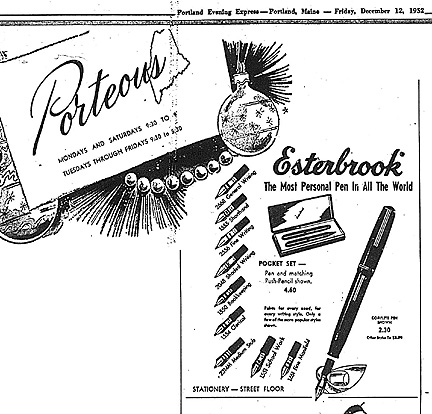
To do justice to my occupation, I taught myself about when certain various prominent buildings were built, extended, or demolished. Such facts continue to be invaluable for identifying undated imagery and supporting researchers. Years ago while sleuthing out the sites of extinct streets, writing narrative essays with an expression I coined: “ghost streets.” This is to say buried thoroughfares that are gone without a trace. These have been very popular. In a juxtaposition of past and present, cheering an audience on an especially damp day, I made reference to how the local art college is currently in a former department store building constructed in 1904. The store was called Porteous, Mitchell, and Braun (that first name is pronounced “POHR-tchuss”).

now that's a proper pen department


“Now imagine,” I offered to the group, pointing to my left, “walking up Congress Street, stepping inside that big building at number 522, and suddenly noticing bright chandeliers, colorful merchandise, the din of chatting salespeople and customers above the muffled piano music, and the aromas of cosmetics and perfumes.” There followed memories of people among my audience, chiming in with their own recollections. I held up a Porteous ad for Esterbrook fountain pens, printed from a 1952 Christmas season issue of the Portland Evening Express (which gave me a chance to explain the microfilmed newspaper collection). I am often in the role of informing patrons about what was, en route to explaining what is.


somehow, all I needed was the advertisement, and look what I brought back from my time travel errand.


Early 20th century archival theorist Sir Hilary Jenkinson taught that archivists do best to read the documents in their care, and to be acquainted with the contents. I’ve personally seen this to be an extremely useful idea, especially when it comes to the level of service I can provide, and how I draw together sources and researchers. It’s really about recognition and making connections. Like compassion, these are uniquely human abilities. I’ve been studying the materials, making notes, and committing many things to practical memory. Indeed, this has become the less-traveled road, but the relational touch is surely the most meaningful. Just as people are souls, archives are recorded activities that attest. Through the years of preserving and providing public access to archival material, by default I’ve also had innumerable occasions to be acquainted with many of the people who inquire and use these artifacts. Often, there are patrons who will show up daily for a stretch of time, feverishly nibbling away pursuing evidence of parts of their personal histories. I witness all ages seeking the past, looking for understanding and purpose. I’m no different. Each request is respected, never derided. So many among us simply want to know, then let the witnessing archivist be an eloquent accompanist. With the philosopher Blaise Pascal who pondered in writing: “I am astonished at being here rather than there; for there is no reason why here rather than there, why now rather than then.” Inevitably, archives are facts that can enchant the imagination. Once again, and along with my students and patrons, I’m affected, too. Frankly, I could never figure out why other archivists don’t write about their metaphysical experiences. Manuscripts, images, maps, ships’ logs, and even ledgers present much more than what superficially meets the eye. And then there are the interactive discoveries for researchers interpreting the records.


The preservation of the documental record is meant to inform the panoramas between planning ahead, as well as the fleshing out of historiography. Narratives abound in manuscripts, revealing human activities and communications. Indeed, we can understand the popularity of historic novels! And then there is reverie. Serving the public for many years, once in a while I’m asked by patrons marveling over century-old photographs of streets crowded with pedestrians and trolley cars, “Why can’t things go back to the way they were?” Many, many more people wish this without admitting so much. We imagine with our hopes; speaking as a New Englander in the local parlance: “So don’t I.”

From pinched and barricaded confines, imagination insistently pries at the horizons. Ambition is vital. Don’t expect anyone to remind you to flex your hopeful imaginings; we must know to exhort ourselves. Speaking for myself, I write my wishes and prayers as journal entries, often scribing them amidst woeful environments. Remember to dream forward: observe and read between the lines. What we see is not all there is. Our conditioned and compromised cultures reduce our palates to bland, surface bluntness. It is for us to challenge ourselves to think beyond what is “at face,” and cultivate our intellects. We navigate societies of documented hard numbers and literal databases, but the human-voiced manuscripts invite us into the poetry of metaphor. When I managed and facilitated the reference library in a Catholic college, I read the memoir of St. John XXIII in which he wrote of himself, “I am a songbird perched in thorns.” Such a powerful metaphor has never left my thoughts, and I’ve invoked it numerous times since.


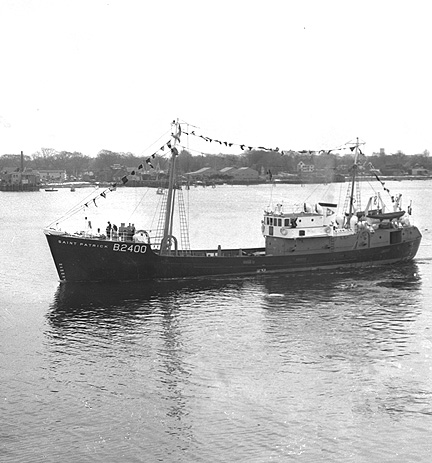
The spheres of metaphor and allegory have always provided places of habitation for me, though perceiving through these lexicons can be a two-edged sword when I have to creatively translate for those who cannot interpret subtlety. Fulton Sheen once said, “Introspection requires a lot of humility;” helpful words for speaker and listener alike. I’ll occasionally use archives as metaphor with my philosophy students. Wonderfully diverse as they’ve always been, they refreshingly think and speak at multiple levels. Archival work is entwined with axiological applications- as principles of origin, function, and value are integral to stewardship. Examples help provide crossroads for abstraction and practicality to meet. These also provide runways for metaphysical flights of fancy. Pointing to historic maps and photographs, I’ll ask, “Do places have intrinsic memories?” We’d like to think so. In my helpless insomnia, I imagine being cradled on the waves, aboard a peaceful vessel. In my curatorial adventures, I found documentation from 1948 about a Friend Ship that was sponsored by the Maine Rotary, which brought 107 cargo tons of food and clothing to France. The ship, built in Maine, was called the Saint Patrick, and it crossed the Atlantic in eleven days. Pleasant thoughts of calm seas and noble ambitions. Keep on visualizing better times. As confining situations constrict, my imaginings of comforts, vastness, and possibilities intensify as antidotes. I’d like to think there is still time for improvement.

the Saint Patrick sailing from Portland, Maine to Nantes, France


Sunday, November 12, 2023

within

“The Spirit moves the faithful to plead
with sighs too deep for words by inspiring in them
a desire for the great and as yet unknown reality
that we look forward to with patience.
How can words express what we desire when it remains unknown?
If we were entirely ignorant of it we would not desire it;
again, we would not desire it or seek it with sighs,
if we were able to see it.”


~ Saint Augustine, The Spirit Pleads for Us.


Maybe you’re a bit like me, and your morning routines include tuning into the news of current events. If you know better than to do this, you’re much smarter than me. An old habit of mine for many years has been to wake-wash-dress-caffeinate with the radio tuned to the news. Added to the ensemble is online news and checking for messages. In recent years, the “ensemble” is more like a barrage to me. Invariably, I’ll glean just enough to know what’s happening and something about weather prognostication, increasingly choosing to begin the day with writing and reading. Indeed, lit screens are integral to each day- especially at work- and can be very useful, if not essential for connectivity, communication, and construction of resources. After all, I’ve been a blogger for 17 years, gratefully authoring essays, and the results have opened doors to extraordinary writing opportunities and fellowships. Simultaneously, considering the internet’s persistent abundance, controlling even a limited stream is equally essential for clarity of thought. Especially at the start of the demanding day. The pandemic era revealed to the isolated many that it is left to the individual to manage their own mental and spiritual health. And develop an intellectual, artistic life. Without such pursuits, it becomes even easier to be lulled into digital complacency. Days flow into months and years. “We have only so much time,” said a pastor friend of mine, “to gladden the hearts of those who make the journey with us.”


As I try experimenting with apportioning my sparse, unsold slivers of time, I’m minimizing media to make space for unfettered constructive thoughts. Making a few written notes in my journal, the words are re-read and built upon later in the day. Thoughts at daybreak seem as unimpeded as any I’ll have. Extending to my uttermost reaches to improve a desperate situation, I’m repeatedly writing about hope. A soul that hopes is one that aspires to see and inhabit better days. And persistent hope does not cease to seek ways to succeed. A living hope somehow generates its own adrenaline supply: a saturated strength, especially as it’s captivated by the unseen. Ideals may seem abstract, but conceptually striving efforts toward better work and housing are tangible motivations. Hope’s objects may be out of view, but these intentions are solid. Many individuals want to talk about their hopes, sharing them, even assisting others with theirs. Unfulfilled hopes drive many to the extremities of their abilities, becoming pleas for assistance, and further as outpourings of prayers.


A conscientious, focused suppliant turns the mind and thoughts to God. Contemplation essentially entails immersing the mind into the heart. Ancient wisdom as recorded in the Philokalia refers to prayer as “conversing with God, in reverent respect and hope.” Saint Dimitri wrote, “Collect all your thoughts: laying aside all worldly cares, direct your mind towards God.” As worries reflect fears, prayer reflects a driven hope. An aspiration that is anything but passive demands a paradoxical combination of persistence and surrender. And it must be lived, much more than observed. To be thwarted for many years at every turn is exhausting, yet still I counteract the weariness with increased striving. Navigating a careful balance between coasting and full-throttle intensity is a discipline in itself. A mystery, indeed, that is neither vague wishing nor obsessive grasping. Intent upon improvement, what lesson is there to be gleaned? Hope is essential, but perhaps one mustn’t hope too intensely? Wishing and hoarding are sentiments than run in opposite directions. We’re all susceptible to overthinking, particularly when straining to overcome deficiencies en route to goals. I surely know the dangers of the paralysis-of-analysis, yet I fall under them nonetheless. It’s a long, long haul and if improvements are merely incremental, they’re still positive factors.


Outside of such things as archival documentation (speaking from many years as a professional archivist), all that is past has ceased to pulsate: At best, it informs, whether we choose to look back a day or a decade. Trying to steer away from anxious wakefulness, my efforts are to channel thoughts to the immediate. Aware of juggling several unsustainable continua, I warn myself against pondering this. Just pursue and tack toward calmer waters. Endure and trust. I’ve witnessed countless friends burn out, and notwithstanding how much I’ve had in common with most of these fine souls, thus far I’ve avoided such straits and fates. Navigating as such by my wits doesn’t mean I’m better; it means I’m intent upon surviving to see and to live improvement. Competition is at all hands, and the last thing I’d ever want to do is damage my chances. Inevitably, the finest of hopes grow amidst discouraging, fruitless, and inhospitable thickets. And thus, the words hope and must are twinned by necessity.


Admittedly, treacherous shoals are far from limited to those offered by such outlets as those announcing what’s wrong and what’s deficient about us. There are parallel dangers in perfectionism, trend-chasing, and lack of compassion. “We’re human, all likewise God’s children,” wrote Josemaría Escrivá, “and we cannot think that life consists in building up a brilliant curriculum vitæ or an outstanding career. Ties of solidarity should bind us all and, besides, in the order of grace we are united by the supernatural bond of the Communion of Saints.” I read Escrivá’s remark while shivering at a deserted bus stop, admiring his big-picture view that inspires individuals to look beyond themselves. Has my manicured résumé really helped to pave a road for me? That’s the desired result, but so much of this entire odyssey reveals the limited control one person has over the critical complexities of living. Roadblocks attest to what cannot happen, but as with swerving away from dangers, these denials can become prompts toward magnanimity. One recent pared-down early morning, my gratitude came to mind that I’ve arrived at the impulse to ceaselessly look to God, and for the grace of perseverance. Manifestations of this type of grace, wrote Theophan the Recluse, “show itself on a person’s side in a yearning and aspiration towards God, and on God’s side in good intention, help, and protection.” At the very least, I am certain that God is. Perhaps there is more to that conviction than I’m able to comprehend now. In his work, Collations on the Hexaëmeron, Saint Bonaventure beautifully observed:

“The soul has to learn how to be willing and consistent. Grace lifts the soul above its own nature and effort, when grace elevates it to receive direct illuminations from God, which then become the subject of spiritual reflection and theological speculation.”


Considering the sanctity of the soul, and trying to remove as much that is deleterious as possible, mental and spiritual refuge must be carefully and judiciously replenished. Winnowing chaff and pursuing advancement, I’m reminded of the first Johannine epistle. To me, John is the archivist’s apostle, peppering his letters and his evangel with terms such as the record, that which he witnessed, and that which was written, as one connecting historicity, his younger audience, and his personal experience. “Test the spirits, beloved,” he wrote in chapter four, so that we can discern what is authentic and confirming of the gospel. He encouraged his faithful students with, you’ve overcome cruel spirits, because greater is the Holy Spirit within you, than that which circulates through the culture in our midst. A popular American financial institution advertises its credit card by asking, “what’s in your wallet?” Over two millennia ago, John asked his listeners and readers, “what’s within?” What’s enshrined in your sanctuary? Applying some language from the archival profession, “what’s your collection development policy?” and “what are your appraisal criteria?” Like stewarding multifaceted archives, being the curator of one’s soul implies confrontation of deciding what warrants preservation. At the same time, I’m maintaining room for growth on the shelves, leaving space for worthwhile acquisitions.


Sunday, November 29, 2020

thought


“Toute notre dignité consiste donc en la pensée. C’est de là qu’il nous faut relever et non de l’espace et de la durée, que nous ne saurions remplir. Travaillons donc à bien penser: voilà le principe de la morale.”

(“All our dignity consists, then, in thought. By it we must elevate ourselves, and not by space and time which we cannot fill. Let us endeavour, then, to think well; this is the principle of morality.”)

~ Blaise Pascal, Pensées, 347


provisioned and purposed

During these times of bunkering and hunkering, it seems many have been brought to consider the practical meaning of self-sufficiency. We need the comradeship of one another more than we may have previously realized. Many that have had to navigate this world in these recent months have seen how individuals’ safety precautions are mutually much broader safety precautions. My safety is equally your safety, too. Yet it may be instinctual for us to form ourselves and our lives toward goals of having everything we need. Is preparedness about survival, or is it more about fear of not having enough? And does the latter cause us to hoard more than is needed? Do we need to prove our self-sufficiency against a fragile security with abundance? All questions for an observer of a world of billions of little islands that long for connecting bridges. It has been crucial to find one’s own definition for preparedness. An expression like take care has derived a wishful connotation that has come to parallel the post-sneeze God bless you which originated during medieval plagues. Being prepared and provisioned is a motion toward continuity- toward survival and emergence.


As it has become vital to my own approach to survival, I’ll shift to a lighter musing- on this occasion, about provision. Since my childhood years, I’ve always been fascinated by intricately inclusive “kits” that provide all that is necessary to complete a task. By this, I mean a portable receptacle that can be taken to various locations so that you have what you need to accomplish a project. A first-aid kit wouldn’t quite fit my definition any more than a flatware drawer: these are gatherings of items to keep you going. I’m thinking much more along the lines of my tacklebox of archival conservation tools which I take with me to do fieldwork in libraries and museums. The box filled with tools I’ve gathered over the span of two decades contains what I need to solve just about any preservation problem. The spatulas, bone-folders, knives, tongs, cleaning instruments, gauges, among other tools are the “constants,” to which I’ll add rolls of various papers, board material, and even cameras- depending upon a specific project. It’s also at the heart of all my conservation workshop teaching. The box is always packed and at the ready, being a quintessential inclusive provisions kit.


Another everything-kit which I keep intact and at-the-ready is my larger tacklebox packed with all that is needed to do and to teach calligraphy. Many of my lettering projects are done on-location, including countless makerspaces I’ve led. It’s also easy for me to simply set the box near my desk, as everything’s gathered together and portable. The calligraphy box has many multiples of pen-holders, nibs, inkwells, and numerous related tools, so that I have what is needed just for myself- along with plenty of extras for others when I am teaching groups up to twenty people at a time. As with the book & paper conservation box, the calligraphy box has traveled many miles with me. On several occasions, I’ve journeyed with both kits to large teaching events at which I’ve taught both subjects. Indeed, there are more “free-standing” kits to mention, involving photography, writing, and sewing- as examples.


a thought kit


In ways that are similar to how we can outfit ourselves for purposes that are best accomplished with a supply kit, what about our thoughts? As we navigate life- especially amidst our respective isolated experiences- can a ready thought kit be appropriately stocked? We do, after all, carry our thoughts with us; consider how we naturally “collect our thoughts,” while trying to make sense of a situation. Recollection is one of my favorite words, particularly in the contemplative context of attention to the presence of the Divine within the soul. In addition to carrying our thoughts with us, we can also choose to “tap into” our thoughts, “calling to mind” impressions, memories, and ways of thinking. Very much as it is physically when assembling the essentials for a comprehensive tool kit, there are surely spiritual disciplines when deciding which thoughts are the best ones to keep in one’s conscientious stock. It also means making room by discarding and replacing various supplies that become outmoded and dulled.


There are certainly more “terrestrial” ways to curate knowledge to benefit our thinking processes and memories. Along with daily journaling, I’ve maintained a parallel run of chapbooks in which I jot down thoughts and found quotations. I’ve even digitally indexed a number of these chapbooks, to make things easier to find later. I transcribe my research gleanings from my travels, and back up the documents in ethereally-titled “cloud storage.” As well, two favorite pieces of digital technology are my portable netbook and a good spacious flash-drive. While I view these as tools themselves, and also as supply-kits, I’m well aware of the care needed to keep things intact and accessible. These are not necessarily thoughts, but surely aides-mémoires.


Among his many written thoughts, left to posterity on hundreds of small leaves of paper, the philosopher Blaise Pascal made thought a topic in itself. He affirmed how humans are capable of thinking at levels beyond all living beings. “Pensée fait la grandeur de l’homme,” which is to say “thought constitutes the greatness of humanity.” To think- to carefully and thoughtfully consider- is essential and is the means through which our greatness proceeds. Pascal elaborated that we humans are more than mere sentient creatures:

Man is but a reed, the most feeble thing in nature; but he is a thinking reed. The entire universe need not arm itself to crush him. A vapour, a drop of water suffices to kill him. But, if the universe were to crush him, man would still be more noble than that which killed him, because he knows that he dies and the advantage which the universe has over him. The universe knows nothing of this.


Evidently there are reeds, thinking reeds, and minds like Pascal’s. Here he speaks about the paradox of our fragility and the enduring transcendence of our thoughts. In this transcendence, we do file our unique thoughts and accomplishments in the archives of our souls. Our most refined and substantial thoughts can be easily dissolved, but the spirit of our cultivation lives beyond finite days. We ponder fleetingly about eternity. The extent or the duration of thoughts cannot be known by an individual, yet so many of us, like Pascal, unhesitatingly make intellectual investments. It is undoubtedly worthwhile.


thoughtfully equipped

Being equipped with a multi-tiered kit of curated thoughts, the supplies are meant to be used. Theory meets practice when learning meets the road. Attentiveness to observation can be refined into applicable treasure. But it’s easier said than done, to be sure. During this protracted pandemic, that carefully constructed trove of thoughts is put intensely to the test. What are the recollections that right the ship? Deep into the wilderness of bad news, misery, and barricades- we must dwell upon things that console and help light the way. Although most of this past year has offered no opportunities to venture out as I’ve always liked to do, the venturing has had to be inward. New learning and new thoughts can certainly be pursued and noted; I’ve been doing that as much as possible with my existing resources. There remain thoughts to be held every day. I continue looking forward to the prospect of writing about these times in retrospect. Between my apartment, my workplace “bubble” (at which I spend 2 of my 5 workweek days), and my few and critical errands, I also make time to maintain letter correspondence with friends. We write to one another, each from our own circumstances of exile. Much like listening to a calming radio broadcast, the letters I receive are living messages from another world.


spare parts


Provisions of the spirit are not always necessarily major concepts or “large events” committed to memory. My own stock of inspiring impressions consists of what I call spare parts. Subtle enough to fit between events and complexities, spare-part thoughts can be equated with cooking spices at the ready as a pinch or a dash may be needed. They are in the forms of things said to me, words I’ve read and remembered (and very likely written down), as well as images engraved in my memory. One evening last week, I called in to my friend Jordan Rich’s radio programme, broadcast from Boston, when he brought up the topic of writing and correspondence; this was a way to chime in and cheer him on at the same time. A parallel thread about gratitude gave me a chance to speak to a cherished spare part. He asked about causes for thankfulness, “and not the big-ticket items, but things you might be taking for granted.” I spoke about literacy, being grateful to know how to read and write. That’s a source beneath the source-material. Subtle as it’s been through the years, literacy is a profound blessing during these times of isolation.


Various friends tell me about seeking calm by focusing their thoughts on the “happy places” of their memories. There’s a lot of good sense in this, and I do some of that in my journaling as I seek healthy distractions these days and nights. These are certainly occasions for reaching for both the big-ticket reminders, as well as the more covert spare parts. I appreciate reaching for the wise words of compassionate people I’ve known. Years ago, I worked at a college which had been founded by a women’s Catholic religious order. The campus ministry was led by the sage and elderly Sister Sylvia, a mentor who taught me something about mentoring: she would say, “I won’t tell you what to do, but I’ll walk alongside you.” Metaphorical as that was to say, she is one who likes to walk. I have a vivid memory of how she would walk across the green quads of the campus with her rosary. She called this prayer-walking. Contemplative and practical. And praying the rosary itself is a plunging into the depths of spiritual memory, using the increments to find context in the timeless. Like Sister Sylvia who encourages generations of listeners to “shine that light,” holy writ comes to thought from everlasting with “walk while you have the light.*” Between there and here are the words of Sant Joan de Déu (San Juan de Dios), of the 16th century, urging us to keep going and “do all the good works you can while you still have the time.” Even from places of isolation, and even when the machinery indefinitely needs all the spare parts in the kit.


_________________________
* John 12:35

Monday, August 31, 2020

world of our own


“Close the door, light the light
We're stayin' home tonight
Far away from the bustle and the bright city lights
Let them all fade away, just leave us alone
And we'll live in a world of our own

We'll build a world of our own that no one else can share
All our sorrows we'll leave far behind us there
And I know you will find there'll be peace of mind
When we live in a world of our own.”


~ The Seekers, A World of Our Own

redeeming the time

Even in quarantine, there remains a need for safe refuge. And I am bearing in mind how there are woefully so many that are without places of residence, along with those without employment- each in a personal state of emergency. As for my continuum, it is through tentative and part-time work, although my thoughts and efforts are occupied on a full-time basis. Over these pandemic months, I’ve been able to accomplish about 75% of my work from my apartment. Albeit in a small living space, it’s been important to keep the “work work” away from my writing table. The two areas are at opposite corners of my apartment- even using two different laptop computers. Yet still, after the intensities of each day, there must be time and space to decompress. And the recollective and regrounding time lasts well into the night- long after the whole building has gone to sleep, and long after the drunken rowdies from the nearby bar’s outdoor operations have driven away (under the influence, no less). A few midnights ago, I pencilled this on a slip of paper: Even in quarantine, we seek refuge. Tranquility is not automatically part of our shut-in situations.

patience and pace


Every meaningful idea and project takes time and patience to develop. Central to the frustration of the present societal standstill is how the paces of time remain unrelenting. If hurry up and wait wasn’t bad enough, now we have something more like, it must but it can’t. Procedure and impatience never played well together. As children, our superiors reprimanded many of us for our impatience; as adults, many of us must chafe under the impatience of our superiors. Ponder that bit of irony. For this occasion, I’ll single out the professional archival work I’ve been accomplishing for the past twenty-two years through projects and public service. My mentor in graduate school used to repeat to us that we archivists should always be ready to educate colleagues around us about what our work entails- particularly librarians and administrators. Conserving, curating, interpreting, and managing original documents and artifacts is meticulous work. Doing the work methodically and correctly actually saves time, so that it will not have to be re-done later. The best stewardship means choosing not to cut corners, thinking of the benefits to be derived by future researchers. It takes time for any organic entity to bear fruit, and my two decades of experience have shown me how true this is. And the benefits are well worth the hard work- with this attentive labor requiring equal parts of patience, drive, steadfastness, and sensitivity to the subject matter.


archival processing


In September 2009, I seized upon an unusual opportunity that very few archivists ever encounter. After years of taking on and completing a number of regional archival and preservation projects, I was alerted by a family member of the city’s newspaper founder that the company had been resold and the building housing all publishing operations was being gutted. Rushing downtown on my bicycle and descending to the old building’s sub-basement, I saw large piles and stacked boxes and bags of unorganized photographic negatives. Being both a career photographer as well as an archivist, I recognized the mounds of cellulose fragments as camera originals, and very likely a century of Greater Portland history in primary form. Through the buzz of removal service workers, I found the supervisor and asked him about the film. He found it curious that I wanted the discarded negatives, even after I told him about my livelihood. “You want this stuff? You gotta take it away this week, or it’s all going to a smelter,” he said, evidently referring to the silver content in the film. Speaking for my institution, and with the newspaper founder’s elderly granddaughter ready to support my rescue, I said “That’s not going to happen. I’ll take it all.” With the descendent’s extremely valuable support, the ownership and copyrights were legally cleared in favor of my institution and department, and all the film was moved out of the gutted sub-basement to a temporary offsite workspace for me to use as I began organizing this massive accession. And there began my odyssey of salvaging and rescuing what has turned out to be a priceless trove of more than a half-million unique photo images, taken between 1936 and 2004.

The process is surely worth its own series of essays, but for the moment it suffices to say that my life’s experiences served me well, marching into this project undaunted, using and defending the best practices of my field at every turn. It took three years to analyze, organize, and arrange all the pieces of film; during that first-pass I began creating the control document- known as a finding-aid. I examined over a million exposures. The second pass has been the highly critical descriptive treatment, which I merged with rehousing the images into non-acid alkaline enclosures. The process is painstaking, even at my level of dedication and devotion, and a great deal of research has been needed so that these images (which had been right on the precipice of a smelter!) could be brought out to audiences. I’ve been making productive use of these lockdown times by turning up my paces with this vast project, having fewer interruptions, focusing on the digitization of the most informative of these images. I’m carefully identifying all locations and coordinates, including building addresses, personal names, and intersections, remembering how researchers value pictures of streets and structures. The best of the images have intrinsic value, but that value is inestimably enhanced with through descriptive information providing context for the subjects.


the phenomenon of archival photographs


When I rescued all the film discarded by the newspaper, I had a fairly good idea concerning the extent of the manual and intellectual strain that would have to follow. Despite knowing that physical space for processing and storage was going to be a problem, the urgency of securing the images was my greater concern. And it must be written here that as clearly as I recall the trash removers’ remarks about smelters, I also remember looking at those sorry mountains of scattered negatives and visualizing the completed work in my mind’s eye. I’m almost there. To be able to advance this project on a daily basis, on a shoestring and without proper facilities, I fronted my own money for some equipment, generated a grant, and recruited a team of volunteers to assist with the cataloguing and rehousing. And the unexpected joy in this stewardship is how the project began to take on a community aspect.


My hand-picked assisting volunteers have been senior citizens with a flair for history and memory. They remember many of the subjects in the photos, and our work together has been as satisfying as its been productive. We’ve had to use a work table in a public area, which has meant many passers-by have been watching the project take shape. People naturally ask questions, and the years of banter have forged a fellowship of appreciation for preserving local history. Everyone has stories, and I’ve been glad to listen. Such splendid intangibles cannot be properly bullet-listed in annual reports. Spirited friendships are for the archives in our hearts.


As the reckoning with quarantining and having to work from home set in, many of my coworkers found themselves either furloughed or scrambling to keep busy. Capitalizing on this productive solitude, I brought access to my thousands of image scans from the negatives, plus that priceless finding-aid, to my dining table so that I could begin building substantial digital archives. As with the initial processes, digitization and accurate interpretation is equally demanding. But these are necessary results, fruits of the labors of salvaging and preserving, and respecting the historicity of these treasures. Each uploaded image has been prefaced by my analysis and delicate scanning. More often than not, I confirm precise locations with maps and city directories- even when I know places from my own memory. Each image has stories to be respected.


Just as elements of serendipity have surfaced throughout this project, from the initial pass through the researching stages, this unique archive brought to life during pandemic times has accumulated a serendipitous audience. As the digital image collections have been growing in substance and coverage, viewership has been exponentially increasing. For the past several months, I’ve been hearing from hundreds of grateful browsers from places far away from Maine. Local residents, ex-pats, and admirers love the photos; and they tell me about their connections to the subjects. Most are people I’ve never seen before, and would not have been among my walk-in traffic. The comments are profoundly touching. This inadvertent and large new audience gives me a lot encouragement, and the sum total confirms to me that I’ve been doing the right things in the right ways- from the day I saw those acetate heaps in the gutted building. These images, these frozen moments in the lives of places and people, are indeed meaningful to many. The affections of the viewing public are equal to mine.


Among the many things I’ve been learning over the past 5 months is about the sustaining power of nostalgia. People everywhere are shut away from the lives they had before last spring. The months since have been filled with news that is at once grim, disappointing, and often tragic. Future hopes of cures, vaccinations, opportunities, socializing in person, and economic recoveries are too far away to predict. And in our natural inclination to dream, amidst closed doors we look to the past. More precisely, we look for comfort to what we like about the past. People tell me about the stores and dining places dear to their remembrances, and because I’ve so carefully catalogued these businesses by names and addresses, I post to the online archive the beloved department stores, small shops, diners, coffeehouses, and restaurants of Portland. I’ve been adding schools, streets, parks, and aerial views- all to the delight of many. It ceaselessly amazes me to see how a still image can ignite emotional and detailed stories from people far and wide. I digitized and posted a photo of a popular doughnut shop, and another of a delicatessen- and streams of comments followed, regaling me about what everyone loved to order, summer jobs, school days, and family traditions. When I post photos of stores, people tell me about what they bought at these places. It’s really wonderful. At the sight of a picture of a furniture store, a man told me that he had no pictures of his father’s store from decades ago. Well I found it and posted it, to his great joy. Into people’s frustrated quarantines, I’m providing some consolation through their memories, using archival imagery.


Louis Armstrong gets a Maine lobster.


worlds of our own


When an anticipated turn is undetectable, good news can come from reminders of the past visiting our present. Reflective personal writing and professional life both cause me to comprehend this; often the two spheres are juxtaposed. I can certainly understand my corresponding library patrons just as I could with years of walk-in seekers. Even the most serious researchers want to reminisce. And I accompany all of them, occasionally blending in names and locations from my own memories. As for the negatives- especially the later images, having been a journaling local and an active participant in this city, I’ve enriched descriptive metadata that would never have been gleaned from minimalist microfilms. As an archivist, the facts must be verifiable, and yet I've discovered the crossroads of archival processing and a kind of documentary narration. I'm able to provide descriptive context from my own memory, giving roots to the subjects when they are missing.


I was present when the photos were taken, took one of them myself, and personally knew the people in the photos. In addition, having found these photos, I am able to document the connections between the social resource and its founding church, to tell the most complete story possible. It's important to be the one that can AND will do this sort of thing.


As we do what we can do, and refrain from what we can’t do, having worlds of our own will be integral to survival. I do not consider nostalgic viewers of archives as different from me. It is as though thousands of individuals, each with a camera, are pointed at the same locations. Obviously, the differences are in our ages, backgrounds, personal interests, and how each of us look at life. While I’ve been assembling archives out of the film I rescued, diligently entering coordinates, names, and dates, I’ve also been reconstructing a world that is gone yet still remembered by many. The crisp and captioned photographs are sharpening countless memories. People are telling me they had forgotten how this store and that store were across the same street; they ask me “what’s at so-and-so’s address now?” The photos are sparks that rekindle vibrant recollections, well worth recording. Photography has unique ways of saying, “yes, this was true,” and “it was really there, and so were you.” In that sense, archival photographs are evidence, stopping time in the click of a one-hundredth-of-a-second’s lens shutter. It is a phenomenon that is part of my every day.


“Joy is the serious business of heaven,” wrote C. S. Lewis as the narrator in Letters to Malcolm. Amidst reading and hearing about the cheers of recalling things cherished, I am in a humbled wonder at the effects of the pictures. And it is very serious business, too, to be accurate and thorough. By presenting these archives, I am “giving back” the histories of those whose existing imagery was through what they try to remember. Anecdotes faded and blurred by the mists of time are sharpened. In an archivally metaphysical way, I’ve been rebuilding demolished places that are missed by many. During the voyage of tracking through seven decades of negatives, I saw how many churches this city had, which are long since torn down- and quietly as a subseries, I created a complete visual database of houses of worship. These are vanished places that are both historically very interesting and also very dear to many. Once again, it is a vital role to be the one who can and will do this sort of thing. Treating the joys as serious business has generated a heartening appreciation that exceeds anything I’ve experienced prior to this past April. There is more to do, and there are moments to be seized while possible- even in the unpredictable not-knowing. The worlds of our own may include grand stores and luncheonettes, Victorian railroad stations, houses and neighborhoods, repair shops, pastries, holidays, events, celebrities, relatives and friends, children’s street games, and big snow storms. We have these worlds, and the more they inspire and instruct, the more they are worth cultivating and conserving.