Showing posts with label bookbinding. Show all posts

Sunday, June 5, 2022

beautify


“Love of beauty is taste... The creation of beauty is art.”

~ Ralph Waldo Emerson, Nature, ch. 3


1

Years ago, I had a friend named Robert Park. He was an elderly neighbor, and I would run errands and shovel snow for him; then we would enjoy great conversations over coffee in his very cluttered and book-filled living room. He was originally from Cambridge, Massachusetts- and he pronounced his name without sounding the R’s. Invariably, we would talk about politics. With exasperation, he would say, “It just gets worser all the time; worser and worser.” It was difficult to completely agree with him, wishing so much to follow my aspirations. Even though he’s gone now, I continue to muse about his sad admittance. Is it true? If it is, would I start saying this? These are brutish and grim times, all around. Globally and personally. While I flail at my dubious career and strive against the brink of losing my housing, I remain at heart an artist who thinks about hopeful aesthetics. For a long time, I’ve been crafting things that accentuate beauty in the midst of ugly times. There is profound worth, understated as it may be, in beautifying the commonplace and the daily components of living. Having inherited aesthetic tastes from my family, I think of them when I create things and decorate, using good materials. Cooking and baking, I choose my ingredients with care, and set out meals as I was raised to do. Presenting sensitively made objects and foods to others is a way to demonstrate compassion, even if it is modest and simple.



2


Ralph Waldo Emerson observed that “beauty is a wayside sacrament.” Tangible signs of invisible grace are to be respected, and that itself is a reverence for aesthetics. Indeed, beautification and its appreciation directly affect the life of the spirit. Moreover, in such destructive and violent times, spiritual health is all the more imperative. I am well aware of the greater need for balance, eloquence, good reading, and sundry reminders of the sacred now more than ever. Recently, in the Boston Athenaeum manuscripts room, I read the words of Philip Doddridge (18th century) which include: “The care of the soul is the one thing needful, because without it you cannot avoid a state of eternal misery,” adding that- as we all know- misery can be aggravated if we aren’t paying attention to the health of our spirits. Of the topic of the One Thing Needful, as coined in the Bible, Ezra Stiles Gannett (19th century) wrote that it would be a living and active personal faith. Gannett observed that a conscientious and practical faith provides foundations for our pursuits and our work, as it can:

“...endue a person with a divine spirit, can clothe them with an invincible energy, can empower them to go on their course rejoicing through good report and through evil report, through labor and sickness and penury, through loss of friendship and of home even, till death closing this scene shall introduce them to the reward of their faith and patience. The feebleness of our faith prevents our experiencing or illustrating the full efficacy of religion. O Lord, increase our faith; that it may triumph over every obstacle, and may preserve us in obedience to thy holy will, and in hope of thine everlasting favor.”


Handmade box, which I also lined, for my typewritten manuscripts.


In my pursuits of continuing my artisanry and active faith, while desperately trying to find a place to live, I’ve decided to keep on being creative. The life of purging, packing, searching, and going to work amount to a wall of hurry-up-and-wait. Writing needn’t cease to be important; in fact, my journals and thoughts have increased as sheltering venues. Having already packed up most of my things, various loose papers accompany me through my daily rounds. I thought I’d design and create folios made with beautiful materials, for carrying and organizing my projects.

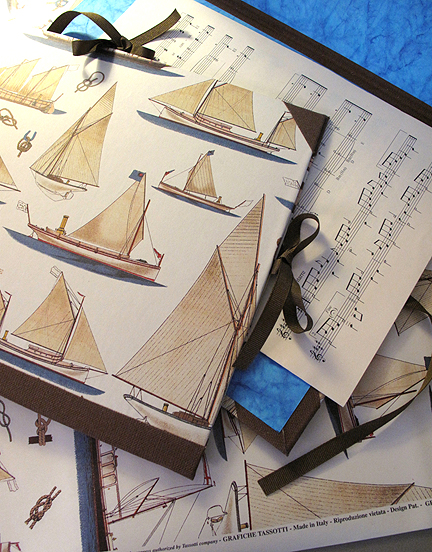
Large sheets of Tassotti paper which arrived damaged, and my attempt to remedy the paper.


Months ago, I had purchased large sheets of Tassotti paper which had arrived from Europe damaged by the shipping. The sheets were meant to be for bookbinding projects, but creased and dented as they were, the paper seemed perfect for “welding” via adhesives to rigid chipboard stock- though I still needed to flatten the damaged paper as well as possible. Trimming and designing the folios, the nautical motifs looked all the more appropriate, as I am striving to persevere in forward motions. Matching the colors of the paper, I used brown bookcloth and ribbon which were among my conservation and binding supplies. Reinforcing the folios with strong and acid-free components, I lined the interiors with thick, handmade paper: blue for the ocean and sky. I tried two different sizes, and made a few extras with an additional nautical-themed paper.


__________________________________________


Making these, and giving some as gifts, further reminded me about my love of beautifying the ordinary. Ironically, devotional books and Bibles tend to be made with drab covers and poor-quality bindings. I remake these, too, since I regularly carry such books with me, and tend to keep them for long periods of time- often personalizing their structures.

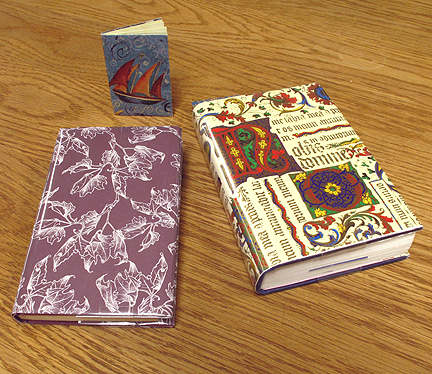
Sacred texts with sanctified bindings.


3

My toolbox which I use every day in the Archives, and I lined the trays with handmade paper.


About as ironic as drab-looking production bookbindings that are filled with inspiring words, I currently experience more stability at work than at home. The latter was always the other way around. These intensely anxious times tinge and threaten the most routine of activities. When my errands cause me to drive along pretty residential streets that are lined with neat houses and tidy lawns, my grief surfaces with the intensity of an exile. Surely a broadbrush observation, I see an ocean of haves from the excluded vantage point of a have-not. The gentrified-out are driven east of Eden. And far, far too many have much less than even my modest means and employment. So very many are homeless, subjected to misery and injustices that are unconscionable. I wonder what tourists think, when they see people sleeping in doorways and along the sidewalks of this now-blatantly stratified small city.


While I’ve been pushed to the brink, I also bear witness to the present landscape along with the years that led to these prohibitive conditions. Mere observations with open eyes reveal the sicknesses of these times. But alongside sensitivity and acts of compassion, mental strength is vital. But we must also attend to the immediacy of our midst, particularly as it involves matters such as housing and sustenance. While distracting myself with slivers of creativity in a wilderness of undetectable mercy, my thoughts ponder the question of what to do when something beautiful comes to an end. It has long been in my nature to preserve, to restore, to reinforce. Perhaps the wider question is to consider that which should be designed to last.


Sunday, November 29, 2020

thought


“Toute notre dignité consiste donc en la pensée. C’est de là qu’il nous faut relever et non de l’espace et de la durée, que nous ne saurions remplir. Travaillons donc à bien penser: voilà le principe de la morale.”

(“All our dignity consists, then, in thought. By it we must elevate ourselves, and not by space and time which we cannot fill. Let us endeavour, then, to think well; this is the principle of morality.”)

~ Blaise Pascal, Pensées, 347


provisioned and purposed

During these times of bunkering and hunkering, it seems many have been brought to consider the practical meaning of self-sufficiency. We need the comradeship of one another more than we may have previously realized. Many that have had to navigate this world in these recent months have seen how individuals’ safety precautions are mutually much broader safety precautions. My safety is equally your safety, too. Yet it may be instinctual for us to form ourselves and our lives toward goals of having everything we need. Is preparedness about survival, or is it more about fear of not having enough? And does the latter cause us to hoard more than is needed? Do we need to prove our self-sufficiency against a fragile security with abundance? All questions for an observer of a world of billions of little islands that long for connecting bridges. It has been crucial to find one’s own definition for preparedness. An expression like take care has derived a wishful connotation that has come to parallel the post-sneeze God bless you which originated during medieval plagues. Being prepared and provisioned is a motion toward continuity- toward survival and emergence.


As it has become vital to my own approach to survival, I’ll shift to a lighter musing- on this occasion, about provision. Since my childhood years, I’ve always been fascinated by intricately inclusive “kits” that provide all that is necessary to complete a task. By this, I mean a portable receptacle that can be taken to various locations so that you have what you need to accomplish a project. A first-aid kit wouldn’t quite fit my definition any more than a flatware drawer: these are gatherings of items to keep you going. I’m thinking much more along the lines of my tacklebox of archival conservation tools which I take with me to do fieldwork in libraries and museums. The box filled with tools I’ve gathered over the span of two decades contains what I need to solve just about any preservation problem. The spatulas, bone-folders, knives, tongs, cleaning instruments, gauges, among other tools are the “constants,” to which I’ll add rolls of various papers, board material, and even cameras- depending upon a specific project. It’s also at the heart of all my conservation workshop teaching. The box is always packed and at the ready, being a quintessential inclusive provisions kit.


Another everything-kit which I keep intact and at-the-ready is my larger tacklebox packed with all that is needed to do and to teach calligraphy. Many of my lettering projects are done on-location, including countless makerspaces I’ve led. It’s also easy for me to simply set the box near my desk, as everything’s gathered together and portable. The calligraphy box has many multiples of pen-holders, nibs, inkwells, and numerous related tools, so that I have what is needed just for myself- along with plenty of extras for others when I am teaching groups up to twenty people at a time. As with the book & paper conservation box, the calligraphy box has traveled many miles with me. On several occasions, I’ve journeyed with both kits to large teaching events at which I’ve taught both subjects. Indeed, there are more “free-standing” kits to mention, involving photography, writing, and sewing- as examples.


a thought kit


In ways that are similar to how we can outfit ourselves for purposes that are best accomplished with a supply kit, what about our thoughts? As we navigate life- especially amidst our respective isolated experiences- can a ready thought kit be appropriately stocked? We do, after all, carry our thoughts with us; consider how we naturally “collect our thoughts,” while trying to make sense of a situation. Recollection is one of my favorite words, particularly in the contemplative context of attention to the presence of the Divine within the soul. In addition to carrying our thoughts with us, we can also choose to “tap into” our thoughts, “calling to mind” impressions, memories, and ways of thinking. Very much as it is physically when assembling the essentials for a comprehensive tool kit, there are surely spiritual disciplines when deciding which thoughts are the best ones to keep in one’s conscientious stock. It also means making room by discarding and replacing various supplies that become outmoded and dulled.


There are certainly more “terrestrial” ways to curate knowledge to benefit our thinking processes and memories. Along with daily journaling, I’ve maintained a parallel run of chapbooks in which I jot down thoughts and found quotations. I’ve even digitally indexed a number of these chapbooks, to make things easier to find later. I transcribe my research gleanings from my travels, and back up the documents in ethereally-titled “cloud storage.” As well, two favorite pieces of digital technology are my portable netbook and a good spacious flash-drive. While I view these as tools themselves, and also as supply-kits, I’m well aware of the care needed to keep things intact and accessible. These are not necessarily thoughts, but surely aides-mémoires.


Among his many written thoughts, left to posterity on hundreds of small leaves of paper, the philosopher Blaise Pascal made thought a topic in itself. He affirmed how humans are capable of thinking at levels beyond all living beings. “Pensée fait la grandeur de l’homme,” which is to say “thought constitutes the greatness of humanity.” To think- to carefully and thoughtfully consider- is essential and is the means through which our greatness proceeds. Pascal elaborated that we humans are more than mere sentient creatures:

Man is but a reed, the most feeble thing in nature; but he is a thinking reed. The entire universe need not arm itself to crush him. A vapour, a drop of water suffices to kill him. But, if the universe were to crush him, man would still be more noble than that which killed him, because he knows that he dies and the advantage which the universe has over him. The universe knows nothing of this.


Evidently there are reeds, thinking reeds, and minds like Pascal’s. Here he speaks about the paradox of our fragility and the enduring transcendence of our thoughts. In this transcendence, we do file our unique thoughts and accomplishments in the archives of our souls. Our most refined and substantial thoughts can be easily dissolved, but the spirit of our cultivation lives beyond finite days. We ponder fleetingly about eternity. The extent or the duration of thoughts cannot be known by an individual, yet so many of us, like Pascal, unhesitatingly make intellectual investments. It is undoubtedly worthwhile.


thoughtfully equipped

Being equipped with a multi-tiered kit of curated thoughts, the supplies are meant to be used. Theory meets practice when learning meets the road. Attentiveness to observation can be refined into applicable treasure. But it’s easier said than done, to be sure. During this protracted pandemic, that carefully constructed trove of thoughts is put intensely to the test. What are the recollections that right the ship? Deep into the wilderness of bad news, misery, and barricades- we must dwell upon things that console and help light the way. Although most of this past year has offered no opportunities to venture out as I’ve always liked to do, the venturing has had to be inward. New learning and new thoughts can certainly be pursued and noted; I’ve been doing that as much as possible with my existing resources. There remain thoughts to be held every day. I continue looking forward to the prospect of writing about these times in retrospect. Between my apartment, my workplace “bubble” (at which I spend 2 of my 5 workweek days), and my few and critical errands, I also make time to maintain letter correspondence with friends. We write to one another, each from our own circumstances of exile. Much like listening to a calming radio broadcast, the letters I receive are living messages from another world.


spare parts


Provisions of the spirit are not always necessarily major concepts or “large events” committed to memory. My own stock of inspiring impressions consists of what I call spare parts. Subtle enough to fit between events and complexities, spare-part thoughts can be equated with cooking spices at the ready as a pinch or a dash may be needed. They are in the forms of things said to me, words I’ve read and remembered (and very likely written down), as well as images engraved in my memory. One evening last week, I called in to my friend Jordan Rich’s radio programme, broadcast from Boston, when he brought up the topic of writing and correspondence; this was a way to chime in and cheer him on at the same time. A parallel thread about gratitude gave me a chance to speak to a cherished spare part. He asked about causes for thankfulness, “and not the big-ticket items, but things you might be taking for granted.” I spoke about literacy, being grateful to know how to read and write. That’s a source beneath the source-material. Subtle as it’s been through the years, literacy is a profound blessing during these times of isolation.


Various friends tell me about seeking calm by focusing their thoughts on the “happy places” of their memories. There’s a lot of good sense in this, and I do some of that in my journaling as I seek healthy distractions these days and nights. These are certainly occasions for reaching for both the big-ticket reminders, as well as the more covert spare parts. I appreciate reaching for the wise words of compassionate people I’ve known. Years ago, I worked at a college which had been founded by a women’s Catholic religious order. The campus ministry was led by the sage and elderly Sister Sylvia, a mentor who taught me something about mentoring: she would say, “I won’t tell you what to do, but I’ll walk alongside you.” Metaphorical as that was to say, she is one who likes to walk. I have a vivid memory of how she would walk across the green quads of the campus with her rosary. She called this prayer-walking. Contemplative and practical. And praying the rosary itself is a plunging into the depths of spiritual memory, using the increments to find context in the timeless. Like Sister Sylvia who encourages generations of listeners to “shine that light,” holy writ comes to thought from everlasting with “walk while you have the light.*” Between there and here are the words of Sant Joan de Déu (San Juan de Dios), of the 16th century, urging us to keep going and “do all the good works you can while you still have the time.” Even from places of isolation, and even when the machinery indefinitely needs all the spare parts in the kit.


_________________________
* John 12:35

Saturday, February 15, 2014

preservation and imprint


“Those who have greatly cared for any book whatever
may possibly come to care, some day, for good books.
The organs of appreciation exist in them.”


~ C. S. Lewis, The World's Last Night.


Beginning to look back at my studies at Oxford, and how they continue on, my sense of direction is reinforced. While thoughts linger and digest the rich experiences of the late-summer and early autumn past, I proceed to absorb new learning with renewed perspective. Though I’ve been backlogged in my writing projects, I’ve continued my usual reading and note-taking. It seems natural to nurture a thirsting spirit with persevering studies into inspiring literature. It is also evidently unavoidable. Just the other day, at the Boston Athenaeum, the slant of late-day light streaming in through west-facing windows lit the small ancient book in my hands. The side-lighting cast shadows from paper fibers and into typographic embossed crevasses. Such tomes that reflect the light of this very day attest to worlds and times beyond the generations of our ancestors.


As with the memories and lyrics we carry with us, so our received words of inspiration help to carry us along this earthly sojourn. That which I have beheld and handled, and have even listened to, in the tones of written words, occurs to me now as having been made available to me. Whether across millennia, centuries, or modern decades, enduring words are gratefully received as they are handed down and across to my fledgling hands. At the Bodleian Library, the books and documents of my studies came from many different places- and I myself had done so, too. Words and images have reached me, as I have reached for them, and their origins share a collective mystery with their conveyance to this present era.


books


At Oxford, I was elated to find the Bodleian preserves and maintains a manuscript of Johannes Scottus Eriugena (9th c.), who has been dear to me for many years. Supporting research into the works of his thought, the library also includes a collection of printed offerings about Eriugena and early Medieval philosophy. I even found a contemporary publication about Eriugena, at the Oxford University Press bookstore, and added it to my own collection. The constraints of long-distance travel limited how many books I could fly back with (and how many I could mail), due to their weight.


Another volume well worth procuring was a book I learned about as my steps traversed paths left by Tyndale (16th c.), and that is Sir Thomas Wilson’s Arte of Rhetorique, originally published in 1553. The edition I purchased is an imprint published at the University’s Clarendon Press in 1909. It had been artfully made to replicate the quality of a 16th century book, using thick paper stock, replicating the original typography, marginalia, and frontispiece illustration.


Written by the headmaster of Magdalen College, the work itself had been a textbook used at Oxford in Tyndale’s years, and had instructed and influenced countless scholars. Its themes treat the subjects of eloquence, oration, and the clear organization of knowledge. Often the text blends in the author’s reasons for clarity of thought, which are to reflect the sacred. Sir Thomas dares his readers to excavate the ways of holiness: “Who would digge and delve from Morne till Evening? Who would travaile and toyle with ye sweat of his browes?” The wise advice presented by the book is strongly reminiscent of Eriugena’s spirit of division and recollection (divisoria et resolutiva). Ancient guides continue to teach.


conservation


Being an archivist and conservator by trade and livelihood, I was graciously introduced by the Bodleian staff to the university’s conservation department, known as Collections Care. Responding to their generous invitation, I was privileged to spend a day at the bindery and laboratory. The department is located in Osney, along the River Thames, in a western district of the city. Reaching the “Osney One” complex from the university provided an opportunity to walk along a very narrow stretch of the river. Lined with canal boats and trees, the walk to Osney is a meditative diversion from the city center’s density and crowds.


Repositories of rare and archival research materials balance the tandem mission of preservation and access. We preserve in order to assure availability. There may seem an inherent conflict, as handling could be seen to be endangering preservation, and watchful conservation could be seen as an endangerment to potential handling. Inevitably, research libraries establish workable compromises that protect the integrity of original artifacts, while also extending opportunities to readers. Continuity in physical conservation parallels the continuum of scholarly access.


Conservation of a medieval book : rebinding the signatures
(gathers of pages).


The paper conservators at Osney demonstrated how they had been processing the personal papers of radio pioneer Guglielmo Marconi, as the collection had been accessioned by Oxford. The documents were being mounted in fascicules, which are interleaved archival albums. The same treatments had been done with the C. S. Lewis papers, and subsequently as I proceeded with my studies in the research rooms, I remembered what I had seen at Osney. Careful inventorying, cataloguing, and physical treatments all happen before a manuscript or rare book reaches the library shelves and reading tables.


New binding, cords, and custom-fitted
wooden boards, to be covered with new leather.


Along with some great discussions about our respective projects, we examined the conservation phases of a medieval book of hours. The book had been purchased for the university, because in its contents there is mention of Oxford. Requiring a full-scale restoration, the book needed to be rebound and recased using the most authentic materials possible. A specific type of leather was chosen, to stretch over the new signature cords, and custom shaped wooden boards that had been purchased from a lumber company in Wales that supplies the Bodleian Library. There are numerous such tomes in the Library’s collections, each requiring their own treatments- whether extensive or simple maintenance. Archival material has its own axiology, and we speak of the value of the original artifact as being evidence of an action, or a person’s creative thought, or the documentation of decisions. The intrinsic value of a manuscript often refers to the integrity of an original artifact which cannot be replicated because it is the item that had been written upon, owned by a specific person, or had made a historic voyage.

oxford university press


Written words are preserved and rejuvenated by conservation. For centuries, the printed word has been produced with presses, bound, and further extended. (Electronic formats extend the contents of the printed word still more.) During my residency in Oxford, I had the pleasure of visiting the famous Oxford University Press, and meeting with their archives’ staff. The Press is a department of the University, and its printing operations began in 1478, shortly after Johannes Gutenberg’s innovations with moveable type and printing presses. Oxford University Press has been at its present location, on Walton Street, since 1830, having been previously based in the Sheldonian Theatre (in the 17th century), and in the Clarendon Building (in the 18th century). It came to mind how great many of my graduate school texts were produced by Oxford, which also includes their academic Clarendon Press. The large buildings at Walton Street include an informative gallery of artifacts displaying milestones in the continuing history of Oxford University Press. A visit is well worthwhile.


Printing press at Oxford University Press


Oxford English Dictionary display.
Documents below are Dictionary editorial notes made by
J.R.R. Tolkien, who contributed to production.


Returning to my work at the Bodleian Library, I unavoidably noticed spine labels bearing the Oxford Press imprint on countless books in the reading rooms and aisles of shelving. I subsequently noticed this, back in New England libraries, and amusingly back in my apartment. As with my research, the visits with Collections Care, as well as Oxford University Press, have added an enhanced sensitivity to the artistry related to the sustenance of written artifacts.


reading on


Bodleian Library


Travelling on, and reading on, written and printed words speak in bolder tones to my mind’s ear. Readings which inspire most embody a totality of sound, substance, and typographic aesthetic beauty. Illuminated thoughts reach me by reflectant pages. Words combine to transfer a message which is received and transposed by my reading. Or by your reading. Written words adorn the roads of our reading voyages, and I have seen my own path has definitively navigated ports and passages of places which inspire future articulation.