Showing posts with label Ralph Waldo Emerson. Show all posts

Friday, August 29, 2025

back-to-school season

“Finish every day and be done with it.
For manners and for wise living it is a vice to remember.
You have done what you could;
some blunders and absurdities no doubt crept in;
forget them as soon as you can.
Tomorrow is a new day; you shall begin it well and serenely,
and with too high a spirit to be cumbered with your old nonsense.
This day for all that is good and fair.
It is too dear, with its hopes and invitations,
to waste a moment on the rotten yesterdays.”


~ Ralph Waldo Emerson, The Letters of Ralph Waldo Emerson,
Volume 2, 1836 - 1841


Long before the weathervanes of corporate retail brought out their marketed wares, the liminality of back-to-school season became very clear to me. Summer heat and humidity yielded to tree-bending blustery air, and on a random morning I suddenly remembered walking to grammar school in new shoes. Changed slants of light and earlier evenings indicate the setting of August. Though my graduate school thesis term was many years ago, memories- especially of my earliest education- vividly remain. The first day of a new school year was a burst to the senses: the look of new spaces, unfamiliar sounds, and the strong smells of industrial cleaning ingredients. At Public School No.13, in New York City, classroom numbers had their corresponding numbers painted on the gridded asphalt surface of the schoolyard; this became the place to line up every morning, prior to processing into school for the day. That was embedded within my first five years of schooling. Many other formalities followed, but as my father observed, “when you’re six years old, one year occupies fifteen percent of your life.” Back-to-school has always meant a fresh start, and at every age a learning of room numbers, names, and navigational strategies. A common post-secondary puzzle required knowing various campus buildings and the time needed to connect between them. To this day, late-August and early-September rekindle memories of new beginnings. Notwithstanding all the teaching I’ve been doing since college, I continue to purchase a new calendar book every summer. Labor Day Weekend is essentially the recognition of a new year.

A few of my classmates at the High School of Art & Design, New York.


Some of us are physically affected by the season. Back-to-school acquired my added connotation of allergy season. Parallel to my beginning high school, my one allergic condition emerged, which is ragweed pollen. As some of you know, some years are tougher than others. At the start of sophomore year, as a woeful fourteen-year-old, I had several protracted sneezing spells that frightened the teacher such that I was re-situated to the back of the classroom. That’s a great first impression to make for a teen, and surely not how I wanted to be noticed. Over the years, I learned to be equipped with neutralizing medication. On a better note, back-to-school meant reuniting with familiar faces and meeting new people. At the start of my senior year at the High School of Art & Design, at age seventeen, a number of old friends noticed how tall I’d suddenly gotten. New school years- both in high school and undergrad college, both four year institutions- began with re-acquaintances and recounting our summers. Fresh starts, in themselves, open to new horizons. And every venture, at any age and level, needs its equipage. Notebooks, writing materials- including aromatic wooden pencils, sometimes a new bookbag.

I still have this- from a Maine College of Art graphic design prof
who said to me, "Here is an E for your excellent work!"


Because of my high school’s focus on the visual arts, there were always supply lists to be filled. My mother, an experienced artist, and I made errands to the famous Pearl Paint- in SoHo- for our provisioning. Art college in Maine also meant filling supply lists, but with less variety. Unlike all the public schools I’d attended, college and university life required purchasing my own books, adding to the “new year” rituals. To send myself off in style to graduate school in Boston, I drove to nearby L.L. Bean and treated myself to a rugged backpack for the new journey. Each and every academic year began with reminders in the forms of brisk air, longer shadows, sneezing, and motivation to reach beyond my self.

Above: From my matriculating days in the MA program
at UMass-Boston. Notice my notebook-holder.

Below: Simmons University, Boston.


“Major in the Rest of Your Life” read the banner in the large vestibule of Boston’s Simmons University, highlighting my first day en route to my masters degree. It took two years of extremely hardworked matriculation to reach that beginning, but my gratitude produced its own energy. I hope Simmons has reused that brilliant motto. It may surprise those who’ve known me since my postgrad years, that I did not like school. I dreaded it. During childhood, I called the daily trudge “going to jail” and those tiresome stretches of time (in any duration) seemed agonizingly endless. Everything changed with the intense challenges of graduate schooling, which I loved. Perhaps it was the added years of work experience, but indeed I chose new vocations and goals, and I also chose each one of my courses. Back-to-school was a series of forward motions, even further hastened by summer sessions. The subject matter, as I advanced from one program to the next, became increasingly fascinating to me: from history, with the addition of philosophy, and then finally to archival sciences. With each new semester, the projects and assignments intensified- including publishing about book conservation. I took to beginning each academic year by watching that great film, The Paper Chase. For those timed, cheat-proof, fill-the-blue-booklet exams, I had a magic fountain pen which I’d bought in Paris. Every evening before one of those draining experiences, I’d make myself a brain-enriching fish dinner, and would perch that Waterman on my stereo to the tune of Meyerbeer’s benediction of the daggers from his opera Les Huguenots. All of this prep amounted to straight A’s. The pen wrote a perfect score.

The Waterman fountain pen with the 4.0 average.


My love for learning hit its permanent stride, when I joined the Boston Athenaeum immediately after graduating with my Masters degree. I’ve since lectured and taught there. Back-to-school is something I’ve been experiencing and supporting as an educator, and can attest that pursuing my own continued learning is an unending feast. In his Collations on the Hexaemeron, Saint Bonaventure wrote, “The door to wisdom is the vehement desire for it.” The season associated with the re-entry to school for so many among us retains its significance for me. Just as scholarship is stewardship, studies need application- all of which require conscientiousness. In his brilliant work and ready companion to me, The Intellectual Life, by A.G. Sertillanges, the chapter called Preparation for Work is especially appropriate for the season. His use of the word gĂ©nie doesn’t quite translate as “genius,” but is something more like “inspired intellect.” He referred to this kind of wisdom as something that “stimulates us and gives us confidence. The stir it arouses is a spur to ardent personal endeavor, revealing a vocation, correcting overanxious timidity. A sense of sublimity breaks on our soul like a sunrise.” He described how we can use inspiring source material to fuel our ambitions and projects. Sertillanges’ references about cherished personal readings amount to an individual’s assembly of strategic reserves. Their cultivation increases with each measure of progress, such that “back-to-school” encounters less and less inertia. Studies lend well to spiritual formation, in an ongoing stream. Navigating currents and tides, we bring along our prized primary sources and faithful instruments.


I was well aware that my room at Simmons was on Pilgrim Road.

Sunday, May 28, 2023

en plein air

“Adopt the pace of nature.
Her secret is patience.”


~ Ralph Waldo Emerson, Nature


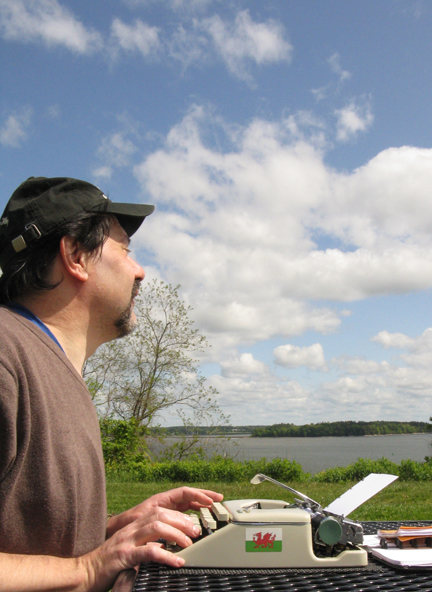
With an extremely rare weekday off, I chose to stay in town and write outdoors. Not only that, I decided to write on the Eastern Promenade- a writing perch I’ve enjoyed for many years, long before having to move from my home in a suddenly-gentrified West End building. Indeed, last autumn- until it got too cold- I walked to the “Prom” as often as possible, getting away from the puny apartment, just to be able to look upward. Going outdoors to write allows me to transcend “addresses,” and their confinement. People travel to Portland from great distances, to be able to perch along Casco Bay. The scenery continues to be inspiring to me, just as it was for me last month in the Berkshires. Getting out gets me away from oppressive and bland spaces, as well as from the static recirculating air of the workplace. “Retreat” needn’t mean extensive travels; it’s really about stepping back and away from structure and demands. I could be from anywhere and come here to write, at the same time as being from here (which I am) and forget about annoying confines. The outdoors also provide an escape from alienation. Open, and accessible spaces strike a needed contrast from offices, phones, and lit screens- allowing me to listen to my thoughts and make some notes. Skies provide a taste of ceilinglessness (and how cooperative that my typewriter doesn’t redden or rewrite my made-up words).


Writing at the Eastern Prom, which includes a busy playground, brings to mind the day camps that were lights to my adolescent summers in New York City. Asphalt jungle childhoods comprise scarce amounts of trees and clean grassy spaces for playing and perching. There was always a lot of broken glass to sidestep, along with other detritus I stopped seeing after moving here to Maine to begin college. No doubt, the air was a comparison I could immediately make, and since then has always been rolled into what I’ve come to know as “the outdoors.” But humble as it was, day camp gave me a taste of things easily taken for granted in northern New England. In the city, the change of context brought kids like me on long yellow school buses out to the lush and landscaped parks of Queens- namely Forest Park, and for a number of years Kissena Park. Hardly any of the other kids were from my neighborhood: the blighted and dangerous projects in Corona; they were from just about everywhere else. But we were all together, frolicking outside, jumping through sprinklers, and fanatically playing baseball every single day. We were easy to please, once we had time and space. Perhaps some of us retain those traits. There was no structure and no technology- even for the camp counselors that watched over us, also serving as our umpires through all those raucous ball games.

From my high school years:
Above: Greenway Terrace, Forest Hills, New York City
Below: High School of Art & Design cafeteria, as we all wondered what was really in those sandwiches.


I’m one of those adults that can still think very much as I did when I was ten. The ache to have time and space to muse, around those fettered and adversarial school days, resembles the ache to have time and space to muse between job tasks and inane meetings. Free time becomes increasingly costly. For most of us, liberation is rare and at best incremental. Reflecting back, childhood redemption arrived in an unwitting combination when I was 13. My year began as I completed rigorous and intense religious studies, thus declared an adult at that rather young age. In my naive determination, I survived my final year in what happened to be New York City’s most overcrowded public school, which went by the heartwarming name of I.S. 61. Its schoolyard was surrounded by housing projects and scrapyards. The city was a good 2 decades away from gentrifying, and my daily walks to school were imperiled by gangs and packs of feral dogs. Almost all the threatening and thrashing ended for me with the post-middle-school summer at a healthy summer camp in the mountains of Upstate New York, followed by my parents’ purchase of a house in a strikingly beautiful and safe neighborhood- still right in the city. And finally, still at age 13, I began my sojourn of secondary education at the High School of Art and Design, on the tony east side of Midtown Manhattan. A whole lot in a short year. My father gave me my first bicycle, enabling me to run a lot of errands, including grocery shopping. I explored all the streets of Forest Hills and contiguous neighborhoods, also toting my first camera- which had been a 13th birthday gift.

My Rudge-Whitworth bicycle, which I purchased used for $20 to replace the new bicycle robbed from me by muggers.
Above: Photo I took in 1981, in New York City.
Below: Photo I took (I still have the Rudge) recently at Acadia National Park, Maine.


The bicycle symbolized freedom and an enduring sense of self-propulsion. I would joke about drinking a glass of milk, then bicycling the length of Queens Boulevard and over the 59th Street Bridge en route to a library I frequented on East 38th Street. All on one glass of milk, as I’d say. One afternoon, while bicycling with a neighbor through Flushing Meadow Park, I was accosted and mugged at knifepoint, forced off my shining new bicycle. I still remember this well, and can recall the sheer powerlessness of that event. At my summer job in a supermarket, I saved my earnings to buy another bicycle- a used one that I defiantly considered to be too ugly to draw any thug’s attention. I still have it today, driving it throughout the Portland area, including all the carriage roads in Acadia National Park. Self-sufficiency continues to be its own brand of liberation. Alas, and as I’ve learned, childish and childlike are really two different traits. At best, that early spirit endures by adaptation. As well, self-sufficiency shows its hard limits, particularly in the powerlessness of housing searches, employment scavenging, and economics. Recalling Saint Augustine, “I do not know what I do not know,” and thus I want to know what I don’t know. If there’s any way to improve things, it must begin with avoiding prior mistakes.

Outdoors on the 2nd floor terrace at the Boston Athenaeum.


How much of a factor are our interpretations that are based upon our subjective perceptions? Obviously, something entirely subjective is my taste for perching outside to write and read in 40-degree temperatures, which I find perfectly comfortable. Then there’s the fascinating aspect of how syntax plays a role in how we view and depict our discoveries. For example, traveling to a location with a variety of cameras allows me to photograph similar motifs with different formats. The images will look distinct from one another, based upon the tools I’m using. Same with writing: pencils, pens of varied construct, typewriters, and computers will each lead to results reflecting the tools’ influences. Within this is the example of journaling with a dip pen, requiring many regular pauses to re-ink the pen, while the mind continues its train of thought. Those pauses surely reflect what is written. I’ll often switch writing instruments, when I notice aridity in my words. Varying the vantage point is also as effective with writing as it is in photography. Getting outside amidst the swirl of nature permits for an appreciation of Emerson’s description about the patient paces of nature. Light, skies, and horizons will surely affect how I interpret what I see, and how I interpret my thoughts. In a similar sense, I write during my mid-day breaks inside the Archives stacks, as well as aboard lurching city buses. What I notice and the ensuing words are affected by their situations of notation.


When I’m not on the job, and I turn away from doomscrolling online searches for apartments and employment, while the blaring and trampling from upstairs disturbs the peace, I know to go outside. Beneath the skies, there are no upstairs. Life gets to return to looking open-ended as it did when my friends and I would lie on our backs in green and sunny Kissena Park, just talking and looking up at airplanes going to and from LaGuardia. The paces of nature are surely not those of such humans as those among us who use the expression, hurry-up-and-wait. Coaxing the inertia out of the wheels of progress is exhausting. During the thick of childhood, time slogged like a schoolday. It felt endless. In retrospect, that was a brief period of time- its space on my timeline diminishes as the adventure continues. Looking back exclaims the necessity of looking ahead. My decades of tireless efforts have yet to pave ways to my profoundest wishes, to exercising and really seeing my best abilities coming to fruition. How close is success? Is it completely out of reach? I’m daring to believe it isn’t, notwithstanding my scarce resources and lack of influence or allies. Echoing Saint Anselm’s prayer in the Proslogion, “I have still to do that for which I was made.” Yet, the stuff of eternity does not include accolades or material. The moment and all subsequent time stands for me to redeem. Knowing how to redeem liminal time is a daily and constant challenge. Having little more than faith and gumption, I’m left to heeldigging trust, insisting upon finding the sacred in the ordinary. Such thin rations need the light and rain of the outdoors, for the vines of latent presence to proliferate and provide.


Sunday, June 5, 2022

beautify


“Love of beauty is taste... The creation of beauty is art.”

~ Ralph Waldo Emerson, Nature, ch. 3


1

Years ago, I had a friend named Robert Park. He was an elderly neighbor, and I would run errands and shovel snow for him; then we would enjoy great conversations over coffee in his very cluttered and book-filled living room. He was originally from Cambridge, Massachusetts- and he pronounced his name without sounding the R’s. Invariably, we would talk about politics. With exasperation, he would say, “It just gets worser all the time; worser and worser.” It was difficult to completely agree with him, wishing so much to follow my aspirations. Even though he’s gone now, I continue to muse about his sad admittance. Is it true? If it is, would I start saying this? These are brutish and grim times, all around. Globally and personally. While I flail at my dubious career and strive against the brink of losing my housing, I remain at heart an artist who thinks about hopeful aesthetics. For a long time, I’ve been crafting things that accentuate beauty in the midst of ugly times. There is profound worth, understated as it may be, in beautifying the commonplace and the daily components of living. Having inherited aesthetic tastes from my family, I think of them when I create things and decorate, using good materials. Cooking and baking, I choose my ingredients with care, and set out meals as I was raised to do. Presenting sensitively made objects and foods to others is a way to demonstrate compassion, even if it is modest and simple.


2


Ralph Waldo Emerson observed that “beauty is a wayside sacrament.” Tangible signs of invisible grace are to be respected, and that itself is a reverence for aesthetics. Indeed, beautification and its appreciation directly affect the life of the spirit. Moreover, in such destructive and violent times, spiritual health is all the more imperative. I am well aware of the greater need for balance, eloquence, good reading, and sundry reminders of the sacred now more than ever. Recently, in the Boston Athenaeum manuscripts room, I read the words of Philip Doddridge (18th century) which include: “The care of the soul is the one thing needful, because without it you cannot avoid a state of eternal misery,” adding that- as we all know- misery can be aggravated if we aren’t paying attention to the health of our spirits. Of the topic of the One Thing Needful, as coined in the Bible, Ezra Stiles Gannett (19th century) wrote that it would be a living and active personal faith. Gannett observed that a conscientious and practical faith provides foundations for our pursuits and our work, as it can:

“...endue a person with a divine spirit, can clothe them with an invincible energy, can empower them to go on their course rejoicing through good report and through evil report, through labor and sickness and penury, through loss of friendship and of home even, till death closing this scene shall introduce them to the reward of their faith and patience. The feebleness of our faith prevents our experiencing or illustrating the full efficacy of religion. O Lord, increase our faith; that it may triumph over every obstacle, and may preserve us in obedience to thy holy will, and in hope of thine everlasting favor.”


Handmade box, which I also lined, for my typewritten manuscripts.


In my pursuits of continuing my artisanry and active faith, while desperately trying to find a place to live, I’ve decided to keep on being creative. The life of purging, packing, searching, and going to work amount to a wall of hurry-up-and-wait. Writing needn’t cease to be important; in fact, my journals and thoughts have increased as sheltering venues. Having already packed up most of my things, various loose papers accompany me through my daily rounds. I thought I’d design and create folios made with beautiful materials, for carrying and organizing my projects.

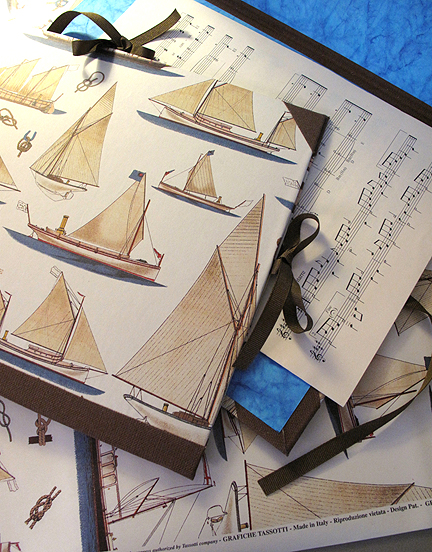
Large sheets of Tassotti paper which arrived damaged, and my attempt to remedy the paper.


Months ago, I had purchased large sheets of Tassotti paper which had arrived from Europe damaged by the shipping. The sheets were meant to be for bookbinding projects, but creased and dented as they were, the paper seemed perfect for “welding” via adhesives to rigid chipboard stock- though I still needed to flatten the damaged paper as well as possible. Trimming and designing the folios, the nautical motifs looked all the more appropriate, as I am striving to persevere in forward motions. Matching the colors of the paper, I used brown bookcloth and ribbon which were among my conservation and binding supplies. Reinforcing the folios with strong and acid-free components, I lined the interiors with thick, handmade paper: blue for the ocean and sky. I tried two different sizes, and made a few extras with an additional nautical-themed paper.


__________________________________________


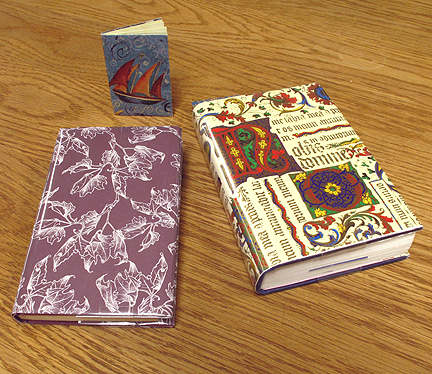
Making these, and giving some as gifts, further reminded me about my love of beautifying the ordinary. Ironically, devotional books and Bibles tend to be made with drab covers and poor-quality bindings. I remake these, too, since I regularly carry such books with me, and tend to keep them for long periods of time- often personalizing their structures.

Sacred texts with sanctified bindings.


3

My toolbox which I use every day in the Archives, and I lined the trays with handmade paper.


About as ironic as drab-looking production bookbindings that are filled with inspiring words, I currently experience more stability at work than at home. The latter was always the other way around. These intensely anxious times tinge and threaten the most routine of activities. When my errands cause me to drive along pretty residential streets that are lined with neat houses and tidy lawns, my grief surfaces with the intensity of an exile. Surely a broadbrush observation, I see an ocean of haves from the excluded vantage point of a have-not. The gentrified-out are driven east of Eden. And far, far too many have much less than even my modest means and employment. So very many are homeless, subjected to misery and injustices that are unconscionable. I wonder what tourists think, when they see people sleeping in doorways and along the sidewalks of this now-blatantly stratified small city.


While I’ve been pushed to the brink, I also bear witness to the present landscape along with the years that led to these prohibitive conditions. Mere observations with open eyes reveal the sicknesses of these times. But alongside sensitivity and acts of compassion, mental strength is vital. But we must also attend to the immediacy of our midst, particularly as it involves matters such as housing and sustenance. While distracting myself with slivers of creativity in a wilderness of undetectable mercy, my thoughts ponder the question of what to do when something beautiful comes to an end. It has long been in my nature to preserve, to restore, to reinforce. Perhaps the wider question is to consider that which should be designed to last.