Showing posts with label idealism. Show all posts

Thursday, April 24, 2025

ideals and possibilities

“By judging the truth of things according to the divine measure,
we acquire wisdom; by embracing the supreme good,
we are liberated to enjoy and use the goods of creation
for the enrichment of human life.”


~ Zachary Hayes, O.F.M., The Hidden Center.

The lead quotation for this essay comes from a book written by a modern-day Franciscan, addressing Saint Bonaventure- a fellow Franciscan who lived in the 13th century. The consistency of insight to this reader is such that I have the impression of studying a philosophical writer reflecting upon his own esteemed ancestor. I read the sentence to my philosophy students, as an example of idealism- and good, lofty one, too: Acquire wisdom and improve the lives of others. Cultivate what is needed to practice the golden rule. We subsequently had a lively Socratic forum about such divisions of idealism as the subjective, the divine, the ontological, and the epistemological. These topics will be revisited in greater depth, seeing how strongly they’ve resonated with the group.


One of my colleagues added encouragement, having participated in my treatment about how happiness ("eudaemonia") is defined in philosophy, generating an enthusiastic discussion. “Keep doing these,” she added, “we all need this.” Admittedly, so do I. Perhaps the study of philosophy- or philosophizing, in itself- may be just a bit escapist? Well, that’s worth another group forum. For the moment, I’ll say it’s a combination of reckoning with the surrounding world, and consolation. All points lead to understanding, to making sense of perceptions. Beyond the abstraction of thought is the praxis of a physical sign. The illuminative and the literal riding in tandem, searching for signs. Spring began showing itself at least a month later than usual, in northern New England, with persistent cold temperatures clashing against lengthened daylight. Eager for new growth, both metaphorically and three-dimensionally, I have my camera close at hand to photograph what treasured signs can be found and savoured. Living to such ideals as Bonaventure’s, and the later Bergson’s “realization of what is yet to exist which will provide greater significance” relates well to the new promise of spring.


For a week of respite, my first in four months, I recently enjoyed a nourishing string of days in Boston. My studies at the Athenaeum were centered around encouragement and assurance, all penned by various theological thinkers. More philosophy for inspiration. I select the readings through bibliographies and lengthy catalogue searches, followed by submitting the requests several weeks before my arrival. Those e-mailed communications signify initial forward motions toward pilgrimage, choosing my direction immediately after having my time-off request delicately approved. As the swirls of preparation, packing, transportation, and logistics settled, the brilliance of great company and thoughtful studies emerged. A lingering thought occupying many musings was a suggestion to consider the possible as an antidote in the struggle against confining and incessant frustrations. What possibilities are available while swamped in recessed economics, undercapacity, and treadmill existence? Turning toward an ideal of possibilities brings me to the captivating word, potential. Convinced for many years of the underutilized potential for my skills and experience, my perseverance toward better days continues to be fueled by the prospect of future opportunities. Necessary components and energies are at the ready; but there needs to be a convinced and welcoming receiving end. Realized potential as an ideal is the stuff of daily and constant prayers, immersed in quotidian productivity and conscientious service. The magnitude and immediacy of responsibility eliminates the option of waiting around for the miraculous. But a state of readiness can still abide, seeking out the possible, despite the encroachment of negative limits.


While drafting this essay, and during my recent week of commuting, my reading included two new books by Pope Francis, one which included these words...

“Do not surrender to the night; remember that the first enemy to conquer is not outside: it is within you. Therefore, do not give space to bitter, obscure thoughts... Faith and hope go forward together.”
(Light in the Night, 2024)

...and the day after reading these sentences, I learned of his passing. Pope Francis wrote in gentle and direct tones, as a seasoned mentor. The surrender he wrote about refers to something familiar to me, and I absorb his exhortation as a warning against my habitual tendency toward immersing thoughts with impossibilities. Entirely unusual for his position, Pope Francis engaged with this world and its many humanitarian crises, sharply critical of injustice- yet his idealism remained solidly intact. As with Brother Roger of Taizé (whom I knew), living to a similar age, Pope Francis consistently wrote about hope. Both leaders approached the entirety of life as a pilgrimage of trust. Brother John, former prior of Weston Priory (whom I also knew), passed away last month at the age of 100. When an esteemed leader- especially an elder- passes from our lives, and we notice traits and turns-of-phrase attributable to them, we begin to realize a spiritual inheritance.


“In revealing the possibility of a life lived in the presence of God,” continued Zachary Hayes’ gloss of Saint Bonaventure, “it reveals what is in fact the original possibility of humanity, created from the beginning in the image of God.” We’re reminded that various possibilities are in our midst to be discovered, if the “big picture” isn’t lost, while struggling to create wider opportunities. During my recent studies at the Boston Athenaeum, I read the inspiring Life of God in the Soul of Man, written by Scotland’s Henry Scougal in 1677. His term for spirituality was the divine life, and his intention for the work was that his readers derive encouragement to stay the course through the challenges of hardship. His enjoinder to continue making progress in faith has the reminder that with wholehearted devotion, “we shall have all the saints on earth and all the angels in heaven” interceding for us. Readers are instructed to take heart, keep faith, and not be afraid. “Away with perplexing fears,” Scougal insisted, continuing with:

“We cannot excuse ourselves by the pretense of impossibility.”

... which is to say that we mustn’t be so quick to unquestioningly say “it can’t be done.” Indeed, we have yet more idealism, and I welcome strengthening words, relieved to discover such fine company. Studying written treasures is more than reason enough to travel. As I witness the passing of various visionary leaders that taught generations preceding and including mine, I’ve become increasingly aware of thinning ranks, in no less than these darkened times. Let us all consider our reception of torches passed into our hands, no matter our states of readiness. Many are already teaching others, unwittingly and by profession. There is little choice but to carry on. Now, how shall we find and flex our discovered possibilities?


Sunday, February 3, 2013

l’idéal


“If you can dream—and not make dreams your master;
If you can think—and not make thoughts your aim;
If you can meet with Triumph and Disaster
And treat those two impostors just the same;
If you can bear to hear the truth you’ve spoken
Twisted by knaves to make a trap for fools,
Or watch the things you gave your life to, broken,
And stoop and build ’em up with worn-out tools...”


~ Rudyard Kipling, If


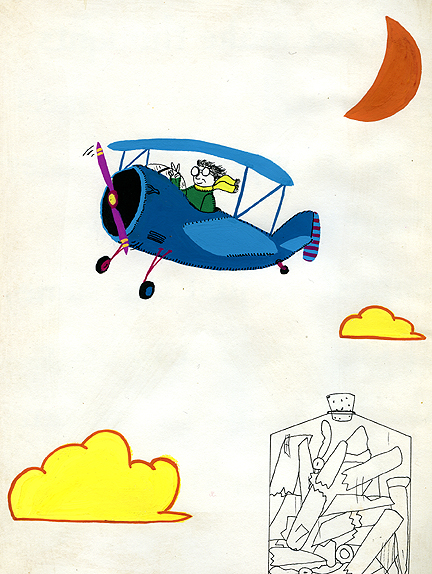
(The calligraphy
and illustrations
for Kipling's poem
were done by me
when I was 15.)


open questions


Open questions are investigative queries with which we must evolve. I refer to open as differentiated from open-ended. In the field of information sciences, the opposite of a closed-ended question is an enquiry that demands more than a statistical answer. Open-ended often implies a comparison, and surely more than a simple yes or no. But a matter that is entirely open may require protracted and lived research; there may not even be an apparent answer. The element of time can alter long-abiding questions. Over spans of years, I’ve mulled various advising words of parents and directives of teachers, walking with their meanings. In less abstract ways, I’ve seen myself change travel routes after better comprehending roads, highway systems, and compass directions. From the depths of spiritual life, why questions (“why am I here?”) have led to what questions (“what am I to do?”), then on to how questions (“how shall this happen?”), and when questions (“when does the terrain level off?”). Surveying the vast waters in all directions brings to mind questions of expectations.


When comparing long-held hopes with my lengthening road of lived findings thus far, I am brought to question all my expectations. Repeatedly high aspirations are repeatedly disappointed. Perhaps it is a question of standards, and perhaps some compromises must be made. But a descent to the latter would happen with heavyhearted reluctance. Only now, I’ve begun to weigh the double-edge of idealism. With hopes set very high, combined with ardent work ethics, those plunges that spiral unrequitedly down are deep drops. Yet I seem to insist upon holding fast to ideals, sure of their practicability.


idealist

("walk with kings and not lose the common touch.")


But idealism has some mixed connotations. Dictionary definitions dryly treat idealism as the opposite of realism. Granted, an idea often does stand in opposition to sensible reality. Still more, the ideal can float far beyond the conceptual idea itself. As looming summits of cascades, and distant islands of green, profoundest aspirations dwell enshrined. These are reference points with which sense, assessment, and correction can be sounded and fathomed- albeit without the power of ever attaining to the ideal’s perfection. What if there weren’t ideals? I dare say that would confine souls to a terribly uninspired rendition of limited and tangible realism. Idealism provides context to perceived reality. The deserted expanses and aridity in everyday life cause the soul to consider the spiritual to be the centrally vital factor in reality.


While I hold to ideals that elevate fairness, honesty, egalitarianism, artistic creativity, and holiness, there are no delusions as to their consistent practice and reciprocity. Idealism does indeed come with a warning label. There will be disappointments; they very well may occur at each and every turn. There may be every good reason to renounce those ideals and let cynicism prevail. But I will do no such thing. Remembering Kipling’s immortal poem, “If,” though I’ll make allowance for doubting, I’ll continue to wait and not be tired by waiting, will not deal in lies, or give way to hating, but rather persevere even in defeat to start again at my beginnings. Too clearly in prominent thoughts are fellow idealists, such as my friends who live the monastic community life. Their commitments to their sacred ideals exceed whatever trials they have. I’ve been ceaselessly impressed at how they are able to keep all their routines and rituals fresh and new. Then I recall St. James’ guideline about embodying generosity while keeping oneself unpolluted by the world.*


Much has filled my sights to give me more conflicts to sift through. In response, my abilities to filter and discern must proportionately increase. Emerging from my thoughts in recent weeks is whether or not idealism and maturity are divergent roads. Can noble and benevolent aspirations superimpose with experience and growth? I wonder how to continue aligning these threads. Struggle mustn’t necessarily produce callousness. Neither should isolation. Too often a by-product of professional elitism is the harming of its respective profession. Titles frequently tend to dissuade their contents. Educators that claim highest formal credentials ironically lead the charge to remove manual skills from our hands. Professional license, it seems, paves ways to discard reading and practical arts without challenge. In a further show of irony, pastorates assuming leadership in spiritual communities notoriously cannot communicate or foster community spirit. Perhaps the status of “seasoned pro” requires desensitization. There are surely downsides to Babel-like structures that excessively formalize. I’m reminded of how my childhood classmates and I decided to opt out of little leagues because we wanted to enjoy playing baseball. Nothing like a childlike mind to see through artifice.


idealism personalized

("risk a heap of winnings to lose and start again.")


As we develop our intellectual lives, continue to grow, and sense the Spirit within, our ideals form in a naturally cultivated parallel. Just as goals are wished for, they are tested; and amidst the trials that accumulate with advancing forays into the world, these aspirations are endangered. During sojourns through thickest Maine forests, I’ve admired how wildflowers such as “lady’s slippers” persistently emerge brightly through dark cover. Expectations of goodness and innocence early in life are endangered flora. Setbacks, easily leading to jaw-setting embitterment, can equally be steered into cultivating heart-courage. Schoolyard smirks, putdowns, and injurious bullying find their harvests in adult-sized sniping, pessimism, and injustice. With gained experience and years, countless jaded souls have crossed my path and offered me their wares. Many, from childhood to the present, are notably memorable: not just their voices, but the many varieties of what’s-the-use shrugging. Very early on, the I-don’t-cares and the so-whats ignited an inner wariness. I’ve found the same suspicion and repellent to be both necessary and applicable. Insensitivity corrupts the human spirit.


Is the state of being jaded inherent in the maturing process? Must weariness and dulling of spirit manifest as matters of course? Conversely, is idealism equivalent to immaturity? Venturing forth surely implies complex navigation through hostile territory. Holding one’s line against “invasions” to hopes and faith can self-negate. The collateral damage includes exhaustion and an odd sense of doubt as to the worth of vigilantly forging ahead. Believing the pilgrimage toward holiness is worthwhile is an ideal that resists erosive aspects that accumulate on a daily basis. During my packing up to leave home, at the age of 17, my mother gave me some drawing and painting materials to take with me to art college. She told me that it’s good to know how to compromise, but that I must never compromise my convictions. An ideal with which to be guided, both in general situations and through defeats. Knowing what to do with amassing disappointments means not allowing them to amount to disillusionment.


open questions : evolving answers

("don't look too good, nor talk too wise.")


“L’idéal, voilà l’échelle mysterieuse qui fait monter l’âme du fini, à l’infini” wrote French philosopher Victor Cousin, in “Du Vrai, du Beau, et du Bien.” This is to say, “The ideal is the mysterious ladder of ascent for the soul to advance from the finite to the infinite.” Without having an answer to the questions connecting maturity to cynicism, I will connect idealism with perseverance. Remembering my friends who live consecrated lives, I’ll add the questions about how daily life can remain always new to a soul. The vitality of pursuing holiness and generosity implies the pursuit of ideals, and I expect to continue on. But I also know the hazards of running contrary to the grain of rationalism. Yet another question regards purposefully being somewhat naïve to the wheel-and-deal world of “leveraging” every possible activity and interest into monetary units. Guarding and holding fast to ideals also means pursuing and upholding them, too. Lamps are meant to be held high, even while reckoning with expectations that force low ceilings. I insist upon expecting much, and impatiently so.


Finally, during a recent lunch hour in a public atrium, I overheard a man complain to his tablemates and say, “I guess you have the right to be miserable, when you get older.” Indeed, I added that declarative to my journal-writing. Well, he is quite correct in his claim to his civil right, but I’ll try not to connect the two aspects as intertwined inevitabilities. An idealist would not permit compounded disappointments to simmer the soul into a quiet acceptance of “the way things must be.” That would be too easy, and more days wouldn’t be needed to disprove such compromised convictions.


("hold on when there is nothing in you
Except the Will which says: ‘Hold on!’")


* James 1:27