Showing posts with label aspirations. Show all posts

Monday, January 1, 2024

looking forward

"The kingdom of heaven only costs as much as you have."
~ Saint Gregory

Between the completion of various projects, commitments, and the subsequent holiday weekends, I was able to take a few days away for a quiet retreat in December. Respite time has been extremely rare in the past four years, now generally known as the “covid era” (albeit with the first year being under quarantining orders). Laborers on pared-down staffs often became the surviving hands-on-deck in their respective places of work. I wrote about being among “the working wounded;” yet truly thankfully employed and bill-paying, but holding course while staving off the burnout in my midst. This pandemic era may be tailing off now, but economic and societal conditions have been permanently altered. Suffice it to say, many practical matters are simply too dissimilar to those of four years ago to be as reliable as they were. Try finding an actual hardcopy newspaper now (and when you do, notice how the price is exponentially higher). Notice how social interaction is much more electronic than in-person, how commerce is relegated to impersonal self-checkout, and how a “wallet” is now stored financial data. A “menu option” left the context of restaurant dining, and became a term of robotic telecommunication. As recently as four years ago, taking earned time off meant physically turning to a colleague and comparing calendars; it has since become cajoling and electronic wrangling. Much more than the rigors of earning the time, there are added equations in being able to use the time. The bar having been raised, it is necessary to jump higher with the changed rules of the game. Of course I can do this, and I must.

As the will makes for the way, I recently managed to negotiate for a very modest amount of respite and backup coverage. Eight months in the waiting, the worthwhile carrot at the end of the proverbial stick was a stretch of days for slivers of spiritual health, silence, and writing. Having very little time to plan, as well as to find coverage, I searched for a place that would make space for a pilgrim during this time of the year. An Advent intermission from the beaten track and the routines was what I needed, and a very kind invitation came from a Cistercian community in Massachusetts. Getting through the subsequent complexities related to springing forth for a short time, the more pleasant parts of preparation ensued.


As I’ve known for years, most any sojourn can be a pilgrimage; it needn’t involve great distance. Intention is basically all that is needed. For a pilgrim of trust, the purpose is to sanctify time and place for immersion in the sacred. In anticipation, I began to assemble trip necessities such as writing and reading material, clothing, camera, and some groceries to add to the guesthouse provisions. This was my first time both at Mount Saint Mary’s Abbey, and in southwestern Norfolk County, though I know the general region. My drive to Wrentham took about three hours on roads that traverse familiar New England terrain that comprises cities with repurposed mill buildings, farms, forests, and villages. The winding country road leading to the abbey slices through tall pines, and must be navigated slowly. Arriving to gentle greetings, I proceeded to the guesthouse and found an envelope on a lit end-table which welcomed me in cursive flourishes resembling the tones I’d heard moments before. Setting my satchel and duffel bag in my dormered room, I immediately and gratefully felt the quiet of the place, along with like the country air. Two of the community’s guest sisters and I spoke about the vitality of contemplative silence. We talked about how burnout endangers the souls of this culture’s understaffed overworked. We also made reference to weather alerts pertaining to an approaching storm. From there, we all prepared for vespers. Above all, being in late-December I was among kindred spirits in anticipation of the Advent.


Gradually settling into the old, familiar monastic rhythm, I immediately noticed how tightly-wound I’d been for too long. Equally old and familiar is the sense of reverse-inertia: slowing down to a halt needs quite a long runway. The soothing tones of sung liturgies harmonize with the natural landscape, helping to transit from stressful vigilance to receptivity. Even as the rainstorm arrived, the patter on the abbey church roof pronouncedly audible, the peaceful ambience of the place simply absorbed all sounds. During an evening service, the rain intensified into a backdrop for the readings, chanted psalms, and silent adoration. I later heard the continuum of pelting rain on the skylight immediately overhead in my little room.


The storm amounted to something similar to a hurricane, with torrential rain and 90mph winds persisting throughout the following day. I cannot remember ever seeing such hard rain. Looking from the guesthouse windows reminded me of driving through a carwash, but this went on for more than a day, eventually causing felled trees and a regional power outage. Along with the loss of electricity was the loss of heat, hot water, and backup generators. The abbey had to cancel services. We used plenty of candles in the guesthouse, dining on leftovers, still savouring the spirit of the community. Even considering the cold, dark night ahead, I did not try to make an early trip back to Maine; the storm was moving north, and I would’ve been contending with hazardous conditions all the way up. The best thing to do was to patiently wait out the weather. Inevitably the storm passed, yet the outage was predicted to last another day. Washing with cold water the following morning, and downing day-old tepid coffee from my thermos, I packed my car for the return in daylight. Before taking to the roads, I made sure to thank my hosts and to bask in the healthful silence of the unlit abbey church. While the retreat had to be shortened, there was plenty to cherish, such as an open-ended welcome to come back, some new friends, and the acquaintance with an oasis new to me. Driving between large branches and fallen trees, en route to highways and hot coffee, was that among other things I have hope itself.


the storm past; writing by candlelight


“Still will we trust, though earth seem dark and dreary,” William Burleigh composed more than a century ago; “Though rough and steep our pathway, worn and weary.” Indeed, I returned from a shortened sojourn, back to work and the search for better, holding fast to Advent light as night falls in the afternoons. A new year approaches. Perhaps a suitable excuse, as the stroke of midnight on New Year’s Eve may not automatically regenerate much more than a calendar. As the Battle for the Better continues, albeit via Advancement by Small Measures, I’m looking to the upcoming year with the usual ache for a good future. Fully aware of being in the thick of significant work, there’s every good reason to keep at it. Looking forward is the best thing I can possibly do. I needed at least a year and a half to write the housing-loss grief out of myself. Now it’s the forward gaze that indicates preparation for the granting of my most vigorous wishes. It isn’t really difficult to insist upon looking forward, with essentially so little left for which to look back. If anything at all, I’m looking forward to returning to the abbey in Wrentham during better weather. Grand things manifest because of humble things. While commenting about Psalms 13 and 14, Saint Augustine remarked that “Interior and unceasing prayer is the desire of the heart.” Essentially, one’s profoundest hopes are distilled into intentions of the spirit. He added, “The desire of your heart is itself your prayer.”


Reminiscent of my original profession and my most fluent language: photography, I find my reminders for the present. Practitioners of the craft like me can recall or point to studios, portfolios (effectively our resumés), projects, exhibitions, and tools of the trade. Far and away, the most important aspect is a cultivated sense of vision. This transcendent ingredient is also known as “the photographer’s eye.” Artistic vision, as I’ve found, can be applied to numerous types of work and facets of life- even the human imagination. As a working archivist and conservator for nearly 26 years, I’ve often envisioned completed results (and their remedies) ahead of time. But that doesn’t mean I can predict the events of the new year, as these involve much greater complexities than those of my sole efforts. Once again, and at the very least, I can put up my end of things, and I know enough to "forget those things which are behind, and reach forward to those things which are ahead, pressing toward the goal for the prize of the upward call*". Everything is in need of improvement; bring on the new year.


views from Saint Mary's Abbey, by ambient light only


_____

*Philippians, chapter 3

Monday, December 5, 2016

simmering


“I slept, and dreamed that Life was Beauty;
I woke, and found that life was Duty.
Was my dream, then, a shadowy lie?
Toil on, sad heart, courageously,-
And thou shalt find thy dream shall be
A noon-day light and truth to thee.”


~ James Freeman Clarke, Self Culture.

1

A few weeks ago, I wrote about regathering, and the term implies that of spirit, strength, and wit. And there is more to this necessity than constructively responding to societal currents. The need to personally recalibrate reaches to and through the core of being. Deep in the protracted trenches of seeking and weighing opportunities, I’ve arrived at yet another costly pause. The proximate past has been spent on mere sustenance far more than on creative productivity. Solvency tamps down sentimentality, and suddenly taste buds become dulled. When old, long-bolstered sentiments and ambitions lose their fortifications, they enter the crosshairs of questioning. I’d worked through graduate school to begin a second career, while watching my first one dissolve. I can identify the symptoms, and have been seeing them again. The labyrinth has so many barricades and blind alleys. Are there too many to be realistically hopeful? The days descend into winter darkness, and it’s time to find new dreams. New dreams and aspirations, to replace what now look like outdated notions, are not materializing fast enough.


2

Alas, as with all too many matters of personal urgency, needs are delayed, time is passing, and grace looks deferred once again. There are too many rehearsals and not enough performances. It is as though invisible root networks below ground exponentially outpace humble shoots that may see light of day. “What’s the new dream?”- has become something of an obsession. The sentence appears daily in my journal entries. The idea visits conversations I have with close friends- especially those I trust for advice. This gives me a chance to listen to how others navigate their own scrapyards. Nobody really has an answer for me, but I don’t expect more than good exchanges of ideas and stories. Indeed, I’d love a crisp and unambiguous directive. It would surely save time.


And taking time into account intensifies the unrest. The passage of time tells us there really is no sitting still: treading water is like falling backwards, and both are inferior to progressing ahead. During a recent lunch hour, an elder friend of many years told me, “I know it’s painful to stay put, but you’re wise in doing so.” Of course, the next step must be an upward step, but will that happen, and how much longer the wait? Patience is an honorable trait, yet by definition it means unhurried. The line dividing patience and impatience is wavering and not always defined. Imaginably, one could impatiently want to know the limits of patience. The popular idea of “buying time” smacks of something more like a costly rental. My thoughts turn to recalling times when patience has benefitted, and times when rashness piled on to existing setbacks. Lengthened journeys provide troves of anecdotes.


As with writing and reading, mulling and musing can only happen between obligations. Daily slices of time- early mornings, late nights, and lunch breaks- provide chances to reflect and make notes for me to subsequently stitch together. Quite like cooking a rich soup, thoughts are as spices and morsels added and changed over a span of time- not all at once. Soups and stews are best when they simmer, rather than rapidly boil. With time, the tastes of the different ingredients affect each other, and the whole mixture develops a texture. The depths of contemplation simmer, rather than flash in pans. While intensely impatient to see improvement and achievement, it is taking additional effort to stir and simmer all the ingredients. They have been seasoning for a very long time. Perhaps it is that new dreams cannot instantly manifest by just adding hot water. Watching for pots to boil is the opposite of simmering.


3

With any dilemma, great or small, the light of experience is among the first navigational tools to reach for. At my intersection with How Shall I Do This, there’s a tattered road atlas called What Worked Before. A creased, stained artifact, but still somewhat useful. My sense of direction becomes more vital, and I can effectively improvise. But I know not to stand still and wait for boiling water; it serves me better to keep going. Observations are simmering and there are opportunities for helpful distractions. Long walks and road trips allow for some reflective solitude, and certainly writing outdoors as well. As with listening to friends, I’m able to see more of the breadth of this world. Travelling provides some freedom both to confront and deflect the unknown.


Recently, within the space of two weeks, I made two road trips- the first for a professional conference at which I lectured, and the second was a 2200-mile Thanksgiving round-trip to and from the Midwest. The shorter trip had the melancholia of closed ends, but when I drove a stretch of 1100 miles only five days later, I did so with the eagerness of seeing loved ones. Although being en route to a specific location demands exact turns at crossroads and certain lanes at interchanges, there are tastes and views that rise above the quotidian labyrinth. The open road provides thought-provoking adventures. Changes of scenery, weather, and sound to add spice to that simmering soup. This may also be true for others. While refueling my vehicle in a faraway state, a man asked me, “Are you really from Maine? I used to know someone from there.” At a diner, a waitress asked me where my accent is from. Evidently, I am part of that change of scenery and sound, too. The road is also an interior adventure, and while reconciling with detours and delays, reminders surface about past dreams that fell by the wayside. Looking across the windshield, What’s the new dream? It simmers yet, and there are immediate urgencies such as keeping an alert eye on the road.


4

The urgency for a new dream coincides with obsolescence of the outmoded. Old, long-held hopes are not necessarily “bad.” Ambitions can be time-honored; they can be sculpted out of otherwise useless heaps. But, on the other hand, releasing expired aspirations is an unburdening action. Even after many years of hard work and investment, the way forward implies cutting losses. It makes for a raw liminality: the process of shedding invalid notions is one that runs parallel to testing spirits and discerning new dreams. Paring down, building up, and simmering something fresh amounts to a reformation. For me, it must take shape in midstream- without the luxury of stopping. Prayer on the go. Highways with a commuter mug and finger food. Beneath the rapid paces is that imposed simmer. It can’t be microwaved. How infuriating. Still more mystifying are my ungranted, relentless petitionary prayers. I’m reminded how the transit of letters to me have nothing to do with how often I look in my mailbox. Such things, alas, have their own simmered timing. I’m left simply to hold course and redeem the time.


5

Awareness of my unsuccess is counteracted by taking stock of the good that is in my midst and that which I create. Fortune may yet tilt in my favor, and the response will be that of the immense gratitude of a lifetime’s worth of honest effort. There still seems to be time. Well, there will have to be, and while held off by simmering, my end of the bargain is constructive productivity. An admirable mind, named Charles Henry Brent, once expounded upon the words of Zechariah the Prophet who said, “Turn ye to the strongholds, ye prisoners of hope.” To this, Brent observed, “You can win your humanity only by finding your highest opportunity in your more evil days. We are prisoners of hope.” With faith comes strength, and from there follows longing. In this context, longing refers to a fuelled aspiration that drives and strives and pushes ahead for a better life. Longings have goals, as well as sources; discerning new dreams implies evaluating both. Indeed, there are expectations, and that’s a risk in itself. Perhaps this is a test of undefined extremity. But even now, rather than grouse about dashed dreams and enumerating the graphic details, my thoughts must point toward new ambitions. The simmer of the dark ages has got to boil over into renaissance. For the moment, the taste of the new has yet to manifest. It’s still simmering.


Sunday, February 3, 2013

l’idéal


“If you can dream—and not make dreams your master;
If you can think—and not make thoughts your aim;
If you can meet with Triumph and Disaster
And treat those two impostors just the same;
If you can bear to hear the truth you’ve spoken
Twisted by knaves to make a trap for fools,
Or watch the things you gave your life to, broken,
And stoop and build ’em up with worn-out tools...”


~ Rudyard Kipling, If


(The calligraphy
and illustrations
for Kipling's poem
were done by me
when I was 15.)


open questions


Open questions are investigative queries with which we must evolve. I refer to open as differentiated from open-ended. In the field of information sciences, the opposite of a closed-ended question is an enquiry that demands more than a statistical answer. Open-ended often implies a comparison, and surely more than a simple yes or no. But a matter that is entirely open may require protracted and lived research; there may not even be an apparent answer. The element of time can alter long-abiding questions. Over spans of years, I’ve mulled various advising words of parents and directives of teachers, walking with their meanings. In less abstract ways, I’ve seen myself change travel routes after better comprehending roads, highway systems, and compass directions. From the depths of spiritual life, why questions (“why am I here?”) have led to what questions (“what am I to do?”), then on to how questions (“how shall this happen?”), and when questions (“when does the terrain level off?”). Surveying the vast waters in all directions brings to mind questions of expectations.


When comparing long-held hopes with my lengthening road of lived findings thus far, I am brought to question all my expectations. Repeatedly high aspirations are repeatedly disappointed. Perhaps it is a question of standards, and perhaps some compromises must be made. But a descent to the latter would happen with heavyhearted reluctance. Only now, I’ve begun to weigh the double-edge of idealism. With hopes set very high, combined with ardent work ethics, those plunges that spiral unrequitedly down are deep drops. Yet I seem to insist upon holding fast to ideals, sure of their practicability.


idealist

("walk with kings and not lose the common touch.")


But idealism has some mixed connotations. Dictionary definitions dryly treat idealism as the opposite of realism. Granted, an idea often does stand in opposition to sensible reality. Still more, the ideal can float far beyond the conceptual idea itself. As looming summits of cascades, and distant islands of green, profoundest aspirations dwell enshrined. These are reference points with which sense, assessment, and correction can be sounded and fathomed- albeit without the power of ever attaining to the ideal’s perfection. What if there weren’t ideals? I dare say that would confine souls to a terribly uninspired rendition of limited and tangible realism. Idealism provides context to perceived reality. The deserted expanses and aridity in everyday life cause the soul to consider the spiritual to be the centrally vital factor in reality.


While I hold to ideals that elevate fairness, honesty, egalitarianism, artistic creativity, and holiness, there are no delusions as to their consistent practice and reciprocity. Idealism does indeed come with a warning label. There will be disappointments; they very well may occur at each and every turn. There may be every good reason to renounce those ideals and let cynicism prevail. But I will do no such thing. Remembering Kipling’s immortal poem, “If,” though I’ll make allowance for doubting, I’ll continue to wait and not be tired by waiting, will not deal in lies, or give way to hating, but rather persevere even in defeat to start again at my beginnings. Too clearly in prominent thoughts are fellow idealists, such as my friends who live the monastic community life. Their commitments to their sacred ideals exceed whatever trials they have. I’ve been ceaselessly impressed at how they are able to keep all their routines and rituals fresh and new. Then I recall St. James’ guideline about embodying generosity while keeping oneself unpolluted by the world.*


Much has filled my sights to give me more conflicts to sift through. In response, my abilities to filter and discern must proportionately increase. Emerging from my thoughts in recent weeks is whether or not idealism and maturity are divergent roads. Can noble and benevolent aspirations superimpose with experience and growth? I wonder how to continue aligning these threads. Struggle mustn’t necessarily produce callousness. Neither should isolation. Too often a by-product of professional elitism is the harming of its respective profession. Titles frequently tend to dissuade their contents. Educators that claim highest formal credentials ironically lead the charge to remove manual skills from our hands. Professional license, it seems, paves ways to discard reading and practical arts without challenge. In a further show of irony, pastorates assuming leadership in spiritual communities notoriously cannot communicate or foster community spirit. Perhaps the status of “seasoned pro” requires desensitization. There are surely downsides to Babel-like structures that excessively formalize. I’m reminded of how my childhood classmates and I decided to opt out of little leagues because we wanted to enjoy playing baseball. Nothing like a childlike mind to see through artifice.


idealism personalized

("risk a heap of winnings to lose and start again.")


As we develop our intellectual lives, continue to grow, and sense the Spirit within, our ideals form in a naturally cultivated parallel. Just as goals are wished for, they are tested; and amidst the trials that accumulate with advancing forays into the world, these aspirations are endangered. During sojourns through thickest Maine forests, I’ve admired how wildflowers such as “lady’s slippers” persistently emerge brightly through dark cover. Expectations of goodness and innocence early in life are endangered flora. Setbacks, easily leading to jaw-setting embitterment, can equally be steered into cultivating heart-courage. Schoolyard smirks, putdowns, and injurious bullying find their harvests in adult-sized sniping, pessimism, and injustice. With gained experience and years, countless jaded souls have crossed my path and offered me their wares. Many, from childhood to the present, are notably memorable: not just their voices, but the many varieties of what’s-the-use shrugging. Very early on, the I-don’t-cares and the so-whats ignited an inner wariness. I’ve found the same suspicion and repellent to be both necessary and applicable. Insensitivity corrupts the human spirit.


Is the state of being jaded inherent in the maturing process? Must weariness and dulling of spirit manifest as matters of course? Conversely, is idealism equivalent to immaturity? Venturing forth surely implies complex navigation through hostile territory. Holding one’s line against “invasions” to hopes and faith can self-negate. The collateral damage includes exhaustion and an odd sense of doubt as to the worth of vigilantly forging ahead. Believing the pilgrimage toward holiness is worthwhile is an ideal that resists erosive aspects that accumulate on a daily basis. During my packing up to leave home, at the age of 17, my mother gave me some drawing and painting materials to take with me to art college. She told me that it’s good to know how to compromise, but that I must never compromise my convictions. An ideal with which to be guided, both in general situations and through defeats. Knowing what to do with amassing disappointments means not allowing them to amount to disillusionment.


open questions : evolving answers

("don't look too good, nor talk too wise.")


“L’idéal, voilà l’échelle mysterieuse qui fait monter l’âme du fini, à l’infini” wrote French philosopher Victor Cousin, in “Du Vrai, du Beau, et du Bien.” This is to say, “The ideal is the mysterious ladder of ascent for the soul to advance from the finite to the infinite.” Without having an answer to the questions connecting maturity to cynicism, I will connect idealism with perseverance. Remembering my friends who live consecrated lives, I’ll add the questions about how daily life can remain always new to a soul. The vitality of pursuing holiness and generosity implies the pursuit of ideals, and I expect to continue on. But I also know the hazards of running contrary to the grain of rationalism. Yet another question regards purposefully being somewhat naïve to the wheel-and-deal world of “leveraging” every possible activity and interest into monetary units. Guarding and holding fast to ideals also means pursuing and upholding them, too. Lamps are meant to be held high, even while reckoning with expectations that force low ceilings. I insist upon expecting much, and impatiently so.


Finally, during a recent lunch hour in a public atrium, I overheard a man complain to his tablemates and say, “I guess you have the right to be miserable, when you get older.” Indeed, I added that declarative to my journal-writing. Well, he is quite correct in his claim to his civil right, but I’ll try not to connect the two aspects as intertwined inevitabilities. An idealist would not permit compounded disappointments to simmer the soul into a quiet acceptance of “the way things must be.” That would be too easy, and more days wouldn’t be needed to disprove such compromised convictions.


("hold on when there is nothing in you
Except the Will which says: ‘Hold on!’")


* James 1:27

Monday, October 17, 2011

certitude in uncertainty


“My Lord God,
I have no idea where I am going.
I do not see the road ahead of me...
Therefore will I trust you always
though I may seem to be lost
and in the shadow of death.
I will not fear, for you are ever with me,
and you will never leave me
to face my perils alone.”


~ Thomas Merton, Thoughts In Solitude.


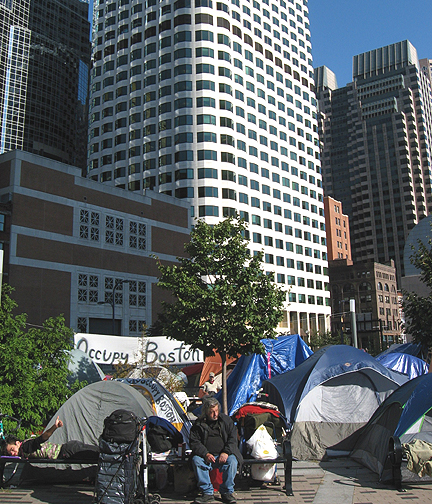
Boston (above) and Portland (below)