Showing posts with label ethics. Show all posts

Monday, October 13, 2025

love- hope- strength

“I'm just gonna sing about the things that I need:
A little bit of love, a little bit of hope
A little bit of strength, some fuel for the fire.

To build the ships to set the sails
To cross the sea of fools
To be dealt the cards
To play our hand
To win or else to lose
In this cruel world that kicks a man when he's down.”


~ The Alarm, Deeside.


fearful times

Without venturing into making sociopolitical statements, many agree that we live in upsettingly violent and fearful times. And that is excessively our context. An ordinary person, of dauntingly modest influence, can at least try encouraging others. Being a grain of inspiring leaven must persist with every passing day. Straight through the doldrums, no matter the ignominy. The stewarding of responsibilities is a trail that rarely juxtaposes with pursuits of success. Indeed, I’ve always tenaciously worked for both, but my high-minded idealism remains along a castle courtyard in the sky.

As one recession follows another, I thankfully keep on working. Whether or not it’s satisfying has had to decrease in importance. Scores of skilled workers lose their jobs, and exponentially more lose their homes. What may one dare to presume? The job market is as lifeless as this present culture is impoverished, yet personal defeat cannot be permissible. I must continue fueling my own engines. There are too many things yet to be accomplished; giving up the ship is still not an option. While life frustratingly remains in holding-pattern mode, I continue cultivating and flourishing where I’m planted. Foundering and drifting are undoubtedly worse than slowed movement and tacking. In the process, I can still be helpful to others. Most everyone I know is seeking a better situation for their livelihood. So many are struggling. On top of that, I’m listening to individuals of all ages express their cravings for community. Somewhere between pandemic quarantine life and The Great Resignation, too much of humanity turned inward to itself. The general willingness to gather pieces and create unifying bonds anew has left the popular consciousness. My own efforts continue, but indeed neighbors, colleagues, and kindredships are sum-totals comprising warm-blooded persons. Electronic personae cannot amount to reasonable facsimiles of human compassion and insight. As much as we know this, too many prefer their little pocket devices. Ironically, the bulk of human resources officers that recruit workers largely ignore the humanity exemplified in their conscientious applicants.


searching for positive signs

Grim times and thoughts intertwine to clog the mind as milfoil tangled around a ship’s propeller. Getting on the road does plenty to help my perspective, along with any intentional change-of-air. Occasionally I’ll have some music or radio accompaniment, but almost always some good threads of encapsulating monologue. And healthful silence. A good road trip- especially a scenic one- allows me to hear myself think (or not). Recently, getting outta Dodge was my very long-awaited family visit to Chicago, driving across the northeast, taking in the terrain. Making notes in my journal during a highway stop, I noticed how I had plenty of stamina for the 2200-mile round trip, but little for the sort of creative writing I’ve always loved doing. Exhaustion can be oddly asymmetrical. While listening to music and remembering the recently-departed, longtime favorite Mike Peters, I revisited the album “Strength” for the zillionth time. The Alarm is a prominent part of my life’s soundtrack. Among the songs, one of Peters’ verses, wrapped in refrains about struggling workers in a shuttering Welsh steel mill, affirms I’m just gonna sing about the things that I need, which are Love, Hope, and Strength. Essential, to be sure, and as the song proceeds, fuel for the fire. Enjoying the very short respite of being able to close my eyes while my coffee cooled in an I-90 service plaza, I penciled this in my journal: Sing about the things you need.

urban oasis


Inadvertently, my musing became an intrguing journaling prompt. “Sing about the things that I need,” looked to me like a way to cheer up my writing, and step back from the prevailing grimness. It surprised me that I found it difficult to answer the question with more than survival basics, though less poetic than “Love, Hope, Strength.” Instead, it was more of my quagmired scribbling about better work, quality of life, health of loved ones, stability, and community. Thinking through writing often carries a lot of repetition along, but re-reading thought processes can be fascinating. My ten days away from the grind began with some refreshingly unstructured time, which is always great for writing and reading- things that ordinarily require doses of stolen moments. My sister created a garden in a small space that has taken shape as an astonishing urban oasis. Perching outside was in itself salubrious, beginning with writing about gratitude for my earned-time-off to be able to make the travel, as well as for the welcomes received. Fresh air, good company, and tasty food; more gratitude. Looking up at the city’s trees, then down to my books on the patio table, gave me some Mike Peters-worthy words: Air, Light, Belonging, Writing, and Philosophy. Garden quiet combined with large-city hum, brought to mind choosing the substantial over the artificial. The following day, at a busy downtown café in the Loop, I added more answers in my journal such as “things that attest to the human spirit.”


notice what is good

The Newberry Library


Being a native born-and-bred city kid, I love a great city, and Chicago is a place that attests to the human spirit. As always, it did my soul a lot of good to immerse myself in miles of walking, intricate neighborhoods, grandiose avenues, L trains, and chatting with plenty of people along the way. On this particular sojourn, there was enough time and mild weather to see exhibits and some favorite businesses. The city’s vibrancy helped me replenish, at multiple levels.

Above: The Paper and Pencil, in the Andersonville neighborhood.
Below: Atlas Stationers, in the Loop.


savoury Chicago cheesecake, at The Pittsfield diner


It’s a long, long haul- and notching all those highway tolls, towns, and milemarkers reminded me of that reality, along with the constant need for patience in all things. After returning to Maine, a good friend said to me that “OK is fine,” which is to say that my big aspirations are a lot to expect. This was somewhat reassuring for me to hear, while my efforts continue as always. There are major projects yet to accomplish, and never enough time or influence. Survival always screams loudest and thus gets the majority of my attention. Countless others are likely in similar straits. Speaking for myself, along with my dreams, OK is momentarily fine, but I’ll keep on reaching higher. Modest measures of forward movement are better than nothing. Town-to-town gets me to the bigger destinations. En route, I’ve found it to be wisest to keep on identifying what is good, as much as possible. At work, I’m helping and teaching dozens of people daily, while conserving and offering primary source material. Every single workday attests to the extraordinary value of professional versatility, and how polished and productive I’ve been making this, contrasting how too many recruiters assume an unreality that ascribes one-skill-per-worker. Excelling at many things amounts to a full and focused life, and this should be desirable for any institution- no less in tight economic times. Identifying what is good keeps things interesting. This came to mind as my long-distance navigation wove through fields, vineyards, and along some of the Great Lakes. Despite the job market and all its barriers, like a true Alarm fan, I’m singing about the things that I need: Love, Hope, and Strength.

my favorite Chicago bookstore, The Armadillo's Pillow- in the Rogers Park neighborhood.


“...things that attest to the human spirit.”


Lake Michigan, viewed from the Rogers Park neighborhood.


Friday, September 29, 2023

more than this

“I'm hearing right and wrong so clearly
There must be more than this.
It's only in uncertainty
That we're naked and alive.
I hear it through the rattle of a streetcar;
Hear it through the things you said.
I can get so scared.
Listen to the wind.”


~ Peter Gabriel, That Voice Again


Major efforts are composed of small measures. This often occurs to me, when in the throes of processing large archival aggregates out of many thousands of single components. Years are made of days which comprise hours. A friend talked about their job search, comparing it to throwing big rocks at a wall until it crumbles. That’s the desired outcome. Thinking of the present as an indefinite trial, linking unresolved days, generates its own brand of exhaustion that only loads more upon existing burdens. I try to avoid doing this, but like any forward-moving driver, I must check all gauges and mirrors. Patience in tribulation is essential in these staggering times.


Now 13 months into housing displacement and its accompanying instability, there remains no rest for the weary. As my friend with the wall metaphor, there isn’t a day without searching and inquiring. And constant, earnest prayers. It’s how I push back against oppression and thwarted hopes. Other vital tactics are to persevere in my studies and writing; these are solid sources of inspiration and means to higher goals. Such things are extremely hard to find; if you find literary sources, forms of creative expression, and devotions that uplift (instead of “dumb down”), hold fast to these things and grow with them. Keeping vigil for better situations parallels my interests in learning and trying to understand the broader world. For many years, I’ve started each day with radio-accompanied ablutions and coffee. During my graduate school years, that routine would typically begin at about 5am. In high school, it was New York City’s Newsradio88; life in Boston and its orbit got me into 1030-WBZ. Invariably, the repetition of basics and ads sends me to the checkerboard realm of religious radio. At the tops of hours, I bounce back to WBZ for much less-stilted news. Within that minefield, however, are a few edifying and useful homilists. Most of the preachers are terrible orators, sounding to my New Englander’s ears like something between auctioneers and Huckleberry Hound. But this professional archivist can separate wheat from chaff. Radios can always be switched off, too, as much as I’m intrigued to hear what’s out there.


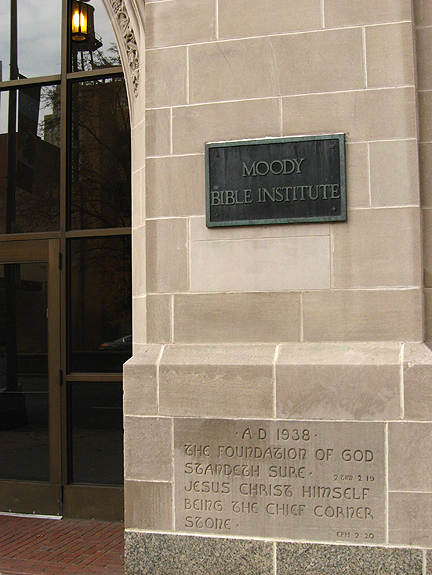
Among the more scholarly and nonsectarian Christian resources are the broadcasts from Chicago’s Moody Institute. Recordings of the late Rev.Weirsbe’s brilliance, delivered with his gentle Midwestern lilt, continue to outshine almost all of what proliferates. The successor to Weirsbe is Moody’s Rev. Lutzer, also with an academic and folksy yarnspinning style, though much more stoic than his predecessors. Well, on a recent workday morning with hot water running and coffee on the bathtub’s edge, I caught one of Lutzer’s installments on his theme, Making the Best of a Bad Decision. I’ll add that many of us must make the best of other people’s bad decisions. Can I get an Amen? Back to Lutzer. Through the noise of first-thing scrubbing, I heard the radio voice beckon, “If you’re still alive, God isn’t through with you.” Surely he wants to encourage his listeners, but considering my state of affairs of recent years, I can easily look at those words ambiguously and through my snowballed sarcasm. Sometimes I do, yet the resultant bad feeling makes me take it back. Reverting to a bleary-eyed positive, my leanings reach inward and upward, through my imagination. That’s my supplicatosphere, which is the stratum immediately beneath clouds of unknowing. “Through with me,” in the wrong context, sounds threatening; but in a healthier frame of reference, my wish really is for Divine intervention. Why is grace deferred? Did I misstep? How am I supposed to know, if nobody tells me? Have I overstayed my welcome? Perhaps I’m inhabiting the very attempt to comprehend the meaning of hope.


While trying to glean insights about things eternal, I’m also constantly reckoning with the ways of mortals. Recently with my philosophy students, I taught about the Golden Rule, framing this in the context of ethics. Our group discussion, probing the time-honored “do unto others as you would have them do unto you” went right into dilemmas about what happens when there isn’t any reciprocity for our respectful acts. Do we keep on being honorable and forbearing, or do we conform to the hardball tactics that confront us? You can imagine our very lively Socratic forum discourse. Whatever we do, we need to choose our reactions and responses. Generally, there’s the trigger end, and there’s the barrel end. Are you the issuer, or are you the inflicted? When so many critical factors are out of our control, what is within a person’s reach? With each day, questions arise in my thoughts as to whether landlords, employers, and community leaders should care about their inhabitants and “stakeholders;” in a word, neighbors. Perhaps it’s unrealistic to expect such people of influence to care, as I care. Ever the cockeyed idealist, I believe everyone should care. That’s how things stand a chance of changing for the better. A genuine sense of respect, even in simple transactions, runs against the currents of pessimism.

Just the other day, I helped a researcher with a query so complex we needed to go back and forth rather extensively in order to unearth the actual question. Having some specifics that mutually made sense, I set about producing what I could find to help this fellow. In the midst of my retrievals, the man frustratedly stormed out of the research room. While I began putting the materials away, he returned and apologized. “I’m sorry,” he said, “I think this world of instant gratification has gotten to me.” He pointed disdainfully at his smartphone. After expressing my understanding, he sat down to read through what I had found, and we talked about his projects. His initial and abrupt impatience was disappointing, but his later presence of mind was impressive. In a handful of minutes, I witnessed metanoia- on both our accounts. Reflecting upon this, later in the day, I was reminded about a barely-known spiritual exercise called examination of conscience. I use parts of my daily journal writing for this purpose, considering such writing as the safest space for articulating thoughts. “Make an appraisal of the entire situation,” wrote Francisco Fernandez Carvajal, adding that we must know what means are available to us, and how to be faithful and thorough. In addition, we must also contemplate how we can remove obstructions in our intentions, as “knowledge of self is the first step the soul must take in order to arrive at the knowledge of God.”


Collecting and digesting knowledge comes very naturally to me, always taking notes. My notebooks become reference sources themselves and they’re great for me to reread when distractions throw my studies off course. These many pages of annotated gleanings remind me of the philosophical texts I’ve been so carefully reading, while struggling to prosper above the fray. As it is with examining my conscience, there must be focused intention to transform head-knowledge into heart-knowledge. What is there for me to learn, from my experiences? “When a person accepts a great undertaking,” as Carvajal recommended, “they must consider various possibilities and look for the opportune means for bringing the work to successful completion,” adding that “we have to be aware of what is lacking so that we can ask God confidently.” In my repeated recoveries from rejected applications, trying to figure out my deficiencies (because reasons are never specified), while left to figure things out I remind myself that more attempts will be accompanied by more failures. More at-bats increase the odds of striking out. Yet still, and even now as the setbacks persist unabated, my efforts continue and amplify. It’s imperative. The here-and-now is at once stifling, uninviting, and tentative; it’s more than enough to keep the search coals stoked. As an extension of my certainty that all we see is not all there is, during the present drudgery I’m convinced there is more than this, and the accumulation of my being is meant for better and more conducive circumstances.


Sunday, August 29, 2021

disciple

“Learn of me.”

~ Matthew 11:29


Be teachable, and you will make great strides,” wrote Desiderius Erasmus, the exemplary and indefatigable Renaissance author in his Paraclesis. The directive is reminiscent to me of my father who has now been gone fifteen weeks from this life. He also admired Erasmus. When I arrived at Oxford, I was sure to send my Dad an e-mail message about walking the same paths and halls as Erasmus did, as a C. S. Lewis Scholar-in-Residence. Dad remarked about The Praise of Folly, as well as Lewis’ Screwtape Letters. The wisest people we know are those who want us to be teachable. My pilgrimage of learning continues on, but without my father- without adding to our running commentaries. Of his best friend of many years, four years his senior, Dad said, “Jack introduced me to so many things,” particularly in their work as pioneer computer programmers and connoisseurs of classical music. When Jack passed away, Dad wrote me about how one day many years back, while they were working at IBM on Madison Avenue at 57th Street, “a security alarm sent everybody into the street. We had no idea how long we would have to remain outside the building. So we just walked over to nearby Carnegie Hall and, on seeing that the Cleveland Orchestra was in town and giving a matinée performance that very day, we decided we would take our surprise break as an occasion to enjoy Beethoven's Ninth as performed by George Szell. It was a spontaneous thing and an afternoon that we always cherished.” A wonderful story of two New Yorkers making the best of things.


taking stock

In his reflection about his departed best friend, my father immediately remarked about how much he had learned. For my part, throughout these recent months, I’ve been taking stock of how much I learned from my father. Taking stock is the opposite of taking for granted, meaning a conscious cherishing of something valuable that is immediately at hand. It is a form of gratitude. Things of which I take stock are palpable consolations to me. To this day, it astonishes me to recognize how much I learned from my father. Last night during a lonesome road trip on the Maine Turnpike, I started imitating his voice, surprising myself as to how accurate I sounded.


Having a difficult time focusing my thoughts, I took Dad’s portable Royal typewriter (I now have all three of his) with me to write in view of Casco Bay. About sixteen years ago, he gave me his two portables- a customized Olivetti Lettera 32, and a small Royal Signet- which he’d often lend to me. Now I have the heavier Royal DeLuxe he used in school. With a sunny Saturday, I took the Signet with me to the park at the Portland Breakwater. Dad told me he had bought that typewriter in 1965 for $35 during a workday. At the time, company employees’ handwritten reports and letters were typed by a secretarial pool according to priorities assigned to the secretaries. Apparently, these were standard procedures. Dad didn’t see a point in having to wait to get something typed up for him, when he could very well do this himself. He descended to West 23rd Street, a very busy Manhattan thoroughfare- near the Flatiron Building, and walked to a typewriter shop to buy the Signet. From then on, he typed his own documents. Dad also explained to me that he favored ribbons that had both black and red inks, so that he could flip the lever to get red ink when he wanted to emphasize something to his recipients. With such spirit and ambition, success followed success.

The Royal Signet belongs to me, and I’ve proudly left the ‘60s embossed label with Dad’s name on the machine. As with many other gifts from him, this is a living treasure, because it gets used. Like the pocket watches Dad gave me, they work best as long as they are used. He taught me plenty about using and maintaining these mechanical marvels. Neither of us could type in the “proper” office ten-fingered way, but we both found ways to type quickly and effectively. In more recent years, he sent me a set of beautiful pens and I keep the letter which he put in the gift box which refers to our common passions that include fountain pens, opera, trains, and a good portable typewriter. And that was just the beginning of interests we shared and talked about. We did not agree about everything, to be sure, but we had enough in common to provide plenty of subject matter.


equipping for the rest of the way


In my father’s absence, a wise friend suggested that I write my gratitude for the ways I’ve been equipped to go the rest of the way. Typing in the park, using the Signet, I began writing about some of the essential things I’ve learned from Dad. Indeed there are many and detailed practical skills, beyond the tools of writing and the precise ways of play-by-play scoring of baseball games. To this day, whenever I begin a new notebook that does not have a pocket in the inside back-cover, I use a trick Dad taught me a long time ago: folding an envelope flap backwards so that the adhesive adheres to the back cover, creating an instant document sleeve. He taught me how to read and interpret maps when I was very young, showing me how to create a “trip ruler” out of a piece of paper, scribing the scale of miles on it and moving the paper along the lines that represented the roads. Dad taught me to drive, shifting the gears smoothly so that passengers would not sense the jolt of transition. And the deft art of feeding a toll booth coin bucket while still in second gear- and then rocketing out of the gantry at the “paid” signal. Knowing which portion of a subway train to enter, in order to alight at the stairs that will take you to the best street exit for your purpose. Dad taught me that in New York, and I translated that savvy much later in Boston. Numerous nuanced abilities, most of which had to do with making forward progress. He had lots of travel stories about having to combine air and surface transportation, in order to connect locations during weather-related cancellations. The important thing, he’d say, was to keep going in the needed direction. Logic took the forms of navigating, analyzing a baseball strategy, and DOS shortcuts. Always destinations to be reached, puzzles to be solved. As Dad used to like to say, “That keeps things interesting.”

Always a mileage log, and always a tire-pressure gauge:
I will always be my father's son.


As my recollections surface of practical skills learned, I’m writing about them in my journals. Transcending all of these things are the subtler abilities, more like traits, and they have occupied more of my thoughts when I consider what has been left to me for the long haul. The more I navigate the roads of this life, the more I see the extreme rarity of my father’s character: that consistent sense of understated dignity, genuineness, and humor. The torch extended to me, in his physical absence, is his gift of intellectual inquiry. By their examples, both my parents gave me the running start to be able to think on my feet. Question what does not look or sound right- not just ethically, but also aesthetically; this foundation is also owed to both my parents. Dad’s high standards, ever beyond my reach, are somehow also my high standards and expectations. But no two souls are alike, and I must keep in mind that our contexts are as different as our generations, pursuits, and paths. These things notwithstanding, I’ll always admire that practical style of integrity and quick-wittedness amounting to being nobody’s fool. If there’s any downside, it’s how the wit is understood by fewer and fewer by the day.


Dad once quipped that my keeping his typewriters working represents his legacy. Of course it was said in jest, in the midst of our usual multi-faceted discourse. His real legacy as I see it, is his consistent sense of decency. That’s the most important way that I want to be like my father. To be civil, classy, unclichéd and genuine; and to keep making people laugh- not at any person’s expense, but about the amusing and ironic things in life, along with that lighthearted way of pointing out such attributes. Dad’s jovial sense of decency. What a great way to be; the world is missing this trait. Amidst learning about high standards- higher than “just good enough”- was my growing to understand my father’s dislike of mediocrity and half-hearted efforts he called “slap-dash.” In this comprehension were his directives to be ambitious. As I got a bit older, more responsible and aware, I grew to also avoid the “slap-dash” in things- and occasionally in people, as well. Such awareness is not uppity, and sensibly unpretentious. It’s much more a judgment of oneself- to unceasingly seek learning, improvement, and continuity.


daring eclecticism


The clergyman who officiated the funeral service, a Midwesterner and also a friend of my father’s, reverently remarked that the breadth of Dad’s cultivated mind was “so very New York.” Undoubtedly, we all agreed. But one might say “urban,” to describe a spectrum of pursuits that encompassed worlds of the arts, sciences, sports, and politics. Yet to say, “so very New York” acknowledges more than the variety of pursued topics of interest: it’s the intensity and enthusiasm of the pursuits. Stereotype that it may be, there are still many who exemplify the energy of such a densely vast and extraordinary place. Enough has been said about the pluck of old-school New Yorkers to fill many volumes, so I’ll choose one exemplary comment: "You just learn to cope with whatever you have to cope with,” said the legendary actress Lauren Bacall. “I spent my childhood in New York, riding on subways and buses. And you know what you learn if you're a New Yorker? The world doesn't owe you a damn thing." Accomplishment must be earned, and the perfunctory is to be exceeded. The mindset is one that tends to be impatient with the mediocre and slipshod, and our quick wits and sharp tongues are often misinterpreted. We don’t think of our critical minds as being “attitudes,” but rather passionate convictions that need to be expressed! Urban common-sense is often vented this way, and notably so among New Yorkers. Dad’s living expression of this was nothing short of lovable. We used to sing Frank Loesser Broadway show tunes to each other on the phone.


Above: The view from Lexington Avenue at 34th Street.
Below: Dad's beloved Caffe Reggio, Greenwich Village.


In the spirit of a legacy that has taught me about ability and perspective, I’ll add what I call inherited instincts. Dad had an admirable knack for reading a situation. This reminds me of how he would say that part of the fascination in baseball is how analysis is built into the game itself as it unfolds. He loved the symmetry of threes and nines- especially in the National League. But reading a situation in real-time is also being a participant. Among the times during which I’m certain of an instinct inherited from my father is when I “break the ice” in a stiff room of inactivity. Another is how I’ve become able to speak with anyone- and getting them to talk. Yet another is having a healthy way of questioning what I perceive: There can be a negatory way of doing this- and I’ve also learned to tell the difference between constructive reflection and simply being a combatant that sets out to confuse things even further. Such traits, practiced at their best, are surely attributed to my father’s example. Finally, “keeping things interesting” is also knowing to have plenty of other things in my life, aside from employment and its related struggles. Learning and being teachable keeps the mind youthful and expanding. Indeed, continuity and improvement, one giving purpose to the other, must always ride together. And thus- like Erasmus of Rotterdam, and like Dad of New York- great strides are made.


Monday, June 28, 2021

o let me ne'er forget

“This is my Father's world:
He shines in all that's fair;
In the rustling grass I hear Him pass,
He speaks to me everywhere.”


~ Maltbie Babcock, This is my Father’s World

Last month, I had the profoundly sad experience of having to bid farewell to my beloved and brilliant father. He has been quoted many times in these pages, and I expect that to continue, having committed so many of his words and anecdotes to memory. The funeral was last month. It is one thing to travel and visit, and even be at a gravesite, on adrenaline- but quite another to return home. Suddenly re-seated at my desk in my apartment, I became aware of the ocean of reminders of Dad in my midst: the fountain pen and radio on my desk, the typewriter nearby, the operatic recordings on the shelves, as well as numerous mementos and recollections.


Returning home to my place also meant grappling with a culture that does not provide sufficient time and space to mourn. I’ve had to buy time and push as many things back as workably possible. I see how people do not want to acknowledge death. Thankfully, I always know to write in all circumstances. But the grieving has been wavering in its intensity, often as crags and sometimes submerged. My photographer’s mind calls forth decades of vivid memories, especially from childhood. I’ve been particularly conscious of these, and decided to write down as many as possible lest I lose them. People who know me well have long been used to hearing me use the expression, I am my father’s son, after all. That will always be true.


Driving home, I passed plenty of places with references to adventures with my father. He used to give me historic explanations to go with town names, especially in New York. Cooperstown has the Baseball Hall of Fame, of which he would say, “that’s the museum you can’t get me out of.” The Hudson Valley, the Adirondacks, and the Catskills are filled with Native American and Dutch names. Road trips with Dad were the pleasant kinds of learning experiences. Throughout my growing-up years, we would walk and talk together; doing this supplied my visual and verbal stock of memories. He had stories to go with everything, and I was listening. I enjoyed being the sidekick on my father’s errands and weekend workplace chores, navigating the length and breadth of The City That Never Sleeps. I met all his coworkers and ate with them, too- even as a young child. Dad and I used to walk together late on Saturday nights to buy the freshly-printed Sunday New York Times directly from the sidewalk newspaper stand assemblers.

Dad taught me how to precisely score baseball games, play-by-play, according to Brooklyn Dodgers' broadcaster Red Barber. This is the style (above). For example, starting off the bottom of the 1st inning Mookie Wilson tripled to center field (he was very fast), and scored on Wally Backman's infield hit to shortstop.


Dad taught computer sciences at New York University, and I tagged along there, too, noticing how his students loved how encouraging and jovial he was. I recall how he gave out number 1 pencils for coding, because the dark marks reproduced much better for later transcription. This occasioned more adventures for us; sojourning the cobbles of warehouse shops on the Queens side of the East River, we’d visit the Senator Pencils factory so Dad could purchase soft-lead Ones by the gross. As he’d say to me- much more recently- “Each day is a mini-project.” Always an adventure, always puzzles to solve. We’d also buy just-made doughnuts from the Silvercup Bread Company bakery- still warm in the box, causing the acetate window to fog.

"Like watching a painting." Eastern Promenade : Portland, Maine


When I was about nine years old, while we were walking and talking along Junction Boulevard, I noticed Dad walk over to a beggar and give her all the change he had in his overcoat pockets. The woman was astonished and thanked Dad with a litany of gratitudes and blessings; after several paces, he looked down to me (I was just 9) and said, “Try to do someone a favor before they ask.” I’ve never, ever forgotten this and have quoted it in my essays, too. There is no finer personal ethic. Our father-and-son adventures included baseball games (including road trips to see games in Philadelphia and Boston), operas and concerts, libraries, hockey games (including a New York Islanders Stanley Cup playoff), barbershops (in adjoining chairs, so we could talk with each other looking toward the mirror), department stores, specialty shops, theaters, workplaces, subways, and countless New York City diners and restaurants. Dad knew everything about New York, and I loved all his animated references. From my earliest memories, when he’d say, “Want to go with me?” I always said yes. Errands were actually adventures, but in commonplace settings. We were like this wherever we went- New York, Paris, Chicago, and along Boston’s Commonwealth Avenue. Dad loved the Eastern Promenade, in Portland (he said, “it’s like watching a painting”)- pointing out how Casco Bay has an island for every day of the year (The Calendar Islands). His general encyclopedic knowledge was unlike anything I’ve ever experienced, even to this day. So very many good stories, I can paraphrase the portion of the Gospel in which John observed that if the many anecdotes could each be recorded, "I suppose that even the world itself could not contain the books that would be written."

Eastern Promenade, May 2021


Among the most painful aspects about witnessing his final days and funeral were not really about the past, but the present and future. This time, I cannot tag along- either as his young son strolling shotgun on 8th Street in Greenwich Village, or as his adult son chatting and comparing our handwritten scorecards at Wrigley Field. There isn’t a now; it’s a not-ever. I must walk the rest of the way- leaning even more upon my memories of our adventures, Dad’s intelligent discourse, and the gentlemanly ethics I tried to absorb. Remembrance is more than respecting the person departed- in this instance my father, it’s recalling the substance and spirit of his character. Remembrance is to continue being taught by his example. I suppose I must go the rest of the way, whatever the duration, without Dad’s storytelling voice. The world has lost some bright colors and is more of a bore than before. We used to sing Frank Loesser songs to each other on the phone. Recently, an elder and wiser person said to me, “You are the continuation of your father,” to which I replied, “If I am, I’m open to the improvement.” Some say I sound like him, but that’s less vital than to be able to apply more of his perceptive savvy and thoughtfulness.

After he retired, my father gave me his prized typewriter which he used for more than forty years. Notice the math symbol keys near the red tab key; he had the machine customized for his computer program coding.


The lyrics I quoted above, by New Yorker Maltbie Babcock, include the line: “‘round me rings the music of the spheres.” Such imagery will also have to be enlisted, for the remaining voyage. When I began publishing my writing with a book, Dad said to me that he admired that I was “contributing to the world of knowledge.” He was an encouraging voice through my employment struggles, but also applauding how my writing and teaching were leading to travels. He liked hearing about the conferences, about Wales, about Boston, and about Oxford. When I taught preservation at Harvard, I called Dad and said, “I’m your eyes and ears here,” describing the wonderful experience. During a residency in 2016 on Beacon Hill and at the Boston Athenaeum, I read a document by Babcock called The Success of Defeat. Reminding me very much of my own father’s words, Babcock wrote: “The only real failure is inside, not outside. It is not being true to the best we know. Inside failure is the only calamity. Outside failure may be the greatest blessing.” Dad seemed to think that I was a success, but I cannot quite agree. At least not yet. Here I will once more invoke Matlbie Babcock:“Success and failure subtly interpenetrate.” For the moment I will consider my inspirations rather than my results.


For the moment I’ll continue to treat the immediate, albeit cast adrift. And the waters are far from calm. My survival instincts cause me to keep rowing. Hopefully there’s still time for things to get better. Through the past seven weeks, I’m noticeably taking nothing for granted. Comfort is difficult to find, and understanding is nearly as scarce. Falling back on my reliable provisions, I reach for the good words I’ve known. Saint Augustine, in the late-4th century, wrote about grieving as a modern mind might express:

There are some who say people should not grieve. Then, let them try, if they can, to ban all loving interchange of thoughts, cut off and outlaw all friendly feelings, callously break the bonds of all human fellowship, or claim that such human relationships must be emptied of all tenderness. And if this is utterly impossible, it is no less impossible for us not to taste as bitter the death of those whose life for us was such a source of sweetness.


These words appear among the essays of Civitate Dei (Book 19). Along with the philosophers who continue to teach me, I add my father with his wise words- many of which came to me when I was too young. I heard myself say to a hospice counselor that I neglected to imagine that I would outlast my father. Perhaps most of us do this. Perhaps, also, none of us can know what that is like until we find ourselves on that regrettably bland and charmless road. If anything, it’s going to take time to navigate out of this fog. It’s going to take a long while before I go to ball games, listen to opera, singing “Bushel and a Peck” again. And I’m not going to hurry it, either. Dad used to tell me to enjoy the day because you live once.


____________________________________


From my mileage log book I keep in my car. I am forever my father's son.