Monday, January 25, 2010

beginning the world


“Always the same underdog stance
under the same happy-sad sky,
eternally crying. Am I still shy?

I am always beginning the world
beginning the world.”

~ The Innocence Mission, Beginning the World


Only in the last couple of days I’ve resumed journaling, after more than a week’s hiatus. A week without assembling words is in itself indicative of a disruption of life’s pace. But with the resumption of narrative is a persistent questioning of the meaning of progress. What are the determinants of the soul’s advancement?

The mystery of real progress is akin to that of time. Mile markers along roads indicate linear distances, yet it is common in many lives to repeatedly pass by the same signs. Even with experiences of bicycle marathons and pool-swimming laps, I wonder if there’s been any tangible progress in the grand scale of my continuum. Or enough. Such pre-occupations become off-putting to me, and I’d prefer to deflect them. The big world is rife with human hardships, revealing an absurdity to worries about the small spaces beneath my feet. They are fleeting, and recognizable by their contexts and connotations. Trying to define self and success is, alas, unavoidable. And if thoughts are to be documented- albeit in passing- even the expressions of obscurity have their places, especially before a re-launch.

Momentum. A fair share of days seem to begin by just showing up. In an effortless perpetual motion, my multitasking flows among objectives, interactions, connecting points of due dates, and even the unscheduled interruptions. Tasks can even be accomplished while other projects are being done. In the broader sense, work demands can weave between reflection, leisure, memory, and aspiration. One motion feeds another. Knowledge from one school or job adds to the sum and solution of an application in another. Sometimes things actually work this way, as though decades of rollers and gears have effortlessly and purposefully joined.


Inertia. Stubborn weeds among the fruitful time periods are those spells of overcoming resistance. Moving out of inactivity (or too much of the same activity) seems to require rebuilding. It’s as though the world must be recommenced from its foundations. A few dependable systems falter, or perhaps become obsolete, and suddenly all seems thrown backwards. A “system” may be mechanical, or internal, or ethereal. And the breach can be mild and unapparent, or overt and stagnating. Stagnation can be so profound that energy must be consumed just to be able to stand- let alone imagining a sustained posture. Navigating through and out of inertia puts the soul in an unusual sensitivity that takes nothing for granted. Through the dark night comes a surrendering of unproductive drives for control, despite the unknowing. While sensing what appears a very fine thread holding everything together, there is a parallel challenge that this may be an effect of impaired perspective. Though it is easy to admit to knowing very little, it is equally difficult to be convinced that nothing essential is lacking. Wondering about being “behind in the game” only invites defeatism. Especially in these times. Inertia and resistance can be overcome with a beginning as basic as counting the blessings of what is good.


A recommencement can retrace the remembrance of momentum. Chroniclers can retrieve journals written in brighter days and revisit the old fighting form that made reaching these shores possible. In yet more adventures of trust, my thoughts must repeat as often as necessary that the unseen Holy Spirit will always hold my footsteps firm. Looking forward through unknowing and material uncertainty is an act of faith. Holding to it is a continuous exercise of trust. There is one direction to go, and that is forward. In so doing, that tension must give way to savored paces that reclaim the airspaces connecting being with environment.

Only a few days ago, I exercised a decision I did not fully realize I had. Hurtled forward by salesmen and financial experts, I very nearly bought a house that I didn’t really like- and could barely afford. Indeed, habitations can be investments, but they must also be worthy places to live. Though a valuable learning experience, the whole episode was one of helpless despair. It began to resemble a perilous conveyor belt rolling my misgivings to a distribution dock of no return (and no savings). In the faces of financiers, I followed the forceful intuition I almost suppressed. If I can possibly help it, faith in the future will trump fear and fatalism. I stopped a process that began in trepidation and the ensuing peace has been palpable.

In my gratitude, few things are taken for granted. Something has indeed changed, and by continuing on I’ll find out. I paid the building inspector, adding a thank-you letter (written on my cursive typewriter), and will pay February’s rent with a relished relief. As I came to see it, all those I met in the process were fine souls. It is in weakness that strength is discovered. I ponder the immortality that happenstance causes me to brush against. It is the heart of God that connects all of us. With this surprise of the freedom already possessed, I happily donated to a few charitable causes. The ability to give is in itself a gift presented to me. I know my steps are guided- even to a threshold of my own some day. But for now I will have to “begin the world” to some extent, though it needn’t be more than simply reconnecting to all I love best.


Friday, January 15, 2010

graphite alight


“You walk into the room with a pencil in your hand...”

~ Bob Dylan, Ballad of a Thin Man


A reprieve of stillness mercifully interrupted the day’s chaos. With notebook and pencil in hand, I sought the quiet sanctuary of an empty office. After having started writing, it became obvious to me that nothing cohesive was materializing. But I kept noting words- even if some of them were about feeling devoid of anything to say. I wanted some new thoughts, but that hour offered no written developments. So that’s exactly what I wrote. After returning home from work that night, those bedraggled words re-appeared as I opened my journal again. It seemed I’d been foraging for glowing embers using a pencil. It happens, ungratifying as that can be. The aspect for which I do express gratitude is for knowing to reach. Even a few scribbled sentences reveals forward motion.

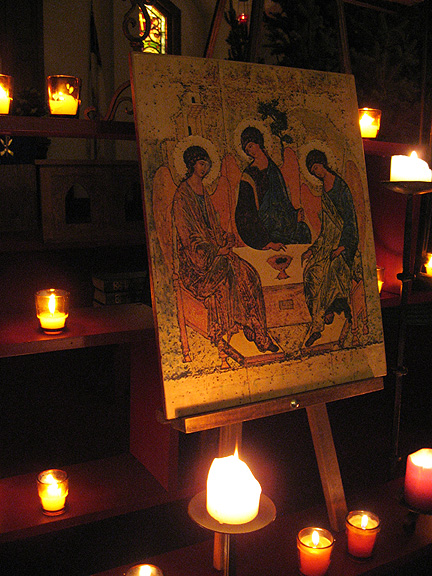
Throughout this recent season of Advent and Epiphany, I’ve travelled to parishes throughout the region, providing music and creating contemplative spaces. Last Sunday night, during the long meditative silence, I glanced up from my sheet music to the front of the sanctuary. Lit only by scattered flickering candles, warm-toned icons met my gaze. These are the same icons that I’ve hefted across thousands of miles, beginning in Taizé, France. Occasionally, I am surprised by the austere mystery on the painted figures and faces. The Spirit invites. Such images are not sources, but brilliant reflections of light that confounds the dark. If darkness is prelude to light, then I must consider my failings and frustrations as prefatory to discovering.


Consider how a physical space appears transformed in our eyes, as our perceptions evolve. The same venue that witnessed anguished desperation can be the setting for elated recognition. Contrasting connotations can be noted anywhere: a café, a busy street, a schoolyard, a workplace, a room in a house. My apartment has been something of a stage for human drama. A downtown diner has been a repeating backdrop for scribing trepidations and for calligraphic catharses alike. Noting how a space is transfigured is to recognize changed realities perceived.

Amidst this reach for understanding is the unfathomable mystery of the origin of light. From there follows the wonder of how a spirit can be re-ignited. If to discover is epiphany, then to arrive is to be present: to alight. The act of alighting is to descend from one place and come to rest in another. Perhaps there is something to note, in my journey, about coming to terms with the Source of life without having seen the Eternal. In Tauler’s exhortation to endure in good cheer, we are to abound in good works for God’s sake. “And then,” he wrote, “shall you be made partakers of overflowing measure that runneth over on all sides.” This alighting touch of grace reaches the brimming human vessel, which “pours itself back again into its Divine source, from whence it has proceeded." In Tauler's description of this mystery, "all knowledge, love, perception are all swallowed up and lost in God, and become one with God." This grandeur challenges my own belief, in that it is more than I think I should ever expect. But perhaps that wouldn't be reaching as I ought. While trying to comprehend these things, why not keep working and keep the pencil moving on the page?


A good friend of mine is a historian of tool-makers and their utilitarian creations. His enthusiasm and expertise has breathed new life into our local Charitable Mechanics' Association- which dates back to Colonial times. Our friendship inspires in both directions. I am becoming attuned to the old ways of production, and he now uses antique typewriters. One day, as I spoke of the "tools of the spiritual life," he quipped, "you've said it all right there. Tools are spiritual." Indeed, we speak in two different senses of the word: implementation of a practice and the physical implements themselves. Surely, the actual tools of the writer (along with the builder and the mechanic) deserve their due. With these writing instruments at our ready, we experience the miraculous- and can create documentation.

As with light, our documenting tools help us liberate our thoughts, our stories, and our voyages. I have seen the worth of keeping the pencil moving- even while reaching and straining for description. And the tools do accommodate, no matter how cold; graphite cannot freeze. These exterior sub-zeroes teach us the value of continual movement. In time, the frozen granite steps will be bathed in spring rains and adorned with ivy.


Wednesday, January 6, 2010

beyond this point


“I wandered about for a long time in different districts,
having for my fellow-traveller the Prayer of Jesus, which heartened
and consoled me in all my journeys, in all my meetings with other people,
and in all the happenings of travel.”


~ The Way of a Pilgrim


Wednesday, December 30, 2009

toque-sain


Oh what will you give me?
Say the sad bells of Rhymney.
Is there hope for the future?
Cry the brown bells of Merthyr.

Who made the mine owner?
Say the black bells of Rhondda.
And who robbed the miner?
Cry the grim bells of Blaena.

Even God is uneasy,
Say the moist bells of Swansea.
And what will you give me?
Say the sad bells of Rhymney.

~ Idris Davies, Bells of Rhymney


In these harsh times, my thoughts turn to seeking the sense of what is seen. Of course, I want to know. And quite naturally the immediate fills my sights. But the undisciplined eye sees limits at all hands. More is asked of fewer that remain standing in recession economies. In my still-young working life, I’m well-familiar with the conscious gratitude of walking and working among the employed- seemingly defying the odds. “To whom much is given, much is required,” is a biblical text often in my thoughts. But there must be more than simply punching a time-card. This has always been clear to me, though opportunities are rare or often drowned out by thoughts of what may have already been missed. Another fine reason to self-berate; another action producing no results.

Looking beyond self-confinement breaks out of drawn limitations. And it becomes necessary to be sensitized to perspectives that my own notions have not considered. Perhaps for post-moderns, a “career” is defined by what has been eclectically assembled- more than the old-fashioned multiple-decades at one company that sees an individual move up through ranks. We find our own ways to redeem the time. Given some morsels of earned time off, I go on pilgrimages. If it’s just a day, there are excursions that present refreshing changes of scenery and new points of view for my learning. Within these verbal exchanges and visible vistas, there are messages for me to derive. Countless times, over the years, conversing with friends has provided that vital forum for commiserating and stock-taking. Listening to others’ approaches to their situations subtly reminds me of how the voyage cannot prosper without kindred souls. It may be akin to the accord of dulcet chimes, or to the impact of tower bells. With some conscious focus, I become able to hear what is needed. My antidotes to dead ends are continuity and refinement of vision.


Lately in my journals, the question, “what is real?” has provided a good writing exercise. The year and this decade are concluding, and the question permits for some retrospective along with forward-looking thought. What sense- and what nonsense- have I been carrying along among the cargo? From within sounds a percussive alert- a reality check. It is a questioning of what unfolds immediately before the ship’s prow, and whether my intended course has been faithfully maintained.

Sources of reality checks can be as simple as posing questions that reconsider how things have always been done. Or, for that matter, experience causes reconsidering attitudes toward people, ideas, even institutions. There can be surprises- from anywhere between offices and street-corners. On all sides, so long as there is breath, it is never too late to revise points of view. One might imagine that all it takes to maintain openness of heart and mind is plenty of solitary contemplation. Not quite. And not without some varied activity, either. With no means of reality check and balance, an intense inner life lends too well to detrimental isolation. My favorite windows let in fresh air and light, as well as offering an outward view from inside. When my writing runs short of words and ideas, I realize how much I need to look outside of my own resources. Words and ideas replenish with reading and observing. And I am thankful for my bolder friends, whose pointers can burst my bubbles of self-absorption. This idea of exercising a broad view came to mind yesterday as I used a wide-angle lens on my camera. A 28-millimeter lens encompasses both ground and sky.

Awareness of perspective is no more than a sensitization. There continue to be times when I am called to navigate through darkness, At times, it is a plain yet pressing heavy-heartedness that disrupts my sleep. Hard times and closed ends, convincingly insurmountable, may be more permanent than previously thought. Or perhaps it is better to accept my inability to figuring everything out. Nights of the soul and long walks that are needed to be able to see and to sense can be means by which new understandings are reached. In a spirit of sincere inquiry, darkness reveals as much as light. Strolling past rows of decorated houses, along icy streets, I wondered how far my steps have drifted from the truths I’ve been pursuing. If I truly believe the words, then I “In the world ye shall have tribulation: but be of good cheer; I have overcome the world,” then I must be convinced I am not at the end of my road.


Turning my steps away from unappealing avenues of bitterness, music returns to my thoughts. So many tunes and words committed to memory reappear and remind. My hope now is for sharper focus- toward compassion and away from entrapments of the mind’s realm. There is a music of hopefulness, and this occurred to me while listening to vespers last week, and later during performances of folk music I hadn’t heard in years. The tones, twists, and lyrics conveyed life-giving ingredients. That which gives life is able to re-ground, encourage, and offer new vision. As a sounding bell from within, signaled turning-points are identified.

Following a mid-day service, several days ago at King’s Chapel, I asked to see the bell up close. The sexton simply opened a very narrow wooden door, after seeing me off at the organ loft. With deliberate care, I ascended the ancient series of ladder-like steps, all the way up through the bell tower above this 17th century Boston church. Standing astride the massive bell, signed by its maker Paul Revere, I thought of how such an instrument rang to alarm and warn, along with a history of ringing out in festive celebration. From the tower’s snowy louvers, the sight of busy Tremont Street below had me wondering about how the scenery has changed through the centuries. Perception can alter one’s sense of reality. Leaving the ready and quietly-nestled bell, I slowly descended through the building and then out to Beacon Street. The bell’s resounding gift to me was neither foreboding tocsin nor weekly Sunday chimes: its silent steadfast witness had spoken to my soul.


Thursday, December 24, 2009

for peace


"O hush the noise, ye men of strife,

And hear the angels sing.

And ye, beneath life's crushing load,
Whose forms are bending low,
Who toil along the climbing way
With painful steps and slow,

Look now! for glad and golden hours

come swiftly on the wing.

O rest beside the weary road,
And hear the angels sing!"

~ Edmund Sears, It Came Upon the Midnight Clear


A peaceful and blessed Christmas season to all.

Friday, December 18, 2009

deux fois cent


“I take a long look
A long look
It's a hard climb that takes a long time
I can see where I'm going
And some places I've been
I take a long, long look”


~ Sandi Patty, Long Look, from Le Voyage.


Today's entry to this blog is my 200th, and thus an occasion to consider the draw of writing to record thoughts. The world and ways of words and wonder comprise my movable feast. When I think of this verbal vocation, it is with gratitude for what has become a means for continuing discovery. When I was a printmaker, the work was inextricable from the need for printing presses. In my first career, photography, there had to be studio and darkroom space- not to mention the plethora of tools, papers, films, enlargers, chemicals, and hosts of hardware for both film exposure and for printing. By contrast, written observation requires almost nothing. A pencil or pen is applied to paper as footsteps reaching a new meadow. Pages rolling through the typewriter map my city streets, coasts, and country roads.


Materials and tools are to be animated in their application. My photo gear continues with me as part of my bookbinding equipment- and as means to accompany written thoughts. Those utensils which respond to the stirrings of the creative spirit are at the ready. Just downstairs from where I note these words- at the Boston Athenaeum- is a collection of Benjamin Franklin's books. Of these, my favorites are his volumes of Diderot's Encyclopedia. They are as Franklin had left them- with bookmarks, folds, and marginal notes. Well-used tools of the craftsman.

Indeed, my gratitude for the writing impulse has been expressed before. Now, the purpose beyond the craft itself deserves its due. When journaling became very important to me, increasingly more of my time was set aside for this. I remember hearing myself say to my friends that I wanted to write through my culled ideas and hopes. I described the process as "doing the long division," rather than to simply calculate for instant answers. My elementary math teachers required that we "show the work," demonstrating how results were reached. By giving place to thoughts, otherwise voiceless words are distinguished- even if humbly so. Expressing the inner life by configurations of letters and images becomes a pursuit within the grander voyage.

Navigating days and distances as a writer has revealed some unexpected liberties. Regarding content, form follows sincerity- and the idea of "poetic licence" is an encouragement to explore forms of expression. The liberties I refer to here are related to the freedoms opened up by writing. When I traveled as a photographer, my purposes and intentions were often questioned. Traveling as a writer- albeit a journaling scribbler- prompts gracious and courteous treatments in public venues, inns ("this'll be a fine room for you to write in"), restaurants, on flights, and in museums. (Aren't museums places for musing?) Penciling words into notebooks permits me to freely move about the aisles of this world. In addition, that idea-scribing penchant has bailed me through banal meetings in the past, dull events, and aimless lectures. More importantly, creative projects provide constructive ventures other than employment travails and perfunctory obligations.


In several days’ time, the next essay will begin taking shape. At this moment the topics are as yet unknown to me. But there will be something, as surely as there will follow another day of journaling- through my coffee breaks and lunch hour. For me, it is a privilege, and never a tiresome task. In a discourse about her love of gleaning through jotted ideas, Elizabeth Berg wrote:

“Nothing matches this feeling. Nothing brings me this particular kind of joy. And I need it. I crave it. When I don’t have it, I suffer. I feel like a drug addict with an exceptionally wise drug of choice.”


The need to continue writing is equivalent to the necessity of perseverance. In a world replete with instability and static, the critical need to keep balanced and finely-tuned is all the more urgent. The word vocatio translates as a summons. It is a call to persist- not simply in letters and imagery, but in faith. A reminder not to forget to dream, and to go forth with a solid aspiration for better days. There are blessings now, and there is room for improvement. Each day is a step. Alongside the paths of steps, carefully-recorded written words attest to what happens- and how the movements are interpreted. When I organize groups of manuscript records, the basic steps are known in the field as arrangement and description. To do this well, the materials and their respective contexts must be comprehended, otherwise the composite collection will not be coherent to future researchers.

Retrospectively, there is a broad view that presents both ends of the active lives of noncurrent archival records. By contrast, journaling lives in the here-and-now, notwithstanding distant recollections and anticipated aspirations. An archivist’s view of a continuing journal would be that of observing the active life of a current chronicle. Without an end-date, it is an ongoing documentation. There are yet more words to arrange, more journeys to describe.


Wednesday, December 9, 2009

lights and places


“Then the star appeared again,
the same star they had seen in the eastern skies.
It led them on until it hovered
over the place of the child.
They could hardly contain themselves:
They were in the right place!
They had arrived at the right time!”

~ Matthew 2 : 9,10.


Wednesday, December 2, 2009

highways


“I’ve seen by the highways on a million exit ramps
those two-legged memorials
to the laws of happenstance
waiting for four-wheeled messiahs
to take them home again;
but I am home anywhere
if You are where I am.”


~ Rich Mullins, Here in America


It took a lot of driving for me to begin collecting my thoughts. In fact, the changes began once my wheels left New England and took to the beginning of a 400-mile stretch of the New York State Thruway, en route to Chicago. Departing the Berkshires, the terrain gradually flattened as I continued westward. A prelude to the Midwestern landscape of fields extending to horizons under seamless skies. The smooth and broadened highways appear equally limitless in their reach. Necessary stops concern paying tolls, refueling, and taking breaks- not the deficiencies of road surfaces themselves. But just as the ocean forms the sea-navigator, road adventures shape drivers and lend character to the beaten track. Traveling through unfamiliar or less-familiar places allows for an ephemeral detachment that easily finds wonder in newness. Within that are the stories of travelers, and listening to these is part of the adventure.


Unlike local roads and expressways, interstate highways present a truncated world. At faster speeds that tempt higher extremes, it is a fleeting milieu of ramps and signs, occasional waterways and overpasses, and names that reveal traces of regional histories. And of course, radio broadcasts that vary with the travel’s progress. Somehow, through the standardized predictability of interstates, the lure of the open road emerges. And without wanderlust, my appreciation for my home town wouldn’t be quite as strong. An appetite for travel and for changes of scenery strikes a contrast with routine. Within that contrast is the cherishing of mobility amidst a restlessness for reaching rest-stops of repose.

Compared to my northern New England roads and streets, superhighways are not endeared to me. Of course, they are purposely uniform to span the continent; that’s the idea. Roads around where I live follow the sloping bending contours of terrain and water. Interstates were blasted through rock, not to be compromised by earthbound obstructions. Many straightaways were designed to double as level ground for emergency plane landings. Perhaps tollways are exempt from our aesthetic assessments. They get us where we need to go, and back again- allowing us to do that with the least travail. In cruise control. And the sameness of the roadside stops and motels are supposed to offer a sense of comfort. Some states refer to their service plazas as “oases,” as if throughways are deserts!


Highway systems, airports, and “intermodal terminals” remind me of how we want to cover distance as fast as humanly possible- and of how our conditions demand that we maintain the pace. It may be impossible to revert to the smaller and slower roads that traverse municipalities. Many towns have lost their cores of commerce due to sprawling development. As the larger, faster, newer, more predictable, and measurable become what is sought after, do the humbler places cease to matter? Is the memory of the unseen negated? Traversing and admiring the vast landscape on the way to Illinois, my thoughts were reminded of the many Main Streets I’ve seen when making the voyage by train. Towns and cities are bypassed by interstates, and are indicated only by sign. My vehicle is small and often solitary in the universe of thoroughfares. Fixtures and structures are few and far between.


Roads and places are stories in themselves. Listening is essential. Considering the discipline of attentiveness strikes a comparison between the patience of observation and the impatience of challenging speed limits. By traveling, it is possible to meet those who have sojourned even more. Seasoned travelers like to talk, and my random survey is to ask such people about their favorite places they’ve seen. One career Merchant Marine offered a vivid description of sailing into Manila harbor. He said it was the most beautiful sight he’d seen. Walking and talking in Chicago with an 88-year-old family friend permitted a chance to bring up my continuing query. Asking Manny about his favorite places from his road sales years caused him to re-enact his recollections for my listening ears. Now I have his stories to reflect upon- his word pictures of roadside fields of sunflowers in North Dakota, all bright and waving to the sounds of trumpeting geese. “Just like a horn section,” he said. He told these stories slowly, as though presenting a gift to me. Manny’s sense of patience is refreshing, and his demeanor reminds me not to hurry or wish away time. The long highway trips are so much about wishing distances away. “How many more miles to...” is the pervading concern. And it will surely manifest over and again in my thoughts, in drives to cover as much distance as possible- hoping to rest later.


Being able to reflect back upon travels and holidays indicates the advance of time and age. My elderly friend encourages me about how most of my years are ahead of me. Now I wouldn’t dare deny such encouragement to someone who is 88! I mustn’t let the advance of time become an excuse for pessimism. It is a fact of living. Remember that as students we are supposed to graduate; that is the goal of formal education. Thus, if one aspires to graduate, it is effectively a wish to mature and grow into the pilgrimage.


In my wonder at the ways faraway points may be connected by navigating highways, routes, tracks, and paths, the road begins to represent hopeful ways forward. Journeying becomes a tangible exercise that observes distance, difference, and proportion. As such, sojourning is essential for a life of learning and understanding. But at the same time, it’s something of an invitation to displacement. Consider hiking and camping. It forces the issues of how to be equipped, how not to be equipped, and what must be done without. But the venturing is pursued by many of us, even enjoying the simplified limitations- which permit for exploration. Indeed, there is spiritual geography as surely as geography may be part of spiritual practice.


Returning east a couple of days ago presented the resuming of mountains, valleys, and at last the mist of Casco Bay. On the way, I thought further about the “hopefulness of the road,” and what that signifies. It’s a present hope for what is too distant to see right now. As well, it is an advancement forth from what is past. Taking to the road is an act of trust in the destination, the means of transport, and of navigation. The vehicle has what it requires to get there, and my understanding of the roads and my sense of direction are sufficient. Even the desire to go forth is an engine in itself. With movement there follows motivation. And in launching out of the onramp, even into the night and across boundaries, the hope of the road endures.


Wednesday, November 18, 2009

airwaves


“It’s not true I had nothing on.
I had the radio on.”


~Marilyn Monroe


When welcoming a houseguest, I try to share as much of my living space as possible. For most of my adult life, I lived in 2 ½ rooms. More books meant less furniture, but it was always neat and tidy. Guests always got the room with the bed surrounded by bookshelves, and I’d take the dining area. Recently with a visiting family member, I followed the same custom of creating a welcoming space. Yesterday, I thought of how monastic houses balance shared and private spaces. I remembered how the common spaces are entered and passed through, with a warm sense of deference. I set aside the morning essentials from off my desk, before bidding my guest goodnight. Early the following day, I noticed myself quietly camped on my livingroom floor, with coffee, journal- and radio. The always-faithful wireless: iconic and useful, with the ready steadfastness of a portable typewriter. Radio often reminds me of who I am and what I am. I comprehend, therefore I interact with this world. With selections and references of my own, I listen.


broadcast presence

Despite all the scientific explanations, the very idea of radio signal reception remains magical to me. The little rectangular box usually perched on my desk can be dialed to faraway broadcasts transmitted through the air. On shortwave, sounds from continents away visit my writing surface. So much is conveyed with seemingly very little. The little box of batteries, numbered dials, speaker, and transistors accompanies me around the house- and out on the front stoop. Radio retains many of its time-honored attributes, and is still somehow an intimate form of media. The operas, the pop tunes, the narratives, the cheering fans, and the chimes of Big Ben (at the top of each hour)- all mingle in the stratosphere.

My mother likes to humorously point out how we tend to look at the radio as we listen. We gather around the sounds that visit our habitations. Long predating the Web, radio is freely accessible 24 hours a day. Live programming is immediate, and does not require reloading a page. Commercials can be turned down. The best sportscasters are assigned to radio, which is only as effective as the human ability to articulate is successful. Intrinsically neutral, the broadcast medium presents both troubling and calming voices. The format lends itself to use and misuse. We can engage the airwaves to find what speaks to our sensibilities.


personal connotations


Beyond the radio as an object, it is a subject replete with profound connotations. As an archivist, cataloguing a manuscript requires that I describe the item as well as the subjects pertaining to the item. What does the object mean? Radio broadcasts are accessible through other avenues, along with traditional receivers. A few years ago, during an immense blizzard in Vermont, I stopped at an inn for a break from my treacherous drive. The British innkeepers had no guests that day, and served tea while nostalgically recalling their beloved BBC. I showed them how they could listen through their computer. In their ecstatic gratitude, they offered me a place for the night- and moved their desk computer to where they could listen to the “Beeb” with their tea. Radio is still radio. A vacuum-tube Marconi from the 1930s can bring you next year’s World Series.

Radio listening has an inherent time-travel aspect. Not simply via music and archival rebroadcasts (both sources of enormous wealth), but also in current programmes in a style of another time. Mystery Theater and Twilight Zone Radio represent new manifestations of a long tradition of thrillers in the “theater of the mind.” National Public Radio’s lively quiz shows and the much-loved Prairie Home Companion endure with off-the-cuff literary wit that has long-since disappeared from television. New Englanders are regularly regaled by the seasoned voices of Jordan Rich (WBZ), and Steve LeVeille (also WBZ)- both of whom are endeared to their countless listeners. They represent a demeanor from an era that fused spontaneity, directness, and a high regard for decorum. Rare and not shrill. Encouraging and not alarmist. Good listening is an exercise of memory, as well as an understanding of significance. Weighing ideas is an opening to interpret the world. The spoken word without pictorial footage lends well to imagination. An amusing juxtaposition would occur during early-morning commutes in rural Maine, during which I could pick up frenetic Boston traffic reports. Turning off the sound, I’d glance again at the dairy farms and pastures around me. Truly, the newswatch never stops, and radio reminds me to remain awake to the present, reference the past, and participate in life’s developing story. Always making notes- mental and otherwise, I continue to collect words, sounds, and anecdotes.


accompaniment

As personal essentials are determined, it is easier to know what travels along. Radio goes with me on every major travel, be it in or out of the country. With every locality, there is always something to listen to, reminding me of where I am. In Europe, it’s a cornucopia of languages. On returns from cross-country road trips, I move across NPR (or Radio Canada) affiliates, until I get within range of my New England favorites. Familiarity comes by sound and cadence. Radio has accompanied me at all my jobs, studios, apartments, cars, and has echoed through every darkroom I’ve worked in. It is a medium without moorings. Being a postmodern, radio has always had a suggestion of being something a bit antiquated. As a teen, my parents offered to give me a television of my own. To their surprise, I gratefully said no, and asked for a table radio instead. I still have it, and the sound is as rich as ever. After one of his enthralling monologues, I wrote a letter to Gene Burns- with a matted landscape I printed for him- to say thank you. I told him that his programme was something of a graduate education in the liberal arts. He wrote a memorable letter back to me. Assuredly, my life’s influences include some of those golden voices inspiring worlds of words and oration. To be immersed in depths of musical and verbal sounds also inspires a life of listening.


“Hello, Mr. Radio, you friendly station,
So glad of your company, your morning music...
Your voice comes riding home across the air,
You travel 'round the world, but still you're here”.


~ Jeff Lynne, Mister Radio