Showing posts with label perception. Show all posts

Friday, January 26, 2018

just for now


“Our transitory burden of suffering is achieving for us above measure
exceedingly an eternal weight of glory;
while we look not at things seen, but things unseen;
for things seen are temporary, but things unseen are eternal.”


2nd Corinthians 4:17-18.

Among some old habits of mine is that of keeping a few bandages in my wallet. Through my adventures in art school, studios- and as a bookbinder- I’ve had to provide my own ready supply. Foraging enough with lacerated fingers, through remote and sparsely-stocked first aid kits, taught me to be self sufficient. Most of the time, the band-aids are for my own immediate patching-up, but I’ve given many of these away as needed. In such situations, the most effective cure is the most instantaneous. The cuts and scrapes can be revisited and redressed, beyond the momentary and stabilizing remedy. Rather like temporary, low-speed spare tires that allow us to retake the road en route to safety and more enduring solutions. It is the instantaneous aspect of a short-throw response that lingers so meaningfully. I believe this also holds true, when it comes to timely and thoughtful words that represent generous intentions. As with the small bandages, lightweight tires, splicing tape, binder clips, lengths of fishing line, and plastic tarps, consoling words do not necessarily solve problems: but they may act as vital stop-gaps. The idea of such triage is to reach the next step intact.


The new year is off to a start that too closely resembles the old year. Indeed, a calendar page’s turn does not automatically change our living standards. Road signs inform us about our direction; their purpose is not to tell is how enjoyably we’re travelling. The passage of time is about my only detectable progress. Apparently, the list of those who meteorically rise in flashy success is short. For me, the pace has more of the resemblance of a forest tree. True to a northern New Englander’s colors, seasons are stark and rapid. Roots anchor deeply, and whatever is above the surface must endure battering elements for some ten months per year. Seedlings evidently need a lot of time, accumulating forces and building some requisite ballast. The process, as least for this mortal, is excruciatingly slow. Fruition cannot manifest soon enough.


But what to do, when the ground trembles at every turn and foundations are endangered? Planning ahead and projecting only go so far in front of closed doors and locked gates. Now that surely needn’t negate composing wish lists. Instability demands a closer focus upon the present- even taking stock to appreciate the temporal. A wise friend once told me about “split seconds;” as anyone might do, catching their breath to regain composure and be able to stand at ease. A change of perspective is to sense my immediate context, and leave the far future for later- even if just as an experiment not to overthink. To me, a split-second regathering is a restorative moment, a stabilizing and portable respite.

Pondering this, through the tentativeness of unaffordable housing and difficult employment, my sense of momentary consolation is put to the test. There remains much to appreciate, but it requires creating some space in the chaos to be better able to savor what is life-giving. Appreciation must be an active observation. Don’t just admire that perfect cup of coffee; drink it before it gets cold. Just the other day, it came to me, as I was reassuring an anxious colleague. I heard myself say, “this is just for now.” Somehow those few and small words alleviated stress, pointing to the fleeting nature of a present oppression. The storm will pass and dissipate. Just for now. Later on, through the week, I noticed that I was occasionally repeating this to myself. Even the typographic "J4N" has been appearing in my journal entries.

But an active mind always aspires for more, especially as sources are discovered and tapped. And the motivation for supply is the demand. While just for now helps soothe the soreness of defeat, the memory of a long-ago “split second” has recently returned to me. Way back when I played hockey, the teacher that coordinated and watched over us did his job with fierceness and with the vigilant eye of a mentor. We were unruly kids, yet we followed our leader. Amidst our rambunctious collisions and adrenaline, he’d say to any one of us, “[are] you all right?” -or “you okay?”- in an understated tone of voice. Channeling this memory of sound, I’ve claimed this as another momentary respite: You all right? You okay? In an imagined response, I’ll say, sure; all right, and instantly resume whatever task I’d interrupted with that very brief pause.


Those split-seconds’ worth of resuscitation are punctuation marks in seamless streams of verbiage and shifting surfaces. Not solutions in themselves, but they are stepping stones in the days’ traversals- small yet vital bandages at the ready. Just for now is both grasp and release. In recent years, my experiences have comprised a voyage of survival, requiring a development of momentary consolations. The salve of just for now may be in response to difficult days, or weeks, deadlines, of crises of varied duration. The “time being” of a just for now might be a long time.

The relationship of time and memory amounts to yet another dimension in the human odyssey. As with any reactive remedy, just for now exists in real time. Retrospective observations are not about now, but about then. “Somehow, I pulled through,” or “I nearly didn’t survive,” are both statements that look back. Intrinsically, administering an instant cure is pointed toward the future- yet it is the present that is stabilized. A fleeting pause may be an eye in a storm, buying a tiny bit of time to find some bearing, take stock of the present, and look ahead.


Memory makes demands that are not unlike looking forward: as progress is intently expected, so memory expects time to stand still. In a sensation very similar to how we anticipate, we are often incredulous with the ways things change from past to present. As an archivist, I notice this daily among my clientele. Passing by places with which I have lengthy and vivid personal histories, it’s easy to be astonished at how they have changed over the years- irrationality notwithstanding. Memory iconographically freezes objects and people in place, registering images as a camera might on film. For example, my mind’s eye recognizes a school, a house, or a past workplace, but none of the people now are familiar to me, and I am merely an observer with a memory. Missing a person, a place, or a situation amounts to much more than people and physical surroundings, but what they represent for us. Remembrance revisits deeply registered pictures and footage, intensifying contrasts between past and present. It is often a reluctant realization that prized and enshrined memories were also fleeting instances of just for now. Still, we continue to preserve, to expect, and to be startled. Bereavement, another example, is a just for now of undefined duration, and the losses are of those who should have been permanent and unchanging. Of course that’s unreasonable, however real the pains and wishes can be. Just for now cannot be more than temporal- and paradoxically the just for now is integral to healing and continuity.


Friday, August 15, 2014

y tir


“According to thy name, O God,
so is thy praise unto the ends of the earth.”


~ Psalm 48


y tir (terra)

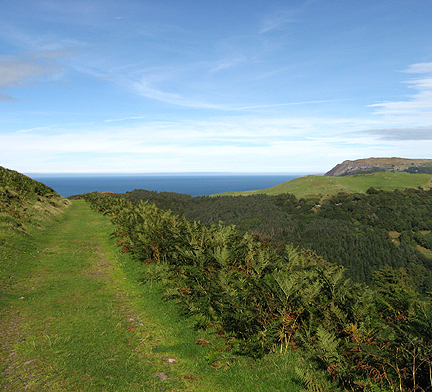
Timing a sojourn to Wales after an intense term of study turned out to be serendipitous. From the intricate, labyrinthine campuses and cloisters of Oxford, my steps alighted among the coastal mountains of Snowdonia. Very shortly after leaving my bags in the Noddfa house, I walked downhill through the village of Penmaenmawr, to the seashore. Immediately, I realized how soothing it was to be amidst wide open space. The same sensation struck me the following day, hiking in the mountains, and without thinking I swung my outstretched arms like windmill blades. The landscape, seascape, waves, and fresh air reminded me of home. A restful week-and-a-half in North Wales, following a profoundly scholarly experience at Oxford, drew me to savour the terrain, waterways, and skies.


These travels have taught me to treasure each step, each setting and encounter along this providential way. An old Bostonian named James Freeman Clarke once wrote about the cultivated habit of recognizing the miraculous and the beautiful as we navigate our lives. Using the example of a classic poet, Clarke pointed out how “Milton lived in London, but he saw more beauty in one morning’s walk in the country than many country people observe in all their lives.” (Conversely, it may require a country poet to notice the nuances of beauty in places like Boston and London!) But, indeed, a change of air and place can awaken our sense of appreciation for the elements we may otherwise take for granted in our worlds of routines. As I noticed details in the urban layout of Oxford, my impressions upon returning to Wales were equally enhanced. New terrain and the beaten track become intermingled. I remember an occasion, on a boat, when I described the islands near my home on Casco Bay, Maine, as the peaks of undersea mountains. It was simply noticing what was in front of my visitors and me. The terrain in North Wales is as eventful as it is varied, and my many steps sauntered streets, paths, and mountain trails.


enduring paces


Reflecting upon these sojourns, my thoughts mull the distinctions between lands navigated in a place such as Wales, compared to my forgettable workaday trudges. How are my steps and strides in various lands distinguished? After all, the paths are navigated by the same individual- the same pilgrim of trust on earth. The differences are in perception- and place. Granted, and quite obviously, a trail such as the road of the ancient Celtic pilgrims is many times more exotic and rarified than Cumberland Avenue. To be able to equally regard all earthly thoroughfares might require a strong sense of self-awareness combined with a disciplined spirit.


Similar to the old adage about the sea determining the substance of the mariner, the pilgrimage builds the integrity of the pilgrim soul. In turn, the pilgrim determines the worth of the long journey’s paces. An intensified significance especially applies when a sojourn is of our choosing. With every week’s paycheck, the first thing I do is tabulate how many earned-vacation hours I’ve accrued, and then divide that number by 8-hour days. It requires a month of full-time toil to earn a day-and-a-half of liberty. Time is bought at a price. Redeeming time which is at once longed for and cherished, as well as regretted and grieved, is a lifelong comparison. I’d do well to view these daily commutes and staff-meeting shufflings as though en route to the next mountaintop, around the next Neolithic standing boulder, or to the next wellspring. While trying to think of it that way, I hope to make my steps matter.


If our actions produce a memory or an effect that extends beyond our reach, then our steps do as well. Pilgrimages, by definition, are intentional travels to inspiring sources and alongside the very footsteps of our predecessors. In so doing, we generate impressions, making marks of our own. It is as though we contribute to the very achievements we seek to witness. There is increasingly more to remember, as time passes. A handful of small stones I’ve saved from the trails, and the words I wrote in transit, help to recall memorable places navigated. While captivated by the idea and action of motioning and reaching forward, I suddenly wonder who will be seeking our footsteps? Considering milestones and crossroads past, directions taken now have future implications. Travelling linear paths across ancient clearings, forests, and mountains broaden perspective. Our todays may surely meet with the todays of others whom we cannot know. The proverbial pearl of great price, as we know from holy writ, is not isolated without context, but is indeed found in a field. And it is a field we will leverage ourselves to gain.


Abergwyngregyn


proceeding


Through my explorations in Wales and nearby England, I listened to countless pleasant stories about travels to the U.S. It was good to hear about visits to Maine and other parts of New England, with admiration for our respective homes. As well, I was both surprised and heartwarmed at the exuberance about not just the city of New York, but about New Yorkers! A group in north Wales gave me their gleeful renditions of the New York accent, so I cranked mine up, and we all had a very loud time. Learning to attend, observe, and to notice what is around us, returning to James Freeman Clarke’s words, “changes time into life.” He described the skill of observation as a great art.

“Many of us pay half-attention to what we see and hear. Then we do not remember it. Travelling in new countries is useful as calling out the faculty of observation. The traveller feels it his business to notice everything, and often while abroad, is interested in what he has seen at home, but has not noticed it there.”


Along the History Walk, on the Bangor High Street.


The paces of time surely cannot be rewound like a mechanical watch, or turned back by paging through an old calendar. There is an important difference between attentively walking, compared to smothering the terra firma. Awareness is to conscientiously pace oneself. Physical motion looks all the same to the casual observer, yet the intention is as incongruent as arranging a dinner place-setting is from throwing a fragile artifact against a cement floor. We can boorishly bellow, or we can speak and attend with respect. Both require words. The distinction is in the spirit and the delivery.


I hope very much to return to Wales, not just to explore new corners and coasts, but also to revisit familiar places. The mountains and hills of Snowdonia will always compel and console. The trails with the best views tend to be the steepest pinches of shoulder-width divots between sharp rocks. Consequently, angular descents compressed my toes into the fronts of my shoes. (For relief, I occasionally descended by walking backwards.) Navigating the notches is entirely worthwhile, with each vista cherished. The way of broadened wonder is paradoxically one that is narrowly focused.


Isle of Anglesey


Walking the land in this pilgrimage of trust on earth lasts the length of life. Newly-found trails are combined with repeated paths. At times, I’ve made opportunities to re-walk the routes that are dearest to me. On other and rare occasions my steps intentionally overlapped past impressions in order to verify and change them. What should I have done that I failed to do? What can be corrected, and redeemed into time? Is the distance ahead worthy of the distance behind- even exceeding it?


Our adventures teach us how to proceed. Among other things, I’ve learned about how an action such as sojourning finds its distinction in its very intent, the spirit beneath the action. Just as a pilgrim can sense the ambiance of a place, so can the ground feel human intention. Seeking the solace of the fair country, I have surely tasted that solace.


Tuesday, August 6, 2013

heart to the highway


“Set thee up waymarks, make thee guide-posts;
set thy heart toward the highway,
even the way by which thou wentest.”

~ Jeremiah, 31:21


Tuesday, August 16, 2011

vessels


“Être toute la vie
porteur de joie
et de la paix.”


~ Frère Roger, de Taizé, Un Avenir de Paix


As I begin writing these words, my hands hold the notebook and pencil which are supported by a table and flooring beneath my feet. The cup in front of me is a vessel holding coffee. A shoulder bag hanging over the back of my chair holds books and workday provisions. The wallet in my back pocket contains a little bit of currency, and my calendar book holds the week’s receipts and listed commitments. My journal notebook is something of a carrier itself, and as it gets filled with words and experiences, the book itself seems to transform. These examples speak for just a few of the vessels immediately seen. Perhaps you may be able to glance from your reading to notice a few vehicles, or containers, or bearers which move their respective transitory holdings. We bear- or carry- ourselves about, recalling that our physical standing may be referred to as our carriage. In French, being the porteur can mean one who is the deliverer of an item, but it is also the word for one who is supporting. An ordinary day is replete with vessels, with compartments that transport. What are the messages we are delivering?


One of my many adventures involving archival fieldwork brought me to the small town of Wilton, Maine. I’d been hired to spend several work days there to organize their local manuscript collections and train a group of volunteers to continue the process. It is always a true labor of love and an honor to be called upon to help preserve the documentary heritage of my home state. By phone, in advance, I’d been told about a Civil War “secretary” by my hosts in Wilton. Once I arrived, I found out what that was. Apparently, so did a crowd of townspeople; they were told the archivist would know how to open the mysterious 19th century box, then we’d all find out what was in it. Immediately, I was set to the task- and fortunately by moving the desktop-sized polished wooden box on my lap, I was able to find the series of concealed inlaid rods which required some pressing-in so the lid could be opened. The box had been the portable desk of a Union Army officer who hailed from this little Maine town, and inside it were his spectacles, gloves, uniform épaulettes, and a number of handwritten documents. We catalogued the box itself, as well as its contents, setting the tone for the rest of the project’s work. This occasion comes to mind when I imagine time-capsules and their discoveries. We “store” experiences, names, sounds, and pictures within our memories. The human soul is inherently something of a time-capsule. As with the Union captain’s artifacts, we create our own museums and shrines- with both artifacts and recollections. Being our own curators, we each provide the interpretive narration. What accompanies our journeys? Do our narratives proceed with us, and do they evolve? Are the stored memories stagnant? If the human time-capsule warrants our preservation, there must surely be purpose to our curatorial commitments.


While considering the recording of history and its housing in vessels, there are also containers that do hot hoard. Indeed, not all conveyance chambers are meant to be storehouses. A camera is simply an instrument for the exposure of images; the purpose of the chamber (“camera,” in Latin) is to facilitate the creation of imagery, rather than its archival storage. Further still, consider the radio: receiving and transmitting signals for our minds’ interpretive abilities, it does not compile or stash away voices, events, or documentation. I listen to today’s news on an antique radio. Occasionally I wonder at its past years of songs, baseball games, and variety shows- from long before my birth. The radio cannot remember; its speaker conveys only what is broadcasting now. But the soul recollects and can identify meaning to its received coordinates. We hold great treasure, albeit as earthen vessels. Is there a limit as to how much the human vessel can hold? I like to think the archive of the soul has an unlimited capacity, providing it is well organized and maintained. Even with that in mind, there must always be an ability to receive and convey without stockpiling.


A vessel of any kind transports something to someplace, whether in the form of a ship, a freight train, a locket, or a notebook. During the weeks and months it takes for me to fill a blank book with journal entries, the tome itself alters its shape and appearance. The vessel physically reflects its adventures as well as the writer’s personal investment. Inevitably a journal captures narrative words in its content, as well as an artifactual testimonial of its life as an expressive instrument.


(The graphite-holder, above, is called a porte-mine*.)

Generally speaking, vessels are the essential vehicles for deliveries to destinations. Writing life’s pilgrimage, conduits and way-stations are surely more immediate concerns than any ultimate terminus. Being incurably intrigued, I wonder more about from whence my inherited words and ideas originate- before they pass through my hands and mind. We like to refer to treasures we convey as temporal, yet quite naturally regard them as eternal. It’s easy to take the immediately visible as all there is. It seems the intellect must make a pilgrimage of its own to the heart’s inlets and coves. As living vessels, how real are our conveyances? Are the experiences and artifacts less real than the container itself? As couriers, what are our contents? It is a relief to remind myself of my role as simply a good steward, when reviewing the archives in my charge- past and present. Historic treasures are to be dignified and made known. In life away from work details, there is a transcendent and widening journey. As with the ancient parable of the talents, the important thing is to invest and leverage wisely and conscientiously. While trying to imagine the destination, albeit knowing content and conduit will eventually be released, there remains every good reason to craft the cargo and its vessels with utmost care.


______
(* pronounced: POHrr-te meen)

Friday, August 5, 2011

behold


“Do we know within us
the call to change our heart?
If we do,
the Spirit is alive in us.”


~ The Monks of Weston Priory, New Life, New Creation


This time, knowing time has passed is a matter of profound gratitude. Rather than being swept by puzzlements past, my thoughts are set at ease that today is not last month. On an afternoon of subsided summer heat, suddenly cognizant of oceanic east winds, my steps drew me to the water’s edge. Although the ocean is daily within view, it is quite another thing to make the crags, waves, and sands into a destination. The soul must find its rest. Those sea-spiced winds called to remembrance a consolation that rises above circumstance.


Leaving aside confining walls and words, paved roads revealed rock ledges and large skies. Vastness changes context, removing constraints and thus subverting contained thoughts. Details lose their prominence beneath ceilingless celestial heights. It suffices simply to sit, aperch on a jutted emergence. Nothing else needed and no demands made. My eyes had only to behold, and take stock of my refuge. And with eyes closed, the Divine reassures by air current, spray, and seabird song.


Yes, I wrote a few words- a notebook being something of an appendage- but they did not amount to much. As sensible as it was to write, it did not matter whether the words made any sense. Just as it mattered less what I saw than it did to simply gaze seaward. All was in motion, save for my rocky perch. Watching tidal pools, pondering my own depletion brought to mind the prospect of passing into something new. Inlets need not strive to collect living water. They have only to behold.


Openness to replenishment is far more perception than action. It may be alighting by the ocean, unarmed by agenda. Or, as on a recent evening, it may be setting a chair into a library aisle of choice and reading portions of books. Phrased insights swirled to shore. Just enough to set forth again. Between work shifts and city errands, skies provide reference to the expanse I beheld above the waves. The seascape formed a kind of musical chord that conveyed an assuring grandeur. Added to this are wise words read and heard. The sum of the parts is brought together at the shores around my steps. Making note of the heavens, I ply the waters.