


“Tu toucheras la terre
La mer porteuse d’îles
Tu verras les bateaux,
La barrière et le moine
Le château et le pont
Et tous les champs d’avoine.
C’est à toi tout cela.”
~ Félix Leclerc, Tu te lèveras tôt


 Posts
All Comments
Posts
All Comments
“Tu toucheras la terre
La mer porteuse d’îles
Tu verras les bateaux,
La barrière et le moine
Le château et le pont
Et tous les champs d’avoine.
C’est à toi tout cela.”
~ Félix Leclerc, Tu te lèveras tôt

“The sheer bulk of modern records
makes their destruction inescapable.
The difficulty is to decide wisely and well
what shall be destroyed
and what shall be retained.”
~ William Kaye Lamb, The Fine Art of Destruction
One of those things only I would be able to recognize and laugh at, is noticing that whenever I tenaciously clean my desk area at home, I’ll do the same sort of cleaning at work- or vice-versa. It seems that if I want to clarify my thinking, the effort manifests across the boards. Years ago, when my office-studio included a darkroom, one evening while at home it occurred to me how my kitchen resembled the photo lab. Right down to the little bulletin board above the light switch. Organizing baking utensils seamlessly mirrored how I kept printing and developing tools at the ready. One of the downsides to having many avocations mixed with vocations is how each involve accumulations.
And I’ve had to focus my pursuits, prioritize how I can try dividing the time I have, and then make space by giving away what is no longer useful. In the progress of living, we invariably learn that we can’t keep everything. I’ve found that I can do many things- but surely not everything. And would I want to, anyway? More than proving multi-tasking prowess, there is greater sublimity in selectivity and simplicity. Accumulations and collecting manifest in many forms, including the tools and results of our crafts, mementos, and assemblages of our thoughts. And equally, we can bury ourselves with both material and mental agglomerations, especially without some boundaries. Aspirations are not to be bound, not as we might exercise the confines of schedule and space. Limiting personal aggregations are separate from the detriment of limiting one’s perspective and aspirations. But how else to know one’s figurative limits, aside from lived realities? Being always younger than the majority of my colleagues, over the years, I’ve seen how many establish their limits. I’m also aware not to resign myself to limiting my sense of exploration and anticipation- choosing not to be sunk by cynicism. Doing this seems to require a vigilance similar to that of cultivating a body of work, or a craft. Looking at the work I do so intently, it has been occurring to me how there are theoretical connections between the different skills I practice and the spiritual vocation I’m called to express and pursue with my life.

Theory and practice: what we say and what we do; one can evaluate the other- and surely this is inevitably how we are evaluated. Momentarily speaking from the standpoint of a fulltime working archivist, it seems that archival theory has some application to this double-theme of managing excess. It seemed ironic to me, that while I’ve been organizing major historic collections, having the charge of one such department, and even traveling the region instructing the curatorship of archives, that my life apart from work should occasionally find itself in disarrays of paper heaps and jumbled thoughts! Why keep what neither serves nor informs? If simplicity helps me think more clearly, than it’s worth the effort to assiduously keep things simple and purposeful. For a curator of the soul, there are “collections management” issues that are really the same as those affecting document archives.
In graduate school, we studied texts by Sir Hilary Jenkinson, one of modern archival theory’s innovative minds. Jenkinson entered the field in the aftermath of World War I, when the antiquated profession found itself unprepared to deal with a massive proliferation of manufactured documents. A bit like today. Suddenly, the profession had to engage in the unprecedented obligations of selecting materials for preservation- and for disposal. Jenkinson posed the question, “What is the criterion for destruction?” “There,” he added, “is the starting-point of criticism.” The crossroads, in any matter, are what get us thinking. From there, we join a continuum of advocacy for the historic record, while also evaluating documentation against context. At the prospect of reaching his archival terra incognita, Jenkinson suggested keeping “destruction diaries,” that would inventory and thus represent what had been deemed documentary chaff. Decades later, with tested records-management policies long in place, W. Kaye Lamb added that while controlling quantity, archivists needed to keep open minds regarding future potential uses of the documents in our spheres of stewardship and carefully focus preservation energies on unique and informative collections. We all have only so much space and time- for an institution it may be shelves and laborers, and for a human soul there are limits on what we “give place” to, in our hearts and thoughts*.

Now consider what archival methodology has to teach about managing the extraneous. How to minimize and dispose of things and thoughts that obstruct my vision of sources that have actually strengthened me through struggles and false starts in this life. When I’m in the role of archival consultant, seemingly “parachuted” into incorrigible messes of heaped volumes, deteriorated ledgers, and rolled up embrittled maps, documents, and pictures... I begin with a survey. Resisting the impulse to stand still in overwhelm, surrounded by dusty and unlabeled piles in acidic boxes and bags (paper and plastic), I simply list what types of materials I can find- by format- getting a sense of what I’m dealing with. On such a cursory pass, I only move the stuff so I can see what there is, and to do some quick measuring. Each area and wall gets a name, like “3rd floor, north wall,” for example, so I can at least retrace my steps. All the complex strategies, labor-intensive processes, and researching follows. During those surveys, I make myself able to visualize the whole mess as a trim, finished, and indexed collection. Subsequently there are all the procedures for developing, presenting, and maintaining these collections, always looking for what may need additional conservation.

Likewise, for the archives of the soul, there will always be collections to manage, to groom, to verify, so they can be referenced well. A constant method, if you will, is that of maintenance: the tending of the soul. We are ever collecting information and impressions, and discarding them. Being our own curators implies an assessment of the vitality and value of our own inner archives of anecdotal thoughts, attitudes, and perspectives. After the type of triage I’ve described, which is needed when organizing a neglected corpus of unfocused accumulation, the follow-through comes in the forms of careful upkeep and watchful acquisition. Subsequent accessions are to be considered in light of the integrity of existing collections, their context, and pertinence. To appropriate again from Jenkinson, what you uphold must warrant your “physical and moral defence.” It may be an influence, an affiliation, a demand, an accumulation held too long after its records life-cycle, or some other burdensome digression. Here is where it becomes easier to shard away what can’t be used, by comparing whatever that is, to what is needed in order to progress to a wholeness that is a benefit to others, self, and true to a sacred vocation.
In this context, it makes a world of sense to dispose of these types of space-consuming inner archives, or even to make the effort to remove a pervading destructive consciousness of collected thoughts. But that is far easier said than done, and if what remains for a while is a Jenkinsonian “destruction diary,” then so be it- but let it be inconveniently shelved. In a spirit of trust, the obsolete and useless collections will ultimately be vanquished. The anonymous author of The Cloud of Unknowing observed how daunting distractions can get for those who “take up the contemplative work of love.” He advocated a healthy detachment from things material and even spiritual, from situations and projects both good and ill. “To put it briefly, during this work you must abandon them all beneath a cloud of forgetting.” In so bold an effort, repressive hindrances are effectively neutralized. A mindset of hopelessness leads nowhere and the antidote is trust in the Immutable, realizing how the Divine indeed manifests in our lives. This kind of mindfulness keeps us aware of the strength needed to artfully de-accession the records we don’t need. And in the yield there will be space for newer and more relevant archives.

* Ephesians 4 : 25-27
“A right intention demands that we work with enough detachment to keep ourselves above the work to be done. But it does not altogether prevent us from gradually sinking into it over our ears. When this happens, we have to pull ourselves up, leave the work aside, and try to recover our balance and our right intention in an interval of prayer.”
~ Thomas Merton, No Man is an Island, p.73
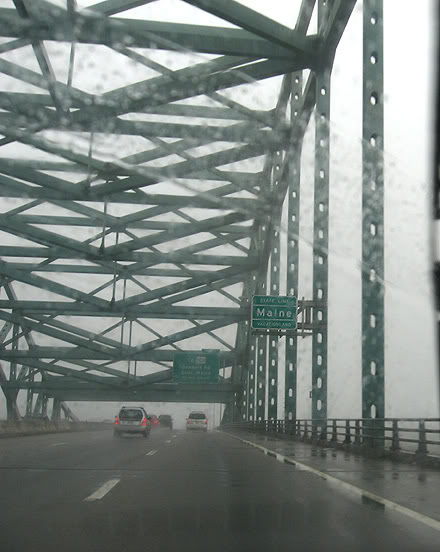
The northeast journey back from Vermont, from rutted roads and through highways, went quietly and without incident. Calmly dreamlike, I traversed some familiar scenery, though beneath changing skies- some darkening into downpours. During the drive, transiting mountains and rivers, my thoughts continued bearing the impressions of nine days’ absence from routines that had encroached upon my abilities to think more clearly and to listen deeply. Such opportunities are all too rare, and it is well worth seeking ways of interpolating reflection into the everyday. A chance to savor moments at my doorstep, reminded me to try applying that better in less rarified circumstances. I chose to make the trip home into a gentle transition, remembering past experiences of various rough landings and disappointments. Subtle things, like packing food for the journey, taking a scenic route- even through rainstorms, and approaching the city via side streets, made for an enjoyable re-entry. Indeed this continuum matched the welcome I received. Sure, the sullen ambiance of hard economic times was immediately felt as I returned to work. But that’s everywhere, I told myself. At least it’s still possible to take stock of all the good projects in progress, and recall the positive aspects that I can effect. Indeed, as with my successive and incalculable steps, I cannot know the beginning of the momentum that carries me even through this day, however it is for me to continue forward.

Moving through the week as something of a clean slate- yet already back to stealing moments for gathering thoughts- I tried to reflect upon what I’d learned after some extended contemplative silence. Realizing how the mountaintop experiences may be places of profound respite, they mustn’t be the sole places of spiritual growth. For the learning and perceiving to go on, no matter the time and place, I must keep listening. And it is a listening for an almost wordless presence that speaks from within. Keep listening. A conscientious practice that makes it possible to really attend to others, as well. Pondering the idea of “keeping,” brought to mind such connotations as maintaining or cultivating, rather than a stagnant holding-back. If our nature is pliable to our ideals, then keeping on with a constructive discipline is not a constraint, but truly a boundless practice. Balancing ideals with realistic expectations is a constant evaluative process. When they conflict, I must make every effort not to indulge in embitterments that expect- and even demand- responses that are out of my control. This is a way to extend the same spirit of reconciliation that I have received in the silence of retreat. Continuity is within my reach, and as I keep attuning myself to listening for a sacred purpose, I find there is more of the Holy Spirit’s voice to be understood. Now it is a learning that involves removing undermining and outdated traits, and allowing a dynamism to what is newly cultivated. It seems, when a structural block is removed, it must be replaced with another that substantially exceeds it, otherwise there will not have been any progress. It’s the difference between learning and applied follow-through.
How shall I continue walking steps that connect me with the wooded paths around my hermitage to this morning’s paved avenues? And conversely, should I wish to entertain an exhausting thought, I might try imagining back to the diverse and innumerable trails and stops which have preceded the place in which my feet are planted right at this moment. But rear-views and side-views are not meant for us to stare into; rather, these are instruments for our occasional and darting references, while moving ahead. The idea is to maintain a worthwhile direction that tells me I’ve derived something useful out of the old errors. To proceed with a sense of clarity is to keep above the din of daily demands and distractions. Now re-acclimated to the routines, but not yet fully entrenched by them, I am making sure to seek out quiet spaces in the days’ intervals. In the rhythm of spiritual exchange, it is both necessary to listen for God’s voice speaking to me from within, and also for me to be able to respond.
During the Wednesday coffee break that occasions this writing, I am imagining what I can do, in order to be faithful to the travels I’ve just made- as well as to the grand pilgrimage long since embarked upon. As contexts and environments evolve, my intentions must be consistent. If I can resist being an obstruction to my own progress, light can shine through my darkness in such a way that makes the two extremes undifferentiated to my seeing. It is to continue the desire that corresponds to God’s desire toward us, and to keep in mind the potential vitality that always accompanies our steps.


“Look up and see
the vast and endless sky;
Who knows how far and wide
the stars intensely shine...”
~ The Monks of Weston Priory, Peace to You
So often, calm and chaos seem to alternate in rotation. Hardly able to breathe in the catharsis of a traveling teaching project, it became necessary to spend a long weekend producing an exhaustive report on a sudden deadline. Midway through the process, I became annoyingly conscious of the observation that too many elements in my days had become matters and projects of very compressed proximity. The computer screen seemed to symbolize how a task that is here this week and forgotten tomorrow can take up so much space as to obscure my field of vision. It occurred to me that many sides of my daily life had lent themselves to the defaulted confines of a closed-in space or some sundry chore. Too constraining for a soul, ever invited to soar heavenward, the sentiment resembling that of term-paper writing in April. Production was as challenging as conjuring up the level of focus needed to get it done. Then, during the process of the report’s completion, I took to walking to the windows and looking out, realizing the need to regain the knack of enthrallment over reluctantly obligatory topics. But on I wrote, researched, and wrote some more- until the whole thing accumulated something of a passion. Perhaps whether we’re making the case for some institutional matter, or offering words to the silent stirrings of the Holy Spirit, it still is written expression after all.
It is both immediate and easy to take what is superficially right in front of us, and consider it to be everything we have. Too often, all we set before ourselves is focused up to ten feet away, and thus resembling an uncalibrated lens we miss our depth-of-field. Indeed, renewal of vision can be literal and figurative. Varying angles of view can be a daily practice, manifesting in many forms. While I was in art school, I worked a third-shift night job in with a couple of guys- father and son- both named Tony. Anthony T. and Anthony A., referring to themselves as “Trouble and Aggravation.” They even dressed alike. The two Tonys preferred to work at night, so they could hike and explore on their afternoons. The elder Tony used to mutter profound nuggets of advice to me, in his endearingly laconic staccato. “Try to walk to work and back home as many different ways as you can,” he’d say, along with asides like, “I come to work every day to burn the meanness outta me.” His phrasing may have belied something about the value of strenuous work to his spirit. Variety in life surely adds to one’s collections of anecdotes, and that’s just one ephemeral source.
At last, I have reached the threshold of a very well-anticipated pilgrimage, and have achieved all the requisite clearances to freely take to the road. In that cycle of chaos and calm is catharsis, and somehow the energy to travel is with me- in just the right amount. Retreats do combine mysterious and new, with familiar and assuring. My route from coastal roads, to mountain passes, and to unpaved narrows, is always a journey that progresses from the tide-tossed surface and into the deepest heart of the soul’s forest. Along the way, there is always the notice of what is new and changed, driving through towns and alongside landmarks. Even the monastery, being a living community, will present some new additions of landscaping or the sorts of maintenance that can only be carried out in the mild weather months. Many familiar faces, and countless still to meet; the known and the new. But inevitably, no matter the time, it’s still the Priory, it’s still God, and it’s still me. Like the psalmist who used the illustration of nesting sparrows, my heart, too, has leapt ahead of my pilgrimage steps and is already in the highlands.
When I gradually transcend through an exhaustion with enough force to travel, it causes me to consider the true source of my strength. From whence comes our strength? And I mean the source, beyond temporal fixes like adrenaline and caffeine. How much of our forces of mind, heart, and muscle originate from us? Obviously there are ways to build physical strength and mental capacity, through what we ingest, how we exert, and through concepts we commit to memory and practice. But there is also the very real aspect of what we look toward, where we direct our focus. In the midst of a journey which hadn’t the slightest connotation of leisure, a multitude discovered their saving strength- far exceeding their most energetic protests- by simply looking at a symbol raised high that signified death vanquished*. “Looking at” a mystery so barely explicable may have been something more like a cross between a stupefying gaze and looking to the response to their profoundest fears and actual pains. In the nuanced ancient language, it was a looking up, as well, and in that certain radiance an innate awareness of the forces of creation and the very source of compassion. Further, in looking beyond ourselves, to the vastness that is also near, comes the reminder of the reliable strength working through us, which will get us there.
* Numbers 21:4-9


“Therefore, be attentive to time and the way you spend it. Nothing is more precious.
This is evident when you recall that in one tiny moment heaven may be gained or lost.
God, the master of time, never gives the future. God only gives the present, moment by moment, for this is the law of the created order, and cannot be contradicted in creation.
Time is for humanity, not humanity for time.
God, the Lord of nature, will never anticipate our choices which follow one after another in time. We can never be able to excuse ourselves at the last judgement, saying to God, ‘You overwhelmed me with the future when I was only capable of living in the present.’”
~ The Cloud of Unknowing (14th century)
Anonymously, the author of The Cloud of Unknowing wrote his observations and counsels, intending the words for novices in his monastic community. The unnamed author essentially mentored people for whom the consecrated life must have been quite new. One can just imagine the stories he must have heard from postulants, struggling to distinguish between frustrations of the past and doubts they naturally confronted. The quote surely attests to the spiritual teacher’s addressing the serious matter of discouragement. Regret and remorse are powerful emotions, and enough to deter anyone’s growth and renewal. The author knew the ageless anguish of those who, in futility, wished to repair their pasts while also trying to comprehend the roads before them. In the monastic life, as with this uncertain society, one’s haunting misgivings manifest as desert temptations that threaten to isolate. One needn’t even be a novice to be swerved off course by a sense of being just too far behind the metaphorical eight-ball to not only regain one’s steps, but also to know progress of new terrain. Kempis once pointed out how our spiritual visitations are either in the form of challenge or consolation. If this is so, then both circumstances inevitably present the need for a cultivated discipline of remaining encouraged. A practice so attentive, and yet not centered on self, means keeping close at hand that which inspires, as well as determining what must be kept out of one’s midst. The protagonist of Pilgrim’s Progress follows the admonishing to “fly to God by prayer,” echoing the ancient wisdom of unburdening oneself and casting our cares upon God who ever invites us.
When I think of the reference points that restore courage to my heart, I wonder how all that is good can be so easily forgotten. In the practice of strengthening a sense of assurance, it now occurs to me how simply one can recollect and take stock of the present in order to rejoin the continuum. Here, a reaching back for a past impression becomes a practice of great value- delicate yet powerful. Memory is itself a bottomless mystery of abstraction and objectivity, of idea and actuality. Indeed a two-edged sword to deftly wield, with enough anecdotes to incriminate, but indeed with a potentially forceful trove of grounding knowledge to reassure one’s being. Given a quiet moment, be it a stoplight or a long walk, any one of us can recall comforting or encouraging words, reinforcing events, even their accompanying faces and voices. Perhaps your recollections include the light and air, the colors and musical sounds encapsulated in the occasions in which you felt profound purpose and a sense of being alive to the very instant. But in the distillation of what we remember, there is a refining intuition that informs our choices to keep and to release. Keep and maintain what inspires and can be shared. Relinquish and release what ceases to help and that which clouds the pursuit of what is holy.

Speaking as a professional archivist, I can attest to the wise practice of keeping only the documentation that is of enduring value. Assessing manuscripts requires a learned instinct for recognizing records with evidential value, but indeed to be able to discern documents of research value. This is to say, we cannot keep everything and the careful and costly work of conservation is reserved to the documents deemed worthwhile to preserve. What is worth preserving? Generally, the best way for me to know is to read through all the materials, understand their context, and use a subtractive process. For practical reasons, we must always consider how much space the by-products of material culture occupy. Indeed, there are instances when our best practical and axiological assessment causes us to make room for something extraordinary. This also holds true for all of life’s dimensions. Just the other day, for the first time in my life- and I have always lived by the ocean- a hat flew right off my head in a wind gust. All I could do was watch the cap tumble across the tilting deck and into the choppy wake of sea forever lost. After a momentary sulk, I rationalized that I can just find another if I really miss the hat after all. The best part was that it got me writing- and on a windy starboard-side I held the notebook with a good grip. My thoughts turned to how we change what we consider to be “indispensable,” with time and our own evolving priorities. Imagine the ideas and things held highest at different intervals of your life’s journey. For years I would assiduously file my negatives and slides in a set of fireproof strongboxes. In recent years they have been joined- and at times replaced- by my journals, family pictures, and all the letters I saved from my grandmother. Ideas and perceptions have strongboxes of their own, albeit unseen. Concepts can take up a lot of space. There’s a far-reaching expression in the gospel about binding and setting loose; what we cannot release will bog us down later, and what is conscientiously sown now will manifest at a time we cannot know. When we are anchored down by obsolete burdens, we cannot be borne up on the winds that fill our sails with affirmative direction.

Considering the exercise of making room for what ceases to be of constructive use, I begin to imagine the soul’s capaciousness in the way the trunk of my car efficiently holds only so much material. Capacity has a connotation when it comes to items we can undamagingly pack, as well as it concerns the images, thoughts, and sentiments we hold. A person’s capacity indicates more than a passive ability to receive or contain. Strength of mind brings us to capably absorb impressions and make sense of them. At the same time, the pace of living and the desire for learning and formation makes it necessary to pare down the excesses and release what ceases to encourage.

Outdated notions resemble broken mechanisms that we often find with “out of order” signs on them, or vehicles with “out of service” marquées that will not take us anywhere. Such blunt mottos can work both ways: there are “no admittance” signs to represent closed avenues, and surely I can say “out of service” right back- to ways of thinking, as well as to directions. It “does not serve” to help my own forward motion, or to support anyone else’s. Becoming a vessel with more spacious capacity, it is possible for me to notice and to maintain those open windows needed for the Eternal to move through me. Releasing my grip on sharply-focused remembrances of wrongs does not eliminate what I’ve learned from their significance, it just releases me from them, from things that serve no purpose. “These things of humanity,” wrote Aquinas, “prayers, merits, sufferings, and all the rest are by no means futile; they are the coins by which heaven is bought, not because they change the will of God but because they fulfill it.” Making room for newness of vision and thought, in the spirit of trust, is revealing an expanse of capacity, even an unbinding that allows for an absorption with God. If “capaciousness” could be called a process, indeed the abilities involved in releasing and making space will be vital for the length and breadth of the journey.


“Let the river
Let the river run.
Let the water
Let the water fall.
Flow down off the mountain
and into the sea.
Let the river run its course.”
~ Mike Peters and The Alarm, Let the River Run its Course
Among those who ask for my help with their studies, there are many whose fascination with history is combined with grieving the passage of time. One person that comes to mind exemplifies this sentiment, which draws together a true spirit of inquiry with a kind of desperate regret over the consequences of societal change. “Why was that place torn down?” “Why don’t people do this, or that, anymore?” Looking at old photographs that have advertisement signs on diners, I hear, “why are meals so much more expensive now?” Such inquiries know no age limitations; I’m hearing questions like this from age groups not commonly associated with such sentiments. It’s a nostalgia for a past not even experienced. “Why isn’t that place the same as it was before?” What a wondrous question, indeed. Of course, there are deliverable and practical answers. Economics and inflation. Buildings that weaken, relocations, and misbegotten destruction called “urban renewal.” I hear myself explain why some place or thing is no longer as it was- or where it had been- trying not to sound oddly parental or pessimistic.
Indeed, I myself am not without my own sentimental streak- which I’ve unwittingly had since childhood. And surely the passage of time is the natural course of living and witnessing the years we each have known. Well aware of these things, and capable of conveying the rational answers, there do remain those quiet moments when I wonder at the rapid movement of time- and also notice myself wishing to retrieve it. Oh, and don’t we see this all around us: costly efforts to try to arrest, avert, or reverse the by-products of time. Many want to find what they feel they’ve lost, even with the fervor of a self-imposed desperation. Such pressures are fed by the ways communication technology and research are becoming more instantaneous. But we must beware not to focus on mirages which are superficial representations of what we think we seek. The mythical Dr. Faustus sold off his life’s blessings and burned his eternity in exchange for an unfortunate backward turn of the clock. Though a fable, so stark a tragedy gives us an allegory that directly connects the idea of selling oneself out in pursuit of what can never be possessed. Inevitably the only constructive thing to do is to come to terms, both reluctantly and gratefully, with the flow of years and seasons. The easiest course is to work with the continuum of our selves and the world around us, and not to be consumed in resisting friction.
When we embark upon a retrieval of what is past, our steps navigate a diverted direction from the course of reality. What might resemble a retracing of paths is something more like a reconstruction upon shifting sands. We may have harbored yearnings for what has passed, but the past is not a home that waits for us. I can think of occasions in which I have returned to places that had deep impressions from long ago. After the first understanding of my disorienting comparison between past connotations and a kind of present benignity, there are occasions I’ll return even just to test that spirit of transformation. One might say we are our own context, especially when streets seem suddenly narrower, distances shorter, and our intuitive responses at ease. If things appear different, perhaps indeed they are. And if we recognize our own changes, surely those people and places we have known surely do not remain as they are etched in our impressions. Our natural attempts and our subsequent reconciliations are reminders of the constant transition of our lives themselves, which were created to evolve and be open to advancement. Was it really so good, back then? After all, we do selectively visit our pasts. Still further, does the past miss anyone? In the harmony of accepting, and not resisting, comes the reminder that in the momentary heaviness of letting go of what is already buried by layers of time, there is also a buoyant liberation of unknown prospects that await.
While pondering these questions and ideas over the past week, I’ve wanted to write these thoughts along a river- and here I am perched upon a riverbank. Textured ripples pass across my line of sight in an unending scroll of calligraphic strokes and words. Not as the receding and advancing tides I know along the ocean, but a single-direction flow. Barely a quarter-mile upriver, there are falls which feed this present breadth- with rapids unrelenting and constant as the passage of time. I remember, as a twelve-year-old, looking with wonder at mountain waterfalls, telling myself that “it never shuts down,” city kid that I was. I imagined the voluminous torrents going night and day through every season, “always on and never running out.” This amazed me.


The late-summer brings me to especially recall continuities and returns. This time of the year has always felt more like a new year’s threshold to me. The Hebraic calendar draws together times of reflective reckoning with the observance of a new year of seasons. Part of that introspection includes an actual casting of bread upon moving waters, known as Taschlikh which means “you will cast away.” In a heart’s movement of trust, we can release those symbolic fragments and watch them disappear along the streaming conduits of the earth. This tradition echoes the words of Micah, who expressed how our souls are cleansed with reconciliation as God casts our sins into the farthest irretrievable depths to be remembered no more. For me, it is also a casting away of regrets, a gesture of unburdening, and a choosing away from what obstructs me from what is holy. At this bend in the river, it is for me to jettison what I do not need, so that I can make room for what is life-giving. Those bread morsels are not insignificant, humble as they may be, disappearing past the overhanging willows and reminding me that to truly gain my life I must let it go. My role is more a steward’s than an owner’s. It is for me to navigate the tides of time, and not to be consumed with resisting the currents by deviating or freezing the waters. The river itself is a sign of continuity, as well as a conduit from mountains to sea. It is solidity in fluidity, and as I write it is visible to me that in the faithful consistency of prayer, silts of excess are washed away.


“With the last full-stop comes the question,
‘Have I managed to say what I intended?’
No. Then why write?
A boundary always remains,
beyond which we are left alone with ourselves,
whether we are writing
or speaking spontaneously.”
~ Brother Roger of Taizé, Struggle and Contemplation
Of course, the writing continues. As surely as there is waking and breathing with each day- and there’s news on the radio and in the papers, I write my thoughts. Even on the fifteen-minute coffee breaks, my notebook and pencils go with me. There may be ideas to jot. And it is all to be able to write the pilgrimage, nothing more. Enshrining thoughts and adventures with words takes time, and I am also finding- many attempts and much patience. To express a journey, you need to journey. Wholeheartedly. Along the way, it occurs to me how writing and living not only influence one another, they can give each other validating perspective.
This medium, which casts personal thoughts abroad, brings some of my handwritten journaled thoughts outward- and it has amazed me to receive kindred observations. The journey of faith is often faced alone, but indeed we can discover how very much accompanied we truly are- and have been. For weeks I have been unsure about creating an entry about something which promotes this writing, being content with my intended anonymity. But considering my gratitude for the encouragement to continue this voyage, I’ll direct readers to the journal Sacred Journey, from Princeton, which has asked me for permission to publish sections of La Vie Graphite, featuring an entry in the current issue. For this, on a weary Friday night concluding an arduous work week, I am very thankful- and with hope, I carry on.


“On the corner
where the sun had shone,
The people gathered ‘round,
Then scattered as the raindrops
hit the ground.
The rain is falling.
Will it wash away the lonely tears.”
~ Jeff Lynne, Rain is Falling
Rain has been inordinately part of every day, for nearly a month. So much so, that the ordinary spaces and conditions through which destinations are connected become distinctive environments in themselves. Indeed, it is possible to appreciate relentless torrents when they are not factors in destructive equations, as we see in parts of the world. Observing rainstorms from high ground along the Maine coast reminds me of watching snow billow on Vermont mountaintops; quantitative measure becomes inconsequential. Even with few I can find who share my enjoyment of the pouring, the dampness, and even the refreshing quaffs of bracing air, my contention remains that this intervention of nature itself lends well to introspection. To varying extents, we are compelled to draw inward - even in the subtlest and slightest ways- when we seek temporal sanctuaries on this adventure we must navigate. And surely, ducking into and through intermittent shelters need not weigh down a soul. The light is a diffused and shadowless grey. An extended overcast atmosphere has effected a kind of housepaint white backdrop to all roads and buildings, seamlessly matching the sky overhead. Is this gloom? What’s not to enjoy? Great strides can be made, when there are few shadows and the immediate panorama is one of sweeping movement. Of twirl and tumble- and then startling sound and light effects. On the coast, paroxysms of nature- no matter the season- are interleaved with cool, briny breezes- all at once gritty, earthy, and rejuvenating. Invariably, there are signs to be noticed: reminders and pointers attesting to what is past that remains to inform, and horizons revealed.

To abide in the midst of nature’s voice is to dwell among transitory places of inspiration. When the air around us sounds and gusts and even adds a coating to us, it is an experience of both sense and spirit. These rains are reminiscent of what is above, beneath, and around me. Indirect light creates a context of muted reflectant colors, and with such palettes are many accompanying recollections. If you are among those who appreciate the rain, the grey light, and that washed-sky aroma, try drawing in a breath of that cathartic air which comes to us between storms. And reminders follow. As a child in the city, I hated rainy weather; it was- as many things in huge cities- an annoying obstruction. Darkness and cancellations. Humid busses and subways, squeaking slicker coats that stick to skin, and damp summer camp bunks. Though I may be projecting the helplessness of my adolescence, the impressions are surely accurate. But somehow, so many connotations began changing as I left home at seventeen, arrived in this place, and embarked upon the life of faith. And reaching forth for the new has an underpinning in a foundation of remembered experience. Scent can produce powerful memories and internal references. Rainswept air is our breathing after a purging lamentation. Memory is a realm at our very margin, that we may only visit as we recollect and contemplate. The brick and earthen streets of Portland return me to the cobbled and saturated streets of Paris. A good rainstorm can even be heard from the interiors we inhabit, be it swishing traffic, dappled windowpanes, or tympanic thunder. The landscape changes, and as we notice our own transformation, our sense of the scenery around us evolves, too.

Some of my colleagues and closest friends are aware of my penchant for what most consider to be “awful” weather- and a few understand it. Heading out to this café to write these words, a friend recommended, “take your umbrella, if you’re going out there,” pointing at the windows. It looked as if the whole building had been driven into a car wash. Adventures have their necessities: ponchos, boots, rain-gear, umbrellas, rain-proof containers. The great pilgrimage, we are told, requires but a pair of sandals and a walking-stick; unextravagant enough not to exclude anyone. Grateful for my associate’s presence of mind, I took the advice- and my umbrella. This modest perch of little tables, hot coffee, and bantering voices is shelter- certainly not the silence of Elijah’s cave, but similarly in the way one can sense the consolation and purpose of Divine presence. This exploration traverses unknown desolate places, separations, and also winds through unpredicted oases. The nature of a way-station is in its very provisional aspect, as a rainstorm blows out to sea. The way forward is antithetical to stagnation. In the unknowing, I must maintain a practical sense of remembrance, to be capable and equipped for the voyage. As the pilgrim soul is ever in motion, so are the skies in transition. Adapting to the forces of nature- to storms, terrain, and visibility- we reconcile with creation. Being reminded of vast heights and depths, we can be diverted from making our troubles larger than these sources of life themselves.

Noticing striding sidewalk adventurers outside, under their varieties of umbrellas, there is a fine symbol of pilgrimage. We must equip ourselves, as we move through this world- even under cover of portable shelters. Weather is indiscriminate, varying according to geography rather than by personality sharing proximity (however the better-healed are often better equipped). The sun rises upon all of us, however deserving we may think each other to be, and “the rains are sent upon those who do right and those who do wrong.” Heavy rains represent nourishment- and at times devastation. It is for us to find or create our sanctuaries from the storms, where we can fold up those umbrellas for the time being. If the skies present signs to us, among them is the certainty of transition. And as I weather these seasons, gazing back while looking for tomorrow’s light, through the rain there emerges a precursor of assurance.


“‘Can you remember by what means you find your annoyances to seem
as if they were vanquished?’
‘Yes,’ he answered,
‘it is when I think of what I saw at the cross- that will do it;
and when I look upon my broidered coat, that will do it;
also when I look into the scroll that I carry in my bosom , that will do it;
and when my thoughts wax warm about whither I am going, that will do it.’”
~ John Bunyan, The Pilgrim’s Progress
It would be a forbidding limitation, to impose timetables and quantitative expectations upon spiritual matters. But many of us want to, or wish we could, but then again wish that wasn’t our first impulse. As it appears, ratings and rankings are this culture’s necessary evils for assessment. This comes to mind while listening to “places rated” surveys, polled prospective voters’ results (who’ve not yet voted), reading abstracted sports predictions, and remembering academic “measurements” and “outcomes.” These are accepted ways of discernment, often someone else’s partialities made to look impartial to us. I once had an employer who was particularly fond of the “numbers don’t lie” mantra, and often invoked it when we would all discuss ideas and ways to surmount business hardships. Sure there’s rationale, but such pat lines were roadblocks to progress. I’ve contended that situations are not what fail us, but the difficult ones sure can feed our handily available fatalism. It seems we are flanked by a society that obsesses over results, numbers, and outcomes- and it even extends into market-driven “spirituality.” Participants in this culture then become vulnerable to trying to assess personal faith by relying on tangibles, which of course cannot be accurately done. Indeed, we may present varieties of works inspired by faith, but the finest and subtlest forms of immersion into spiritual life are not to be displayed. When it’s come to unique steps of faith, beyond the harbors of rote ritual and tradition, the oceanic panorama demands risks that we navigate by our own cultivated criteria. Will we risk launching forth, daring to test the spirits- and even to trust in the unseen Holy Spirit that holds us buoyant?
When the seamless swirl of multi-tasked pursuits pushes silent reflection out of reach, I find ways to regroup. Enough learning experience with monastic orders has taught me about interspersing industriousness with contemplation. Indeed, this insight is as yet unrefined, and a work in progress. I do wonder about my own spiritual development, and noticing how healthy disciplines lapse, it seems as though I must “restart” from where I imagine having left off. From there, I am reminded of that conditioning which ever pressures for results, causing me to ponder how much I might have really changed at all. Does one- or can one- really “make up for lost time,” as we commonly say for many things, when it comes to spiritual life? Surely, this defies how we perceive through old compensatory methods like exam-cramming or highway back-tracking. In many ways, restarting is a greater challenge than beginning from scratch, having to distinguish between recovering momentum while also desiring to cover new ground. I find a state of unsettle accompanies an odd obstacle course of remorseful feelings, colliding with a more rational understanding of Divine forgiveness. The sense of perplexity to forge through is strong enough to require some reckoning. What ignites the quagmire, and what are its sources? What assurances can be drawn, so as not to remain frustrated? “It is not in vain,” Thomas Aquinas wrote, “that the fires of this divine discontent have been kindled within us.” Comprehending the inner voyage very well, Aquinas added in his Summa Theologica how “it is our heart, not our feet, that rushes to God’s embrace or flees judgment.” Yet, he asserts, “God is rapturous beyond our most extravagant desires.” As much a learning about myself as about God, I see the limits of my cognition and how that which is eternal can hardly be described. Thinking about this throughout the week, the unsettle is really an impatience with my own journey, with its fleeting situations, and actually a thirst for new discoveries. For progress and purpose.

Returning to the unquantifiable nature of spiritual progress, I ought to revel in its defiance of descriptive calibration or limitation. Spiritual life has no measure, no means as ostensive as the wordless prayer of the heart. Articulating the unsettle began as a vague notice of disconnect, revealed in a simple yearning for respite amidst an excess of scattered material concerns. Then it became a list of feelings and impressions, though still not providing a launch in a positive direction. From there, I thought about sources of such restlessness- points that any of us can encounter when our worlds disappoint while also sharply sensing a divergence from sacred calling. How temptingly simplistic it can be, to focus on comparative progress, on closed doors, on uncertainty, and on regrets. Conversely, I started to enumerate sources of contentment instead, some of which I have known, such as fulfilled efforts, a confirmed sense of purpose, an awareness of completion- that nothing essential is lacking, and an ability to see a general humor in life. Again, I saw how these come off as descriptions of feelings and deep impressions, as in “the sense of...,” reminding me to stand away from thoughts as objects to be observed. Surely there are other, less self-conscious, interesting things to consider instead of musing over my own progress. If one must self-evaluate, here is a rare example for which looking back has great value, making it possible to see what has happened to bring us to this moment.
Having lived a number of years in the same vicinity, I am able to visit geographic life-crossroads of my own- for better or worse. Various landmarks and streets have what I call, a “sense of visitation,” with my present day footsteps meeting those of my unique history, my memory calls forth residences, places of work, classrooms, and events. The difference is signified by the years that have passed, discernable only by my mind’s eye. Surely this is occasional, and these are not incessant thoughts. And I am selective with my landmarks, preferring the places that have been pivotal on my pilgrimage. But when I encounter crossroads, and look to new horizons, I can also look to a physical geography of intersections. Indeed, we are immersed in the currents of time. In my impatient grasp for signs of transformation, while also wary of society’s presuming calculations, I remind myself that we do not remain unchanged. Our paces on the pilgrimage of trust are not known by increments in city blocks or miles, but by our hearts’ deepest desires. Pascal once wrote about how our unity with God is by humbling graces that surpass our nature, adding “you are not in the state of your creation.” He concluded with the recommendation that we observe our impulse to be able to distinguish how we are being reshaped by the Spirit (Pensées 182).
We are each uniquely able to see how our thoughts and perspectives have changed. When I consider this prospect, and then try imagining that God knows me better than I do myself, there follows an unusually intensified personal vision of God. On an unfolding journey, perhaps the soul need not be concerned with “back-tracking.” Whether or not I can know if I am making the best of my time and resources, I must take heart in the very desire to know, remembering the words, “take my yoke upon you and learn of me, for I am gentle and lowly of heart; and you will find rest for your soul.” The important thing is to proceed, unpredictable results notwithstanding.


