Showing posts with label trust. Show all posts

Friday, December 25, 2020

why write


“Bet you’ve all got a story
You're just aching to tell.
Haven't we thrown our coinage
Down the wishing well?”


~ Bill Mallonee and the Vigilantes of Love, Doublecure


ask foundational questions

The year which is about to close out generates as much comment as emotion. During a recent radio interview for which the topic was journaling and letter writing, I talked about eagerly looking forward to the privilege of reflecting back about this current crisis in retrospect. This is to say when this plague is past. For the time being, and much of the last 10 months, I’ve continued writing, teaching remotely, and encouraging others to write their stories. Every person has volumes. Throughout the year, I’ve thankfully continued working at my employment- humble as it is- and in as much isolation as possible. Interspersed with my duties, whether on-site or in my apartment, my daily journaling also continues. I’ve noticed my written entries are much more detailed about the mundane than before. It’s surely related to the confinements of pandemic life. Although I’m staying afloat, it’s a desolate voyage. Perching to write last night, it amazed me that even amidst this time of exile there is still plenty to write about.

An old and affectionate ballad asks the pleasantly rhetorical question, “tell me why the stars do shine; tell me why the ivy twines?” The listener surely knows the answer, as these lines state what is mutually obvious, as sure as the ocean is blue. “Tell me,” I asked myself, “why do I write?” Well, the ocean is blue, the ivy twines; and as surely as I live and breathe, I write. Being in a much more pared-down life than before last March, the creature comforts are few and modest. But I make sure to write: this is a continuum that is always enjoyable, consoling, and vital. Neither a smoker nor a drinker, I do keep myself in good writing materials and strong coffee. These rank high among provisions. Especially now. Living and writing inextricably go together.

As I scribe my thoughts these days, usually between tasks, it is evident to me how trivial things are magnified while the wider world seems diminished. With all the necessary hygienic precautions and rules, there are no longer any spontaneous errands as before. Walks to the post office and grocery store trips have become equipped expeditions. What can’t be done or visited outnumbers what can be done or visited. At the same time, current events are brought very close- with scant positive news. Perceptions about proximity, distance, and time have been altered. All the more, writing is crucial as a balancing and restorative ingredient to my days. There is the action itself of physically setting down words on paper by hand, untethered from electronic media- and then there are the reasons for doing so. As with any creative art there are the physical actions of making, along with created content, and the work’s significance. It’s easy to take these things for granted, having committed to writing long ago (and photography much longer ago). Part of my stock-taking at the end of this difficult year is writing about why I write.


the invisible hand of providence

An easy and not altogether inaccurate answer for why I write is to say, “because I have plenty to say but I don’t wish to be tedious to those who know me.” Fine enough, though it isn’t really why I write. A person makes a mark on a page (or sculpts, composes, et cetera) in response to inner impulses strong enough to take some coordinated action. Indeed, the context for creative output is highly individualized. Throughout the decade during which I taught photography, I would say to the class that a photo image is the result of many intuitive decisions by the photographer. Such factors include vantage points, camera settings, composing what one has decided to include in the viewfinder, lighting, to name a few- and it all happens in fractions of seconds. The intentions behind the imagery are equally unique to the creative person. When I teach philosophy, I’m sure to point out the concepts of being and meaning as central to very many foundational questions.

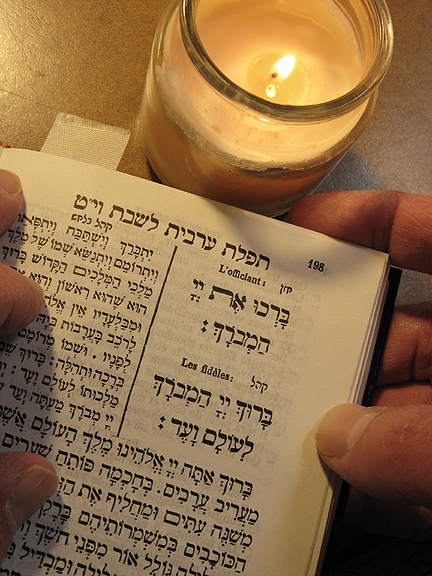
In the spirit of the Advent season, I’m remembering how I’ve referred students to Blaise Pascal as having been solidly aware of the invisible hand of Divine providence. Agreeing with Pascal about this point, as well as that of openness to the serendipitous, I’ve learned not to lean too much on contrivance. The nature of discovery is surprise. Years ago while in art college, I strongly felt the need to read the Bible- in the vernacular. As a child in my religious instruction, I had to translate Hebrew into English; I wasn’t very good at it, and the reading was not smooth. With the High Holidays in season and feeling rather desolate, I went to the public library and borrowed a King James translation. Reading at night, after my schoolwork, I found all the familiar places and people from my childhood studies- but in refreshingly fluid English (even if it was rather Elizabethan).

Everything was linking together between ancient history, the traditions I had learned and practiced, and all the fascinating personalities. Then I arrived at a threshold in the form of a blank page and turned it, finding something I had never seen before, the New Testament. Suddenly the names were not familiar, but I continued reading. The words and events were compelling, haunting, and sweet to me. I felt the Spirit very naturally taking root, and what followed after some time was the strength of the message forcing the expansion of my ancestral religious perimeters. Embracing the gospel eventually ostracized me from my community and led to some extremely difficult years of rejection and alienation. Looking back, it is astonishing how I did not break under the strain. An old soul with a new faith. Studies, work ethics, new friends, a few great mentors, and opened spiritual horizons were just enough to start gathering some momentum for the long haul. Surely many ruts in the road; it’s never been easy, but such is the pilgrimage of trust. But the Rabbi of Nazareth taught that hard times are inevitable, yet at the same time wise words will providentially take shape from within: “By your perseverance you will gain your soul.”* I write because an unusual, irrepressible, and enduring message has been given to me.


living for the emergence


Advent represents as much about manifestation as about anticipation. The waiting is not passive. As with my native traditions, the observance lends itself to merging the historic and the symbolic. At the same time the defining spirit is a looking-forward, emphasized at the darkest stretch of the year. The turning of the season offers a chance to be inspired by the sheer passage of time, by the potential for transformation. Although journal writing is often the place for looking back to make sense of what was, and reflecting upon what is, the musing becomes an arena for ambition. In this sense, writing is aspiring. Just as I keep telling myself to keep on going while gaining context, I’m also writing ahead. The lines of my connected script date back to my first cursive loops at Public School Number 13, in New York City. (I’ve actually had the honor of visiting with the current and retired school principals at P.S. 13- even reading to them from my journal. It was a chance to express my gratitude, speaking this time as an adult with fellow adults- educators all.) Centuries before personal journal writing was popular, Quakers of all ages- women and men- were writing their reflections and impressions in diaries. Many of these journals survive to this day and are fascinating to read. The travels, perils, interactions, meditations, reminiscences, testimonies, and personal convictions represent the context of these driven individuals. Early on, Quakers believed their journals were continuations of the biblical book of the Acts of the Apostles. Good reading lightens the darkness, and so does upholding the writing torch. My inked and graphite loops and jots twine like the ivy, page after volume. And my written steps will find their way through this crucible of isolated exile when the storm passes by.



________________________

* Luke 21:19

Tuesday, October 13, 2015

beati


“Blessed are the merciful: for they shall obtain mercy.”

~ Matthew 5:7.


In the spiritual life, there is excessive emphasis on two extremes: the discovery of the start, and the finish line. But the indefinite crucible is equivalent to what chess players call the middle game. This is where drudgery and alienation happen, not at the opposite ends of the voyage. Deserted stretches of the middle game are the places of trial, and often the places of abandonment of faith. For some, however, the long stretches of practical life provide the stages for acquisition and success. For most of us, those unglamorous highways, with their innumerable offramps and detours, navigate the territory routed between the bulleted items on our résumés. Ungrudging contentment with ignominy is itself a gallant act of forgiveness.


I remember the heart-wrenching defeat of having been eliminated from the candidacy search for the job I wanted most, out of any job I’ve ever applied for. It was the position I desired all through the sacrifices of graduate school life, with all pertaining compromises and debts. Anticipating the opening, I volunteered two full-term practica at that university, hoping to impress them and show them what a good fit I’d be. Well, after the door closed between my steps and that land of Canaan, I eventually reached out to the out-of-stater they hired, and collegially treated them to lunch- saying nothing about the process, but instead took the role of introducer to this area and the local professional community. I’ve also continued supporting the university, as a professional and as a neighbor. I care very much about the success of the school. Are these such grand gestures? Perhaps, though I’m not sure. But they are decent gestures. I’m not certain about how forgiving I’ve been, but I do know that is the sentiment I most prefer.


Back when I worked in a small college, I befriended the chaplain, and immensely enjoyed helping his ministry as a volunteer. One day, I went to him for a few good words, after having experienced a crippling heartbreak. He could see how demoralized I’d been, and how aimless the road ahead looked. He said, “you feel cursed, don’t you?” I was so choked, I could merely nod. “Well, don’t be cursed. Be blessed.” He told me to consider myself spared, and that he knew a few things I didn’t know. “Really,” he said. “Be blessed. And if you don’t know what to do, just do the next right thing you know to do.”


What does it mean to be blessed, and how do we know when we are? How do we know when we are agents of blessing? In essence, it may not be for us to know. Doing the right, or decent, thing might be the more important matter. Holy writ offers us the Beattitudes, and these help balance human perspective as it concerns defeat and humility. We are told that the honorable approach to others and to life, whether or not we are appreciated, is to respond peaceably and with genuine civility. The “blessed are you” sayings of the Gospel are the basics which inform our specifics. For the many of us that must rely upon intangibles, we must find our luxuries in the unseen. We must find our recognition in assurances without plaques, titles, or lucrative portfolios.


We deliver provisions and furniture into swanky addresses, and then go home to gritty flats at night. The extent of our summer breezes and sunshine happens during commutes and snippets of weekends. Our oceanfront property is the city pier. We help others celebrate, and do so with honest cheer. We wish success to others. We conscientiously welcome and include the hirees that have bested us. Blessed are we!


If you wished you were blessed, well then, blessed are you. Blessed are you that consciously remember where you came from; you will be remembered. Blessed are those who look forward, along with those who strive to improve themselves. Blessed are those who are concerned with the well-being of those around them; there will surely be pleasant surprises from unexpected directions.


Blessed are those who yield to the right-of-way, and refuse to tailgate. Blessed are those who patiently wait their turn, and those who drive and walk gently upon this earth. You know you’re doing the right thing, following the high road that is worthy of community life. Blessed are those who recognize the unacknowledged and applaud the overlooked. Friendships are cultivated unawares every day, with each kind gesture. Blessed are those who leave disproportionately large tips at eateries. Servers bring food and drink right to your seat, and you are paying yourself with the goodness you show to your neighbors that serve you.


When you contemplate the beauty of creation, blessed are you. When you choose to see what is good, even when it is not obvious, blessed are you. When you boldly hope against the apparent and the predictable, blessed are you. Welcoming the ungrateful; deferring in respect; listening at meetings; playing fair; defending the bullied; voting your conscience; extending understanding; concealing your generosity.
Blessed are you. Blessed are you. Blessed are you.

Sixty floors rise above the sidewalks of Boston’s Downtown Crossing, and the developers are calling it “The Neighborhood in the Clouds.”
Still, the meek have a kingdom in heaven. Be blessed.


Wednesday, April 17, 2013

wishes wanting


“I prize the cloudy, tearing sky
for the thoughts that flap and fly.
For staying in and reading by.
For sitting under.

This is a day for hearing bagpipes
somewhere playing.
This is a day for hearing sarabands
and hiding away.”

~ The Innocence Mission, And Hiding Away


Writing, when as a quiet verbal witness to each day’s living, bears some valuable review. If our written lines parallel the course charted by personal experience, then a functional archive is subtly being constructed. That archivist’s sense, abiding on and off the job, continually reminds me of the vitality of authentic documentation. An archival document needn’t be of any particular age, neither should it originate from any particular quantity of material. Of far greater importance in manuscript records is their authenticity and connection to their provenance- or source. Our most honest and accurate documentation can reveal actions and emphases. A study of documentation strengthens comprehension and informs present and future.


Within the context of narrative documentation, journal-writing finds its place. After all, for personal journals to be effective, the writing must be honest and as uncensored as possible. Whether an entry takes the form of a task list, a clipped criticism, or a lengthy reflection, the writing stands as a recording of a thought process at a specific time. Several years ago, I began the regular practice of indicating the time of day, as well as the date, of each journal entry. The tones of writing will differ from 6am to 10pm. Preserved thoughts belong as much to their author as to their time of writing. Having made these observations, I must add that I surely spend far more time writing than reading my journal entries. Yet as life’s rhythm warrants, I’ll remember my noted thoughts as both sounding-board and mirror to my state of affairs. Realizations tend to form and solidify between intense stretches of time, when there are bits of space to make notes. Being in full-time service to employment, I’ve long found ways to own thin slivers of my own time for the cause of creativity. Of late, I find that I must interrupt myself so that I can write what must be documented. Of late, as well, I’ve noticed quite a lot of enumerated frustrations. I occurred to me that in my daily written musings, wishes are left wanting. There isn’t enough wishing going on. At least, not as usual.


remember


Informed by my own archival record, I was able to see my own aspiration deficit. Along my persistent quest for what I need to know, I found myself reaching through some matters I’d already acknowledged in writing. Often, I hear myself say that “I want to know what I don’t know.” What is being overlooked? There must surely be explanations for my lack of success, yet in spite of that, through a combination of the air and light of early spring I saw the absence of wishes in my words. This is to say hopes, wishes, aspirations; essentially an active transcending of earthbound limitations. And thus, a distinction between the longings of the spirit and material ambition arises. As much as the latter aspect remains a motivation, I found the former neglected and unfocused in recent months’ entries. With my attention drawn, while writing under windblown skies, it was evident to me that we are prone to prevent ourselves from aspiring beyond today’s trenches.


A wise friend once advised that, given the choice, it is preferable to “write what you want to write, not what you have to write.” Often, in my mind, the two are the same, but the context of our banter had to do with the idea that repeatedly writing about abiding troubles may not be the most enjoyable thing with which to be occupied. Well, indeed, and duly noted. Writing about the uncontrollables runs its course, and a world of prospects must follow suit. So, I set about trying to articulate my wishes. Easier said than done. Day followed day, with the final task at my desk being a procrastinated, unwritten list. This is supposed to be easy to do- especially for a dreamer. Finally, my journal entries began to include wishes for places to go, and ways to be. My wonder turned from an incredulity at the absence of wishes, to yet another puzzlement at my reluctance to articulate wishes. With some pencil-twisting, I returned to recording some wishes, some aspirations with hopes of fulfillment. Some were smaller and simpler, to balance the hopes for better days, fruits of persistent labors, that aspirations may come to actuality. My experience has been to aspire and then to act. Yet, a beginning comprises the speaking forth of wishes- even in simple written words, or in wordless prayer.


aspire


In this gradual learning, across trackless time, the appreciating value of self-discipline cannot be overestimated. Part of that is to pray unceasingly, and not lose sight of wishing. Arid and dark deserted stretches must be lit by hopes. Paths and chambers are to be decorated with found eloquence. While trying to determine the controllable elements within reach, there remains great worth in wishing irrationally. Pascal once commented that wisdom sends us to childhood. He was quite right. Children are generally the ones preoccupied with trusting wish-lists, fantastic stories, and magic. I must know to not distance myself from such virtues. Respect and love toward neighbor as to oneself must surely also mean wishing goodness to oneself equally as wishing the best for neighbors. Wish for goodness, and do so with irrational generosity.


To aspire is to reach from the depths of memory, as well as against its tidal currents. The reach requires strength, as well as ability to distinguish matters of past, future, and present. When hopes are hindered by leaning back upon past events and notions, it becomes too easy to become entangled by incomplete histories. Past unsolved matters remain too close to the forefronts of thoughts. When wishes fixate exclusively upon the future, it is a revolving meander into air-wrought castles that neglects today. But the present, inadequate as it may be, does provide crossroads for memory conduits and future prospects. Temporal links such as intersections and highway ramps are inherently transitional and liminal. These are not dwelling places. Temporary passes permit for the collecting of thoughts. Incongruence can be rerouted from embittering to emboldening, as discontent fuels the reach forward. And in that sense of direction there must be a grounding in the immediate, a tending of rooted plants of this day. Progress, as it presently appears to me, indicates a composting of past to fuel future efforts. The ongoing written record continues in its role as creative witness, and as my evolving cartographic documentation. Fulfillment remains to be written. Or perhaps it is slowly forming, and cannot be seen in this present perspective. Nevertheless, with instruments and pages at the ready, the pilgrim scribe attends.


Friday, April 20, 2012

called forth


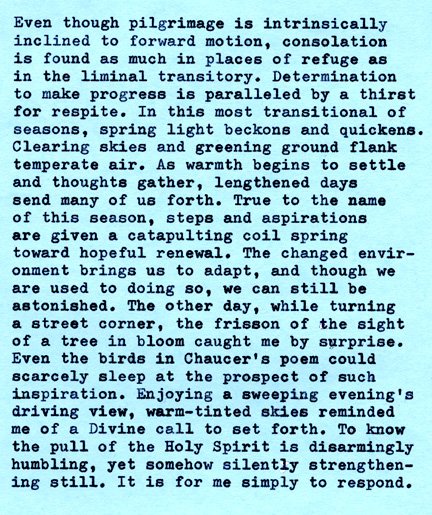
“When that Aprill with his shoures sweete
The droghte of March hath perced to the roote,
And bathed every veyne in swich licour
Of which vertu engendred is the flower;
Whan zephirus has with his sweete breeth
Inspired hath in every holt and heath
Tendre croppes, and the young sonne
Hath in the ram his halve course yronne,
And smale fowls maken melodye,
That slepen al the nyght with open eye
(so priketh them nature in hir courages);
Thanne longen folk to go on pilgrimages,
And palmeres for to seken strange strands,
To foreign halwes, known in sundry landes”
.

~ Geoffrey Chaucer, The Canterbury Tales


Tuesday, April 13, 2010

theophany : progress, part 3


“As for the Future,
your task is not to forecast,
but to enable it.
And surely you have enough work on your hands
when you are given the Present
as your raw material.”


~ Antoine de Saint-Exupéry, Citadelle, ch. 50


Tuesday, March 24, 2009

olympians


“Waiting at the airport on my suitcase,
a girl traveling from Spain
became my sudden friend,
though I did not learn her name.

And when the subway dimmed
a stranger lit my way.

This is the brotherhood of man.”

~ The Innocence Mission, Brotherhood of Man