Wednesday, May 15, 2013

as is


“Being, in all things,
is that which partakes
of the Divinity.”

~ St. Dionysius the Areopagite


intrinsic value

Simply by our very being, we are part of our respective contexts. It is for us to determine our levels of involvement. By virtue of living, an individual is inherently qualified to participate. While indiscriminately serving a public diverse in experience and age, through years of employment, there have been countless and daily personal instances to observe. Serving and observing happen quite naturally, though it remains essential to reserve judgments- or at least to keep them minimal and discreet. But we navigate complex paths, and none are without intersections. I also try keeping in mind how much I dislike the undue judgements of others.


Yet, still, there are evident types among those who most frequent the cultural institutions designed for one and all. There are project-researchers, and those who self-educate (and I am among them), along with those who are simply inquisitive. Open doors and alacritous assistance are invitations in themselves. Then there are the many who long for company, or for stability, or for some sort of human acknowledgment. Not everyone is conscious of this, or gracious about it, but that is outside of my control. Listening to their stories teaches me a great deal about the broader community and its visitors, as well as about a great many individuals. This is pastoral work, but without the divisive connotations of sectarian clergy; the interactions are daily and pedestrian, rather than weekly and by isolated commute. And it is humbling. I see, over and again, how the love of reading and a fascination with history transcends economic boundaries. The sheer spirit of inquiry is cause for gratitude.


The desire to be respectfully acknowledged is more universal than you may think it is. Who among us doesn’t relish the chance to have our complaints heard? Who doesn’t find consolation in validating witness to their lives? During a workplace breather, I went to a window to rest my eyes with some natural light. Looking at the traffic and human activity, I remembered some of the jobs I had while in high school. As a deliverer of groceries for an inner-city supermarket in New York, I’d navigate a dense neighborhood, strategizing high-rise service elevators and apartment blocks for my destinations. Elderly customers would regale me with their stories, passing along otherwise forgotten wisdom from long ago, and launching it into the future with a young person. Even back then, I recognized loneliness and treasured the histories recited to me. Significance in the humbled state, mine included. Returning to the fray, it came to mind there is an essential challenge in looking to others (and self) without the outward trappings that obstruct souls from view.


Even in compromised situations, such as with employment, unemployment, communities, and social status, our lives do remain profoundly meaningful. There just isn’t much to remind us of this. Prestigious titles and wealth are not required- as much as ameliorations of both would solve many serious problems. To live and to contemplate are the merest necessities for creativity and constructive participation in the world. As we live, we are each significant, and each with prospects. In the previous essay, I looked at the natural striving for rewards as a kind of self-justification. By contrast, the intrinsic value of the soul, the true and created self, is discovered in being. Achievement isn’t necessary for our living, but surely living is necessary for our achievements. If we continue living and thinking, our very being is the undergirding meaning- it is our intrinsic value. Hence, we mustn’t lose heart and concede defeat in a culture that too freely informs us of our successes and setbacks.


safe harbors of thought


To be able to reconsider the patterns and types recognized within myself, and in front of me, there must be safe harbors for thought. I refer to those “window moments,” as mentioned above, if not lengthier respites that allow for the completion of an idea- or the questioning of notions. When there isn’t time for retreats in the wilderness, or silent sanctuaries, there is always my journal notebook or some excuse for car rides and evening strolls. Noticing trends and drawing in strength can really take place with some form of recollection. As recorded in the ancient compendium, The Philokalia, Saint Barsanuphius (6th C.) wisely observed and advised:


“While the ship is at sea, it is a prey to dangers and winds. When it reaches a calm and peaceful harbor, it no longer fears dangers, calamities or winds, but remains safe. In the same way, while you are among people you must expect tribulations, dangers, and mental buffetings. But when you reach the harbor of silence prepared for you, then you will have no fear.”


Among our endeavors, one of the worthiest is the cultivated skill of balance: listening and speaking, accepting and pursuing, reading and writing. The wider the spectrum of interests, the easier it is to divert by balance. Variety of perspective can be a great antidote to tunnel vision. Of late, the matter of teaching handwriting in elementary schools is being debated. Many believe that penmanship is an obsolete skill, and the craft should no longer be integral to primary education. But there are many others, myself included, that see every good and practical reason to teach the forms of cursive writing en route to developing one’s own mature style, and to be able to interpret handwritten text. It is very much a parallel to the cultivation of visual perception and manual skills. Learning to write by hand amidst a present culture that is thumb-operated, bears similarity to learning how to cook despite the ready availability of fast food. Quick fixes rarely endure; history proves this time and again, along with the very real way perseverance is always twinned with practice.


Balancing a sense of time and the human journey requires ability to see beneath and beyond the immediate. While inhabiting this very moment in time, each one of us extends some form of the historic, and we are each on our way to an unseen destination. With these things in mind, our actions and intentions carry potential influences which we may not ever see in our tenures or lifetimes. We cannot yet see the extents of our present actions. Similarly, our very being- just as we are- represents some form of fulfillment our ancestors could not have seen. We are uniquely able to realize what has come to us, and which of these things we’ll bring forward, or refine, or finally set aside not to make the voyage. The individual, in the present, must make such judgments. Considering one’s being- as is- with what is known and held, we come to recognizing meaning beneath and above things and ideas.


In his major work, De Divisione Naturae, Scottus Eriugena (9th C.) wrote, “We cannot know what things are in themselves, but only what they appear to us to be and that the whole fabric of nature can only be successfully investigated through the medium of time and space.” There is more to what is real than is evident. Time brings us to comprehend that no strengthening nuance is insignificant. None of us can know the reach of our energies. Indeed, much can be made of legacies of distrust and destruction. More than enough is easily available to devalue the human spirit, and thus vigilance is needed. For this illustration, consider the constructive, life-bearing legacies of grace. I was reminded of small yet meaningful gestures of kindness when I saw a person affectionately attend to a cat. The cat’s obvious gladness showed me that subtly great gifts were being exchanged. Anyone that can improve any other life has done something truly magnificent. Even if for a small cat. And the caring human that clearly felt the little animal’s gratitude demonstrated a heart enhanced by those few minutes. I saw how being, because it is participatory life, has enormous intrinsic value. In our simplest absorption of grace, we are completely able to reciprocate. Without accolades and trappings, perfectly equipped as is.


an enjoinder


Now I want to encourage each of you, holding forth on your respective courses. Your turns and straightaways imply more than you presently perceive. Generosity and genuineness of spirit, as well as action, form the path of best investment that dispels disingenuousness. In some demonstrable and disturbing ways, these are darkened times fraught with violence and complacency. But the will to persevere and to carry the Light must stand in opposition to cynical resignation. Spiritual life ever straddles the rational and the miraculous. The latter assures a persistent opening to pleasant surprises.


Among my cherished friends is a policeman who happens to be a great bibliophile. In an off-duty moment, he stopped in to my workplace with a surprise of a gift of calligraphy pen-points and wooden holders. I was heartened by such thoughtfulness, yet even more by his request. He wants me to teach him the basics of calligraphy. Of course, I will, and he’ll do great because he wants to succeed. For me, it is a double gift. The tools are fine, a bit fancy for me, but with meaning beyond the materials. The second gift is the request to provide a gift. Within the gift is a reclamation of the endangered skill of handwriting, and the action is steeped in the pursuit of conscientiousness. Going forth, in any season, is to be a torchbearer of grace and to make note of what is good. Trying to keep in mind the purposes of these present trials, I return to Saint Barsanuphius’ words in the Philokalia:


“Do not lose heart in sufferings and in labors of the flesh, which you bear for the sake of the community, for this too means ‘to lay down your life for the brethren,’ and I hope the reward for this labor will be great. As the Lord placed Joseph in Egypt in the position to feed his brethren in time of famine, so God placed you in the position to serve your community. And I repeat to you the word of the Apostle: ‘Thou therefore, my child, be strong in the grace that is in Christ Jesus.’”


Wednesday, May 1, 2013

reward and recognition


“The one thing needful for a person is to become-
to be, at last, and to die in the fullness of their being...
and happy is he who puts forth to see, with treasure freighted.”


~ Antoine de Saint-Exupéry, Citadelle, ch.38


understanding accolades


Many of us earn some measure of recognition, but many more of us watch the awarding of others. Competitions and rewards accompany our days for our earliest interactions with this world. From elementary school, to summer camps, workplaces, and community life, alluring merits and prizes abound. Generally, fame and notoriety, in their varied manifestations, find recipients among those with the highest grade-point averages, the most sales, the lowest earned-run-average, and the largest pumpkin at the fair. These are the more statistical awards. Then there are the more subjective accolades, such as the best-tasting apple pies, beauty contests, grammys, oscars, and the Most Valuable Player. While we can fairly well figure out the necessary attributes for the gaining of an award, we are also left to marvel at the more subjective awarding criteria. Why does fortune smile on one, and not another? I’ve wondered at such strange examples of selectivity, both as frequent witness and as infrequent recipient. Singling-out and exclusion are two sides of the same question.


When I look at the scattered commendations I’ve received over the years, reminders of herculean work efforts and those fleeting moments of bestowal come to thought. Then they dissolve. And then I marvel at how so many others that expend significantly less effort than I do, receive exponentially greater fortunes and rewards. It is easy to be left to wonder whether less done means greater rewards. Nothing, then, must be worth inestimable fortunes! Postmodern culture, expressed by its peculiar language, finds this context in the application of win. “With this product, everybody wins.” Using such-and-such strategy, the company wins.” “As we follow this course, goodness wins.” Has somebody actually won something? Who lost? Is there a second prize? How about a victory banner? Surely, winning is advisable over being defeated. In attempting to distinguish between the two apparently contesting sides, it becomes necessary to articulate the meanings of reward and recognition.


halls of fame


If recognition belongs to the finite moment, questions about enduring value come to mind. We may consider how many hard-driven and decorated athletes pawn off their medals and rings for the artifactual worth and precious metal content. Has the value of the award as an object outpaced that of the victory itself? Perhaps time depreciates accolades, especially as contexts disconnect and evaporate. Yet tokens and statements of recognition are somehow as dear to us as they are ephemeral. Such memorials are fleeting, and persistent will is needed to keep recognition in active memory. It may be that the inherent ephemeral nature within rewards is what fuels the human craving for acknowledgment. For each of us, there will be a scale of importance, as it concerns awards and those who issue them. For many, a parent’s or an employer’s tangible approval has greater worth than gold watches or sums of money. Beyond amnesic popular culture, each one of us can determine the awards that endure.


As recipients have their definitions, so do those who bestow recognition. In a broad sense, most rewards are used as incentives. If a quota is met, or some goal achieved, a reward may follow. It’s the old carrot-and-stick idea we knew in grade school, and it seems to keep the wheels of progress in perpetual motion. By parallel contrast, the less-productive have cause to fear. But at all hands, rewards are prominently at the center. “If you do this, you may very well qualify to get that,” but there are no promises. Alas, hard work and success are not inextricable.


Consumer culture propagates its own definitions of rewards. Even plastic charge cards named after precious metals. Premiums and property are promised, but earning the elusive requisite points demands greater cost than the monetary value of the rewards themselves. It has become an exception to find businesses without affinity programmes and purchase cards, promoted as customer benefits, yet surely advantageous as marketing and demographic devices. “Loss-lead” is the term used when an item is priced unusually low, for the purpose of drawing the attention of customers to engage and buy more. Every coffeehouse in town wants me to punch a card; it’s as though I’m continually on the job. The tenth cup free, after paying for nine, continues to look like a good deal for my loyalty.


What are the enduring awards? Which ones are worth the invested time, energy, and expense? Looking at collected diplomas, certificates, honor pins, trophies, and reference letters, I see how quickly they fall silent. Their respective moments move farther away from the present, with each day that passes. The human hunger for applause demands new tokens in constant succession. But do such ephemeral items really advance us through life? Recently, I was asked to organize the archives and artifacts of a journalist who had passed away several years ago. Unpacking the cardboard boxes, I found certificates and medals among the stacks of papers. Examining such personal documents as passports and correspondence, I wondered about this man’s attachments to these things, and whether their value to him had changed through the years. Walking by a trophy store the other day, all the pedestal-mounted memorials, plaques, glass objects, and ribbons grouped together on display suddenly looked like expendable merchandise. In theory, anyone can have a personalized award made for any reason at all. “First-Place in the Squandered-Talent Show, awarded to...,” and be sure to enter that middle-name, to make it look official. Looking away from the veneered trophies, a good and effective effort should stand on its own without material recognition.


status update


A greater work than any career, that may or may not exist, is a conversion of mind that conscientiously eschews reward. It is a death to oneself, and quite contrary to so many of this culture’s motivating forces. What liberation awaits, after letting competitions barrel down their divergent highways, while choosing country roads instead? Where was that mechanical racetrack rabbit going, anyway? But, alas, most of us must compete for better employment, and must navigate the narrow channel that passes between serpentine cleverness and dovelike innocence.


Lately, I’ve been referring to myself as “the prodigal’s brother.” As in the famous biblical parable, contrasting the hard-crashing and dramatically-repenting prodigal, is his brother: the one who loyally stayed, responsibly working in his backwater town. The brother watches the returning prodigal’s festivities with incredulity, unable to comprehend his own uncelebrity. Readers are left to wonder if he ever learned to recognize the good in his perseverance, and if his steadfastness was ever rewarded to his satisfaction. In his philosophic Citadelle, Saint-Exupéry wrote, “Strive to break the bonds that tie you to worldly goods- trade yourself in exchange for something greater than yourself.” When considering disentangling from the chasing of rewards and notoriety, I realize my own vulnerability to such pursuits. Can an ambitious soul in this world be dissuaded from the driving desire for recognition and material comfort?


It is a test of faith, rather than a challenge of belief. With a solidly bare faith, it would be a matter of assuredly looking forward without bitter strain to better days and prospects. Belief in God’s presence is a far easier reckoning. The oft-used figure of speech about “the left hand not knowing what the right hand does,” in its origin was a compliment wrapped in a reproach. Jesus used this imagery to illustrate the virtue of not broadcasting our charitable works, not trumpeting what we think our virtues are. Choose well, but do so in quiet confidence. In the fluidity and fickleness of time, the rewards of status seekers are temporal at best. Indeed, many among us have known of such subtle truths for a long time, easily agreeing and sympathizing with the rarified road of covert holiness. But the unspoken underside asks us to cultivate a disinterested regard for public recognition. Once more, belief prompts agreement, but trusting faith holds the soul to realigning and developing an unreluctant understanding of reward and recognition.


Wednesday, April 17, 2013

wishes wanting


“I prize the cloudy, tearing sky
for the thoughts that flap and fly.
For staying in and reading by.
For sitting under.

This is a day for hearing bagpipes
somewhere playing.
This is a day for hearing sarabands
and hiding away.”

~ The Innocence Mission, And Hiding Away


Writing, when as a quiet verbal witness to each day’s living, bears some valuable review. If our written lines parallel the course charted by personal experience, then a functional archive is subtly being constructed. That archivist’s sense, abiding on and off the job, continually reminds me of the vitality of authentic documentation. An archival document needn’t be of any particular age, neither should it originate from any particular quantity of material. Of far greater importance in manuscript records is their authenticity and connection to their provenance- or source. Our most honest and accurate documentation can reveal actions and emphases. A study of documentation strengthens comprehension and informs present and future.


Within the context of narrative documentation, journal-writing finds its place. After all, for personal journals to be effective, the writing must be honest and as uncensored as possible. Whether an entry takes the form of a task list, a clipped criticism, or a lengthy reflection, the writing stands as a recording of a thought process at a specific time. Several years ago, I began the regular practice of indicating the time of day, as well as the date, of each journal entry. The tones of writing will differ from 6am to 10pm. Preserved thoughts belong as much to their author as to their time of writing. Having made these observations, I must add that I surely spend far more time writing than reading my journal entries. Yet as life’s rhythm warrants, I’ll remember my noted thoughts as both sounding-board and mirror to my state of affairs. Realizations tend to form and solidify between intense stretches of time, when there are bits of space to make notes. Being in full-time service to employment, I’ve long found ways to own thin slivers of my own time for the cause of creativity. Of late, I find that I must interrupt myself so that I can write what must be documented. Of late, as well, I’ve noticed quite a lot of enumerated frustrations. I occurred to me that in my daily written musings, wishes are left wanting. There isn’t enough wishing going on. At least, not as usual.


remember


Informed by my own archival record, I was able to see my own aspiration deficit. Along my persistent quest for what I need to know, I found myself reaching through some matters I’d already acknowledged in writing. Often, I hear myself say that “I want to know what I don’t know.” What is being overlooked? There must surely be explanations for my lack of success, yet in spite of that, through a combination of the air and light of early spring I saw the absence of wishes in my words. This is to say hopes, wishes, aspirations; essentially an active transcending of earthbound limitations. And thus, a distinction between the longings of the spirit and material ambition arises. As much as the latter aspect remains a motivation, I found the former neglected and unfocused in recent months’ entries. With my attention drawn, while writing under windblown skies, it was evident to me that we are prone to prevent ourselves from aspiring beyond today’s trenches.


A wise friend once advised that, given the choice, it is preferable to “write what you want to write, not what you have to write.” Often, in my mind, the two are the same, but the context of our banter had to do with the idea that repeatedly writing about abiding troubles may not be the most enjoyable thing with which to be occupied. Well, indeed, and duly noted. Writing about the uncontrollables runs its course, and a world of prospects must follow suit. So, I set about trying to articulate my wishes. Easier said than done. Day followed day, with the final task at my desk being a procrastinated, unwritten list. This is supposed to be easy to do- especially for a dreamer. Finally, my journal entries began to include wishes for places to go, and ways to be. My wonder turned from an incredulity at the absence of wishes, to yet another puzzlement at my reluctance to articulate wishes. With some pencil-twisting, I returned to recording some wishes, some aspirations with hopes of fulfillment. Some were smaller and simpler, to balance the hopes for better days, fruits of persistent labors, that aspirations may come to actuality. My experience has been to aspire and then to act. Yet, a beginning comprises the speaking forth of wishes- even in simple written words, or in wordless prayer.


aspire


In this gradual learning, across trackless time, the appreciating value of self-discipline cannot be overestimated. Part of that is to pray unceasingly, and not lose sight of wishing. Arid and dark deserted stretches must be lit by hopes. Paths and chambers are to be decorated with found eloquence. While trying to determine the controllable elements within reach, there remains great worth in wishing irrationally. Pascal once commented that wisdom sends us to childhood. He was quite right. Children are generally the ones preoccupied with trusting wish-lists, fantastic stories, and magic. I must know to not distance myself from such virtues. Respect and love toward neighbor as to oneself must surely also mean wishing goodness to oneself equally as wishing the best for neighbors. Wish for goodness, and do so with irrational generosity.


To aspire is to reach from the depths of memory, as well as against its tidal currents. The reach requires strength, as well as ability to distinguish matters of past, future, and present. When hopes are hindered by leaning back upon past events and notions, it becomes too easy to become entangled by incomplete histories. Past unsolved matters remain too close to the forefronts of thoughts. When wishes fixate exclusively upon the future, it is a revolving meander into air-wrought castles that neglects today. But the present, inadequate as it may be, does provide crossroads for memory conduits and future prospects. Temporal links such as intersections and highway ramps are inherently transitional and liminal. These are not dwelling places. Temporary passes permit for the collecting of thoughts. Incongruence can be rerouted from embittering to emboldening, as discontent fuels the reach forward. And in that sense of direction there must be a grounding in the immediate, a tending of rooted plants of this day. Progress, as it presently appears to me, indicates a composting of past to fuel future efforts. The ongoing written record continues in its role as creative witness, and as my evolving cartographic documentation. Fulfillment remains to be written. Or perhaps it is slowly forming, and cannot be seen in this present perspective. Nevertheless, with instruments and pages at the ready, the pilgrim scribe attends.


Tuesday, April 2, 2013

typosphere cheer


1969.

"The human mind, itself invisible,
becomes visible or manifest in words,
and writing, and gestures."


~ Frederick Copleston, A History of Philosophy, v.2.


The lengthened light of spring establishes itself once again. Fresh seasons turn the wheels of writers, return carriages recharged, prime platens, and calibrate keys anew, as we seek greater escapements into rejuvenating journeys. Economics, politics, and popular culture are no better than they were last month, yet somehow hope springs eternal. Defeat is mysteriously negated beneath fresh green baseball lawns. Flagging energies rekindle in such ocean winds as those which flog the Maine coast today. Renewed expectations become less our testaments of struggle, and rather causes for our optimism. And for the cause of encouragement, here are some images which have not seen light of day in a very long time- some not ever- to inspire you to shine up your writing instruments and train your springs through your own spring training. Archival documentation reminds us of souls who’ve gone before us.

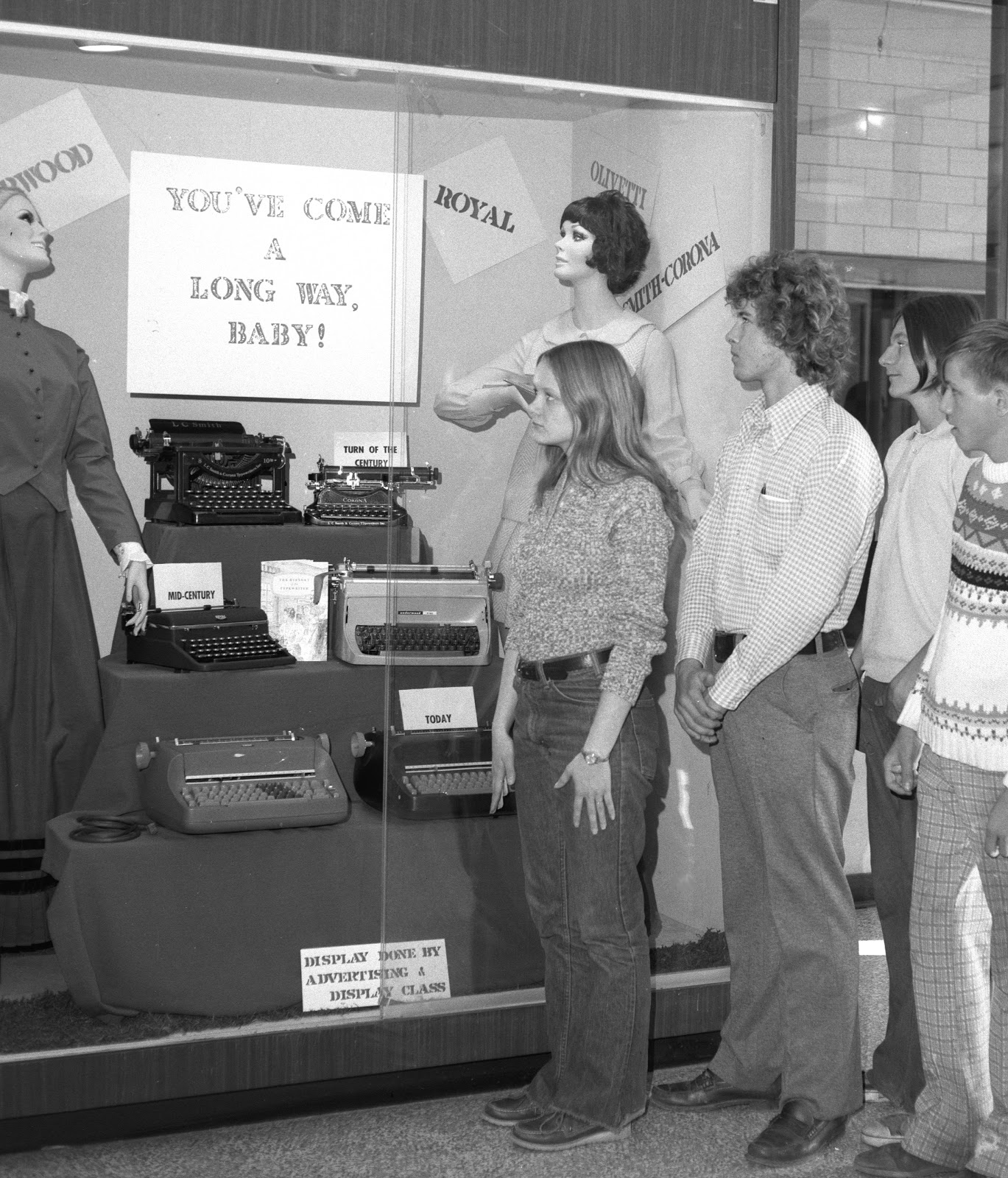
Recently, I completed a thorough archival survey of approximately seventy years of newspaper photographic negatives. Woven around and through my daily work duties, and using every bank holiday, it took slightly over three years for me to review an estimated 1.2 million negatives. It was a rescue effort, as the huge collection was nearly discarded in a building-emptying corporate downsize. The project for me has been an adventure filled with wonder and fascination. Amidst dust, rust, and acrid acetic acid odors, I’ve witnessed my home region’s twentieth century in silver cellulose. Crates and rotted cabinets filled with disorganized film is now under control and being indexed for conservation and future studies. Out of chaos comes order. This experience of perseverance and accomplishment will always accompany my thoughts, and I’ve gratefully combined my photographic roots with my archivist’s sense. Readers of these pages may remember graphite archive, which incorporated pencil-writing images I discovered as I made my way through the collection. The decades illustrated in these negatives also comprised numerous images of typewriters, and indeed I indexed these, too. The same eyes that could recognize a pencil in a subject’s hands in the reverse image of a photo negative could also identify the presence of a typewriter. Still photographs potentially offer immense amounts of information about their respective context.

As many of us already know, typewriters are extraordinary motifs for photography. The machines themselves are far from being impersonal mechanical contraptions. Typewriter owners have always tended to make the machines their own, thus extending personal touches through instruments sensitive to the human touch. Even typestyles and sizes vary among the varieties of machines and their epochs. When you observe this selection of photographs, notice how people and their typewriters are pictured together. Authors and their machines appear parallel to concert pianists and their particular expressive instruments. Every student and professional needed a typewriter; these tools were especially required in order to compose correspondence, submit polished reports, scripts, and to finalize projects. Notice the vitality of typewriters in offices, personal studies, schools, and on chemists’ countertops. Typewriters continue to be instruments for creative writers. From the machines themselves, notice the sampling of environments- in this case, it is northern New England from the late 1930s through the early 1980s. Look at the typewriters’ habitats, along with those of the writers themselves (this essay can also be viewed as a slide show).

Having so many indexed images to present, I chose to categorize them in this essay by the uses of typewriters by students, professionals, creative writers and authors, and in places of procurement. The latter category refers to the need for supply sources for typists’ commodities and places for repair. Consider the parallels with automobile showrooms and garages, and contemporary bicycle shops. Here’s to the Typosphere, those who straddle the ether of the internet with the solidity of their cherished Olympias, Underwoods, Olivettis, Smith-Coronas, Royals, Adlers, and on and on, persevering with the passion (and shoulders) required to produce bold marks on a manual platen. Cheers to the ‘spheres!


at school

1937.


1955.


1960.


1975.


Above: Students at Southern Maine Vocational Technical Institute (SMCC, today), in 1974.


Westbrook College students, 1968.


at work

1942.


1982.


1947.


1948.


1944.


Detective studying a fingerprint, 1958.


1959.


1959.


1962.


1968.


1976.


Retirement party, complete with new typewriter and a tasty lobster wrapped in a ribbon, 1962. Only in Maine!


creativity

1979.


1948.


1940.


1981.


Top: 1947; Bottom: 1944.


1957.


1949.


Historian A.A. Hoehling, 1959.


1973.


1974.


sources

Underwood and Smith-Corona stores were on Federal Street, in downtown Portland. Top: 1940; Bottom: 1942.


At Royal Typewriter store, on Exchange Street, Portland, 1948.


1965.


1965.


Roberts Office Supply, was on Middle Street, Portland, 1973.


Wigon Office Supply, in 1966. Still in business, and still on Free Street, Portland. Wigon's still sells typewriter ribbons.
_____________________________________________________

1976.