Showing posts with label typewriters. Show all posts

Thursday, August 8, 2019

open windows


“You must know that if there are ruts,
you must jump your wheels out of them,
and if there is no language in which to reach
your audience, you must invent one.”


~ Austin Marsden Farrer, from Called to be Saints.


graphite


Pencil journals are for my flow of ideas, and the more pocketable, the better. The smallest Moleskine notebooks are very useful for this. I've been using their Boston themed journals, adding my own mementos to make these like scrapbooks.


ink


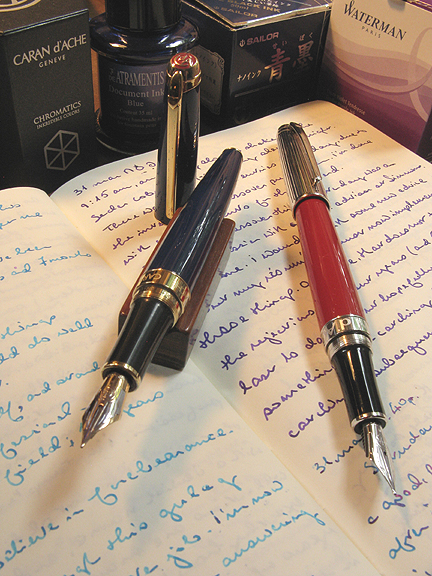
My daily journals must be free of lines- completely blank. My mother taught me how to write before I learned in school; no guidelines or grids, thank you very much! My taste for fountain pens is thanks to my father. There are many good pens out there- such as Waterman, Dupont, Diplomat, and Cross, but for me there's nothing quite as smooth and solid as a Caran d'Ache.
Many good inks, too- such as Pelikan, Mont Blanc, Monteverde, Diamine, and- yes- Caran d'Ache.


Ballpoints are great for writing aboard jostling buses and trains, when I have to lean more into the notebooks. Waterman and Diplomat make nice ballpoints, but for many years Ballograf has been tops for me. The designer of these invented the push-button pen, and he also designed the pens used by astronauts in space. They are made in Sweden, and I bought the set in this photo in Norway. I use the .5 mechanical pencil for marginal notes.


typewriting


As surely as I am my father's son, I love a good, dependable portable typewriter that can be taken anywhere. Nothing fits the bill quite like an Olympia. Durable and precise. I made the typecast pages above on a cursive-writing Olympia SM9. I do a lot of my writing on disc-bind paper, which snaps into Levenger binders. I've found this to be a great way to journal, and these items are easy to travel with. In the photo below, which I took in the Boston Public Library courtyard, you can see one of the Levenger binders decorated with a pencil motif!


notes

A bit of the creative process: Here is the outline I wrote- at the Weston Priory- en route to the essay, "before us." The finished essay followed this sequence. The important thing was to write this down while I had the concept in mind.


The poem, "so they say" was sketched out in my graphite journal. I made many changes, based on how it sounded when I'd read it aloud. These pencil notebooks are ideal for designing my essays and collecting additional thoughts.


____________________________________________


Sunday, November 24, 2013

royal visit


“There are a few of my personal belongings which I say farewell to
with deeper regret, for it has been my companion for thirty-five years, almost half my lifetime.
On it were produced
The Lewis Papers, my Biographies, and all my own books.
Also, on a rough computation at least twelve thousand of Jack’s letters.
I shall, I’m afraid, feel very lost on a new machine.”


~ Warren Hamilton “Warnie” Lewis. (from his journal)


During the excited flurry of anticipating my Oxford sojourn, most of the preparation focused on the study fellowship with the manuscripts of C. S. Lewis. Having the parallel prospect of a month’s residency at The Kilns (Lewis’ home) generated additional preparatory correspondence. As the travel time drew closer, my talks with the Lewis Foundation were joined by additional friendly conversations with the caretaker of The Kilns, officially the Warden of the house. Indeed, there are house rules, but they are all sensible ones as The Kilns is a historic home, and is maintained as a place for Scholars-in-Residence to live. The house may also be visited, by arrangement, so that visitors can be introduced to the life and world of C. S. Lewis from the vantage point of his home, at the eastern edge of Oxford.


Oxford and The Kilns


Our introductory correspondence and subsequent chats always touched upon our mutual respect for Lewis, as well as for the craft of writing. It is heartening to know that so many others are also cultivating projects. We must each find time and energy to pursue our vocations, often with few resources. Well, as I mentioned gathering my resources for the journey, referring to my typewriter- an Olympia Splendid, my hosts described the Lewis typewriter, and how it is on display at The Kilns. Anticipating an added intrigue to the voyage set before me, I packed a spare typewriter ribbon. Until recently a staple at any stationer, ribbons have become difficult to find (outside of the Boston area), and so the Foundation’s administrator was pleased to hear I was going to bring one to Oxford.


Above: The typewriter before maintenance.
Below: Comparing handwritten manuscripts and typescripts.


Settling in at The Kilns, as well as in the University libraries at Oxford, required some acclimating- all of it pleasant- from left-side traffic regulations, to ordering in eateries, to cooking on an Aga stove. Very quickly, with thanks to the Warden of The Kilns, and the University staff I met, the essentials were easily found and daily life was as comfortable as it would’ve been back home in New England.


Garden work at The Kilns.


The Lewis typewriter is displayed in the dining room at The Kilns, on a safe and sturdy high table, so that tour groups cannot miss seeing the very well-worn machine. The Royal portable, as I had been told, was likely not used since Lewis’ brother Warnie’s passing in 1973. Warnie did most of the typing. It had been taken out of storage in recent years, and a close look at the machine’s workings revealed the detritus following decades of inactivity. Fortunately, the typewriter did not appear to have been coaxed into much more than decoration. With the grateful blessings of my hosts, I set aside an afternoon to gently restore the machine to functioning order.


Oiling, a new ribbon, and the Cambridge Typewriter treatment for the Lewis typewriter.


The typewriter needed a bit more than a simple ribbon change. One day, after my studies, I went to Boswell’s Department Store- Since 1738- on Broad Street, to buy light machine oil and a toothbrush. These proved to be indispensable, as were the bamboo skewers I’d brought with me to spin the new ribbon onto the old spools, as well as to clean the typebars. Carefully removing the machine from its case, I used the house vacuum cleaner to remove the undercarriage dust. Then, out in the Kilns garden, with the typewriter resting on a towel, I proceeded to oil all the moving parts and clean its surfaces, using all the good practices I’ve learned through my years of friendship with Tom Furrier of Cambridge Typewriter. As a light rain began to sprinkle the outdoors, I finished the cleaning and lubricating in the kitchen, along with spooling the new ribbon. Every single bone-dry pivot and joint seemed to sigh with my stealth applications of machine oil.


The Royal Signet shines and writes again!


The serial number is ES 14545.


Indeed, the typewriter does work again, and has all its parts. Its spartan appearance, having no ribbon covers, standard platen-roller controls, tabs, or margins, is due to the machine’s manufacture during the Great Depression. Sending a closeup photo of the serial number to Cambridge Typewriter, Tom wrote back that the machine, a Royal Signet, had been made in 1932. He also mailed matching spoke-style spools to The Kilns, to parallel the vintage of the machine. His one request was that I type him a letter on C. S. Lewis’ typewriter. So, I did. The Signet was used for thousands and thousands of letters and typescripts, and it is quite likely that I’ve typed its last letter. Though the machine is now nice and shiny, with its new ribbon, and functioning, its role is for historic artifactual display. The Warden was thrilled with its refreshed look, and we proudly displayed it for Oxford Open Doors, in mid-September. It was during my maintenance and careful handling of the Signet, that I fully realized the instrument’s importance. At the Bodleian, I’d been reading a great many typed pages of both Jack’s (C. S. Lewis) and Warnie’s (Warren Hamilton Lewis) provenance. Yet another honor, among many others during this sojourn, was to have been able to “re-warm” the Lewis typewriter and return it to its place of prominence at The Kilns.


The Lewis typewriter "In Situ."


Writing a letter on the Signet.


A visitor lands on my notebook, in the Kilns garden.


Tuesday, April 2, 2013

typosphere cheer


1969.

"The human mind, itself invisible,
becomes visible or manifest in words,
and writing, and gestures."


~ Frederick Copleston, A History of Philosophy, v.2.


The lengthened light of spring establishes itself once again. Fresh seasons turn the wheels of writers, return carriages recharged, prime platens, and calibrate keys anew, as we seek greater escapements into rejuvenating journeys. Economics, politics, and popular culture are no better than they were last month, yet somehow hope springs eternal. Defeat is mysteriously negated beneath fresh green baseball lawns. Flagging energies rekindle in such ocean winds as those which flog the Maine coast today. Renewed expectations become less our testaments of struggle, and rather causes for our optimism. And for the cause of encouragement, here are some images which have not seen light of day in a very long time- some not ever- to inspire you to shine up your writing instruments and train your springs through your own spring training. Archival documentation reminds us of souls who’ve gone before us.

Recently, I completed a thorough archival survey of approximately seventy years of newspaper photographic negatives. Woven around and through my daily work duties, and using every bank holiday, it took slightly over three years for me to review an estimated 1.2 million negatives. It was a rescue effort, as the huge collection was nearly discarded in a building-emptying corporate downsize. The project for me has been an adventure filled with wonder and fascination. Amidst dust, rust, and acrid acetic acid odors, I’ve witnessed my home region’s twentieth century in silver cellulose. Crates and rotted cabinets filled with disorganized film is now under control and being indexed for conservation and future studies. Out of chaos comes order. This experience of perseverance and accomplishment will always accompany my thoughts, and I’ve gratefully combined my photographic roots with my archivist’s sense. Readers of these pages may remember graphite archive, which incorporated pencil-writing images I discovered as I made my way through the collection. The decades illustrated in these negatives also comprised numerous images of typewriters, and indeed I indexed these, too. The same eyes that could recognize a pencil in a subject’s hands in the reverse image of a photo negative could also identify the presence of a typewriter. Still photographs potentially offer immense amounts of information about their respective context.

As many of us already know, typewriters are extraordinary motifs for photography. The machines themselves are far from being impersonal mechanical contraptions. Typewriter owners have always tended to make the machines their own, thus extending personal touches through instruments sensitive to the human touch. Even typestyles and sizes vary among the varieties of machines and their epochs. When you observe this selection of photographs, notice how people and their typewriters are pictured together. Authors and their machines appear parallel to concert pianists and their particular expressive instruments. Every student and professional needed a typewriter; these tools were especially required in order to compose correspondence, submit polished reports, scripts, and to finalize projects. Notice the vitality of typewriters in offices, personal studies, schools, and on chemists’ countertops. Typewriters continue to be instruments for creative writers. From the machines themselves, notice the sampling of environments- in this case, it is northern New England from the late 1930s through the early 1980s. Look at the typewriters’ habitats, along with those of the writers themselves (this essay can also be viewed as a slide show).

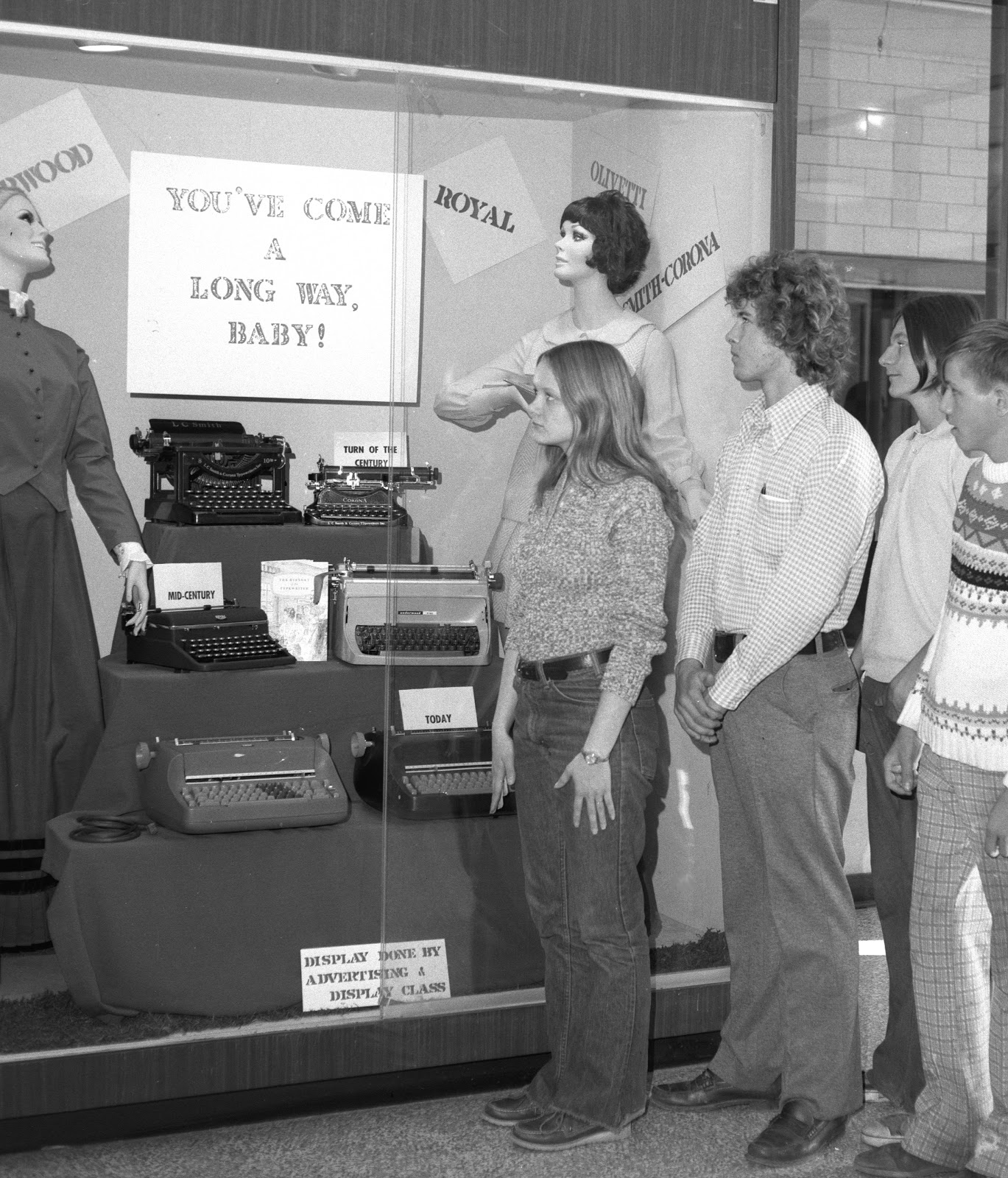
Having so many indexed images to present, I chose to categorize them in this essay by the uses of typewriters by students, professionals, creative writers and authors, and in places of procurement. The latter category refers to the need for supply sources for typists’ commodities and places for repair. Consider the parallels with automobile showrooms and garages, and contemporary bicycle shops. Here’s to the Typosphere, those who straddle the ether of the internet with the solidity of their cherished Olympias, Underwoods, Olivettis, Smith-Coronas, Royals, Adlers, and on and on, persevering with the passion (and shoulders) required to produce bold marks on a manual platen. Cheers to the ‘spheres!


at school

1937.


1955.


1960.


1975.


Above: Students at Southern Maine Vocational Technical Institute (SMCC, today), in 1974.


Westbrook College students, 1968.


at work

1942.


1982.


1947.


1948.


1944.


Detective studying a fingerprint, 1958.


1959.


1959.


1962.


1968.


1976.


Retirement party, complete with new typewriter and a tasty lobster wrapped in a ribbon, 1962. Only in Maine!


creativity

1979.


1948.


1940.


1981.


Top: 1947; Bottom: 1944.


1957.


1949.


Historian A.A. Hoehling, 1959.


1973.


1974.


sources

Underwood and Smith-Corona stores were on Federal Street, in downtown Portland. Top: 1940; Bottom: 1942.


At Royal Typewriter store, on Exchange Street, Portland, 1948.


1965.


1965.


Roberts Office Supply, was on Middle Street, Portland, 1973.


Wigon Office Supply, in 1966. Still in business, and still on Free Street, Portland. Wigon's still sells typewriter ribbons.
_____________________________________________________

1976.