“My Lord God,
I have no idea where I am going.
I do not see the road ahead of me...
Therefore will I trust you always
though I may seem to be lost
and in the shadow of death.
I will not fear, for you are ever with me,
and you will never leave me
to face my perils alone.”
~ Thomas Merton, Thoughts In Solitude.
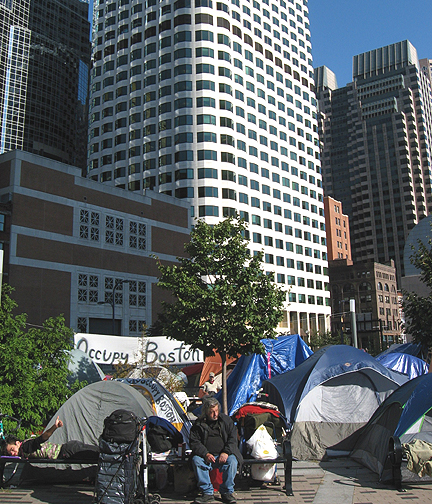
Boston (above) and Portland (below)

Monday, October 17, 2011
certitude in uncertainty
Thursday, October 6, 2011
common ground field notes
“Happy those who with their hands
bring to harvest the fruits of earth.
Blessed are we to share this food
served with loving care and faithfulness.
May we strive to share with those
whose hunger knows no end.
With thanksgiving let us be as good as God
for others.”
~ Monks of Weston Priory - table grace before meals.
Parallel to summer’s transition into autumn is the season of harvest. In northern New England, the liminal fall season is swift and bright. Successions of agricultural fairs happen throughout the region, remaining very popular with all ages. In the State of Maine, some of the largest country fairs occur as early as the first of August- such as the Skowhegan State Fair, which is nearly 200 years old. Though sharing many similarities, no two fairs are alike; they vary in dimension and in their emphases. For countless Mainers and visitors to Maine, the Common Ground Fair best represents the fruits of fall. Sponsored by the Maine Organic Farmers and Gardeners Association (MOFGA), which is 40 years old this year, the fair’s popularity has much to do with its uniqueness.
Over the years, the Common Ground Fair has grown into its own 200-acre fairgrounds (near the town of Unity, Maine), continuing to draw exhibitors who cultivate organic farms, raise free-range farm animals, and produce energy-saving structures and household goods. Woven into these annual events are musical and educational events, instructional demonstrations of practical skills, and children’s festivities. Consistent with the fair’s ambience, there are no carnival rides and all the food is locally grown. Instead of cotton candy, there are maple-sugared peanuts- and honey-sweetened lemonade. One year, I had a chance to taste blueberry butter which was savory and memorable! Another year, I got to try my hand at an apple cider press. This year, realizing how many times I’ve gone to the Common Ground Fair, I decided to make some new photographs to go with some I’d made on my earliest visits. When we find that we’ve created traditions of our own, then we can connect personal historic reference points. Photographing a country fair, in its entirety, would take many dozens of pictures; there just isn’t enough space! As well, within so much visual interest, by making a place one’s “own,” the eye is drawn to what it most favors. Here are a few images:
At the heart of an agricultural fair, there is livestock and produce. Demonstrations include oxen-pulls, sheep-shearing, horse shows, and the very popular sheep dog events. In the photo immediately above, the sign near the potato baskets reads, “Raised in Atkinson Maine on land that has been free of all chemicals for 25 years.”
Portland's Big Sky Bakery was at the fair, with herbal spiced bread.
Having a ready notebook at the fair is exceedingly useful. A palm-sized Field Notes journal perfectly suits the occasion. There are recipes to record, quotations from discussions and speakers to note, addresses to copy down, and in between browsing there are fresh thoughts to harvest. Human countenances bright with autumn light. Among the old friends I see at the Common Ground Fair, there are always inspiring ideas that would be more elusive in the city. Briny, salty, and paved Portland is nicely balanced by pine, sweetgrass, and earthen Waldo County.
The following set of photos shows an aspect of great enjoyment at the fair: the sharing of skills. The original organizers of the fair saw the event as a way to compare notes about organic farming and gardening. Mentoring also finds its place by way of imparting time-honored ways of bread baking, stenciling, furniture and canoe building, producing yarn, and numerous additional skills. These are just a few. One year, while watching a blacksmith’s demonstration, I got the idea to do my own version of this type of delivery- with bookbinding- and have followed through at many conferences and book festivals.
Are you taking notes?
To go with the fair’s fascinating and informative demos, a major draw to Common Ground is the music. At the gates of the fairgrounds, the large signboards inform visitors of events and their respective locations. I look for the music performances and write down times and tents. Over the years, I’ve enjoyed great folk music by local acts, such as Ti-Acadie, the Gawler Family, Gordon Bok, Castlebay, and Crooked Stovepipe. Then there are the musicians who are not on the schedule- playing their instruments around the fairgrounds and adding to the sum of the day’s colors.
Photo above is from 1982; photo below is from last week.
Above, members of the Gawler Family;
below, a hymn-sing after a shape-note lesson.
Homemade wares for sale include soaps, crafts, tools, jewelry, art works, baskets, and furniture. A cottage business called Alder Stream custom-produces backpacks. I first saw these at last year’s Common Ground Fair- dutifully writing down the details in my notebook. This time, I decided to order one, and with Jane Barron’s patient assistance we looked over materials and took some measurements. By next month, my handmade backpack will be mailed to me- complete with side pockets for camera gear, and a vertical interior pocket made to the size of an A5 notebook. And a water-resistant liner. A writer’s special, Jane added, and a treasure for future journeys. Amidst cultivated crops, traditions are renewed, sources are sown, and more shall be written.
Saturday, September 24, 2011
early autumn
“Methinks the reflections are never purer
and more distinct than now at the season
of the fall of the leaf, just before the cool twilight has come,
when the air has a finer grain.
Just as our mental reflections are more distinct
at this season of the year,
when evenings grow cool and lengthen
and our winter evenings with their brighter fires
may be said to begin.”
~ Henry David Thoreau, Journal : 17 October 1858.
Thursday, September 15, 2011
reminders
“Divine things are not named by our intellect
as they really are in themselves,
for in that way it knows them not,
but they are named in a way
that is borrowed
from created things.”
~ St. Thomas Aquinas, Summa Theologica
Looking up from my journal this evening, notably cooler air caused me to narrow my desk window’s opening. Not to be mistaken, this brisk air is welcome. Through summer’s writing, my journal has been propped open with a small rock which I’d pulled up while swimming in the lakes region here in Maine. The small fragment from a lake floor had been rounded and formed by its waters, and it’s been my handy paperweight. Now, the rock has become a reminder of freshwater swimming on a hot summer day. Scooped up by my hands from beneath the surface, I held the little rock in my palm, facing up to July sun. Finding its textures and shape appealing, it wound up in my backpack, and then upon my desk.
In varied ways, reminders come to us. They may be gifts transferred to us, discoveries of our own, and even reminders we deliberately seek out through our travels. Objects, sounds, sights- even tastes- potentially call to mind paths taken. Reminders point to past events, as well as ahead to needed strength in order to persevere. I think of my father when using his typewriters and when calling upon my better common sense. Cooking favorite foods brings memories of my grandmother back to me. A life of always having music in my midst, there are lyrics, songs, and symphonies to remind me of where I’ve lived, worked, and travelled. An employer once complimented what he called my “go-for-it attitude,” and I try remembering these sorts of words during quagmired times. Then there are the many negative reminders which require formidable discipline to sort out and deposit in their proper places. The full spectrum reminds me of my journeys past and those I might anticipate. Time and circumstance help determine which reminders remain. The small rock that serves as a paperweight may not be kept for long, but the source stays with me. Recently, during a day of bicycling across an island, setting the bike down, and with my back against the terrain I had a strong impression of resting atop a mountain whose base lay anchored at the bottom of the ocean. It was a sense of being supported. To be prompted to recollect is to be invited to certitude. Knowledge and remembrance are parallel threads.
Reminders may come to us as inherited discoveries. Through time, we become recipients of the gifts of those around us. Their recollections can become ours, too. We all receive keepsakes in varying forms, and that surely includes stories. In this way, we are also discovering gems that land in our paths. Although significance may have been ascribed by predecessors, we can add our own appreciation. In sharing reminders, we can assure one another of the great purpose to our steps. Reminders may also manifest through our unique definition. I think of these as the reference points that we establish ourselves. By observing our own experiences, significant images emerge. As we accumulate sources and repertoires, these are accompanied by reminders sought. This is to say, they’ve not yet occurred, but they will because we understand the search. In other words, we are reminded to discover. The term “point de repère” speaks to the idea that a “point of reference” is equally a “point of departure,” or a “benchmark” (“niveau de repère”). Times of retreat fit into this category, and for me it has been sanctified time away from routines- often in places conducive to contemplation and community life. Another, more ordinary activity is writing in coffeehouses; my favorite venues each have their own histories. Places can remind as forcefully as artifacts can.
Our finest reminders are those which re-strengthen. During a visit with my mother, a few years ago, she surprised me with a gift of an item I never knew she owned. Accompanying this extraordinary yet humble artifact was the associated story of how the family that rescued my mother from the worst of the Holocaust gave her a specially blessed silver medal from the church in Sablé, Normandy. My mother had carefully kept it since the early 1940s, through decades and crossing the Atlantic, finally deciding to pass the medal along to me. I had never seen this before. The tiny silver etched medal is my most prized possession in the world. Indeed, the brave and generous family chose it well: it is the image of Perpetual Help. Of course. That makes sense now. If this small sacred icon could talk! It is with me, and so are the stories, names, places, and my mother’s gesture that brought this reminder to my life.
As well as points of reference, reminders are compass points. Direction connects destinations with origins. Past and horizons are called to consciousness. Reminded of what to seek, we are also reminded of what to avoid. In doing the latter, we develop ways to find the buoys and markers that indicate treacherous shoals. Further, with time, collections of recollections grow into a many-storied experience, a reference source in itself. At the same time, along the same voyage, reminders must not encumber. Unburdening is integral to the process of collecting. Through the vastness of our landscapes, with open spaces, one can carry only so much on their person.
While considering some of the ways by which life’s gleanings are called to mind, there must be purpose in their faithful preservation. Surely, there remain lights to be found in darkness. Countless gems are as yet unsifted. Reminders are found in recollections received and discovered- and even in written words we read. With our kindreds, we are able to remind one another of what we recognize among us. The reminders of our loved ones become points of reference for us, too. I’ve begun to perceive my travels as being both fresh experiences and reminders at the same time. Though daunting in these times, we must daringly remind one another of the future. What is yet to be needn’t resemble what is now or what has been left in the past.
Be reminded.
Saturday, September 3, 2011
attending
“Before you speak,
it is necessary for you to listen,
for God speaks
in the silence of the heart.”
~ Mother Teresa of Calcutta
Anticipating some days off, my thoughts turned to the preparation. After all, there was much to do before the road trip. Ironically, the prize of unstructured time has been the result of rigid planning. But must this be so? Perhaps there are alternatives to the usual prefatories. Looking forward was joined by gathering material, working on my car, and surveying weather conditions along with calendars of events and maps. I knew enough to find humor in this, being one who is content to simply perch and write. With these milder weather months, the perching and writing may easily take place outdoors- at sea, and along mountain trails. Destinations and pathways alike comprise sojourns of all lengths and modes.
By force of cultivated habit, necessities began accumulating near my desk as thickening vegetable patches. The small piles were then succeeded by three bags: a duffel bag for clothing, a camera bag, and a backpack for writing materials and books. A small typewriter was already in my car. From the corralled vital spare parts, such as a pencil sharpener, a bottle of ink, a battery charger, some leaves of Ko-Rec-Type, and instant coffee, wafting late-summer air drew me from the packing to my open window.
Along the outbound road to the Friends Meeting House, late-afternoon skies presented a pale, housepaint backdrop for the verdant landscape I traversed. And among the leafy trees, swaying with storm-foretelling wind gusts, stands the red brick chapel. Very fortunately, the proprietors had propped enough windows open to invite in the expectant breezes. Being an occasional attender at their community, each instance is a fresh encounter in notably sacred space. I chose a seat near one of the open windows, and with the other congregants entered the shared and sanctified silence that attentively waits upon the Holy Spirit. After a short time, cool winds began filling the ancient, high-ceilinged sanctuary, intensifying with distant hints of thunder. In this prayerful environment, with eyes closed, swirling winds brought to mind the devotion that centers around the refrain, Veni Sancte Spiritus, and in the midst of human silence the rains arrived in full force. Though nothing was spoken, everything was surely noticed. With that evening’s experience in mind, I drove further up the Maine coast.
Along the way down-east, I leisurely stopped to enjoy towns, open shores, and woods. Content to simply perch and write, there were many such opportunities. My gratitude for this spell of respite seemed to exceed the amount of my writing ideas. Forest trails, birds, and ocean waves are surely welcome distractions. We can indeed inscribe our thoughts by looking from our pages and out toward nature. Further still, resting in harmony with the grandeur of creation does not always require words. Often the sacred silence is needed so that heartfelt words can be found. The tree-sifted wind atop Mount Megunticook called to mind the Quaker meeting house that had been filled with cool rainwashed air. This particular sojourn wasn’t turning out quite as I expected, though I hadn’t brought along any projects. This time, getting away to write became retreating to observe and to listen. Not for accomplishment, but for reflection, attending to place and time.
Silenced into listening, I was more compelled to look at temporal summer skies than to specifically describe them. Finding a mountain stream during a hot day, I soaked my hands and face in its startlingly cold water- then sat on a rock just to listen to its continuity. It remains the same stream, even though changing waters ceaselessly cascade along its way.
Listening, attending to the moment, resembles reading. Carefully absorbing surroundings, the mind becomes better able to articulate. In this sense, the trees and waters become means for lectio divina, inviting self to broaden perspective. And like attentive reading, observing is not passive. It means turning away from doing and toward being. The word assiduous finds appropriate use here, encompassing such meanings as diligent and industrious, as well as attentive- and being continually present. The root word, “assidere,” means “to sit down to.” As one that is content to simply perch and write, I am brought to consider the timeless roots of contemplation. The assiduous persevere in their sense of application, in a ready disposition. Ancient language includes the Hebrew word “yeshiva,” referring to being seated to learn, and the Welsh “eistedd” (as in “eisteddfod”) meaning to assume a seat as a reciting raconteur. The action implied is one of attentiveness.
Now returning to my humble quotidian experience, I’m eager to try applying a better appreciation for place and time in the old routine. A time-honored studio photography way of testing a new lens is to tack a newspaper page or a large map to a bulletin board and make a series of exposures at varied apertures. The test allows for an evaluation of how well the lens retains its field of focus. In a life of full-time work, agenda-free days are occasional exceptions. During lunch hours and front-stoop evenings this week, I’ve tried beginning journal entries with describing what is immediately proximate. What is seen, what is heard, and how does the food taste? The light as it appears right now will be different within a few minutes’ time. The sparrows that are content simply to perch on the next bench away from me will snap to flight in the twinkling of an eye. This day cannot be replicated, and that prospect may come as a relief. Preparations and maintenance are constants, albeit with their adaptations and variations. But the woods, winds, waves, and ways warrant our awareness. And it is for us to attend.