


 Posts
Posts


“There is no creativity in fear.”
~ Raymond Reitze (“Old Turtle”), during a conversation, 23 Sept. 2016.
For a public speaker, I have never heard such an unforced, subdued voice. Mr. Raymond Reitze speaks definitively and with authority- but if you don’t sit close, you’ll miss most of his subtle words, even with a microphone. Recently, I heard him lecture and respond to audience questions, for the 3rd time in 3 years, at Maine’s annual Common Ground Fair. As usual, the audience of attendees at his talk filled from the front rows. The general listening posture was that of a collective forward leaning, to catch Reitze’s observations. The fair itself is an extraordinary event, now 40 years running, sponsored by the Maine Organic Farmers and Gardeners Association. The fair has surely seen these pages before. All agricultural and crafts exhibitors emphasize respect for the natural environment and sustainable living. Among the livestock and land-cultivation demonstrations are traditional crafts workshops, folk music, and lectures. And amidst the speakers in fairgrounds areas such as the social action tent, and the whole life section, Ray Reitze has come to be a beloved fixture at the fair.


Ray is best known in his roles as Registered Master Maine Guide, and as teacher of philosophy. He is originally from a farming region west of Portland, in southern Maine- and lives in central Maine, operating a lodge since 1988 called the Earthways School of Wilderness Living. His vast experiences as an outdoorsman, thinker, Vietnam War veteran, instructor, and admirer of creation undergird his softly measured words. The training process for a Maine Guide is considered the most rigorous and difficult in the U.S. The Maine wilderness and inland waterways are heavily-forested and difficult to navigate. Maine Guides are qualified to lead others through the Maine woods. Ray is an expert canoeist, and received his name Old Turtle from a Micmac elder and mentor. The Micmac and Maliseet are among the first nations of much of Maine’s land. Years ago, I was told by Micmac in neighboring New Brunswick, Canada that they are popularly considered the inventors of the canoe.


Having met and listened to Old Turtle three times, I’ve glanced back at the notes I’ve taken in my journals. Of course I take notes! In the stream of writing experiences and insights, there is always room to add the words and ideas in my midst. Journals may begin as real-time recorded observations, but they may serve well as personal historic archives.

In 2014, when I first met Old Turtle, his topic was the inward journey to growth that bears fruit in the decisions we make and the good we can provide. He drew a picture of a tree, and repeatedly referred to it as a symbol of life. Pointing to the roots, he said that a life of compassionate love must rise up from the root. Too often, he said, the “top tier,” the outer branches of physical life become our directing influences, taking the place of the human heart. He emphasized that each person needs to know themselves: “Realize who you are, what you are, and where you are. Ask yourself about what motivates you. Use the realization, and then dream.” Speaking about hopefulness from his vernacular, he encouraged all of us to, “see your way through the necessary hardships. If you sense fear, stop and set up camp; then proceed freely without worrying about success.” From this context, he quoted a biblical verse from John 14 about living a Christlike life, “I tell you, whoever believes in me will do the works I have been doing, and they will do even greater things than these,” reminding us that we are not alone, and that we must “expand our energies like a big, spreading tree.”
2015
 My rendition of Old Turtle's tree picture.

In 2015, upon entry at the fair, I made sure to direct my steps early to Old Turtle’s tent. His themes centered around living conscientiously. By using care in our thoughts, we can guard against destructive attitudes. “The mind doesn’t know how to rest,” he offered, “we draw to us what we think, and become what we do.” By focusing upon generosity and its ramifications, we can be present to those around us. “We are souls,” said Old Turtle, “and our life is our earthly expression.” Sounding as an environmentalist, he emphasized that we do not fully live life by ourselves, but with community and in community. By removing a sense of resistance from our perspectives, we become better able to propagate kindness, and to “say ‘no’ to what is against your conscience.” Old Turtle laces his talks with stories about his wilderness experiences- and his homsepun adventures. Setbacks are explained through a colorful story about baking burnt cakes, one after another, until he got everything correct. But he loved the burnt cakes best. From there, he told an amusing story about helping a neighbor fix a flat tire, and what a good time they had. “Celebrate the burnt cake,” said Old Turtle, “because those errors move us toward perfection.” I began to recognize an Old Turtleness in his comment: “Don’t grieve mistakes, just give it another whirl.” But he is quite serious, adding that fear creates reaction, but love creates action.
2016

This time (2016), about 5 weeks ago, with Old Turtle at the top of my list of Common Ground Fair musts, I squeezed into the crowded tent to hear him speak about “the universe within.” He began with “all that lives in the universe is inside a soul.” Of course, this brought to mind the Gospel passage from Luke 17, “They can't say, 'Here it is!' or 'There it is!' You see, the kingdom of God is within you." Old Turtle admirably juggles his abstract metaphors with his earthly stories. In the same breath, he said, “Get out of your head and into your heart; quiet the mind,” and “what have you got going? What do you want to do- who and what do you want to be?” After saying, “much of our world works on the principle of resistance,” he used electronics and internal combustion engines as examples. He returned several times to the vital balance between head and heart. “The heart directs, and the mind facilitates.” Admirably positive, he continues to say that “experiences of setbacks can become opportunities.” I needed to hear that. After his talk, I asked Old Turtle for some advice about setbacks of my own. Talking about job-market rejections and my struggles to stay positive, he recognized how little is actually in the power of a job-hunter. His suggestions included creating some constructive habits, and having confidence in my abilities. “Ego is what feels rejected,” said Old Turtle, “You have to believe you are the best person for the job.” From there, he said, “there is no creativity in fear.” After recounting a memory about the Micmac elder he called Grandfather, he remarked that life is filled with stories. Using imagery from his decades of long-distance canoeing adventures, Old Turtle said, “We stretch each other’s strength, and we make progress together.” Instead of focusing on problems, focus on wellness and wellness will take over. These are among the many and understated gems from listening to Old Turtle.

As Mr. Reitze, also known as Old Turtle, speaks of those he has learned from, it is easy to see that many learn from him and still more consider him a mentor. In these times, a wise, gentle, respectful voice is all the more welcome. Old Turtle likes to remind us to slow down, take stock, and “get comfortable with what you know.” Listen to the eloquence of the woods. Souls like Old Turtle invite us to think, to see ordinary as extraordinary. Philosophical insights are to be found in stories about loons, the northern lights, fishing, and digging farm trenches. That pleasant, humorous, gentle presence compels. I’m reminded that a life of eclectic influences and experiences can dovetail into one integrated journey.

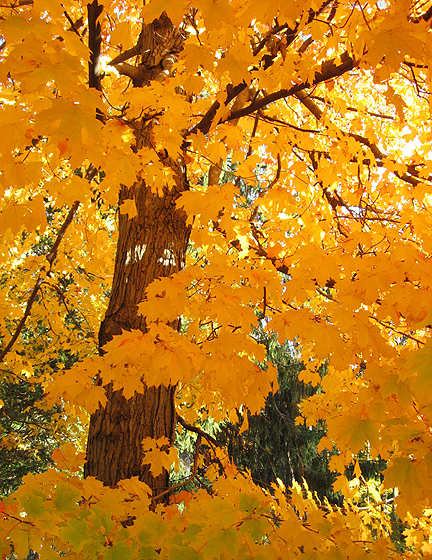
Now traversing the heart of autumn, with noticeably shorter days and colder air, the colors and balmy sweetgrass air of the Common Ground Fair go with me on the winterbound trail. Into the hunkered dormancy of cold months, during which I must continue working as diligently as usual, I’ll have words like Old Turtle’s with me. That elderly and soft voice that describes his memories of his grandfather surfacing when he laces up his snowshoes, reminds me of how I think of my father when I hold doors open for strangers. Like me, Old Turtle likes watching a good snowstorm and how the trees react. His steps connect snowbound shelters, mine connect city streets, and we navigate our respective regions of Maine. Old Turtle teaches us to be relentlessly grateful. When you think you’re too busy, he said, stop and smell the roses. “Stop and look at something beautiful. Just admire the beauty in what you’re seeing. Then go on your way. Stop again and admire... just simple admiration.”

Above: Poetry Grove, Common Ground Fair- Unity, Maine.
Below: A visitor during my writing.


