Sunday, September 5, 2010

lighthouse lines


“By marsh and tide,
by meadow and stream;
A will-o’-the wind,
a light o’-dream.”


~ Bliss Carman, The Joys of the Road


With a chance to see the land and water around me from an elevated vantage point- a lighthouse- I went up. Fredericton, New Brunswick has a city lighthouse at a bend in the Saint John River, where the downtown is centered. The city is close enough to the Atlantic for the river’s reversing currents to be witnessed. Tides from the Bay of Fundy send salt water upriver. A view, without fog, from a lighthouse is an inviting opportunity.


The lighthouses I know at home in Maine are anchored to rock ledges which are battered day and night by waves. Fredericton’s modest lighthouse shines a beacon toward watercraft, but also overlooks some city streets and distant landscape.


After making a circuit around the top of the tower with my camera, the sheer serenity of the place kept me there. There was certainly a better breeze than on the ground-level. Spiced with cool gusts, the sunlight was brilliant and unimpaired. And having no pressing time limitation, I found the niche between the beacon and the peripheral catwalk to be an ideal writing spot. Being instinctively drawn to edges and confluences, I wound up aperch the northwesterly direction, with the city to my left and the meandering widening river to my right and straight ahead. My week of sojourning along the Saint John came with the hope of unwinding and finding some uninterrupted writing time. Somehow, it took being at the top of the lighthouse- after several days of journeying, absorbing scenery, and flailing through mundane journal entries- for my words to begin finding the stride of the moment. So I stayed a good while, that much closer to the skies. Long enough to watch currents and clouds. Long enough to respire between paragraphs. As the beacon in its context, the writing and forward movement must persevere through all conditions in order to reach any sort of summit of thought.


a high-angle haiku


Looking toward the city buildings, I was reminded of one of my favorite features of Fredericton, which is the Poets’ Corner. On the previous day, I’d seen a rambunctious outdoor theatrical performance about the city’s literary history. Recalling the syllabic formula for haiku, I came up with a simple one from and about the lighthouse. From there, my attention was drawn to the river path below. The descent to continue exploring was equally eager as my ascent had been to observe. Primarily, I sought photographic vantage points, but thankfully my stop atop the lighthouse turned out to be a way to find some words.


Friday, August 27, 2010

compline


“Rest in me, O weary traveller,
rest in me and do not fear.
Rest in me, my heart is gentle,
rest and cast away your care.”


~ Sylvia Dunstan, Come to Me, O Weary Traveller


Let your thoughts be as still as your repose, dear traveller. Days and terrain so barren and uneven. Though much disquiets, sleep is undeterred. With the weight of these times, soft blankets anchor respite to this safe harbor. Cold rain outside does not disturb, but lulls; it does not tick toward urgency, but keeps its own wafting pace. Rest secure, though the world be not still.


Your room of muted spectral warmth dissolves to grain gray haze. Wallet, keys, and pen on a nearby ledge- just in case. These, too, lie dormant. A bedside rug supports packed bags and tired, still-tied shoes. Your father’s typewriter stands in its well-travelled case with handle unretracted. Inanimate, these things breathe their rest, motionless as you, the sleeping sojourner whose guardian angel attends. Pictures and wall calendar are muted in the blanketing dark. Yet this motionless space speaks of living promise.

The road ahead immeasurable and vast, the voyage arduous thus far. Let not your heart be troubled, dear pilgrim soul, though rolling landscape appeared in your first-closed eyes. Dream lofty images that rise above this crepuscule. Take heart and remember. Find refuge and recollect. Your friends tell you to stop worrying; your grandmother used to say you work too hard. Call to remembrance your song in the nightfall, with heart unguarded. Solitude was necessary and is an old habit, but you are not alone. The smallest still voice speaks your continuity and courage.

Wake with a keen sense of the undying fire under ashes past. The day must not be entered in defeat. Begin, instead, as the gradually illuminating turn of ambient light: increasing and growing thorough. Now edges are visible through the chalk of twilight, revealing texture and color. Red clock numbers glow the earthbound hours, reverting from eternity’s taste of rest.


Monday, August 16, 2010

paths


"I saw also that there was an ocean
of darkness and death;
but an infinite ocean of light and love,
which flowed over the ocean of darkness.
In that also I saw the infinite love of God,
and I had great openings."


~ George Fox, The Journal of George Fox


_____________________________________________


A prayer written by Brother Roger of Taizé:

"Jesus our peace, you never abandon us.
And the Holy Spirit always opens a way forward,
the way which consists in casting ourselves into God as into the depths.
And astonishment arises:
these depths are not an abyss of darkness;
they are God-fathomless depths
of compassion and innocence."


Tuesday, August 10, 2010

measures


“For in the realm of the spirit
heaven is as near up as it is down,
behind as before, to left or to right.
The loftiest and surest way to heaven
is measured by desires
and not by miles.
The one who longs to be there
really is there in spirit.”


~ The Cloud of Unknowing, chapter 60


Two beachcombers stopped to talk, as I busily wrote aperch on a rock. “Is that your journal? Are you writing poems?” “It is,” I answered, “but I’m just making notes about the day.” “That’s awesome,” one of them said. In response I asked, “do you write poems?” “I did when I was young,” replied the girl who looked no older than ten; “now we draw lots of mermaids- like this!” They proudly displayed one of their notebooks. “Definitely awesome,” I said, later remembering myself as a ten year old that used to say, “when I was young.”

With time and distance, there are increasingly more complex things of which the mind must make sense. Measures and increments. We refer to how many years ago, or jobs ago, or who was with us- and the places, tasks, titles, and names apply measure to time. Interacting our lives with time and space leads to the necessity of comprehending their quantities.


In the midst of desert wilderness, ends are not within sight; if they could be, an interminable trudge would seem more a definable sojourn. Alas, we cannot know the duration of a temporal condition. Using the standard measures of time when referring back to, say, the time between completing grad school and that first serious full-time job, the words three-and-a-half years roll forth with an ease that dishonors the countless miles, missed meals, hopeful presentations, and nerve-wracking poverty. And those rejection letters: I’d made a rule for myself that no rejection letter was to cross the threshold into my apartment. Spans such as three-and-a-half years are lived in hours, days, weeks, and blurs. Measuring devices provide some degree of command over the portioning of areas and amounts. It is for the individual soul to determine scales of importance, thus using personal significance to establish proportion. Having this in mind, perhaps there is asymmetry in our measuring of time- and even time itself. Consider how ages 12 to 17 covered five years; so did 25 to 30. Five years is five years. Well, perhaps not as simply as that. There are proportions, experiences, and what we archivists call enduring value. These defy measurement.

With time lived, and distances experienced and navigated, comes a reckoning with procedure. Progress manifests in steps. Structures are constructed in phases. Foundations precede roofs, a chassis is built before an interior is detailed. When conserving a book, I don’t encase gathers of pages (called signatures) before binding them first. I had to learn to patiently wait out an adhesive’s curing process. By contrast, it requires precise rapidity to be able to carry out paper repair procedures. Part of the continued cultivation of patience is through appreciating sequence. An increased comprehension of progress helps develop perceptive abilities.


Lest more time and opportunities elude my reach, I hope to better perceive my context. How else to arrive at a cultivated sense of vision, between impatiently desiring this trait- and by incidental endurance? To envision does incorporate a perspective that refers back to the times and lives of enterprises and projects, as well as looking ahead without encumbrance. Balancing between the jaundiced pitfall-knowing eye and seeing open-ended potential as it presents. Remembering archival principles, when faced with massive quantities of unorganized records, we archivists must first establish intellectual control over the material. This means to get a sense of the documents we’re to preserve and for which to create access tools. If there’s no discernable order or provenance (origin), we must impose a coherent classification, with respect to the sources (or roots) of the records. In a similar sense, it is for the perceptive soul to size up the overabundance, and apply principles of context appraisal, provenance, and ascertain evidentiary value. With perspective, I can appreciate confluences of terminology and import them freely into my own context. The impulse to organize and preserve must be checked, however, lest there be an unnecessary strain to uphold obstructive and stagnating notions.


Even with a sense of my roots and a remembrance of the providential, I often wonder how to look forward. The unknowing may be just as helpful as the corpus of all that I do know. Though having a sense of direction, the course to chart is of unknown measure. And even by making notes about the day, recording them with written words, it is a one-way travel. With shoulder to the plow, there’s no heading back- certainly not beyond reflection through historic record.

I’d like to think there is more reason to prefer the future to the past. It’s still a good idea to look forward, even with no apparent place to go. The time being is of an unseen duration. There remains the near, the manageable future, which has some delineated measure. This evening after work, having fulfilled my obligations, I’ll have time to write. A modest and attainable goal. Indeed, there are the grander ones, too, providing plenty of bucket list lining material. “Bear well in mind,” wrote Saint-Exupéry in Citadelle, “ that your whole past was but a birth and becoming.” For him, the desert represented the mind. This occurs to my thoughts, as so much around me appears as deserted places. The adventures we all live contain lessons, and perhaps mine at present is to see what I can create in a persisting desert. The past is definable and can be analyzed. The present and immediate future are the waters now plied. Their distant extremities cannot be measured or defined. Without grasp, comfort must then be taken in the Unsearchable and Immeasurable.


Friday, July 30, 2010

blue ink and blueberries


“We need the deeps
of the world of spirit,
as well as the wide and varied
outer world of knowledge
and of sense.”


~ Evelyn Underhill, The Inside of Life


Wednesday, July 21, 2010

fourth and go forth


“My Journal is that of me
which would else spillover and run to waste,
gleaning from the field which in action I reap.
I must not live for it, but in it”


~ Henry David Thoreau, Diary entry, February 8, 1841


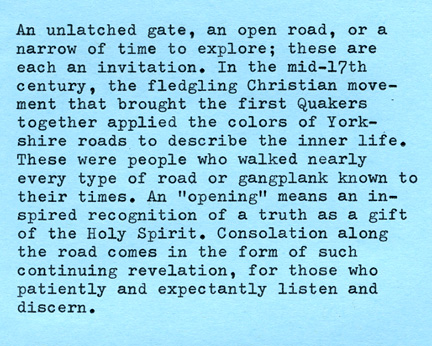
Some unusual hot weather is hurrying the summer toward its midpoint, though it slows my paces and thought processes. The other day while speaking with a friend about journaling, I heard myself say that “no written mark is without meaning.” It reminded me of an instance, years ago, when my best friend tried to console my incredulous heartbroken self with “no gesture of sincere love is wasted.” Maybe so. But of journaling, to say that every thoughtful intention is of consequence and importance is surely beneath the papered layers of personal writing. Further, this idea was part of what motivated me to set forth my journaled musings on a blog four years ago.


By speaking on one’s own behalf, a healing path may be hewn out of wilderness. The first attempts were on the one free utility I knew at the time (mid-2006), which was MySpace. With the prominence and easy flexibility of Blogger, I moved to the latter, though continued posting to both sites for about a year- noticing two very different sets of responding audiences. Trying not to think too much about readership, I consolidated the blog- though I’ve been very grateful to readers, to being included in the eclectic Typosphere, for the various awards and publications. It’s all encouragement to persevere. The important thing has been to continue the journey. Among the benefits is deciding to appreciate landmarks in time.


Gratefully, I grew away from some of the blog’s early intent. Struggling with ignominy was at least enough to strike a spark, but then the idea of exulting in being unknown revealed freedom and comfort in navigating through blessed unknowing. And therein lies another essential to journaling: the action of writing through perplexities and hardships. Subjects must be brought above the status of conversation pieces; they need to be lived experiences. Even the recollections of past events occur in the real-time of journaling. Written words follow, and sometimes parallel, living; and that includes retrospection. Through pilgrimages and workweeks alike there is an inner voyage to document, observations, aspirations, and reminders not to lose sight of the human longing for advancement. The interior kind of pilgrimage is accompanied by outer progress. Cultivating perception corresponds with perseverance, which cultivates perception.


Trying to imagine “what is next” is almost antithetical to the idea of writing the journey. It seems the best thing is to write and not subject too much thought to this. Admittedly I heard myself say (my contribution to the world of writing prompts) that too much emphasis on the present can subvert a view to the future. To take stock and to cherish are fine things, but these must coexist with hopes and projects. An elder friend recently asked me, “what are your dreams?” It still surprises me how difficult that is to answer. Turn the page and re-ink that pen. Why not reclaim the aspect of “unreasonable” dreaming? Make wishes that needn’t be precluded by preconceptions of what’s possible and what isn’t. Alas, a detrimental by-product of endurance is the disabling of aspiration such that the outset is entangled in limitations. This leaves the narrowest of margins for dreams, prayers, and active hopes. Writing should be a chance to dispel such constriction.


Posting journal essays via blogging amidst a pervasive “Web 2.0" seems like canoeing the North Atlantic. The medium itself is equated with abundance and overload. Accompanying such ubiquitousness is a detectable general sense of media fatigue. Ironically, weariness with unrelenting persistent information networks occurs simultaneously with the hunger that feeds it. Nevertheless, as for me, the writing will continue. There are always ideas and images. Distances continue to be covered. As months and years advance, memory increasingly encompasses and deepens. But reflection- particularly in writing- has a way of compressing time. Something to ponder while sharpening a quickly-shortening pencil. There are always more, and they don’t cost much. With gratitude, year five of this experiment is already underway.


Thursday, July 8, 2010

process and progress


“Divide each problem
into as many parts as possible;
that each part being more easily conceived,
the whole may be more intelligible.”


~ René Descartes, Discourse on Method


I’ve never been able to write much at home. Writing typically kicks me out of my place. Going out to write surely doesn’t reflect any insufficiency of the home desk or front stoop. Choosing to go someplace especially for the purpose of writing is choosing away from distractions and demands. There is only one thing to do, and that is to make note of the journey. The distance from mind to page becomes more proximate with travel- even a walk across town. Perhaps it’s in the change of venue. Pursuing contemplative and reflective processes draws my steps away from bills, chores, demands, and other such moorings.

Getting out prompts adaptation and awakens the senses. This time, having a rare morning off, these words are joined together in a busy coffeehouse. The servers in this place are creating their offerings with a mix of cheer and methodical authority. It reminds me of how I talk shop with fellow visual artists and writers about projects and tools. Process deserves its due, as those foundational procedures are what allow us to venture forth in our own creative ways. By knowing how a result is reached, the various processes in our midst can be seen to connect and relate. My questions for the café workers are similar to those for my friends who are mechanics, repairers, cobblers, and cooks: with the “new eyes” that admire unfamiliar methodology that inspires crafts familiar to my instincts.


Learning more about creative processes leads to a more conscious appreciation for the disciplines that help make things happen. My life in photography- which began as I taught myself at 15- was steeped in scrupulous applications of calibrated processes. Starting out with cribbing from Morgan & Morgan’s Photo Lab Index with a memo pad in the aisles of B. Dalton’s bookstore on 5th Avenue, and learning more through art college, I so hungered to be fluent in the profession that I followed all the steps and processes I could find and use. By the time I reached the heart of my 14 years in custom photographic lab work, I bought my own copy of Morgan & Morgan, adding in my old notes into the thick tome of formulas, specifications, and logarithmic film charts (classed by manufacturer, beginning with Agfa). With a beam balance, I made my own developers and paper emulsions. Accomplishing all those techniques permitted me to teach them and to be able to look at those arcane photo methods in perspective. There are measured aspects: temperature, quantity, time intervals, and chemical agitation. Parallel to these are human aspects: assessing density, contrast, and color. No instrument can replace a cultivated human eye. A third factor is a consistent and respectful use of the equipment- from optical glass, to densitometers, to gently winding color filters back to zero before making any printing changes. With such command, the ground can be flown away from, the lifting off limited only by creative energy. Somehow, that photo-instinct which I applied every day for years and years manifested in my approaches to cooking, baking, calligraphy, and bookbinding. Reverence for method and practice is followed by the twinning of imagination and intuition.


Setting down the writing materials- with care, of course- I asked the coffeehouse staff about procedure. Comparing notes, there is indeed a specialized methodology to what they create for their discerning audience. After all, Arabica Coffee Company is Portland’s finest and has been for many years. In the sequence of photos (below) Salli barista par excellence graciously described the steps that bring those famous cappuccinos into being:


After the coffee cup has been heated with boiling-hot water,
milk is poured into a beaker to be steamed,
anticipating the finishing steps.


A special blend of espresso beans is finely ground,
and evenly loaded into a measure.


The process of tamping the ground coffee is called dosing.


The coffee is brewed under hundreds of pounds of pressure.


As the fresh coffee is brewed, the beaker
of steamed Maine milk awaits!


Pouring the steamed milk into the thick brewed coffee
is skillfully done here by Salli. The result below, known
as a rosette, resembles a forest fern.


As she set the finished cappuccino down on the counter,
Salli sidearmed a little spoon into the saucer. She said the final drop
of the spoon into its place "is like signing the artwork."


By the end of this quick photo session, a rush of customers diverted us all back to our routines. A few good side-conversations evolved. A fellow calligrapher asked about this essay and the pictures. Mentioning my appreciation for creative disciplines, she offered her opinion that “there isn’t enough discipline in this culture.” Another good friend pulled up a chair and noticed my typewriter and journal. He owns an art gallery, and added his observations about creative processes. As much as there are frameworks to comprehend, we have the serendipity of side conversations to savor.


Processes that may appear unrelated actually do intersect with an individual’s sense of perspective. It is for us to make those connections, beginning by noticing them. Preparing and sizing my materials when conserving a book is the same as my mother’s way of cutting fabric. Writing reports at work has my father’s unambiguous and persuasive language. My best example of craftsmanship as a photographer was learned across town in etching classes taught by a Tamarind Institute lithographer. This instructor had a refreshing willingness to rework her printed images; it was not the discouraging purism I saw in the college photo department. During my high school senior year, I got to meet the great typographer and graphic designer Ismar David. He took me to his drafting table and showed me his sketches for a stone memorial he was designing. I looked wide-eyed around the studio filled with tools, spring-armed lamps, and drawings tacked to the walls, listening to the artist talk about how he wanted visitors to the memorial to understand what they’d see. Mr. David shuffled through a sheaf of pencil schematics on tracing paper that animated all the angles. A three-dimensional design. I remember this as if it happened last week, and these glimpses affirm the role of procedure on a long journey of undetermined structure. Process helps establish foundation. By understanding how something works, we can make things work in our creative pursuits. And as process recedes into second nature, intuition and openness to spirit become procedure.


~ with special thanks to the typewriter-loving, always gracious and supremely neighborly:
Arabica Coffee Company, 2 Free Street, Portland Maine