“I have a guide,
and in his steps
when travelers have trod,
whether beneath was flinty rock,
or yielding grassy sod,
they cared not, but with force unspent,
unmoved by pain, they onward went”
~ Thomas T. Lynch, The Staff of Faith


 Posts
All Comments
Posts
All Comments
“I have a guide,
and in his steps
when travelers have trod,
whether beneath was flinty rock,
or yielding grassy sod,
they cared not, but with force unspent,
unmoved by pain, they onward went”
~ Thomas T. Lynch, The Staff of Faith

“The labor, of course, is in the unrelenting struggle
to banish the countless distracting thoughts that plague our minds
and to restrain them beneath that cloud of forgetting. This is the suffering.
All the struggle is on man’s side in the effort he must make
to prepare himself for God’s action, which is the awakening of love
and which God alone can do. But persevere in doing your part
and I promise you that God’s part will not fail.”
~ The Cloud of Unknowing, ch. 26
Our journeys are accented with words and images. The words may be written as well as spoken. How many of the events and words remain committed to memory is not always within my control. The popular adage, “making one’s mark in life” lends reference to accomplishing major, even indelible, works. I assume there may potentially be many marks. With adventures we accumulate figurative jottings and storied anecdotes.We may hear a lot of “don’t mention it,” or “think nothing of it,” but that doesn’t always prevent us from mentioning and thinking.
Darting across the rainy streets of my lunch hour today, I thought about the lasting marks. Which memories are not washed away by storms? I wondered about the gathering of words, images, and information, balanced by some means of erasure. Our events are irreversible, and that is in the nature of action and coexistence as we live. Our recollections remain, and these become potential resources to inform our own navigational charts. Can there be an eraser? So many works and expressions begin and end in figurative charcoal dust. As it is with time, reflection is fluid and fleeting, with graphite jottings subjected to smudging and erasing.

Memory fascinates me as a uniquely human mystery, particularly in its intricacies. Experientially I am aware of remembrances’ powers, both within and in my everyday work as an archivist. Recollections accurately called forth may be both blessing and liability. Indeed, my musings have oft visited this double-edged sword. This time I am contemplating how an eraser of thoughts can be employed. At times a shared history can become a corporate memory- the type from which more than one person can draw. In this instance, I am thinking of personal recollections. My vivid memory seems to produce a random rotation of reminiscence, perhaps depending upon what touches off the images.
Ancient minds used the imagery of an ethereal written record. Inscriptions in the Book of Life. Perhaps the geography of the spirit has a gazetteer. The Psalmist prayed for offenses to be blotted out. Can the engraved be erased? Isaiah penned these consoling words to those in his midst, in the 6th century BC:
“I have blotted out, as a thick cloud,
your transgressions, and,
as a thick cloud your sins:
return to me;
for I have redeemed you.”
Though reconciliation may come to me from high and low, it remains for me to forget what is reckoned with, and past. The clouds of forgetting may be the strata beyond remorse and resolution.

Encyclopedic lives comprise details and nuances whose justice can hardly be served by mere words. But that doesn’t discourage me from trying. There is imagery to accompany the words. And editing, too; involuntarily subjected to our interpretations. Perhaps the additive aspect of living implies a natural subtraction. But what of that which is difficult- perhaps impossible- to erase? A wise friend used to tell me about wanting to be as a stream that runs clear.
To erase is to remove scribed marks by means of abrasion. Other ways to clean documents include light-bleaching and alkaline aqueous washes . When I think about keeping a clear and unjaded vision, the clean slate comes to mind. A tabula rasa, translated, is a “scraped tablet,” a renewed writing surface readied for new inscription. With palimpsests, scraping away portions or entire layers of text, reconditioned parchment for new illuminations and words. With our computers, we simply reformat drives and overwrite files.

In recent years I’ve instinctively found myself practicing my own way of reckoning by overwriting. It was one of those unintended solutions that occurred quite by accident. A career change and the beginning of my hard-worked graduate school odyssey were my attempts to recover from a deluge of intense personal crises. As the worst of it passed, including a near-death experience, I had little left, aside from my work and my path toward my masters degree. I recall an excruciating semester of uncertainty, concluding at Christmastime, with a perfect set of grades. Still raw, but surprisingly strong on my feet, I found myself using my open afternoons to retrace my steps.
At both ends of my 120-mile commutes between Portland and Boston, it seemed there were paths and venues for me to revisit. Very consciously, I’d stop at landmarks such as the Café Paradiso, on Brattle Square, which had unwittingly become a late-night way-station through my anguish. But this time I walked through all these places with a strength and perspective that, in my own way, set things straight. From workplaces, to bus stations, campuses, and streets- as my notebooks are my silent witnesses- every valley was exalted. It wasn’t until I had been well on my way- with teaching, publishing, and a new savor for living- that I recognized this way of setting things right by overwriting what had passed. Writing through the journey. Taking myself out to a certain restaurant alone had been startlingly emotional; returning to it, as well as to a variety of locations and settings became a kind of reclaiming adventure. And in true pilgrimage fashion, the means could not be the destination.

Overwriting and revisiting has been for no other accomplishment but for me to transcend. Surely, not every inexplicable side of life lends itself to such an application. Time itself, requiring patience and discipline, has erasing properties. The passage of time broadens spaces between living beings and fixed landmarks, though I know enough not to expect it to heal all wounds. Erasing the prominence of darker marks by overwriting might be an odd form of poetic justification, but it does liberate me from outdated apprehensions. Even friendships have been mended in this way.
Just as memory can soothe, it can also be a forum of torment. As any volatile substance, remembrance is subject to destructive misuse. Past is prologue, but it is not intended to be repeatedly relived. Studying manuscripts in the soul’s archives provides for a panning distillation of history to reveal the gold nuggets of usable currency. And from there? Recording, erasing, overwriting, and clouds of forgetting are now in my consciousness. These are skills that are occasionally necessary, if old steps are to be retraced in order to cultivate constructive perspectives. Very gradually, my antidote to prohibitive fears has been to build trust. And those “corrective” efforts find their way to becoming the new memories, the new reference points, and my own reckonings of their respective places and predecessor events. Indeed, this attests to the forceful influence of connotation and iconographic symbols and signs.


“Take this
Mute mouth
Broken tongue
Now this
Dark life
Is shot through with light.”
~ Suzanne Vega, Pilgrimage


“Pieces of coal, hewn from the deeps of the earth,
Here in my hand, spectra of lights retain;
Crystal on crystal knit, back in its birth-
Sun meeting sun again.”
~ Huw Menai, Pieces of Coal
formed from this earth
We are formed from this earth. Like the coals drawn from untold and lightless depths, the soul is drawn to surge upward to divine fires. With the coal-blackened laborers and the burdened haulers, I, too, know the work is relentless. Nothing less than conscientious effort is needed for me to arise and walk this earth with strength and wisdom. Through the winter, I’ve had a fragment of coal on my desk. It is from very far beneath the ground, brought up in untold tons by unseen hands that toil and risk their lives’ safety. Souls whose wildernesses are subterranean, whose ocean is the earth’s crust, and their enormously hard-worked paths are confined to narrow tunnels.
In the work life I endured that enveloped my twenties, my average workweek saw very little daylight. Prolonged travail in complete darkness disrupted my sense of what time it was- save for deadlines. Further and broader still, extended overtime and intenseness in a foul and exploitive darkness seemed to meld the years. I don’t know how much more of my earnest energies I’d have added to that job, had I not found myself in a tide of layoffs. It was confining and toxic- though only one level underground, but being a daily reality, difficult to break away from. I free-fell into the light of day, and though it was barely ten years ago, some of that shock of life-contrast does remain in my ordinary thoughts. Re-evaluating one’s continuum sets a soul on the verge of self-definition. Aquinas wrote of how the reality of creation stands at the brink of the world. Every time we dare to behold the wonder of creative power, we stand at the edge of the known world.

depth and depths
What breathes life into dry ground and stone ledges? Along the roads, still layered with months of sand and grit, the landscape remains barren with granite, ice, and spines of trees. Outstretched branches try to collect enough rain. They do not wait in vain to be reshaped, even as fire transforms masses of anthracite to set colossi into motion. Often when we think of our sources, we refer to the ground of our being as though we had a geographical idea of our rootedness. But surely my basis isn’t limited to the substrata beneath my feet. Might there be roots nearby, far above, and even right alongside my hands writing these words? Speaking of a “center,” or a “core,” may confine us into imagining the spirit that gives us life begins within us, rather than respirating through us.
Among my disciplines is an effort to avoid clichés, or at least unclarified terminology. In this society, we accept too many catchphrases, pat lines, and sound bites- and it seems counter-cultural to take the time to explore and more thoroughly comprehend. It’s fine to conscientiously “go to one’s center.” All right, go to the source. And then what? You just stand there? Not at all. I’d like to think life is more a working library than a sealed-off museum. The source is for our immersion. Mine the depths of the soul; jump into that water of life. Traverse that guardrail from spectator to participant. Looking at a sumptuous meal is one thing, but savory dining is quite another interaction. Even in the early morning, I find it vital enough to give space to recollect thoughts- but that coffee should be downed while it’s hot. If stopping at the shoreline of the Source isn’t satisfactory, take that as a good sign. Indeed, as the Holy Spirit takes hold, the unresisting natural course is to respond and pursue. My understanding of immersion begins with internalizing the wisdom that I gradually comprehend. “So walk ye in him,” wrote Paul, as he wrote his listeners to practice their professions of faith. For me it is to seek more of the source, and even to become part of it. To arise with a constant gratitude that mirrors the constancy of the wellspring of life.

coal and work
The coal on my desk was given to me by a railroad trackman, along the waterfront. The heap of coal reminded me of the histories that described black mountains of anthracite on Portland wharves that were regularly offloaded from massive schooners. Nowadays, we rarely see such elements as those which are consumed in the operations of our days. These pieces of coal may have been cut from seams that were two or three kilometers underground. But they look like they could be from the Moon. As it were, reverse-meteorites from darkest inner-space. When struck by light, the fragments reflect as glittering silver. During my fourteen years in photographic manufactures, we’d quip about our labors as “silver mining,” with hours in which we could not see our hands in front of our faces. I remember driving to Pictou, Nova Scotia and stopping in Stellarton. It was only months after the Westray Mine disaster, and I wanted to pay my respects to the more than two dozen miners that perished at their work far beneath the ground. It was a rain-spattered afternoon, and amidst a mournful and desolate stillness, I stood and sent my deepest prayers to the living and to what memories they had of the deceased. May they rest in peace. Almost reluctantly I took a few pictures, since I often think through the camera. About a half-dozen years later, the entire Westray complex was torn down- the ashes returned to the earth.


antiquity and present
Bringing our souls up from the depths means a descending of mind into profoundest heart- and there we mine the bituminous ore the Spirit can ignite. The ancients whose thoughts are compiled in the Philokalia shared their imagery of prayer as being a descent into the heart of our being. Imaginably inspired by their desert wildernesses, inwardness always seems equated with ways modern westerners refer to upwardness: vast yet intimate. It is fascinating to notice what appears as an inversion of upward and downward, perhaps not intended by the ancients as a reversal of popular perceptions. They described contemplation as a search through the depths of the human heart, prayer being the descent. In these journeys, it is necessary to navigate through the darkness of one’s most haunting and destructive thoughts- armed only with faith and a disciplined mind. With a view that considered thoughts as separate from self, St. Neilos the Ascetic wrote, in the 5th century, of how “the mind descends into the darkness of our thoughts.” But indeed, we are not to simply dwell in such crepuscular paralysis. Realizing the presence of mercy, and that it comes not from but through us, we are brought to a humility that cleanses the heart. Arriving at a recognition like this, even in tears, as Nikitas Stithatos noted:
“...your consciousness of the love of God will grow lucid and you will begin to contemplate the mysteries of the kingdom of heaven and the inner essences of created things. The more you descend into the depths of the Spirit, the more you plumb the abyss of humility.”
Thomas Aquinas, in the 13th century, observed how the brink of creation is known in our depths. He equated the darkness encountered by the soul as Divine mystery. When we realize how creation was called into being from nothingness, our sense of wonder defies plain sight, and we plunge into truths we cannot see. But going forward must be without hesitation, even if one is “caught between the terror of mystery’s invitation to step out into the darkness- and our mind’s insistence on knowing the truth.” Comfort is found, alas, in realizing one’s mind is not the full measure of all truth. In this instance, vastness takes the astonishing form of reassurance.

source
Still amidst times of seismic upheaval, I know the vitality of vigilantly drawing from sources of strength and trust. And as I heard myself say to a friend the other day, it can be as unspectacularly consoling as opening a cherished book and seeing the soothing words. In the swirl of the fluidity of these times, I take heart that God is both steadfast and creating force. As strengthening as it is to know what the ancient Psalmist called “the everpresent help in times of trouble,” I try assuring myself of the unusual dynamism of unknowing. Rather than to presumptuously assess that which is around blind corners and distances beyond my field of vision, I’d sooner take stock in the openness of what is yet to be. God is ever so much nearer than I thought. As near now as in the murky, damp, cement-floored darkness that I’d grown accustomed to as I made my living for a fourteen year span. What fascinates me now is this unseeing sense of certitude even though I am not sure how dark the figurative glass of comprehension, through which I must navigate, will remain. Next week, I’ll return the coal fragments to the heap near the railroad where it will all be used. And I’ll continue to wonder at the prospect of whether depth is measured from above or below, or if the spiritual life even has a fixed surface from which to determine measurements. Is the pitch darkness in an earth-gripped tunnel or a lightproof corridor as close at hand as the sky? The Divine is as near as the notebook in which I write my words. Indeed, proximity may need only one reference point.


“Waiting at the airport on my suitcase,
a girl traveling from Spain
became my sudden friend,
though I did not learn her name.
And when the subway dimmed
a stranger lit my way.
This is the brotherhood of man.”
~ The Innocence Mission, Brotherhood of Man


“When all is dark and dusty down the tracks;
And all paths from exile have roadblocks
on all points saying ‘no way out of here,
go back to where you came from.’
Only the thunder knows
what drives a man in his darkest throes
Fortune and poverty,
they’re so close, so close.”
~ Mike Peters and The Alarm, Only the Thunder
Stories, and rumors of more losses, surface and loom with each day’s passing. Pausing during a coffee break, it occurred to me how many setbacks I hear about, at nearly every turn. People moving out of the region, a neighbor vacates without notice, and numerous plans must be minimized. Long-standing businesses and cultural fixtures dissolve or downsize. Many who elude job losses must navigate warily in threadbare and fearful environments. And still, across all situations, there are more who listen to personal testimonials that string together with broadcast news stories. Pondering this today, I started categorizing the relocation, layoff, dissolution, and transition stories I’ve been hearing daily. The listening is part of dignifying the need for individuals to tell their adventures. And it’s hard listening. But there are unspoken embers of hope when the language of defeat is superimposed by creative alternative plans. There seems a fine line dividing what we determine to be success or failure. Indeed, our realities are challenged when another reality visits upon us. Of course, we’d prefer to draw the lines, rather than to have them drawn for us by somebody else. In this continuum, we will surely note the changes in our midst. And somehow, in realizing all that is transitory, the status quo reveals an undertone of fragility.

When considering the meaning of fragile, what comes to mind is the breakable. My thoughts turn to this imagery when the permanently dependable looks precarious. The idea of fragility speaks of delicate plants, complex mechanisms, anything requiring sensitive and conscientious handling. Hopes and health. Though essential, easily forgotten. And paradoxically, through these, strength is found. Disrupted balances are causes to perceive well-being as hanging by a thread. Is the status quo as delicate as it appears, when stopping to think about it? Perhaps it’s best not to stop and think- or at least not to allow a focus on vulnerability to derail forward continuity. Peace of heart is, in itself, fragile- even if well-anchored in road-tested faith. The nature of dynamism is fluidity, which may be considered a fragility. But in vigilantly maintaining balance and a consistent openness to the Holy Spirit, flexible strength is reinforced. There is fragility in all that is dynamic, and although it may seem a conflict of terms, both require the depths of our patience. “Tears may endure for a night,” wrote the ancient Psalmist, “but song finds us in the morning,” hours during which reassuring joy is easier to discern. Oh, but to thrive against restrictive limitations! In these times, so many of us find ourselves taking stock in our most palatably compromised ways of functioning and making ends meet. But it need not cheapen our dreams.

As the road ahead must negotiate unpredictable detours, it is vital to be able to prosper through instability. Whether or not I can serve as a conduit of hope, my proximity to the wellsprings of promise requires steady vigilance. A most surprising moment occurred last week during a long-distance pilgrimage travel: At the heart of complicated logistics, commotion, and exhaustive music preparations- was a ten-minute silence amidst over 400 people. A forgiving, respirating, and transporting quiet. Afterwards, resuming my instrument to play the next piece, I thought about how I might find ten-minute slivers in my early mornings- or even lunch hours- to help balance frenetic work weeks. Confident aspiration is a long looking-forward, hopefulness a serious business to which we must take hold.
Reflecting upon the many stories I’ve listened to recently, along with the hard-worked years of my own, I think of how to arrive at consistency amidst instability. After seeing enough times how circumstances can delicately oscillate, my thoughts turn to how one can pivot the fine point from untenable to productive. While so much is said about “bad to worse,” or as a neighbor once said to me, “just worser and worser,” this is enjoining me to aspire through such darkness. A solid course of trust pursues a fine line through narrow gates, laying tracks of trust. One recent cold post-midnight, gazing through icy windows at silent streets, I thought of that dividing line between despair and confidence. How to press forward along the high road. Somehow, the most reassuring thought was to remind myself of where I am now, and how far I’ve traveled on this marathon voyage.
There are prospects yet to ascend. Within a vital perseverance must be a solid sense of durable certainty. Memory recalled the words of the imprisoned apostles, passed down from antiquity, referring to being held captive by their hopes. The fine line may be one of perception of circumstances, how derailing realities can be dealt with and interpreted. Fluid situations demand a readiness which must rise above the gravity of grimness. Indeed, thriving above undertones of instability requires more daring than before, challenging me to continually renew inwardly despite what is outward and perishable. At times the juxtaposition of enduring and impermanence is more obvious than others. For now, the present exposes such contrasts. As an artisan, I am aware that with an increase in contrast there comes an emergence of sharp edges and fine lines.


“Cease not in thine intent, but strike evermore
upon this cloud of unknowing that is betwixt you and your God
with a sharp dart of longing love,
and loathe for to think upon ought under God,
and go not thence for anything that befalleth.”
~ The Cloud of Unknowing, ch. 12
The dawn-to-dusk workday offered scarce light and no rest. What impelled me through the hours was the prospect of relaxation and fresh air that evening. By mid-afternoon, I had decided upon a hot bath as a clarified and appropriate reward. My chilled walk through the dark streets going home began the process of exhaling thick dust and grime out of my lungs. A good bubbly hot water immersion needed some efficacious thoughts, so I coincidentally brought Baxter’s The Saint’s Everlasting Rest with me. Sinking into the suds, the 17th century orator’s words wafted to me from my weary arm’s reach: “A heart seldom thinking of heaven can fetch but little comfort here.” The hardworking chaplain of Kidderminster held to the ancient contention that “there remaineth a rest” in the eternal future. We are unsettled in our earth-bound lives, Baxter claimed, because we neglect to meditate upon heaven. Impressed by these poetic reminders, while draining away the day’s travails, it occurred to me how I don’t think much at all about what we refer to as “heaven.”
Admittedly, I do get bogged down, if not diverted, with immediate concerns and the weight of keeping as many jumps ahead of deadlines as possible. Indeed, this culture refers to the stuff of heaven as the “afterlife.” When I stop to ponder, I realize how far one can perpetuate distorted perspectives. Rather defensively, my response is there’s so much “down here” in the “real world,” occupying my energies and all personal resources. Perhaps projecting some ingrained ideas from my uninterrupted working life of grinding and burning-out, looking ahead to some yonder break. The intermissions are never enough, and I tend to spend half of those times trying to stabilize myself with rest so that I can actually enjoy wherever I am and whatever I’m doing. Unfortunately that taints my view of heaven: that I’ll work on numerous well-intended projects and self-improvements until I simply can no longer. Then my life will be followed by some sort of ‘perpetual paid vacation,’ entailing a lot of harp-playing inside the fabled pearly gates. Merciful heavens, this can’t be it.
The problem is that I interpret references to heavenly eternity with terribly distorted and uninviting imagery. Quite the opposite of goodness and peace. No wonder these pictures of a hazily simplistic heaven are never in my thoughts or dreams. I begin to regret the notion that it may not look like Paris. Or eastern Maine. Surely there must be gentle people, books, good coffee, and bicycles. I, too, apply my own humble human projections. A bit more Robert Doisneau and a whole lot less Fra Angelico; I’d like that. Indeed, Richard Baxter himself- and the biblical sources- cannot spell out what we will see and do not bend to the limits of the scale of human perception. Baxter calls heaven “our own happiness,” and that a life of praise and inclination toward the infinite Divine, draws us away from being devoured by our convenient miseries. Whatever it is, or can resemble, will be our very utmost good. At this point it’s more than enough to get me to visualize a 4-day weekend, let alone heaven. Still, meditating upon these things helps me re-learn how a heavenward focus causes a more balanced earthly view. This evening it’s easy to imagine a perfect rest. That everlasting rest for all who have labored and knew heavy burdens. “On earth as it is in heaven,” begins to look to me like “in application as it is in ideal.” The place is for later.
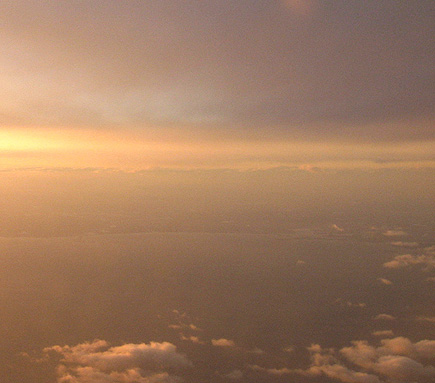
Piercing those clouds of unknowing is a concerted effort and a constant need. Each day begins with a former perception to shard away. Perhaps darts that transcend cloud-coverings are not about the world to come, but really about an undaunted pursuit. These are aspirations. An unseeing intent that reaches forth to the Divine attains to the absolute. Yes, going forward even when unable to see through the void of a fog bank; even without sonar. The anonymous writer of Cloud of Unknowing wrote of the blind intent stretching to God, which, if wholeheartedly directed toward God, will surely meet its goal. The sharp dart of longing love is essentially an unfettered desire through which the soul attains the absolute, which really cannot be apprehended by any particular contrivance or method. Hidden between the rigidity of contraries- such as speaking and silence, eating and fasting, company and aloneness- is the sublime spirit discovered. “Up there,” as so commonly gestured, becomes “close at hand,” with distances delineated not by miles but by the will of the heart. Perhaps a better view I might have of what life manifests beyond might be to contemplate the passing away of the unknowing. Knowing even as we are known.
It seems I am reaching forth by faith toward something for which my understanding is evolving. But knowing enough to reach, and even to strike upon the clouds, envelops the pursuit in this very assuring mystery. A vivid recollection involves hiking to a favorite place of solitude, close to home and along the ocean. One of those countless ledges of crags and pines. This time, I encountered a dense and palpable fog, so dense that it was impossible to see the edge of terrain. My steps became vignetted by the same blanched smoky void that was straight ahead of me. The sound of crashing waves informed my advances. Of course while knowing what was on the other side of the fog, I couldn’t tell how near. Standing on a jutting rock, I simply marveled at the upward view being undifferentiated from the views ahead, left or right. What vistas await, surpassing the unknowing? Details are less important, but the goal must not be forgotten. Sowing must not hesitate with fears about quantitative results. “Contemplatives,” wrote Thomas Merton, “must empty themselves of all created love in order to be filled with the love of God alone.” With this in mind, my imaginings of what follows might remain at the edges of peripheral sight, yet the heavens are surely present.