Monday, May 30, 2016

berkshire pilgrimage


“Spring was moving in the air above
and in the earth below and around him,
penetrating even his dark and lowly little house
with its spirit of divine discontent
and longing.”


~ Kenneth Grahame, The Wind in the Willows.

Liminal spaces herald the passage of time. A threshold into a new season is a reminder of the close of what preceded it. Of course, the days and months advance, and we have no control of that. What we can do is take notice. Acknowledgment settles thoughts across thresholds. As I’ve often done, over the years, during the trudging drudgery of winter’s traversal I plan spring retreats. I’ve learned how valuable it is to plan some respite, while amidst particularly intense spells of work. Recognition prompts movement, and at this time of the year, I want to be able to see and taste the spring season I’ve only been able to notice as a backdrop. While juggling the daily business of life and labor, I noticed enough seasonal progress to decrease the number of clothing layers, parallel to increasing temperatures. As well, I’ve immediately cherished the return of post-6pm daylight. Surely a sign to pause the pace and savour the season.


A pilgrim soul recognizes the subtlest of ingredients as contributing to the grander journey. My hard-won earned time off is attributed in weekly increments of 2.8 hours, corresponding with my full-time employment. Indeed, calculation is part of the preparation for a pilgrimage. Also swept up in the planning are tasks such as paying bills, maintenance on my car, and gradually tossing provisions into a tote bag at the base of my desk at home. As the travel draws closer, each accomplished project, each lecture, each household chore joins with my pilgrim path. The early months of this year merged into a challenging obstacle course, yet I was able to fulfill all my commitments in time. During the two weeks prior to setting forth, I had been an organizer in two large community events, in two different Maine cities, and served a community dinner in between. Even my writing projects had to be postponed. Some holy adrenaline was followed by catharsis, all of which pointed me south and west to my chosen place of retreat.


During the winter, while thinking about a spring retreat, I thought of where I might find a lot of unstructured quiet. And fresh air. I wanted unimpaired aromas of the season. As usual, it needed to be a place conducive to spiritual renewal. With these things in mind, I thought of the Berkshires. The mountainous region of western Massachusetts- before tourist season- can be healthfully peaceful. Stockbridge has a pilgrimage destination, the National Shrine of the Divine Mercy. I had not been there in four years, and my first extended retreat in that area was twelve years ago.


the pilgrim arrives


Gathering these physical and spiritual threads is the act of pilgrimage. This is to say an intentional sojourn for the purpose of maturity and comprehension of the sacred. Indeed, I remain ever in agreement with the anonymous author of The Cloud of Unknowing, who affirmed that our advancement toward holiness is measured not my mileage, but by desire. “Love and desire constitute the life of the spirit,” he wrote. It is such profound and propelling motivation that brings souls to reach forth to holy sites and reminders of creation. Seeking and finding recurs many times. Continual searching indicates continual discovery. It is the deepening of a lifetime of faith.
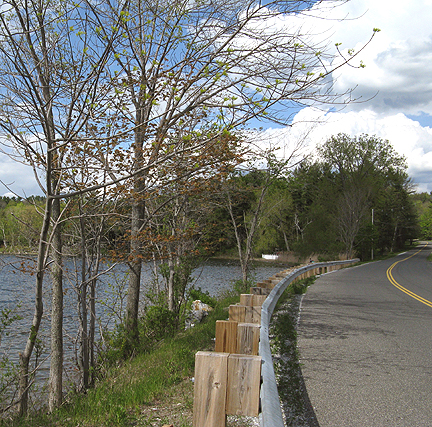


While pilgrimage is a physical stretch forward, and retreat a contemplative pause, struggles can follow the traveller. Along with the forward advance are invasions from the past, especially the recent past. To better appreciate and savour beautiful surroundings, it becomes necessary to shard off the accumulated detritus of anxiety, worries, workplace hardships, and lingering negative thoughts. That takes time. A good change of scenery helps to balance perspective. I used much of my four-hour drive, diagonally across the heart of New England, to lecture to myself about my recent ordeals. There’s nothing like a solo road trip to give yourself your undivided attention and set things straight! As the scenery rolls along, traffic thins out, and my own recognition gives way to acknowledging fatigue and longing for positive change. My self-talk runs its course, and words advance into prayers. The Massachusetts Turnpike finds its westernmost terminus in West Stockbridge, and I depart to mingle with curved and steep little quiet roads. My back seat is freighted with clean clothes, books, and writing materials- and I have a head filled with thoughts and hopes. Retreats are lifelines, liminal spaces between treacherous desert stretches. Gratitude comes very quickly, along leafy and lilac-scented lanes.


Wheeling into Stockbridge, and recognizing some familiar places, I checked into my little 18th century room. There was a welcome note on the writing table, with some baked treats. The blended aromas of linens, the ancient interior, and lilacs at my window reminded me to make note of the present. Monument Square suddenly felt at least 240 miles behind me. There was no more travelling or arriving to be done. And I proceeded to do the “what tells me I’m here” things. That’s my way of beginning to absorb a place long-awaited. I took my camera, and walked a few steep hills near the shrine church; I walked some bucolic pathways, looked skyward, and drew in deep breaths of sweet mountain air. I wanted some new imagery to fall asleep by. Writing and reading followed, after which I sunk into an antique bed. The arrival to a retreat is simply for absorbing the surroundings. It is a place for inquiry and intention, not for problem-solving. In a short evening’s arrival, I already saw I’d chosen the right place.


Saturday, March 26, 2016

writing pilgrim


“Give me my scallop shell of quiet,
My staff of faith to walk upon,
My scrip of joy, immortal diet,
My bottle of salvation,
My gown of glory, hope’s true gage,
And thus I’ll take my pilgrimage...

...Then am I ready, like a palmer fit,
To tread those blest paths which before I writ.”


~ Sir Walter Raleigh, The Passionate Man’s Pilgrimage.


Optimism is an increasingly grave matter. By this, I refer to upholding an earnestly positive perspective. More than that, to do so, full on, through all circumstances- even in these times. With each day, there are more than enough current events stories to erode heart and hope. I try to limit my exposure to news media, and long ago gave away my television. With scarce time to write, I’d rather not be immersed in continuous streams of advertising and superfluous, avoidable noise. Not enough time for reading and writing; too many excuses that lead to fear and a sense of insufficiency. Claiming some safe space, at least enough for a good night’s sleep, takes as much vigilance as the simple- yet vital- will to be creative.


There are many plausible reasons to just give up the effort. During a recent lunch hour’s journal scribbling, my recorded thoughts included the phrase, “why persevere?” Later, that evening, the philosophical discussion forum which I moderate elected to use the question as the shared topic. I listened to a variety of definitions to illustrate the meaning of perseverance. In the usual Socratic fashion, the discussion moved from the human will to live, to continuity, to whether altruism exists. Philosophy tends to beget more philosophy. Hearing so many insights spiral out of the idea of persevering was much more interesting than expressing my own doubts.


Going to work every day, with an insistent drive to see better days, has been my unworded answer to the question. Of course, persevere. If I don’t, I’ll be out of a place to live (if gentrification doesn’t strike first), or employment (if budget cuts don’t strike first). There’s no standing still. That’s a persistence related to survival, and at second thought seems rather shallow. Shouldn’t there be grander goals than water-treading persistence? The great work cannot merely be an ascent to the surface; baselines are not suitable destinations. An enduring image is brought to mind from my adolescence, when my father would take me on long walks. I loved doing this, just tagging along and absorbing his observations. Sometimes we’d stop for a breather at park benches, during which he would tap the bowl of his pipe, to shake out the old tobacco in order to replace it with new. When he’d do this above an ant hill, we would watch how the ants furiously dug out from under the ash. It never mattered how frequent, they would always upwardly clear away their places and paths with the same persistent urgency. I found this really fascinating, and the memory of this has visited me at many of my jobs, and when I have to exhume my car in the winter dark of early-morning.


It was no less than a seasoned monk (in a monastery) that called me a “cockeyed optimist.” Maybe he saw something that I couldn’t. Persevere? Well, of course. Why not? Making some measure of progress, however modest, is vital. When there are no through-paths in sight, looking forward is a foraging for escape hatches. Keep aspiring, stay productive, and continue reaching for a better situation, despite the dead ends in sight. Beneath this activity, within all the improvement attempts and hopes, is the pilgrimage spirit. Reach forth without the solidity of reward.


Excessive thought can become an obstacle to action, especially when it comes to weighing justification for not trying. Blind faith is, admittedly, quite unreasonable. As a pilgrim soul ever explores and navigates, it seems to me that hope often defies reason. And amidst reasonable hopelessness is some kind of unreasonable aspiration. You may not understand this. It doesn’t really make sense, when considering what little is immediately visible. And that’s just it: we have to size up and interpret what we can see, against what we cannot. Consider the contrast between an after-midnight sleepless gaze upon motionless and darkened streets, compared to the same window view to a sunstreamed landscape hours later. To my ears, it seems rather absurd when an athlete on a last-place team says something like, “we’re making great improvements, and with a few adjustments we’ll succeed.” But absurdity, in this case, is in the ears of the beholder. By contrast, how does the athlete perceive their own situation, and the way upward?


There is much to overlook, in order to see straight to the horizon. I have to visualize past numerous daily reminders that are capable of convincing me to simply give up. It is a struggle in itself to protect clear and well-intending vision from exhaustion, resignation, and anger that can easily harden into cynicism. There is a life-threatening, cavernous drop from such a steep precipice. Still more perseverance is needed, as if there’s an endless supply. But how much and how far is unknown, and that is an uneasy dimension of pilgrimage. On this hard journey, perhaps I’ve accomplished much, but admittedly I haven’t done a tenth of what I’m well prepared to do. Time does not stand still, and neither does my patience. Should I see the present as the start of what is yet to fulfill, or as the point from which to measure my time remaining to try correcting my failings? There must be good enough reason to soldier on, better than meeting creditors’ deadlines, making the digging out of the ant hill worthwhile. Without a tidy conclusion to these dilemmas, work commitments demanded that I close book and pen. Retaking the crosstown pavement, I chose to walk along Pleasant Street, and to think about that.


Several evenings ago, while waiting on a long line at a supermarket, the customer in front of me noticed my lapel pin. “Love that typewriter pin.” The next comment was memorable: “Are you a writer by trade, or is it your passion?” Much is implied in a question like that. Sometimes avocation and vocation do coincide. Because I don’t punch a clock as a paid, professional author, I balked in my response. “Oh, it’s a passion, all right,” I replied, righting myself. Within these little interactions is another illustration of the life of a pilgrim of trust. Pilgrimage, by definition, is a one-way voyage through unknown passes, en route to an eternal destination. The way is indefinite and unpredictable. Incorporated into the grand voyage are months, days, and hours of stages in the journey. For the writer, the increments are paragraphs, sentences, and jots. Indeed, there is always something to write about. Our “scrip and staff” relate to the instruments of our craft. With fellow journeying writers, we compare our notes. There are trails, paths, and desert stretches of road; there are tasks and trials. With our companions, we regale one another, continuing the ancient ways of storytelling as we see in Chaucer’s Canterbury Tales. A writing pilgrim often must create their own maps, and surely the scrolls are of our creation. Among prized instruments that permit us to make our marks, are our collected words. With our words and inspirations come our functional metaphors. In this context, a great example is the word compass.


Places of respite and pauses are sparing, brief, and never quite satiating. Perhaps I must take that to mean I cannot rest long on the sidelines. There is no shrinking back from the continuum. Within this is the most difficult terrain for the pilgrim soul. Proceeding without good reason. Invest the entirety of one’s life and energy in the midst of waste land. Do it anyway, and wholeheartedly. The immediate is tangible, the hereafter is accepted on faith, but the intervening span is the greatest unknown. Uncertainty must be armed with readiness, aimlessness with direction. In motioning forward is the brashest boldness.


Tuesday, February 23, 2016

change of pace


“If you don’t like how you’re feeling,
change what you’re doing.”


~ Fr. John Tokaz, Capuchin Franciscan friar, from Boston.

Over the years, I’ve absorbed friendly jabs for making round-trip journeys using two different routes. As an example, the outbound trip using highways is complemented by an inbound return trip using country roads. I do these worthwhile things without much thought. Another recurrent set of curiosities has to do with all those solitary retreats and pilgrimages I’ve made through the years. I use hard-earned vacation time for these travels, which continue to be very worthwhile to me.


But it is good to change the pace. This culture incorporates more than enough unquestioned repetition, especially the endurance-contest life of multiple and full-time work situations. The better employment settings allow for some healthful variety. When it does not, the sanity factor depends upon what can be done during time-slivers between shifts. Early mornings, earned-time breaks, and late-nights offer some opportunities for diversions. These have taken shape among the simple forms of writing, reading, observing by camera, and thoughtful reflection. Routines repeated over a protracted period of time cause things in general to lose their tastes and stagnate. Stagnation is the enemy of creativity. The long-haul challenge is to blend changes of perspective into the desert stretches that dangerously devour precious time. It can’t all be about punching the clock with time cards. And though it may seem counterproductive, when it comes to fitting activities in between blocks of obligations, my preference is to slow the pace that I’ve interrupted. Reflective quiet is a replenishing change of pace. Silence and savour actually help me re-enter the frenetic fray. Though the passage of time cannot be slowed, our tempi can be changed.


While I was working my way through art college, one of my jobs was a graveyard shift from 8pm to 8am in a newspaper printing pressroom. The best part about that job, aside from all the free blank newsprint paper I’d use in my drawing classes, were my benchmates. I worked with a father and son, both named Tony. Tony senior, a military veteran and single parent, was a walking trove of wise aphorisms. With Tony junior, the three of us had a lot of laughs, even amidst the roughcut brutishness of the factory-like workplace. We kept each other sane. I’ve committed some of Tony senior’s wisdom to memory, such as his advice to walk to and from work different ways. He would tell me to change sides of the street, just to shake up the daily routine. The spice of life is found in variety. My grandmother used to tell me to vary my diet, lest- as she said- my “intestines would get bored.” Those little reminding shreds are road signs that I continue to see in my mind’s eye. A memorable colleague used to tell me that, “hardship is inevitable, but misery is optional.” This is to say there are some margins for choice, even under limitations.


Baseball uses the term “change-of-pace,” to describe a kind of throw designed to confuse an opposing batter’s expectation. As a pitcher, you would throw a change-up, making a slower pitch seem like it’s advancing faster and straighter to the batter. But, by surprise, the ball’s velocity slows and its path curves, thus amounting to a changed pace. Diversion has the element of surprise; even the force behind the decision to divert will experience the unexpected. A collegial friend, with whom I keep in touch, likes to refer to his innovations as “troublemaking.” Essentially, he’s a creative thinker among bureaucrats, and he says that stirring the waters keeps him motivated. “I get up in the morning,” he once told me, “and think of what kind of trouble I can cause. Otherwise, it’s not worth it.” This fellow is something of a bureaucrat himself, and when he says “trouble,” he really means something more like changing the paces and perspectives of entrenched ideas.


We know how the elements in our midst can cause us to change our pace. An obvious example is the weather. Simple errands on frigid winter days require armor made of improvised clothing layers and heavy footwear. Vehicles must be exhumed, chiseled, and warmed for use. As spring sets in, the novelty returns which allows us to skip outdoors in shirtsleeves, start the car, and just go. More subtly, our social environments and influences weave into our paces. How about the other way around? Can our interior evolvement effect exterior change? Can an individual’s response to an unsatisfactory status quo hasten tangible, positive change?


Contemplative and active dimensions intertwine, in the expansion and acceleration of our paces. The liminal season between winter and spring provides some reminders. Appropriately, A.W. Tozer offered a description of the human challenge in keeping spiritually alive and what he called “personal renaissance.” In Winter Experiences, he wrote of the flagging soul as “going under for a winter.”

“In other words, something happens to you, little by little, until you get snowed under and frozen over. There is life down there, covered up by the frost and ice. It may be hidden; it is there somewhere.”

How can interior affect exterior, bringing the forces up through our frozen ground? Still further, what happens when new growth joins with old routines, after changes of pace? After all, neither dimension exists in isolation from the other. Far beneath the metaphorical frost-line is Ruysbroeck’s Vale of the Soul. The 14th-century contemplative exhorted his readers not to think too highly of themselves, but rather to see themselves as reflecting vessels. Ruysbroeck’s vale, stark and austere, is lit by the sun at its apex, as well as light cast from surrounding mountains. Implicit here is the necessity of the snowcapped heights as means by which we navigate the recesses. In this recognition, a person recognizes their own humility, “marking their own lowliness,” and “making of themselves a valley of humility.” Proceeding forward,

“This valley, the humble heart, receives three things: it becomes more radiant and enlightened by grace, it becomes more ardent in charity, and it becomes more fruitful in perfect virtues and in good works.”

Knowing to change the pace is a more complex discipline than mere vigilance. This is more about cultivating ways to intuit the need to vary one’s vantage point. Shutting out external noise is one matter, but it’s quite another, and more transcendent still, to keep from generating one’s own interior noise. Being right where you are, is already a way to change things up. Regarding the as yet unknown, the view might be more interesting from a country road, or the other side of the street.


See also: Valley Street.


Saturday, January 30, 2016

awakened forces


“Did they tell You stories
‘bout the saints of old?
Stories about their faith?
They say stories like that make a boy grow bold;
Stories like that make a man walk straight.”


~ Rich Mullins, “Boy Like Me / Man Like You.”


winter’s progress


Latter January days are plotted among the depths of winter’s navigational chart. Today’s distance is far enough away to have lost sight of departure’s shore, yet too far still to detect land on the horizon. Along any lengthy voyage, there arrives a point at which the launch becomes too far away for me to reach back. An about-face would be as perilous as the way forward. And simply by virtue of the distance already covered, there follows the additional virtue of perseverance. Mind says to body, “look how far we’ve gone; we can only continue moving forward.” Mind seems to take for granted that it is of no consideration to stand still. There isn’t enough time to be dropping anchor out at sea. But the driving forces to proceed must be close at hand, and such sources must not drop out of sight.

assurance


Of late, my thoughts have been turning to the idea of how we can sense our own forces. We may not always be aware of the strength we have available to us in our personal reserves, but on some occasions we can sense it. We may even articulate our sources of strength. Admittedly, recollections of “fight-or-flight” crisis reactions can provide instances of reaching for our survival forces. In this instance, I refer to something more subtle and yet also more constant. I have known quiet instances of having been surprised by the realization of assuring strength, even when it was not necessary to call forth any special effort.

The memory of a fleeting impression remains with me, during which I had been simply walking across a busy thoroughfare. It was an early afternoon, and I had completed my day’s work. I might have been en route to a café, striding across Monument Square. I was momentarily and entirely at leisure, with neither backpack nor satchel appended to me. Very simply, hands in pockets, I paced across the bricks and looked upward. Sculpted façade-tops opened to seaside skies. Traversing the oldshoe familiar terracotta plaza, I was instantly astonished by an overspreading sense of completion. The old buildings and cobbled streets appeared as softly near as the flannel of my side pockets. I did not stop walking, and did not even slow my steps. But I comprehended that very moment which remains with me, years later.


sensing forces


What brings us to sense our forces? I frequently refer to teaching as a labor of love. Lesson planning and prep often feel like rehearsals toward interactive performances. I’ve been doing this for more than two decades, and the cathartic satisfaction always remains. Amidst helping others make artistic and intellectual discoveries, I momentarily forget my troubles. The ability to connect what we know and love- with professional challenges, or with the needs of others- finds us “in our elements.” A sense of strength can certainly manifest at repose, too. A strong sense of strength can settle in, during times of contemplative silence- even without a specific thought, or at times which might appear to be “inactive.”


The spirit transcends action and place. Reminders of strength can arrive as discreetly as a subtle thought, or solidly as a physical locale: a plain remembrance of my ancestral roots can be as forceful as the view from an ocean crag. I still remember elders telling me to “remember who you are.” Notice how athletes say “playing with confidence” is a decisive factor to their consistency. Still further is an ancient phrase from holy writ, intent to assure humble-hearted listeners they will overcome evil with good, as greater is the Divine that is within you, than that which is in this world.


big shoulders


The holiday season provided an opportunity to return to Chicago. While driving, strolling the Mag Mile, and peering from CTA trains, I thought about the sensing of strength. When do we “feel our forces,” whether they are stored up within us, or reflected through our prism-like selves? Can we call upon needed strength, when exhaustion and discouragement bring us to disorienting ends of our reserves? In Chicago, I saw family and familiar sights, yet was also reminded of the breadth of this world. Driving more than 2200 miles, and appreciating some unexpected kindnesses, I made note of the present as I looked forward.


While in Chicago, I went to an Irish tavern to hear a talented local ceilidh group play traditional Celtic music. Having played in many ensembles myself, I know how music shared among a group can generate cleansing joy. This particular group was really radiating cheer, and true to Chicago form they worked in a few jazz tunes. Toward the end of their energetic set, the whole group sang two hymns, beginning with I’ll Fly Away, and ending with How Can I Keep From Singing. I’d never heard folksinging voices interpret these before, and was struck by the spirited intimacy of the latter’s lyrics:

"No storm can shake my inmost calm,
while to that rock I'm clinging.
Since love is lord of heaven and earth
how can I keep from singing?

My life goes on in endless song
above earth's lamentations,
I hear the real, though far-off hymn
How can I keep from singing?"


An awareness of strength involves recollection. While listening to the music, I reached for my notebook and jotted, “remembrance and rejuvenation do not always coincide; spiritual and physical- both are ideally necessary.” Indeed, the ability and application of reaching for sources and reserves of strength is a self-discipline.

perspective


Calling forth needed strength occurs to me as a cultivated practice. Now my thoughts turn to occasions of taking charge of situations, and instances of defending undefended individuals. Then I think of less-sentient situations during which I’ve had to create carefully arranged and indexed archives from heaps of barely discernable chaos. And still further, I recall how I’ve been maintaining small measures of constructive calm as a caregiver, by studying philosophy in hospital waiting and recovery rooms. When I could not write, I could find wise words to read and safely inhabit.

With all these things in mind, I considered the subtly strengthening potential of ideas and words. Visiting with a fellow writer provided some insights I might have otherwise overlooked. My friend talked about exercising perspective, and keeping focus upon what is positive. We talked about writing through all sorts of seasons- the rough and the smooth. She described the positive energies immediately at hand, reminding me of the Greek word paraclete, which means the comforter at one’s side. With written words of truths and ideas passed along through the ages, there are assuring words spoken to present-day uncertainties.


I’ve brought this topic to a few more trusted friends. Through what kinds of situations do we feel our forces? Can we call upon our sources of strength, when it is most needed? I asked another esteemed friend, a fellow that leads a raucous rock band that is constant in performing and recording. He correspondingly perseveres with composing and practicing- to the extent that he told me that as he performs to large crowds, he feels that he’s “not really there.” I interpret that to mean he is not excessively self-focused, but rather moving with the immediacy of the pressured moment. He also says that right before a show, he suppresses his analytical thoughts. Being in one’s element is more about confidence and self-possession that about self-consciousness. When it comes to reaching for inner strength, he described going for solitary walks. The topic prompted us to talk about the importance of place. True to our shared Maine colors, he said his most recharging walks are along seashores.

Physical place is more than merely a point of reference; it can also be inherently a source of strength. Ocean perches and beaches, along with mountain trails, are places by which I find my forces. But to say inherent is as subjective as the interpreting individual. Yet it is easy to consider a physical setting as having intrinsic value. Such perspective attests to the solidity of human thought. Landscapes change, as do their connotations for each of us. Yet for our spirits, the most fluid, most elusive and ethereal references are those which produce our profoundest ground.


Friday, January 1, 2016

equipped for the new


"My pipe is out, my glass is dry;
My fire is almost ashes too;
But once again, before you go,
And I prepare to meet the New:
Old Year! a parting word that’s true,
For we’ve been comrades, you and I --
I thank God for each day of you;
There! bless you now! Old Year, good-bye!"


~ Robert W. Service, "The Passing of the Year."


An arduous year has concluded, making way for a new one. Although I speak in relation to the Western calendar, with weeks and months appearing as the dotted lines of municipal peripheries, there remains a sense of new frontiers. We may each mark the anniversaries of our personal milestones, ascribing meanings of our own. But with the prospect of a new year, I noticed time thresholds while routinely re-inking my pen. In this context, some of my everyday routines absorbed the marking of time passing.

In recent years, I have been profoundly engaged in a large project resulting from my rescuing of seventy years of newspaper photographic negatives, which I’ve been organizing and conserving into an exhaustive documentary archive. The trove of many hundreds of thousands of pieces of film had been destined for disposal- but that has surely been prevented. In the almost-daily pursuit of identification and indexing, I’ve been examining- and in a metaphorical sense, inhabiting- each of these images, one at a time, marking their eras, and travelling through the decades from the 1930s to the mid-2000s. As New Year’s Eve approached the present threshold of 2016, I catalogued June of 1954. Amidst descriptive work to index Memorial Day of 1954, the back of my thoughts began to perceive the close of 2015. Yesterday, while identifying the photo (below), of a Mr. Sampson opening his new grocery store in 1954, I mused at my light-table, and noticed the radiating pride of a family businessman. He was surely looking confidently toward the future.


With my 4x magnifier, I looked closer, and remarked at a gesture of eager preparedness: Mr. Sampson had no less than eight sharpened pencils in his tweed suit pocket, pointed up and at the ready. Hope sprung eternal in Mr. Sampson’s spring of 1954, and I am burrowing through the winter of 2015-2016 determined to be undaunted. It’s a new year. Sharpen the pencils, ink the pen, oil the typewriter carriage, take some deep fresh-air breaths, and persevere. Out with old; be equipped for the new.


Along with the grocery store photo, and numerous sundry group pictures from the society pages, I identified a Mr. Jacobsen (below) at his desk. It seemed insufficient to leave it at that; I enriched the finding aid (the archival term for a collections inventory) with an additional line about the table radio behind him, as well as the pencil. This is more than a portrait for a news item: he is assiduously at work. There are tasks to be completed, and he is ready!


Today, more than 61 years after the above photos were taken (and they haven’t seen the light of day since), I am gathering my forces to venture into 2016. Indeed, as I write this, I hope to encourage you in your future constructive pursuits. Remaining encouraged is essential.


Here’s to a New Year of growth and life-giving ventures.
Thank you to each of you, for reading and your encouragement!


~~~~~~~~~~~~~~~~~~~~

See also : Graphite Archive;

and Typosphere Cheer.