Tuesday, April 2, 2013

typosphere cheer


1969.

"The human mind, itself invisible,
becomes visible or manifest in words,
and writing, and gestures."


~ Frederick Copleston, A History of Philosophy, v.2.


The lengthened light of spring establishes itself once again. Fresh seasons turn the wheels of writers, return carriages recharged, prime platens, and calibrate keys anew, as we seek greater escapements into rejuvenating journeys. Economics, politics, and popular culture are no better than they were last month, yet somehow hope springs eternal. Defeat is mysteriously negated beneath fresh green baseball lawns. Flagging energies rekindle in such ocean winds as those which flog the Maine coast today. Renewed expectations become less our testaments of struggle, and rather causes for our optimism. And for the cause of encouragement, here are some images which have not seen light of day in a very long time- some not ever- to inspire you to shine up your writing instruments and train your springs through your own spring training. Archival documentation reminds us of souls who’ve gone before us.

Recently, I completed a thorough archival survey of approximately seventy years of newspaper photographic negatives. Woven around and through my daily work duties, and using every bank holiday, it took slightly over three years for me to review an estimated 1.2 million negatives. It was a rescue effort, as the huge collection was nearly discarded in a building-emptying corporate downsize. The project for me has been an adventure filled with wonder and fascination. Amidst dust, rust, and acrid acetic acid odors, I’ve witnessed my home region’s twentieth century in silver cellulose. Crates and rotted cabinets filled with disorganized film is now under control and being indexed for conservation and future studies. Out of chaos comes order. This experience of perseverance and accomplishment will always accompany my thoughts, and I’ve gratefully combined my photographic roots with my archivist’s sense. Readers of these pages may remember graphite archive, which incorporated pencil-writing images I discovered as I made my way through the collection. The decades illustrated in these negatives also comprised numerous images of typewriters, and indeed I indexed these, too. The same eyes that could recognize a pencil in a subject’s hands in the reverse image of a photo negative could also identify the presence of a typewriter. Still photographs potentially offer immense amounts of information about their respective context.

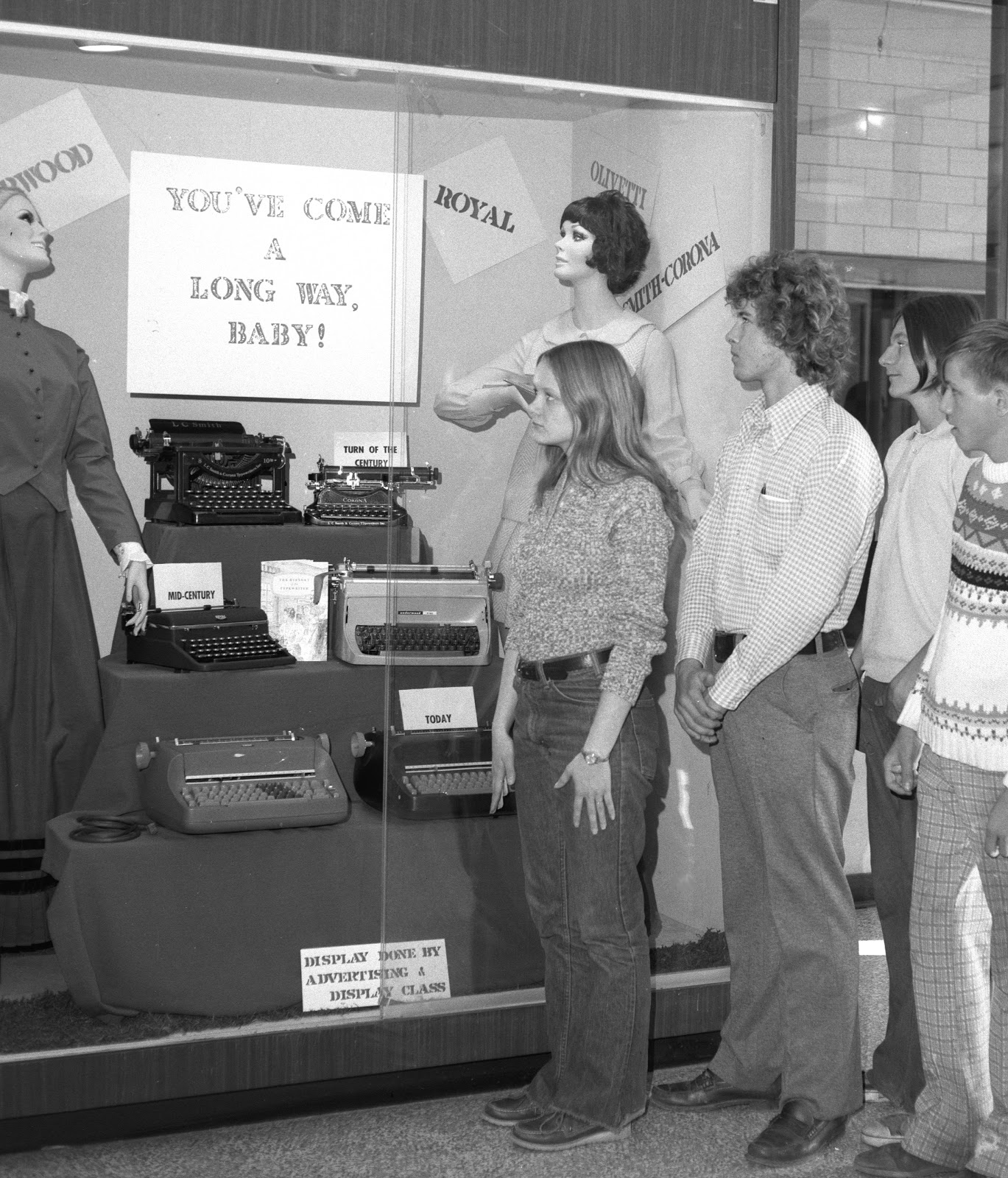
As many of us already know, typewriters are extraordinary motifs for photography. The machines themselves are far from being impersonal mechanical contraptions. Typewriter owners have always tended to make the machines their own, thus extending personal touches through instruments sensitive to the human touch. Even typestyles and sizes vary among the varieties of machines and their epochs. When you observe this selection of photographs, notice how people and their typewriters are pictured together. Authors and their machines appear parallel to concert pianists and their particular expressive instruments. Every student and professional needed a typewriter; these tools were especially required in order to compose correspondence, submit polished reports, scripts, and to finalize projects. Notice the vitality of typewriters in offices, personal studies, schools, and on chemists’ countertops. Typewriters continue to be instruments for creative writers. From the machines themselves, notice the sampling of environments- in this case, it is northern New England from the late 1930s through the early 1980s. Look at the typewriters’ habitats, along with those of the writers themselves (this essay can also be viewed as a slide show).

Having so many indexed images to present, I chose to categorize them in this essay by the uses of typewriters by students, professionals, creative writers and authors, and in places of procurement. The latter category refers to the need for supply sources for typists’ commodities and places for repair. Consider the parallels with automobile showrooms and garages, and contemporary bicycle shops. Here’s to the Typosphere, those who straddle the ether of the internet with the solidity of their cherished Olympias, Underwoods, Olivettis, Smith-Coronas, Royals, Adlers, and on and on, persevering with the passion (and shoulders) required to produce bold marks on a manual platen. Cheers to the ‘spheres!


at school

1937.


1955.


1960.


1975.


Above: Students at Southern Maine Vocational Technical Institute (SMCC, today), in 1974.


Westbrook College students, 1968.


at work

1942.


1982.


1947.


1948.


1944.


Detective studying a fingerprint, 1958.


1959.


1959.


1962.


1968.


1976.


Retirement party, complete with new typewriter and a tasty lobster wrapped in a ribbon, 1962. Only in Maine!


creativity

1979.


1948.


1940.


1981.


Top: 1947; Bottom: 1944.


1957.


1949.


Historian A.A. Hoehling, 1959.


1973.


1974.


sources

Underwood and Smith-Corona stores were on Federal Street, in downtown Portland. Top: 1940; Bottom: 1942.


At Royal Typewriter store, on Exchange Street, Portland, 1948.


1965.


1965.


Roberts Office Supply, was on Middle Street, Portland, 1973.


Wigon Office Supply, in 1966. Still in business, and still on Free Street, Portland. Wigon's still sells typewriter ribbons.
_____________________________________________________

1976.


Thursday, March 21, 2013

the society of books


“These momentary chances we covet, and spend our years
and passions and powers in pursuit of little more than these;
while meantime there is a society continually open to us...
lingering patiently, not to grant audience but to gain it,
in those plainly furnished and narrow anterooms,
our bookcase shelves!”


~ John Ruskin, The Society of Books, from Of King’s Treasuries.


refuge in motion

Along the pilgrimage, this lifelong voyage turning with earth’s curvature, I’m occasionally able to find intermittent respite. Retreats I’ve discovered along the way have become my hospitable way-stations. But halting the paces of obligations and survival demands is both rare and earned through extraordinary strain. And although my returns to the fray are often hard landings between contrasting situations, the retreats continue to be enormously worthwhile. Years of intermissions cultivate enduring touchstones to inspire daily enterprises and illuminate roads ahead. Experiences provide reminders, yet I’ve still to refine a skill of translating healthful ambience from retreats to workaday life. At the same time, I recognize some inherent dissonance between spiritual priorities and market-driven motivation. The individual soul must invariably choose which master to serve.


This time, the spans without respite draw my interest. Arid stretches of unknown duration, paralleled by constant and vigilant striving, are surely times during which a consistent awareness of sanctity is vital. Finding refuge while in motion, without being able to sufficiently stop, is the challenge. During a recent lunch break, I looked to the skies and thought about long haul aircraft that refuel while airborne. Then I remembered my training in art education, being taught to provide “in-process reinforcement.” With every subject I’ve taught, to this day, the value of checking by conversational reinforcing that a new concept is understood has more than proven its worth. Recalling these ideas caused me to consider refining a presence of mind that can better reinforce in process, that can maintain fuel levels, even when respite time cannot be procured. Thoughts of refuge returned to me the other day, while ensconced aboard a Boston subway train; recharging while in motion. I had been listening to inspiring music, during my transit to visit libraries and friends. Transit provides productive moments for written reflection.


liminal


Ordinarily, the concept of liminal space is associated with brief, transitional times; short spans between stages. Threshold lengths amidst broader adventures along a soul’s pilgrimage of trust constitute the liminal connectors. It is expected that- once noticed- a space between pursuits or phases of life will be short-lived. And what if they aren’t? How long before liminal becomes an indefinite way of being? How permanent is temporary, and how temporary is what we assume to be permanent? Perhaps the present is a protracted exercise in my learned perception of time. While feverishly wondering how I can hasten my fortunes, I also question the very sense of the course of my pursuits. How far along the way is too far to make another career change? Closed doors and expired opportunities abound. But surely, there must be open lanes. My thoughts circle back to whether I’ve been missing something that I should’ve long known. Perhaps a lack of common sense, or perhaps a lack of jadedness, all of which remains to be seen.


Indeed, part of attempting to comprehend the liminal present is imagining how I will look back upon these times. Through such trials, no matter their duration, there remains an incorruptible assurance, even though it neither pays my bills nor releases me from indignities. Well aware of his life-sentence, albeit as an innocent prisoner of conscience, the ancient Boethius composed his immortal Consolations of Philosophy. In spite of his conditions, he insisted that God is the objective, transcending, enduring good, who does not give up on us, no matter the extremities our emotions can twist us into accepting. My readings in the old, familiar Consolations tend to begin in Book 4, in which Boethius has become well acquainted with the majestic Lady Philosophy, and their dialogue proceeds to address the importance of trusting faith. In this, he observes how even our unhappiness can be of use to humankind and to our understanding of divine grace. Revisiting these readings spoke to my musings of what is reliable in the fluid and abiding present: enduring words and the Spirit upholding them.


books and words


One night last week, following yet another exhausting day, I chose to read instead of write. Too much space in my journals had been given to enumerating frustrations. From my small desk, I turned to the shelves of old friends conveniently adjacent to my perch. Purposefully, my choices favored life-giving and thought-provoking words. Pascal, Aquinas, Merton, the Bible, Brother Roger of Taizé, and two small books called Great Companions. The latter title was drawn from Walt Whitman’s poetic beckoning to seek out the great companions and belong to them. The books’ contents comprise numerous “readings on the meaning and conduct of life from ancient and modern sources.” Published by the Beacon Press, on Boston’s Mount Vernon Street, Volume I was first printed in 1927, and Volume II in 1941. The books in themselves are great companions to me, both as destinations and as launches into further studies of the selections’ sources.


The Beacon Press, Boston.


Quite naturally, yet still a soothing surprise, I reached for the kindredship and consolation of words. When writing runs dry, or is cast adrift, it is a reminder to read more consistently. Replenishment is as productive as the coverage of distances. My gratitude for reading brought to mind that as the individual is an earthen vessel carrying the gift of God, so the books at my reach are rafts of composed words. The great companions in cherished readings are at once consolations and distractions. With that in mind, I decided to awake before dawn on my day off, and go to Boston. One of my favorite things to do at the Athenaeum library is to set a chair in the aisle of “Cutter 3's and 4's,” and seek out gems at random. Never a disappointment; always new pearls. Having opened windows from my closed thoughts, I can inhabit the ministrations imprinted carefully upon the pages before me.


From Cassiodorus, to Plato’s trinity of Spirit, Reason, and Memory, I proceeded to the classic sermons of Phillips Brooks. An illustrious Boston cleric of the 19th century, Brooks wrote of the human craving for Continuity, Variety, Influence, and Reality. All my readings combined to remind me of heavenward aspirations. These ideas and statements represent messengers of grandeur, expanding perception, and transcending the temporal. Leaving my perch in the Athenaeum library aisle, I walked across downtown to Copley Square, remembering the Phillips Brooks statue near Trinity Church. The broad piazza is flanked by the large church and the flagship Boston Public Library. Visiting the church also permits for a stop into the Great Reading Room which was filled with pensive souls. The readers, and reading in itself, reminded me of the innumerable great companions ever in my midst. A sense of wonder is indeed a sign that indicates one’s progress along life’s pilgrimage. In agreement, Phillips Brooks, in his On Promoting Spiritual Life (1893) adds:
“Wherever there is a wonder, we are sure that if we listen with our hearts we shall hear, out of the depth of that mystery, some richer teaching, some large revelation of God’s truths.”


"My service, my true will-dedication
ought to bring me out into the light; at least I will remember that.
I will not be content with darkness.
I will not let despair of positive belief settle down on me with its chilling power."

~ Phillips Brooks, "The Withheld Completions of Life"


Trinity Church, Boston.

Monday, February 18, 2013

school of silence


“There is another school
where the soul must go
to learn its best eternal lessons.
It is the school of silence.
‘Be still and know,’
said the psalmist,
and there is profound philosophy there,
of universal application.”


~ A.W. Tozer, The Set of the Sail.


The simplest sojourns lend themselves to becoming intricate adventures, when moving with the moment. Amidst gift occasions of unstructured time, deepest learning can take root. My responses to the sudden possession of earned and rare leisure reverts me to reverent wonders of times past. Especially at school, though it has easily transferred to employment life. It is a childlike joy, even to old souls, to freely look up to unimpaired skies and mid-day colors outside the usual walls and fences. Undemanding unstructure is so unusual to many of us that the very context generates an inherent exhilaration.


Open air and open-ended days are rare treasures for those who toil in the trenches from which remuneration must be drawn. The light and air of a late morning is for the exultation of the unconfined, and perhaps lives of constant work are best able to find and savor contrasts. Gazing up from labyrinthine constriction, horizons cannot intimidate. Promise, potential, and newness of life manifest mysteriously in the form of a clear slate. I’m reminded of this each and every time I’ve made an arrival at a place of retreat. Reaching a desired destination generates an incidental excitement, along with gratitude for the careful purpose of repose. During last week, I experienced a retreat that was warmly familiar yet ever new, an immersion into substantial silence at the center of a large city. Through seasonal frozen New England air, I arranged an intermission from my work and travelled to a week’s sojourn in Boston. My destinations and the winter ambience provided wise silences from which I found learning and consolation.


Beacon Hill Friends House
Above: Beginning of snowstorm;
Below: During snowstorm.


The waystations of my week of retreat, cozy as home, included my esteemed Boston Athenaeum for days of reading in their rare books room, lodging amidst the lively community life of the Beacon Hill Friends House- with its sacred spaces, mornings with the Divine Hours at the Church of the Advent, and all points in between on Beacon Hill. An unanticipated element came late in the week, with the arrival of a 28" snow blizzard. The elements did fit serendipitously well together, amounting to a composite of comparable settings of nourishing and needed quiet. Travelling by train during post-commuter hours, on the journey from Maine combined late-morning hush with astonishing sunlight- surely outside the realm of countless workdays.


Alighting at North Station, my first stop was to settle in at the Friends House and deliver desserts I baked in gratitude for the always welcoming “Housies.” From there, I walked to the Athenaeum to deliver more desserts for the library staff. If I have any influence in this vast world, one thing I can surely do is to express my thankfulness. Having planned the travel well in advance, a shelf of ancient tomes awaited my arrival in the Special Collections reading room. With each of these reading retreats, anticipatory reviews of the Athenaeum’s catalogue allow me to create themes with diverse reading materials. During one retreat I read journals written by Quaker adventurers of the 1600s, and on another week’s sojourn I sought the fascinating literary colors of Richard Baxter. This time, I sought personal inspiration, choosing 16th and 17th century reading that emphasized perseverance, faith, and conscience.


Boston Athenaeum, during snowstorm.


Within the Athenaeum library, a sanctuary in itself, the rare books room is an inner sanctum available only during weekdays. In between acclimating to reading Elizabethan English on four hundred year old paper, I reminded myself to look around the high-ceilinged room. Beneath large oil paintings and skyward windows, a polished wooden table supported study lamps and cradled the folios open before me. Facing up to me from the great many pages I read were insights and exhortations from across the ages. John Preston’s words from the early 1600s reached my 21st century eyes, and I pencilled them verbatim into my notes:


“We have but a short time to live in this world, the strength of our mind is the most precious thing we have, the thoughts and affections that we have, the business, the activeness of our minds; we should be careful to improve them, we should be careful that none of this water run beside the mill. That is, that it be not bestowed upon things that are unworthy of it.”


Above: My reading notes from the rare books room.
Below: Writing in the Friends House library, lit by snow.


Only pencil and loose paper leaves are permitted in the rare books room. I even had to leave my binder outside the room, though now it has 22 new pages of notes and quotations from a week’s worth of reading 5 different books by as many different authors. My daytime hours were arranged around these studies, and as news of the impending blizzard solidified, I changed my reading sequence, and the Athenaeum reference staff very kindly adjusted their coverage of the rare books room to for me to maximize my time. By the time I could see snow billowing outside the large reading room windows, causing the library to cancel operations for the day- and the following days- I had completed my reading. The weather really did not disappoint any plans, but actually provided contemplative time after my intense studies. There was just enough time to visit a dear old friend, whose chaplaincy at Northeastern University includes The Sacred Space which provides healthful solitude and refuge for his community. The balance of my week’s time, under heavy snow, was open to visiting, writing, and walking.


Church of the Advent, at left.

Two days of unrelenting snowfall silenced the large city, as well as the entirety of New England. I had the unusual benefit of being at the center of an arm’s-reach downtown neighborhood which did not experience outages, and at leisure. My daily attendance at the Church of the Advent’s morning vigil continued, thanks to the rector lending me his snow galoshes. The Friends House community itself was in a pleasant snowbound mode, making the best of things with potluck meals and rotating shoveling duties. Their large kitchen is very much a livingroom. Continuing as a pilgrim retreatant, I was able to enjoy the House’s own library, take photographing walks through snowfilled streets, and write during mid-day hours. Reviewing my Athenaeum notes, I noticed how often Preston would return to the Genesis 17 reference to “God is all-sufficient,” as though a sung refrain in his work, “The Saint’s Daily Exercise.” Francis Atterbury, also among my readings, emphasized “acquaint thy self with God,” over and again in “An Acquaintance with God the Best Support Under Afflictions.” My places of quiet contemplation varied, though qualitatively they were entirely consistent.


In his journal, which I studied at the Athenaeum, Daniel Stanton (an 18th century Quaker) described his travels through Colonial era New England. Indeed, I had to look up and enjoy my window views when I read his words from 250 years ago: “I was somewhat detained by a storm of snow; when it moderated, I got forward.” On a following page he wrote, “I enjoyed great comfort of mind, and near unity with Friends... it bespoke a day of visitation of God’s love, and I wish it may be ‘as bread cast upon the waters, that it may be found after many days.’” Throughout the week, and along the hushed northbound train home, the idea of deep learning through contemplative silence continued emerging in my thoughts. The savoring of silence is itself a schooling. It requires shutting away distractions and departing from noise we otherwise adaptively absorb. Yet the goodness in being immersed in goodness has lasting effects. The reminders have followed my steps and will lead my subsequent steps toward future sojourns.


At Beacon Hill Friends House.


Sunday, February 3, 2013

l’idéal


“If you can dream—and not make dreams your master;
If you can think—and not make thoughts your aim;
If you can meet with Triumph and Disaster
And treat those two impostors just the same;
If you can bear to hear the truth you’ve spoken
Twisted by knaves to make a trap for fools,
Or watch the things you gave your life to, broken,
And stoop and build ’em up with worn-out tools...”


~ Rudyard Kipling, If


(The calligraphy
and illustrations
for Kipling's poem
were done by me
when I was 15.)


open questions


Open questions are investigative queries with which we must evolve. I refer to open as differentiated from open-ended. In the field of information sciences, the opposite of a closed-ended question is an enquiry that demands more than a statistical answer. Open-ended often implies a comparison, and surely more than a simple yes or no. But a matter that is entirely open may require protracted and lived research; there may not even be an apparent answer. The element of time can alter long-abiding questions. Over spans of years, I’ve mulled various advising words of parents and directives of teachers, walking with their meanings. In less abstract ways, I’ve seen myself change travel routes after better comprehending roads, highway systems, and compass directions. From the depths of spiritual life, why questions (“why am I here?”) have led to what questions (“what am I to do?”), then on to how questions (“how shall this happen?”), and when questions (“when does the terrain level off?”). Surveying the vast waters in all directions brings to mind questions of expectations.


When comparing long-held hopes with my lengthening road of lived findings thus far, I am brought to question all my expectations. Repeatedly high aspirations are repeatedly disappointed. Perhaps it is a question of standards, and perhaps some compromises must be made. But a descent to the latter would happen with heavyhearted reluctance. Only now, I’ve begun to weigh the double-edge of idealism. With hopes set very high, combined with ardent work ethics, those plunges that spiral unrequitedly down are deep drops. Yet I seem to insist upon holding fast to ideals, sure of their practicability.


idealist

("walk with kings and not lose the common touch.")


But idealism has some mixed connotations. Dictionary definitions dryly treat idealism as the opposite of realism. Granted, an idea often does stand in opposition to sensible reality. Still more, the ideal can float far beyond the conceptual idea itself. As looming summits of cascades, and distant islands of green, profoundest aspirations dwell enshrined. These are reference points with which sense, assessment, and correction can be sounded and fathomed- albeit without the power of ever attaining to the ideal’s perfection. What if there weren’t ideals? I dare say that would confine souls to a terribly uninspired rendition of limited and tangible realism. Idealism provides context to perceived reality. The deserted expanses and aridity in everyday life cause the soul to consider the spiritual to be the centrally vital factor in reality.


While I hold to ideals that elevate fairness, honesty, egalitarianism, artistic creativity, and holiness, there are no delusions as to their consistent practice and reciprocity. Idealism does indeed come with a warning label. There will be disappointments; they very well may occur at each and every turn. There may be every good reason to renounce those ideals and let cynicism prevail. But I will do no such thing. Remembering Kipling’s immortal poem, “If,” though I’ll make allowance for doubting, I’ll continue to wait and not be tired by waiting, will not deal in lies, or give way to hating, but rather persevere even in defeat to start again at my beginnings. Too clearly in prominent thoughts are fellow idealists, such as my friends who live the monastic community life. Their commitments to their sacred ideals exceed whatever trials they have. I’ve been ceaselessly impressed at how they are able to keep all their routines and rituals fresh and new. Then I recall St. James’ guideline about embodying generosity while keeping oneself unpolluted by the world.*


Much has filled my sights to give me more conflicts to sift through. In response, my abilities to filter and discern must proportionately increase. Emerging from my thoughts in recent weeks is whether or not idealism and maturity are divergent roads. Can noble and benevolent aspirations superimpose with experience and growth? I wonder how to continue aligning these threads. Struggle mustn’t necessarily produce callousness. Neither should isolation. Too often a by-product of professional elitism is the harming of its respective profession. Titles frequently tend to dissuade their contents. Educators that claim highest formal credentials ironically lead the charge to remove manual skills from our hands. Professional license, it seems, paves ways to discard reading and practical arts without challenge. In a further show of irony, pastorates assuming leadership in spiritual communities notoriously cannot communicate or foster community spirit. Perhaps the status of “seasoned pro” requires desensitization. There are surely downsides to Babel-like structures that excessively formalize. I’m reminded of how my childhood classmates and I decided to opt out of little leagues because we wanted to enjoy playing baseball. Nothing like a childlike mind to see through artifice.


idealism personalized

("risk a heap of winnings to lose and start again.")



As we develop our intellectual lives, continue to grow, and sense the Spirit within, our ideals form in a naturally cultivated parallel. Just as goals are wished for, they are tested; and amidst the trials that accumulate with advancing forays into the world, these aspirations are endangered. During sojourns through thickest Maine forests, I’ve admired how wildflowers such as “lady’s slippers” persistently emerge brightly through dark cover. Expectations of goodness and innocence early in life are endangered flora. Setbacks, easily leading to jaw-setting embitterment, can equally be steered into cultivating heart-courage. Schoolyard smirks, putdowns, and injurious bullying find their harvests in adult-sized sniping, pessimism, and injustice. With gained experience and years, countless jaded souls have crossed my path and offered me their wares. Many, from childhood to the present, are notably memorable: not just their voices, but the many varieties of what’s-the-use shrugging. Very early on, the I-don’t-cares and the so-whats ignited an inner wariness. I’ve found the same suspicion and repellent to be both necessary and applicable. Insensitivity corrupts the human spirit.


Is the state of being jaded inherent in the maturing process? Must weariness and dulling of spirit manifest as matters of course? Conversely, is idealism equivalent to immaturity? Venturing forth surely implies complex navigation through hostile territory. Holding one’s line against “invasions” to hopes and faith can self-negate. The collateral damage includes exhaustion and an odd sense of doubt as to the worth of vigilantly forging ahead. Believing the pilgrimage toward holiness is worthwhile is an ideal that resists erosive aspects that accumulate on a daily basis. During my packing up to leave home, at the age of 17, my mother gave me some drawing and painting materials to take with me to art college. She told me that it’s good to know how to compromise, but that I must never compromise my convictions. An ideal with which to be guided, both in general situations and through defeats. Knowing what to do with amassing disappointments means not allowing them to amount to disillusionment.


open questions : evolving answers

("don't look too good, nor talk too wise.")


“L’idéal, voilà l’échelle mysterieuse qui fait monter l’âme du fini, à l’infini” wrote French philosopher Victor Cousin, in “Du Vrai, du Beau, et du Bien.” This is to say, “The ideal is the mysterious ladder of ascent for the soul to advance from the finite to the infinite.” Without having an answer to the questions connecting maturity to cynicism, I will connect idealism with perseverance. Remembering my friends who live consecrated lives, I’ll add the questions about how daily life can remain always new to a soul. The vitality of pursuing holiness and generosity implies the pursuit of ideals, and I expect to continue on. But I also know the hazards of running contrary to the grain of rationalism. Yet another question regards purposefully being somewhat naïve to the wheel-and-deal world of “leveraging” every possible activity and interest into monetary units. Guarding and holding fast to ideals also means pursuing and upholding them, too. Lamps are meant to be held high, even while reckoning with expectations that force low ceilings. I insist upon expecting much, and impatiently so.


Finally, during a recent lunch hour in a public atrium, I overheard a man complain to his tablemates and say, “I guess you have the right to be miserable, when you get older.” Indeed, I added that declarative to my journal-writing. Well, he is quite correct in his claim to his civil right, but I’ll try not to connect the two aspects as intertwined inevitabilities. An idealist would not permit compounded disappointments to simmer the soul into a quiet acceptance of “the way things must be.” That would be too easy, and more days wouldn’t be needed to disprove such compromised convictions.


("hold on when there is nothing in you
Except the Will which says: ‘Hold on!’")


* James 1:27