“When that Aprill with his shoures sweete
The droghte of March hath perced to the roote,
And bathed every veyne in swich licour
Of which vertu engendred is the flower;
Whan zephirus has with his sweete breeth
Inspired hath in every holt and heath
Tendre croppes, and the young sonne
Hath in the ram his halve course yronne,
And smale fowls maken melodye,
That slepen al the nyght with open eye
(so priketh them nature in hir courages);
Thanne longen folk to go on pilgrimages,
And palmeres for to seken strange strands,
To foreign halwes, known in sundry landes”.
~ Geoffrey Chaucer, The Canterbury Tales
Friday, April 20, 2012
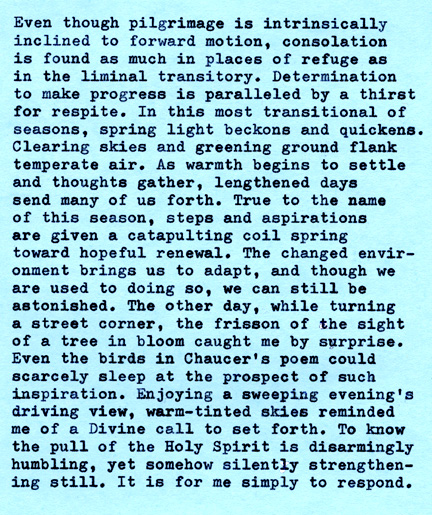
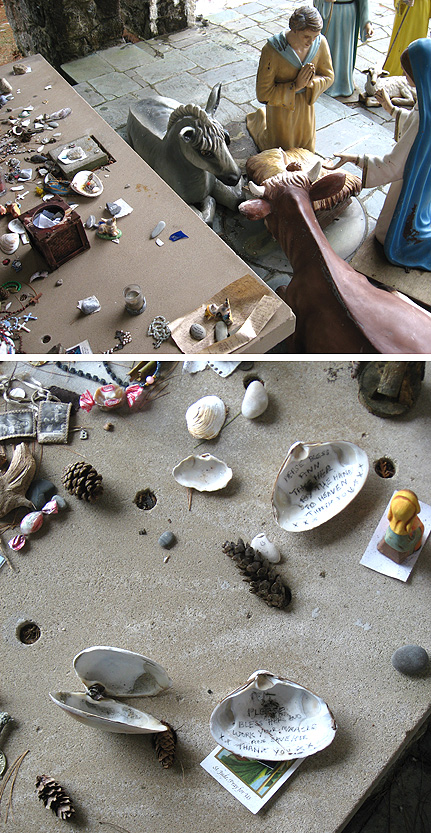
called forth
Thursday, April 12, 2012
graphite archive
"I've got to feel the pencil
and see the words
at the end of the pencil."
~ William Faulkner
When work impresses itself as encouragement upon daily life, extraordinary momentum and renewed energy manifest to merge both spheres. Through the occasions during which vocation and avocation intertwine, various aspects of life provide for cross-referenced appreciation. My years in commercial photography and printing helped me to become proficient at cooking and baking. The study of history and philosophy, combined with the active pursuit of the spiritual life, inspired the practice of journaling. By writing the adventures of personal journeys and the business of the quotidian, I’m better able to perceive as an archivist.
A current project permits me to play many of my cultivated notes. Just over two years ago, I was called upon to organize, index, and preserve seventy years worth of negatives produced by a local newspaper. The publisher’s building was being emptied and the sub-basement’s contents included dozens of rusted file cabinets stuffed with photographic negatives- which were being destined for a refuse smelter. Providentially, I took on the project and the experience has been as wonderful as it has been mountainous. The collection comprises hundreds of thousands of celluloid and acetate images- an incomparable treasure trove of regional images- and I’ve already identified many thousands of places, events, institutions, and individuals.
The best way to deal with this massive amount of unorganized and unindexed material has been for me to review each single piece of film, while taking a macro approach regarding descriptive depth and preservation. By doing this, I’ve been living the collection in numerous ways and at many levels. My personal memories are being bolstered by illustrative artifacts that are much older than I am, and the continuum has been blending into my own. Throughout this continuing and painstaking process, I’ve been trying to communicate the immense joy of this large project to those around me that cringe at the prospect of the daunting tedium of commandeering many hundreds of linear feet of negative images without accompanying prints. I consider it an honor and a privilege to be conserving this photographic history of my home. From the beginning, it’s been clear to me that I’ve been discovering more than mere imagery. Being a process in progress, only small portions have been made available, and a growing number of individuals have already been blessed by these thin slices of time, and new anecdotes come to me by the week. There are many stories, even now at these early stages, and I try to write as many as possible in my journal.
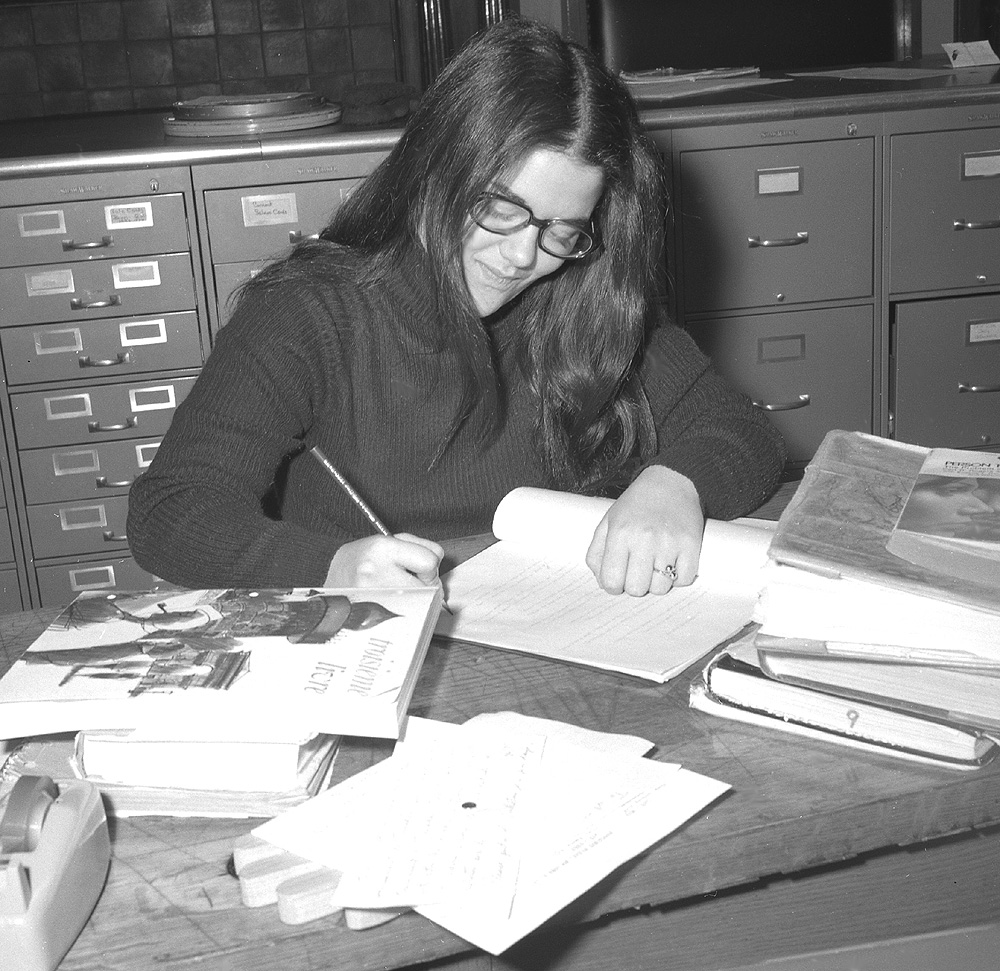
In the process of reviewing each negative, assessing physical condition and date, I’ve seen (and indexed) a great many unusual images. When newspapers were more local in their production and coverage, there was a strikingly personal touch to the content. Between the 1930s and early-1950s, I started to take note of a few sensitively composed images of people writing, even indicating the pencil-writers in my spreadsheet index. This cast of characters is at school, at work, at home, and outside. Here are a few of the gems (from the '30s - '80s, so far) with hopes that you’ll find some encouragement to write your days and journeys. Enjoy the photographs which are little worlds that now visit ours, and enjoy the continuum in which each of us participate.
gearing up
Below: Enthusiastic customers at Grant's Department Store.
at school
Below: Comparing notes.
at work
Below: Pencilling orders at the malt shop.
and for the Maine State Legislature (below).
wandering and musing
Above: Ideas are afoot on the grocery store stoop.
Below: Writer aperch in a cushioned jump-seat!
What's in your pencil box?
Monday, April 2, 2012
Sunday, March 25, 2012
lettered trails
“You must write throughout the whole of your intellectual life.
In the first place one writes for oneself, to see clearly
into one’s personal position and problems, to give definition to one’s thoughts, to keep up and stimulate attention which sometimes flags
if not kept on the alert by activity- to make a beginning on lines of investigation which prove to be necessary as one writes,
to encourage oneself in an effort that would be wearisome
in the absence of some visible result, lastly to form one’s style
and acquire that possession which puts the seal on all the others,
the writer’s art.”
~ A.G. Sertillanges, The Intellectual Life, p.199.
After considering the draw of physical pilgrimage, inward lettered paths provide the complement. By this I refer to the rewards of reading pursuits. Imagine the roads, air lanes, and waterways finding equivalents among library aisles, pages, and sketched images. Learning is implicit to discovery. Seeking to find is essentially a venturing forth to comprehend. Foraging through written words, books, conversations, even active listening, can mark paths to our own written words. As with geographic travel, voyages through ideas and words must be purposefully sought. In my experience, the lure of promising landscapes is akin to the drive for insight. The latter is a continuing search for practical knowledge and perspective, so that I can take to the trails more skillfully.
During a meandering walk, I noticed how thoughts naturally distill into ideas. In their own intangible ways, untethered musings become fruitful. Though not visibly productive, an adventure is in progress. Words, images, and aspirations are forming with each step. Consequently, thirsting for wisdom and insight proceeds as a continuing pursuit. One might not consider such studies necessary, but I’ve found learning to be vital, satisfying, and useful. As pilgrimage travels are beyond the perfunctory, so contemplative reading is far too compelling to be burdensome. Essentially, the whole of life’s advancement comprises different forms of research. Enjoyable reading and inquiry generates momentum, and I am able to find the narrow passages through thinly-sliced schedules. Such pilgrimage is a worthwhile continuum of construction and refinement.
Reflective reading and writing permit for the recording and charting of journeys past and upcoming. When ideas are in short supply, it generally means I’m not reading or observing enough. Inspiring written words, along with landscapes and skies, bring souls to pose questions. If not for inquiries into worlds of knowledge and Spirit, I’d be pulled into whirlpools turbid with time’s undertow. Yet indeed, the research passion is discreet by nature; thought processes not for their own sakes, but with hopes for application.
Ordinarily, elementary and secondary school experiences enforce study specifically toward the goals of passing exams. With fear and hope as tandem motivating factors, the shame of failure combines with the drive for timely completion. Between Chaucerian “fear fled with fury,” and Coleridge’s “work without hope draws nectar in a sieve,” potential joys in studies suffocate. Then, in the post-survival, comes the challenge of finding one’s own delight in learning that will last beyond time. For me, the steadily sweeter tastes evolved alongside my increased abilities to choose my own coursework- especially in graduate school.
A decade on since thesis-writing, the momentum remains, even intensifying with each exploration. I still recall how in my solitary jubilation at completing the heavy, source-cited, footnoted, field-tested document, I took that printed pack of paper out for a steak dinner. Raising a toast to the achievement was simultaneously a celebration of more freedom to read anything I want. And freedom to do more writing (albeit with less free time). That mixture of gratitude and exhilaration has not died away. It is surely reignited during sojourns in extraordinary libraries such as the Boston Athenaeum.
As a thirsting pilgrim, I seek the words of experienced narratives from times other than my own. For such forays, I’m “reading with a pencil,” slowly savoring turns of phrases and making notes. Often these notations become indexes for subsequent references which I’m able to use and share. Stored wisdom, like a cupboard’s ingredients, can find value in its uses. These mined gems are in themselves good reads. Not unlike journaling, the indexes are written and referred to, for memory and future navigation. The assembling of thoughts and words can be as gratifying as active reading. Maps drawn during one journey can inform explorations that follow.
(Below: How I've indexed Antoine de Saint-Exupéry's Citadelle.)
Recently, I attended a lecture given by a social commentator. It was entertaining, and I could see how the speaker draws remuneration from these sorts of presentations. About midway though the talk, it became obvious to me (and perhaps to others) how the speaker was far more an observer than a practitioner. There are significant differences between speaking about expressive processes evidently as an outside observer, compared to providing a practitioner’s experience while describing creative processes. Spectators that also participate on the playing field can attest to the ways both reading and writing complete a nourishing cycle of absorption and manifestation. The twin endeavors of reading and writing intertwine, being ways of inquiry and understanding.
The speaker’s words stumbled whenever it came to describing materials and processes, despite the implication that we were all to believe the speaker knew these things from the inside out. With respect, I hope there are chances for future projects that will bring the presenter into personal pursuits of applied process. Sertillanges once advised that:
“We must always be more than we are;
the philosopher must be something of a poet, the poet
something of a philosopher; the craftsman must be poet
and philosopher on occasion,
and the people recognize this fact.”
Perhaps the great “published work” is a self that develops an improving sense of perspective and of the sacred. Thus, reading, studying, and writing are components in a construction project. Aspiring to be at once observer and practitioner causes us to “be more than we are.” An invaluable pursuit, at many levels, and the type of path worthy of plotting, mapping, and travelling.
Monday, March 12, 2012
travel advisory
“When thou dost purpose aught, within thy power,
Be sure to do it, though it be but small:
Constancy knits the bones, and makes us stour
When wanton pleasures beckon us to thrall.”
~ George Herbert, Conduct
Routines, habits, and their observation have had their places in these pages. During this season, I'm reminded of distinctions between perfunctory and passion. As children, many of us recall fretting about what I call the haftas and the wannas. This is to say when what has to be accomplished obstructs what is so much more desirable. By adolescence, I'd begun to learn the discipline of attacking the haftas with gusto, looking forward to enjoying the wannas, once I’d successfully reach those hospitable shores. When certain obligations tend to require dragging my will and tail, they may be done according to the usual high standards, notwithstanding a few wreckingball swings through opaque reluctance. Then there are other matters, often more demanding than quotidian obligations, that I regularly seem to find the requisite energy to pursue. Seeking out new ideas and inspiration is essentially congruent to my pilgrimage travels. A search is in progress, and there isn’t a moment to be lost.
When we cannot choose enough details in our adventures, we may at least convert conditions into enlightening experiences. It is exceedingly worthwhile to continue discovering meaning and expression amidst the ephemeral. Intrinsic to the spiritual life is an insistence upon finding what is good in unconducive times. Search for pearls in the desert, and for the worthy in the wastelands. And day after day, the energy to persevere must be found. Recently, I was reminded once more of the benefits found in good company. Early one Saturday morning was a breakfast with one group of friends, and dinner that evening was still another meal with yet another group of friends. Exchanging stories amounted to discoveries of goodness I might not have otherwise noticed. Granted, much of the talk referred to these difficult times and how no end is in sight. Yet we continue and we carry on with cheer. Walking home, I wondered if the cheer is necessarily contingent upon any conditions. The quest for one’s passions may indeed be intensified by adversities. With this in mind, the Lenten journey implies an insistence upon discerning goodness and not permitting the negatory to implant lasting impressions.
The call of the Spirit to the soul is surely not aimless. Inquiry implies discovery. We continue to search because we continue to find, and thus driven onward. Even in my lesser moments, there is nothing more appealing than to aspire and continue. Now I’m remembering the portion of John’s gospel in which many perplexed disciples have drawn back from Christ, unwilling to risk another ounce of trust. Too much looks too frighteningly out of control. At this crossroads, Simon Peter spoke the immortal “to whom shall we go? You have the words of eternal life.” As I can only choose to journey onward, in a sense I haven’t a choice. What else could I do, having absorbed the words and the Spirit that speak directly to my condition, even the evidence of things unseen. We search because we’ve discovered, and we find because we’ve been recognized. It is as though one must hope and strive; beyond the precipice there is no choice- turning back has lost its lure. It may appear that we are driving our explorations, but indeed the source is as palpable as it is covert. Perhaps that explains an individual’s relentless quest for their creation, their origins, their purposes.
Though driven forward, the spiritual voyager is somehow both navigator and passenger. And the journey is not reluctantly pursued: surely more wanna than hafta- if anything, a vital gotta. The pursuit of holiness and knowledge ironically evolves into something less self-centered and more outward-looking. The grand voyage becomes a great travel with waystations for appreciation of detailed instances and sweeping landscapes alike. My work as an archivist reminds me that understanding must rely upon context, and that events and observations take shape in a developing succession. Like the search to discover, questions and answers evolve in an organic rotation such that a stumbling soul derives just enough reinforced direction to be able to advance. The desire to proceed and learn might be considered a grace, a gift recognized through an enjoyment of the cultivating continuum. What else could I do, but be grateful for the persistence to discover and the appetite for the light of the Spirit.
Last week, I participated in a pilgrimage gathering in Montréal, as a musician, for the twelfth consecutive year. Between there, here, and many points farther afield, I’ve made countless similar travels over tens of thousands of miles- often in challenging driving conditions, always at my own expenses, and each single time an invigorating joy. The adventures are golden occasions, replete with conviviality and insight. In a discussion, Brother Emile of Taizé spoke about daring to live by a trusting faith, instead of being driven by fearfulness. “Plus profond du mal, il y a la bonté,” he added- meaning that far deeper and more powerful than hardship, there is goodness. He put forth an open sentence that his prior liked to ask: “When we set forth with a trusting heart...” It is a statement for the listener to complete. I pencilled these notes at my music stand, sometimes using the top of my classical guitar as a support. The road home included a visibility-blocking snowstorm. It was not surprising, and I had no regrets- even as I had to slowly drive through the adverse conditions. Perhaps a heart that trusts can become capable of sculpting circumstances into worthwhile adventures. The great challenge is to do so consistently and meaningfully.
The image below is the song list for the Taizé Pilgrimage of Trust, held in Montreal in 2007 (I always write down the music lists in my journal!). This unusally large gathering was broadcast on the radio. The prior, Brother Aloïs of Taizé (France) spoke to all in attendance, as well as Cardinal Jean-Claude Turcotte (Montréal).
Friday, February 24, 2012
aperch
“Talk of mysteries!
Think of our life in nature,
daily to be shown matter,
to come in contact with it;
rocks, trees, wind on our cheeks!
the solid earth!
the actual world!
the common sense!
Contact! Contact!
Who are we? Where are we?”
~ Henry David Thoreau, The Maine Woods
Subtle encounters with nature do much to point out our whims. We must always be able to see that our environments extend far beyond the clamshells of our laptops. In vastness is captivating intricacy found. But it takes some cultivated perspective- and the ability to perch oneself at conducive vantage points. My tastes draw me to edges and confluences: shorelines, precipices, and mountains; as edges these have much in common with streetcorners, front stoops, and windowsills. The mind must keep an awareness that horizons are surely farther away than an armspan. It seems the meetings of depths and surfaces provide places for reflective repose. Writing requires a good perch.
Promontories with interesting views are as compelling as they are distracting. But that goes with the territory. One perch is selected in favor of another due to sheer intrigue. A pleasant diversion can serve as needed writing spice, broadening tastes and views. One afternoon at the Boston Athenaeum, a beloved perch of mine, I glanced up from my journal and books surprised by a sizeable red-tailed hawk on the terrace railing.
Such birds of prey find plenty to do between their nests atop office buildings and open spaces such as the Boston Commons, or the Granary Yard which is behind the Athenaeum. Of course I put down my writing to have a good look at the hawk. From its railing intermission, the sleek raptor surveyed the landscape. We looked at each other from our respective perches, and in a few short minutes the hawk flew off to glide above the canyons of Downtown Crossing.
I’ve long referred to the act of writing as the taking-up of a perch. Similarly to perching birds, a writer’s pause to recollect, record, and look ahead to the next flight of fancy is momentary. A suitable perch merely needs the furnishing of a sturdy surface. It can be a chair, a flat section of rock, a dock, a low brick wall, or a well-inclined hill for some back support. Just about the same list may be employed, if a table-surface is needed. Being birds of our own feathers, we each find the landing places for our thoughts. Around the places in which we temporally situate ourselves are the elements of air, light, and either sound or the cessation of sounds. Essentially a preferable perch is a place of reflection. And from that figurative branch with beak between books, victuals, and curiosities, words sing forth.
For this occasion, these words are assembled at the coffeehouse nicknamed in more than fifteen years of my journals as The Familiar Perch. The shopfront is now under its 3rd manifestation as a café, prior to the mid-1990s it was a perfume shop, and these transformations surely follow numerous uses since the rows of brick buildings on Exchange Street were built in the late 1860s. At the base of the narrow street, at the heart of the Old Port, this is an ideal location for its contemporary purpose.
At first, I’d come here to do my homework, preferring the convivial continuum for writing after spending extended silent reading hours in my apartment. Then as semesters progressed into graduate work, constant weekday road travels made any sort of nonacademic writing a rare luxury. The Familiar Perch became a base for my ritual of Saturday morning coffee and journaling- regardless of the previous weekdays’ chaos of coursework and the years of employment-juggling that followed. But it is indeed always a perch. Sitting here to write, I’m a bird on an extended branch scratching recollections on leaves. Some are bound, others are loose folios. Sometimes the words are pecked by typewriter. Over the years, I’ve accumulated additional favorite perches in various cities, states, and countries. These are cherished island oases amidst an expanding ocean, making it necessary to have places to perch though arduous journeys.
Still, the Familiar Perch is distinct with personal history and ambiance. Most of my New Year’s Eve “year in review” journal entries have been written here. During the previous name-change of the café, the new owners set the glass tops over the table linens that remain there now. Writing surfaces have intrinsically mirrorlike properties, and I’m always pleasantly startled when birds in flight high above the mansards across the street are visible in the glass tabletops. Just now a cormorant has darted, it seems, from under the saucer and across to the next table. Sometimes the coffee itself becomes a reflecting pool. The sensation is one of noticing the sky while looking down to write.
Birds intersperse their flights with perches, as there must be pauses to strengthen and observe. Hence the perching writer becomes as a branchseated bird, noticing the world of sights and wind currents, retrieving and sending forth song from within. After reckoning with the moment, a launching toward the next way-station. Perhaps you are aperch right now, or you may be on your way to an inviting ledge of your choosing.