


“Often look up
and see the splendor
of life suspended
in your heart and mind.”
~ The Monks of Weston Priory, Listen


 Posts
All Comments
Posts
All Comments
“Often look up
and see the splendor
of life suspended
in your heart and mind.”
~ The Monks of Weston Priory, Listen

“As for the Future,
your task is not to forecast,
but to enable it.
And surely you have enough work on your hands
when you are given the Present
as your raw material.”
~ Antoine de Saint-Exupéry, Citadelle, ch. 50


“Deep calleth unto deep
at the noise of thy waterspouts;
all thy waves and thy billows
are gone over me.”
~ Psalm 42 : 7
Longing guides my steps to the waterfront. Watching gusts of rain, whether at the open shore or along harbor piers, aquatic textures blend. Seeing skies mirrored by the water surface brings a fascination with distance and volume. Altitude from sea level is readily seen, and can be noted with every terrain or air-travel ascent. When it comes to water depths, ocean charts inform and provide a sense of distance below surface. Simply watching the stirs of blue-green waves is insufficient for a realistic impression of how far- or near- edges of crags may be. Both knowledge and sharpened sense are needed. Trying to synthesize these two aspects, my thoughts return to the idea of progress. I consider whether deepening of trust, of learning, and of direction can be known, as hypnotic hatching tidal lines group and disperse around me. Depth-of-field, a very familiar concept to me, concerns broadening areas of sharpened focus by using only the center of a camera lens. Through slower shutter speeds and finer apertures, more area can be sharply seen. It is the more patient view. But thirst urgently desires heights above and depths below surfaces.

Pelting rain adds layers of circles to the weave of ocean. When it becomes snow, the falling flakes shuffle with whispers into the water. Such unparalleled sounds are audible once away from city or ship-engine noises. Recently, I thought to call the Maine Geological Survey to ask about how ocean depths are measured. The scientist I spoke with helpfully explained depth soundings- also known as echosoundings, which is much the same as sonar. Acoustic signals are sent from an instrument towards the bottom, and depth is calculated based on the time it takes for the signal to come back to a transducer mounted on a vessel. Higher topography in the water will have reflected signals that come back sooner than areas that are deeper. Calculations are based on the speed of sound through water, which varies with salinity and temperature. It is fascinating to know how precise these depths- and even the shapes of bathymetric forms (underwater topography) are determined.
After this intriguing conversation, my usual waterfront walks brought these depth soundings to mind. Rather than to imagine any pinging rates of my own, a preferable quest is to plumb the depths and sail the heights of the Divine. Just the other day, out on a briny pier and breathing in the salt-washed air, I called unto the deeps. A simple supplication for refuge, from the depths preceding me- toward the Creator of all life whose understanding is unfathomable. And the words returning to me from beneath the tides are to continue onward. Greater things are up ahead than those yet seen. The unseen and trust- a tandem to accompany the cloud of unknowing and unceasing prayer. Once beyond my own perimeters, God’s expanse is limitless. Of course, it is quite human to ponder any progress I may have made; to marvel is something beautifully mortal. I wonder about what’s really changed, whether the changes have been for the better, and if this year’s product is one I would’ve bought last year- or even 10 years ago. It is all terribly humbling, and brings me to modest contentment with the small increments of distance effected.

Between digitally-plotted soundings and the heart’s sonar is the crossroad of ostensible and intrinsic. Indeed this is not meant to set one against the other, as both aspects are necessary. And somehow, no matter how much can be verified, the greater interest is in the elusive and unknown. In his tractate Signs of the True Ground, Meister Eckhart (13th c.) wrote “there are few who get beyond the science and the theory,” being well aware of the vitality of balance. “By being free from notions,” he continued, we can “be carried up beyond all rational concepts,” borne by the Spirit “to this truth and to this blessed life which no one can attain except in abstract knowledge and pure understanding.”

Discovery, alas, is often subtle and indirect. Straining at a conundrum doesn’t guarantee a solution. It’s as though endurance is tied to creativity. If answers are not immediately apparent- even with persistence- the subtler, overcoming discipline is to focus away from the matter. Irrational as that may seem, the emphasis becomes a more general context. Motion, and a panoramic view, will help overcome the paralysis of analysis. Notice how waters in channels, inlets, and around islands steer around obstructions. These directions are diverted by encountered resistance, though not prevented. Thirst for wisdom and the pilgrimage of trust come at one’s own risk, but it is well worthwhile- as St. Diadochos wrote in the 5th century, quoted in the Philokalia:
“For in much wisdom is much knowledge; and he that increases knowledge increases sorrow... the soul is tested by divine rebuke as in a furnace, and through fervent remembrance of God it actively experiences joy exempt from unreality”.
Discoveries and changes follow humbling episodes and experiences. Similar to steering away from fixating upon a question or a problem, listening for answers begins with embarkation. Standing straight, proverbial mat rolled up, and going forth with a perspective unburdened by old grudges. Pursuit inevitably teaches perseverance. But it requires getting going first; drawing a bold black charcoal mark on the large blank paper. By creatively engaging the voyage, we write off the detours that divert the road of communion. Or as St. Diadochos wrote, “ceaselessly journey toward God within the soul.” Somehow, in unexpected ways, endurance enhances understanding as hyper-focus in isolation cannot. Having already navigated some depths, echosoundings will reveal their worth as guiding coordinates.


So far, so good,
so close, yet still so far.
Step in, step out of the rain
I’m goin’ to walk on up to the Waterfront.
~ Simple Minds, Waterfront
With this advancing and burgeoning spring, my thoughts turn to crossroads as signs of reflection. During evening walks, my paces across converging roads are especially noted. Nightfall happens later, with each passing day and with more temperate air. Lengthened days invite more musings. An intersection such as a nascent spring revives recollections of transitions and graduations. And expectations. Now progress is a loaded term, often blending unrealism into reality, yet remaining a necessary aim. Which ideals are worth this obstacle course? Are measures of progress based upon comparisons of what, or where, or whom we think we should be?
In the realm of sports, exaggerated fortunes are tied up in games, teams, and empire-maintenance. The nature of assembling a dominating “dynasty” strikes a curious contrast with the humane aspect of mercy. Or loyalty. A person endures an unproductive spell and is branded as “washed up.” Such judgments are batted back and forth between athletics and the workaday world. Identity is determined by the progress one makes- or fails to generate. Indeed, this mentality also infects religious circles. Acceptability too often tied to material expectations, constantly raising bars of demand, confuses places of worship with pressured places of work. Surely there must be limits to the meaning of “enough,” and the humble spaces we offer and influence may be done so as peaceful oases.

Driving my various errands and obligations today, I turned off the radio news- and thought about trends that define these times. Much is determined by what scares or angers us; many affirm what they are not, rather than who they are. Some careful listening reveals this, and it brings my thoughts to imagine the role fear plays in the motivation of people. As much as fear can drive some to evasion, it can also motivate overcompensation. Worrying about interaction or the challenge of something different frightens us into isolation. I remember working for a place in which the smallest, most mundane memoranda were copied to a universe of additional personnel. Issued words to be witnessed, along with all responses, as proofs of some sort of activity (or lack of inactivity) in this litigious society. It seems exaggerated expectations, mixed with fear-based interpretations of accountability, cause the subjected fearful soul to overstate what they do. Part of the noise that deafens this culture is the defense mechanism of overstating practically every personal action.
Another strange way to express “progress” is to connect it to self-justification. “Redemption” happens by vindication. So many of us have known the cornered-animal state of mind that taps into primal adrenaline as we’ve met deadlines and performed “to save our lives.” And more than once. “Hero today, goat tomorrow,” as sports and real life imitate each other- both by experience and semantics. Still, amidst being pulled along by the need to competitively survive, it is difficult not to notice how living souls are appraised and assessed. Inhabiting this culture needn’t imply succumbing to spreading spells of cynicism. Trying to keep things workable and healthful has meant an operating knowledge of “the system” while attending to my own ideals. Parallel to being multilingual, the language of commerce permits for a livelihood, and the heart-language is the one through which understanding and prayer happens. That inner language- an inner citizenship- must be continuously cultivated on my own time and on my own dime. But this worthwhile endeavor, with an inner life, is both vital and the way out of conforming with societal images of success and progress- of how to look and talk, and of what one is supposed to have accomplished and purchased so to appear respectable.

As for qualitative progress, how shall this be determined? If the soul’s advance is a discernment of conscience, inspiration should be free of competitiveness. Yet, in the spirit of exploration, I do hear myself ask, “against whom- or what- do I compete?” There must be continuity of inquiry. Progress that transcends finite situations is the career undefined by fixed measures. Though unquantifiable, the Spirit is undiminished. Depths and breadths untold, yet with a certainty of presence. Transitions, which I can only hope to be steps of progress, register as points of recognition. Short-term goals are frequently moving targets; they’ll be something else tomorrow. Taking walks around familiar and personal landmarks invites occasions to ask myself about perceiving things differently. Corners, crosswalks, and structures resolutely rest as solid signs. And my circulating traversals salute these humble sentries, while new paces overlap previous paths. Houses and schoolyards retrieve words and moments, as familiar slants of light remind me of distances covered to now. The day soon a memory, giving way to the present’s fluidity, and destinations unfolding as gradually opening hands.


“Always remember this luminous gospel reality: ‘it was God who loved us first.’
That is a light for your life.”
“What is the source of this hope? It is in God, a God who simply loves and no less, a God who never stops seeking us. Our hope is renewed when we entrust ourselves humbly to God.”
~ Brother Roger of Taizé, The Sources of Taizé
Continuity encourages me to look ahead, yet with a sense of the past. An invitation to venture to the Source is simply too good to resist. A long-anticipated travel was a night away. One of those simple journeys with an overtly spiritual purpose. Regularly traveling like this for some fifteen years now, I routinely stop to write just before leaving. Journal jotting is as necessary as packing provisions. When they occur, launch moments are times to cherish- and that includes a pause upon the return trip. Both ends are points of embarkation, and enough experience has shown me how clumsy it can be to write in transit. Moreso than to write, a time to absorb. Collecting written thoughts before heading out I can preserve impressions to read later that describe how I was before the experience. Preparing for a pilgrimage provides an example for the preparation for life’s journeys of any duration. Part of the readying is the anticipation.
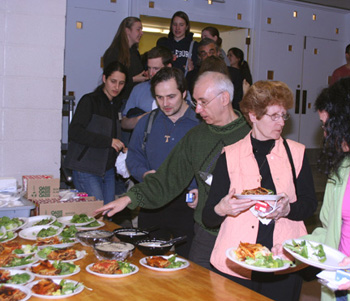
Even after arriving, there is preparation and anticipation. More arrivals will follow, and they will be welcomed by us. By preparing for the event by decorating shared spaces, music practice, setting out and serving food, the welcomed become providers of welcome. Amounting to an instant spectrum of reciprocity, it is yet another privilege to be included. The present becomes a shared home for a vast diversity of pilgrims, seekers, and the boldly curious. We are all bound together in a festive current.

Turning a corner, traversing a borderland, and recognizing a new passage is to discover a season. Distances covered become paths reached. The pilgrim road directs human steps toward the source of the Spirit within. Though material conditions appear unchanging, it is for me to actively detect transition by observing my perspectives. A season, such as the Lenten weeks, can be one of expectation that is itself anticipated. At the culmination of the Lenten season is the intensity of Passover: a looking forward to an extraordinary span of time, including a change in daily life, house-cleaning, and even in what foods to eat or be stored in the cupboard. As though preparing for a voyage, there is a similarly expectant air. Ordinary days can present numinous journeys, windows to our sources. A stretch of eight days, within forty, inside a year is an example.
These short seasons remind me of my acquired taste for the savor of gradual successions of days- or process- more than the single-day emphases. No day is an island. More than to hinge times of renewal upon a season, invitations and beginnings are inherent with daily experiences. Our continued interactions and prayers can lead to a mindfulness of God's presence, to our extension of that presence, and hence a closeness to the source of what is life-giving. As I’ve come to understand, the monastic expression going to the source is really a reference to prayer- and thus continuing to commit one’s life to openness to God. But the action of advancing in steps toward holiness becomes something of a resource itself. A setting forth that remembers the source from which I’ve known goodness in the past and through which I comprehend.

A thirst for advancement becomes intrinsic to an aspiring soul. The clearest expression of this for me- which even encompasses actively helping others- is life as pilgrimage. This is motion especially dedicated to fulfillment, encounter, and expression. Inward harmony to manifest as outward harmony. It implies ever drawing- and remembering to continue- from the wellsprings of trust. Just two weeks ago, I had the privilege of participating in an unusual Taizé gathering- also known as a Pilgrimage of Trust- as a musician. This was my tenth year of traveling to do just this! As a result, with each year, city, and country there are more and more friends to recognize- and vice-versa. The venue this time was a large Eastern Orthodox church in Montréal. For the music ensemble, this was something very new and thus every impression was a first. We were given very little time to tune in advance and get settled. Walking into the expanse of space my first impression was one of quiet wonder, absorbing the bright iconography and the dry aroma of incense. Life-sized frescos and the increasing numbers of gathering humanity amounted to a sum of glowing colors in the grey dusk of the sanctuary.


Acclimating to the space, I began to notice more nuances. Beneath this, my thoughts were occupied with the idea of the sources of trust. The front of the sanctuary had the appearance of a lit settlement with something of a skyline. Numerous shimmering icons populated the area around all of us, and the space around the altar brought to mind gates of prayer. The Brother of Taizé who was with us gave a talk about rejoicing in the thirst God has placed in us. This concept, from the ancient Psalms, was reflected in the chant and music we continued with. De Noche Iremos: “by night we seek the living waters; only our thirst lights us onward.” Following the days together, we all dispersed to resume our lives- in so many different places. Yet it was an advancing forward in great company, each continuing their pilgrimages in new strength. With sore left fingers, I clutched the handles of my guitar case down through the chilled subway. But it could hardly have been more wonderful.
Returning home and to my job, and then looking at the work itself, I thought further about sources. We refer to primary and secondary sources: original manuscripts and published editions. Primary and secondary; destinations and way-stations. The adventures of prayer, gathering together, and divine words become the presence we carry with us. The Source of all life does not draw from yet another source, but creates resources. On the road back, I asked my traveling companions about how their gleanings become sources. We traded stories about artifacts we’ve admired. I remembered seeing Longfellow’s manuscripts- complete with the very pencils he used for writing his epic Evangeline. My flute-playing friend talked about how he owns his grandparents’ engraved tea set which they received at their wedding, and imagined what the festivities might have been like. What do sources look like? What sounds do they create? Indeed, there are the created who can create, as well as created matter that cannot. Experiences of God form our approaches to the Source. Directed to the Source, the voyage is a life’s pilgrimage reaching beyond limitations, driven by thirst.


“It's all making me ready.
It's all doing what you gonna do.
I know "A"
I see my life come shine.”
~ Jeff Lynne, King of the Universe, from On the Third Day
This time of the year has come to be my busiest. Although late winter is conducive to recollection, my routines have been gratefully diversified with travels, playing music, and being among friends along the way. Part and parcel of the pilgrim path is note-taking and photography. Here is a chance to catch up. On a recent sojourn in Paris, an elegant subway poster drew my steps to an enthralling exhibit about the history of written letter forms at the Musée de la Poste (the postal history museum). The venue is familiar to me, but this show was extraordinary in presentation and depth of collections- the galleries filled with artifacts, printed and handwritten works, connected by narrative installations. It was easy to take dozens and dozens of photos, thinking of my fellow writers who might at least enjoy an edited version.

When we are writing, we join with a vast and boundless continuum of thoughts expressed in lettered articulation. Words constructed of typographic elements are shaped into our communication, description- even unspoken narrative. Further, understanding often hinges upon clarity of letter and language. Arrays of individual letter characters, with which thoughts are framed, present their unique graphic balance. The very letters I handwrite- and even type at this very moment- are inheritors of evolved typographic architecture. This museum exhibit reminded me very much of our working legacy of form and function. Indeed, an already existing affinity for the practices of graphic arts and calligraphy kept me in the Musée de la Poste for hours! Yet, all the more after exiting, my appreciation extended further as I noticed letter forms on buildings, in print, and in the city’s adornments. Then I chose a corner café to continue journaling.


Between wall panels displaying very large translucent parchment-like A-to-Z letter murals (as in the top photo) and illuminated manuscript pages, were these books. Just above, in Persian, and below from Ethiopia and China. The Asian displays included collections of ink-grinding tools and lettering brushes.


Moving through history, the galleries turned to displays of writing tools using ink and paper. These French-made materials were also beautifully advertised, reflecting the styles of their times. Note the pen-stands, and glass-pointed pens. There were display cases filled with the tiny boxes in which copper pen-points were packaged and sold.

The sections of a glass-reservoir Waterman fountain pen just below. These pens are still made in France. Fountain pens began to replace dip-pens and inkwells.

Among the impressive variety of inkwells displayed (one resembling a chariot, another in the shape of a coal stove) are these, just below. At right is Voltaire's inkwell and pen stand. Imagine what had been written with these tools!

Indeed, a fine showing of graphite writing tools not to be missed. Sennelier and Caran d'Ache are two brands that are still popular today. Pencils have hardly changed in the past century. Note the crank sharpeners on the right.

Just below is a portion of a large Bic ballpoint display. Some of the memorabilia advertising Bic, also a French company, was loaned by the Musée Carnavalet (the museum of Paris city history).

Though the focus of this history of writing exhibit concentrated on handwritten letters, the concluding gallery displayed letter-press printed pages, a 19th century cast-iron printing press (made in Boston!), and an Underwood typewriter. And, yes, a nod to word-processing. Being the national museum of postal history, there was a great display of antique postcards, and an area for children to write letters. During my visit, a tour guide was teaching a school group the basics of calligraphy.


Resuming my steps along side streets and broad avenues, typographic forms abounded. A large and familiar letter A appropriately met my path.
Just below, miles away from the museum, a calligraphic display in the Sennelier store along the Seine.

Spring is almost here.
Bonne écriture !


