


 Posts
Posts


“Humanity does not pass through phases
as a train passes through stations;
being alive, it has the privilege of always moving
yet never leaving anything behind.
Whatever we have been, in some sort we are still.”
~ C. S. Lewis, The Allegory of Love.
lewis’ environment

The Kilns, with C.S. Lewis' bedroom (below).

During the winter, I’ve had some time to digest and reflect upon this past late-summer and early-autumn’s residency in Oxford. There will likely be one more essay on the topic. This occasion permits for some reflection as a participant in C. S. Lewis’ world. With the Scholar-in-Residence fellowship, I lived at The Kilns, which is the Lewis home. From the house and its grounds, to neighboring Headington Quarry, to Oxford’s streets, paths, canals, and colleges (with their libraries), to the breadth of greater Oxfordshire, the experience exceeded that of an invitee: I was an inhabitant in a broad and colorful sphere.

High Street, Oxford. Below: University College, Oxford.

Walking was the best mode for observation, though public transport was essential for traversing the city to my various appointments. Covering the smaller distances on foot provided opportunities to look closely at memorials, shop displays, and to try various vantage points with my camera. Aboard the buses, I chose upper-deck perches, and the higher-angle views were ideal for viewing architecture as well as the scurrying humanity along the sidewalks. Lewis did not drive, and he either walked or used public transportation to connect The Kilns with Magdalen College. I learned about how he loved to walk, no matter the distance. Long strolls on footpaths become places of meditation as well as that of conversation with friends. Walking chats, and walking to air my thoughts, were integral experiences to my Oxford sojourn. Assimilating the Oxford of C. S. Lewis, I gradually found my “own” Oxford. Inhabiting the places of importance to Lewis, these places also became important to me. Places and paths complemented all I was learning about his life and about the people closest to him.

Joy Davidman Gresham's home, Headington,
prior to her marriage to C. S. Lewis.

places

Bury Knowle Park's garden, which features Narnia-themed carved sculptures. Aslan the Lion (above), and a wardrobe-shaped entrance.

Through the ages, writers have known the value of place as source and conduit of inspiration. My comprehension and appreciation for Henri David Thoreau was significantly enhanced, after having spent time at Walden Pond. My lifelong admiration for Dylan Thomas ultimately brought me to the parts of Wales that are illustrated by his words. I had the great fortune of being able to live in the Thomas family home, which is also the poet’s birthplace, in Swansea.
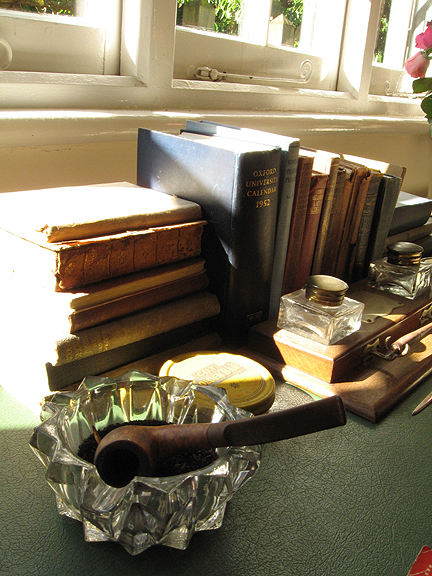
Mindfully ascending the carpeted wooden stairs each night, the same steps walked by Thomas as a child and as an adult, found parallels when I also walked the cliff walk to his rockperched boat house in Laugharne. These thoughts returned to me, as I’d daily climb and descend the steep steps of C. S. Lewis’ at The Kilns, then around the garden, the verdant length of Addison’s Walk, and to his rooms at the cloistered Magdalen College and University College. Lewis may not have considered his notebooks and manuscripts as “places,” but I did. The texts themselves, upon their original paper substrata, are places of learning. My daily studies, comprising close readings and note-taking, amounted to a month of habitation in the spaces created by his written words. The lines and pages of insights were subtexts and themes to my days of exploration.

Studying Lewis' manuscripts.

By comparison with the fantastical worlds vividly described in the Space Trilogy books, and the Chronicles of Narnia, the earthly geography of C. S. Lewis did not cover much territory. But his imagination was surely boundless. He was able to invent complex and elaborate lands while amidst the sedate landscape of the English Midlands, the stone streets of Oxford city, as well as drawing from his upbringing in north Ireland. As well, the community life cultivated by Lewis, among friends and associates in Oxford, brought voices and stories into the places of his spirit.

sacred spaces


Views of Saint Mary's, Oxford.

Becoming acquainted with the places Lewis valued brought me to several beautiful sacred sites. Although the individual colleges have chapels within their enclosures, the university church is the centrally-situated Saint Mary’s, dating back to the 13th century. Among the addresses Lewis preached at Saint Mary’s was his celebrated Weight of Glory, in 1941. Closer to The Kilns is Lewis’ home parish, Holy Trinity Church, in Headington Quarry. On Sundays, during my time in Oxford, I had the honor of sitting in the Lewis pew, which is marked by a small brass plaque. The favorite church perch for Lewis and his brother was purposely chosen because it’s at the left (northerly) edge of the nave, partly obscured by a thick stone pillar. Jack and Warnie were able to make early and discreet departures after communion, in order to reach the Masons Arms pub in time for an after-church pint!

Holy Trinity, Headington


Holy Trinity was indeed dear to them, having been their place of worship for more than thirty years, and the churchyard is their final earthly resting place. The Lewis brothers’ grave is marked by a flat stone marker. I was sure to visit the grave to pay my respects, and brought seashells from Maine with me to place upon the stone (and I tucked some underneath it). Inside Holy Trinity, right next to the Lewis pew, are the Narnia Windows. The windows memorialize C. S. Lewis, with characters from the Narnia stories engraved into plain glass. The images have the effect of relief sculpture, and beautifully catch the ambient light.

The Narnia Windows, Holy Trinity Church.


The Lewis grave, with seashells I brought from Maine.

gathered places

Assembling my materials at The Kilns and preparing to continue my travels, I was already aware of having gathered experiences of places along the paths of C. S. Lewis. In my momentary context, these places have become mine, too. The two journals and one memo book I filled are joined by my well-worn street map, postcards, my university ID card, bus pass, several significant stones, and various accumulated mementoes from this extraordinary sojourn. The dozens and dozens of pages of notes I made at the Bodleian Libraries were graciously scanned into electronic files for me by the staff at Radcliffe Science. Sifting through the nearly 2500 photos I took helps me relive the journey’s chronology. In my attentiveness to the places of importance in the life of Lewis, I invariably found my favorites- such as the Bodleian Lower Reading Room, Duke Humfrey’s Library, the Golden Cross Café, the Covered Market, and the Friends Meeting House.
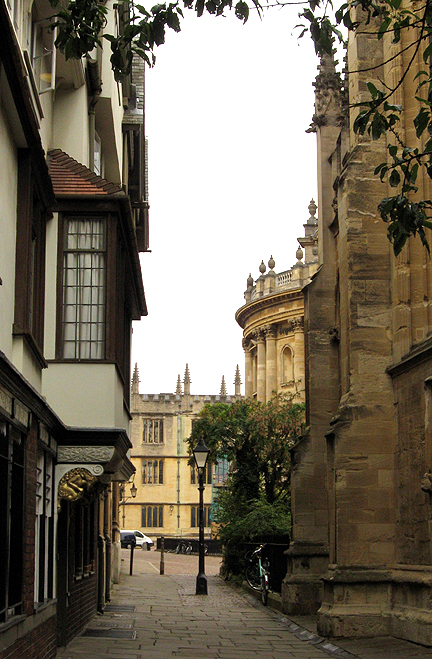
Walking along Saint Mary's Passage, en route to the Bodleian Library, Lewis noticed the juxtaposed faun and lamp-post which influenced some of the symbols which appear in the "Chronicles of Narnia."

C. S. Lewis was one among a great many souls whose cultivation found fertile ground at Oxford. Paths crossed depends very much upon a researcher’s area of study. My interests brought my steps to the Oxford of not only Lewis, but also of Tyndale, Wycliffe, Shakespeare, Shelley, Newman, Wesley, as well as that of the Inklings. A sense of past and present juxtaposed in these places is strongly evident. Contrary to the sentiments of much of our popular culture, that which is past is not necessarily dead and gone. Places and manuscripts from eras long ago become ever new as they are discovered and rediscovered. Realized knowledge is always current. Even Lewis, who drew from ancient literature as easily as he comprehended his own times, was well aware of the timelessness of wisdom.


Saint Paul reminded his readers in Rome about how the Spirit of God “quickens the dead, and calls those things which be not as though they were.” The breath, the pneuma, of spirit, infuses our being; it converts the static into the dynamic. When I consider having gathered glimpses of the spirit of Lewis, one encompassing attribute comes to mind, and that is perseverance. Studying his manuscripts while immersed at Oxford, I recognized a thread of individual tenacity and valor connecting the character and many-faceted works of C. S. Lewis. The spirit of Lewis testifies that learning and living must not cease- even at precipices of desolation. Perseverance in education is to be accompanied by continuity in the craft of synthesis: being harmoniously eclectic; being able to see present-day relevance in ancient wisdom, and vice-versa. Alongside skills in synthetic thinking, Lewis exercised his adventurous imagination. I must remember to do the same, to always remain open to the stirring of the Holy Spirit, available to the miraculous, the serendipitous.

Above: Strolling along Addison's Walk. Magdalen College in background.
Below: Magdalen College Chapel.

Lastly, Lewis articulated and lived an admirable form of facing fears- indeed, as any of us, having to improvise along the way. In the throes of grief, his faith was shaken, as it might happen to any of the best of us. We wonder at the tangible value of blind belief and whether our faithfulness is requited. Lewis created a subtly sinister character called Screwtape, who knew something of human pliability in times of vulnerability. In The Screwtape Letters, the character warns an evil henchman that “The worst possible thing that can happen to us, and that which glorifies our enemy the most (namely God) is when a man looks around and sees no reason to go on believing in God’s love and still believes anyway.” This phrase, spoken by Lewis through a fictional character, exemplifies the spirit of perseverance. There we find the spirit of saint Lewis.

I saved a last Maine seashell for the pond at the C. S. Lewis Nature Reserve.
After throwing in the shell, it was impossible not to notice the shadows' shape in the pond.

Writing in the same room, near the same hearth, about 55 years apart.


