Showing posts with label Saint Teilo. Show all posts

Wednesday, September 12, 2012

sanctuaries in wales


“My pen is not able to set forth
the solemn quiet awe, the calm,
serene state of mind that I enjoyed
for many days, so that it seemed
that I had gotten into another world.”

~ Memoirs and Journal of Hugh Judge, 18th century Quaker


We may well consider that moving through hours and days, connecting locations and occasions by our paths, a voyage of distances and way-stations has long been in progress. We need only to realize. There is a natural longing for safe havens, and these manifest in as many ways as we are individuals. Viewing the whole of living as a continuous pilgrimage, sanctuary may be found as easily in a café as in a cathedral. Opening my journal to write, during a hillside intermezzo, the book itself represented a shelter of worded thoughts. Pages already inscribed enshrine sanctified ideas and impressions. The subsequent blank pages to follow are as lands yet untracked. The recording of moments resides in the liminal, with freshly written lines shining back available light. Though not always conscious of our searches for places of tranquility, they are surely recognizable in our unguarded wonder.


Hardly able to believe I had reached the Pilgrims' Way- and North Wales- I made sure to do this.


______________________________________________


Above two images and sculpted icon below: Saint David's Cathedral, Cardiff.


By definition, one may well think of high altars, congregational solemnities and ritual celebrations, but in general sanctuaries include places of refuge as well. Where refuge is found, tranquility, safety, and respite are discovered; these represent oases from such forces as those which exhaust and endanger the soul. Over the years, I’ve learned to seek out such locations and situations; they are vital and necessary. Sanctuaries are places conducive to strengthening, pointing wayfarers to reminders of God, of consolation, of the value in the voyage.


Above: Bible Garden, near Bangor Cathedral
Below: Bangor University Chapel.


A sanctuary may be perceived as something pulling the traveller off the road and interrupting progress. It may look to all the world like unproductive destinations, but indeed, I draw needed inspiration to retake the road undauntedly. Fresh starts are crucial, however they are tried in fresh continuances. Beginnings have their references in my continuum of terra cognita, but my journey’s end ever remains unknown to me. What I can and must do, is to hold the wise course of living faith.


Penmaenmawr


______________________________________________


Above: The small chapel at right was used by the BBC for Dylan Thomas to broadcast his poems and essays, just far enough away from the bombings of Swansea harbor during World War II.


Life as an ongoing pilgrimage of trust provides context as I string together nurturing venues amidst the constancy of transition. It is a process of learning and growth. Times of retreat provide for places of strengthening, sending me into the stream again, so that I can face the world newly intact. With a mindset of sanctuary, large and unfamiliar spaces can become intimate, with reminders of the Holy Spirit’s presence.


Recently, while travelling by train, I looked up from my writing and coffee to look around at my environs. Passengers with their belongings, and rolling scenery through the windows, brought to mind how the train itself was a sheltering passage toward future places. Returning to the view from my window, my thoughts turned to what I call “discovered sanctuary,” which is how I describe the realization of being in a peaceful place- when sanctuary is found incidentally. Then, turning back to my journal, the book itself reminded me of its own intrinsic properties as a portable refuge.


Caernarfon Castle. The photo below is the site of the castle's chapel.
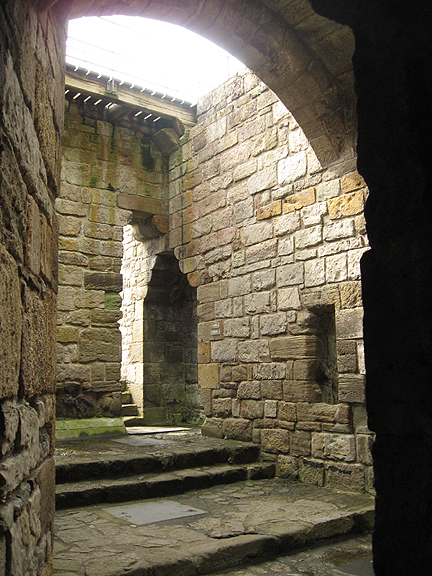


In Wales, my experience was very much an incidental succession of sanctuaries, no matter where I travelled- indoors and outdoors alike. My steps crossed thresholds of holy places, paths, and homes. Each encounter was wrapped around a sincere welcome, and I was sure to express my appreciation. My seatmate on a train in North Wales happened to be from the Isle of Anglesey. I asked him what his favorite peaceful place was, and he replied with the 6th century Penmon Priory; he described the “quiet presence” there, and how much he loves to walk the grounds. I followed his advice, grateful that I’d asked.


Penmon Priory, Isle of Anglesey. Yes, I was really there.


The hospitable openness to converse, which I found everywhere, brought my steps to sacred sites I may not have easily found. Fellow pilgrims I met along the way pointed out where I could find stone circles and cairns.


Ancient cairns, Carmarthenshire.


Circle of standing stones, Bangor.


Circle of standing stones, Cardiff.


While in Swansea, I was told not to miss the colorfully-decorated Saint Teilo’s Church, north of Cardiff and Llandaff. The plain exterior offers no hint as to the brilliant frescoes that are inside.


Saint Teilo's Church :


In Cardiff, my curiosity to see the 200-year-old Tabernacl Caerdydd found the doors open to this extraordinary and majestic Baptist chapel. I’d learned just enough Welsh for salutations, and the congregants and ministers graciously regaled me in English; the associate pastor told me about how he had been to Maine. The downtown Welsh-speaking church had been the parish of the famous preacher Christmas Evans. Standing near the historic pulpit, I looked toward stained glass illustrations of the spiritual graces.


Cardiff Tabernacle


An enduring memory occurred during the deep silence of worship at the Quaker Meeting House in Bangor. As the community settled into the customary waiting upon the Holy Spirit, a tremendous rain fell upon the skylights and windows, pelting with sublime and persistent percussion upon the whole town while we were warmly sheltered inside the sanctuary. Each place I visited left profound impressions that remain with me.


Above: Quaker Meeting House, Bangor.
Below: Quaker Meeting House, Cardiff.


Above: Sign of peace, in English and Welsh, Quaker Meeting House, Cardiff.
Below: Cardiff Synagogue. The inscription is Isaiah 56:7.


While dining in a small streetcorner bistro, a glance about the place once more brought the idea of safe harbor to mind. Not unlike the train and the chapel, the quietly humming eatery was serving as a sheltering hearth. Momentarily setting down knife, fork, and pencil, I heard the dulcet chimes of porcelain, teacups, and glasses mixed with a din of soft voices. As with most sanctuaries, this was a place of temporary recess for those who had arrived and will press forward en route to subsequent places. Waystations have the inherent property of being short-term habitations. Perhaps your own discovered sanctuaries come to mind, as you ponder this. And common to the sanctuaries I’ve found is the stilling message of perseverance.


Penmon, Isle of Anglesey.


Friday, August 10, 2012

llandaff pilgrimage


“The pilgrim oft,
at dead of night, ‘mid his orisons hears,
Aghast, the voice of Time disparting towers,
Tumbling all precipitate, all down-dashed,
Rattling around, loud thundering to the moon.”

~ John Dyer, poet of Llanfynnydd (18th c.)


A month of places, discoveries, roots, and souls in Wales were connected by roads, rails, and numerous miles of paths. Routing from the southwest back through Swansea and toward Cardiff, I chose to explore the capitol city only after a walking pilgrimage to Llandaff. Turning my steps, I was reminded of a ship tacking northeastward. Packed bags and filled notebooks had already accumulated treasures and impressions. By this point in the voyage, I’d grown very pleasantly familiar with Wales. Travelling and exploring does, however, have its fatigue factor- but this was a cathartic roadweariness. Journeying pilgrims inherently grow a bit edge-frayed, but appearances also become less important with each adventure partaken. Longer journeys allow voyagers to take stock of experiences while in the midst of travelling.


Along the road.


The River Taff, north of Cardiff, and entering the Cathedral Close in Llandaff.


The freedom to pace oneself differentiates healthful motion from the life of fulfilling demands left at places of employment. Travels that stem from a drawing-forth of the Spirit are by nature meditative. Ever a pilgrim of trust on earth, walking the winding miles of the Cathedral Road which begins near Cardiff Central railroad station, my thoughts raised skyward with “what do I really have in this world?” Not as deprivation, but an untethering. The ancient Psalmist that said “whom have I heaven but Thee,” has such present-day successors as those who set forth on foot en route to 1,500-year-old holy places and stop along sidewalks at book shops. The journey to Llandaff transitions from city streets to verdant landscape as the settlements wend their gradation from the 21st century to the 12th. Even with one of Wales’ most prominent pilgrimage sites as a destination, the way there is integral and to be savoured. Journeying from the place of heart’s longings is also actively observing and learning with each successive step. Alerted senses notice sights that can be easily overlooked.


Llandaff Cathedral.


Since the 500s, Llandaff (“church on the river Taff”) has been a place of prayer, beginning with Saint Dyfrig’s community. Saint Teilo (one of Saint Dyfrig’s students), whose remains are in Llandaff Cathedral, was the bishop of the community. His cousin was Saint David, the patron saint of Wales. Devotion to Saint Teilo can also be found in Brittany, which is the Celtic region of France- where a number of parishes are named Saint-Télo. A large 6th century stone Celtic cross outside the cathedral represents Saint Teilo’s times. Llandaff cathedral itself dates back to the 12th and 13th centuries, and has long been a place of pilgrimage. On top of enduring its span of tumultuous centuries, the cathedral had been severely damaged in World War II. The latter made careful and extensive repairs urgently necessary, extending into the late-1950s. The combination of abiding antiquity with phoenix-like ascension provides profound impressions for an advancing pilgrim.


This extraordinary and modern Risen Christ is at the center of an enduring ancient site. Nearby is a reminder of the cathedral's rebirth after World War II.


The roads into the town center of Llandaff lead to a mediaeval market square, from which paths descend through trees toward the cathedral. Towers and spires reach skyward, contrasting the sense of being in a riverside vale. Through ancient arched doors, the entrance steps down into the vast cathedral. Inside the cavernous space, paces connect ancient and modern shrines, reminders of events and lives, always with a wonder of this witness of assembled sculpted stones. Engravings and reliquaries remind me of the great cloud of saints that have preceded us. Large, decorated, handlettered Bibles are kindred ancestors of the printed pocket New Testament in my backpack.


William Morgan was a 16th century Welsh Bible scholar and translator.


Circling the cathedral altar slowly was an experience of having arrived at a very central place. Pilgrimages have destinations, though true to a life of passage and traversal these terminus points are waystations. Along the paths to these sites, I was well aware of the trails as having been left to the present by pilgrims of old. Following the flagstone steps with reverence, I also know that my own journey is unique, as it is the one upon which I have been doing the travelling, and the way of my navigation.


From the Cathedral Green to the High Street, the town's essentials are found. The post office (below) is also a stationer- with toy dragons in the window.


Llandaff cathedral gives the small town of its environs the qualification of city. Asymmetrical streets and houses nearest to the cathedral are the oldest, with a blending of mediaeval and Tudor styles. Fortunately, the ancient market and cathedral square is not interrupted by traffic thoroughfares. One of the roads emanating from the center is the Llandaff High Street, along which are shops and tea rooms. Not to be missed, essential pilgrims’ waystations are places of nourishment. With many miles already walked, and more to go en route to Cardiff, a needed pause was taken to taste of Saint Teilo’s town.


A savoury feast fit for a pilgrim, on the Llandaff High Street.


Now, my writing friends- after window gazing at the tools of our profession, wouldn't you look twice at the street sign below?.


Strengthened by the short respite, the road resumed. From stone and earthen paths, to lanes, streets, and the A4119, continuing on to Cardiff, the way rejoined the busier city paces. With some doubling back, various landmarks were recognizable to me. I’d also become accustomed to the low-mounted street signs often affixed to walls, instead of the high-posted intersection signs in North America. Looking ahead to the capitol city reminded me of my eventual return from these remarkable travels. There are always subsequent journeys to anticipate. For the moment, however, new acquaintances with ancient sacred sites and saints provide enduring gratitude. Docks, downtown avenues, and colorful Victorian arcades were awaiting at the other end of the Cathedral Road.


The Llandaff end of the road to Cardiff.