Showing posts with label radio. Show all posts

Friday, September 29, 2023

more than this

“I'm hearing right and wrong so clearly
There must be more than this.
It's only in uncertainty
That we're naked and alive.
I hear it through the rattle of a streetcar;
Hear it through the things you said.
I can get so scared.
Listen to the wind.”


~ Peter Gabriel, That Voice Again


Major efforts are composed of small measures. This often occurs to me, when in the throes of processing large archival aggregates out of many thousands of single components. Years are made of days which comprise hours. A friend talked about their job search, comparing it to throwing big rocks at a wall until it crumbles. That’s the desired outcome. Thinking of the present as an indefinite trial, linking unresolved days, generates its own brand of exhaustion that only loads more upon existing burdens. I try to avoid doing this, but like any forward-moving driver, I must check all gauges and mirrors. Patience in tribulation is essential in these staggering times.


Now 13 months into housing displacement and its accompanying instability, there remains no rest for the weary. As my friend with the wall metaphor, there isn’t a day without searching and inquiring. And constant, earnest prayers. It’s how I push back against oppression and thwarted hopes. Other vital tactics are to persevere in my studies and writing; these are solid sources of inspiration and means to higher goals. Such things are extremely hard to find; if you find literary sources, forms of creative expression, and devotions that uplift (instead of “dumb down”), hold fast to these things and grow with them. Keeping vigil for better situations parallels my interests in learning and trying to understand the broader world. For many years, I’ve started each day with radio-accompanied ablutions and coffee. During my graduate school years, that routine would typically begin at about 5am. In high school, it was New York City’s Newsradio88; life in Boston and its orbit got me into 1030-WBZ. Invariably, the repetition of basics and ads sends me to the checkerboard realm of religious radio. At the tops of hours, I bounce back to WBZ for much less-stilted news. Within that minefield, however, are a few edifying and useful homilists. Most of the preachers are terrible orators, sounding to my New Englander’s ears like something between auctioneers and Huckleberry Hound. But this professional archivist can separate wheat from chaff. Radios can always be switched off, too, as much as I’m intrigued to hear what’s out there.


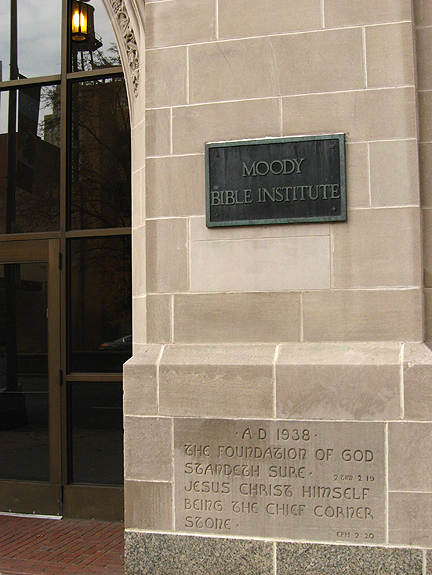
Among the more scholarly and nonsectarian Christian resources are the broadcasts from Chicago’s Moody Institute. Recordings of the late Rev.Weirsbe’s brilliance, delivered with his gentle Midwestern lilt, continue to outshine almost all of what proliferates. The successor to Weirsbe is Moody’s Rev. Lutzer, also with an academic and folksy yarnspinning style, though much more stoic than his predecessors. Well, on a recent workday morning with hot water running and coffee on the bathtub’s edge, I caught one of Lutzer’s installments on his theme, Making the Best of a Bad Decision. I’ll add that many of us must make the best of other people’s bad decisions. Can I get an Amen? Back to Lutzer. Through the noise of first-thing scrubbing, I heard the radio voice beckon, “If you’re still alive, God isn’t through with you.” Surely he wants to encourage his listeners, but considering my state of affairs of recent years, I can easily look at those words ambiguously and through my snowballed sarcasm. Sometimes I do, yet the resultant bad feeling makes me take it back. Reverting to a bleary-eyed positive, my leanings reach inward and upward, through my imagination. That’s my supplicatosphere, which is the stratum immediately beneath clouds of unknowing. “Through with me,” in the wrong context, sounds threatening; but in a healthier frame of reference, my wish really is for Divine intervention. Why is grace deferred? Did I misstep? How am I supposed to know, if nobody tells me? Have I overstayed my welcome? Perhaps I’m inhabiting the very attempt to comprehend the meaning of hope.


While trying to glean insights about things eternal, I’m also constantly reckoning with the ways of mortals. Recently with my philosophy students, I taught about the Golden Rule, framing this in the context of ethics. Our group discussion, probing the time-honored “do unto others as you would have them do unto you” went right into dilemmas about what happens when there isn’t any reciprocity for our respectful acts. Do we keep on being honorable and forbearing, or do we conform to the hardball tactics that confront us? You can imagine our very lively Socratic forum discourse. Whatever we do, we need to choose our reactions and responses. Generally, there’s the trigger end, and there’s the barrel end. Are you the issuer, or are you the inflicted? When so many critical factors are out of our control, what is within a person’s reach? With each day, questions arise in my thoughts as to whether landlords, employers, and community leaders should care about their inhabitants and “stakeholders;” in a word, neighbors. Perhaps it’s unrealistic to expect such people of influence to care, as I care. Ever the cockeyed idealist, I believe everyone should care. That’s how things stand a chance of changing for the better. A genuine sense of respect, even in simple transactions, runs against the currents of pessimism.

Just the other day, I helped a researcher with a query so complex we needed to go back and forth rather extensively in order to unearth the actual question. Having some specifics that mutually made sense, I set about producing what I could find to help this fellow. In the midst of my retrievals, the man frustratedly stormed out of the research room. While I began putting the materials away, he returned and apologized. “I’m sorry,” he said, “I think this world of instant gratification has gotten to me.” He pointed disdainfully at his smartphone. After expressing my understanding, he sat down to read through what I had found, and we talked about his projects. His initial and abrupt impatience was disappointing, but his later presence of mind was impressive. In a handful of minutes, I witnessed metanoia- on both our accounts. Reflecting upon this, later in the day, I was reminded about a barely-known spiritual exercise called examination of conscience. I use parts of my daily journal writing for this purpose, considering such writing as the safest space for articulating thoughts. “Make an appraisal of the entire situation,” wrote Francisco Fernandez Carvajal, adding that we must know what means are available to us, and how to be faithful and thorough. In addition, we must also contemplate how we can remove obstructions in our intentions, as “knowledge of self is the first step the soul must take in order to arrive at the knowledge of God.”


Collecting and digesting knowledge comes very naturally to me, always taking notes. My notebooks become reference sources themselves and they’re great for me to reread when distractions throw my studies off course. These many pages of annotated gleanings remind me of the philosophical texts I’ve been so carefully reading, while struggling to prosper above the fray. As it is with examining my conscience, there must be focused intention to transform head-knowledge into heart-knowledge. What is there for me to learn, from my experiences? “When a person accepts a great undertaking,” as Carvajal recommended, “they must consider various possibilities and look for the opportune means for bringing the work to successful completion,” adding that “we have to be aware of what is lacking so that we can ask God confidently.” In my repeated recoveries from rejected applications, trying to figure out my deficiencies (because reasons are never specified), while left to figure things out I remind myself that more attempts will be accompanied by more failures. More at-bats increase the odds of striking out. Yet still, and even now as the setbacks persist unabated, my efforts continue and amplify. It’s imperative. The here-and-now is at once stifling, uninviting, and tentative; it’s more than enough to keep the search coals stoked. As an extension of my certainty that all we see is not all there is, during the present drudgery I’m convinced there is more than this, and the accumulation of my being is meant for better and more conducive circumstances.


Thursday, December 1, 2022

radio silence

“And after the earthquake a fire; but the Lord was not in the fire:
and after the fire, a still small voice.
And it was so, when Elijah heard it,
that he wrapped his face in his mantle,
and went out, and stood in the entrance of the cave.
And, behold, there came a voice unto him, and said,
What doest thou here, Elijah?”


~ 1st Kings 19:11-13


Refuge, these days, has become entirely a state of mind. The most critical aspect resulting from the loss of my housing is the absence of physical sanctuary. Chased from our respective homes in the recently-sold apartment building, my neighbors and I suddenly had to find places to live. Some moved far away, most to various parts of this region, but all reluctantly. With employment in mind, precarious as that is, I’ve managed to stay in the city, yet at a heavy price and in an inhospitable place. Along with many of my fellow Maine workers, I’m an offer or a loss away from leaving the state. The grim reaper’s name is Gentrification, nipping at the heels of most of us, regardless of how industrious and loyal we’ve been. For the unwealthy, things are closing in. Looking around my tiny, temporary quarters, filled with boxed belongings, the closing-in is blatant and suffocating. There remains a great need for refuge, above the din of discomfort and anxiety- all the more when assurance continues to be out of range.


Silence, like music, is received and internalized uniquely by each individual. There is a silence beneath surfaces of desolation, of deprivation. There are also qualitative, nourishing silences which soothe the soul. The latter is obviously the sort of quiet that is welcomed and desired. I cherished this long before it became elusive- as it is now in the temporary space. Healthful quiet is a treasure; if you have this in your life, count it as a major blessing. Throughout the recent months, my search for a sense of peace has meant going outdoors to breathe and stretch- often closing my eyes and awaiting those measures of grace. I’ve noticed myself doing this at bus stops, as well as during the late hours after the stomping, thrashing, and television racket overhead finally gives out for the night. It’s a daily staggering for peace, as though on a frenetic and exitless highway. When my friends tell me how “this too shall pass,” my response is “when?” The search continues, to be sure, notwithstanding how consolation, peaceful living space, good job ops, and spare money are all equally scarce.


The constant and compulsive clatter reminds me that many people are afraid of silence. And just as many are unaware of the existence of others in their midst. Aspiring to be compassionate, it is essential to be forgiving of the inconsiderate. After all, somebody needs to be aware of the unaware. As this life is in preparation for eternity, here is the time and place to refine the ability to forbear. But as a flawed mortal who finds forbearance unbearable, I try distracting with noise-canceling headphones (which I can hear through), listening to music, running a household fan, and turning to a lifelong friend: radio. As with any means or instrument, it is for each listener to discern and discover that which suits. Due to all the noise in the building, I’m applying a dulcet layer of classical music to try masking the din of disturbance. My less passive form of listening happens when I seek out noteworthy programs and lectures. If the bulls-in-their-china-closet are too disruptive, especially when they rattle the walls, I’ll use earphones. Amidst the chaos, I’ve taken many inspiring notes from timely broadcasts. With all of this mentioned, when I sense a late night hour when the building falls silent, I’ve noticed how I turn the radio off- just to savour the silence. My shoulders and brow noticeably settle back. It’s the good silence.


The expression, radio silence, has migrated from its technical origin to popular parlance. A command to “go radio silent,” generally meant stopping any transmission due to security concerns about signal interception. This was also employed so that a weak distress signal might be detected. Whatever the case, radio silence is when no broadcast signal is transmitting. In our common discourse, one can remove themselves from interactions, or withhold specific information. If there is a receiving end awaiting a message, there is no signal- just air- and the listener is at a loss for knowledge. Radio silence then becomes a not-knowing. Turning up the sound only reveals static. One might as well switch off the radio, although doing so eliminates the possibility of picking up a signal later. Waiting and potential are intertwined concepts. Non-broadcast air space and static often follow housing and employment applications, often known as ghosting. Inquirers disclose personal information and credentials, and anticipate responses that never arrive. The passage of time accompanies the radio silence. Companies and landlords never worry about offending anyone; they seem to have all they need.


The luxury of enacting a broadcast silence of my own is an tempting idea, especially as I embark upon my 33rd straight month of being a one-man department at the pared-down workplace. It’s been an even longer time since it’s been possible to make the kind of monastic sojourn that I’d take twice a year. The pandemic era has comprised a marathon of work and workarounds for lots of us, but I’m very thankful to be working and managing my expenses. I’m always aware of those who are much worse off. Yet even with a sense of broader context in mind, the prospect of a healthful pause would be an oasis somewhere along the unknown way. This is among the topics of pondering while awaiting late buses in frigid, pelting weather. If only all the inflictions ceased, perhaps just long enough to not have to try being a perfect applicant, or with providential buffer space that is free from brutish situations. Or if things cannot stop, maybe they can noiselessly coast along like those fancy electric cars I’m seeing in the East End. The present experience emphasizes how contemplation needs the respite of quiet, or at least the ability to think above the din. Without the resources to create a large landscape, I can make small snapshots. Until substantial traveling becomes possible, there can be modest spans of reflection. Writing outdoors these days happens in colder weather, but I still make sure to intermittently set the pencil down and look skyward. If anything, doing this helps my perspective. Being attentively aperch is a shorthand regathering. Assiduousness is among my favorite words: rooted in the Latin assidere, it is to sit down by one’s attentive initiatives. Hardly the vacuum of radio silence.


The purgative passage of the soul into darkest night comes to mind in radio silence. There is a receiver that is scanning, attempting to tune for an elusive transmission. Indexing across all available bands, adjusting antennae and power supplies, no signal can be pulled in. The crepuscular radio silence of the spirit lends itself into questioning whether there is a signal at all. Temptation in the desert. Faith says there is a frequency, despite my flailing attempts. Atmospheric conditions can change to something more favorable, so it is critical to keep tuning and hold course. But the when is exasperatingly unknown. Too much time has been wasted. Waiting is anguishing; it is neither passive nor tranquil. A thread running through these times is surely the learning and testing of confident poise. Struggle is a necessary given. We are conditioned to reserve gratitude exclusively for times of success and goodness. The challenge is to maintain that vital resonant circuit in desolation, when there are no soothing broadcasts or music. Gratitude in the radio silence. As well, being a discerning listener means not adding any obstructions of my own.


Sunday, November 29, 2020

thought


“Toute notre dignité consiste donc en la pensée. C’est de là qu’il nous faut relever et non de l’espace et de la durée, que nous ne saurions remplir. Travaillons donc à bien penser: voilà le principe de la morale.”

(“All our dignity consists, then, in thought. By it we must elevate ourselves, and not by space and time which we cannot fill. Let us endeavour, then, to think well; this is the principle of morality.”)

~ Blaise Pascal, Pensées, 347


provisioned and purposed

During these times of bunkering and hunkering, it seems many have been brought to consider the practical meaning of self-sufficiency. We need the comradeship of one another more than we may have previously realized. Many that have had to navigate this world in these recent months have seen how individuals’ safety precautions are mutually much broader safety precautions. My safety is equally your safety, too. Yet it may be instinctual for us to form ourselves and our lives toward goals of having everything we need. Is preparedness about survival, or is it more about fear of not having enough? And does the latter cause us to hoard more than is needed? Do we need to prove our self-sufficiency against a fragile security with abundance? All questions for an observer of a world of billions of little islands that long for connecting bridges. It has been crucial to find one’s own definition for preparedness. An expression like take care has derived a wishful connotation that has come to parallel the post-sneeze God bless you which originated during medieval plagues. Being prepared and provisioned is a motion toward continuity- toward survival and emergence.


As it has become vital to my own approach to survival, I’ll shift to a lighter musing- on this occasion, about provision. Since my childhood years, I’ve always been fascinated by intricately inclusive “kits” that provide all that is necessary to complete a task. By this, I mean a portable receptacle that can be taken to various locations so that you have what you need to accomplish a project. A first-aid kit wouldn’t quite fit my definition any more than a flatware drawer: these are gatherings of items to keep you going. I’m thinking much more along the lines of my tacklebox of archival conservation tools which I take with me to do fieldwork in libraries and museums. The box filled with tools I’ve gathered over the span of two decades contains what I need to solve just about any preservation problem. The spatulas, bone-folders, knives, tongs, cleaning instruments, gauges, among other tools are the “constants,” to which I’ll add rolls of various papers, board material, and even cameras- depending upon a specific project. It’s also at the heart of all my conservation workshop teaching. The box is always packed and at the ready, being a quintessential inclusive provisions kit.


Another everything-kit which I keep intact and at-the-ready is my larger tacklebox packed with all that is needed to do and to teach calligraphy. Many of my lettering projects are done on-location, including countless makerspaces I’ve led. It’s also easy for me to simply set the box near my desk, as everything’s gathered together and portable. The calligraphy box has many multiples of pen-holders, nibs, inkwells, and numerous related tools, so that I have what is needed just for myself- along with plenty of extras for others when I am teaching groups up to twenty people at a time. As with the book & paper conservation box, the calligraphy box has traveled many miles with me. On several occasions, I’ve journeyed with both kits to large teaching events at which I’ve taught both subjects. Indeed, there are more “free-standing” kits to mention, involving photography, writing, and sewing- as examples.


a thought kit


In ways that are similar to how we can outfit ourselves for purposes that are best accomplished with a supply kit, what about our thoughts? As we navigate life- especially amidst our respective isolated experiences- can a ready thought kit be appropriately stocked? We do, after all, carry our thoughts with us; consider how we naturally “collect our thoughts,” while trying to make sense of a situation. Recollection is one of my favorite words, particularly in the contemplative context of attention to the presence of the Divine within the soul. In addition to carrying our thoughts with us, we can also choose to “tap into” our thoughts, “calling to mind” impressions, memories, and ways of thinking. Very much as it is physically when assembling the essentials for a comprehensive tool kit, there are surely spiritual disciplines when deciding which thoughts are the best ones to keep in one’s conscientious stock. It also means making room by discarding and replacing various supplies that become outmoded and dulled.


There are certainly more “terrestrial” ways to curate knowledge to benefit our thinking processes and memories. Along with daily journaling, I’ve maintained a parallel run of chapbooks in which I jot down thoughts and found quotations. I’ve even digitally indexed a number of these chapbooks, to make things easier to find later. I transcribe my research gleanings from my travels, and back up the documents in ethereally-titled “cloud storage.” As well, two favorite pieces of digital technology are my portable netbook and a good spacious flash-drive. While I view these as tools themselves, and also as supply-kits, I’m well aware of the care needed to keep things intact and accessible. These are not necessarily thoughts, but surely aides-mémoires.


Among his many written thoughts, left to posterity on hundreds of small leaves of paper, the philosopher Blaise Pascal made thought a topic in itself. He affirmed how humans are capable of thinking at levels beyond all living beings. “Pensée fait la grandeur de l’homme,” which is to say “thought constitutes the greatness of humanity.” To think- to carefully and thoughtfully consider- is essential and is the means through which our greatness proceeds. Pascal elaborated that we humans are more than mere sentient creatures:

Man is but a reed, the most feeble thing in nature; but he is a thinking reed. The entire universe need not arm itself to crush him. A vapour, a drop of water suffices to kill him. But, if the universe were to crush him, man would still be more noble than that which killed him, because he knows that he dies and the advantage which the universe has over him. The universe knows nothing of this.


Evidently there are reeds, thinking reeds, and minds like Pascal’s. Here he speaks about the paradox of our fragility and the enduring transcendence of our thoughts. In this transcendence, we do file our unique thoughts and accomplishments in the archives of our souls. Our most refined and substantial thoughts can be easily dissolved, but the spirit of our cultivation lives beyond finite days. We ponder fleetingly about eternity. The extent or the duration of thoughts cannot be known by an individual, yet so many of us, like Pascal, unhesitatingly make intellectual investments. It is undoubtedly worthwhile.


thoughtfully equipped

Being equipped with a multi-tiered kit of curated thoughts, the supplies are meant to be used. Theory meets practice when learning meets the road. Attentiveness to observation can be refined into applicable treasure. But it’s easier said than done, to be sure. During this protracted pandemic, that carefully constructed trove of thoughts is put intensely to the test. What are the recollections that right the ship? Deep into the wilderness of bad news, misery, and barricades- we must dwell upon things that console and help light the way. Although most of this past year has offered no opportunities to venture out as I’ve always liked to do, the venturing has had to be inward. New learning and new thoughts can certainly be pursued and noted; I’ve been doing that as much as possible with my existing resources. There remain thoughts to be held every day. I continue looking forward to the prospect of writing about these times in retrospect. Between my apartment, my workplace “bubble” (at which I spend 2 of my 5 workweek days), and my few and critical errands, I also make time to maintain letter correspondence with friends. We write to one another, each from our own circumstances of exile. Much like listening to a calming radio broadcast, the letters I receive are living messages from another world.


spare parts


Provisions of the spirit are not always necessarily major concepts or “large events” committed to memory. My own stock of inspiring impressions consists of what I call spare parts. Subtle enough to fit between events and complexities, spare-part thoughts can be equated with cooking spices at the ready as a pinch or a dash may be needed. They are in the forms of things said to me, words I’ve read and remembered (and very likely written down), as well as images engraved in my memory. One evening last week, I called in to my friend Jordan Rich’s radio programme, broadcast from Boston, when he brought up the topic of writing and correspondence; this was a way to chime in and cheer him on at the same time. A parallel thread about gratitude gave me a chance to speak to a cherished spare part. He asked about causes for thankfulness, “and not the big-ticket items, but things you might be taking for granted.” I spoke about literacy, being grateful to know how to read and write. That’s a source beneath the source-material. Subtle as it’s been through the years, literacy is a profound blessing during these times of isolation.


Various friends tell me about seeking calm by focusing their thoughts on the “happy places” of their memories. There’s a lot of good sense in this, and I do some of that in my journaling as I seek healthy distractions these days and nights. These are certainly occasions for reaching for both the big-ticket reminders, as well as the more covert spare parts. I appreciate reaching for the wise words of compassionate people I’ve known. Years ago, I worked at a college which had been founded by a women’s Catholic religious order. The campus ministry was led by the sage and elderly Sister Sylvia, a mentor who taught me something about mentoring: she would say, “I won’t tell you what to do, but I’ll walk alongside you.” Metaphorical as that was to say, she is one who likes to walk. I have a vivid memory of how she would walk across the green quads of the campus with her rosary. She called this prayer-walking. Contemplative and practical. And praying the rosary itself is a plunging into the depths of spiritual memory, using the increments to find context in the timeless. Like Sister Sylvia who encourages generations of listeners to “shine that light,” holy writ comes to thought from everlasting with “walk while you have the light.*” Between there and here are the words of Sant Joan de Déu (San Juan de Dios), of the 16th century, urging us to keep going and “do all the good works you can while you still have the time.” Even from places of isolation, and even when the machinery indefinitely needs all the spare parts in the kit.


_________________________
* John 12:35

Monday, November 2, 2020

sound

“A person’s music is seen as a means of restoring the soul,
as well as confused and discordant bodily afflictions,
to the harmonic proportions that it shares
with the world soul of the cosmos.”


~ Plato, The Timaeus

While pandemic life has grounded elaborate plans and ambitions, simple attainments are also made difficult. Now thinking back through eight months of triage, distancing, and working amidst bunkering, I make note of the narrowed horizons. My optimistic travel plans drawn up last winter were humbled into crosstown errands. Indeed, I’m merely one of countless many that are scaled down to the brass tacks of personal safety and the earning of sustenance- all within the context of isolation. Hopefully it will not become necessary to have to choose between the two vital aspects of health and employment. It takes as much vigilance and resourcefulness to stay productive as it does to keep well. But as time irretrievably passes, though it may appear as such, quite clearly nothing stands still. Time continues cascading over all the stopped progress. There is so much to accomplish, but very few things can actually be done. The focus is survival.


Even at the outset of these times of lockdowns and related hardships, I noticed the prevalence of contrasts. As social malevolence manifested and broadcast itself, those who chose generosity emerged as bright exceptions. Humanity scrambles between the extremes of exploitation and mercy, while the natural world keeps vigil. And in this portion of my own vigil, as I keep watch in this night, my thoughts turn to the place held by sound in these times. Just as I recall the completely silent skies immediately after the 11th of September 2001, the first and most eerie aspect I noticed as the world began locking down in March was the desolate quiet of the streets.


The absence of sound is cause for notice, and so is the welcome presence of assuring sound. But this is surely not to say that quiet cannot be comforting. Just as there are welcoming forms of silence, there are also pleasant sounds. Several nights ago, the transformation into the late-autumn became pronouncedly audible to me, as I was awakened by wind and rainstorm-rattling windows. It was a reminder of sounds I’ve always liked. Soothing sounds provide an effect resembling fresh air. It’s a calming, accompanying presence. Indeed, not all sounds have these properties- even in the same categories. Radio, a lifelong companion, can be as much of a conduit of good reminders and wonder as it can be a prism of abrasion. A few weeks ago, I listened to Schumann’s Forest Scenes for the first time, and was so taken by the music and its performance that I stopped working so that I could better savour the sounds. I have a rather irrational habit of looking at the radio, when I want listen more clearly; I looked and listened. This particular radio station does not always broadcast music I find appealing. Normally, it’s a kitchen sink of classical pop: lots of martial-sounding rat-a-tat-tat “classical” orchestral music- regardless of time of day or night. Contrasting the sounds that I find to be sweet and textural- with cellos, harmonies, and counterpoint- are the pieces I call “music that needs to be oiled.” That latter category speaks for sounds that are scratchy, whining, and cacophonous that cause me to switch stations- or just choose some silence. It doesn’t make sense to opt for more annoyances than what already exists, especially in this chaotic era.


Pythagoras famously said, “Either be silent, or say something better than silence.” And by my lights, in this context, better is to say: consoling, life-giving, or perhaps even constructive. Surely a subjective and highly individualized definition. The quiet at five in the morning, with my coffee and breviary, is an expectant silence pointed toward newness and hope. A sound as subtle as the dulcet hiss of cars passing along my street is something I find soothing. So is the wind through the trees, familiar soft voices, birds, the scribing of my writing on paper, my percolator that converts sound into aroma, my landlady’s footsteps from upstairs, and foghorns from the waterfront. Part of why I’ve always loved walking and perching at the ocean’s edge, aside from the vistas, are the sounds of the water. The tides will determine the forces of crashing waves, along open seas. Then there are the sheltered inlets, with much quieter stirrings. With eyes closed, my imaginings are of an affectionate ladling of a large seaweed soup, the rounded stones clacking under the waters’ pulling. Such sounds transcend pandemics and hardships. Beyond material provisions, resourcing myself also includes knowing where to find consoling sounds.


The light and weather of November suddenly brought to mind one particular long-distance road trip I made. Having to cover 1300 miles in 2 days, I drove more than 750 miles in a straight shot, with just 3 brief fuel stops. The highways between western New York State and northeastern Ohio were imperiled by a fierce winter storm, but I reduced speed and stayed my course. I kept the windows defrosted and the radio on, gripping the steering wheel and bonding with my rental car. Finally reaching my planned destination, parking in a snow drift next to a hotel and shutting off the engine, I instinctively closed my eyes. The driving was intense and my catharsis was equally pronounced. Walking to a nearby diner to decompress and replenish, the restless fatigue was later finally solved when I saw that my small hotel room had a real bathtub. Part of that perfectly consoling and soapy hot bath was in the sound of the water, reminding me of home, while the winter weather continued pelting at the windows. Before retaking the road the next morning, I dined with fellow guests in the breakfast room.

The hotel, on the following morning.


Sharing meals with strangers in a common room, replete with convivial sounds of voices and crockery, is now an impossible enjoyment. Surviving the pandemic has brought about alienation from our travels and from one another. The timbres and tones of humanity are severely curtailed. The last time I was compressed in a crowd was in late-February at Boston’s North Station. My thoughts were not occupied with contagion, but rather with getting a good seat on the train. Nobody would’ve expected that crowd noises would become something rarified. And so rarified that when major league sports resumed to play their abnormal and abbreviated seasons, they would be doing that in empty arenas against the backdrop of canned crowd noises (to audiences of cardboard photos of spectators). Listening to some of the baseball games on the radio had me wondering about broadcast technicians splicing together enough sounds of sports fans to create many hours of banal background noise. What an odd testament to the greater oddness and unreality of isolation. It also attests to how important pleasant and assuring sounds are to so many, reminding us of our wishes. We search for comforts while carrying a nostalgia for a better future. Within the need to be resourced for survival is our comprehension of sound: choosing away from what injures the soul- as much as possible- and choosing toward strength and inspiration.


Thursday, January 10, 2013

songs in the night


“He said within himself-
Surely, if men be tried and troubled exceedingly,
it is because, while they think about their troubles and
distress themselves about their fears, they do not say,
‘Where is God my Maker, who giveth songs in the night?’”


~ Charles Haddon Spurgeon, Songs in the Night


Winter winds have returned recollections to me that highlight reminders of many late nights ago. In the process of becoming a self-possessed high school student in the early 1980s, I developed a habit of staying awake late into the night. Being the only soul awake in the house, I’d perch at my desk with school art projects spread on the surface- with the radio nearby. The volume was kept low, out of respect, as well as to enjoy the quiet. Even New York City tones itself down very late at night. My tastes have always tended to times long preceding mine. History and depth were always understood to be intertwined. After all, une histoire means “a story,” too. Elder teachers, family members, and neighbors had the most captivating stories with matching dramatic recitative voices. Coming of age at a crossroads was somehow clear to me, and I would ponder this during my midnight musings, already longing for more warmblooded times. In the graininess of night, books, outer clothing, and satchel rested still as granite, but the radio was on. Before AM broadcasting became fully infested with political pugilists, much of the programming gave airspace to local commentators. New York’s abundant airwaves were resplendent with stories, reminiscences, and musings- in between round-the-clock news stations and music. Perhaps the older radio personalities also thought themselves at crossroads.


Listening to calming tones eases the environment and creates an oasis in time. Indeed, as sound is involved, spoken and musical content must soothe, lest the frequency be changed to another station. In my farthest memories- and there still exists some of this today- I’ve enjoyed live broadcasts during which the radio hosts reflect with anecdotes, or converse with guests, or place verbal interludes among music selections, or address the audience as a counterpart. “How in the world are you?” was how King’s College president Robert A. Cook would begin each of his radio offerings. The more interesting commentators display a signature style. Some have been able to make their commercials into entertaining extensions of their shows. Art Raymond, on WEVD, would advertise sponsoring eateries and tell the audience what to order at these businesses.


During dark and solitary hours, the earth and all its life forces continue unceasingly. I knew this from my window, at my desk, with the radio on. Such diversions are able to distract individuals away from making life’s boundaries into something as narrow as a table surface. My radio imaginings would include picturing the sources of the broadcasts. Studios are ensconced in large downtown office buildings, with announcers and technicians awake through the night hours. Some of them tell us how cold it is outside, and about traffic patterns on the roads and bridges. Through all the textbook diction, I could detect local accents. I remember how I could hear Richard Gladwell puffing on his pipe amidst gentle narratives within his classical music show. To this day, I often look at the radio while listening; perhaps many others do this, too. The gesture is similar to that of respectfully eyeing the person speaking to you.


This Philips radio from France has the perfect home in my apartment, with a slanted back
that exactly matches wall's angle.


Among our treasures we find our own iconography: gifts, heirlooms, and the finds that for us mean more than their surface appearances. Indeed, material is inherently temporal, but meaning is transcendently enduring. Only through personal experience can the iconographic aspects of places, things, sounds, and even thoughts be discovered and realized. It is for each of us to comprehend meaning and grasp that which is solid in our spirits. Radio is at least as endlessly fascinating to me as it is to see a photographic image manifest in a tray of developer. Even after all these years. There are technical and scientific explanations for these processes, yet the magic of retrieving sound signals from the air exceeds rationalization.


A radio’s purpose is to clearly receive a range of frequencies, and it must be tuned and positioned to make reception possible. And the goal of the radio’s purpose is for a person’s ability to listen. Radios have no memory. They do not store their commodities. Like cameras, they are instruments designed to register the moment. If such objects are considered in an iconographic context, we can ascribe our personal memories to these instruments. You may see a Realistic Chronomatic 9, but I always see the 15th birthday gift from my father. He offered to buy a television for me, but I said I’d rather have a radio. Over the years, I’ve added a few antiques, and find it remarkable how well they continue to work daily- thus defying the culture of manufactured obsolescence.


Providing company at work. The G.E. radio (top right),
a gift from my lifelong best friend, has accompanied me
through schools, studios, apartments, and many workplaces.


From my nighttime desk, the warmth of quiet music emanating from my radio aperch by the arching lamp, the new year stretches out before me. True to ascribed iconography, the small Grundig on my desk is understated yet far-reaching. It reflects this very instant, having neither past nor future. Yesterday’s news, scores, and statements are forgiven. Brightly through night hours, sounds of Mozart sweeten the horizonless abyss. Its life is a constant update; times and temperatures are always of the moment. The parable of the radio is one of receptivity and discernment, with static cleared away. Winter’s deeps remind us that above reportage and ads are angelic messengers bearing words of assurance. Mystery steeps our midst, and we’ve but to merely acquiesce.


A bright morning near the radio at The Palace Diner,
in Biddeford Maine.


Tuesday, February 14, 2012

heartsong


“Whistling in the dark,
I see the lights all over town,
And I keep walking up and down,
While I am whistling in the dark.”


~ Bert Ambrose, Whistling in the Dark


Tuesday, August 16, 2011

vessels


“Être toute la vie
porteur de joie
et de la paix.”


~ Frère Roger, de Taizé, Un Avenir de Paix


As I begin writing these words, my hands hold the notebook and pencil which are supported by a table and flooring beneath my feet. The cup in front of me is a vessel holding coffee. A shoulder bag hanging over the back of my chair holds books and workday provisions. The wallet in my back pocket contains a little bit of currency, and my calendar book holds the week’s receipts and listed commitments. My journal notebook is something of a carrier itself, and as it gets filled with words and experiences, the book itself seems to transform. These examples speak for just a few of the vessels immediately seen. Perhaps you may be able to glance from your reading to notice a few vehicles, or containers, or bearers which move their respective transitory holdings. We bear- or carry- ourselves about, recalling that our physical standing may be referred to as our carriage. In French, being the porteur can mean one who is the deliverer of an item, but it is also the word for one who is supporting. An ordinary day is replete with vessels, with compartments that transport. What are the messages we are delivering?


One of my many adventures involving archival fieldwork brought me to the small town of Wilton, Maine. I’d been hired to spend several work days there to organize their local manuscript collections and train a group of volunteers to continue the process. It is always a true labor of love and an honor to be called upon to help preserve the documentary heritage of my home state. By phone, in advance, I’d been told about a Civil War “secretary” by my hosts in Wilton. Once I arrived, I found out what that was. Apparently, so did a crowd of townspeople; they were told the archivist would know how to open the mysterious 19th century box, then we’d all find out what was in it. Immediately, I was set to the task- and fortunately by moving the desktop-sized polished wooden box on my lap, I was able to find the series of concealed inlaid rods which required some pressing-in so the lid could be opened. The box had been the portable desk of a Union Army officer who hailed from this little Maine town, and inside it were his spectacles, gloves, uniform épaulettes, and a number of handwritten documents. We catalogued the box itself, as well as its contents, setting the tone for the rest of the project’s work. This occasion comes to mind when I imagine time-capsules and their discoveries. We “store” experiences, names, sounds, and pictures within our memories. The human soul is inherently something of a time-capsule. As with the Union captain’s artifacts, we create our own museums and shrines- with both artifacts and recollections. Being our own curators, we each provide the interpretive narration. What accompanies our journeys? Do our narratives proceed with us, and do they evolve? Are the stored memories stagnant? If the human time-capsule warrants our preservation, there must surely be purpose to our curatorial commitments.


While considering the recording of history and its housing in vessels, there are also containers that do hot hoard. Indeed, not all conveyance chambers are meant to be storehouses. A camera is simply an instrument for the exposure of images; the purpose of the chamber (“camera,” in Latin) is to facilitate the creation of imagery, rather than its archival storage. Further still, consider the radio: receiving and transmitting signals for our minds’ interpretive abilities, it does not compile or stash away voices, events, or documentation. I listen to today’s news on an antique radio. Occasionally I wonder at its past years of songs, baseball games, and variety shows- from long before my birth. The radio cannot remember; its speaker conveys only what is broadcasting now. But the soul recollects and can identify meaning to its received coordinates. We hold great treasure, albeit as earthen vessels. Is there a limit as to how much the human vessel can hold? I like to think the archive of the soul has an unlimited capacity, providing it is well organized and maintained. Even with that in mind, there must always be an ability to receive and convey without stockpiling.


A vessel of any kind transports something to someplace, whether in the form of a ship, a freight train, a locket, or a notebook. During the weeks and months it takes for me to fill a blank book with journal entries, the tome itself alters its shape and appearance. The vessel physically reflects its adventures as well as the writer’s personal investment. Inevitably a journal captures narrative words in its content, as well as an artifactual testimonial of its life as an expressive instrument.


(The graphite-holder, above, is called a porte-mine*.)

Generally speaking, vessels are the essential vehicles for deliveries to destinations. Writing life’s pilgrimage, conduits and way-stations are surely more immediate concerns than any ultimate terminus. Being incurably intrigued, I wonder more about from whence my inherited words and ideas originate- before they pass through my hands and mind. We like to refer to treasures we convey as temporal, yet quite naturally regard them as eternal. It’s easy to take the immediately visible as all there is. It seems the intellect must make a pilgrimage of its own to the heart’s inlets and coves. As living vessels, how real are our conveyances? Are the experiences and artifacts less real than the container itself? As couriers, what are our contents? It is a relief to remind myself of my role as simply a good steward, when reviewing the archives in my charge- past and present. Historic treasures are to be dignified and made known. In life away from work details, there is a transcendent and widening journey. As with the ancient parable of the talents, the important thing is to invest and leverage wisely and conscientiously. While trying to imagine the destination, albeit knowing content and conduit will eventually be released, there remains every good reason to craft the cargo and its vessels with utmost care.


______
(* pronounced: POHrr-te meen)