Showing posts with label calligraphy. Show all posts

Sunday, November 29, 2020

thought


“Toute notre dignité consiste donc en la pensée. C’est de là qu’il nous faut relever et non de l’espace et de la durée, que nous ne saurions remplir. Travaillons donc à bien penser: voilà le principe de la morale.”

(“All our dignity consists, then, in thought. By it we must elevate ourselves, and not by space and time which we cannot fill. Let us endeavour, then, to think well; this is the principle of morality.”)

~ Blaise Pascal, Pensées, 347


provisioned and purposed

During these times of bunkering and hunkering, it seems many have been brought to consider the practical meaning of self-sufficiency. We need the comradeship of one another more than we may have previously realized. Many that have had to navigate this world in these recent months have seen how individuals’ safety precautions are mutually much broader safety precautions. My safety is equally your safety, too. Yet it may be instinctual for us to form ourselves and our lives toward goals of having everything we need. Is preparedness about survival, or is it more about fear of not having enough? And does the latter cause us to hoard more than is needed? Do we need to prove our self-sufficiency against a fragile security with abundance? All questions for an observer of a world of billions of little islands that long for connecting bridges. It has been crucial to find one’s own definition for preparedness. An expression like take care has derived a wishful connotation that has come to parallel the post-sneeze God bless you which originated during medieval plagues. Being prepared and provisioned is a motion toward continuity- toward survival and emergence.


As it has become vital to my own approach to survival, I’ll shift to a lighter musing- on this occasion, about provision. Since my childhood years, I’ve always been fascinated by intricately inclusive “kits” that provide all that is necessary to complete a task. By this, I mean a portable receptacle that can be taken to various locations so that you have what you need to accomplish a project. A first-aid kit wouldn’t quite fit my definition any more than a flatware drawer: these are gatherings of items to keep you going. I’m thinking much more along the lines of my tacklebox of archival conservation tools which I take with me to do fieldwork in libraries and museums. The box filled with tools I’ve gathered over the span of two decades contains what I need to solve just about any preservation problem. The spatulas, bone-folders, knives, tongs, cleaning instruments, gauges, among other tools are the “constants,” to which I’ll add rolls of various papers, board material, and even cameras- depending upon a specific project. It’s also at the heart of all my conservation workshop teaching. The box is always packed and at the ready, being a quintessential inclusive provisions kit.


Another everything-kit which I keep intact and at-the-ready is my larger tacklebox packed with all that is needed to do and to teach calligraphy. Many of my lettering projects are done on-location, including countless makerspaces I’ve led. It’s also easy for me to simply set the box near my desk, as everything’s gathered together and portable. The calligraphy box has many multiples of pen-holders, nibs, inkwells, and numerous related tools, so that I have what is needed just for myself- along with plenty of extras for others when I am teaching groups up to twenty people at a time. As with the book & paper conservation box, the calligraphy box has traveled many miles with me. On several occasions, I’ve journeyed with both kits to large teaching events at which I’ve taught both subjects. Indeed, there are more “free-standing” kits to mention, involving photography, writing, and sewing- as examples.


a thought kit


In ways that are similar to how we can outfit ourselves for purposes that are best accomplished with a supply kit, what about our thoughts? As we navigate life- especially amidst our respective isolated experiences- can a ready thought kit be appropriately stocked? We do, after all, carry our thoughts with us; consider how we naturally “collect our thoughts,” while trying to make sense of a situation. Recollection is one of my favorite words, particularly in the contemplative context of attention to the presence of the Divine within the soul. In addition to carrying our thoughts with us, we can also choose to “tap into” our thoughts, “calling to mind” impressions, memories, and ways of thinking. Very much as it is physically when assembling the essentials for a comprehensive tool kit, there are surely spiritual disciplines when deciding which thoughts are the best ones to keep in one’s conscientious stock. It also means making room by discarding and replacing various supplies that become outmoded and dulled.


There are certainly more “terrestrial” ways to curate knowledge to benefit our thinking processes and memories. Along with daily journaling, I’ve maintained a parallel run of chapbooks in which I jot down thoughts and found quotations. I’ve even digitally indexed a number of these chapbooks, to make things easier to find later. I transcribe my research gleanings from my travels, and back up the documents in ethereally-titled “cloud storage.” As well, two favorite pieces of digital technology are my portable netbook and a good spacious flash-drive. While I view these as tools themselves, and also as supply-kits, I’m well aware of the care needed to keep things intact and accessible. These are not necessarily thoughts, but surely aides-mémoires.


Among his many written thoughts, left to posterity on hundreds of small leaves of paper, the philosopher Blaise Pascal made thought a topic in itself. He affirmed how humans are capable of thinking at levels beyond all living beings. “Pensée fait la grandeur de l’homme,” which is to say “thought constitutes the greatness of humanity.” To think- to carefully and thoughtfully consider- is essential and is the means through which our greatness proceeds. Pascal elaborated that we humans are more than mere sentient creatures:

Man is but a reed, the most feeble thing in nature; but he is a thinking reed. The entire universe need not arm itself to crush him. A vapour, a drop of water suffices to kill him. But, if the universe were to crush him, man would still be more noble than that which killed him, because he knows that he dies and the advantage which the universe has over him. The universe knows nothing of this.


Evidently there are reeds, thinking reeds, and minds like Pascal’s. Here he speaks about the paradox of our fragility and the enduring transcendence of our thoughts. In this transcendence, we do file our unique thoughts and accomplishments in the archives of our souls. Our most refined and substantial thoughts can be easily dissolved, but the spirit of our cultivation lives beyond finite days. We ponder fleetingly about eternity. The extent or the duration of thoughts cannot be known by an individual, yet so many of us, like Pascal, unhesitatingly make intellectual investments. It is undoubtedly worthwhile.


thoughtfully equipped

Being equipped with a multi-tiered kit of curated thoughts, the supplies are meant to be used. Theory meets practice when learning meets the road. Attentiveness to observation can be refined into applicable treasure. But it’s easier said than done, to be sure. During this protracted pandemic, that carefully constructed trove of thoughts is put intensely to the test. What are the recollections that right the ship? Deep into the wilderness of bad news, misery, and barricades- we must dwell upon things that console and help light the way. Although most of this past year has offered no opportunities to venture out as I’ve always liked to do, the venturing has had to be inward. New learning and new thoughts can certainly be pursued and noted; I’ve been doing that as much as possible with my existing resources. There remain thoughts to be held every day. I continue looking forward to the prospect of writing about these times in retrospect. Between my apartment, my workplace “bubble” (at which I spend 2 of my 5 workweek days), and my few and critical errands, I also make time to maintain letter correspondence with friends. We write to one another, each from our own circumstances of exile. Much like listening to a calming radio broadcast, the letters I receive are living messages from another world.


spare parts


Provisions of the spirit are not always necessarily major concepts or “large events” committed to memory. My own stock of inspiring impressions consists of what I call spare parts. Subtle enough to fit between events and complexities, spare-part thoughts can be equated with cooking spices at the ready as a pinch or a dash may be needed. They are in the forms of things said to me, words I’ve read and remembered (and very likely written down), as well as images engraved in my memory. One evening last week, I called in to my friend Jordan Rich’s radio programme, broadcast from Boston, when he brought up the topic of writing and correspondence; this was a way to chime in and cheer him on at the same time. A parallel thread about gratitude gave me a chance to speak to a cherished spare part. He asked about causes for thankfulness, “and not the big-ticket items, but things you might be taking for granted.” I spoke about literacy, being grateful to know how to read and write. That’s a source beneath the source-material. Subtle as it’s been through the years, literacy is a profound blessing during these times of isolation.


Various friends tell me about seeking calm by focusing their thoughts on the “happy places” of their memories. There’s a lot of good sense in this, and I do some of that in my journaling as I seek healthy distractions these days and nights. These are certainly occasions for reaching for both the big-ticket reminders, as well as the more covert spare parts. I appreciate reaching for the wise words of compassionate people I’ve known. Years ago, I worked at a college which had been founded by a women’s Catholic religious order. The campus ministry was led by the sage and elderly Sister Sylvia, a mentor who taught me something about mentoring: she would say, “I won’t tell you what to do, but I’ll walk alongside you.” Metaphorical as that was to say, she is one who likes to walk. I have a vivid memory of how she would walk across the green quads of the campus with her rosary. She called this prayer-walking. Contemplative and practical. And praying the rosary itself is a plunging into the depths of spiritual memory, using the increments to find context in the timeless. Like Sister Sylvia who encourages generations of listeners to “shine that light,” holy writ comes to thought from everlasting with “walk while you have the light.*” Between there and here are the words of Sant Joan de Déu (San Juan de Dios), of the 16th century, urging us to keep going and “do all the good works you can while you still have the time.” Even from places of isolation, and even when the machinery indefinitely needs all the spare parts in the kit.


_________________________
* John 12:35

Wednesday, February 19, 2020

practical sentiments


“Be practical as well as generous in your ideals.
Keep your eyes on the stars,
but remember to keep your feet on the ground.”


~ Theodore Roosevelt,
from a 1904 speech to the Groton School (Massachusetts)

Teaching has been a professional pursuit of mine, since the age of 22. Beginning at the college level, I was nearly the same age as my students. That didn’t seem to matter, as I already had requisite experience to draw upon, and the vital ingredients that continue to serve very well: energy and preparedness. Just as during my very first semester of teaching, last week and this week have seen the benefits from exponentially more hours of preparation than the actual in-class hours. And that’s just fine; better to have and not want, than to want and not have. During that first year, I had to submit each and every lesson plan for review. Now, a synopsis that speaks for the year suffices. There are many other distinctions as well- not the least of which is that I have many more adventures to recount about the topics, the teaching of the topics, and- very importantly- my continued learning of the topics.


To teach well, one must always be learning well. Being ready with the materials and scholarly sources for my own studies is similar to being prepared for their instruction. I, too, am a student. My teaching philosophy, whether for teaching art, history, philosophy, writing, or archival sciences, can be summed up into three words: We Learn Together. My respect for people around me, the informational resources, and the learning process- is in three integral parts of one entirety. I don’t measure success by clever statements or numbers, but instead whether the people I mentor proceed to mentor themselves and others. My own student experience is that when I’ve been inspired and have enjoyed the aspects of learning, I’ve continued on. Graduations are not so much ends, but beginnings and means to apply toward the greater efforts of following our passions. Transcending the “required cores,” we can freely choose the subjects and motifs for our own appetites.


My old habit of setting up classroom spaces with a lot of time to spare, parallels how I prepare dinners for guests. All needed ingredients have been procured early on, with some things cooked in advance, and there are extra things on hand. The table is set with the essentials for my guests. Placing paper and printed handouts in my classrooms is just like setting down linens and flatware at my dining table. The wish for the food to be tasty is the same as for scholars to enjoy the experience of learning. We savour with our taste buds as well as we do with our minds. Our educational experiences have unique histories. You surely recall the first thing you ever learned how to cook, or the times you learned to bicycle or swim. When my mother taught me how to make an omelette, she said to me, “every Frenchman should be able to make an omelette.” That was when I was about 13. Many years later, she taught me how to bake bread from scratch, during a blizzard that cancelled my flight. The memory of billowing snow remains with me, when I drizzle flour onto my wooden bread board, even now.


Two weeks ago, I taught one of my calligraphy workshops to a capacity class group. It amazes me that people of all ages want to learn how to letter with a dip pen. Just as with bookbinding, if people want to learn, I’m happy to oblige. Workshop-teaching on an as-needed basis means the tools may be dormant for weeks or months at a stretch. For this recent occasion, hearing about the enrollment, I needed to purchase more supplies. To figure out what I already had meant that it was necessary to bring out materials I’ve had since my school days. Collecting and divvying-out what I needed for the group this month took me back to those heady years of art college, back even further to New York’s High School of Art & Design, and further back still to when my mother taught me calligraphy using the Speedball penpoints my father gave me when I was about 10 years old.


My tool box, called an Art Bin, houses more than the instruments of the craft; it also has an effective way of holding the aromas of the materials. The smells take me right back to the enormous art supply emporium Pearl Paint, which was on SoHo’s Canal Street. That street in the 1980s was a wide thoroughfare of urban confetti and cacophony. I loved it. One of my teachers at Art & Design, Henry Garrison, taught me his mantra about calligraphy: He had me watch how he’d ink a pen and follow through with his perfect flourishes, accompanied by his vocal overtone, “think D, write D; think E, write E,” et cetera. Two weeks ago, using the latest digital overhead camera-projector and screen, I taught this to my class, focusing mind upon a letter form, while writing the letter on parchment paper. Our crafts not only jog our memories, they can also compress time, Suddenly I was Henry Garrison to my calligraphy students, and the philosophy student I was, back at University of Massachusetts-Boston is alongside the philosophy students I taught last week, here in Maine. There is inestimable value to “knowing where you came from.”


Encouraging teen students with their fledgling calligraphy skills, I tell them about a job I had as high school sophomore, making hand-lettered menus for the tony Plaza Hotel on 5th Avenue. Yes, they used handmade menus for their dining guests. I’d take their lists of entrées and other delicacies home, showing the courses to my mother before I rendered the fancy names in Chancery italics. Such curiosities, but they paid me! I was just a willing art student, behind the scenes. Thinking of it now, calligraphy has wound its way into every job I’ve ever had, from poster-making to decorative signs in libraries, to place cards, invitations, and certificates- along with teaching the craft itself. As with photography, these skills have gone everywhere with me, always somehow finding outlets and uses. As time passes, the stories grow with the projects and their respective scenarios.


I like to regale my elder students about how the most accomplished Asian calligraphers tend to be upwards of eighty years old. These artisans have the cultivated disciplines of poise and finely-tuned tension. Theirs is an art that comprises meditation and dexterity. Pointing this out also provides encouragement- to all ages. In a sweet sort of reciprocity, I have an Archives volunteer at my workplace, a retiree originally from Harbin, China. When he sees me journaling during my lunch breaks, he points to my notebook and exclaims, “that is so good for your brain!” In his professional employed life, he was a neurobiologist, and that inspires him to explain to me why journaling is so good for the mind’s health. You can be sure I repeated that to my writing class.


Sunday, February 3, 2013

l’idéal


“If you can dream—and not make dreams your master;
If you can think—and not make thoughts your aim;
If you can meet with Triumph and Disaster
And treat those two impostors just the same;
If you can bear to hear the truth you’ve spoken
Twisted by knaves to make a trap for fools,
Or watch the things you gave your life to, broken,
And stoop and build ’em up with worn-out tools...”


~ Rudyard Kipling, If


(The calligraphy
and illustrations
for Kipling's poem
were done by me
when I was 15.)


open questions


Open questions are investigative queries with which we must evolve. I refer to open as differentiated from open-ended. In the field of information sciences, the opposite of a closed-ended question is an enquiry that demands more than a statistical answer. Open-ended often implies a comparison, and surely more than a simple yes or no. But a matter that is entirely open may require protracted and lived research; there may not even be an apparent answer. The element of time can alter long-abiding questions. Over spans of years, I’ve mulled various advising words of parents and directives of teachers, walking with their meanings. In less abstract ways, I’ve seen myself change travel routes after better comprehending roads, highway systems, and compass directions. From the depths of spiritual life, why questions (“why am I here?”) have led to what questions (“what am I to do?”), then on to how questions (“how shall this happen?”), and when questions (“when does the terrain level off?”). Surveying the vast waters in all directions brings to mind questions of expectations.


When comparing long-held hopes with my lengthening road of lived findings thus far, I am brought to question all my expectations. Repeatedly high aspirations are repeatedly disappointed. Perhaps it is a question of standards, and perhaps some compromises must be made. But a descent to the latter would happen with heavyhearted reluctance. Only now, I’ve begun to weigh the double-edge of idealism. With hopes set very high, combined with ardent work ethics, those plunges that spiral unrequitedly down are deep drops. Yet I seem to insist upon holding fast to ideals, sure of their practicability.


idealist

("walk with kings and not lose the common touch.")


But idealism has some mixed connotations. Dictionary definitions dryly treat idealism as the opposite of realism. Granted, an idea often does stand in opposition to sensible reality. Still more, the ideal can float far beyond the conceptual idea itself. As looming summits of cascades, and distant islands of green, profoundest aspirations dwell enshrined. These are reference points with which sense, assessment, and correction can be sounded and fathomed- albeit without the power of ever attaining to the ideal’s perfection. What if there weren’t ideals? I dare say that would confine souls to a terribly uninspired rendition of limited and tangible realism. Idealism provides context to perceived reality. The deserted expanses and aridity in everyday life cause the soul to consider the spiritual to be the centrally vital factor in reality.


While I hold to ideals that elevate fairness, honesty, egalitarianism, artistic creativity, and holiness, there are no delusions as to their consistent practice and reciprocity. Idealism does indeed come with a warning label. There will be disappointments; they very well may occur at each and every turn. There may be every good reason to renounce those ideals and let cynicism prevail. But I will do no such thing. Remembering Kipling’s immortal poem, “If,” though I’ll make allowance for doubting, I’ll continue to wait and not be tired by waiting, will not deal in lies, or give way to hating, but rather persevere even in defeat to start again at my beginnings. Too clearly in prominent thoughts are fellow idealists, such as my friends who live the monastic community life. Their commitments to their sacred ideals exceed whatever trials they have. I’ve been ceaselessly impressed at how they are able to keep all their routines and rituals fresh and new. Then I recall St. James’ guideline about embodying generosity while keeping oneself unpolluted by the world.*


Much has filled my sights to give me more conflicts to sift through. In response, my abilities to filter and discern must proportionately increase. Emerging from my thoughts in recent weeks is whether or not idealism and maturity are divergent roads. Can noble and benevolent aspirations superimpose with experience and growth? I wonder how to continue aligning these threads. Struggle mustn’t necessarily produce callousness. Neither should isolation. Too often a by-product of professional elitism is the harming of its respective profession. Titles frequently tend to dissuade their contents. Educators that claim highest formal credentials ironically lead the charge to remove manual skills from our hands. Professional license, it seems, paves ways to discard reading and practical arts without challenge. In a further show of irony, pastorates assuming leadership in spiritual communities notoriously cannot communicate or foster community spirit. Perhaps the status of “seasoned pro” requires desensitization. There are surely downsides to Babel-like structures that excessively formalize. I’m reminded of how my childhood classmates and I decided to opt out of little leagues because we wanted to enjoy playing baseball. Nothing like a childlike mind to see through artifice.


idealism personalized

("risk a heap of winnings to lose and start again.")


As we develop our intellectual lives, continue to grow, and sense the Spirit within, our ideals form in a naturally cultivated parallel. Just as goals are wished for, they are tested; and amidst the trials that accumulate with advancing forays into the world, these aspirations are endangered. During sojourns through thickest Maine forests, I’ve admired how wildflowers such as “lady’s slippers” persistently emerge brightly through dark cover. Expectations of goodness and innocence early in life are endangered flora. Setbacks, easily leading to jaw-setting embitterment, can equally be steered into cultivating heart-courage. Schoolyard smirks, putdowns, and injurious bullying find their harvests in adult-sized sniping, pessimism, and injustice. With gained experience and years, countless jaded souls have crossed my path and offered me their wares. Many, from childhood to the present, are notably memorable: not just their voices, but the many varieties of what’s-the-use shrugging. Very early on, the I-don’t-cares and the so-whats ignited an inner wariness. I’ve found the same suspicion and repellent to be both necessary and applicable. Insensitivity corrupts the human spirit.


Is the state of being jaded inherent in the maturing process? Must weariness and dulling of spirit manifest as matters of course? Conversely, is idealism equivalent to immaturity? Venturing forth surely implies complex navigation through hostile territory. Holding one’s line against “invasions” to hopes and faith can self-negate. The collateral damage includes exhaustion and an odd sense of doubt as to the worth of vigilantly forging ahead. Believing the pilgrimage toward holiness is worthwhile is an ideal that resists erosive aspects that accumulate on a daily basis. During my packing up to leave home, at the age of 17, my mother gave me some drawing and painting materials to take with me to art college. She told me that it’s good to know how to compromise, but that I must never compromise my convictions. An ideal with which to be guided, both in general situations and through defeats. Knowing what to do with amassing disappointments means not allowing them to amount to disillusionment.


open questions : evolving answers

("don't look too good, nor talk too wise.")


“L’idéal, voilà l’échelle mysterieuse qui fait monter l’âme du fini, à l’infini” wrote French philosopher Victor Cousin, in “Du Vrai, du Beau, et du Bien.” This is to say, “The ideal is the mysterious ladder of ascent for the soul to advance from the finite to the infinite.” Without having an answer to the questions connecting maturity to cynicism, I will connect idealism with perseverance. Remembering my friends who live consecrated lives, I’ll add the questions about how daily life can remain always new to a soul. The vitality of pursuing holiness and generosity implies the pursuit of ideals, and I expect to continue on. But I also know the hazards of running contrary to the grain of rationalism. Yet another question regards purposefully being somewhat naïve to the wheel-and-deal world of “leveraging” every possible activity and interest into monetary units. Guarding and holding fast to ideals also means pursuing and upholding them, too. Lamps are meant to be held high, even while reckoning with expectations that force low ceilings. I insist upon expecting much, and impatiently so.


Finally, during a recent lunch hour in a public atrium, I overheard a man complain to his tablemates and say, “I guess you have the right to be miserable, when you get older.” Indeed, I added that declarative to my journal-writing. Well, he is quite correct in his claim to his civil right, but I’ll try not to connect the two aspects as intertwined inevitabilities. An idealist would not permit compounded disappointments to simmer the soul into a quiet acceptance of “the way things must be.” That would be too easy, and more days wouldn’t be needed to disprove such compromised convictions.


("hold on when there is nothing in you
Except the Will which says: ‘Hold on!’")


* James 1:27

Monday, October 1, 2012

bringing it home


“Pedair llong wrth angor yn yr afon
Aros teit i fynd tan Gastell Caernarfon
Dacw bedwar goleu melyn
A rhyw gwch ar gychwyn
Clywed swn y rhwyfau wedyn.”

“Four ships at anchor in the river
Keeping close to pass Caernarfon castle
There are four yellow lights
And a boat is starting
Hear the sound of oars in water.”

~ Llongau Caernarfon, Welsh folk song


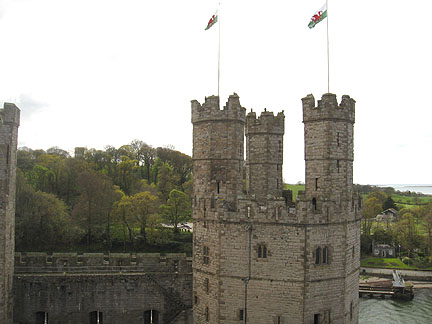
Caernarfon Castle and its town figured prominently during my travels in Wales. The massive 13th century coastal structure, which extends as a castellated town center preserves and presents centuries of history. Caernarfon (pronounced c’NAR’von) is in northwest Wales, facing the Isle of Anglesey, and its harbor is at the confluence of the Menai Straits and the Irish Sea. Bangor is a short bus ride away. When my mother was visiting Caernarfon, the castle was being spruced up for Prince Charles’ investiture as Prince of Wales. On my visits, I saw displays commemorating Queen Elizabeth’s Diamond Jubilee in June of this year. Climbing each of the towers, strolling the small streets, and exploring the medieval buildings and castle walls provided numerous vantage points.


Viewing the harbor from the tops of the castle reminded me of the folk song about this extraordinary and ancient place. Descending from the walls and narrow streets, walking along the docks, and taking pictures, the melody swirled through my impressions. “Llongau Caernarfon” (“The Ships of Caernarfon”), a song I’ve known for many years, is about someone admiring the vessels in port that reach faraway places (such as France and Ireland) and wishing to be able to ship out on one of them, too. I’ve often hummed the tune quietly while aperch on the Maine State Pier, in Portland. Walking along Caernarfon harbor, and glancing up at the castle, reminded me of being “on the other side” of the Atlantic from the ledges of my home on Casco Bay.


Caernarfon and the folk song returned to my thoughts as I prepared to participate in Maine’s first-ever Maker Faire, just a few weeks ago. I had volunteered to help present the large, public event, which went very successfully in a section of a renovated textile mill in Lewiston. The idea is to gather craftspeople and inventors with a spectrum of skills to offer instructional demonstrations and plenty of conversational interaction with all who attend. I taught and modeled calligraphy and bookbinding throughout a very full day- the former throughout the morning, and the latter during the afternoon. Preparation and the day itself demanded a great deal of energy, but indeed the finest reward of all was to see how many people of all ages want to know about these skills. It was a heartening experience for me. The calligraphy class I taught was full, with an overflow group.


The work I do, in both calligraphy and bookbinding, involves creating or restoring materials that ultimately leave my hands. With calligraphy, the inscriptions, certificates, invitations, and cards I’ve made have been by request. As a result, I have just a few examples I can teach with. For the occasion of the Maker Faire, I decided to add to the teaching portfolio of typestyle alphabets and illuminated letters. The Welsh sea song about Caernarfon came to mind, perhaps because I’d so recently been there, and so I chose a stanza to illuminate. I made additional pages, using Latin and French, so that viewers could concentrate more upon the letter forms in the different scripts and colors. In one of the countless serendipitous moments of that day, a Welsh-speaker stopped to compliment the piece.


Journeys that have tapped into all our senses, including personal family histories, along with artistic and spiritual pursuits, amount to multiple layers of enduring impressions. I did not bring back many objects, aside from shells and small stones from some of the places I was privileged to have visited. Now thinking retrospectively about my first sojourn in Wales, what have I brought home with me? Or perhaps I may rephrase it as what returned home with me, in terms of perspectives and ideas. Many songs returned with me, both literally and metaphorically. These combine with images, words, and messages of what is good and grand and ground for my being.


Wednesday, January 14, 2009

lettera


“There is in books
one voice and one letter that is read,
but it informs not all alike.
For I am within,
secretly hidden in the letter,
the teacher of truth,
the searcher of the human heart.”

~ Thomas à Kempis, Imitatione Christi, ch.43


How amazing to consider the ways jottings and their configuration can call forth a full spectrum of lived experience! The names and symbols above recount an evening I spent at Fenway Park, last June.