Posts
Posts


Meno: What do you mean by saying that we do not learn,
and that what we call learning is only a process of recollection?
Can you teach me how this is?
Socrates: I told you Meno, just now, that you were a rogue;
and now you ask whether I can teach you,
when I am saying that there is no teaching, but only recollection.
~ Plato, Meno.
Going by the numbers on what is commonly called the Western calendar, here comes a new year to be seized upon. I began journaling in 1994, albeit sporadically, and then consistently beginning in 1999. Even back then, I’d reserve an evening leading up to New Years Eve for a “year in review” journal entry. These are great to read back over, and I highly recommend this for those who write their perspectives. As 2000 approached, I wrote a “decade in review,” and have had occasion to do this twice since. Such practices are not meant to handwring and rehash, but I naturally took to preserving reflective summations of time spans, such as years, or weeks at work, or eras at schools and jobs, or lengthy travels. Having taught writing, I’ve created years of lesson plans built around journaling prompts, and encourage writers to make up their own so they can keep going. My favorite prompt materialized as I’d write in an Exchange Street café now long gone: I heard myself say... Coffeehouses, prior to the pandemic, were great places for lively conversations and for reflective writing. When I’d shift from some animated discourse to assembling written thoughts, something always lingered from what I’d heard and what I heard myself say. It’s a way to visit what is really in one’s thoughts. What have you heard yourself say? Living under covid-era restrictions (and now fewer cafés), configurations have changed, but eventually we can catch our spontaneous thoughts and still make note of them. Resolved to emerge from the last year’s housing misery which led to an inhospitable living situation, recently I heard myself say, “I think the only way to not crumple under all this is to see the dynamism in the open-endedness in front of me.”
That’s how to start a new year.

I’ve always admired restorers of objects, structures, and historic artifacts. Gratefully, my speed-dial numbers include my typewriter repairer, fountain pen restorer, camera technician, and auto mechanic. These individuals are also esteemed friends. When any of us talk shop, we’ll often note the parallels between their crafts and mine as a bookbinder and conservator. The purposes of our respective restorative work is to keep things in fine operational order. Often when I stitch a set of signatures and add silk bands at the extremities of a spine, I’ll invoke how the owner of Cambridge Typewriter says, “it doesn’t just have to work well, it has to look good!” Tom says this while polishing the parts and cover of a Royal or an Olympia- just as Greg across town used a special chamois to make my sterling silver Bossert & Erhard fountain pen gleam as crisply as it writes. When I use decorated endpaper material to conserve a book, I’ll usually make matching bookmarks and dustjackets out of the excess. Among my workplace colleagues, the maintenance workers take as much interest in what I’m doing as the librarians. Now 24 years in professional practice, I’ve always considered preservation to be the archivist’s operatio Dei. Conscious of that, I’m sure to use the best alkaline, long-fibred materials I can find, so the books and documents will have lengthened lives of utility and integrity. Too many aspects in societies, workplaces, municipalities, and throughout the world are woefully broken. While wishing all along to practice a tangible compassion, some things I can do are to continue preserving the documental record and the written word, and try to be an encouraging ingredient to all those with whom I interact.

As startling as it is to ponder, the covid pandemic era is now at its 3-year mark. If the present time is a latter stage, its duration remains unknown. Social and mental health impacts have yet to be fully evaluated. An immediate shock for many were the sudden disruptions, quarantining requirements, and isolation during the scrambling for immunization. Surely a topic for a later essay. Sufficient for the moment, as a social being and public employee, I had to fall back upon skills cultivated during my years of solitary work. While we were all learning about “supply chains” and shortages not seen in more than a half-century, many turned their efforts toward “do it yourself” work-arounds to such practical matters as producing household cleansers, clothesmaking, and doing more cooking from scratch. A great many of us that had never “worked from home” found ourselves, by necessity, pressing our apartments and computers into service to be able to stay employed. I created a remote version of my service desk by using a corner of my dining table, also purchasing headphones and a refurbished laptop- even repairing books in my kitchen.

As a longtime bookbinder, as well as a bicycle repairer, I could simply use my various sets of tools to remedy basic mechanical and electrical problems. During the 14 months of rotating my work site, between the library and my apartment, I took to carrying tools from one location to the other. In order to stay organized, I separated the materials and flash-drives by their function, helping to always have on hand what was needed. With just about all my commerce done online, along with most everyone, I had to deal with purchases arriving after long spans of time- and damaged. For example, a small toolbox for archival marking tools, hard enough to find, broke in transit. The vendor did not have any others, and kindly reimbursed me. Really wanting to use the box, and taking a good look at it, I replaced the completely broken hinges by melting small holes in the plastic with a bookbinding awl which I heated in a candle flame, and using 2 pairs of needlenose pliers to create rings out of bent-out thick paperclips. My repair worked like a charm, and has been holding up now for 2 ½ years and counting. Like my stitched bindings, the repaired item has more strength than the original structure. I use the box daily, it’s become one of my reminders of these times.


Essential to the repair of an item is understanding how it works. Having to do much more of my living and working as a reluctant shut-in, it invariably became necessary to organize my household. (This proved helpful when the building very sadly had to be emptied of its residents last summer and all of us had to move out.) My usual studies and writing had to be done in and close to home (but at least I had a spacious place to live, at the time). Very thankfully, a supply line was opened to me via the Boston Athenaeum’s mailing and database services. I also continued teaching via Zoom, joining the many who became fluent in the medium.

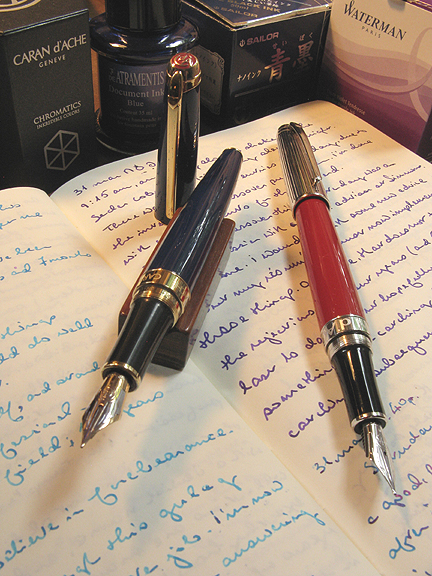
Amidst these times, I reacquainted with old writing tools, and put them into working order. Pens present their own forms of mechanical puzzles. While rinsing a much-loved Reynolds fountain pen from one of my many sojourns in France, I watched the ring from the nib section roll across the kitchen sink and irretrievably down the drain. As with the toolbox mentioned earlier, a study of the pen showed me how the ring was more than decorative trim- it actually provided the needed margin of space to allow the pen to be tightly capped by pushing the nib section into the mechanism that snaps it closed. I set the disabled pen on my desk, not sure what to do with it. One night, while writing and listening to the radio (a supply-line of culture itself), I stopped to look at the poor old Reynolds and an empty yoghurt cup I used for calligraphy. That curved rim got me thinking, and it occurred to me that perhaps if I could slice the plastic just right, I’d have a replacement part. Using my narrowest bookbinding mat knife, and masking tape to hold the container in place, I sliced thin strips of the plastic. It took a few tries, as I saw how exact the fit had to be, to get the pen to snap closed with the same click as it did before with its former metal ring. After getting the precise breadth and length, I sliced an extremely thin slice of archival plastic tape for the inside of the replacement ring. It worked perfectly, and I was able to use the pen as before- albeit sporting a white yoghurt container ring.

I later found other uses for the strong, yet thin, plastic material to create spacers for altering new refills to fit older pens. Either due to cost savings, or forced obsolescence, inserts for even the higher-end ballpoints are manufacturered shorter now than before. Unlike a fountain pen, a ballpoint is essentially a “handle” that houses an inserted refill combined with its writing-point. The two components, like a textblock and book-cover, need to perfectly fit to be functional- and look right. Using very tiny pieces of the yoghurt cup plastic, I created spacers to customize and “push out” the points as needed for both the writing and the retracting. Getting the right fit was followed by adhering my homemade parts to the backs of the refills, and using a heated sewing pin to create a “breather” for the ink. Again, the repairs have held up to use, and the tools have been in the fine operational order of my preference!

Having field experts as friends makes for great conversations. As well, I can turn to their professional expertise, supporting their enterprises, too. As it became possible to visit with neighbor and longtime friend Pat Daunis at her shop, I brought her my Reynolds pen, and asked about creating a permanent part to replace what I had made. She liked what I’d created, and used it as a reference point. We had a great visit, talking about the crafts of lettering and calligraphy- and I hired her shop to fashion a new pen ring. Daunis jewelry is among the very best and most highly-regarded that is made in Maine. Pat made the new and precise pen ring out of brass. This will surely last for the life of the pen- and I’ll make certain to rinse it over a tray, with the sink drain-stopper in place!


Last week, I visited with another old friend whom I respect very much, and that’s Andy the owner of Classic Camera & Repair of Maine. I’m continuing to work full-time through these extremely difficult times. The slivers of personal time I’m able to find are for reflective writing and photography. I made sure to keep my faithful Rolleiflex unpacked, and have been making new images during snowstorms again. Andy helped me by testing the camera’s shutter, and that occasioned a heartening visit.

Repairs and restoration are expressions of healing. I think of this when I bring books back to life, as well as when I see how fellow craftspeople and mechanics perform their own renditions of this. Of course, the treasures made for written and photo arts are meant to be used en route to new creative ventures. The damage done by the displacement last year, like collateral social ramifications of this pandemic, have yet to be assessed or remedied. I won’t know the extent of this current nightmare, until landing in a peaceful and comfortable living space- away from stomping, blaring, odors, and congested confinement.

Finally and for the moment, I recently stepped away from the fray for the first occasion in a year, with a week in Boston. Soul repair takes much more time than it does to calibrate an instrument or to fabricate components. And iron-willed patience. Between the always-welcoming environment at Beacon Hill Friends House, and inspirational studies at the Boston Athenaeum, I especially savoured the sweet familiarity of beloved communities. Not only could I hear myself thinking, but I sensed myself breathing, being in the presence of many kindred spirits, and in the absence of overhead bombast. Indeed, the idea is to bask amidst the moment, though admittedly it became a distraction to want to load up on peaceful civility for the road ahead. To say the least, I took many notes, aperch in some beautiful places.