Showing posts with label art. Show all posts

Sunday, March 26, 2023

pursuits

“Naturally, we desire knowledge, happiness, and peace;
knowledge, since we see our thoughts curiously investigating
the sources of things: happiness, since each person
and indeed each animal acts with a view to procuring good
or avoiding evil: peace since the pursuit of knowledge
or that of happiness are not followed simply for
the sake of the pursuit but in order that the desire
in which it is born may be appeased by calm and repose.”


~ Etienne Gilson, The Philosophy of Saint Bonaventure, p.87


1


During difficult winter months, more energy than usual is needed for the basics. Getting from place to place is impaired by weather conditions, and overcoming such variables requires added time for car excavation, window-scraping, and idling the engine. Indeed, all symbolic to this writer. Trying to find hope amidst instability and unease tests all systems. It’s been taking a real stretch of the imagination to stay creative, ambitious, and sharp. There’s plenty to dull the senses and wits, in this present situation. Often, while I’m defrosting my windshield, I stare beyond treelines and rooftops- much as my aspirations set sights beyond the bland anguish of this winter in the East End. Where are the sources of cheer? Certainly not in the news. As much as I want to know the currents, I’ll wade in just enough, avoiding the misery of immersion. Without more than a pertinent acknowledgment, as I want to focus these words upon pursuits that raise my sense of vision, I’ll mention how my housing displacement (and continuing search for a place to live) prompts me to monitor economic news. Well, upon the ground of living in a perpetually depressed and intensely stratified region, the term recession is hardly distant; it’s been here a painfully long time. Atop years of toiling and producing in educational nonprofits, last year shoved me to this present brink. When articles ask readers to compare now with 12 months ago, I needn’t look far to recall living in 40% more space at 30% less rent in a beautiful place that was in a better neighborhood. Alas, it was sold and everyone had to leave. I know to avoid dwelling upon this much further, as trauma runs its course. This type of thing has been happening all over this city. I’m daring for something even better, while as yet unaware of its location.


2


Survival is more than necessary in order to settle here-and-now responsibilities; it’s also the way to steer toward better horizons. Having to keep on working and contending with expenses, while making an emergency relocation, served to maintain focus. Fear, however, does little to nurture creative energy. Threatening, litigious language abounds- reminding me of how meanness can trickle all the way down to simple transactions and what could otherwise be good-faith agreements. Once more, it is vital to keep finding ways to be motivated by a vision of goodness, over and above the baser goading by impersonal threat. Some of us, even now, continue in our idealism. My previous landlord, may he rest in peace, was a dentist whose office was below my apartment. He was born in that building and my predecessor in “apartment 2" was his mother. When he handed the keys to my twenty year old self, he said to me: “We have one rule in this building; it’s the Golden Rule. You know what that is, right?” I quoted it to him, “Do unto others as you’d have them do unto you,” to which he responded, “that’s right, you know it,” patting my shoulder. That’s all that was needed, and in so many ways it’s the most essential of ethical rules.


A less-ancient saying goes as follows: “Everything is a teachable moment, if we’re willing to be taught.” Though it’s been a strain, dear readers, I’ve been wrenching myself through daily uncertainties, discomfort, and desolation at all hands to learn what I can in this. Revealing how relative these things can be, several months ago during a mid-workday cancellation my director told me I could go home any time I wanted. I replied that I preferred being at work. “The Compartment” is no home to me, and I described that to him. We had a good and relaxed conversation in the empty hallway, and I gratefully kept on working. Better things are surely ahead, and each day is a day closer. Even my mustard seed’s worth of faith is enough to convince me of that. Keep the pursuits in mind. I’m in this life to create, to inspire, to foster the Golden Rule. And that’s just for starters, just like persevering in my work and sanctifying each task and interaction.


3


As severely as the city of Portland has hollowed itself with its gentrification, I still manage to bump into friends on the streets. “Whatcha reading?” a fellow West End refugee asked, stopping to greet me at my spartan bus stop. Closing my book, I held it up, and my friend said “Philosophy. That’s heavy.” I defended my vice by saying, “Saint Bonaventure; he’s keeping me from jumping off the bridge.” There must be pursuits to raise sights and spirits. Creative projects are just about impossible in cramped and oppressive living quarters, not to mention the daily and nightly stomping and sound system racket penetrating ceilings and walls. But... during my coffee break in the middle of my 8-hour workdays I can scribble a few notes, and late at night when the stampeding herds cease I can steal a few more moments to write and read more philosophy. I’ve invested in a strange “white-noise” machine that has a setting that imitates the sounds of rainstorms. And this returns me to those windchilled bus stops. Just for now, I persist in my insistence. On better days, the wincing and cringing become pointers to remind me of the progress of time. This is surely transitional. I’m wagering my life on it, and my philosopher saints will ride shotgun with me.


Such pursuits as the arts and philosophical studies may appear as goals, but these are indeed means. Bonaventure’s responses to the Sentences of Peter Lombard include the observation that we will not find our fulfilling achievements in the finite. “Our desire tends beyond each finite goodness toward and beyond another finite goodness.” In his enduring Itinerarium, Bonaventure wrote, “To follow the way of the soul towards God means to strive with all one’s strength to live a human life as close as possible to that of the blessed in Heaven.” Reflecting upon Bonaventure, Etienne Gilson wrote of the itinerary’s road as illuminative, and the pilgrimage is adhered to by love of the destination. A brilliant member of my staff whom I mourned last year liked to say, the saints are always teaching us. And I like quoting how she used to tell me this, Elaine surely being among those saints. Submerged in an undefined and intensely anxious time of instability and discomfort, such means as writing, the study and teaching of philosophy, spiritual devotions, and productivity on the job serve to maintain my sanity. I meant what I’d said to my friend at the bus stop. The itinerary trims the undivided highway margin between humiliation and humility. The latter is necessary for the exploration of philosophical truths, admitting that reason alone cannot achieve its object unaided, submitting to the Light which irradiates and moves the conscience.


Wednesday, June 29, 2022

see beyond

“We must accept finite disappointment,
but never lose infinite hope.”


~ Dr. Martin Luther King, Jr., 1968

This time of the year is especially conducive for outdoor writing. Perching on the sunwarmed granite front stoop to write and read has been consoling for many years. But now with the inevitability of losing my housing, even benign routines have become tainted with mournful tones. Necessity and survival demand that I force myself to see beyond these liminal times. While I witness the steady evacuations of my neighbors, as we are all anticipating the “redevelopment” by the next landlords, I am also wildly scouring the grounds for a place to call home. Yet, still, the stately Victorian architecture remains, as do roses, leafy trees, and ants scurrying across the stone steps. Occasionally, an ant will run right at my book, realize it’s an obstruction, and either climb over it or scramble around it. Then I’ll stand the book up, to see how it tries to figure out how to navigate, determined to hold its direction. Not wanting to antagonize the poor thing, I remove the barrier and let it scamper on. Like these small creatures, I am also trying to make sense of setbacks. Most of us have them; sometimes the hardships are compounded. Job hunting, apartment searching, seeking grace- all look the same, all pursued with the same desperation. Perhaps it’s all too similar, and this will require some thoughtful parsing. In crisis mode, too many things seem alike. All the begging, scraping, and strenuous attempting to impress are amounting to levels of humiliation unusual even to me. Yet the fight must not cease, neither should the refinements of my pitches. There is surely much more to lose by clutching a status quo, than in making a move.


Another annual summer reminder is my memory of arriving in Portland. After my hardworked endurance of the New York City school system, I graduated from the High School of Art and Design. Commencement was at nearby Carnegie Hall, and the speaker was alumnus Ralph Bakshi. I had saved my money to travel back to Paris so that I could spend the summer with family. I had missed everyone very, very much- especially my grandmother- and there was nothing I wanted more than to be there. It was undoubtedly a great decision in every way. By Labor Day weekend, with a great many thoughts and ambitions, I arrived in Maine. The building containing my first apartment is down the street from the place I will have to leave. Through eight different apartments, I remained close the center of the city.

I remember very well how desolate it was to be a seventeen-year-old stranger in town- even after beginning at Maine College of Art. I’ve since been active in numerous community efforts- creating, befriending, giving, serving, teaching, and working- but this housing crisis has me no less on the ropes than when I first arrived. A stranger in my own town. Maine is a wilderness at multiple levels: Yes there are thick and endless woods, as the state is mostly rural, with beautiful landscape. But it is also a hard culture. Somehow I wound up fitting in among kindred spirits, especially as I got more involved in civic and artistic life. The cultural differences surface as I seek advice and help from among the hundreds of people I know. A city person like me prefers to communicate directly and unabashedly (but with the best of manners). The stereotypic Yankee mindset is to go about things indirectly and laconically. People tell me about this-and-that empty apartment across the street from them, but they can’t tell me who owns the place because they either never speak- or the owner is an “avowed enemy.” I’ve heard that latter expression many times. Social media is well suited for such personalities, because they can suspiciously snoop around without directly communicating. I’d like to think I’ve evolved over the years, but never into that. My purpose in life is to be a doer, not a spectator. As much as I inhabit this world, I am not of it. Still, try making any progress with housing or employment without help from others- especially those “in the know,” and the “gatekeepers.” Even if you ask politely. Even if they know you.


I’m reminded of a Maine College of Art memory; a very subtle one that I somehow remember. I had written a paper for a literature course, and my professor wrote an interesting reflection after my last paragraph. Professor Aldrich concluded his positive comments with confessing there was something he couldn’t quite agree with, and then wrote “but maybe it’s just the mood I’m in today.” His candor was commendable enough, but the admission also taught me something about context. We tend to perceive according to our circumstances. The covid era is now 29 months running. We can look back across 2½ years of world-altering plague. While we all heard daily about fatality numbers and immunization, both the housing and job markets spiraled into merciless stratification. Before realizing how different everything became, everything began to look different. Like many others, I kept on working- setting up a remote space at my dining table with an extra laptop computer I had purchased, when not pitching in for various departments on-site. The imperative has been to keep on working. While I witnessed furloughs, layoffs, and countless voluntary departures- I kept on working. Lunch hours became isolated twenty-minute breaks, and vacations became impossible. All was subsumed for the causes of relevance and productivity. And survival. The mood I’m in today is that I’ve kept on working, obstacles notwithstanding.


One of my colleagues recently said to me, while discussing what we’ve been able to accomplish in the past fiscal year, “We’ve all been through a lot.” Stopping and looking up, I replied, “We have, indeed.” The covid era has weatherbeaten and accelerated the aging of most of us across all the generations. Ambitions held so preciously in the depths of our lockets, tenaciously carried through our school years, collide at the compromising crossroads of plague. The imperative is to survive, but what are the rewards of survival? Like the ants on the front stoop, it would be good to know that I’m scurrying to something better in this life. I seem to have met many of the descendants of the friends of the biblical character Job; they like to tell me I’m being tested, and that my life is a trial. And it’s much more than being on the brink of losing my home. Well, if this is indeed a protracted spiritual test, there isn’t much else I can do but to stick to my scruples. It means to believe without seeing, to pray insistently into the opacity, and to forgive all the tin-eared people from whom I’ve asked for help. Speaking with a wise friend, I mentioned the weight of some kind of bewildering punishment. He told me to do all in my power “not to go there,” and to be reminded of Divine compassion. Going further, he told me to be sure of that. Perhaps if this is a test, it’s about how I perceive God. Purposes are often discovered amidst struggles.


Maybe I’m not being punished. Maybe I’ve heard the expressions no-cause and at-will a few too many times to be reminded of my own humanity. Everything looks very different now. But while I continue straining to perceive through cluttered apartments and dilapidated buildings, my self-prescribed imperative is to see beyond reticent neighbors, see beyond this smallminded culture, see beyond constant setbacks, see beyond roadblocks and rejections, see beyond exclusivity, and see beyond all that tells me to just give up. Seeing and proceeding beyond limits may lead to a clearing, a pasture, a wellspring. That inner locket is still where it has always been, with me since my school years when I was thrashed around by bullies who outweighed and outnumbered me. It’s still kept safe, and the preserved spirit of forgiveness and devotion will repel the tarnish of these times.


Sunday, June 5, 2022

beautify


“Love of beauty is taste... The creation of beauty is art.”

~ Ralph Waldo Emerson, Nature, ch. 3


1

Years ago, I had a friend named Robert Park. He was an elderly neighbor, and I would run errands and shovel snow for him; then we would enjoy great conversations over coffee in his very cluttered and book-filled living room. He was originally from Cambridge, Massachusetts- and he pronounced his name without sounding the R’s. Invariably, we would talk about politics. With exasperation, he would say, “It just gets worser all the time; worser and worser.” It was difficult to completely agree with him, wishing so much to follow my aspirations. Even though he’s gone now, I continue to muse about his sad admittance. Is it true? If it is, would I start saying this? These are brutish and grim times, all around. Globally and personally. While I flail at my dubious career and strive against the brink of losing my housing, I remain at heart an artist who thinks about hopeful aesthetics. For a long time, I’ve been crafting things that accentuate beauty in the midst of ugly times. There is profound worth, understated as it may be, in beautifying the commonplace and the daily components of living. Having inherited aesthetic tastes from my family, I think of them when I create things and decorate, using good materials. Cooking and baking, I choose my ingredients with care, and set out meals as I was raised to do. Presenting sensitively made objects and foods to others is a way to demonstrate compassion, even if it is modest and simple.


2


Ralph Waldo Emerson observed that “beauty is a wayside sacrament.” Tangible signs of invisible grace are to be respected, and that itself is a reverence for aesthetics. Indeed, beautification and its appreciation directly affect the life of the spirit. Moreover, in such destructive and violent times, spiritual health is all the more imperative. I am well aware of the greater need for balance, eloquence, good reading, and sundry reminders of the sacred now more than ever. Recently, in the Boston Athenaeum manuscripts room, I read the words of Philip Doddridge (18th century) which include: “The care of the soul is the one thing needful, because without it you cannot avoid a state of eternal misery,” adding that- as we all know- misery can be aggravated if we aren’t paying attention to the health of our spirits. Of the topic of the One Thing Needful, as coined in the Bible, Ezra Stiles Gannett (19th century) wrote that it would be a living and active personal faith. Gannett observed that a conscientious and practical faith provides foundations for our pursuits and our work, as it can:

“...endue a person with a divine spirit, can clothe them with an invincible energy, can empower them to go on their course rejoicing through good report and through evil report, through labor and sickness and penury, through loss of friendship and of home even, till death closing this scene shall introduce them to the reward of their faith and patience. The feebleness of our faith prevents our experiencing or illustrating the full efficacy of religion. O Lord, increase our faith; that it may triumph over every obstacle, and may preserve us in obedience to thy holy will, and in hope of thine everlasting favor.”


Handmade box, which I also lined, for my typewritten manuscripts.


In my pursuits of continuing my artisanry and active faith, while desperately trying to find a place to live, I’ve decided to keep on being creative. The life of purging, packing, searching, and going to work amount to a wall of hurry-up-and-wait. Writing needn’t cease to be important; in fact, my journals and thoughts have increased as sheltering venues. Having already packed up most of my things, various loose papers accompany me through my daily rounds. I thought I’d design and create folios made with beautiful materials, for carrying and organizing my projects.

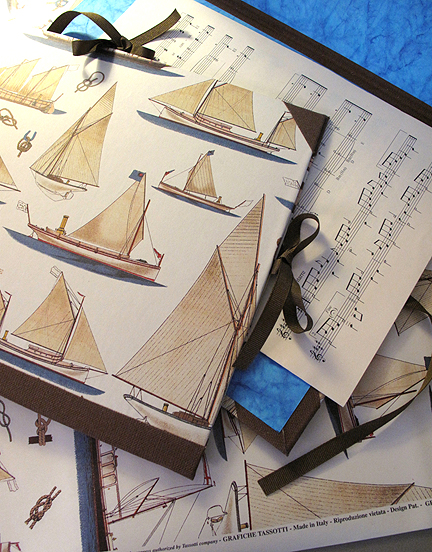
Large sheets of Tassotti paper which arrived damaged, and my attempt to remedy the paper.


Months ago, I had purchased large sheets of Tassotti paper which had arrived from Europe damaged by the shipping. The sheets were meant to be for bookbinding projects, but creased and dented as they were, the paper seemed perfect for “welding” via adhesives to rigid chipboard stock- though I still needed to flatten the damaged paper as well as possible. Trimming and designing the folios, the nautical motifs looked all the more appropriate, as I am striving to persevere in forward motions. Matching the colors of the paper, I used brown bookcloth and ribbon which were among my conservation and binding supplies. Reinforcing the folios with strong and acid-free components, I lined the interiors with thick, handmade paper: blue for the ocean and sky. I tried two different sizes, and made a few extras with an additional nautical-themed paper.


__________________________________________


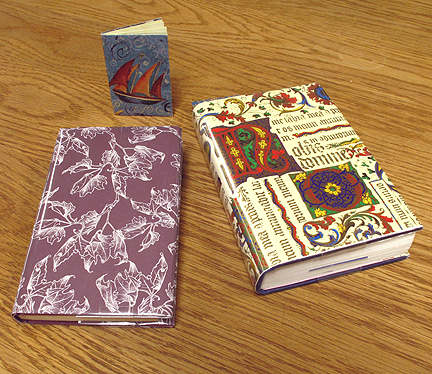
Making these, and giving some as gifts, further reminded me about my love of beautifying the ordinary. Ironically, devotional books and Bibles tend to be made with drab covers and poor-quality bindings. I remake these, too, since I regularly carry such books with me, and tend to keep them for long periods of time- often personalizing their structures.

Sacred texts with sanctified bindings.


3

My toolbox which I use every day in the Archives, and I lined the trays with handmade paper.


About as ironic as drab-looking production bookbindings that are filled with inspiring words, I currently experience more stability at work than at home. The latter was always the other way around. These intensely anxious times tinge and threaten the most routine of activities. When my errands cause me to drive along pretty residential streets that are lined with neat houses and tidy lawns, my grief surfaces with the intensity of an exile. Surely a broadbrush observation, I see an ocean of haves from the excluded vantage point of a have-not. The gentrified-out are driven east of Eden. And far, far too many have much less than even my modest means and employment. So very many are homeless, subjected to misery and injustices that are unconscionable. I wonder what tourists think, when they see people sleeping in doorways and along the sidewalks of this now-blatantly stratified small city.


While I’ve been pushed to the brink, I also bear witness to the present landscape along with the years that led to these prohibitive conditions. Mere observations with open eyes reveal the sicknesses of these times. But alongside sensitivity and acts of compassion, mental strength is vital. But we must also attend to the immediacy of our midst, particularly as it involves matters such as housing and sustenance. While distracting myself with slivers of creativity in a wilderness of undetectable mercy, my thoughts ponder the question of what to do when something beautiful comes to an end. It has long been in my nature to preserve, to restore, to reinforce. Perhaps the wider question is to consider that which should be designed to last.


Wednesday, February 19, 2020

practical sentiments


“Be practical as well as generous in your ideals.
Keep your eyes on the stars,
but remember to keep your feet on the ground.”


~ Theodore Roosevelt,
from a 1904 speech to the Groton School (Massachusetts)

Teaching has been a professional pursuit of mine, since the age of 22. Beginning at the college level, I was nearly the same age as my students. That didn’t seem to matter, as I already had requisite experience to draw upon, and the vital ingredients that continue to serve very well: energy and preparedness. Just as during my very first semester of teaching, last week and this week have seen the benefits from exponentially more hours of preparation than the actual in-class hours. And that’s just fine; better to have and not want, than to want and not have. During that first year, I had to submit each and every lesson plan for review. Now, a synopsis that speaks for the year suffices. There are many other distinctions as well- not the least of which is that I have many more adventures to recount about the topics, the teaching of the topics, and- very importantly- my continued learning of the topics.


To teach well, one must always be learning well. Being ready with the materials and scholarly sources for my own studies is similar to being prepared for their instruction. I, too, am a student. My teaching philosophy, whether for teaching art, history, philosophy, writing, or archival sciences, can be summed up into three words: We Learn Together. My respect for people around me, the informational resources, and the learning process- is in three integral parts of one entirety. I don’t measure success by clever statements or numbers, but instead whether the people I mentor proceed to mentor themselves and others. My own student experience is that when I’ve been inspired and have enjoyed the aspects of learning, I’ve continued on. Graduations are not so much ends, but beginnings and means to apply toward the greater efforts of following our passions. Transcending the “required cores,” we can freely choose the subjects and motifs for our own appetites.


My old habit of setting up classroom spaces with a lot of time to spare, parallels how I prepare dinners for guests. All needed ingredients have been procured early on, with some things cooked in advance, and there are extra things on hand. The table is set with the essentials for my guests. Placing paper and printed handouts in my classrooms is just like setting down linens and flatware at my dining table. The wish for the food to be tasty is the same as for scholars to enjoy the experience of learning. We savour with our taste buds as well as we do with our minds. Our educational experiences have unique histories. You surely recall the first thing you ever learned how to cook, or the times you learned to bicycle or swim. When my mother taught me how to make an omelette, she said to me, “every Frenchman should be able to make an omelette.” That was when I was about 13. Many years later, she taught me how to bake bread from scratch, during a blizzard that cancelled my flight. The memory of billowing snow remains with me, when I drizzle flour onto my wooden bread board, even now.


Two weeks ago, I taught one of my calligraphy workshops to a capacity class group. It amazes me that people of all ages want to learn how to letter with a dip pen. Just as with bookbinding, if people want to learn, I’m happy to oblige. Workshop-teaching on an as-needed basis means the tools may be dormant for weeks or months at a stretch. For this recent occasion, hearing about the enrollment, I needed to purchase more supplies. To figure out what I already had meant that it was necessary to bring out materials I’ve had since my school days. Collecting and divvying-out what I needed for the group this month took me back to those heady years of art college, back even further to New York’s High School of Art & Design, and further back still to when my mother taught me calligraphy using the Speedball penpoints my father gave me when I was about 10 years old.


My tool box, called an Art Bin, houses more than the instruments of the craft; it also has an effective way of holding the aromas of the materials. The smells take me right back to the enormous art supply emporium Pearl Paint, which was on SoHo’s Canal Street. That street in the 1980s was a wide thoroughfare of urban confetti and cacophony. I loved it. One of my teachers at Art & Design, Henry Garrison, taught me his mantra about calligraphy: He had me watch how he’d ink a pen and follow through with his perfect flourishes, accompanied by his vocal overtone, “think D, write D; think E, write E,” et cetera. Two weeks ago, using the latest digital overhead camera-projector and screen, I taught this to my class, focusing mind upon a letter form, while writing the letter on parchment paper. Our crafts not only jog our memories, they can also compress time, Suddenly I was Henry Garrison to my calligraphy students, and the philosophy student I was, back at University of Massachusetts-Boston is alongside the philosophy students I taught last week, here in Maine. There is inestimable value to “knowing where you came from.”


Encouraging teen students with their fledgling calligraphy skills, I tell them about a job I had as high school sophomore, making hand-lettered menus for the tony Plaza Hotel on 5th Avenue. Yes, they used handmade menus for their dining guests. I’d take their lists of entrées and other delicacies home, showing the courses to my mother before I rendered the fancy names in Chancery italics. Such curiosities, but they paid me! I was just a willing art student, behind the scenes. Thinking of it now, calligraphy has wound its way into every job I’ve ever had, from poster-making to decorative signs in libraries, to place cards, invitations, and certificates- along with teaching the craft itself. As with photography, these skills have gone everywhere with me, always somehow finding outlets and uses. As time passes, the stories grow with the projects and their respective scenarios.


I like to regale my elder students about how the most accomplished Asian calligraphers tend to be upwards of eighty years old. These artisans have the cultivated disciplines of poise and finely-tuned tension. Theirs is an art that comprises meditation and dexterity. Pointing this out also provides encouragement- to all ages. In a sweet sort of reciprocity, I have an Archives volunteer at my workplace, a retiree originally from Harbin, China. When he sees me journaling during my lunch breaks, he points to my notebook and exclaims, “that is so good for your brain!” In his professional employed life, he was a neurobiologist, and that inspires him to explain to me why journaling is so good for the mind’s health. You can be sure I repeated that to my writing class.


Monday, November 21, 2011

pilgrim steps


“...that small, interior world widened
as I learned its names and its boundaries;
as I discovered new refuges...”

~ Dylan Thomas, Quite Early One Morning.


My elementary school, Public School No. 13


Above: Saint Patrick's Cathedral- a place of quiet respite on 5th Avenue.


Looking at class photos and trading stories with the current and retired principals at P.S. 13. I had read a portion of my journal to a group of school administrators. The photo immediately below shows the P.S. 13 schoolyard.


Entering one of the classrooms in which I'd been a pupil, to speak to the children.


Taizé at a New York City church : the view from my music stand.


Dylan Thomas, visiting from Wales, read and staged his works at this theatre in Greenwich Village.


The Minetta Tavern was a favorite of many writers, including Thomas and his good friend e.e. cummings.


The Church of Saint Luke in the Fields was the place of Dylan Thomas' funeral (1953). The church's first pastor, in 1820, was Clement Clarke Moore, the original namesake of P.S. 13.


“And one man’s year is like the country of a cloud,
mapped on the sky, that soon will vanish into the watery,
ordered wastes, into the spinning rule,
into the dark which is light.
Now the cloud is flying, very slowly, out of sight,
and I can remember all of that voyaging geography.”


~ Dylan Thomas, The Crumbs of One Man’s Year