Showing posts with label self-discipline. Show all posts

Friday, September 29, 2023

more than this

“I'm hearing right and wrong so clearly
There must be more than this.
It's only in uncertainty
That we're naked and alive.
I hear it through the rattle of a streetcar;
Hear it through the things you said.
I can get so scared.
Listen to the wind.”


~ Peter Gabriel, That Voice Again


Major efforts are composed of small measures. This often occurs to me, when in the throes of processing large archival aggregates out of many thousands of single components. Years are made of days which comprise hours. A friend talked about their job search, comparing it to throwing big rocks at a wall until it crumbles. That’s the desired outcome. Thinking of the present as an indefinite trial, linking unresolved days, generates its own brand of exhaustion that only loads more upon existing burdens. I try to avoid doing this, but like any forward-moving driver, I must check all gauges and mirrors. Patience in tribulation is essential in these staggering times.


Now 13 months into housing displacement and its accompanying instability, there remains no rest for the weary. As my friend with the wall metaphor, there isn’t a day without searching and inquiring. And constant, earnest prayers. It’s how I push back against oppression and thwarted hopes. Other vital tactics are to persevere in my studies and writing; these are solid sources of inspiration and means to higher goals. Such things are extremely hard to find; if you find literary sources, forms of creative expression, and devotions that uplift (instead of “dumb down”), hold fast to these things and grow with them. Keeping vigil for better situations parallels my interests in learning and trying to understand the broader world. For many years, I’ve started each day with radio-accompanied ablutions and coffee. During my graduate school years, that routine would typically begin at about 5am. In high school, it was New York City’s Newsradio88; life in Boston and its orbit got me into 1030-WBZ. Invariably, the repetition of basics and ads sends me to the checkerboard realm of religious radio. At the tops of hours, I bounce back to WBZ for much less-stilted news. Within that minefield, however, are a few edifying and useful homilists. Most of the preachers are terrible orators, sounding to my New Englander’s ears like something between auctioneers and Huckleberry Hound. But this professional archivist can separate wheat from chaff. Radios can always be switched off, too, as much as I’m intrigued to hear what’s out there.


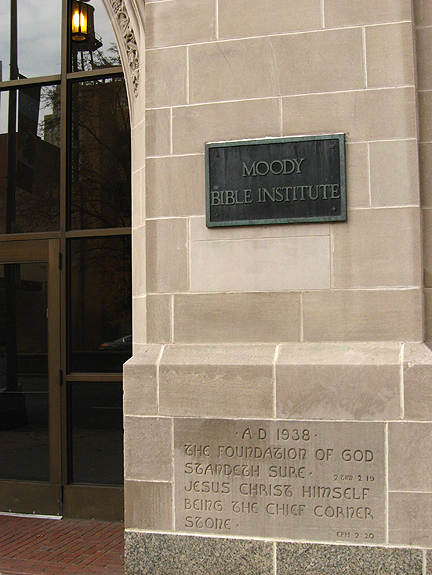
Among the more scholarly and nonsectarian Christian resources are the broadcasts from Chicago’s Moody Institute. Recordings of the late Rev.Weirsbe’s brilliance, delivered with his gentle Midwestern lilt, continue to outshine almost all of what proliferates. The successor to Weirsbe is Moody’s Rev. Lutzer, also with an academic and folksy yarnspinning style, though much more stoic than his predecessors. Well, on a recent workday morning with hot water running and coffee on the bathtub’s edge, I caught one of Lutzer’s installments on his theme, Making the Best of a Bad Decision. I’ll add that many of us must make the best of other people’s bad decisions. Can I get an Amen? Back to Lutzer. Through the noise of first-thing scrubbing, I heard the radio voice beckon, “If you’re still alive, God isn’t through with you.” Surely he wants to encourage his listeners, but considering my state of affairs of recent years, I can easily look at those words ambiguously and through my snowballed sarcasm. Sometimes I do, yet the resultant bad feeling makes me take it back. Reverting to a bleary-eyed positive, my leanings reach inward and upward, through my imagination. That’s my supplicatosphere, which is the stratum immediately beneath clouds of unknowing. “Through with me,” in the wrong context, sounds threatening; but in a healthier frame of reference, my wish really is for Divine intervention. Why is grace deferred? Did I misstep? How am I supposed to know, if nobody tells me? Have I overstayed my welcome? Perhaps I’m inhabiting the very attempt to comprehend the meaning of hope.


While trying to glean insights about things eternal, I’m also constantly reckoning with the ways of mortals. Recently with my philosophy students, I taught about the Golden Rule, framing this in the context of ethics. Our group discussion, probing the time-honored “do unto others as you would have them do unto you” went right into dilemmas about what happens when there isn’t any reciprocity for our respectful acts. Do we keep on being honorable and forbearing, or do we conform to the hardball tactics that confront us? You can imagine our very lively Socratic forum discourse. Whatever we do, we need to choose our reactions and responses. Generally, there’s the trigger end, and there’s the barrel end. Are you the issuer, or are you the inflicted? When so many critical factors are out of our control, what is within a person’s reach? With each day, questions arise in my thoughts as to whether landlords, employers, and community leaders should care about their inhabitants and “stakeholders;” in a word, neighbors. Perhaps it’s unrealistic to expect such people of influence to care, as I care. Ever the cockeyed idealist, I believe everyone should care. That’s how things stand a chance of changing for the better. A genuine sense of respect, even in simple transactions, runs against the currents of pessimism.

Just the other day, I helped a researcher with a query so complex we needed to go back and forth rather extensively in order to unearth the actual question. Having some specifics that mutually made sense, I set about producing what I could find to help this fellow. In the midst of my retrievals, the man frustratedly stormed out of the research room. While I began putting the materials away, he returned and apologized. “I’m sorry,” he said, “I think this world of instant gratification has gotten to me.” He pointed disdainfully at his smartphone. After expressing my understanding, he sat down to read through what I had found, and we talked about his projects. His initial and abrupt impatience was disappointing, but his later presence of mind was impressive. In a handful of minutes, I witnessed metanoia- on both our accounts. Reflecting upon this, later in the day, I was reminded about a barely-known spiritual exercise called examination of conscience. I use parts of my daily journal writing for this purpose, considering such writing as the safest space for articulating thoughts. “Make an appraisal of the entire situation,” wrote Francisco Fernandez Carvajal, adding that we must know what means are available to us, and how to be faithful and thorough. In addition, we must also contemplate how we can remove obstructions in our intentions, as “knowledge of self is the first step the soul must take in order to arrive at the knowledge of God.”


Collecting and digesting knowledge comes very naturally to me, always taking notes. My notebooks become reference sources themselves and they’re great for me to reread when distractions throw my studies off course. These many pages of annotated gleanings remind me of the philosophical texts I’ve been so carefully reading, while struggling to prosper above the fray. As it is with examining my conscience, there must be focused intention to transform head-knowledge into heart-knowledge. What is there for me to learn, from my experiences? “When a person accepts a great undertaking,” as Carvajal recommended, “they must consider various possibilities and look for the opportune means for bringing the work to successful completion,” adding that “we have to be aware of what is lacking so that we can ask God confidently.” In my repeated recoveries from rejected applications, trying to figure out my deficiencies (because reasons are never specified), while left to figure things out I remind myself that more attempts will be accompanied by more failures. More at-bats increase the odds of striking out. Yet still, and even now as the setbacks persist unabated, my efforts continue and amplify. It’s imperative. The here-and-now is at once stifling, uninviting, and tentative; it’s more than enough to keep the search coals stoked. As an extension of my certainty that all we see is not all there is, during the present drudgery I’m convinced there is more than this, and the accumulation of my being is meant for better and more conducive circumstances.


Sunday, February 26, 2023

accidental and transitory

“At the very moment when everything seems to be collapsing
before our eyes, we realize that quite the opposite is true,
‘because you, Lord are my strength.’
If God is dwelling in your soul, everything else,
no matter how important it may seem,
is accidental and transitory,
whereas we, in God, stand permanent and firm.”


~ Josemaría Escrivá, Friends of God, 92

1

Until at least this past decade- with refinements in wireless communications- those who appeared to talk to themselves were generally regarded with suspicion. Urban streets being arenas of assessment, stereotypic self-talkers tended to be written off as rumpled shufflers conversing with the air. Now, stereotypic bluetoothers tend to obliviously stride around, conversing with the air- except for the occasional crackling voice in response. For an observing pedestrian, I’ve gotten used to seeing individuals sauntering around to their own speaking voices. Negatively, the loud talkers in public spaces are intrusive. Positively, I get a great excuse to keep on talking to myself as I might while driving or working. Journaling gives me space to preserve ideas and experiences, as well as making sense of observations and ideas in writing. Speaking to my thoughts while in transit or at work also helps me distill observations and decisions. Thematically, my self-talk and most of my journaling -and photography- are parallel strands along the same streams of absorption, reflection, and creativity. These are extensions of consciousness. But like expression and the life of thought, self-talk wields enough influence to determine how we operate within as well as outwardly. Working alone as a self-propelled and consistently accountable one-person department for 36 months and counting, I’ve been my own voice of assurance. That’s a formidable discipline for me, unceasingly working through the depths of pandemic, personal loss, desolation, and gentrifying displacement, while rarely able to dispel my longrunning streams of verbal self-condemnation. Indeed, surviving present hardships only becomes more difficult amidst harsh self-criticism.


2

Small devotional booklets I've made which also hold my transit pass.


Gesturing with thumb and pointer finger about an eighth-inch apart, I hear myself exclaim, “I’ve got this much margin for error.” Unreasonable as it may sound, there are deepseated reasons beneath this, with a lengthy catalogue of failures, missed opportunities, and comparisons. And yet the hard-driven efforts and persistent hopes continue. Self-talk clashes against the challenge of faith. The equation of oppressive conditions at all hands has forced a necessary straightening out in the form of “Let’s get through this,” and “We’ll get there.” (Oddly enough, I naturally default to the plural- but only interiorly. It reminds me of King David asking his own soul why it was downcast.) In recent months while standing at city bus stops in subzero cold as part of my daily commute, I’ve been reading the wise homilies of Josemariá Escrivá. His essays join my special category of books that seem to have been written for me. I think every reader has their own equivalent bibliography.


A captivating reading, like going out photographing, really gets me out of my own way. Escrivá’s words are notably welcoming. Between the lines of his theological reflections are plenty of his personal anecdotes about his poverty during the Spanish Civil War, and especially his experiences as a university chaplain. As it was for college students in midcentury Spain, present-day individuals struggle with existential angst. It is dangerously easy to believe that what we see is all there is, and that each setback is an unrecoverable blow. But Escrivá asked his listeners and readers to question the perspective that considers denied opportunities to be earth-shattering and perilous. Such things, as he said, should be viewed as “accidental and transitory,” which is to say incidental and temporal. He emphasized keeping in mind an all-essential thirst for the eternal, for the Living God. Escrivá wrote in his essay called Humility, “Why do we become dejected? It is because life on earth does not go the way we had hoped, or because obstacles arise which prevent us from satisfying our personal ambitions.” Of course this speaks to my ill-fitting and uneasy predicament. “Don’t be frightened; don’t fear any harm,” he insisted, “even though the circumstances in which you work are terrible, worse even than those of Daniel in the pit with all those ferocious beasts. God’s hand is as powerful as ever and, if necessary God will work miracles. Be faithful!” Sanctifying the everyday is a theme that manifests throughout his writing.


3


I wonder how many of us, when we graduate from school- brimming with catharsis and ambition- say, “my life’s goal is to be humble and lowly.” Who does this? Not me. Academic and professional work are pointed toward achievement, success, and prominence. As many of us commendably aim high, many of us are frustratingly brought low. The former is in our nature, the latter makes us chafe. And the rub is in the transcendence of setbacks; not once or twice, but persistently countless times. Indeed, it is humbling to consider standing straight in defeat as a measure of success. With my philosophy students, we regularly take up topics in axiology. In one of our Socratic forums my question to the class about the definition of value became a discussion of how we determine value. It was a great discussion, and a parallel thread about the widespread societal concern called success led to how each person defined stability. Engaging in philosophy, we balanced such concepts as implied in material and moral ideas. As we step back to see the fluidity of the present as incidental and temporal, borrowing from Escrivá, an antidote for dramatic devastation is found in the sanctification of understated tasks.


If we regard the present as provisional, rather than as helplessly irreparable, we can freely admit that everything is subject to improvement. That ubiquitous self-talk (for those among us who care to listen to their own thoughts) is also worth improving. Proofreading the inner script is a form of healthful detachment, essentially an untethering from living as though momentary deficiency is some kind of life sentence. Even if momentary amounts to years, and even if the years are saturated with rejections. Resilience has an upturned chin, an affirmative step, and conscientious manners. Things won’t always be like this, I tell myself, even at this late stage of the game. The pearl of great price is the open door in the wilderness labyrinth of barricaded passages. It is imperative to trust enough to hold with insistent certitude that supplications are not spoken into an unattended void. Prayers are surely not self-talk; whether or not they are granted does not mean they are not heard. Grace must be met with courage, and trials must not have the last word. I’m holding to this, as I navigate this throwaway here-today-forgotten-tomorrow culture. It’s easy to believe the immediate is everything. But it really isn’t, and such tempting mirages must be bypassed and resisted at all turns. There is much for me to learn these days about the fine differences between humility and humiliation. Fulfilling the daily obligations, under miserable living conditions, it consoles me to confidently keep its very temporariness in mind and to interpolate dashes of creativity when possible. And continually telling myself to keep faith, look upwards, and never cease searching for better conditions. No doubt, I daily join my praying voice with all who struggle with housing and employment. Fortitudo et spes.


Wednesday, February 19, 2020

practical sentiments


“Be practical as well as generous in your ideals.
Keep your eyes on the stars,
but remember to keep your feet on the ground.”


~ Theodore Roosevelt,
from a 1904 speech to the Groton School (Massachusetts)

Teaching has been a professional pursuit of mine, since the age of 22. Beginning at the college level, I was nearly the same age as my students. That didn’t seem to matter, as I already had requisite experience to draw upon, and the vital ingredients that continue to serve very well: energy and preparedness. Just as during my very first semester of teaching, last week and this week have seen the benefits from exponentially more hours of preparation than the actual in-class hours. And that’s just fine; better to have and not want, than to want and not have. During that first year, I had to submit each and every lesson plan for review. Now, a synopsis that speaks for the year suffices. There are many other distinctions as well- not the least of which is that I have many more adventures to recount about the topics, the teaching of the topics, and- very importantly- my continued learning of the topics.


To teach well, one must always be learning well. Being ready with the materials and scholarly sources for my own studies is similar to being prepared for their instruction. I, too, am a student. My teaching philosophy, whether for teaching art, history, philosophy, writing, or archival sciences, can be summed up into three words: We Learn Together. My respect for people around me, the informational resources, and the learning process- is in three integral parts of one entirety. I don’t measure success by clever statements or numbers, but instead whether the people I mentor proceed to mentor themselves and others. My own student experience is that when I’ve been inspired and have enjoyed the aspects of learning, I’ve continued on. Graduations are not so much ends, but beginnings and means to apply toward the greater efforts of following our passions. Transcending the “required cores,” we can freely choose the subjects and motifs for our own appetites.


My old habit of setting up classroom spaces with a lot of time to spare, parallels how I prepare dinners for guests. All needed ingredients have been procured early on, with some things cooked in advance, and there are extra things on hand. The table is set with the essentials for my guests. Placing paper and printed handouts in my classrooms is just like setting down linens and flatware at my dining table. The wish for the food to be tasty is the same as for scholars to enjoy the experience of learning. We savour with our taste buds as well as we do with our minds. Our educational experiences have unique histories. You surely recall the first thing you ever learned how to cook, or the times you learned to bicycle or swim. When my mother taught me how to make an omelette, she said to me, “every Frenchman should be able to make an omelette.” That was when I was about 13. Many years later, she taught me how to bake bread from scratch, during a blizzard that cancelled my flight. The memory of billowing snow remains with me, when I drizzle flour onto my wooden bread board, even now.


Two weeks ago, I taught one of my calligraphy workshops to a capacity class group. It amazes me that people of all ages want to learn how to letter with a dip pen. Just as with bookbinding, if people want to learn, I’m happy to oblige. Workshop-teaching on an as-needed basis means the tools may be dormant for weeks or months at a stretch. For this recent occasion, hearing about the enrollment, I needed to purchase more supplies. To figure out what I already had meant that it was necessary to bring out materials I’ve had since my school days. Collecting and divvying-out what I needed for the group this month took me back to those heady years of art college, back even further to New York’s High School of Art & Design, and further back still to when my mother taught me calligraphy using the Speedball penpoints my father gave me when I was about 10 years old.


My tool box, called an Art Bin, houses more than the instruments of the craft; it also has an effective way of holding the aromas of the materials. The smells take me right back to the enormous art supply emporium Pearl Paint, which was on SoHo’s Canal Street. That street in the 1980s was a wide thoroughfare of urban confetti and cacophony. I loved it. One of my teachers at Art & Design, Henry Garrison, taught me his mantra about calligraphy: He had me watch how he’d ink a pen and follow through with his perfect flourishes, accompanied by his vocal overtone, “think D, write D; think E, write E,” et cetera. Two weeks ago, using the latest digital overhead camera-projector and screen, I taught this to my class, focusing mind upon a letter form, while writing the letter on parchment paper. Our crafts not only jog our memories, they can also compress time, Suddenly I was Henry Garrison to my calligraphy students, and the philosophy student I was, back at University of Massachusetts-Boston is alongside the philosophy students I taught last week, here in Maine. There is inestimable value to “knowing where you came from.”


Encouraging teen students with their fledgling calligraphy skills, I tell them about a job I had as high school sophomore, making hand-lettered menus for the tony Plaza Hotel on 5th Avenue. Yes, they used handmade menus for their dining guests. I’d take their lists of entrées and other delicacies home, showing the courses to my mother before I rendered the fancy names in Chancery italics. Such curiosities, but they paid me! I was just a willing art student, behind the scenes. Thinking of it now, calligraphy has wound its way into every job I’ve ever had, from poster-making to decorative signs in libraries, to place cards, invitations, and certificates- along with teaching the craft itself. As with photography, these skills have gone everywhere with me, always somehow finding outlets and uses. As time passes, the stories grow with the projects and their respective scenarios.


I like to regale my elder students about how the most accomplished Asian calligraphers tend to be upwards of eighty years old. These artisans have the cultivated disciplines of poise and finely-tuned tension. Theirs is an art that comprises meditation and dexterity. Pointing this out also provides encouragement- to all ages. In a sweet sort of reciprocity, I have an Archives volunteer at my workplace, a retiree originally from Harbin, China. When he sees me journaling during my lunch breaks, he points to my notebook and exclaims, “that is so good for your brain!” In his professional employed life, he was a neurobiologist, and that inspires him to explain to me why journaling is so good for the mind’s health. You can be sure I repeated that to my writing class.


Saturday, October 19, 2019

silent spaces


“For silence is not God, nor speaking; fasting is not God,
nor eating; solitude is not God, nor company; nor any other pair of opposites.
God is hidden between them and cannot be found by anything your soul does,
but only by the love of your heart.”


~ An Epistle of Discretion in the Stirrings of the Soul. (14th century)


The act of writing is as much tied to syntax as it is connected to context. And yet another factor for reflective writers is the essential attribute of observation. During my overscheduled years in graduate school, and in my overcommitted years since, I’ve made the necessary chore of laundry-doing into writing opportunities. The weekly wash is a constant. I’ve often said to Pam the laundromat proprietor, “death, taxes, and laundry!” And journaling. Though I’ve rarely seen others writing in laundromats, I’ve typically seen readers, crossword puzzlers, students doing homework, those who only appear for loading and unloading machines, and those who simply sit or stand with their thoughts. More recently, and today was no exception, I was the lone journal writer- surrounded by hunched individuals enveloped by their glowing phones.


Although this culture is a decade into the “smart phone” era, I’m still startled to notice that commonplace disjointedness which I refuse to espouse. Comprehension requires a mere conscious acknowledgment. Glancing around the busy laundromat, just like peering around any dining area, park, or train, I saw that everyone was engulfed by their little mirror-like electronic devices. Every last soul but me. Amidst the large room full of brow-knitted hunchbacks, I suddenly thought of the lost trait of looking up. Simply gazing upward, at least to me, is a natural motion: something of an interlude from whatever I might be reading or writing. Staring into space has its own healthful aspect, reminding us of distance, proximity, and context. Consider how cats like to watch life from windowsills, thoughtfully and meditatively. Or, perhaps not. Maybe the spacing-out in itself is a wise gesture from which we can learn.


When academic research was new to me, in high school, the idea was to pile up the source material; it was an additive process. With databases and boolean search strings, the conundrum became one of paring down to the relevant; it is a subtractive process. In a general sense, having everything to distract us, from every angle (including elevators, gas pumps, and between innings at ball games), the more conscientious among us must know to subtract. Instead of scarcities of amusements, the profounder rarity is reflective time.


Along with the slivers of breathers I carve away from chore-filled weekends- and monthly sojourns at the Boston Athenaeum- about every 4 months I make time for personal retreats. In our obligatory frameworks, nobody instructs us to seek out healthful silence. It is for us to inevitably know to step back into respite... when possible. Earned time off is a rare benefit, and many of us must endure extended gauntlets en route to a prize of time. Increasingly, as I navigate this world, I notice my stealing away to find tranquility away from the chaotic dins of disappointment. As the encroachments intensify, so does the hunger for unfettered quiet. That very appetite, fueled by depletion, sent my steps toward a recent retreat. And for a week in Boston, public transit is the wisest way there. Busses are clenched and jostling- but they have a strict no-cell-phone rule. Trains are roomier and smoother- but passengers are the mercies of the behaviors of other passengers: this has become a woeful risk.


Sure enough, what could’ve been a tranquil mid-day train ride was an excruciating two-hour sandbagging between a couple of phone-yakkers. No amount of glaring or blatantly sticking my fingers in my ears while trying to read was of any use. I wound up listening to music through earbuds, via my netbook, trying my best to drown out the boors. There is a difference between the dulcet hum of passengers and coffeehouse ambience- compared to the shrill paroxysms of “cell phone voice.” Aren’t there enough of us wincing through such boundariless abuses? Amtrak personnel merely shrug, and that has none of the usefulness of creating and enforcing a rule- like the bus company effectively does. And thus our general culture further extends its unbounded adolescence. Many of us witness how self-obsessions supersede common respect for shared public spaces. Sadly, our defenses are relegated to plugging wires into our ears and turning up “neutralizing” sounds, metaphorically painting ourselves into corners. So much for calming respite.


Getting through the two hours intact, I kept in mind that I was on vacation, and would be getting away from the brutish Downeaster passengers. Navigating the streets and Boston’s subways, I found some refreshing civility. The trolley cars are loud, and instead of hollering into their little mirrors, people are swiping and texting instead. It was good to observe other people reading, as well. Moving through the adjustment from work and routines- to leisure and study, it was easier to notice things easily overlooked. While pursuing a week of reflection and quiet, I was pronouncedly reminded of the popular aversion to silence by the many who cannot (or will not) still themselves or detach from their pacifying devices. Sure, I see this every day during my downtown commuting and lunch breaks, but hadn’t really noticed how strange this looks. Before this current decade, it was considered “abnormal” to walk around in public, talking to oneself. Now we’ve all gotten used to the gesturing solo-talkers, contributing to the characters that surround us that make all the world a phone booth. (Remember phone booths?) I’ve learned to identify the white droplet-looking ear inserts, indicating “hands-free” yakking.


The quality of our civilization’s public settings rests very much in the hands of those who use these common spaces. “Sanctioned” quiet spaces, such as private enclosures and religious sites tend to comprise some expectations and rules. But when the common space is public transportation, a dining place, a building, or even a park, it’s really up to the individuals’ consciences to uphold the qualities of these spaces. Recently, and enjoying the continuing mild weather, I sat in a city park to write. Portland has a no-smoking law posted in all parks, yet there were smokers scattered throughout the place. I chose the least downwind part of the park, to avoid the fumes as much as possible. Each gust of ocean air made the park that much more enjoyable. Then, sure enough, a well-groomed man, that I assumed should know better, appeared in the park. He was pacing in circles, never more than ten feet from me, yammering into his glossy phone about schedules, restaurants, and various domestic trifles. He was so loud and obnoxious that other park denizens and I began exchanging disgusted glances. I could hardly think my next line of journaled text; so I began writing about him. Every time he’d walk one of his “laps” of his nervous circles, I’d think I was rid of him, only to hear the circular yelp get louder again... until suddenly and thankfully he pushed off to sully some other unfortunate part of town. Upon the man’s exit, I looked up from my books, and a park bench sitter and I swapped collective sighs. Even the universe celebrated the boor’s departure, as a busker appeared in the park, playing baroque music on a portable piano. The music was twinkling in its mellowness, blending with the composite din of passing traffic, non-phone chatting murmurs, dogs, and the occasional jetliner in the clouds overhead. This evenness allowed me to listen to the park.


As always, the Boston retreat was a week of salubrious respite. I was welcomed by many friends, and my studies at the Athenaeum were brought together by themes I created around the strengthening of character. Conviviality, collegiality, and kindredship- all threaded together by the leafy streets of Beacon Hill. On this occasion, I was hosted by the College Club of Boston. They’re situated in a grand Victorian town house near the Boston Public Garden. I was offered the writer’s room, which has a stately drop-leaf desk near a window. The house is a retreat in itself; no two alcoves, or rooms, or views are alike. My hosts were heartwarmingly kind to me. Then there was the quiet. Upstairs from the parlors and dining room, the large house was cushioned in a consoling hush that creates space for reflection and rest. I marveled at the difference between the bustle of Newbury Street and Commonwealth Avenue, compared with the muffled interior of the house. I believe that I’m not alone in my cherishing of tranquility and recognition of stepping away from unnecessary noise. Yes, retreats are great and healthful things, but ironically it takes some major effort! Current advertising seems to have caught some of the current: hotels market themselves to resemble spas; vacation getaways include the trappings of “peace and quiet.” These venues all look very expensive and dauntingly stress-inducing. Still, there is a detectable, general thirst for contemplation. Much less exotic, during a walk through Copley Square, I saw ads for public events called “The Big Quiet,” one of which to be held in the Boston Public Library. We can all use some recollective silence.


Richard Rohr, a Franciscan author, recently published an article called "Finding God in the Depths of Silence", in which he wrote: “Probably more than ever, because of iPads, cell phones, billboards, TVs, and iPods, we are a toxically overstimulated people. Only time will tell the deep effects of this on emotional maturity, relationships, communication, conversation, and religion itself.” He added that although silence may come across as a luxury, it is inevitably a decision. Striking a very familiar chord, Rohr offered this succinctly-articulated observation:

We are all forced to overhear cell phone calls in cafés, airports, and other public places today. People now seem to fill up their available time, reacting to their boredom—and their fear of silence—often by talking about nothing, or making nervous attempts at mutual flattery and reassurance. One wonders if the people on the other end of the line really need your too-easy comforts. Maybe they do, and maybe we all have come to expect it. But that is all we can settle for when there is no greater non-self, no gracious silence to hold all of our pain and our self-doubt. Cheap communication is often a substitute for actual communion.


Indeed, the soul needs silent space, in some accessible form. We must procure it for ourselves, even if it is at our expense. Even if it means a few less enslaving gadgets, apps, or activities. Even if it might mean sitting with our thoughts as we decompress in laundromats and on trains. There is more to be missed than to be amassed.


The week of retreat and reflection happened as late-summer transitioned toward early-autumn. A liminal season of noticeably changing light and air. Being in Boston, I’m unavoidably reminded of the annual return to school for the new academic year. Added to the city’s usual intensity are the swarms of arriving students. I saw reminders of this time of the year in all my places of community and study, through the week. But I was in the city for the contrasting purpose of respite. Ancient pages of text reflected up to me in the Athenaeum reading rooms, while muted sounds of traffic audibly reminded me of where I was- albeit on my own schedule. As with the moments in which I saw common spaces upheld by a shared sense of sanctity, I was able to savour the sounds of the environment. Finding silent space of any duration, amidst our chaotic swirls, is essentially our developed skill for identifying counterforms between our time structures. During work weeks, morsels of respite, discovered between rigid forms, can serve as windows through which we can admit light and air. Just as in graphic design, the ability to delineate counterform leads to improved perception of solid form. In the life of thought, this would be parenthetic quiet. Surely not a rule for every person, as we must each determine whether or not some grasp of our consciousness is being denied. Beneath this realization is an awareness of a deficit to be transcended.