



 Posts
All Comments
Posts
All Comments

“For silence is not God, nor speaking; fasting is not God,
nor eating; solitude is not God, nor company; nor any other pair of opposites.
God is hidden between them and cannot be found by anything your soul does,
but only by the love of your heart.”
~ An Epistle of Discretion in the Stirrings of the Soul. (14th century)
The act of writing is as much tied to syntax as it is connected to context. And yet another factor for reflective writers is the essential attribute of observation. During my overscheduled years in graduate school, and in my overcommitted years since, I’ve made the necessary chore of laundry-doing into writing opportunities. The weekly wash is a constant. I’ve often said to Pam the laundromat proprietor, “death, taxes, and laundry!” And journaling. Though I’ve rarely seen others writing in laundromats, I’ve typically seen readers, crossword puzzlers, students doing homework, those who only appear for loading and unloading machines, and those who simply sit or stand with their thoughts. More recently, and today was no exception, I was the lone journal writer- surrounded by hunched individuals enveloped by their glowing phones.

Although this culture is a decade into the “smart phone” era, I’m still startled to notice that commonplace disjointedness which I refuse to espouse. Comprehension requires a mere conscious acknowledgment. Glancing around the busy laundromat, just like peering around any dining area, park, or train, I saw that everyone was engulfed by their little mirror-like electronic devices. Every last soul but me. Amidst the large room full of brow-knitted hunchbacks, I suddenly thought of the lost trait of looking up. Simply gazing upward, at least to me, is a natural motion: something of an interlude from whatever I might be reading or writing. Staring into space has its own healthful aspect, reminding us of distance, proximity, and context. Consider how cats like to watch life from windowsills, thoughtfully and meditatively. Or, perhaps not. Maybe the spacing-out in itself is a wise gesture from which we can learn.

When academic research was new to me, in high school, the idea was to pile up the source material; it was an additive process. With databases and boolean search strings, the conundrum became one of paring down to the relevant; it is a subtractive process. In a general sense, having everything to distract us, from every angle (including elevators, gas pumps, and between innings at ball games), the more conscientious among us must know to subtract. Instead of scarcities of amusements, the profounder rarity is reflective time.

Along with the slivers of breathers I carve away from chore-filled weekends- and monthly sojourns at the Boston Athenaeum- about every 4 months I make time for personal retreats. In our obligatory frameworks, nobody instructs us to seek out healthful silence. It is for us to inevitably know to step back into respite... when possible. Earned time off is a rare benefit, and many of us must endure extended gauntlets en route to a prize of time. Increasingly, as I navigate this world, I notice my stealing away to find tranquility away from the chaotic dins of disappointment. As the encroachments intensify, so does the hunger for unfettered quiet. That very appetite, fueled by depletion, sent my steps toward a recent retreat. And for a week in Boston, public transit is the wisest way there. Busses are clenched and jostling- but they have a strict no-cell-phone rule. Trains are roomier and smoother- but passengers are the mercies of the behaviors of other passengers: this has become a woeful risk.


Sure enough, what could’ve been a tranquil mid-day train ride was an excruciating two-hour sandbagging between a couple of phone-yakkers. No amount of glaring or blatantly sticking my fingers in my ears while trying to read was of any use. I wound up listening to music through earbuds, via my netbook, trying my best to drown out the boors. There is a difference between the dulcet hum of passengers and coffeehouse ambience- compared to the shrill paroxysms of “cell phone voice.” Aren’t there enough of us wincing through such boundariless abuses? Amtrak personnel merely shrug, and that has none of the usefulness of creating and enforcing a rule- like the bus company effectively does. And thus our general culture further extends its unbounded adolescence. Many of us witness how self-obsessions supersede common respect for shared public spaces. Sadly, our defenses are relegated to plugging wires into our ears and turning up “neutralizing” sounds, metaphorically painting ourselves into corners. So much for calming respite.

Getting through the two hours intact, I kept in mind that I was on vacation, and would be getting away from the brutish Downeaster passengers. Navigating the streets and Boston’s subways, I found some refreshing civility. The trolley cars are loud, and instead of hollering into their little mirrors, people are swiping and texting instead. It was good to observe other people reading, as well. Moving through the adjustment from work and routines- to leisure and study, it was easier to notice things easily overlooked. While pursuing a week of reflection and quiet, I was pronouncedly reminded of the popular aversion to silence by the many who cannot (or will not) still themselves or detach from their pacifying devices. Sure, I see this every day during my downtown commuting and lunch breaks, but hadn’t really noticed how strange this looks. Before this current decade, it was considered “abnormal” to walk around in public, talking to oneself. Now we’ve all gotten used to the gesturing solo-talkers, contributing to the characters that surround us that make all the world a phone booth. (Remember phone booths?) I’ve learned to identify the white droplet-looking ear inserts, indicating “hands-free” yakking.

The quality of our civilization’s public settings rests very much in the hands of those who use these common spaces. “Sanctioned” quiet spaces, such as private enclosures and religious sites tend to comprise some expectations and rules. But when the common space is public transportation, a dining place, a building, or even a park, it’s really up to the individuals’ consciences to uphold the qualities of these spaces. Recently, and enjoying the continuing mild weather, I sat in a city park to write. Portland has a no-smoking law posted in all parks, yet there were smokers scattered throughout the place. I chose the least downwind part of the park, to avoid the fumes as much as possible. Each gust of ocean air made the park that much more enjoyable. Then, sure enough, a well-groomed man, that I assumed should know better, appeared in the park. He was pacing in circles, never more than ten feet from me, yammering into his glossy phone about schedules, restaurants, and various domestic trifles. He was so loud and obnoxious that other park denizens and I began exchanging disgusted glances. I could hardly think my next line of journaled text; so I began writing about him. Every time he’d walk one of his “laps” of his nervous circles, I’d think I was rid of him, only to hear the circular yelp get louder again... until suddenly and thankfully he pushed off to sully some other unfortunate part of town. Upon the man’s exit, I looked up from my books, and a park bench sitter and I swapped collective sighs. Even the universe celebrated the boor’s departure, as a busker appeared in the park, playing baroque music on a portable piano. The music was twinkling in its mellowness, blending with the composite din of passing traffic, non-phone chatting murmurs, dogs, and the occasional jetliner in the clouds overhead. This evenness allowed me to listen to the park.

As always, the Boston retreat was a week of salubrious respite. I was welcomed by many friends, and my studies at the Athenaeum were brought together by themes I created around the strengthening of character. Conviviality, collegiality, and kindredship- all threaded together by the leafy streets of Beacon Hill. On this occasion, I was hosted by the College Club of Boston. They’re situated in a grand Victorian town house near the Boston Public Garden. I was offered the writer’s room, which has a stately drop-leaf desk near a window. The house is a retreat in itself; no two alcoves, or rooms, or views are alike. My hosts were heartwarmingly kind to me. Then there was the quiet. Upstairs from the parlors and dining room, the large house was cushioned in a consoling hush that creates space for reflection and rest. I marveled at the difference between the bustle of Newbury Street and Commonwealth Avenue, compared with the muffled interior of the house. I believe that I’m not alone in my cherishing of tranquility and recognition of stepping away from unnecessary noise. Yes, retreats are great and healthful things, but ironically it takes some major effort! Current advertising seems to have caught some of the current: hotels market themselves to resemble spas; vacation getaways include the trappings of “peace and quiet.” These venues all look very expensive and dauntingly stress-inducing. Still, there is a detectable, general thirst for contemplation. Much less exotic, during a walk through Copley Square, I saw ads for public events called “The Big Quiet,” one of which to be held in the Boston Public Library. We can all use some recollective silence.


Richard Rohr, a Franciscan author, recently published an article called "Finding God in the Depths of Silence", in which he wrote: “Probably more than ever, because of iPads, cell phones, billboards, TVs, and iPods, we are a toxically overstimulated people. Only time will tell the deep effects of this on emotional maturity, relationships, communication, conversation, and religion itself.” He added that although silence may come across as a luxury, it is inevitably a decision. Striking a very familiar chord, Rohr offered this succinctly-articulated observation:
We are all forced to overhear cell phone calls in cafés, airports, and other public places today. People now seem to fill up their available time, reacting to their boredom—and their fear of silence—often by talking about nothing, or making nervous attempts at mutual flattery and reassurance. One wonders if the people on the other end of the line really need your too-easy comforts. Maybe they do, and maybe we all have come to expect it. But that is all we can settle for when there is no greater non-self, no gracious silence to hold all of our pain and our self-doubt. Cheap communication is often a substitute for actual communion.
Indeed, the soul needs silent space, in some accessible form. We must procure it for ourselves, even if it is at our expense. Even if it means a few less enslaving gadgets, apps, or activities. Even if it might mean sitting with our thoughts as we decompress in laundromats and on trains. There is more to be missed than to be amassed.


The week of retreat and reflection happened as late-summer transitioned toward early-autumn. A liminal season of noticeably changing light and air. Being in Boston, I’m unavoidably reminded of the annual return to school for the new academic year. Added to the city’s usual intensity are the swarms of arriving students. I saw reminders of this time of the year in all my places of community and study, through the week. But I was in the city for the contrasting purpose of respite. Ancient pages of text reflected up to me in the Athenaeum reading rooms, while muted sounds of traffic audibly reminded me of where I was- albeit on my own schedule. As with the moments in which I saw common spaces upheld by a shared sense of sanctity, I was able to savour the sounds of the environment. Finding silent space of any duration, amidst our chaotic swirls, is essentially our developed skill for identifying counterforms between our time structures. During work weeks, morsels of respite, discovered between rigid forms, can serve as windows through which we can admit light and air. Just as in graphic design, the ability to delineate counterform leads to improved perception of solid form. In the life of thought, this would be parenthetic quiet. Surely not a rule for every person, as we must each determine whether or not some grasp of our consciousness is being denied. Beneath this realization is an awareness of a deficit to be transcended.


“... for in the power of this gentle, unseen contemplative work,
angels will bring you wisdom.”
~ The Cloud of Unknowing : The Book of Privy Counsel, ch. 5.
en route

As the pace of my multi-threaded work commitments reached the time I’d set aside long ago, I headed to Vermont for 8 days. Among many things learned from years of travels, retreats are vital for spiritual health, and hiking in the woods is ideal during the early spring. These are indeed personal conclusions- and for the latter aspect, I’ve found bugless forty-degree weather to be perfectly contemplative. Though I savoured a slow meandering route, the destination was my long-beloved Weston Priory. The Benedictine monastery in the Green Mountains, renowned for its music, has been a place of pilgrimage for me since 1994. I owe much of my formation to my life of sojourns with the community, and returning there continues to be a lifeline for me. In all seasons and all circumstances, the brothers’ welcome is always heartfelt, substantial, and inclusive. The wisdom and words of these monks now stand out for me as needed contrast to the empty language and corporate persiflage from which I seek refuge. The place is also remarkably beautiful, amidst mountains, a national forest, and bracing fresh air.

And there are the roads. Pilgrimages to Weston Priory are as much physical progressions as they are spiritual. I begin the journey on large interstate highways, and interchanges. As my northwesterly direction continues, the roads become narrower, more rural, and steeper. Eventually, the roads into central Vermont parallel winding rivers between woods and mountains, curving and descending, then curving and rising, finally reaching unpaved roads. Arriving, I’ve left behind the sidewalks and streetlights, in exchange for earthen paths and star-filled night skies. Before the trees are fully draped with leaves, waterways and landscape contours are easily visible. The mountains are replete with rivers and streams. Waterfalls are sights of great fascination for me; I think about the sources and depths of these wonders. Rapids and roads are conduits- reminders and signs of interior, contemplative trails.

inward as forward

Pilgrimages do not necessarily require an urgency. Most of these travels have been simply for the purposes of immersion into healthful environs, reflection, and to be of better service to others. Retreats have also been subtle opportunities for profound learning and creativity. This time, the search has been for solace amidst persistent, daunting unsuccess. High hopes of spring refuse my best efforts, rewarding me with closed doors and dead ends. Neither solutions nor explanations are in sight. An indefinite impasse.

Making the pilgrimage sojourn this time represents at least some kind of positive movement, when everything else at hand is in an excruciating standstill. Not all roads have the verdant smoothness of Vermont’s Route 155. My own road is rutted and weatherbeaten, without overpasses or intersecting thoroughfares. Retreats are my earned and occasional waystations. On my way to the Priory, I spent a couple of days hiking and photographing in the woods. It was a way to transition away from work worries and related instabilities, so that I could better absorb the monastic ambience of reflection and community. Among the benefits of journeying with mature souls is to absorb their perspectives illustrating the Divine as the ground of our being. Such frames of reference, that it is a gift of grace that a person merely looks to God, helps to broaden my own context. Expression may not solve problems, but it does help the cause of meaningful endurance.

As I’ve done on numerous retreats, I brought along The Cloud of Unknowing, a book that continues to be an all-weather friend. The author of this gently austere book about the contemplative life, written in the 14th century, remains anonymous- though it is certain he was a Carthusian monk in England who composed the work as a manual for novices. He wanted to assure his students of the worthiness of their endeavors as Christian disciples, and not to give up, regardless of their hardships. In true monastic fashion, the author considered success to be the loss of oneself into the midst of the Holy Spirit. He guides readers to pare down their complicated, verbose prayers into the simplest and deepest “bare and unseeing awareness.” En route to boiling the words down to none at all, he says that it suffices to say to God, I am, and You are. Inevitably, the contemplative arrives at You are. According to the author, this is a meditation within which to dwell for any longevity. There is no time frame.

At the Priory, the brothers compose their own liturgical prayers, and because I go there to be nourished, I discreetly take notes. Memorably during a recent eucharist service, the brother who was celebrant poetically said- with eyes closed and hands raised- “You are our Way in the wilderness.” As the brothers compose their own music, even the Divine Hours have an extraordinary uniqueness. On this visit, I heard a newly-written Psalm refrain: “We make Your Word our home; O God of boundless love.”

Keeping my turmoil away from my sanctified time of retreat was not easy. Participating in community life, listening to the stories of those around me, writing, and reading provided for good diversions. Doing these things keeps the present at front and center. The Cloud of Unknowing uses the illustration of “applying a cloud of forgetting” above subversive distractions to the life of conscientiousness. As to prayer, “the path to heaven is measured by desire and not by miles.” We must guard against limiting ourselves, and surely against limiting how the miraculous may manifest: “For in the realm of the spirit heaven is as near up as it is down, behind as before, to left or right. The access to heaven is through desire. The one who longs to be there really is there in spirit.” Contemplation is itself an indefinite trail; its beginning is as invisibly mysterious as its turns and ends. With dead ends at all hands, especially in my persistent searching for better and sustaining work, there is no future in sight. The remaining open way is the interior road. The constructive way forward is inward. If good and promising things do materialize, there will be a ready foundation.

the not-knowing
“Fly free in your liminality,” was a bit of advice I’d received before getting on the road to Vermont. Another assuring pointer, this time from a career counselor, came in the form of, “you’re doing all the right things and everything you can. Hang in there.” Motivators are not always solutions, but are meant to help us continue on. The unknowns are uncontrollable; the durations of trying times are by nature undefined. I am keenly aware of the recent years and present as some kind of protracted trial. Strange as it may sound, without the benefits of open doors and extended opportunities, encouragement is discovered by way of mountains, waterfalls, and monasteries. Dionysius the Areopagite wrote that as the individual soul is,
"released from the objects and the powers of sight, and penetrates into the darkness of un-knowledge, which is truly mystic, and lays aside all conceptions of knowledge and is absorbed in the intangible and invisible, wholly given up to that which is beyond all things, belonging no longer to itself nor to any other finite being, but in virtue of some nobler faculty is united with that which is wholly unknowable by the absolute inoperation of all limited knowledge, and knows in a manner beyond mind by knowing nothing."
The author of the ancient Mystic Theology encouraged his readers to rise above the world of sense and thought defined by the limitations of sense. He may not have been struggling with job markets, but he wanted to be sure his audience was aware that temporal conditions are transitory. The challenge for me is to do more than hold course, but to productively thrive in the not-knowing. One rainy afternoon at the Priory, we were reflecting about a passage in the 14th chapter of John. This is one of those discourses between Jesus and a group struggling to comprehend some uncharted ground. Brother Daniel eloquently said, “we do live in the face of mystery.” He continued, ever with his positive tone: “What surprises, opportunities, and adventures are unfolding? How do we engage that mystery? The path of prayer is the adventure of discovery.”

Intertwined with the words and sounds of the Weston Priory were the sights of the Green Mountain National Forest and the contiguous Appalachian Trail. With each day, I saw more jottings of spring green growth in the trees. With so few obstructions in the woods, I could get very close to waterfalls- sometimes walking into the rivers. Standing in the cold rapids, looking at the renewing branches, I thought about the nourishment in my midst. My broad impression was one of having seen many reminders about drawing from the sources of life. Rather than to dwell upon desolation, notice the Way in the wilderness, as Brother Richard said.

Stretching out between the proximity of the immediate, and the distant eternal, is the realm of trust and unknowing. A realm is undefined and all at once wilderness, desert, ocean, and the occasional oasis. The pilgrim soul, true to form, knows to conjure up the courage to continue. Proceeding ahead through trials and harsh times happens by inward road. Along the way constructive opportunities are to be made. The interior ways of listening, of prayer, of learning, amount to the navigation through liminality. Rather than to cover distances in record time, what is most important is to keep going. There are no prescribed paces or speeds. Remembering The Cloud of Unknowing, the inward road is gauged by desire, not by mileage. Without the benefit of guardrails, there is plenty of flailing, along with countless missed turns. Well, if I must continue to be a lone voice in the wilderness, I will insist upon progress, and believe by action that good developments are near. How near? There are no mile markers I can use. Doing the next right thing has to coexist with not knowing what is ahead. While at Weston, I spoke with some fellow retreatants there about pilgrimages. By definition, the pilgrim journey does not conclude with reaching a sacred location; it also includes the return travel. As I see it, the pilgrimage is a life’s voyage that envelops all the roundtrips, the rarified distant places, and the grocery store. All of it. This means clouds of unknowing may give way to the miraculous at any time. And my odds improve with every effort.


“Spring was moving in the air above
and in the earth below and around him,
penetrating even his dark and lowly little house
with its spirit of divine discontent
and longing.”
~ Kenneth Grahame, The Wind in the Willows.
Liminal spaces herald the passage of time. A threshold into a new season is a reminder of the close of what preceded it. Of course, the days and months advance, and we have no control of that. What we can do is take notice. Acknowledgment settles thoughts across thresholds. As I’ve often done, over the years, during the trudging drudgery of winter’s traversal I plan spring retreats. I’ve learned how valuable it is to plan some respite, while amidst particularly intense spells of work. Recognition prompts movement, and at this time of the year, I want to be able to see and taste the spring season I’ve only been able to notice as a backdrop. While juggling the daily business of life and labor, I noticed enough seasonal progress to decrease the number of clothing layers, parallel to increasing temperatures. As well, I’ve immediately cherished the return of post-6pm daylight. Surely a sign to pause the pace and savour the season.


A pilgrim soul recognizes the subtlest of ingredients as contributing to the grander journey. My hard-won earned time off is attributed in weekly increments of 2.8 hours, corresponding with my full-time employment. Indeed, calculation is part of the preparation for a pilgrimage. Also swept up in the planning are tasks such as paying bills, maintenance on my car, and gradually tossing provisions into a tote bag at the base of my desk at home. As the travel draws closer, each accomplished project, each lecture, each household chore joins with my pilgrim path. The early months of this year merged into a challenging obstacle course, yet I was able to fulfill all my commitments in time. During the two weeks prior to setting forth, I had been an organizer in two large community events, in two different Maine cities, and served a community dinner in between. Even my writing projects had to be postponed. Some holy adrenaline was followed by catharsis, all of which pointed me south and west to my chosen place of retreat.

During the winter, while thinking about a spring retreat, I thought of where I might find a lot of unstructured quiet. And fresh air. I wanted unimpaired aromas of the season. As usual, it needed to be a place conducive to spiritual renewal. With these things in mind, I thought of the Berkshires. The mountainous region of western Massachusetts- before tourist season- can be healthfully peaceful. Stockbridge has a pilgrimage destination, the National Shrine of the Divine Mercy. I had not been there in four years, and my first extended retreat in that area was twelve years ago.


Gathering these physical and spiritual threads is the act of pilgrimage. This is to say an intentional sojourn for the purpose of maturity and comprehension of the sacred. Indeed, I remain ever in agreement with the anonymous author of The Cloud of Unknowing, who affirmed that our advancement toward holiness is measured not my mileage, but by desire. “Love and desire constitute the life of the spirit,” he wrote. It is such profound and propelling motivation that brings souls to reach forth to holy sites and reminders of creation. Seeking and finding recurs many times. Continual searching indicates continual discovery. It is the deepening of a lifetime of faith.
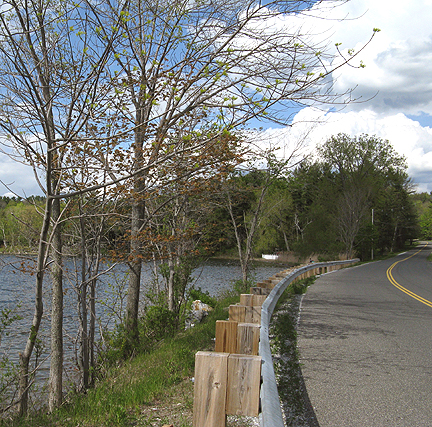
While pilgrimage is a physical stretch forward, and retreat a contemplative pause, struggles can follow the traveller. Along with the forward advance are invasions from the past, especially the recent past. To better appreciate and savour beautiful surroundings, it becomes necessary to shard off the accumulated detritus of anxiety, worries, workplace hardships, and lingering negative thoughts. That takes time. A good change of scenery helps to balance perspective. I used much of my four-hour drive, diagonally across the heart of New England, to lecture to myself about my recent ordeals. There’s nothing like a solo road trip to give yourself your undivided attention and set things straight! As the scenery rolls along, traffic thins out, and my own recognition gives way to acknowledging fatigue and longing for positive change. My self-talk runs its course, and words advance into prayers. The Massachusetts Turnpike finds its westernmost terminus in West Stockbridge, and I depart to mingle with curved and steep little quiet roads. My back seat is freighted with clean clothes, books, and writing materials- and I have a head filled with thoughts and hopes. Retreats are lifelines, liminal spaces between treacherous desert stretches. Gratitude comes very quickly, along leafy and lilac-scented lanes.


Wheeling into Stockbridge, and recognizing some familiar places, I checked into my little 18th century room. There was a welcome note on the writing table, with some baked treats. The blended aromas of linens, the ancient interior, and lilacs at my window reminded me to make note of the present. Monument Square suddenly felt at least 240 miles behind me. There was no more travelling or arriving to be done. And I proceeded to do the “what tells me I’m here” things. That’s my way of beginning to absorb a place long-awaited. I took my camera, and walked a few steep hills near the shrine church; I walked some bucolic pathways, looked skyward, and drew in deep breaths of sweet mountain air. I wanted some new imagery to fall asleep by. Writing and reading followed, after which I sunk into an antique bed. The arrival to a retreat is simply for absorbing the surroundings. It is a place for inquiry and intention, not for problem-solving. In a short evening’s arrival, I already saw I’d chosen the right place.


“And the tougher it gets
And the more that I sweat
And the harder it fights
And the deeper it bites
I’m one step closer to home;
And you can tie my hands
Or whip my back
I can’t give in
’til the sky turns black
I may get lost
I’m one step closer to home.”
~ The Alarm, One Step Closer to Home
An exploration of negation skates upon thin ice. The lowest strata, weighted to darkest depths, are opposed by lofty and liberating heights. Yet it remains for an earnest soul to comprehend spectra of the spirit. Navigating into the open seas of this new year brings me through straits that grapple with the old shoals of alienation. Knowing to steer such shores is essential. Terrain and tossing tides change constantly, emphasizing the critical value of compass accuracy. And thus there must be ways to manoeuver through the anguish of exclusion, en route to the vast embrace of oceans and horizons.
Belonging and acceptance, with their conditional properties, have haunted me since my earliest memories. Of late, it has pronouncedly surfaced how my self-perception has been tainted for too long by the black-sheep and bullied experiences of childhood, along with familial and social rejections of young adulthood. Coming to solid terms with a life’s course of a tacking outsider that never quite belongs does not mean resigning to the shadows. Not at all. It must mean exulting in disjointedness. But thriving along uncharted realms demands an urgency to deflate that lower, darker, defeatist nature that propels despair and bitterness. Throw it overboard.
For the voyage to really progress, the high road of positive growth cannot be delayed an additional moment. Take stock in the kindred, understanding souls you know, and count them among retrievable family members. As protracted and relentless as the journey may appear, our times are temporal. We hang our hats upon provisional hooks, and our season’s duration is unknown. Forever is something that defies cartographic description. One might justifiably say that dreaming and hoping are steeply priced, but I contend that stuffing-away and discarding hopes would be far more costly. While trying to discipline myself not to dwell upon dead-ends, I pondered the skills of how thoughts are squelched by those who busy themselves lest old hopes return to the fore. Perhaps this is what so many do with deposited longings left among inner recesses to decompose and blend into the mind’s depths- too far from the surface to be fished out. Then I wondered whether there is an appropriate age for the cessation of aspirations; it seems I’ve either missed that memorandum or blithely excluded it from my much more consequential messages.
Psalm 137 : Babylonic rivers
Consider the words of the exiled Psalmist who wrote:
“... they that wasted us
required of us mirth...
How shall we sing the Lord’s song
in a strange land?”
More than an indentured captive’s lament, these ancient words reveal a soul forced to produce. The rivers of Babylon, and their circumstances in the opening stanza, represent the inhospitable and unfamiliar. Quartered along the waterfront, the laborers found themselves without music in their midst, and sat on the ground, after hanging their harps on willow branches. But they were commanded to stand again, take their instruments from their hanging hooks, and deliver cheer to their captors. The heart of this somber psalm does not include any description of the work they had to do, but instead the pain of forcing joy out of sorrow. Surveying a hostile proximity has a numbing effect, but the emergence of memory brings the deluge. The psalmist and his companions wept when they remembered their lost homes. They had to sing joyous and sacred songs as strangers in an alien land. Although, as Matthew Henry once commented, “it argues a base and sordid spirit” on the part of the captors, it remained for the captives to sing beyond their anger and their expressed hunger for vindication.
Waters of Siloë
The Waters of Siloë, Thomas Merton’s history of the Trappist monastic order, contains instances of wavering between historiography and subtle autobiography. Contemporary readers are able to apply the benefit of retrospective knowledge about Merton’s life. His superior recognized the potential for Merton’s literary skills to draw popular attention to the monastery, and he set the young monk to publishing histories and translations, along with philosophical works. The results were phenomenal, with new postulants and fanmail flocking to Gethsemani Abbey. As for the dutiful Merton, the life of silent contemplation eluded him; the vocation which brought him to the monastery remained unfulfilled until his last years. While unable in good faith to disobey his order, Merton industriously delivered the goods- even adding the beautifully insightful works that continue to inspire. He found ways to sing the Lord’s song through his anguish, and occasionally his distress appears between the lines.
Providing a historic chronicle of Cistercian monasticism, beginning with the late 11th century, Merton describes the major leaders and communities from medieval Europe to foundations throughout the world. Amidst the general narrative of The Waters of Siloë is a thorough and sensitive portrait of an ordinary French monk named Maxime Carlier. Merton elaborates about how Carlier, called to a life of silent contemplation and monastic solitude, had been sent by his abbot to fight in World War I. Though chronologically impossible, one would think Merton knew Carlier personally by the book’s vivid comments about the latter’s spiritual life and intentions. Merton’s summaries of Carlier’s inner renewal reads remarkably like his own experience. Perhaps it was Merton joining Carlier, sensing that “somehow, I don’t know how it was, my soul entered upon a state in which all its desires seemed to be fulfilled. It enjoyed the delight of resting in a feeling of secret happiness.”
It seems Merton is speaking through his telling of Carlier’s life, expressing the inner torment of having to go to war and leave behind his heart’s vocation. Carlier’s troop even had to march past his own monastery, but he was not allowed to stop and see his brethren. At the close of the Carlier vignette, Merton describes a reckoning which may have been his own: what puzzles us as divine unkindness is actually the sacrifice asked of us en route to perfection. When we are kept away from our hopes and goals, we must continue to bear the cross and walk worthily of our calling. Carlier rescued many of his fellow soldiers, was decorated with the Croix de Guerre, and finally killed in action. Concluding, speaking his voice through his history writing, Merton adds: “then the veils of faith were suddenly shattered, and the noise of the world ended forever, as the Cistercian soldier entered into the sounding silence of a contemplation without obscurity and without end.”
The Cloud of Unknowing : being nowhere
The anonymous 14th century author of The Cloud of Unknowing set out to counsel novices in his community for whom spiritual life seemed arcane and frustrating. Among basic points of advice and encouragement, still applicable to this day, is the unusual exhortation to be nowhere. Strangers and pilgrims do well to set their hearts upon things above, and in so doing find their affections “transformed by the inner experience of nothing and nowhere.”
“But to this you say: ‘Where then shall I be? By your reckoning I am to be nowhere!’ Exactly. In fact, you have expressed it rather well, for I would indeed have you be nowhere. Why? Because nowhere, physically, is everywhere spiritually.”
Reconciling aspirations, accomplishments, and disappointments as one who is “nothing and nowhere” reminds the humbled sojourner of the liberating aspects of being both something and everywhere. “When your mind focuses on anything,” the author advises, “you are there in that place spiritually, as certainly as your body is located in a definite place right now.” He continues, “go on with this nothing, moved only by your love for God.” Tolerating- even thriving- amidst life’s setbacks seems a burdensome purgation, yet somehow a necessary darkness we must navigate through. The nothingness borne within an individual is a cloud of unknowing between humanity and divinity. From material nothingness comes spiritual plenitude: “For in this darkness we experience an intuitive understanding of everything material and spiritual without giving special attention to anything in particular.” The reward for patiently persevering through dark times is confidence about our own destiny.

one step closer
Though we are “compassed about with so great a cloud of witnesses,” the Epistle to the Hebrews equally offers reminders that the most prominent among our ancient forbears “confessed that they were strangers and pilgrims on the earth.” While trying to make sense of my abundant failings and occasional instances of acceptance, the best thing is to revel in the very alienation that oppressed so forcefully in the past. Similarly to the authors referenced in this essay, we move about in worlds as yet unrealized. Rejections far outnumber acceptances, but the wilderness of refusal must be traversed for the cause of gaining the pearl of affirmative. Strangers and pilgrims have the noblest of patron saints, as well as the strongest spines.
Let us be, at least, contentedly disjointed- bringing out the open-endedness and positive aspects of being perennially out-of-place. Instead of lucrative contracts, financial founts, or real estate, my chief assets begin with faith, wits, and oddness. The flip side of exclusion is the “nothing and nowhere” of the Cloud of Unknowing. Though not fully belonging anywhere, somehow part of many places. Moored by mere threads means mobilization toward improvement. Riches and recognition recede in importance, compared to the freedom to choose away from what is unproductive in favor of pursuing what is constructive and good. The voyage requires unrelenting vigilance, no matter how unsure prospects and opportunities appear. Comprehending how the blessed nothingness exceeds the world’s everything may require more than human faculties, therefore trust will have to suffice as a navigational instrument. “For myself,” wrote the anonymous author of Cloud of Unknowing, “I prefer to be lost in this nowhere, wrestling with this blind nothingness, than to be like some great lord going about everywhere and enjoying the world as if he owned it.” We may wonder what is really owned, and by whom.


“For in the realm of the spirit
heaven is as near up as it is down,
behind as before, to left or to right.
The loftiest and surest way to heaven
is measured by desires
and not by miles.
The one who longs to be there
really is there in spirit.”
~ The Cloud of Unknowing, chapter 60
Two beachcombers stopped to talk, as I busily wrote aperch on a rock. “Is that your journal? Are you writing poems?” “It is,” I answered, “but I’m just making notes about the day.” “That’s awesome,” one of them said. In response I asked, “do you write poems?” “I did when I was young,” replied the girl who looked no older than ten; “now we draw lots of mermaids- like this!” They proudly displayed one of their notebooks. “Definitely awesome,” I said, later remembering myself as a ten year old that used to say, “when I was young.”
With time and distance, there are increasingly more complex things of which the mind must make sense. Measures and increments. We refer to how many years ago, or jobs ago, or who was with us- and the places, tasks, titles, and names apply measure to time. Interacting our lives with time and space leads to the necessity of comprehending their quantities.

In the midst of desert wilderness, ends are not within sight; if they could be, an interminable trudge would seem more a definable sojourn. Alas, we cannot know the duration of a temporal condition. Using the standard measures of time when referring back to, say, the time between completing grad school and that first serious full-time job, the words three-and-a-half years roll forth with an ease that dishonors the countless miles, missed meals, hopeful presentations, and nerve-wracking poverty. And those rejection letters: I’d made a rule for myself that no rejection letter was to cross the threshold into my apartment. Spans such as three-and-a-half years are lived in hours, days, weeks, and blurs. Measuring devices provide some degree of command over the portioning of areas and amounts. It is for the individual soul to determine scales of importance, thus using personal significance to establish proportion. Having this in mind, perhaps there is asymmetry in our measuring of time- and even time itself. Consider how ages 12 to 17 covered five years; so did 25 to 30. Five years is five years. Well, perhaps not as simply as that. There are proportions, experiences, and what we archivists call enduring value. These defy measurement.
With time lived, and distances experienced and navigated, comes a reckoning with procedure. Progress manifests in steps. Structures are constructed in phases. Foundations precede roofs, a chassis is built before an interior is detailed. When conserving a book, I don’t encase gathers of pages (called signatures) before binding them first. I had to learn to patiently wait out an adhesive’s curing process. By contrast, it requires precise rapidity to be able to carry out paper repair procedures. Part of the continued cultivation of patience is through appreciating sequence. An increased comprehension of progress helps develop perceptive abilities.

Lest more time and opportunities elude my reach, I hope to better perceive my context. How else to arrive at a cultivated sense of vision, between impatiently desiring this trait- and by incidental endurance? To envision does incorporate a perspective that refers back to the times and lives of enterprises and projects, as well as looking ahead without encumbrance. Balancing between the jaundiced pitfall-knowing eye and seeing open-ended potential as it presents. Remembering archival principles, when faced with massive quantities of unorganized records, we archivists must first establish intellectual control over the material. This means to get a sense of the documents we’re to preserve and for which to create access tools. If there’s no discernable order or provenance (origin), we must impose a coherent classification, with respect to the sources (or roots) of the records. In a similar sense, it is for the perceptive soul to size up the overabundance, and apply principles of context appraisal, provenance, and ascertain evidentiary value. With perspective, I can appreciate confluences of terminology and import them freely into my own context. The impulse to organize and preserve must be checked, however, lest there be an unnecessary strain to uphold obstructive and stagnating notions.

Even with a sense of my roots and a remembrance of the providential, I often wonder how to look forward. The unknowing may be just as helpful as the corpus of all that I do know. Though having a sense of direction, the course to chart is of unknown measure. And even by making notes about the day, recording them with written words, it is a one-way travel. With shoulder to the plow, there’s no heading back- certainly not beyond reflection through historic record.
I’d like to think there is more reason to prefer the future to the past. It’s still a good idea to look forward, even with no apparent place to go. The time being is of an unseen duration. There remains the near, the manageable future, which has some delineated measure. This evening after work, having fulfilled my obligations, I’ll have time to write. A modest and attainable goal. Indeed, there are the grander ones, too, providing plenty of bucket list lining material. “Bear well in mind,” wrote Saint-Exupéry in Citadelle, “ that your whole past was but a birth and becoming.” For him, the desert represented the mind. This occurs to my thoughts, as so much around me appears as deserted places. The adventures we all live contain lessons, and perhaps mine at present is to see what I can create in a persisting desert. The past is definable and can be analyzed. The present and immediate future are the waters now plied. Their distant extremities cannot be measured or defined. Without grasp, comfort must then be taken in the Unsearchable and Immeasurable.


