



 Posts
All Comments
Posts
All Comments

“You have here no place of long abiding,
for wherever you have come you are but a
stranger and a pilgrim, and never will find perfect rest
until you are fully joined to God.
Why do you look to have rest here, since this is not
your resting place? Your full rest must be in heavenly things,
and you must behold all earthly things as transitory and shortly passing away.
And beware well not to cling to them overmuch...”
~ Thomas à Kempis, Imitatio Christi
1
Reminiscent of the sports situation in which a team is down by several goals late in the 3rd period, my furious and relentless five-month search for housing ran out of time. Watching my version of timed “regulation” fizzle, I was forced to choose between an emergency move or eviction. Losing my home of 37 years due to the gentrification of the apartment building is but one unfortunate story among many in a small city that has sold its own soul. A recent housing survey has tabulated that the Greater Portland area is short more than 9,000 housing units. True to the local fashion, years and years of talk do not lead to effective action. The pandemic era causes many of us to try making the better of a bad situation. Witnessing the misery and struggles of countless neighbors and colleagues, I have an idea that I’ve managed to defy some of the odds, albeit on a very modest income. Listening to dozens upon dozens of hardship stories- from sudden compounded rents, to evictions, to evacuations from condemned buildings- has generated a saturation factor causing an emotional wrenching now each time I encounter anything reminding me of housing instability. All the while, I’ve been flailing at creative networking, cold calling, traipsing through more than 30 apartments, and chafing at the unwinnable contest of answering online advertisements. Conceding defeat is essentially managing the losing. It’s also making efforts to insist upon recognizing any good I can find.
Many- too many- people are forced to endure the horrors of having their homes kicked out from under them. So many injured souls. The crisis extends far beyond this region and across the continent. Amidst this overspreading precariousness there is hunger for solidity and consolation. My vigilant searches and inquiries have painfully shown me how there is a severe deficit of compassion and mercy. Who will dare to not exploit? All the courage and fortitude I can conjure up cannot compensate enough. At the same time, what is past needs to be released to create space for the future. The loss of my home is also my farewell to the dwelling which accompanied my adult life up to now. These recent five months of purging, packing, and feverish searching have also comprised a protracted grieving. I’m eager for this to end, even though it means squeezing into a smaller and costlier space. The new chapter is forced by crisis, and the decision is surely a compromise.
2

The general, abiding impression is that of necessary sadness, hoping this is provisional and that I’ll transcend this. Indeed, I want to write about other things. Along with all my neighbors in the building, we did not want to leave. These conditions are equally sad and moving is necessary. The added overlay of a general housing crisis enhances the anguish. It is necessary to move; there are no alternatives. It is necessary to stay the course and insist upon hoping for better days and situations. It is especially necessary to continue cultivating ambition, even in the face of yet another recession. It is, alas, also necessary to compromise living conditions- albeit as civilly as possible. I have learned plenty about how little I can afford. Surviving this crucible is necessary, and the road traverses intense sadness. It is sad to be forced out of my home of many years, before I’ve been able to improve my fortunes. Loss of housing and neighborhood make for a sad equation. At the same time, I have witnessed the decline of my neighborhood’s resources, infrastructure, and quality of life. I also watched the building deteriorate into something unsafe. Sometimes you leave your neighborhood, and sometimes your neighborhood leaves you. In my case, I suppose it’s both. A major aspect of this sadness is connected to the people who have either left or passed away during my years in the building and vicinity. Loyalty is an effortless trait for me, and in these recent months I’ve seen a painful downside as it concerns loyalty to place. Uncertainty about the future is also a sadness, and I know many who share this sentiment. Being a supportive friend helps distract me from personal worries, and allows me to be more useful. Along with that, I have no intention to espouse the passivity of the regional culture- those who watch the sufferings of others, instead of doing something to help. There really is a mercy deficit.
3
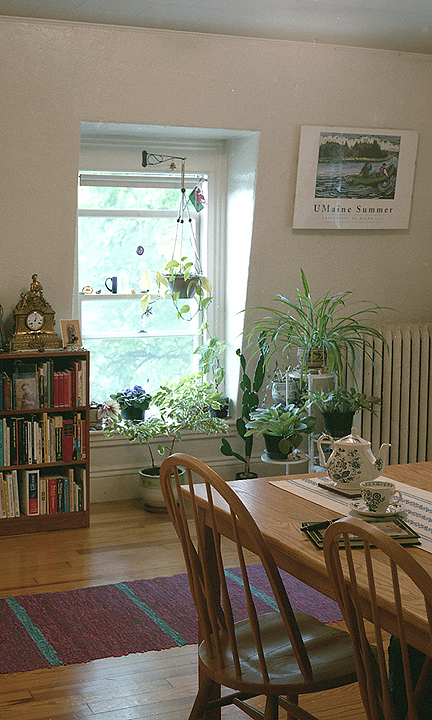
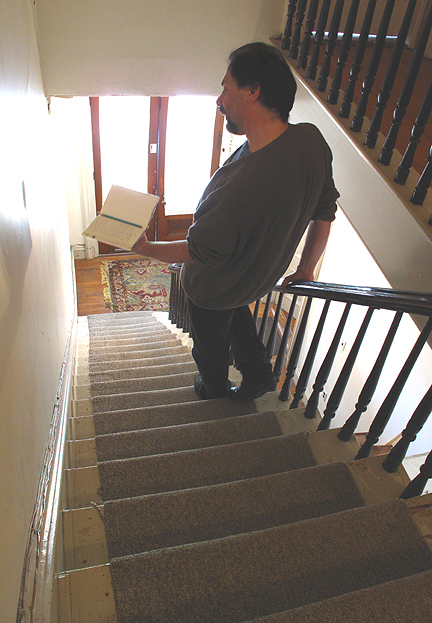
By definition, necessity does not really go away; something is necessary until it isn’t. We all remember requirements from our school days. As for sadness, it may remain as a landmark, and that is preferable to being an enduring state of mind. Grief settles into the fibers of our being, if it must simply be an unresolved landmark in time and place. With this move, unsatisfactory and expensive as it is, there will be a beginning to the distance placed between now and the future. Everything is packed, that frightening lease has been signed, and my reimbursed security deposit for my current place will come from the invisible developers who bought the old building. I’ve been photographing parts of the building that I hadn’t previously documented, and writing at a few perches for the last time. A wise friend suggested that I find ways to break with the place, without regret, and thoroughly. For me, it’s always writing and photography. Of course, those crafts go with me.

While writing on the front stoop, the hallway steps, and at my old window, I am thinking about what proceeds with me from this long night. What will stay with me, after I return my keys and get used to different streets? The necessary sadness comes as a result of a lot of active struggle. Not being able to accomplish my housing preferences, such as with neighborhoods, spaces, and my hopes to continue renting from families, sadness is paralleled with disappointment. At the same time, I’ve actually found something, and that will have to do, for the time being. It has been difficult to separate my disappointment from the hundreds of conversations I’ve had around this metropolitan area. The word-of-mouth efforts failed, although I did meet a lot of people. During interspersed quiet moments, I’m telling myself that it is of critical value to not become angry or bitter toward anyone. Just don’t. Sure this is all rotten, but these times are rotten and desperate for a lot of people. Still more are homeless. As with the general pandemic, this city’s regional gentrification has taken down far too many people through no faults of their own. The cruel consequences are largely unavoidable. We are each left to commandeer our resources and wits. One of numerous leasing agents I met told me about a family she knows that had to live in a tent pitched in a friend’s backyard even though the head of the household had a job. They could not find an apartment, and wound up sinking themselves in an ill-timed mortgage. A neighbor saw me carrying donations out to my car, and we got to talking about this whole sad scenario. Amidst our conversation she asserted that the neighborhood and the building will always be part of me. A number of other neighbors have said this to me, as well. Yes, the memories go with me, and the better ones should stay with me. All the years of photographs will help. And still more valuable is to have it in mind to appreciate what was. A great deal of goodness to reflect back upon, while fully aware of what has finally run its course.


“In the clefts of the rock
I delight to be.
In the covert of the precipice
You would find me.”
~ Song of Solomon, 2:14

Spring returns in much the same way as it happens when visiting with a former colleague after a long absence. There is as much to recognize and recount, as there is the air of the strange and somewhat out of touch. When chatting with an old friend for the first time in a year, care must be taken not to imply too much mutual understanding so as to sound rude. The oddly unfamiliar will re-familiarize, and the past impressions and inside jokes will return. We adapt and find ways to take the remarkable for granted. As winter becomes spring, temperatures in the forties, iceless sidewalks, and light clothing are suspiciously novel. In a short time today, I drove from sleet into coastal fog, rolling the windows down and savouring the swirl of spring air, I stopped along the road at a coffeehouse I like to frequent.

Journal-writing became something permanent and quite natural for me, just as I began my graduate studies. There were fits and starts through earlier schooling, stiffly answering compulsory assignments. Journaling reached a continuous trail for me, as writing developed into an unprovoked stream of thought processes. Accompanying writing and advanced studies, the effects of environment upon creativity were at once obvious to me. There are times for solitude, and there are times for the buzzing of a bustling café. Writing, as with athletics, is kept buoyant with momentum. Scraps of paper are at the ready, when a running start’s worth of thoughts come to me.

As for the cafés, when there is time, I have favorite places for writing and reading. For many years (until they were gentrified out), I referred to a café in the Old Port district of Portland as The Familiar Perch. Numerous journal entries include “F.P.” to indicate where I was writing. With changes in my home town, as well as travels- and similar currents in the various places of my frequency- there are multiple familiar perches of mine. I also have many favorite outdoor perches, too- especially spots that allow me to look up from my books to ocean views. Kettle Cove, in Cape Elizabeth, is one such familiar perch, beloved to me for at least thirty years. The large and angular crags provide for plenty of seating furniture. Where exactly to perch in places like this depends very much upon tidal movement. If the tide is ascending while I’m writing, I have to pay attention! Inevitably, being aperch in the wafts of words is to be nestled in safe clefts in the weatherbeaten ledges of this world. Indeed, a familiar perch can be anywhere, as long as it is a cherished and consoling place. For a cherished place to be familiar to you, a helpful ingredient is to build a positive history with the place- wherever and whatever it is, be it a destination point or a way-station. Among my familiar perches are favorite parks, hiking trails, libraries, restaurants, and even monasteries. I’ll occasionally visit my homework bench, near the University of Southern Maine; it still suits me just fine. A familiar perch can be a recollection point, somehow holding and rekindling memories for us.


A familiar perch as a consoling place serves as a cleft in the rock, a shelter; a place of pause. At the prospect of uncertain exodus, Moses pleaded with God to be certain of the Divine presence that would protect him and the people under his responsibility. As any person- even the strongest among us- he needed to be solidly convinced; he wanted assurance. God actually replied to Moses, and said, “When my glory passes by, I will put you in a cleft in the rock and cover you with my hand until I have passed by.” The sight would have been overwhelming and devastating for a human, like staring straight into the sun at close proximity. As it is understandably human to doubt, it is equally human to want to be convinced of imminent consolation. It would be good to know that desolations are short-lived, even by human standards. The cleft in the rock reminds us of concealing refuge.

Admittedly far humbler than the grandeur of the ancient Exodus, notebooks can be tiny clefts among shifting mountains and barricading boulders. Journals are my portable hiding places, little tents I can set up, write in, and re-fold as time and duty force me to continue moving. These written words are at once fixtures and fluid, yet safe and ready places for thoughts. While the ubiquitous electronically-lit screens are deterrents to musing, handwriting in small notebooks has an immediate physical sense of context. By this, I mean being clearly aware of place and time while writing, with an inherent patience to await the formulation of thoughts. Journal writing as a cleft in the rock is a cherished and consoling circumstance; it becomes its own consistently familiar perch. If writing is a “place,” then it is a communing encampment that moves with the individual writer. And like the biblical sheltering crevice, the written refuge is both the hiding-place and the conduit of discovery.

Above: Kettle Cove, Maine.
Below: Weston Priory, Vermont.


"graphite today: this place of writing is a portable hideout. it has no address and it moves around. it can be folded and hidden, as needed."

“...the wind cut up the street with a soft sea-noise hanging on its arm...
...here and around here it was that the journey had begun
of the one I was pursuing...”
~ Dylan Thomas, Return Journey.


On a weekday, still with books and papers in my arms, I walked to the Oxford railway station to buy my ticket for North Wales. One sojourn leading to another. Not realizing an explanation was needed, I blithely requested a one-way ticket for Penmaenmawr. Then, after helping the ticket agent spell and pronounce “pen-mine-maOW-rr,” I helped him locate the town on his computer monitor. For the record, he was very nice about everything, and perhaps in an apologetic spirit he reserved “table seats” for me aboard each of the 3 trains I needed to get across the English Midlands, to northwestern Wales. Well this Oxford scholar with a New England accent, heading for the “Fortress Gwynedd,” was certainly grateful to look forward to a day’s train travel with reserved perches that included writing surfaces.


Packing to leave Oxford and the goodbyes (with plenty of see-you-laters) were offset by the anticipation of a return to Wales. No longer the first-ever visit, which I experienced in the previous year, but this time a return journey. The distinction is significant, as the mystery of travelling to a place charted solely by maternal recollections and childhood dreams is augmented by the prospect of returning to places remembered in personal experience. This time, I could visualize the destinations. Places, sounds, and countenances joined the stream of expectation. There were tastes I wanted to be sure not to miss, such as bakery-warm Welsh cakes, and S.A. Brains Ale with seafood. There were photo angles to retry on this visit, and opportunities to see more places for which there hadn’t been sufficient time on the first sojourn.
Bangor, Wales.


All journeys are to be savoured, as no two impressions are alike. Return journeys are as unique as initial discoveries. The differences are in the imageries that inform the going forth. In all our journeys, we blend together the known and the unknowing. As well, we are uniquely able to synthesize the composite experience of multiple memories, landmarks, and projected hopes when we return to places of our choosing.
The aspect of returning to a place already visited- or in the case of my monthly travels to Boston, something almost errand-like, the visits are colored by the weather, the tasks-at-hand (if any aside from strolling), and indeed the kind of mood I’m in. But it is a return nonetheless, and one I elect to make. The great distinction is that a choice was made; this is not perfunctory. The dynamic, being one of choice, means that I am just where I want to be, notwithstanding how I feel, where I just came from, and any other baggage that may have come with me. Returning to a place, and wanting to be there, is actually in response to the place calling you to come back. Thoughts become enlivened by the prospects of the object of your wanderlust, of your longing for a very specific place with lanes, skies, handshakes, houses, and aromas.


The train travel took an entire day, with transfers in Birmingham, Shrewsbury, and Chester. The transition into something very different from urban and suburban Midlands to rural mountain country became clearly pronounced as my last train reached the sea. Shoreline was immediately at the starboard side, with the mountains of North Wales above the port side. Skies alternated between stark brightness and overcast spatter. The weather of the Welsh coast, which is so similar to that of the Maine coast, one place now reminds me of the other.
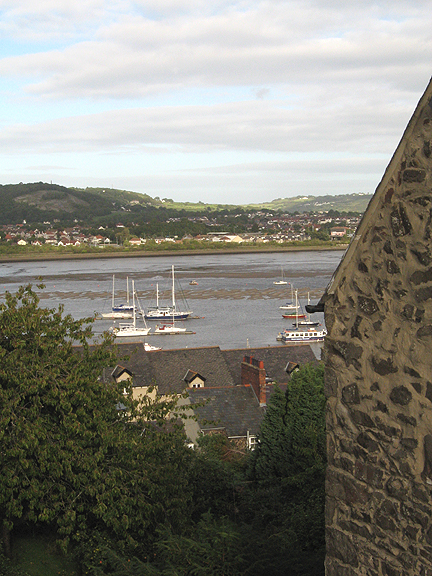

The return to North Wales came a year after my emotional first visit, having had a year to convey stories from the month of Welsh travels to my parents at Thanksgiving, and keeping in touch with new friends, anticipating the return. The arrival this time was directly from a long sojourn at Oxford. Thus, I instantly noticed the Oxford House in the small village of Penmaenmawr- even how the storefront is painted navy blue.

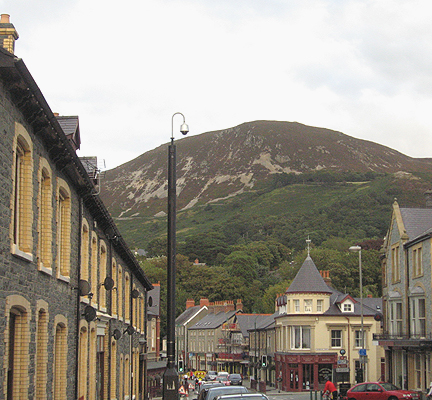

In Bangor, I could notice the progress of construction projects I had seen in the prior year, and how these things (the University arts centre, and some housing complexes) had changed. Before making the trip, during the planning, I realized there wouldn’t be enough time to visit places and friends in South Wales; I could only choose one direction, and chose north. I was gratefully able to welcome the restorer of the Dylan Thomas home, in Swansea, to The Kilns (C. S. Lewis’ home- which had been my home in Oxford), as a sweet reunion. While explaining my choice to Annie Haden, she very matter-of-factly said, “well that’s your Mam’s place,” giving me the impression that if I had chosen to go south, she would’ve said. “Why didn’t you go back to Bangor, child?” I could just picture it. Indeed, I did gratefully go back to the north, following my wishes and remembrances from the past year.
Same gates, but 54 years apart: My mother and me, in Bangor.


Consider the phenomenon of a place returning to you. Not as with unpleasant histories, but the opposite, life-giving kind of haunting. These are dreams we welcome, reminders of the flowering amidst our struggling thorns, gratitude as fruit of survival. When a place calls and colors our dreams, the impression is more than of the place itself. Surely, streets and squares, with addresses, can be physically visited. When a place joins the geographic arrangement of our dreams, we are included as inhabitants of such reveries. These places include our selves as resident travellers. When I revisit Paris and New York, I am there as an infant, an adolescent, a teenager, and as I am today. All the lenses are kept polished. My images of Wales evolved from retold stories and postcards to enquiries and, finally, my own footsteps. Places we hold dear to our hearts and thoughts are in our eyes. They go with us, they return with us, and cultivate our life experiences.


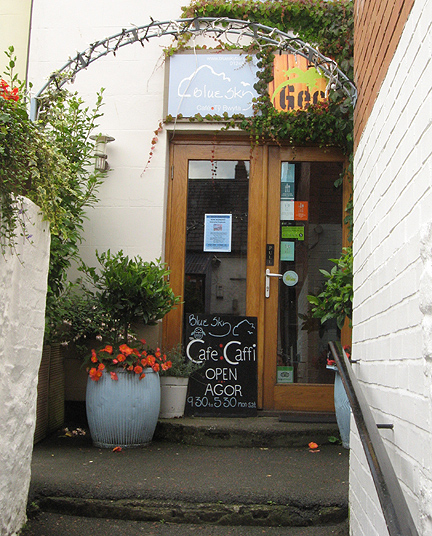
The places and vistas I enjoyed most in Bangor are still favorites of mine. My urban penchant for strolling and browsing draws my attention to High Street, Deiniol Road, and Holyhead Road. The latter is near Bangor University, where my mother studied. At frequent intervals, among shopwindows, are cafés and bakeries. My very favorite is the Blue Sky Café, which is in a high-raftered skylit loft at the center of Bangor.


Bangor Pier.

A meditative stroll along the Garth Road continues onto the Victorian scenic Bangor Pier. On one evening’s visit, the winds whipped through the Menai Strait with such force that pedestrians on the pier were holding on to the boardwalk’s railings. With this return, I was better able to appreciate Bangor Cathedral- both in its general ambience and its architectural details. One of my recent visits was on a pouring rainy day, and somehow the exterior conditions caused the interior to feel much more intimate. The return journey reminded me of the sanctuary, whose foundation dates back to the 7th century, as a place of prayer. Having developed warm friendships through- and with- the Bangor Public Library, that is undoubtedly one of my favorite places in town.


Bangor Library.

Indeed, I did see places I had not seen before, and made new acquaintances, but that’s to be expected. Return visits are new experiences, as today is distinct from yesterday. Now it occurs to me how often I peruse the same favorite districts in Boston, noting changes, discovering new things, and visiting old favorite points of reference. When it comes to hospitable and beloved settings, familiarity breeds endearment. As for Bangor, its environs, and Wales, I am thankful for places of grateful returns. There is no honor quite as sublime as being warmly anticipated. A living sign of mutual recognition, the gift of welcome is a gesture of both extension and inclusion. As our times appear fragile and temporal, embraces represent treasured belonging and the sense of home. Thoughts that console, soothe, and endure. Sights, voices, and days return to me with the effortless prompt of atmosphere. Wafting weather and aromatic air bring words to mind and paper, collated to the volumes of a life.


