Showing posts with label consolation. Show all posts

Wednesday, February 19, 2025

accompaniment

“I see at certain epochs of history what seems like an emergence,
an incursion, of the Divine Life.
It seems as though in a marked way
and to a peculiar degree the Life of God-
again humanly revealed- has broken, like a vernal equinox,
into the lives of humans and into the stream of history.
A new installment of life has burst into the world,
like a mutation, that changes the old level forever...
Divine wisdom, changing the line of march...
Not always was it a saint that did it,
but it was always a transmitter,
and always the trail was luminous.”


~ Rufus Jones, The Luminous Trail.


among others

As I proceed, the trails of my creating are as equally evident to me as the paths I’ve chosen to follow. Survival has required years of roadbuilding and provisioning, albeit through poor visibility. And this is said amidst constant, resourceful, and tireless work. There are countless souls in far lesser straits, visible daily in these stratified times. Having lived for decades in a small city that suddenly turned so radically and severely into gentrification, my continuum has been pushed to the margins. Among those who manage to stay for various reasons, we substantiate one another’s experiences. A significant portion of the pre-2020 Maine population has out-migrated for improved fortunes elsewhere. When a five-year resident looks like a seasoned doyen, community memory loses its depth. As local resources such as businesses and churches have continued closing, replaced- if at all- by big-box versions of both, the hunger for comforts intensifies. It is seen and heard. And the seeing and hearing are right at the surface at squalid inner-city bus stops. The bus line with which I commute to work is busier on occasional Thursday evenings when a city church offers free suppers. I know this because passengers talk to me, and I always respond. Many climb aboard and disembark with backpacks and plastic bags of belongings, en route to shelters. That’s not to mention the desperation along sidewalks. The wait for my return evening bus witnesses the banter among those turned out for the night. Some help one another haul their bundles. City officials really need to get out more. I could teach them how to be an observer and a participant at the same time.


When we recognize each other, we’re reciprocally bearing witness at the most basic level. From there, we can corroborate our stories. That is inspiration’s ground of being- every scenario from pavement filth to plush meeting offices. When U.S. Surgeon General Vivek Murthy published about the Epidemic of Loneliness, he emphasized the vitality of community connections and genuine, mutual care. I’ll add that when we acknowledge each other, we begin to give validity and respect to those in our midst. This is a way to broach an antidote to desolation. Students and colleagues tell me about how dauntingly difficult it has become to make friends. We all agree about how ironic this sounds, in light of abundant connectivity. Invariably we talk about how social media has redefined “friendship” into something virtual and unsustainable- especially without initiative and conscientiousness. “I’ve seen you here before,” a weathered bus stop standee said to me, followed by “You want some food?” She offered me something from her bag. I thanked her and politely declined, mentioning that I had groceries at home. “You should come to Thursday suppah,” she said, “it’s really good.” “I might just do that,” I replied. I used to serve similar suppers, at a crosstown East End ministry called The Root Cellar. Poverty takes multiple forms, including lack of provisions and shortages of human acknowledgment. Our needs for accompaniment are paralleled by that of mutual recognition. What happens when we are “strangers in town” (or even in our own town whose population abruptly shuffles)? How important is it to be recognized and known?


On a lighter side, I’ve taken to trading wisecracks with one of the grumpiest bus drivers, the fellow some of us call Lurch. I think he does pretty well to keep even-keeled, considering all he tolerates. Well, one morning, as Lurch’s bus approached the stop at which I was awaiting, I witnessed some strikingly reckless driving that included an illegal U-turn right in front of his crowded bus. Boarding and scanning my pass, I said to the grimacing Lurch, “Wow, I saw that red Rav-4,” to which he replied, “Yeah, you can’t make up this kinda stuff.” By sheer participation, we accompany those in our midst. Even Lurch. Among my closest friends is a social worker who is also a pastoral minister. I spoke with him recently about how I’ve especially noticed the value of accompanying others, even in subtle ways, both for others and myself. John understood what I was describing, calling what we can do “the ministry of presence.”


saints


Out of necessity, my recent 2½ years of daily commuting have been on public transit. That helps explain my numerous comments about the liminality of waiting under the elements and having to spend a lot of time doing that. For the previous 17 years, I had a few minutes’ walk to work- until downtown life became an impossible luxury. During my twice-daily waits and rides, there have been opportunities to be made, so that I can redeem the time. Choosing away from the ubiquitous phone-fiddling most everyone else does (“lead me not into temptation, but deliver me from evil”), I always have books with me that serve as companions. Being an unhurried reader that takes notes, requisite index cards are typically handy. My satchel is also provisioned with a prayer booklet for reflective pauses. These sources carry forth into my workday pauses, known in my journals as coffee canticles and bus-stop novenas. Long-known as scribbling and nibbling journaling and lunch breaks go together, one as everyday as the other.


My studies and spiritual practice have run juxtaposed lines for many years. Parallel to sacramental sources in ecclesiastical institutions are the wellsprings of inspiring troves found in libraries. Escrivá referred to his spiritual reading as building up a store of fuel. “It is from there,” he wrote, “that my memory spontaneously draws material which fills my prayer with life.” As it frequently happens with favorite authors, I discovered Escrivá’s work through footnotes printed in books. Most of my beloved authors and works have met my path via written references and by spoken recommendations. The incomparable and indispensable Cloud of Unknowing was first introduced to me by a bookstore owner. A late colleague and friend taught me an observation I’ve shared numerous times: The saints are always teaching us. I’ve long tended to latch onto brilliant thinkers of yore by starting with quotes and compelling portions of books, then their biographies, and finally their own works. An example is San Juan de la Cruz, who became profoundly dear to me. I read all the biographies of him that I could find, leading to contextual readings about his contemporaries in Spain and France, after which I revisited his poetry- and then, feeling prepared enough, The Ascent of Mount Carmel. Studying that great work, over a period of months, I created my own annotated index; it was as though I was navigating the mountain, too. After traveling with it, I had to rebind my copy of the book. His work and his life are inextricable and informative. There are many other saints, not necessarily canonized, and no less significantly- teaching me. Erasmus, Ruysbroeck, Kempis, Pascal, Merton, Tozer, Brother Roger of Taizé- naming just a few- ever accompany me. Faithful companions and their words make for a better provisioned voyage, always teaching me. Another saintly and Quaker companion, fellow Mainer Rufus Matthew Jones, teaches us through his enduring books to not limit our vision to proprietary denominational thinking, and rather to transcend societal fractiousness. From his applied wealth of learning and insight, Jones’ books The Luminous Trail, and Studies in Mystical Religion present vignettes of saints in his characteristic unvarnished eloquence. His descriptions of Saint Francis of Assisi stand alongside the similar reverent biography written by Saint Bonaventure. The latter’s life and works have been integral to my current focus of studies. These teaching saints accompany, and they always mention their accompanying portions of holy writ.


mentors and guides


Dovetailing the ancients are the guiding mentors I’ve personally known. As old friends and cherished teachers, I look to them all as beacons in the night. Earlier this week, after an especially arduous day, while waiting for an elusive outbound Number 9A, I noticed myself straining my eyes as far as possible for that rolling and heated transport. It was a brutal 7 degrees below zero, windchilled and pitch-dark. In that coarse half-hour, everything but a 9A passed by. Having memorized the Divine Mercy Chaplet, I focused on that, also adding to my intentions all those that are without homes. When it finally arrived, stepping up and in from the mound of rock ice, I told the driver he was a God-send. He liked that. Then I sat and thawed a bit, before descending for the last part of my pedestrian journey in the deep freeze, the Chaplet returning to me again. Sources and refuge often intertwine.

We strain into the distance for lighted trails, for game-changers leading to better days and paradigms. There are surely many others; in the search for accompaniment, we can each be accompaniment for one another, adding meaning to our shared continua. Perhaps ponder what and who accompanies you through your days. Who follows whom? What and where are the places and contexts of refuge? Amidst the overwhelm of contemporary culture, there remain lifegiving ideas and gestures to memorize.


Seeking the solidity of consolation, in the absence of accessible places of intellectual and spiritual nourishment, I’ve been seeing how many turn to libraries. People thirst for respectful and nonsectarian acknowledgment. And most may not even realize this. There isn’t a week during which I don’t hear, “You’re about the last familiar face I can find.” Who doesn’t want the assurance of familiar faces? Our vulnerabilities hinge upon mutual recognition, which is essentially validation. Whether patrons, or associates, or even donors, there is a common search for witnesses to our lives- for substantiating observers. “Do you remember that?” “Did you know so-and-so?” “Why don’t pictures of such-and-such exist anywhere?” We can only find what has been preserved, and what can be found is what can be preserved. Basic as that sounds, this must be expressed in the gentlest of ways. Interactions reveal food for thought- whether among students, casual visitors, patrons, or colleagues. An occasional researcher totes a large, antiquated computer“tower” with him, which he hefts in a canvas bag. It’s his memory- containing an untold amount of his work; I don’t dare to judge. And then there’s cultural memory. The almost-universal fascination with microfilm is remarkable. Most workers dislike it; I find it very interesting. I call the miles upon miles of filmed newspaper pages history in real-time. Often the queries boil down to people simply wanting to see a time they knew. Reminders. They love telling me about the advertisements they find, along with the long-ago prices. Personal references are often all that any of us can see, in our limited visibility- as with the lights of a homeward bus.


Thursday, May 30, 2024

consoling angels

“I and Pangur Bán my cat,
'Tis a like task we are at:
Hunting mice is his delight,
Hunting words I sit all night.

Better far than praise of men
'Tis to sit with book and pen;
Pangur bears me no ill-will,
He too plies his simple skill...

So in peace our task we ply,
Pangur Ban, my cat, and I;
In our arts we find our bliss,
I have mine and he has his...”


~ Medieval Irish poem, ca.9th century,
The Scholar and his Cat, Pangur Bán.


mutuality and friendship

Gradually familiarizing myself with the newer apartment and neighborhood, after two years of housing instability, the recent weeks have been very much about taking stock. Indeed and also without doubt, even in a spartan building with a longer commute, peacefulness far outweighs inconvenience; as well, the place is more affordable and larger. No regrets. What was endured has somehow been survived. Glancing back at journal entries, essays, and photos from 2022 through early 2024, I’m astonished at the daily reality against which I had to function. Now on incrementally higher ground, I’m slowly rebuilding my physical and spiritual reserves, amidst fulltime work. Many things are still packed, albeit in familiar and carefully-labeled boxes. It’s been only eight weeks; healing takes time.


All the while, this region’s severe housing crisis remains in front of me. I continue to witness homelessness in my midst, and I continue listening to my neighbors’ stories- occasionally offering referrals gleaned from my two years of apartment-scavenging and countless conversations. Early this month, I was featured on a local radio programme, promoting the concept of networking neighbors-helping-neighbors, for a variety of community-reinforcing purposes. I’m hoping to be the sort of person I needed to meet during that agonizingly protracted time during which I met with far too much dismissive reticence. To really improve conditions, there would have to be a serious group of human-sized grains of leaven. I broadened the radio discussion to include more than networking housing referrals, and connecting those in need with supportive hands to assist with chores. Among the limits many of us contend with, encouragement is in short supply. Who will be compassionate?


compassion

In the wake of the Covid-19 pandemic, lingering beyond the physical health risks is what the U.S. Surgeon General calls “Our Epidemic of Loneliness and Isolation.” We adapted so well to quarantining and isolating that much of our human continuum dissolved. My experience included dispersion as colleagues, neighbors, businesses, and parishes left the area- chiefly replaced with remote-economy and short-term arrivals, largely inhabiting elite and gated housing. How friendships and communities now manifest is fluid. How shall we define friendship? Are each of your social media friends actually people you know? Do we know the souls within the names of our contact lists? Will we step up for those we call friends, and will they step up for us? Perhaps there are levels, imitating such service industries as travel, subscriptions, and various tiered “products.” Maybe there are economy-class friends, or gold-card inner-circle communities. In elementary school we counted our friends and best-friends; by high school it was friends and acquaintances. Alas, there were enemies, too. Bullying and fickleness have been around since time immemorial, long before the term unfriending existed. Let us treasure our loved ones, make it known what gems they are, and invest in those connections.

As encouragement is a form of compassion, so compassion is in the expression of consolation. How well do we know to be tactful consolers for those within our reach? Heartfelt reassurance expresses divinity; the Holy Spirit is also known as the Consoler. Petitionary prayers are essentially for consolation, for comfort, for mercy. We wish for this ourselves, as well as to be conduits for others. The gospel recounts how Jesus endured torment and provocation in the desert; as evil departed in defeat, consoling angels appeared. We cannot predict our times as consolers, or when consolation comes to us.


those who console

Arriving at the previous apartment and narrowly avoiding eviction, the intensity of distress combined with that loud and cramped space, filled with heaped personal effects, the mealtime seat was outside on the front steps. There was no place to sit comfortably indoors for at least a month. I naturally looked to the skies, just to see wide open space. In my sorrow about being in that demoralizing place, after losing my home, I’d tearfully pray for better days. In a few weeks’ time, a neighbor’s cat found me on that front stoop. Boo was the friendliest neighbor and consoling angel throughout that difficult time in the East End.


Indeed, Boo has a family and a home on a nearby street, though he liked to roam around among various other neighborhood cats. Some neighbors would pet Boo, or cause him to dart away, but Boo and I reciprocated an extraordinary bond of friendship. Beginning with feeding him bits from my plate, I later bought proper cat treats, ironically called Temptations, which he loved. In fact, Boo received treats every single time he’d come visit. Ordinarily, I’m allergic to most cats- but not to Boo; we were very companionable. Perching outside in all weather, I was always easy for him to find: I was regularly escaping claustrophobia and the bombast of upstairs neighbors, and Boo seemed to like the familiarity of a gentle friend with treats. Boo soon figured out when I’d commute back from work in the evenings, and he’d wait at the door for me to arrive- always polite and never imperious.


Above: Boo often waited at the door for me to return from work.
Below: We shared our tastes in philosophy and seafood.


Being a longtime insomniac, I’d admire how Boo could simply curl up, fold in his legs like retracted landing-gear on an airplane, and simply sleep. Just like that. I’ve tried imitating Boo. When Boo would jump onto my lap and sleep, I’d ponder what a dear soul he is, and that Saint Francis of Assisi sent Boo to my lonely stoop. “You’re such a good, good cat,” I would say to Boo. He really was a consoling angel, and I was sure to make that known; his cat-mother was appreciative. No doubt, he is greatly missed, but in my gratitude I’m glad he has a home, and I have dozens upon dozens of photos of Boo to treasure. In this example, a sweet consolation emerged in contrast to a bad situation. In the depths of despondence, it is vital to keep from desensitizing.


Above: Boo demonstrating expert napping skills.
Below: No matter what Loretta Tupper said in those old commercials, Boo kept his paws on my Parker.


The souls that cross paths with ours, especially friends, and no matter our age, profoundly affect how we live and perceive. Losing a close friend, not because of moving away but due to their passing, intensifies my sense of esteem and their great value. Saint Bonaventure wrote about how we are mimetic by nature, and that we do well to mimic our mentors. I recently lost a friend and role model of more than twenty-four years. My acquaintance with Maddy began when she hired me to organize, process, and conserve the archives of her forebears- Maine’s Gannett family, whose innovations in journalism, publishing, and broadcasting in this state began in the 19th century. The project was a real success, I published some of the results, and Maddy and I became friends for life. Over the years, she connected me with two wonderful unprocessed sources which I brought to equally successful archival fruition: the Children’s Theatre of Maine (her favorite cause) Archives, and the Gannett newspaper photographic negatives (which required my salvaging hundreds of thousands of pieces of film from a gutted building). Painstaking labors of love, to be sure. Through the years, we were both colleagues and friends. She would regularly call me with archival and research queries, and I would call her for wise advice. Maddy was so popularly loved, due to her unpretentiousness and great spirit. We always had interesting things to talk about. She introduced me to many friends, and my permanent gratitude also includes diverting me from my housing misery with tea visits at her home on Littlejohn Island. Healthy distractions, a bit as with Boo the cat. Within my gratitude is the occasional ability to recognize the consoling angels in my midst, and the remembrance becomes all the more vital in their physical absence.


Above: Keeping watch from a cold-weather blanket nest.
Below: Boo is truly a Magnifi Cat, and I'm forever grateful.


Saturday, November 12, 2022

signs

“If we don't release the past,
We'll slap the face of the days to come.
Remember this melody;
Don't ever let it go away.
Sing it to your heart;
Day after day after day.”


~ Michael Roe and The 77s, The Days to Come

1

It seems the most availably productive way to recover my forces damaged by the trauma of housing displacement is to attend to what is immediately required. Learn the new commute, do exceptionally good work, serve those in my midst, and find redeemable aspects in these times. My former neighbors and I could not prevent the loss of our homes in a hastily-sold apartment house. As with countless many others, we’ve all had to navigate disrupted foundations. My home town is now equal parts of unfamiliar and familiar, detestable and endeared, all at once. The old, reliable stabilizing routines have had to be translated into inhospitably cramped and unfriendly confines. A crosstown move might’ve had the balm of improved living standards, but not in this case. The place is also economically unsustainable. Indeed, there will inevitably be another move in the near future; presently, workable compromises are as vital as undaunted ambition.


The pandemic era persists, and the lingering impression is one of a diminished world. Downsized in the sense that there are reduced opportunities. Perhaps there are too many metaphors in front of me, with the clenched apartment in mind. Existing in that claustrophobia-inducing compartment becomes representative of the compression of this stratified society, dead ends, and the intensified expenditure of energy needed to do all that had been previously taken for granted. It’s increasingly difficult to find any basic situation that isn’t forbidding- not to mention affordable. Yet all along I’ve had it in mind that light strikes the brightest contrast in the densest darkness. My own attempts to reckon with substandard housing and the inability to unpack things I used to easily reach for, have me stretching for any healthful inspiration. Perhaps I speak for many in my admission of these times as humiliating. Having admitted this, very consciously resisting identification as a downtrodden person, my focused attention turns to rebuilding confidence. It seems an unrealistic fantasizing to look forward when bleakness reaches to the horizons. News of current events worsen, and in the face of such immersion my journal entries keep straining for the light. I’m limiting my exposure to media sources, and am spending more time outdoors. Fresh air and skies are far more inviting than 8-foot ceilings and Le Cirque des Eléphants above my head within the puny building. And to be sure, the searching for something better continues. Looking, striving, searching, aspiring- so long as I breathe and dream- these must continue.


2

Breakfast and Bruins news on Beacon Hill


Those who know me well also know that I follow one sport, and that’s hockey. The best and worst of humanity’s universally iconographic traits are found in hockey. My father used to insightfully remark how the National Hockey League has always had a special annual award for “gentlemanly play,” the highly esteemed Lady Byng Trophy. One may choose to bear down on the rigors of skating, passing, scoring, and tenacious defense- or one may run up triple-digit penalty minutes in a league that inexcusably countenances brutality. But echoing my Dad, I love the game when it is just played, as in the Olympics, turning on skills and strategies without the violence. I’m grateful for the start of hockey season which brings in a welcome distraction. The ups and downs of the Boston Bruins, along with the Original Six, do a lot more for me than current events and workplace palace intrigues. In a recent Boston Herald article, I made note of a comment made by a veteran hockey coach who had been asked about the resourcefulness of his players, saying “The N.H.L is a find-a-way league.” That comment jumped off the page at me, as I recognized my admiration for such indefatigable pluck. Find a way. Get out there, find ways to score goals and hold a lead. Find ways to block shots. Back when I played hockey on roller skates, I was always told to “cut the angle” and “challenge the shooter.” None of this is easy and finding ways cannot be done from one’s elbows; it’s got to be full-throttle.


Like the coach’s comments and remembering what I was taught, I’m reminded of my instinctive and constant search for signs- for indications to point me forward. Something that draws me to reach forth unto those things which are before can appear in the least-conventional forms, including sports pages. The essential for discernment is openness to sensing the instructional elements in what I experience. Recently on the road, while merging onto the perilous Route 128 in Massachusetts, I gave a quick listen to the traffic report (“on the threes”) on WBZ, after my usual thrice-leftward lane transitions: one lane at a time, signaling like a Lady Byng candidate. After figuring out the necessary detours advised by the traffic report, I began incrementally ascending along the car radio AM dial. Tuning a radio without the presets leaves room for random serendipitous finds. Inching up from somebody prattling about wealth management- clearly meant for the haves, I caught a homily from a broadcast church service. While actively attentive to the rapid traffic, my ear latched onto the pastor’s theme which was compellingly about contending with hardships. His words had the cadence of a mentoring coach, pointing out how present-day lessons can be informed by ancient texts. He observed that personal struggles are means toward purification, that we mortals with our limited perspectives do well to consider how we may be fashioned and sculpted into life in God. He said that we are being pointed toward eternity. I listened intently to this, while the urban traffic thickened, and remembered as many of the words as I could throughout the day.


3

Being attentive to signs of promising directions, my senses have sharpened amidst times and situations that are harsher than I’ve ever seen. The friction and inertia between idealism and present-day realism are palpable. Mindfulness must proceed through minefields, testing even the most seasoned souls. The search for hopeful prospects, for substance, for satisfying applications of time and abilities is especially susceptible to clouding mirages. Ancient wisdom challenges us to test the spirits.


For my purposes, signs are manifestations and portents to suggest possibilities, as well as things to avoid. While adjusting to different surroundings and on the watch for something better, I have my usual photographer’s eyes and archivist’s mind. These discerning faculties help me notice and interpret my experiences, along with comprehending these attributes in context. I try to make sense of things by listening and looking- essentially attending to my surroundings. Even as a child, it was never sufficient to just go through the days’ motions. And to this moment, I need to see the why of things- utility and meaning always on equal footing. Impressions occur in an unprovoked flash. It is not a wrenching contrivance. The temporal present eagerly anticipates a good future. My daily striving is accompanied by taking in the signs of nature, such as the changing skies and lower temperatures. Colorful leaves that waft and fall signify the movements of time. Ubiquitous election campaign signs have not informed me about causes and candidates, but have made for an amusing sea of Yes and No statements. Voting against a cause is voting in favor of something else, and vice-versa.

The Portland Observatory - the signal tower built in 1807


Albeit temporarily, I’m becoming acquainted with the East End, after 37 years in the West End. Barely two miles apart, the two neighborhoods may as well be in two different gentrified cities. To the West End’s brick rowhouses, the East End’s woodframes include a 215-year-old signal tower. My inherent city sense has already figured out strategic shortcuts through the unlit narrow streets. The steep neighborhood has the feel of living on an island: the ocean is always in close view, and conveniences are not nearby. Mornings are damp, to the extent that I now keep a squeegee in my car. Commuting to work is now by infrequent city bus, after decades of walking or bicycling. I miss everything about the old life, but there was no choice for any of us to stay in the building that is now being gutted and luxurified. All there is to do is to continue searching and watching for opportunities to make a beneficial move. I’m reading the signs- both online as well as offline. Giving up cannot be an option; to that, I vote No.


A ubiquitous byproduct of displacement, especially to inadequate confines, is discomfort. More is uncertain than is certain. Signs of assurance may not necessarily appear as spelled-out posted markers. Friendly street greetings and bus driver acknowledgments are cherished. No longer having a budget for leisure, at least I can continue writing and photographing. And preparing comfort food for those humble front-stoop meals. I’m reading consolations in my philosophical studies and in the daily lectionary. In a library book, I saw these words of 17th century Quaker author Sarah Jones:

“Look not at your own weakness,
but look at Him who is calling you.”


I make notes of findings in my chapbooks, adding balance to my journals. Indeed, others have struggled, navigated, and discovered long before me. Their words are clues, signs that can point toward a worthwhile future. Occasionally, signs and consolations find us. The front stoop has been a ready refuge from the apartment’s compression- even though I’m too tall for that, too, and must perch astride it with my legs hanging from the side. But it’s a place from which I can look up, and can greet neighbors.


An especially consoling presence that regularly finds me on the stoop is a friendly cat. Usually the cat notices me first, and sometimes perches on my books to get my full attention. He also gets a slice of smoked turkey. The visits are always timely and appreciated. Among the neighborhood cats, there’s a Maine Coon cat that greets me when I descend from the bus in the evening. The long day’s transactions leave me saturated, but I make time for these visits and sit on the pavement to thank the singing cat. I suppose we all have our causes for vigilance, in the context of realizing the intensity of mine and how much mental space they consume. Exasperated, I see how I cannot force the progress of my urgent conditions- try as I certainly do. As these friendly cats come up to me, and I welcome them, there is something to be read in the arrival of unprovoked blessings. Signs to be discerned. Perhaps what I consider to be vigilance is actually consistency of intention and preparedness.

where the sidewalk ends


Tuesday, September 28, 2021

regrouping


“Philosophy, inevitably, is the human quest for beatitude,
and includes not only a person’s faith and its expansion into the fullness of understanding,
but a person’s will and understanding as well.”


~ A.H. Armstrong & R.A. Markus, Christian Faith and Greek Philosophy.


I’ll bet most of you hear in your workplaces about how close an upcoming Friday is. “It’s almost Friday,” is something I’ve always heard in my midst wherever I’ve worked and gone to school. And I surely feel that headlong lunge toward weekends and days off. “The shore is in sight,” as I hear myself say to the neighborhood postmaster. A colleague of mine likes to say, “we’re almost at forty-eight hours to regroup,” referring to the weekend. As positive as it is to have strong appetites for unstructured and untethered time, there is muted anguish embedded in that stretch for an oasis. Still, it remains vital to keep looking forward to things that are favorable, and no less in these times.


Just as with last year, participating in the recent Oxford Philosophical Society’s seminars was via teleconferencing. But also like last year, I looked forward to our discussions and greatly enjoyed the experience. Indeed, all of us hope next year’s events will happen in person. The pandemic has yet to subside. Fortunately, the desire to teach and learn motivates our technological creativity. The time difference between Maine and the U.K. meant beginning the days at 3am local time, but it was undoubtedly worthwhile. I’ve derived more to share with students, as well as to fuel my own studies in the coming months. Coincidentally, I’ve begun my 7th year of teaching topics in philosophy. For the second year, all of this has to happen online. As with the group at Oxford, the enjoyment of in-person presence is missed, but the benefit of meeting online has removed the limitations of physical location. It’s a strange trade-off, but an undertone of the covid era is to make the best possible out of bad situations.


Surviving intact during a pandemic requires more than those weekly forty-eight hours to regroup, or even the buildup to those two days. In my experience, the regrouping needs to happen daily and obviously in much smaller portions. And those small portions tend to be humbly bland; nowhere as savoury as in pre-covid times. At best, most of us are living compromised lives; often, the regrouping of wits and priorities has to be constant. During the summer, I’ve resumed my monthly travels to the Boston Athenaeum- though complying with all the required health protocols. There’s no telling when things will return to pre-March 2020 life. Thanks to my self-directed studies and my teaching responsibilities, there is encouragement to continually renew, learn, and redeem the time. My working conditions and ambitions continue to ignite my search for a better situation, despite closed doors, rejections, and recession. At least I’m working, producing, surviving, and helping others as much as possible. My studies in philosophy often become sources of wise advice and thought-provoking perspectives.


My discussions and inquiries about the Renaissance-era Oxford reformist philosophers led to a rare 155-year-old book being mailed to me from England. It was more like the gatherings of pages of the book than anything else, as I had to completely rebind the volume’s contents to be able to study the work. The binding was broken, but the textblock was complete and in good condition. The book is The Oxford Reformers of 1498, by Frederic Seebohm. Eager to study a thick tome about Erasmus, Colet, and Thomas More- written by a Quaker social historian, I gathered my best bookbinding ingredients to do justice to the fragments and rebuild them to last. Using conservation-grade cloth, adhesives, endpaper material, and chipboard, I restored the book into something strong enough to inhabit. Restorative projects during tentative times are gestures of hope.


My restorative rebinding of Seebohm's Oxford Reformers of 1498.


Indeed, the book is a treasure filled with treasure. A great read from which I took many notes. The three featured philosophers were kindred spirits and friends who worked together during a time period of wars and plagues. Despite their adversities, they created educational systems and vernacular texts whose influences reached across subsequent centuries and continents. When I find philosophical works that really speak to me, I also seek out biographies about the authors themselves. Seebohm’s volume gave me numerous fine details about the Oxford reformers’ lives. I had never read so much about Colet before. His career in teaching and writing was inspired by having learned from Ficino and Pico della Mirandola, in Florence. After the travels, while still an Oxford student, he began teaching free and public courses which became very popular. He clearly loved doing this, as the preserved letter correspondence attests. The classes, unofficial as they were, continued for more than eight years- until Colet had been appointed Dean of Saint Paul’s Cathedral, London. There is surely something for me to enjoy in Seebohm’s poignant observation:

“The leaven, silently but surely, was leavening the surrounding mass. But Colet probably did not see much of the secret results of his work. That it was his duty to do it was reason enough for his doing it. That it bore at least some visible fruit was sufficient encouragement to work on with good heart. So the years went by; and as often as each term came round, Colet was ready with his gratuitous course of lectures...”


Was the early 16th century any more or less hostile and restrictive than the early 21st century? Was inspiring education and benevolence any more or less scarce than compared to now? In any time, diligence and perseverance are needed in order to excel. It also appears as though an individual’s passion for their work and a willingness to give of their resources were as detectable then as now in the isolating present. Hope and consolation have never lost their value.


Tuesday, May 11, 2021

il dolce far niente

“I'm going nowhere
And I'm going to take my time;
All the questions in the world
I can leave in my mind.
I'm waiting on the sunshine;
The sunshine.”


~ Sixpence None the Richer, Waiting on the Sun

1

Writing daily in a journal as I’ve been doing for many years, I’ve come to use my dated entries as an archival chronicle. As with most any manuscript archive, the journal entries are first-person and in real time, bit by bit amounting to something encyclopedic. Surely I’m doing more writing than reviewing with my journals, though milestone anniversaries are what send me back into my own words past. Often, they are very interesting to read. I’ve used journaling to write through events in order to try making sense of what I witness and experience. The more descriptive, the better. The arrival of the spring season reminded me that the pandemic has cycled into its second year. I re-read what I wrote in February 2020 and because the writing was in real-time, I was using terminology used back then, when many thought of this as a passing “flu panic,” along with describing the intense uncertainty of the extent of things to come. My entry on March 13th describes the national state-of-emergency and the frenzied supermarket-ransacking that followed. That was last spring.

11 March 2020 : "It's as though horizons are closing."


Now a year later, I’m comparing then and now, remembering my first weeks of working from home (which has become much smoother, quite normal, and remarkably productive). Throughout these times, I’ve become aware of the accompanying pandemic inertia that has also become part of life. Last year, because I was struggling to describe it, I referred to my sudden, reluctant, and stifling boredom produced by quarantining, curfews, closures, and no-travel regulations. The overpowering boredom was something as unexpected as it was unfamiliar. Obviously during my on-the-clock workplace hours, I’ve never had to scrounge for projects and duties, and I’ve been grateful to have that constructive framework to stay focused. But outside of those hours, the old compulsion to redeem the time combined with contending with uncharacteristic confinement. After the Philosophical Society conference to which I had been invited last year at Oxford University was cancelled, I had to cancel my travel plans along with scores of people like me around the world having to cancel all kinds of plans of their own. The conference seminars were later held via Zoom- and I did “attend” and participate, albeit beginning the days at 3am Eastern Time. Having that connection gave me needed energy to continue my own studies at home, fueling my insistence upon getting through the pandemic with more knowledge and insight to share than before. I have also continued teaching. Studying has been more of a nourishing means than ever, during these times.


All the while, these times have forced self-confrontations of varying degrees with the incidental aspects of doing nothing. It’s easier for some than for others. Descriptions of that state of being which Italian-speakers call “the sweetness of nothing-doing” has found its way (ironically) to more computer newsfeeds lately. I remember how when someone would ask me, “whatcha doin’?” and I’d answer with “Oh, nothing, really,” the connotation was one of embarrassment at the admission of not being constantly constructive in every sphere of life. The covid era has everyone reckoning with the passage and the uses of time. A culture that increasingly celebrated “extreme” sports, raising the bar with every physical fad, has quieted the quarantined to consider simpler pastimes- including baking, sewing, puzzles, writing, absorbing the outdoors safely. And doing nothing- just being. Simplicity, for many, has become as much choice as necessity. I spoke by phone with a colleague and friend about the recognized value of not-doing. Her response included the merits of simply sitting outside, and that “doing nothing is all right.” It’s a reckoning for my friends, too, as another said, “you know, it’s ok to be bored.” This was journal-worthy, as I’ve never heard anything like this before.

One of the last places I’d expect to see a celebration of nothing-doing is the industrially high-minded Wall Street Journal. This recent March 16th the WSJ published an article about the connections between accomplishment and doing nothing. “Giving your brain a rest” means giving yourself unstructured time to regroup, gather thoughts, and rejuvenate. Admitting that too easily we turn everything into some kind of competitive task, the author suggests doing something essentially mindless, such as taking solitary walks and just sitting down. “Absorb the scenery in silence,” wrote the journalist Annemarie Dooling. I am now more aware of this, and have taken to recollecting with my books closed- or in my own combined way, writing slower in my journal. In appreciation, I’ve become less berating and remorseful about puttering at my writing table and taking aimless bicycle rides. The mind and spirit need to do their own versions of breathing, especially amidst stress. The article quoted a neuroscientist who said, “Rest is one of the most important ways to enhance the neurological flexibility to build the kind of conceptual understanding that is related to identity and purpose.”


2

A cursory online search reveals an abundance of new articles endorsing a “practice” of nothing-doing. The benefits of doing nothing, published by the Erlanger Health Institute, advocates unplugging from technology and “sitting alone in silence” for a while. They also cite the Swedish expression, lagom, which is to say “moderate” oneself (sounding like the way I intersperse some “nothing” with writing). The health institute lures readers by saying that integrating nothingness into our days can reduce stress and boost creativity. I agree, though it would be a conflict in terms to say “I’m going to immerse myself in a state of nothing-doing, in order to be productive.” On a practical level, there are also short “time out” periods, though I’ve never found regulated time-outs to offer enough space for mental meandering. One true and leisurely luxury is to not think about what time it is.


The quotable business school aggregate IvyExec also published an article about the benefits of doing nothing. A more universal appreciation of the Italian “il dolce far niente,” translated as “the pleasantness of doing nothing,” is portrayed as helping multitasking individuals maintain a sustainable pace in their lives. The pandemic has clearly forced reconsideration of how we’ve been doing things, constantly “being busy” to the extent of avoiding healthful stillness and extraneous “screen time.” “Unplugging is difficult,” the article states. “In many ways, it is easier to stay busy than to do nothing.” We are left to wonder about the qualitative aspects of the “busy” of our pre-pandemic compulsions. Further, the article admits how “this culture exalts workaholism,” and that “people feel guilty when they are idle,’ reminding me that I’m far from alone in suddenly having had to deconstruct my breakneck paces. Allowing oneself to do nothing and not feel embarrassed about it, the mind has opportunities to process experiences, make sense of memories, and derive the learning. By our very nature, our imaginations will find ideas and inspirations that may have been smothered under the busyness that we intentionally interrupted.

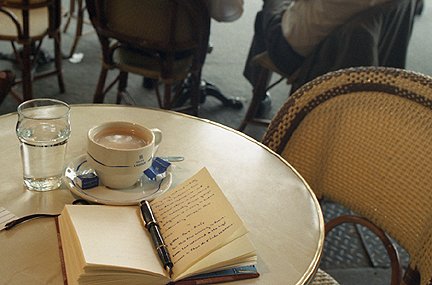
Lao Tse famously reflected about how a person can accomplish much by not overdoing. His quote is often loosely paraphrased as: “Doing nothing is better than being busy doing nothing.” Having grown up and formed in both European (French) and American (Northeast) cultures, I’ve had my own interior ways of observing the differences and the common points as I found them, amalgamating what I’ve admired along the way. In the U.S., hyperproductivity is the stuff of heroism, and we are identified first by our job titles. Evidently, we are the tasks we do. In western Europe, relaxation is essential- even if it’s simply sitting outside. The articles I’ve found about the merits of stillness point out how the time-honored European custom of “just being idle” is an event in itself that needs nothing else. I’ve always admired how Parisian cafés stay open until late hours, filled with people just sitting with their small coffees (and not in “grab and go” thermal cups) and facing out toward the streets, just being. This is also one of my favorite journaling settings. On this side of the pond, having no utilitarian purpose makes Americans uneasy. Generally speaking, our puritanical selves need to have our dithering tendencies condoned. If constructively doing nothing sounds ironic, so does the idea of not being able to hide from ourselves during our pandemic quarantining. Under the limitations of these times, I’ve been using my paid-time-off to give my musing as much perimeter as I can provide. As weather permits or deters, I’ll choose to perch on a rock along the ocean, the front stoop, or my candlelit desk, and simply be.


3

This time last year, many of us at our jobs and schools heard about a hiatus of a couple of weeks. Then a month. Then more. Then it became realistically impossible to predict a duration. Then the word “hiatus” ceased being used. Much of this world has had to move with moving targets, while we no longer hear about the novel virus and the new normal. Everything has had to change, and it remains to be seen whether there can be any reverting back to “before.” How will our societies be affected in the long term? We are yet to see whether our forced “idling” will permanently become part of how we live our lives, and how the adapting we’ve had to do for our survival will alter us.

Photographic paper processor- with the lights on and doors open.


The other day, I was explaining to a friend that I saw a metaphor in something from my days in the custom photofinishing industry. Handmade color prints were individually imprinted in darkrooms with enlargers, lenses, and easels. The paper had to be carefully carried in a lightproof passthrough box into another completely dark room that included the entry for the paper into a roller-transport developing machine. These machines had two modes: Constant Run, and Automatic Standby. We always used the standby mode, to be energy efficient: when there was no paper in the machine, the rollers would go into an idling standby while the chemicals continued to pump at the regulated temperature. As soon a sheet of photographic paper was fed into the machine, the drives would start roaring at full-tilt, taking the machine out of standby, and running the print all the way through the process- as we used to say- “dry to dry.” This present odyssey has taken many people from constant run to automatic standby, and I’ve been in a state of preparedness to have to return to full perpetual motion as needed.


Stillness also becomes an unlikely way to find solutions and even resolve. “Sitting with one’s fears,” means ceasing the flailing and to visualize better outcomes. It doesn’t have to be quite as rarified as it sounds. I had a neighbor on my block who regularly sat out on the front stoop of her building with a cup of coffee and her everpresent cigarette. Of the latter she would say, “they’re what I’ve got.” This was shorthand for describing how she needed to just think, simply sit with her thoughts, and the cigarettes bought her some time and airspace to be able to ponder. Nowadays it may be easier to find this sort of time, yet the stresses of pandemic life can clutter the sanctified stillness right out of the day. Inhabiting a “holding pattern” is very different from reflective time. And these days demand a distinction between hypervigilance and wise caution. Somewhere, in between rocks and hard places, living and looking forward have to continue reaching up. I’m among very many that have had to acclimate to “bubble” work environments for safety’s sake, stricter physical boundaries, leaning heavily into my creative imagination to positively persist. Off-duty hours have had to comprise healthful idleness, and at best the time spent in solitude becomes an investment toward well-being.