Showing posts with label nothingness. Show all posts

Friday, December 23, 2022

unseen visible

“Blessed is that nothingness,
and blessed the secret depths of the heart
that possess everything. It desires to have nothing for itself,
casting away all cares so that it may burn more brightly
with compassion.
Live in faith and hope even though you are in darkness,
for in this darkness God enfolds the soul.”


~ San Juan de la Cruz, Letters XV, XX


1

It has now been four months since my displacement from the sold apartment building within which I had my home of many years. Though each day slogs across quagmires of unease, the work weeks capably string together larger parcels of time. Responsibilities along with demands connected to semblances of normal life force an equilibrium to meet each day. Adaptation, in this case, does not mean enjoyment. If anything, the whiplash effect of diminished conditions has sharpened my senses in pursuit of better living space- of a real home. Perceptions have also sharpened in the direction of transcendence. With merely my thoughts to shelter, while freezing beneath the elements at bus stops, I often gaze skyward. The expanse of distance strikes a contrast against the oppressive apartment which is transitional at best. I also read during my waiting, choosing anthologies portable enough for the transitory. So as not to endanger my rations of inspirational words, I’ve cultivated a knack for page-turning with winter gloves. Routines, in their varied forms, are necessary for many of us to accomplish things in sequential order, such as being prepared for the day’s demands. But memory devices must last only as long as they’re needed, until improvements change relevance. Recently while gazing up at the night sky, from the pavement at the corner of Congress Street and Exchange Street, I considered how we all adapt to survive. After some time and trial, the temporal status quo begins masquerading as a foundation; it’s a temptation for which I refuse to fall. All that I found constricting and objectionable four months ago is no less now. The most solid foundation during a provisional situation is that of the spirit, standing unadorned on frozen streetcorners. The Author and Perfecter of my faith will lead me to better and healthful conditions. When housing and daily life humiliate, the fires of ambition can only burn hotter.


2

Beneath the temptation of acquiescence to an objectionable status quo is the notion that efforts at improvement are worthless and in vain. They are not, no matter how high the defeats stack up. Good and intelligent efforts must amount to positive results. What does keep me guessing is whether intensity and thoroughness meet their reciprocal forms of fruition. I’ve had to painfully learn that hard work is far from the recipe for success I’d been led to believe. Following that was being told that “working smart” needed to go with “working hard.” Granted, efficiency is a cultivated craft, and true to self I’ve mastered every methodology I’ve taken on. Though my results have amounted to numerous completed projects, what might be tangibly considered success remains elusive. Also dauntingly elusive is assurance. By this, I refer to a strongly assuring sense of validation that I’m on the right track. Where is the open door? Where is the welcoming place? Where and when may I unpack boxes that have been sealed since last spring? Liberation from the oppressive little hovel and the overhead circus cannot happen soon enough. Things are not looking good, although faith insists there will be open doors and a good future. I’m putting in my honest eight hours every weekday and I’m paying all my bills. The Advent season is about preparing the way, awaiting with expectant hope for the road to finally crest. Exhaustion, frequently made into a badge of accomplishment and survival, is more than anything a manifestation of overwork. Perhaps my efforts needn’t be overdone, and maybe success can happen on less-severe levels of outpouring. It is my nature to strive to make the best impression in all situations, but contemplative wisdom asserts how the most communicative language is silent affection.


3

With Saint Bonaventure, I’ll cultivate reason upon the foundation of belief. At the same time, I’ll echo the unabashed Psalmist whose very depths called to the deeps of everlasting. A withdrawal of the Consoler’s presence challenges that aforementioned stabilizing foundation. As any of the best of us, the anguished Psalmist incredulously cries, “why am I forgotten?” He needs an assuring spring of water for the desert of his life. Nicknamed the weeping prophet, Jeremiah persevered and cultivated through deprivation and even exile. But he held against desolation, clutching the message, “if you seek Me wholeheartedly, I will be found by you.” The imperative in this testing is to believe without seeing. In this case, there are no reciprocal proportions: in order to see, there must be complete belief.

But divine mercy is invisible and cannot be grasped. And the more persistently out-of-view, the more critical it is to press forward. This is neither passive, nor for the weak-hearted, because visualizing the unseen requires reveling in the lacking. Grace and mercy may yet be present to us, without our knowing. Mysteriously, these things are absent right up until the moment of discovery, yet we are called before we can know to reach. I’m reminded of instances during which I’m looking for an object I had set down moments before, such as on my workbench while binding books. A frequent culprit is a transparent measuring triangle. In its pursuit, I’ll say, “it’s in front of me, but I can’t see it.” My eyes scan the work surface and my hands palm the tabletop, while trying to recall when I last saw it. Eventually, I find these kinds of objects, at times in exasperation. Too often, the certain is not apparent.


4

Reveling while lacking is followed by yet another notch for the raised bar, and that’s an honest gratitude amidst hardships. Thankfulness while wishing for leisure, favor, and fortune. The present moment requires my meditation upon divine mercy. These alienating trials of unknown duration demand the confidence Saint Augustine had when he said:

“All my hope lies solely in Your great mercy. Solely in that, Lord. On Your mercy rests all my hope. Not my merits, but on Your mercy.”


My ancient namesake not only embraced an unseen promise, Abraham had only perceptive faith to sustain and light his way to the end of his complex life: “By faith he dwelt in the land of promise as in a foreign country, dwelling in tents...” His very, very distant descendant in Sephardic Spain, San Juan de la Cruz, taught and wrote about embracing the nothingness that holds everything. Sounding like our common ancestor, Fray Juan’s The Ascent of Mount Carmel includes the enjoinder, “hope in detachment and emptiness. The good that you desire will find you before too long.” He went so far as to discipline his temperament to renounce seeking consolations. Such depletion becomes a clear slate- a lens cleaner for the heavenward gaze. Frozen and overcast night skies conceal brightness yet to be revealed. Grace is at hand, without seeing or otherwise sensing its imminence.


This year has been an extremely difficult year which followed one of loss and sadness. I can merely manage as possible, within very tight limitations. While flailing to rectify a regrettable relocation by scouring for something better, admittedly the biggest mistakes are the ones not learned from. The recent move was surely under duress with few choices, but it stands out as a terrible mistake. Needless to say, the painful learning experience continues, and I know much more about what to really avoid. Yet another temptation is that of setting up shop in the wheelrutted inventories of my failings. An old reflex of mine is to turn away from distasteful things- things that are gaudy, unappealing, cruel, dissonant, and unwelcoming. I’ve always turned my camera toward eloquent simplicity and compelling motifs that inspire. That newer reflex I’ve noticed, looking to skies and horizons, counteracting my confinements, is the pull of contemplating the transcendent. This has been my closest way of looking toward home and being enfolded by hope.

Tuesday, May 11, 2021

il dolce far niente

“I'm going nowhere
And I'm going to take my time;
All the questions in the world
I can leave in my mind.
I'm waiting on the sunshine;
The sunshine.”


~ Sixpence None the Richer, Waiting on the Sun

1

Writing daily in a journal as I’ve been doing for many years, I’ve come to use my dated entries as an archival chronicle. As with most any manuscript archive, the journal entries are first-person and in real time, bit by bit amounting to something encyclopedic. Surely I’m doing more writing than reviewing with my journals, though milestone anniversaries are what send me back into my own words past. Often, they are very interesting to read. I’ve used journaling to write through events in order to try making sense of what I witness and experience. The more descriptive, the better. The arrival of the spring season reminded me that the pandemic has cycled into its second year. I re-read what I wrote in February 2020 and because the writing was in real-time, I was using terminology used back then, when many thought of this as a passing “flu panic,” along with describing the intense uncertainty of the extent of things to come. My entry on March 13th describes the national state-of-emergency and the frenzied supermarket-ransacking that followed. That was last spring.

11 March 2020 : "It's as though horizons are closing."


Now a year later, I’m comparing then and now, remembering my first weeks of working from home (which has become much smoother, quite normal, and remarkably productive). Throughout these times, I’ve become aware of the accompanying pandemic inertia that has also become part of life. Last year, because I was struggling to describe it, I referred to my sudden, reluctant, and stifling boredom produced by quarantining, curfews, closures, and no-travel regulations. The overpowering boredom was something as unexpected as it was unfamiliar. Obviously during my on-the-clock workplace hours, I’ve never had to scrounge for projects and duties, and I’ve been grateful to have that constructive framework to stay focused. But outside of those hours, the old compulsion to redeem the time combined with contending with uncharacteristic confinement. After the Philosophical Society conference to which I had been invited last year at Oxford University was cancelled, I had to cancel my travel plans along with scores of people like me around the world having to cancel all kinds of plans of their own. The conference seminars were later held via Zoom- and I did “attend” and participate, albeit beginning the days at 3am Eastern Time. Having that connection gave me needed energy to continue my own studies at home, fueling my insistence upon getting through the pandemic with more knowledge and insight to share than before. I have also continued teaching. Studying has been more of a nourishing means than ever, during these times.


All the while, these times have forced self-confrontations of varying degrees with the incidental aspects of doing nothing. It’s easier for some than for others. Descriptions of that state of being which Italian-speakers call “the sweetness of nothing-doing” has found its way (ironically) to more computer newsfeeds lately. I remember how when someone would ask me, “whatcha doin’?” and I’d answer with “Oh, nothing, really,” the connotation was one of embarrassment at the admission of not being constantly constructive in every sphere of life. The covid era has everyone reckoning with the passage and the uses of time. A culture that increasingly celebrated “extreme” sports, raising the bar with every physical fad, has quieted the quarantined to consider simpler pastimes- including baking, sewing, puzzles, writing, absorbing the outdoors safely. And doing nothing- just being. Simplicity, for many, has become as much choice as necessity. I spoke by phone with a colleague and friend about the recognized value of not-doing. Her response included the merits of simply sitting outside, and that “doing nothing is all right.” It’s a reckoning for my friends, too, as another said, “you know, it’s ok to be bored.” This was journal-worthy, as I’ve never heard anything like this before.

One of the last places I’d expect to see a celebration of nothing-doing is the industrially high-minded Wall Street Journal. This recent March 16th the WSJ published an article about the connections between accomplishment and doing nothing. “Giving your brain a rest” means giving yourself unstructured time to regroup, gather thoughts, and rejuvenate. Admitting that too easily we turn everything into some kind of competitive task, the author suggests doing something essentially mindless, such as taking solitary walks and just sitting down. “Absorb the scenery in silence,” wrote the journalist Annemarie Dooling. I am now more aware of this, and have taken to recollecting with my books closed- or in my own combined way, writing slower in my journal. In appreciation, I’ve become less berating and remorseful about puttering at my writing table and taking aimless bicycle rides. The mind and spirit need to do their own versions of breathing, especially amidst stress. The article quoted a neuroscientist who said, “Rest is one of the most important ways to enhance the neurological flexibility to build the kind of conceptual understanding that is related to identity and purpose.”


2

A cursory online search reveals an abundance of new articles endorsing a “practice” of nothing-doing. The benefits of doing nothing, published by the Erlanger Health Institute, advocates unplugging from technology and “sitting alone in silence” for a while. They also cite the Swedish expression, lagom, which is to say “moderate” oneself (sounding like the way I intersperse some “nothing” with writing). The health institute lures readers by saying that integrating nothingness into our days can reduce stress and boost creativity. I agree, though it would be a conflict in terms to say “I’m going to immerse myself in a state of nothing-doing, in order to be productive.” On a practical level, there are also short “time out” periods, though I’ve never found regulated time-outs to offer enough space for mental meandering. One true and leisurely luxury is to not think about what time it is.


The quotable business school aggregate IvyExec also published an article about the benefits of doing nothing. A more universal appreciation of the Italian “il dolce far niente,” translated as “the pleasantness of doing nothing,” is portrayed as helping multitasking individuals maintain a sustainable pace in their lives. The pandemic has clearly forced reconsideration of how we’ve been doing things, constantly “being busy” to the extent of avoiding healthful stillness and extraneous “screen time.” “Unplugging is difficult,” the article states. “In many ways, it is easier to stay busy than to do nothing.” We are left to wonder about the qualitative aspects of the “busy” of our pre-pandemic compulsions. Further, the article admits how “this culture exalts workaholism,” and that “people feel guilty when they are idle,’ reminding me that I’m far from alone in suddenly having had to deconstruct my breakneck paces. Allowing oneself to do nothing and not feel embarrassed about it, the mind has opportunities to process experiences, make sense of memories, and derive the learning. By our very nature, our imaginations will find ideas and inspirations that may have been smothered under the busyness that we intentionally interrupted.

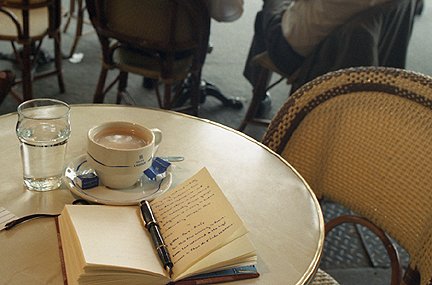
Lao Tse famously reflected about how a person can accomplish much by not overdoing. His quote is often loosely paraphrased as: “Doing nothing is better than being busy doing nothing.” Having grown up and formed in both European (French) and American (Northeast) cultures, I’ve had my own interior ways of observing the differences and the common points as I found them, amalgamating what I’ve admired along the way. In the U.S., hyperproductivity is the stuff of heroism, and we are identified first by our job titles. Evidently, we are the tasks we do. In western Europe, relaxation is essential- even if it’s simply sitting outside. The articles I’ve found about the merits of stillness point out how the time-honored European custom of “just being idle” is an event in itself that needs nothing else. I’ve always admired how Parisian cafés stay open until late hours, filled with people just sitting with their small coffees (and not in “grab and go” thermal cups) and facing out toward the streets, just being. This is also one of my favorite journaling settings. On this side of the pond, having no utilitarian purpose makes Americans uneasy. Generally speaking, our puritanical selves need to have our dithering tendencies condoned. If constructively doing nothing sounds ironic, so does the idea of not being able to hide from ourselves during our pandemic quarantining. Under the limitations of these times, I’ve been using my paid-time-off to give my musing as much perimeter as I can provide. As weather permits or deters, I’ll choose to perch on a rock along the ocean, the front stoop, or my candlelit desk, and simply be.


3

This time last year, many of us at our jobs and schools heard about a hiatus of a couple of weeks. Then a month. Then more. Then it became realistically impossible to predict a duration. Then the word “hiatus” ceased being used. Much of this world has had to move with moving targets, while we no longer hear about the novel virus and the new normal. Everything has had to change, and it remains to be seen whether there can be any reverting back to “before.” How will our societies be affected in the long term? We are yet to see whether our forced “idling” will permanently become part of how we live our lives, and how the adapting we’ve had to do for our survival will alter us.

Photographic paper processor- with the lights on and doors open.


The other day, I was explaining to a friend that I saw a metaphor in something from my days in the custom photofinishing industry. Handmade color prints were individually imprinted in darkrooms with enlargers, lenses, and easels. The paper had to be carefully carried in a lightproof passthrough box into another completely dark room that included the entry for the paper into a roller-transport developing machine. These machines had two modes: Constant Run, and Automatic Standby. We always used the standby mode, to be energy efficient: when there was no paper in the machine, the rollers would go into an idling standby while the chemicals continued to pump at the regulated temperature. As soon a sheet of photographic paper was fed into the machine, the drives would start roaring at full-tilt, taking the machine out of standby, and running the print all the way through the process- as we used to say- “dry to dry.” This present odyssey has taken many people from constant run to automatic standby, and I’ve been in a state of preparedness to have to return to full perpetual motion as needed.


Stillness also becomes an unlikely way to find solutions and even resolve. “Sitting with one’s fears,” means ceasing the flailing and to visualize better outcomes. It doesn’t have to be quite as rarified as it sounds. I had a neighbor on my block who regularly sat out on the front stoop of her building with a cup of coffee and her everpresent cigarette. Of the latter she would say, “they’re what I’ve got.” This was shorthand for describing how she needed to just think, simply sit with her thoughts, and the cigarettes bought her some time and airspace to be able to ponder. Nowadays it may be easier to find this sort of time, yet the stresses of pandemic life can clutter the sanctified stillness right out of the day. Inhabiting a “holding pattern” is very different from reflective time. And these days demand a distinction between hypervigilance and wise caution. Somewhere, in between rocks and hard places, living and looking forward have to continue reaching up. I’m among very many that have had to acclimate to “bubble” work environments for safety’s sake, stricter physical boundaries, leaning heavily into my creative imagination to positively persist. Off-duty hours have had to comprise healthful idleness, and at best the time spent in solitude becomes an investment toward well-being.