Showing posts with label Thomas A Kempis. Show all posts

Monday, September 5, 2022

necessary sadness

“You have here no place of long abiding,
for wherever you have come you are but a
stranger and a pilgrim, and never will find perfect rest
until you are fully joined to God.
Why do you look to have rest here, since this is not
your resting place? Your full rest must be in heavenly things,
and you must behold all earthly things as transitory and shortly passing away.
And beware well not to cling to them overmuch...”


~ Thomas à Kempis, Imitatio Christi

1

Reminiscent of the sports situation in which a team is down by several goals late in the 3rd period, my furious and relentless five-month search for housing ran out of time. Watching my version of timed “regulation” fizzle, I was forced to choose between an emergency move or eviction. Losing my home of 37 years due to the gentrification of the apartment building is but one unfortunate story among many in a small city that has sold its own soul. A recent housing survey has tabulated that the Greater Portland area is short more than 9,000 housing units. True to the local fashion, years and years of talk do not lead to effective action. The pandemic era causes many of us to try making the better of a bad situation. Witnessing the misery and struggles of countless neighbors and colleagues, I have an idea that I’ve managed to defy some of the odds, albeit on a very modest income. Listening to dozens upon dozens of hardship stories- from sudden compounded rents, to evictions, to evacuations from condemned buildings- has generated a saturation factor causing an emotional wrenching now each time I encounter anything reminding me of housing instability. All the while, I’ve been flailing at creative networking, cold calling, traipsing through more than 30 apartments, and chafing at the unwinnable contest of answering online advertisements. Conceding defeat is essentially managing the losing. It’s also making efforts to insist upon recognizing any good I can find.

Many- too many- people are forced to endure the horrors of having their homes kicked out from under them. So many injured souls. The crisis extends far beyond this region and across the continent. Amidst this overspreading precariousness there is hunger for solidity and consolation. My vigilant searches and inquiries have painfully shown me how there is a severe deficit of compassion and mercy. Who will dare to not exploit? All the courage and fortitude I can conjure up cannot compensate enough. At the same time, what is past needs to be released to create space for the future. The loss of my home is also my farewell to the dwelling which accompanied my adult life up to now. These recent five months of purging, packing, and feverish searching have also comprised a protracted grieving. I’m eager for this to end, even though it means squeezing into a smaller and costlier space. The new chapter is forced by crisis, and the decision is surely a compromise.


2

The general, abiding impression is that of necessary sadness, hoping this is provisional and that I’ll transcend this. Indeed, I want to write about other things. Along with all my neighbors in the building, we did not want to leave. These conditions are equally sad and moving is necessary. The added overlay of a general housing crisis enhances the anguish. It is necessary to move; there are no alternatives. It is necessary to stay the course and insist upon hoping for better days and situations. It is especially necessary to continue cultivating ambition, even in the face of yet another recession. It is, alas, also necessary to compromise living conditions- albeit as civilly as possible. I have learned plenty about how little I can afford. Surviving this crucible is necessary, and the road traverses intense sadness. It is sad to be forced out of my home of many years, before I’ve been able to improve my fortunes. Loss of housing and neighborhood make for a sad equation. At the same time, I have witnessed the decline of my neighborhood’s resources, infrastructure, and quality of life. I also watched the building deteriorate into something unsafe. Sometimes you leave your neighborhood, and sometimes your neighborhood leaves you. In my case, I suppose it’s both. A major aspect of this sadness is connected to the people who have either left or passed away during my years in the building and vicinity. Loyalty is an effortless trait for me, and in these recent months I’ve seen a painful downside as it concerns loyalty to place. Uncertainty about the future is also a sadness, and I know many who share this sentiment. Being a supportive friend helps distract me from personal worries, and allows me to be more useful. Along with that, I have no intention to espouse the passivity of the regional culture- those who watch the sufferings of others, instead of doing something to help. There really is a mercy deficit.


3
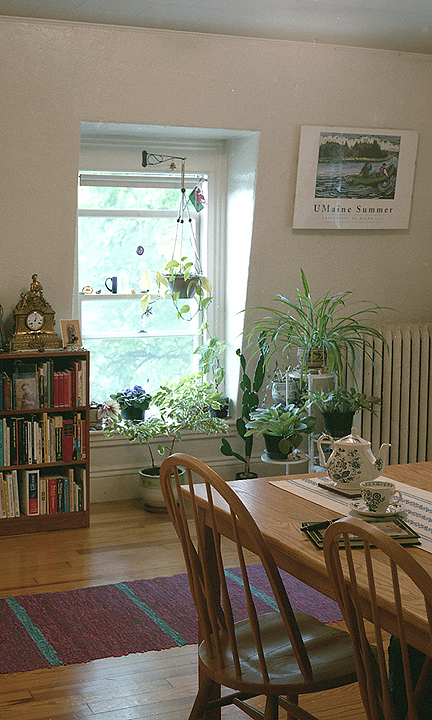
By definition, necessity does not really go away; something is necessary until it isn’t. We all remember requirements from our school days. As for sadness, it may remain as a landmark, and that is preferable to being an enduring state of mind. Grief settles into the fibers of our being, if it must simply be an unresolved landmark in time and place. With this move, unsatisfactory and expensive as it is, there will be a beginning to the distance placed between now and the future. Everything is packed, that frightening lease has been signed, and my reimbursed security deposit for my current place will come from the invisible developers who bought the old building. I’ve been photographing parts of the building that I hadn’t previously documented, and writing at a few perches for the last time. A wise friend suggested that I find ways to break with the place, without regret, and thoroughly. For me, it’s always writing and photography. Of course, those crafts go with me.


While writing on the front stoop, the hallway steps, and at my old window, I am thinking about what proceeds with me from this long night. What will stay with me, after I return my keys and get used to different streets? The necessary sadness comes as a result of a lot of active struggle. Not being able to accomplish my housing preferences, such as with neighborhoods, spaces, and my hopes to continue renting from families, sadness is paralleled with disappointment. At the same time, I’ve actually found something, and that will have to do, for the time being. It has been difficult to separate my disappointment from the hundreds of conversations I’ve had around this metropolitan area. The word-of-mouth efforts failed, although I did meet a lot of people. During interspersed quiet moments, I’m telling myself that it is of critical value to not become angry or bitter toward anyone. Just don’t. Sure this is all rotten, but these times are rotten and desperate for a lot of people. Still more are homeless. As with the general pandemic, this city’s regional gentrification has taken down far too many people through no faults of their own. The cruel consequences are largely unavoidable. We are each left to commandeer our resources and wits. One of numerous leasing agents I met told me about a family she knows that had to live in a tent pitched in a friend’s backyard even though the head of the household had a job. They could not find an apartment, and wound up sinking themselves in an ill-timed mortgage. A neighbor saw me carrying donations out to my car, and we got to talking about this whole sad scenario. Amidst our conversation she asserted that the neighborhood and the building will always be part of me. A number of other neighbors have said this to me, as well. Yes, the memories go with me, and the better ones should stay with me. All the years of photographs will help. And still more valuable is to have it in mind to appreciate what was. A great deal of goodness to reflect back upon, while fully aware of what has finally run its course.


Sunday, April 4, 2021

notandum


“Teach us to love a life hidden with You.”

~ from the Divine Hours, for Easter eve


“Notandum quod iste...” reads a manuscript of Thomas à Kempis’- which is to say “make note of this,” or, “let it be observed.” Kempis wrote the compendium of inspirational essays called Imitatione Christi during the early 1400s. At first, the book was meant to encourage novices among the Brethren of the Common Life, and the Sisters of the Common Life- communities that brought monasticism to eclectic cities in what are now Holland, Germany and Belgium. Kempis’ works continue to be in print today, with a readership that is unconfined by denomination or affiliation. His order was also known as the Devotio Moderna, reviving ancient Christian practice in contemporary context, more than a century before the Reformation. Much of the communities’ self-sustaining income was made through teaching and book-production. The order spanned into the era of the first printing presses (and some of the monastic houses developed highly-accomplished printing establishments). But for the most part, the work was all done by hand, and Kempis was also known as a master calligrapher. Being a calligrapher and teacher of the craft myself, I admire the expression of “making note,” on many levels. That simple expression reminds me to continue to observe, remain aware, write, create imagery, and attend to others. Spring’s arrival is signaling observers to hope with great intent, even against our circumstances.


Central to the wonder of the season that I call winter-into-spring are the abrupt changes in temperature and light. Senses are ignited out of their winter dormancy. In northern New England, there’s that one day upon which I can suddenly notice the aromas of earth and trees, while still walking through snow. In the midst of global tragedy and seamless successions of months, making note of some kind of positive progress is a providential distraction. Perhaps it’s a survival instinct of ours, to divert attention toward things that appeal to the will to transcend. We long to be invited to scenarios of welcome.

In this part of the world, spring ushers in baseball season- even during these times of limitation. In a recent Boston Herald article, a poignant reminiscence of the four-year-old boy (now a parent in his forties) rescued by star Red Sox outfielder Jim Rice after being hit in the head by a line drive looks back at the event in 1982. Rice, now a celebrated hall of famer, ran into the stands and scooped up the seriously injured child and ran to deliver him to the medics that were on duty at Fenway Park. The boy recovered, and now at 43 the man told the Herald interviewer that “you’ve got to live every second,” and cherish every moment. Mr. Keane added that the “smells of the park” are sweet to him: “from the hot dogs to fried onions for the sausages, and the field that is green unlike any green in the world.” Then he reflected, “this year baseball is needed more than ever.” Making note can also be a show of gratitude, as well as an alertness to the immediate, always with the undertone of taking nothing for granted.


For the most part, diversion must be sought. We have to know to look for it. Not every day is a sunny one at Fenway Park. And in my note-taking, which is both written and committed to memory, I remind myself of an elder friend’s wise words from long ago: “If you don’t like how you’re feeling, change what you’re doing.” I try to do this, whenever possible. This very same friend also taught me this saying: “Hardship is inevitable, but misery is optional.” This speaks to what cannot be changed, but what must be worked around- at best. Thomas à Kempis, with his teachers and his students were all living their vocations during the worst times of the late-medieval plagues. Zwolle was the hardest-hit city in Holland. Dozens and dozens of the Sisters and Brothers of the Devotio Moderna died of the plague.

They continued to carry on their ministries to the poor and homeless. Kempis himself survived the sickness, while he saw many of his brethren pass away. He was also the chronicler of his monastic community, named Mount Saint Agnes. Kempis essentially kept the journal of the house. To this day, we can read about the fallen, including highlights about their lives and characters. His chronicles preserved many other aspects about daily life in his community, including what they ate, how they dressed, and features related to the physical landscape. They, too, witnessed the passage of time. Now this season offers us a display of the upward progress of nature in spring- something preciously rare during this pandemic. Predictable progress that parallels the unfolding of time is an irresistible prospect. It drives us onward. Kempis made many references to the hidden life of a contemplative, even a working contemplative outside a cloister. Interestingly enough, some of his unsigned works are identifiable by his handwriting. He did not make efforts to be noticed; his life was one of service and being a compassionate witness to those around him. Indeed, that is a life to be loved and one that ministers through plagues and toward renaissance.


Wednesday, January 14, 2009

lettera


“There is in books
one voice and one letter that is read,
but it informs not all alike.
For I am within,
secretly hidden in the letter,
the teacher of truth,
the searcher of the human heart.”

~ Thomas à Kempis, Imitatione Christi, ch.43


How amazing to consider the ways jottings and their configuration can call forth a full spectrum of lived experience! The names and symbols above recount an evening I spent at Fenway Park, last June.


Wednesday, May 14, 2008

nada te turbe


"Do not think about the world,
nor about your friends, nor about the past, present, or future;
but consider yourself to be outside the world and alone with God,
as if your soul were already separated from the body, and had no longer any interest
in peace or war, or the state of the world.
Leave your body, and fix your gaze on the uncreated light.
Let nothing come between you and God."


~ St-Albert le Grand, De Adhaerendo Deo


Many of us, in the rivers of our days flooded with chaotic rapids, persevere to record words and events. The need to make sense of what we experience forces us to create spaces of time to reflect. So, also, is the need to validate our observations as witnesses of what we see and the realities of our movements in this world. Considering the incessant schedule I have always been able to juggle, I am often asked when I find the time to write. Since words and reflections are part of every day’s living and breathing, I graft the writing in between tasks. Rarely are there spells of consecutive hours to sit and write. For the most part it has been jots in tiny hardcovered books, or sentences typed on a laptop I tote around- just in case. Written words salt my days, actions, and aspirations. Pencil and paper are also there to record and attempt to make sense of difficult events. When such noted words stare back up at me from my notebooks, I become further amazed at the absurdities I have lived through, in this short life. And as these continue, the observations and struggles follow. By documenting faithfully, it is apparent how darkness and light really do coexist.

When the struggle intensifies, and fatigue prevents hurdling more barriers, an unchanged forging-ahead becomes counterproductive. Frustration and analysis can feed one another, giving way to spiraling despair. Realities remain, yet words often fail. That doesn’t mean an end to hope, but more a change of perspective- a regathering of embers to persist through the darkness. When social structures fail us, whether on a national or local scale- or even in our immediate circles, it seems quite natural to leap with so many others into the abyss of cynicism. How inviting to be in such abundant company. The pilgrim road can surely curve into cold and dark forests. Clashing perspectives, as the ancient apostle Paul once observed, fight within the aspiring soul; only the key of grace could liberate him from the despair he described as a captivity of the mind. Even when words and knowledge fail, compassion must not fall away. At times we must quiet our thoughts, in order for our hopes to abide. At other times we find our ambitions silenced by our circumstances. Compassion never falls away, "whether prophecies shall be made void, or languages shall cease, or knowledge shall be destroyed." When an active soul reaches points of saturation, having "seen and heard enough," it is really an "enough" that lays claim on both resiliency and hope. For me, it has often meant finding places of refuge, of civility and tranquility, in order to listen for the spirit and regain my ideals. Retreating is certainly not copping out, but a way for vital embers of hope to be rekindled. Apparently, we do come to times when the high pitch of thinking and doing must stop.

Over five hundred years ago, Thomas à Kempis asked, "What can you see under the sun that will long endure?" He wrote of the wisdom of withdrawal into silence, as a regular part of life. "If you withdraw yourself from superfluous words and from unprofitable business, and from hearing rumors and idle tales, you will find convenient time to be occupied in holy meditation." Within Kempis’ essay, Of Love of Solitude and Silence, he implies how the best we can offer is what emerges from conscientious silence. "No one is secure in high position save he who would gladly be a subject... No one speaks surely save he who would gladly keep silence if he might." Silent recollection is also survival. Consciously repelling the social currents that can poison our hearts, Kempis advocates we exercise ourselves to "shut fast the door of your soul." The sum total is the balance needed for contemplatives to thrive in cultures of carelessness and competitiveness. It is worthwhile to feel stable, and stabilizing to feel worthwhile.

Our intuitions, our "insides," our spirits can testify to us that our times of extremely structured thinking and active struggle cannot be indefinitely sustained. There must be times devoted to simply abiding. This is even something we can provide for those near to us. Endeavor to be quiet, and walk honestly, Paul advised to his friends in Greece. Some translations read "study to be quiet," reminding me of how so simple an aspect of life is a cultivated discipline. In this sense, "quiet" runs far deeper than an absence of verbiage. I have met many people who speak with an impressively peaceful- even a quiet- spirit. It seems the greater discipline is in quieting one’s thoughts. As much as we can choose to commit our experiences to memory, we may also choose not to remember. Shutting fast the door to the soul is also to elect not to exhume detriments that obstruct the embodiment of compassion.


Just now, during a workday meal break, I am enjoying the natural light at the window after having looked to the wide sky outside, amidst aromatic wind gusts. Images of vastness, such as sweeping skies and the immense ocean, are consolations to remind me how temporal and small are my complaints. Looking at the small radio that accompanies me during many of my intermissions, I am also reminded of some attributes these humble and familiar consolers represent. Consider the radio. It has no memory; it does not accumulate its broadcasts. There is no baggage from the past, and only immediate moments are impartially transmitted- pulled from an unseen spectrum of frequencies. It must always be attuned to its source. It reminds me how so often the best I can do is to simply report, in faithful articulation, while receiving and transmitting the most lucid possible signal. The programmes continue, in the harsh and joyful times alike, undeterred by social hardships. From the warmth of familiar and recognizable voices and melodies, there are cadenced gauges for our precarious days. Over whatever is being conversed about at this moment on WBZ, in thickly-accented and animated Boston English, I am asking myself of the true source of my heart’s unrest- even beneath the misery I see daily in many around me. Yes, it is all perilous and we each crave reassurance in our livelihoods. But I turn from the despondence and see how the sun shines, and how even strangers greet me with their welcoming smiles. So little is within our own power. And yet I must bear these fragilities and allow them to be transfigured into something that can light the steps ahead.


Saturday, February 16, 2008

advance and aspire


"Comment tout voir à la lumière du Ressuscité et de l’avenir qu’il inaugure? Et l’on discerne soudain ici le rapport intime qui articule l’espérance et l’éverveillement. Car c’est le propre de l’espérance que de vouloir tout considérer à partir de cet avenir de Dieu. C’est elle qui voit le monde et notre vie de manière symbolique."

~ frère Pierre-Yves de Taizé, Le Souffle de l’Espérance, p.127.


Much as I would delight in the immersion of my musings in uninterrupted pensive reverie, alas that has been the exception to the rule. Being constantly about the work of my employment and the oftentimes relentless web of peripheral logistics, my settled thoughts have been fragments at best. Those occasional exceptions, the retreats and pilgrimages, are all the more appreciated as they contrast the chaos and permit me to take my mind off the "next order of business." Here and there, a spell of time to write, that exceeds an hour, allows for a little taste of quiet recollection- rather as a single savory chocolate truffle amidst the perfunctory quotidian comestibles. In that light, I like to think of monastic writings as coming from working hands whose stopping to write has been as occasional as mine. The pauses to recollect being incidental and en route to various portions of the day, airy counterforms between rigid tasks- all of which offer their own sense of the sacred. Surely the day’s obligations, interactions, and surprises add color to the moments during which we can reflect. Ensconced in the ancient volumes of The Philokalia, the gently scribed words of St. Diadochos of Photiki encourage meditative remembrance. His writing, in short paragraphs, may have been pieced together throughout a life of work, instruction, and thought. There’s a lot about conscientiousness and entering into the love of God, and wholeness of heart. From there, and with consistent application, one "never loses an intense longing for the illumination of spiritual knowledge, until he senses its strength in his bones and no longer knows himself, but is completely transformed by the love of God." Time is never specified, fortunately, neither the duration of the "untroubled silence" he wrote about, which is to say reflection that is not centered on self. For Diadochos, lowliness unites us with God, and his expression of the spiritual voyage is both modest and profound, describing the seeker as one who "ceaselessly journeys towards God in his soul."


My own journeys have taken many forms- the inward descent to the heart, purposeful physical travels, and even the workday steps which may seem, outwardly, to be mundane and unextraordinary. Again and just as fortunate- time, place, and duration of journey is gratefully undetermined, and one’s heart need only to be open as circumstances constantly unfold. Just this week, while traveling home from a pilgrimage, my thoughts turned to this curious rotation of advancing and aspiring in the spiritual life; and indeed the learning and doing often occur simultaneously. This culture and these times do challenge our aspirations, yet we must remind ourselves that our fields-of-vision cannot reveal all that is. And the unseen can point us to an amazement we can only occasionally and acutely sense. Like Diadochos, though present in this life, we are not solely entrenched in it; though dwelling in what we readily see, yet we depart from it.


From the unseen, we draw references to the eternal- and we can recognize those signs in the beauty we see in our midst. Often, as I continue on, I find the powerful intuitive impressions to be more compelling than what I immediately see. The lines, so to say, and what is read between the lines. What we see, and what we clearly know without seeing. Becoming so accustomed to sound-bites that we even begin speaking in that fashion, and can easily neglect to explore beyond what appears on the surface. It seems there is a societal fear of silence, and that becomes evident in the ways we fill spaces with "white noise," including muzak in elevators and even tiny televisions above gas pumps. I’ve visited churches within which bland recorded music is piped in through sound systems, lest anyone be made uneasy by disarming quiet. What frightful thing could happen, when the controls are shut off, and we can hear our own thoughts? What can emerge from our silences, the quiet contrasting the chaos, that we can carry with us through our days? Need everything be overt and ostentatious, without room for subtlety? The vigilant can develop their own sensibilities, and not passively acquiesce to what gets piped into our environments. Kempis, whose own life was both contemplative and public, said "no one speaks with certainty except the one who would gladly keep silent," adding that it is laudable for spiritual people to be seldom seen. Perhaps that conviction flew in the face of what he saw around him in his time. Pascal, as well, spoke of the hiddenness of the Divine. Concealed at times, but not such that a seeker cannot find. He wrote that "God wishes to move the will rather than the mind," and what may appear to help the mind can harm the will. The glimpses of God’s presence that we experience provide a clarity that dramatically contrasts our obscurities.


While in transit, whether traveling a long way or walking to work, our steps envelop an assortment of paradoxes: seen and unseen, commotion and quiet, surface and hiddenness, spectacular and solace. The other day, I noticed how the late skies reveal this now changing season, and considered what points me toward perceiving the future with hope. I might take the point of view that looks to what I try to keep away from my life, or rather what I prefer to embrace. Indeed, we may concertedly reject indifference and negligence, as a kind of subtractive approach- and we may reach for influences that inspire compassion, as a kind of additive process. Surely, both do occur, and we witness this in our own progress. More often than not, I’ve been pursuing my own forms of purgation and absorption. Though, at times, parts of my life seemed to purge me from them- and after assiduous rebuilding efforts I’ve reached many gratitudes, not only for what I came to live well without- but also for knowing what to keep away from myself. And recently, while making my way home, my thoughts turned to the everlasting pilgrimage- the one that goes on regardless of time, place, or momentary destination- whether the scenery involves a shrine or my place of work. Knowing the source of inner joy and a compassion that benefits others, how is it possible to continue returning to that rejuvenating source? As well, a knowledge of ones spiritual center is one thing, but it would be of little avail without cultivating an inherent nature that knows to consistently orient oneself to that Source.


On an occasion last week, I sought the quiet space of a large cathedral. Its greyness matched the monochromatic pallor of neighboring office buildings. I might’ve expected it, but was still quite surprised at the glowing ambience of brilliant colors and warm woodtones within. Cerulean hues and stained glass reflected and transmitted what the overcast skies and grey streets could not. The overall contrast was amazing to me, and it brought to mind the vitality of a quiet sense of wonder. I am finding that a contemplative sense of amazement in the ordinary is a way of conscious perception that prompts me to continue seeing things in new ways. Wonder is a stillness that remains in motion, allowing me to find the good in what I experience, and a way to continually renew my view of life. For the intuitive soul, when seeing and realizing have no words, quiet wonder is a calm that has no need. It is in itself a discipline, yet also a gift of the Spirit- and many times it requires an effort not to let my years and setbacks cause a jadedness to cloud my view of the present. And so that vital glowing ember known as wonder must be carefully and vigilantly tended. Wonderment and hope are interconnected, the two practical concepts inspire one another. In my experiences, when I have not been able to find either of these perspectives, there have been people in my life to bring light to what is astonishing and what is hopeful. As with vivid colors setting forth from ashen greys, from deserted places the soul takes flight.


Lest contemplative practice appear to be an end in itself, and it can, it most surely mustn’t be anything less than a movement from self-conscious, to conscientiousness, to a consciousness of others and, indeed, of God. The learning itself continues to be an immensely satisfying journey, expanding and focusing further as I go. Our perspectives are transformed as we advance, and perhaps we find our vision becomes transformative, as we interact and engage our lives with those around us. Last week, I listened to a monk of Taizé speak about the fire of reconciliation, distinguishing between the choice of faith compared to fear, and that in so doing we begin notice how much of our culture is based upon reactions to fear. Listening to this monk, while pencilling notes and propping my small notebook against my guitar and music-stand, his French translates to this effect: "Rather than to base our lives on fears, and upon what we deem to be impossible, consider how God gives us something else upon which to build our lives- in the Holy Spirit. That’s where we find freedom. Not in fear. To dwell in fear is to refuse life. The Holy Spirit is life, and that means we can and must take the risks to pursue lives of communion with one another." In the happy irony of celebrating risen life, I needed to stop writing and resume playing music. At the next interlude, I wrote further in my little notebook that our hearts bid us to advance further on, and we must have the courage to say yes to that with our lives.


(I am at the lower right corner of this photo.)


Wednesday, September 6, 2006

open my eyes to the wonder of this moment


"It's time for the soul to be patient.
And patience in adversity, far from being a passive virtue, is a rugged aerobic exercise that toughens the soul, muscles up the virtues one already has."


~Thomas 'A Kempis, The Garden of Roses (15th century)


When we ponder the unpaved roads of forebearance, it seems our initial thoughts turn to ideas of conscientious attentiveness to others- not to our very selves. But perhaps the harder and more confrontational practice is to view ourselves with the compassion that we wish for, and desire to convey to those around us. Once more, there appears a contradiction, that if I wish to consider the well-being of others around me, why lavish such attention on my person which needs instead to be humbled? So, will it be humiliation, or self-exaltation? Well, it is to neither extreme that I will find my home, but instead to aspire to view all life with a patience that allows room to breathe and prosper. Often the narrowest window of forgiveness is the one reserved for me. This will require some further exploration, and the answers will be discovered within a deeply rooted core. It will be very much worthwhile, not just to find but also to be lightened by the unburdening.