Showing posts with label Berkshire Mountains. Show all posts

Saturday, May 13, 2023

misericordias domini


“A soul should be faithful to prayer despite torments,
dryness, and temptations; because oftentimes the realization
of God’s great plans depends mainly on such prayer.
If we do not persevere in such prayer,
we frustrate what the Lord wanted to do through us
or within us. Let every soul remember these words:
‘And being in anguish, He prayed more fervently’”


~ Saint Faustina, Diary, 872
[with reference to Luke 22:44].


1

During the recent three years, my hopes for returning to Stockbridge and the surrounding region in the Berkshires never left my thoughts. As it has become less of a health risk to congregate and travel in this present time of late-pandemic, there are more possibilities for roving and visiting. If we’re really out of the covid depths, how shall we consider the past several years? Writing in the first-person, I never stopped working or meeting expenses, soldiering on as what I call one of the working wounded. The effects of last year’s housing loss continue and things remain unresolved, having humble resources in an incurably gentrified part of the country. When I hurried out on the road two years ago to visit with my father in his final days- and then returning after his funeral- I drove through the Berkshires. There was no time to stop there, neither were there opportunities to lodge amidst all the pandemic protocols. The circumstances were anything but leisurely. My years of memories of southern Berkshire County and the National Shrine of the Divine Mercy, continued to provide inspiration. Along with physical health adversities and general economic hardships, the covid era has been marked by what the U.S. Department of Health and Human Services acknowledges as a national epidemic of loneliness and isolation. I’ve fallen back on every useful self-care strategy I’ve cultivated, even dating back to my childhood years. It’s of critical importance not to mind one’s own company and stay constructively balanced, especially at work.


2

Though I cannot claim to be an expert at self-discipline and motivation, at least I know to persevere. And I’m sure to write about it. When Le Cirque des Élephants upstairs starts pounding away and blaring me out of my thoughts, I grab my books, writing, and a chair- and flee outside. During rain and snow, I perch in the building’s entrance, bundled up, writing, and reading. It all merges with my devotions. When I think of Stockbridge, I always recall the Divine Mercy Chaplet, its austere eloquence and thoughtfulness of the needs of others. Others can also mean those who inconsiderately stomp on their neighbors. Everyone needs a prayer. The revered Chaplet as recorded by Saint Faustina in wartime Poland was taught to me by a colleague- Sister Sylvia Comer- about eighteen years ago. The devotion never left me, and it only intensified during quarantining, lockdowns, and coffee-breaks while working in isolation. Meditate upon the Passion, and pray for mercy to strengthen others and for oneself. Be mercy for others, especially when generosity and consolation are painfully elusive. San Juan de la Cruz, in 16th century Spain, famously taught “impart compassion where you do not find it, and then you will discover compassion.” Customarily, as observed by the Marian community in Stockbridge, the Chaplet is observed at 3pm, referred to as the hour of Divine Mercy. In recent years, my insomnia awakens me at 3am most every night, becoming my additional hour of Divine Mercy. It is included by many, and I do the same, as integral with the liturgy of the hours. About 2 ½ years ago, when the intensity of quarantining made it so I could hear a pin drop downtown, those portions of daily psalmody helped provide lifegiving structure.


3

Conversely, when I think of the Divine Mercy Chaplet, the environs of Stockbridge come to mind. The westernmost area of Massachusetts is contiguous to the higher elevations of southern Vermont and eastern New York State. The waterways and woods resemble parts of my home state of Maine, though without the coast that I see every day. Nonetheless, it is New England, complete with the unmarked, winding roads and very small towns. The site of the Shrine, Eden Hill, was the destination for the emigrating Polish religious community in 1943, and continues today as the much larger congregation of the Marian order who nurture the legacy of Saint Faustina. Her diary has been preserved and kept in print by the Marians. The community welcomes one and all, daily- including pilgrims such as myself. I’ve traveled there many times, always grateful for the place, prayer, and people as a complete experience of sanctuary.


True to pilgrimage form, some major effort was needed long before taking to the road. My usual marathon-minded durability makes it unnecessary for me to test the understaffed workplace logistics. Requesting days off however, despite my overabundance of earned time, demands resourcefulness and diplomacy. In the general emergence from winter in my midst, I saw an unclaimed week and seized upon it. Getting the time approved, seeing to auto maintenance, and exchanging messages with my destination, the pull of pilgrimage became an imminent journey. I began assembling writing and reading material for the sojourn, and in the cramped hovel those items were visible to me each day- including unpacking the hat I bring with me on all my retreats. It has a seashell sewn to it, which is the badge of pilgrimage. And true to personal form, I continued working as industriously as usual, and with a small Divine Mercy icon at the side of my desk computer.

As road day drew closer, I realized I would be arriving in Stockbridge right on the Feast Day of the Divine Mercy. As providential as it sounds, it just happened that way- though it did inspire me to leave Maine earlier in the morning than planned. The highway travel was smooth, even with showers and mountain fog; after all it was a Sunday morning. Indexing across the car radio dial along the Massachusetts Turnpike, I picked up a broadcast with interviews of various Marian friars talking about the liturgical holiday, Saint Faustina, and welcoming listeners to the Shrine. As I typically do, I glanced at the radio and said, “on my way.’ It was a good thing I had found that station, as I began to see single-file traffic after exiting the highway in Lee, extending all the way to Stockbridge. Impressively, drivers were civilized and patient. I wondered, “Are these all pilgrims, too?” The radio station began broadcasting the outdoor church service from the Shrine, and finding a parking space in the thick of the village, I proceeded to ascend the steep hill, hearing the singing choir’s music, my steps parallel to fellow sturdy walkers. I later heard that at least 12,000 pilgrims were in attendance that day, surprising the resident community and all present. How wonderful to arrive in such festive contrast to the misery I managed to interrupt back in Maine.


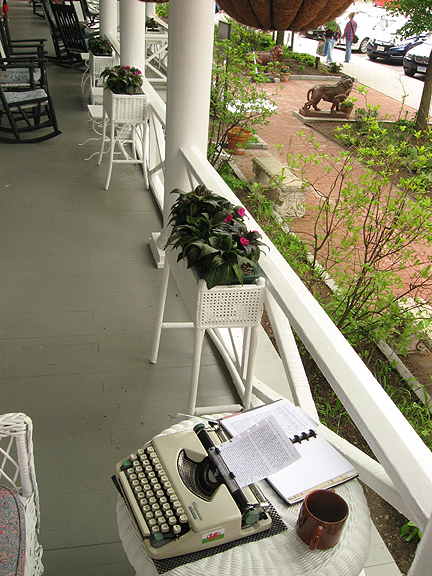
Descending the Hill later, the village center in Stockbridge was replete with visitors, albeit too early for tourism season. Many café patrons and pedestrians were recognizably clergy and members of religious orders. The stately Red Lion Inn offered special rates for the week, and very thankfully I was able to lodge there, close to the Shrine. The 250-year-old Inn was in early-spring maintenance mode and thus uncrowded and very comfortably peaceful. The full-width front porch made for an added place of retreat for me, between Eden Hill, nearby hiking trails, and the village. My room in the Red Lion consolingly reminded me of my old place which I miss very much. I especially savoured the high ceilings and the Inn’s muffled ambience, reminding me of better days. Integral to the pilgrimage was the pleasant company of fellow guests, trading stories and insights. I made numerous notes, wrote letters to friends, enjoyed time to read, and visited with the resident cats.

above and below: Jack and Jane


the Housatonic River, in the Berkshires


At the Shrine’s book store, I asked for a volume of Saint Faustina’s words, “small enough for bus commuting.” The little book has since joined my twice-daily trek and coffee breaks. Throughout my week in Stockbridge, I was sure to be in attendance for Mass followed by the 3pm Divine Mercy Chaplet. There are many to be commemorated, especially Dad and Sister Sylvia. The days were calm and salubrious, replenishing me for me return to the world of struggle and uncertainty. I’ve learned over the years that pilgrimage not only comprises the return travel, but also proceeds on with every day and every task. It is essential to keep these in mind, with all the beautiful things I saw and heard- along with remembering the mountain air, as the pursuits of betterment and stability must continue.


4

Saint Bonaventure wrote about the soul’s itinerary en route to God, and referred to how our pilgrimage is “kindled by the desire for the heavenly country.” The difficult road ahead is fueled by nourishing experiences and contemplation. The painful absence of respite in these recent years has been profoundly felt, and I must find ways to keep well- even while searching for a healthy place to live, and for better work. Writing of life’s itinerary, Saint Bonaventure added, “the route is illuminative and the pilgrimage is adhered to by love of the destination; philosophy is to be engaged in the understanding of the stages by which progress may be made along the route.” Ascension is made in progressive steps as on an upward ladder, and his words accompanied me in the Berkshires as they do on my daily city streets and transactions.

studying the Itinerarium of Saint Bonaventure


During my week at the Shrine, following the afternoon’s liturgy, one of the Marian friars gave all of us in attendance his blessing. He also blessed the devotional articles of all in attendance, such as icons and rosaries. Then, in a well-placed teachable moment, he said to us, “don’t just go home and put these things away in a drawer: bless others! Think of the many people who wish they could be here, and also those who don’t want to be here.” Another officiant earlier in the week preached about exemplifying the meaning of these prayers. Indeed, the work I do with the public and as an educator permit for many opportunities to apply merciful perspectives and ways of communication, albeit in a merciless world. It is unbearable to countenance thoughts of being a lamp concealed under a barrel, after years of consistently intense hard work and persistent defeat. I know enough to remind myself that few are fortunate enough to realize their potential, and many have it far worse. Saint Faustina surely could not have known- and would not have wanted to know- the reach of her words and her example of resilient faith. Among the assorted prayers in her journals is one of gratitude for her ability to love God by whom she need not lower her ideals. She elaborated:

“Although the path is very thorny, I do not fear to go ahead. Even if a hailstorm of persecutions covers me; even if my friends forsake me, even if all things conspire against me, and the horizon grows dark; even if a raging storm breaks out, and I feel I am quite alone and must brave it all; still, fully at peace, I will trust in Your mercy, O my God, and my hope will not be disappointed.”
[1195]



Friday, May 25, 2018

winter into spring


“...the traveller picks his way from islet to islet,
cheered by the music of a thousand tinkling rills and rivulets
whose veins are filled with the blood of winter
which they are bearing off.”


~ Henry David Thoreau, Walden.


The arrival of spring in New England is obvious to the most absent-minded among us. We are brought out of ourselves by signs of future pleasant months. Liminality takes the changing forms of snow-into-rain, rusty-brown-into-yellow-green, lengthened daylight, all immersed in chilled wind currents. Light and air serve to provide context, as well as a palette of signs to illustrate new growth. Days are lengthened into evenings, and they recommence at early hours that had been immersed in darkness only weeks ago. Both in the city and the woods, the metamorphosis of seasonal transition is easily witnessed. Forest trails attest to a burgeoning combination of coniferous green that held forth through months of ice and raw cold, with sudden accents of yellows and reds coarsing through branches. And in the city, I recently marveled at new weeds shooting out from between cement sidewalk pavers. As much as these plants are considered nuisances, a pedestrian such as me can see a persisting manifestation of Augustine’s remark from City of God, that “creation longs to live.” Stems foment their spring escapes from beneath opaque concrete slabs, beating the crocuses to the punch. Surely, this must be admired.


Spring’s abrupt renewal is much more obvious in the mountains than along the seashore, where I live. The latter’s transformation is more subtle. New colors and gusts prompt new tastes and perspectives. Somehow, discoveries continue. If not entirely new, old-growth trees do renew. Hibernated creation awakens, urged ahead by new promise and rejuvenated spirit. One wonders if time is playing tricks, perhaps things have not really changed, and improvement is not possible. But such thoughts, in themselves, can thwart our thoughts into dead-end roads.


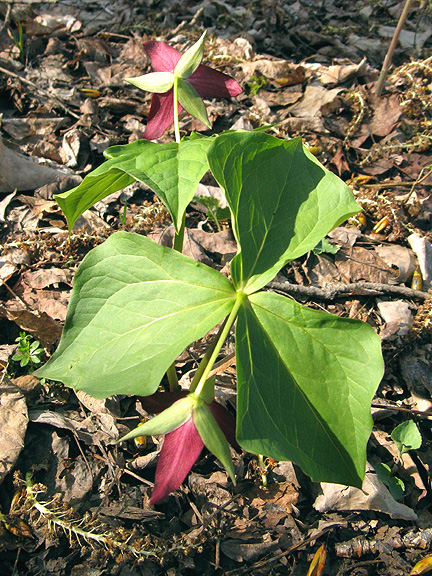
Taking to the roads at the cusp of seasonal change is an opportunity to closely witness an extraordinary renewal. Indeed, this is not to say the winter landscape is lifeless; not at all. It is a different sort of life, as northern climes tend toward the austere. Because the changes are so dramatic, the seasons abruptly replace one another in succession. Recently, I chose to drive southwest to the Berkshires, the mountainous region at the western extremities of Massachusetts. For years it’s been a place of both sanctuary, with the National Shrine of the Divine Mercy- as well as for serene hiking along trails including the Appalachian. At this time of the year, locations like this are not populous. There’s plenty of space to roam, just as it’s possible to see clear through sparsely-foliated forests. In a matter of weeks, some great river views will be completely concealed by growth. Before the arrivals of intense greens and bright tree blossoms, earth tones prevail. Surfaces are still bare enough to see stone strata, the foundational forest floor. Highest elevations still had snow in early May, and melted runoff added vigor to currents in and near the Housatonic River. I set out to find hints of spring, enjoying the ability to walk freely across dormant woods.


Watching the natural elements of the outdoors reawaken, we can tangibly notice how the substantial can grow forth from embrittlement. For an archival conservator, this is a captivating prospect. Rejuvenation has the connotation of new promise. Amidst deteriorative fears, there can be newness. By influence, natural renewal prompts refreshed spirits. Visiting places that are unlike my usual daily surroundings encourages me to savour the commonplace as extraordinary. Noticing the cold, sweet-smelling mountain air, I made sure to draw in plenty of deep breaths. Mountain skies and sunlight are also distinct, just as these can be unique in my home region near the ocean. When it was too overcast to watch a sunset, I was regaled by assembling storm clouds and succeeding downpours from the shelter of a covered porch. Indeed, such things will occur throughout the summer, but in much warmer air and with thicker cover- not quite like this!


Exploring, writing, and photographing are ways of observation. Integral to being a practitioner of these crafts is the ability to observe and study what I experience. In lesser moments there are repulsions, and in better moments there are admirations to commit to memory. But reflection- and even response- are not the full adventure. Observation demands participation. Witnessing the burgeoning spring along trails, waterways, and roads inspires creativity. I’m brought to remember those early-season summer camp days from childhood, and how unusual it was to be outdoors during weekdays. Until my late-adolescence, I did not excel in sports. I would enviously watch games from the sidelines. By 12, I was in the games, figuring out my strengths and abilities, relishing being part of the action.


Watching a spring rain from an ancient porch in Stockbridge, I thought of how recollections grow into prominence like garden perennials. I could not have predicted what would become integral parts of my canon of memory as an adult, so far away from schoolyards, playgrounds, and ballfields. But as with historic records, simply by virtue of having occurred, they are enshrined. No less now than all those years ago, there is no lasting contentment in idleness. Watching the appealing changes causes me to beware of lost opportunities. There is indeed a balance: knowing enough to savour, as well as knowing enough to be vigilant and productive. Unlike my forest discoveries of bright fledgling plants, I’ve yet to find tangible hints to provide direction. Without physical signs, the assurances must be along interior conduits. These are the unseen trails that must indefinitely lead to sustenance, regardless of season. Equally, that expectant hope must be sustained at all costs.


Thursday, July 7, 2016

peaks and points


“The pageant of the river bank had marched steadily along,
unfolding itself in scene-pictures
that succeeded itself in stately procession.”


~ Kenneth Grahame, The Wind in the Willows.

Now returned from a retreat and back to the grind, as always I hope for the fresh inspiration to remain with me. My eight days in the Berkshires are now memories. Returning to work is necessary for the provision of sustenance. In a parallel sense, pausing the quotidian pace is essential for the spiritual health needed to endure. For those without the good fortune- or the monetary fortunes- for subsidized sabbaticals, there is the concept of a self-guided retreat. Through my most destitute, least compensated years, I’ve made sure to give myself occasional, modest, healthful changes of environment. After 22 years of making retreats, I’ve never once regretted any of my own imposed intermissions. No matter the season or situation, it’s been vital to pause repetitious routines, when possible; in recent years, that’s been about every six months. In an indirect way, personal retreats actually contribute to my employment productivity and my general perspective.


Without meaningful, edifying breaks, the years would roll all the more as seamless backdrops. Recalling my time in school (comprising some 40% of my life’s years), spans of days accumulated by units of academic terms and semesters. Afterwards, it startled me to notice how clumps of months quickly became revolving years. I’ve been interspersing as many of these as I can with pilgrimages and various scholarly, artistic sojourns. The many and colorful travels do stay with me; these are treasured chapters for which no bulleted résumé could encapsulate. Perhaps, someday, these salutary and thoughtful experiences will be well-regarded in a workplace; but that is not the purpose for spiritual growth and insight. Creativity and contemplation are worth too much to be subjected to the conditional and the fleeting. Being a lifelong artist, I’m long accustomed to maintaining an undergirding shadow-career that tunnels beneath the work that pays my bills (and permits me to make creative diversions). And that will have to do, as long as there is time and space to write.


Indeed, time and space to write can take various forms and quantities. The most vital ingredient in a creative pursuit is perseverance. If it is writing, the most important thing is to keep writing. Words must be assembled and recorded. Opportunities must be made, at every possible turn, to cultivate ideas. Ordinarily, my chances occur during early mornings, lunch breaks, and late at night. Weekends provide some oases, as well. Place can itself be a source of inspiration. Even the humblest in my neighborhood can go to the ocean’s edge. It is the way we can see a horizon, in a region of crags, hills, towns, and ridges. The Maine coast is not a place of wide, flat plains and straight roads. My home terrain has influenced my tastes for asymmetrical and meandering scenery. Vermont’s Green Mountains, and the landscape of my recent navigation in the Berkshires and along the Housatonic, are at once grand and intimate. In close proximity, the waterways manifest as river paths, streams, channels, passing under bridges, and inspiring lines on my pages.


The retreats would not avail much, without lived followthrough amidst the drudgery. Grim as it may sound, the fruits of the Spirit are meant to bloom and sustain in ungratifying places. Not that I go looking for inhospitable conditions. A disciplined soul is tested in situations of abasement and abounding alike. A lunch break’s writing, similar to a distant pilgrimage, can be an occasion for renewed strength. It is all in the stream of keeping vigil, all tributaries in the cause of continuity. In the historic definition, a pilgrimage is a great deal more than intentional travel to a sacred place and the time spent there. It is also the journey back. Surely, fresh after a mountaintop experience, the return trip does feel very different from the outbound. Refreshed perspective causes ordinary places and situations to look extraordinary. Even the first few days back at work have something of a novelty. The proving-grounds come later; they always do. I choose not to think about this during a retreat. Sufficient unto the day is the evil thereof.


Above: Red Lion Inn, Stockbridge, Massachusetts.
Below: rejuvenating coffee break, between workday shifts.


Since returning from the Berkshires, where I saw spring forests foresee summer, I’ve made sure to be outdoors as much as possible. Hiking in the proximate Maine woods, I make note of parts which are similar to the places of my Western Massachusetts immersion. Granted, the nearby Kennebec is vaster and more vigorous than the Housatonic, the smaller river is no less ancient and inviting. Within that latter aspect is the procession of Berkshire towns that follow the waterway. The natural and built places alike comprise the river’s character. Added to the equation is the context of my journey. I was there to be on retreat, to be among a monastic community of prayer, and to savour the surroundings. We can see our purposes in our intended destinations, and can derive strength as intention meets discovery. In its trail, in a river-like sense, there follows and flows the serendipitous. This would include people met in transit, with their words; suppers, roads, aromas, and artifacts. Like the allegorical Mr. Mole in The Wind in the Willows, “absorbed in the new scents, the sounds, and the sunlight.” The sojourn really has changed my perspective, and it’s a good thing I continued writing, recording thoughts, along the way.


notes in the Berkshires.


Red Lion Inn postscriptum


While staying at the fascinating Red Lion Inn, I noticed a wall-hanging (below) near the entrance to a parlor. It is filled with pencils, and is reminiscent of an old-fashioned workshop apron.


Monday, June 20, 2016

wind in the willows


“He had the world all to himself,
that early summer morning. The dewy woodland,
as he threaded it, was solitary and still;
the green fields that succeeded the trees were his own
to do as he liked with.”


~ Kenneth Grahame, The Wind in the Willows.


True to pilgrimage form, anticipating and preparing are elements in the travelling. The journey begins before the physical setting forth. Having the wheels aligned on my car was part of the sacred journey; the mechanics and I talked about the Berkshires, and how beautiful the mountains are in spring. Between my workdays, leading up to my time off, I gradually set aside provisions, thinking of writing, hiking, photography, and reading. Two weeks before leaving, during an afternoon’s visit at the Boston Athenaeum, it occurred to me that I’d do well with some light reading. For retreats, I’ve learned to intersperse the more demanding texts I tend to favor, with easygoing literature. Occasionally I’ve brought along short stories, periodicals, or novels. This time, while my thoughts drifted to memories of C. S. Lewis and my studies at Oxford, I remembered learning that he admired The Wind in the Willows, a book I hadn’t read yet. Climbing up through the gallery tier of the Athenaeum’s cavernous 2nd floor, I pulled a first edition of the story. Resisting the temptation to open the book before reaching Stockbridge, I placed it in the gradually-filling bag near my dining table, among pencils, cameras, clothing, batteries, ink jar, and bug repellant.

view from 2nd floor gallery, Boston Athenaeum


traversal and transition


The road southwest to the Berkshires begins with an ordinary I-95 drive south on the Maine Turnpike, as any average intercity errand. Taking the offramp that points me toward Worcester indicates that I’m going to do something out of my ordinary. Merging onto the “Mass Pike” is a rare westward commitment, yet I remained amidst plenty of hurried traffic- including the regionally stereotypic tailgaters and nonsignalling, cutoff-passing drivers. Things do change later, as I traversed the Springfield area and I-91. After that, much of the highway is all to myself, as the remainder of exits are among the Berkshires. Continuing northwest of this region are the Adirondacks. The highway grows less bland, curving and rising with the mountains. Anticipating my exit, the look of the terrain had become more interesting to me than the stresses I’d fled from. Finally departing from the toll road, I took up narrower and more eventful lanes. Blustery, chilled, aromatic overcast welcomed me to spring. Just what I like.


storybook imagery


After greetings at the Divine Mercy shrine (on Eden Hill), the center of my pilgrimage, and my hostelry at the nearby Red Lion Inn, the day had been fulfilled. The sight of my surroundings was inspiring in itself. After a short walk, I returned to the Inn for dinner, taking the book with me. At last, while tasting roast beef, horseradish, potatoes, salad, and ale, I began reading. The book accompanied my writing, and other reading, out on the Inn’s spacious front porch, becoming a companion through the sojourn. Settling into the pages, the story was unusually suited to where I was, taking place along a river, in countryside. Having the Housatonic River, the Berkshire mountains, winding roads, and forests around me, it was easy to imagine being part of the adventures.


The characters themselves are small animal sojourners along meandering voyages. Hiking in the woods, along portions of the river, I thought of places that could be hiding such landmarks in the story as Wild Wood, Mole End, or Toad Hall. In fable-like fashion, the characters exemplify personality traits. As examples, the staid and bold Mr. Badger admires the curious and naive Mr. Mole. The weasels and stoats are tribal and militaristic. By contrast, the flamboyant Mr. Toad is magnanimously hospitable, yet completely undisciplined. As a result, Toad’s adventures are the most dramatic and colorful, including an outrageous jail-break. The Water Rat is the fearless and conscientious champion of all the creatures, speaking with a steady voice. I believe he was the model for Lewis’ chivalrous Reepicheep, of the Narnia chronicles. After all, the swordfighting mouse held the honor of Most Noble Order of the Lion. The characters in Wind in the Willows navigate, argue, commiserate, scheme, and dine together.

Stockbridge, Massachusetts


And then there is the yearning wanderlust of Mole. The story opens as he senses the spring from underground where, as he says, “you know exactly where you are; nothing can happen to you.” Yet still, the season of emergence was “penetrating even his dark and lowly” confines, as “something up above was calling him imperiously,” and he tunneled up into sunlight and meadows. This generates an ambitious energy to venture out, and he finds new kindred spirits, and helps the lives of others- and he is happy to return home, in this new context. Easily, with book open in front of me, I saw some amusing parallels to my own experience. Mole instinctively knew to reach beyond the limits of subterranean Mole End. Later, after his adventures take him far afield, he reflects, “Things go on all the same overhead, and you let ‘em, and don’t bother about ‘em. When you want to, up you go, and there things are, waiting for you.” He could as well have been a basement character with top-floor administrators. Mole befriends Rat, and one of their intriguing dialogues includes this notable line, “You ought to go where you’ll be properly appreciated. You’re simply wasted here, among us fellows.” Inevitably, the book became integral to my time of retreat.


Along with these entertaining and introspective characters was the scenery, both in the story and immediately around me, in the Berkshires. The book accompanied me along the river, among the mountains, in the small towns, at meal tables, and even at the shrine. Everything intertwined, and the synthesis was involuntary. For example, one evening after dinner, I was aperch on the front porch of the Red Lion Inn, with books and journal. Turning a page in the story, I saw this: “...he strode along, his head in the air, till he reached a little town, where the sign of ‘The Red Lion’ swinging across the road halfway down the main street...” I looked up from the book and straight at the Red Lion sign as it swayed in the blustery breeze. Story and scenery merge.


red lion inn


The Inn itself deserves a few essays’ worth of narrative. Keeping close to how my seven nights’ stay there added to the pilgrimage and my enjoyment of The Wind in the Willows, the word “comfort” is a start. The Red Lion Inn was built in the 18th century, and the broadly spacious, impeccably maintained wooden hostelry stands on Main Street, in the center of Stockbridge. By today’s standards, the crossroads flanking the Inn are narrow and slow, but in centuries past, each direction would (and still can) bring road travellers south to Hartford and New York, west to Albany, north to Vermont, and east to Boston.


This was surely a logical place to build a large inn with a tavern. Peering daily from the full-width front porch, at passers-by, guests, and motor vehicles, it was easy to imagine stage coaches, horses, the elegant automobiles that followed, and strolling pedestrians. The Inn has a list of dignitaries, presidents, Tanglewood fesitval musicians, and actors that have stayed as guests. Some are among the portraits decorating the many rooms and labyrinthine corridors. The place is furnished with inadvertant antiques. Countless armchairs, sofas, settees, tables, and filled curio cabinets, though spotlessly polished, seem as though they have always been there.


Closer to my end, I was especially grateful to my generously hospitable hosts for providing a writing table at my request. They thoughtfully placed it at the window in my little room. With the outdoors, as well as the shrine, so compelling- not to mention the front porch- I did not spend a great deal of time indoors. But happily there were plenty of occasions for me to appreciate the grand dining room, which occupies most of the ground level. This was another space which joined the story to my experience, considering Grahame’s highly-detailed depictions of the characters’ savoury meals. I had quite a few of my own, and thought of our heroes and their corned beef, pickled gherkins, watercress, french bread, and ginger beer, among other victuals. Creatures all, with our creature comforts.


Leo, of the Red Lion


Within the fascinating collage that is the Red Lion Inn, I found the dining room to be most intriguing. On each occasion, I sat at a different table, to better appreciate the whole space. The wide entrance is connected by the Inn’s front parlor, which has an operating fireplace. This area is a favorite spot for the Inn’s resident cat, Leo. Common spaces allow for visiting occasions with fellow guests. Large, yet intimate, the dining room’s many tables are each decorated with flowers from the gardens immediately outside. The walls are papered with sedate floral patterns, and the lighting is gently diffused. Portions of the dining room are adorned with borders of rippled glass, and along a wide lintel is a collection of teapots perched high above. Breakfast is an especially conducive time for reading and journal writing. With the lenient pace of being on retreat, I could really linger and make note of these beautiful spaces. My neighboring guests were vacationers and fellow pilgrims, also at ease, making it easy to converse. There are no electronic screens to invade and distract the civility of people recognizing one another and appreciating the glory of the present. So many conversations begin with where one hails from; there is surely something ancient about such a way of making acquaintance.


continuity


Despite intervals between chances to read, and my slow-reading habits, I finished the book a few days before my return road trip. The enjoyment of a book is often noticed in its absence. Shortly after finishing the story, I found myself missing those quirky characters, recalling a childhood feeling of being sorry to see the ending of a good book or movie. Just the same, I had to pack my things and part company with the Inn, the Divine Mercy shrine, the Housatonic, and the Berkshires. Another sojourn streaming into the broader voyage. Finding my way to the Mass Pike, I thought of the toll-taker in The Wind in the Willows, a rabbit that cried, "Sixpence for the privilege of passing by the private road!” Not quite what I encountered in Worcester. Along the northeasterly drive across the heart of merrie olde New England, I did think about how the book and the Berkshires are now inextricable to me. Although I did return to the very situations upon which I had forced a pause, at least I do have the benefit of having made such a fine outward-looking inner journey.