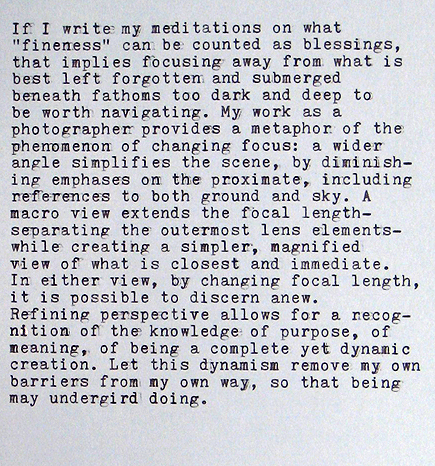
“Waiting at the airport on my suitcase,
a girl traveling from Spain
became my sudden friend,
though I did not learn her name.
And when the subway dimmed
a stranger lit my way.
This is the brotherhood of man.”
~ The Innocence Mission, Brotherhood of Man
Tuesday, March 24, 2009
olympians
Saturday, March 14, 2009
fine lines
“When all is dark and dusty down the tracks;
And all paths from exile have roadblocks
on all points saying ‘no way out of here,
go back to where you came from.’
Only the thunder knows
what drives a man in his darkest throes
Fortune and poverty,
they’re so close, so close.”
~ Mike Peters and The Alarm, Only the Thunder
Stories, and rumors of more losses, surface and loom with each day’s passing. Pausing during a coffee break, it occurred to me how many setbacks I hear about, at nearly every turn. People moving out of the region, a neighbor vacates without notice, and numerous plans must be minimized. Long-standing businesses and cultural fixtures dissolve or downsize. Many who elude job losses must navigate warily in threadbare and fearful environments. And still, across all situations, there are more who listen to personal testimonials that string together with broadcast news stories. Pondering this today, I started categorizing the relocation, layoff, dissolution, and transition stories I’ve been hearing daily. The listening is part of dignifying the need for individuals to tell their adventures. And it’s hard listening. But there are unspoken embers of hope when the language of defeat is superimposed by creative alternative plans. There seems a fine line dividing what we determine to be success or failure. Indeed, our realities are challenged when another reality visits upon us. Of course, we’d prefer to draw the lines, rather than to have them drawn for us by somebody else. In this continuum, we will surely note the changes in our midst. And somehow, in realizing all that is transitory, the status quo reveals an undertone of fragility.
When considering the meaning of fragile, what comes to mind is the breakable. My thoughts turn to this imagery when the permanently dependable looks precarious. The idea of fragility speaks of delicate plants, complex mechanisms, anything requiring sensitive and conscientious handling. Hopes and health. Though essential, easily forgotten. And paradoxically, through these, strength is found. Disrupted balances are causes to perceive well-being as hanging by a thread. Is the status quo as delicate as it appears, when stopping to think about it? Perhaps it’s best not to stop and think- or at least not to allow a focus on vulnerability to derail forward continuity. Peace of heart is, in itself, fragile- even if well-anchored in road-tested faith. The nature of dynamism is fluidity, which may be considered a fragility. But in vigilantly maintaining balance and a consistent openness to the Holy Spirit, flexible strength is reinforced. There is fragility in all that is dynamic, and although it may seem a conflict of terms, both require the depths of our patience. “Tears may endure for a night,” wrote the ancient Psalmist, “but song finds us in the morning,” hours during which reassuring joy is easier to discern. Oh, but to thrive against restrictive limitations! In these times, so many of us find ourselves taking stock in our most palatably compromised ways of functioning and making ends meet. But it need not cheapen our dreams.
As the road ahead must negotiate unpredictable detours, it is vital to be able to prosper through instability. Whether or not I can serve as a conduit of hope, my proximity to the wellsprings of promise requires steady vigilance. A most surprising moment occurred last week during a long-distance pilgrimage travel: At the heart of complicated logistics, commotion, and exhaustive music preparations- was a ten-minute silence amidst over 400 people. A forgiving, respirating, and transporting quiet. Afterwards, resuming my instrument to play the next piece, I thought about how I might find ten-minute slivers in my early mornings- or even lunch hours- to help balance frenetic work weeks. Confident aspiration is a long looking-forward, hopefulness a serious business to which we must take hold.
Reflecting upon the many stories I’ve listened to recently, along with the hard-worked years of my own, I think of how to arrive at consistency amidst instability. After seeing enough times how circumstances can delicately oscillate, my thoughts turn to how one can pivot the fine point from untenable to productive. While so much is said about “bad to worse,” or as a neighbor once said to me, “just worser and worser,” this is enjoining me to aspire through such darkness. A solid course of trust pursues a fine line through narrow gates, laying tracks of trust. One recent cold post-midnight, gazing through icy windows at silent streets, I thought of that dividing line between despair and confidence. How to press forward along the high road. Somehow, the most reassuring thought was to remind myself of where I am now, and how far I’ve traveled on this marathon voyage.
There are prospects yet to ascend. Within a vital perseverance must be a solid sense of durable certainty. Memory recalled the words of the imprisoned apostles, passed down from antiquity, referring to being held captive by their hopes. The fine line may be one of perception of circumstances, how derailing realities can be dealt with and interpreted. Fluid situations demand a readiness which must rise above the gravity of grimness. Indeed, thriving above undertones of instability requires more daring than before, challenging me to continually renew inwardly despite what is outward and perishable. At times the juxtaposition of enduring and impermanence is more obvious than others. For now, the present exposes such contrasts. As an artisan, I am aware that with an increase in contrast there comes an emergence of sharp edges and fine lines.
Wednesday, March 4, 2009
so fine
Saturday, February 21, 2009
dart
“Cease not in thine intent, but strike evermore
upon this cloud of unknowing that is betwixt you and your God
with a sharp dart of longing love,
and loathe for to think upon ought under God,
and go not thence for anything that befalleth.”
~ The Cloud of Unknowing, ch. 12
The dawn-to-dusk workday offered scarce light and no rest. What impelled me through the hours was the prospect of relaxation and fresh air that evening. By mid-afternoon, I had decided upon a hot bath as a clarified and appropriate reward. My chilled walk through the dark streets going home began the process of exhaling thick dust and grime out of my lungs. A good bubbly hot water immersion needed some efficacious thoughts, so I coincidentally brought Baxter’s The Saint’s Everlasting Rest with me. Sinking into the suds, the 17th century orator’s words wafted to me from my weary arm’s reach: “A heart seldom thinking of heaven can fetch but little comfort here.” The hardworking chaplain of Kidderminster held to the ancient contention that “there remaineth a rest” in the eternal future. We are unsettled in our earth-bound lives, Baxter claimed, because we neglect to meditate upon heaven. Impressed by these poetic reminders, while draining away the day’s travails, it occurred to me how I don’t think much at all about what we refer to as “heaven.”
Admittedly, I do get bogged down, if not diverted, with immediate concerns and the weight of keeping as many jumps ahead of deadlines as possible. Indeed, this culture refers to the stuff of heaven as the “afterlife.” When I stop to ponder, I realize how far one can perpetuate distorted perspectives. Rather defensively, my response is there’s so much “down here” in the “real world,” occupying my energies and all personal resources. Perhaps projecting some ingrained ideas from my uninterrupted working life of grinding and burning-out, looking ahead to some yonder break. The intermissions are never enough, and I tend to spend half of those times trying to stabilize myself with rest so that I can actually enjoy wherever I am and whatever I’m doing. Unfortunately that taints my view of heaven: that I’ll work on numerous well-intended projects and self-improvements until I simply can no longer. Then my life will be followed by some sort of ‘perpetual paid vacation,’ entailing a lot of harp-playing inside the fabled pearly gates. Merciful heavens, this can’t be it.
The problem is that I interpret references to heavenly eternity with terribly distorted and uninviting imagery. Quite the opposite of goodness and peace. No wonder these pictures of a hazily simplistic heaven are never in my thoughts or dreams. I begin to regret the notion that it may not look like Paris. Or eastern Maine. Surely there must be gentle people, books, good coffee, and bicycles. I, too, apply my own humble human projections. A bit more Robert Doisneau and a whole lot less Fra Angelico; I’d like that. Indeed, Richard Baxter himself- and the biblical sources- cannot spell out what we will see and do not bend to the limits of the scale of human perception. Baxter calls heaven “our own happiness,” and that a life of praise and inclination toward the infinite Divine, draws us away from being devoured by our convenient miseries. Whatever it is, or can resemble, will be our very utmost good. At this point it’s more than enough to get me to visualize a 4-day weekend, let alone heaven. Still, meditating upon these things helps me re-learn how a heavenward focus causes a more balanced earthly view. This evening it’s easy to imagine a perfect rest. That everlasting rest for all who have labored and knew heavy burdens. “On earth as it is in heaven,” begins to look to me like “in application as it is in ideal.” The place is for later.
Piercing those clouds of unknowing is a concerted effort and a constant need. Each day begins with a former perception to shard away. Perhaps darts that transcend cloud-coverings are not about the world to come, but really about an undaunted pursuit. These are aspirations. An unseeing intent that reaches forth to the Divine attains to the absolute. Yes, going forward even when unable to see through the void of a fog bank; even without sonar. The anonymous writer of Cloud of Unknowing wrote of the blind intent stretching to God, which, if wholeheartedly directed toward God, will surely meet its goal. The sharp dart of longing love is essentially an unfettered desire through which the soul attains the absolute, which really cannot be apprehended by any particular contrivance or method. Hidden between the rigidity of contraries- such as speaking and silence, eating and fasting, company and aloneness- is the sublime spirit discovered. “Up there,” as so commonly gestured, becomes “close at hand,” with distances delineated not by miles but by the will of the heart. Perhaps a better view I might have of what life manifests beyond might be to contemplate the passing away of the unknowing. Knowing even as we are known.
It seems I am reaching forth by faith toward something for which my understanding is evolving. But knowing enough to reach, and even to strike upon the clouds, envelops the pursuit in this very assuring mystery. A vivid recollection involves hiking to a favorite place of solitude, close to home and along the ocean. One of those countless ledges of crags and pines. This time, I encountered a dense and palpable fog, so dense that it was impossible to see the edge of terrain. My steps became vignetted by the same blanched smoky void that was straight ahead of me. The sound of crashing waves informed my advances. Of course while knowing what was on the other side of the fog, I couldn’t tell how near. Standing on a jutting rock, I simply marveled at the upward view being undifferentiated from the views ahead, left or right. What vistas await, surpassing the unknowing? Details are less important, but the goal must not be forgotten. Sowing must not hesitate with fears about quantitative results. “Contemplatives,” wrote Thomas Merton, “must empty themselves of all created love in order to be filled with the love of God alone.” With this in mind, my imaginings of what follows might remain at the edges of peripheral sight, yet the heavens are surely present.
Thursday, February 12, 2009
solace
“Some winters are harder than others.
We are going to take our cameras
and look through at black trees with empty arms,
and sled tracks wandering as we are.
To see him, to see him happy.”
~ The Innocence Mission, Snow
Thursday, February 5, 2009
un avenir de paix
“Some are bearers of peace and trust
in situations of crisis and conflict.
They keep going even when trials or failures
weigh heavily on their shoulders.”
~ Brother Roger of Taizé, A Future of Peace
Ever since my youngest childhood years, I’ve befriended my most elderly neighbors. Perhaps beginning with the patience of my grandmother, and on through my school years I could recognize how my eldest teachers could listen best, and also tell the most captivating stories. And this was common between playgrounds, neighborhood stores, and- when I began working- the customers I served. One of my grocery delivery stops, when I worked for a market in New York City, was the home of a retired teacher. In my gratitude for the wise anecdotes and gentle encouragements, I would give her drawings I made, which she cherished. As I advanced into art school, one of my very rare fortunes in those days was to have landed in an elderly illustrator’s final class before he retired. He had apprenticed with Edward Hopper, and I would divert him from critiquing my work with requests for more stories about camping in the woods of Brooklyn in the 1920s, watching Zack Wheat play for the Dodgers, and the horse-drawn brewery vans in Bay Ridge. This man must’ve been in his 80s, and he taught us plenty about rendering and gesture-drawing. To this day, I remain fascinated with eras that long preceded my birth.
Getting through an enormous hardship, about 14 years ago, and deciding to rebuild my life by focusing all my forces into graduate school, it was an octogenarian neighbor who gave me words of faith. I went to visit him with the good news about beginning graduate school in Boston (to study medieval history and archival sciences). “You’ve been through a lot, for your age,” he declared, adding “but you have a brilliant future,” with his hands gripping both my shoulders. This gentleman passed away shortly afterwards, and so these were his last words to me. At that time, I had so many doubts about my abilities and needed those words. Too much uncertainty to presume far ahead.
These times are replete with indefinitely grim forecasts, all following litanies of harsh news to which we have grown accustomed. And with reason. Added to a general societal apathy are swelling tides of discouragement. Decreases in employment, commerce, and economic opportunities are well entrenched in this culture. In recent months, I have seen friends and neighbors numbered among the disenfranchised. In our conversations, we wonder where the road turns. Have we yet seen the depths of this current duress? Having surpassed the winter’s epicenter, it seems easier to imagine the harshest of generally difficult times is past. But numerous commentators broadcast the worst is still to come. Downsizes, cuts, outsourcing, the “elimination of redundancies,” and references to “the pauperization of the middle class.”What to believe, and where to place that proverbial grain of salt? Beyond that, to be as hopeful as one is realistic- perhaps even more so. Confidently going forward, even as we walk through streets of “closed,” “for rent,” and “foreclosure” signs affixed to empty spaces.
When I first met Brother Roger, in Taizé, he was 88 years old; two years before he published the words quoted above in an essay. He addressed present-day society with references to the ancient Jeremiah, “God has plans for a future of peace for you, not of misfortune.” We must not let ourselves “be caught up in a spiral of gloom,” as some of us have been called to encourage others and be “bearers of trust.” With courageous hearts “we must keep on going,” in spite of the heavy burdens of trials and losses. Brother Roger’s words speak to that antithetical resolve- that determination to persevere when one’s conviction is the only persuasive evidence. Then we really do become creative bearers of stability in the midst of despairing souls. And it is a confrontation of the challenge of that easily spiraling gloom, bearing a shared burden of trust.
We cannot predict where, or when, or if this somber road will turn a corner. Listening to so many grim personal stories and being immersed in this society, my perspectives are put to the test. And listening, saturating as it can be sometimes, is often my wisest response. We all wish to be heard. My recollections only comprise one severe time of recession- that of the early 1990s. The current economic decline brings to mind those years of closings, job losses, and an exodus out of this region. I had been only a few years out of college, and saw most of my friends leave, while I worked two jobs to survive- and be able to stay here. It meant living alongside a lot of misery, investing in what many told me were lost causes. One of the most infuriating things I’d be told, mostly by evacuating acquaintances- and it happened countless times- was “you’re still here?” I developed some good responses, such as “and you’re visiting here?” Brother Roger reminded me that Jeremiah invested in a field that was located in a disaster area, a place from which his friends had fled, as he became certain of his purpose where he lived. But it’s always easier said than done. The necessary ingredient is to trust that assurance of a hopeful future, of bright days ahead, of consistently seeing spring though the winter.
This is an era of hesitancy. Yet we are ever enjoined to go forth, as our days advance in linear succession, even when details and timetables are elusive. Even when what we believe conflicts with what we see. I've lost jobs through layoffs twice, and during one of those ugly processes a coworker of mine blacked out faces on a corporate group photo- respectively with the dismissed employees. He wrote across the top, "who's next" with his marker, in a pained show of gallows humor. When his turn came, after he packed his effects, he returned to the common room, and blacked out his own face in the picture. For those who must bear witness to these things, there must be a reckoning of our own approach to life when there are so many justifiable reasons to be pessimistic. Evidently there will always be trials for us to contend with. And just as fears can be dispelled and stood down, so can ideals be put to the test, and constructive reinforcement can be founded upon reality.
When our tangible sources run thin, our precarious fulcrum points upon which our lives turn become apparent. How to stay inspired, and how to proceed with a realistic positivism, instead of gravitating into that ubiquitous spiral of gloom? Drawing nearer, and depending more upon the wellspring of life, my thoughts can dwell on the hopeful things I can count. Health, abilities, and prospects are stock-taking ingredients. The inadvertent and invaluable investments of rich friendship. Reflect upon the life-giving. Recall the finest words we have received; these things remembered have no expiration date, and are worth committing to memory. Save the good words for the gold coins they truly are. Good-tasting nutrients help too, I have learned from an elderly friend. And it's all needed, since getting through these times requires a lot of energy.
Sunday, January 25, 2009
post tenebras
My time of day is the dark time...
Walking home last night, scaling the embankment along Pleasant Street, I remembered tracking those same sidewalks after groggy all-nighters in my studio at art college. During senior year, I worked a third shift in the dusty press room of the city newspaper, walking home to grind the ink off my forearms with abrasives. Of the divine darkness, there is no defined duration. Perhaps that cognizance of eventide remains with a soul, in varying degrees and times of day. Dionysius wrote how it is in this kind of lucent darkness that we long to be, “and through unsight and unknowledge to see and to know that which is above sight and knowledge, by very not seeing and not knowing.” About nine hundred years later, in the latter 14th century, there followed the anonymous author of The Cloud of Unknowing. Perhaps the symbolic cloud is as much a place of uncontrived comprehension as it is a shield to counteract what Dionysius called the “oversensible.” In silence and in sparing shreds of light, the soul may “be borne aloft to the superessential ray of divine darkness.” At this moment of writing, early in the morning, I am borne aloft by an unseeing sense of expectation. Not really rested, but as always a clean slate. Now writing of this gift, I become more aware of the ingredients with which each day begins.
When the street belongs to the cop
And the janitor with a mop
And the grocery clerks are all gone
When the smell of the rainwashed pavement
Comes up clean, and fresh, and cold
And the streetlamp light
Fills the gutter with gold
That’s my time of day.
~ Frank Loesser, My Time of Day (from Guys and Dolls)
In my most silenced and darkest waking hours, there is time to regather. With ambient light dimmed to crepuscular graininess, even the objects and structures in our midst emerge with softer edges. How are the pre-dawn hours so unlike those we call “late night?” Is there a zone of demarcation- like, say, 1 am? I find the noticeable significance when my awakening renews my alertness very early in the morning, before sunrise. Unlike a world-weary after-midnight wakefulness, my regained consciousness parallels hot water and soap, clean clothes and coffee. The windows are still blackened with night, and mirror my interior back to me. The world is still asleep. Muted sounds from my table radio, the sole permitted murmurs through the holy silence of the day that seems not to have started yet. There’s time, in these nascent hours, to reflect on the day passed and aspire to the one yet to form.
Yesterday’s newspaper sits on the dining table, rendered obsolete by the simple traversal of the night hours. At my desk, situated where I’d left them, my wallet, books, sweater, and writing things await. These inanimate objects in their respite, as the parked cars lined up outside at chilled ease- yet lingering with their owners’ residual imprint. What remains of us, when our instruments and habitations remain in our absence? Does your bicycle in the hallway, the notebook atop your desk, and your chairback-draped coat await only you? By the second cup of coffee, the grey light presents a black-and-white photo exterior. Perhaps in this essence of advancement there may be found the difference between the darkest hours before and after repose. More than a marking of time, it’s an alteration of perspective, the division between the winding-down of well-worn thought processes and the restarting of rested reasoning.
In these precious, slower, somber moments of the half-lit day, there is a sense of catching up with time’s pace, witnessing light’s increase. The scenery outside develops, reminiscent of images manifesting in darkroom processing trays. In the holy darkness, we do not wait in vain. These vigils recall creation, with light dividing the uncomprehending darkness. With such thresholds are new thoughts and reflections to accompany my routines through the work day’s structure and its daunting complexities. Such silent spaces are my Divine Hours, and the hushed darkness- those times of less apparent visibility- invite an expanse of inward roads.
I have never found myself begrudging the early-waking. The time seems to belong to me; it is uninterrupted and given gratefully to unstructured contemplation. Being awake is all there is to be concerned about. There is still time to dream. The slate is clear, hot coffee fresh, and the liminal gradations through dusk are navigated with certitude into light. As I learned in memorable wonder through my many monastic sojourns, from vigils and lauds the day silently emerges into being, and with the ensuing visibility a new admiration for the full sunlight that follows. Another set of very-early-morning memories rewinds my thoughts to junior high school years when I began to take to waking before 5am, hearing my Dad readying for work. We were both half-awake, he with his coffee and me with my cereal bowl, and the New York Times sports section before us. And cartoons. Sometimes, at the opposite end of especially prolific baseball days, we would go out walking after 11pm, to buy tomorrow’s Times. We were the vigilant and purposeful souls, awake before the rest of the block, save for- at least it seemed- the delivery trucks and Newsradio 88. This was the safest part of my adolescent day, and only now when thinking of it I realize the origin of all my good connotations and sensitivities attached to these hours.
Wednesday, January 14, 2009
lettera
“There is in books
one voice and one letter that is read,
but it informs not all alike.
For I am within,
secretly hidden in the letter,
the teacher of truth,
the searcher of the human heart.”
~ Thomas à Kempis, Imitatione Christi, ch.43
How amazing to consider the ways jottings and their configuration can call forth a full spectrum of lived experience! The names and symbols above recount an evening I spent at Fenway Park, last June.
Monday, January 5, 2009
drop-off and pick-up
“When the past haunts you
Leave it alone.
You’ve spent too many nights staring at the ceiling
You can only beat yourself so long
You can only hurt so deep.
What you need is a new sleeping canvas
To paint your dreams a new color
A brighter scheme.”
~ Brian Hardin, Love Will Not Care
This unusual New Year’s observance included an odd general combination of relief, reluctance, and catharsis. The recent calendar’s turning wasn’t even like the millennial “Y2K” anticipation, which was mostly one of excited anticipation- despite fearful survivalists’ exclamatories. This time around, there’s been a hefty dose of political and social commentary showing a kind of mortified hesitation about proceeding into the new year. As if we could actually select not to face tomorrow- or choose alternatives to the natural progress of time. Admittedly, much is not well with this economy and society, but what causes us to look at accepting the motions of time as if it were some sort of choice? Would I really want to go back? Even if I did long for a past era, these would be places for which there are no connecting roads or usable itineraries. “For most, this year’s special joy is in ringing out the old,” read an article title in the January 1st Boston Globe, and I have to agree. The occasion of a year turning (arbitrary as the first of January may seem), provides a forum to do some wringing-out, but also a renewal opportunity. Even with a perspective of living among beginnings, a year’s anniversary marks an extraordinary threshold. Personally, with the closure of an expired year, and a new one presenting itself, I become aware of how much I have navigated the Terra Nova of life in the Spirit. And while I wish to discard old millstones, I also want to bring along the good things I have known and collected.
Every advance of time is a threshold, and a pilgrim’s steps transit between liminal spaces. Thinking of how travelers are increasingly exhorted to minimize their baggage, I am thinking of something more permanent than a sojourn: there is material that should not traverse the new threshold with me. Excess may be physical objects with weight, as well as thoughts and attitudes that figuratively weigh upon us. Noticing how places of transportation have places of inquiry and admission, they also have checkpoints for embarkation- and areas for drop-off and pick-up. The latter functions concern the transition of passengers and merchandise. Usually it is an exchange from one mode to another. With a time-landmark such as a new year, my thoughts turn to the ideas I wish to drop off at the gate and not take with me. But the need for even the simplest provision informs me to pick up necessities. What unnecessary bulk should not be carried into the new year? Here is a chance to put off what holds me back, and in order to do that, I’ve had to identify what that is.
Walking with the idea of dropping off the notions that prevent me from reaching forth, I arrived at the word “justification,” and wrote it down while waiting at a stop light. Not an item, but a concept. It occurs to me that I hold many of my memories in order to give some kind of justice to my survival. Recollecting details about jobs, schools, people, and all sorts of failures and triumphs alike, becomes a way of immortalizing what ceases to exist. In my young life, I’ve witnessed many places and events: countless lives, localities, situations, emotions, and environments. My words and vivid memory-pictures keep all these things- good and bad, joyous and tragic- alive and retrievable. Archivally stored. (When writing of what I call “the archives of the soul,” that should also include applying some good process appraisal principles.)
“Justification,” in this context, means articulating the evidence of what’s been endured, committing details to memory. Justifying how I dealt with adversities, or what needed to be done. Remembering the good and the bad, thus entrenching those assessments. “The best offense is a good defense.” Making sure my experiences retain their value: all that tolerance, hard work, and perseverance were worth something. How exhausting and diverting. I must simply have faith that no honest effort is a wasted one. Notwithstanding the value of historic perspective (practiced by few in this culture), that persistent sense of self-vindication is something to let go of. What to leave outside the threshold brings me to think of the convergence of memory and burden- and their needed divergence. The daring challenge is to let go of failing tallies as well as successful ones. Beneath this is a sense of universal forgiveness.
The strength of negative memory is formidable, and if defeatism is to be dropped off and counteracted, something will have to be picked up. Indeed, not an impulse purchase, but something more of an upgrade. Trade the wasteful guzzler for something practical, durable, and maneuverable. Just as a change of diet, nutrients need to be reconfigured. What is picked up can surely be more trim than what was dropped off, but the soul will need something to take along for the journey, replacing what was dislodged. “Replacing” here refers to how the mind must be occupied and enthralled- yet not ensnared. We are not wired to be devoid of thought. The mystery of our lives’ symmetry involves exchanges of time, of endeavors, of directions. We finish a book and begin another; “the end” implies there will be something else. We intuitively turn pages and restock cupboards.
Just the other day, distracted by the encroachment of materials and cluttering thoughts, and moved to continue my writing at a library, I realized that I needed to thoroughly clean out my desk upon my return home. Reveling that evening in the ability to read and write at my small desk, with both elbows on the newly-polished surface, the pick-up to supercede the drop-off occurred to me. The antidote to narrowing horizons is a healthy sense of fascination with life. Even a kind of constructive tension to parallel the hunger to learn, informing me of how much more there is out there than what I see from my doorstep. And if I am to be confident enough to drop that over-compensatory burden of self-vindication, it must be replaced by an assuring sense of significance. In the face of a stale view that pries into my days with convincements of senselessness, I’ll pick up its very antithesis:
Each day’s set of paths has substance, and none are wasted. And if “finding” the meaning seems forced, well then I’ll fall back on reliable ways, as a journal-writer, the meaning tends to find me. I think I may have had it wrong when I tend to look for fulfillment before getting into a project or job. It seems the other way around, that I must do the work with faith that it will incorporate into a broader sacred vocation, which may be momentarily undefinable. In my favorite of her books, The Golden Sequence, Evelyn Underhill expressed how we cannot know the depths of artistic magnificence unless, “we have learned to look and listen with self-oblivious reverence, acknowledging a beauty that is beyond our grasp.” Realizing this, my relating to creation and the created order becomes something new. The closed-loop litanies of remembered faults, in response, become dead weights. Renewed aspirations allow for open-ended ways ahead, and incomplete mysteries are less daunting and more alluring.