Showing posts with label Richard Baxter. Show all posts

Sunday, January 26, 2014

scriptura et scriptum


“Towery city, branchy between towers;
Cuckoo-echoing, bell-swarm’d,
lark charm’d, rook racked, river rounded..."


~ Gerard Manley Hopkins, Duns Scotus’s Oxford.


Among the many great gifts that coincided with my fellowship and residency at Oxford was the experience of place. Although my residence was The Kilns, and the primary purpose was to study all things C. S. Lewis, I also found myself immersed in one of the world’s great learning environments. Being amidst such depths of philology and library collections was an inspiration in itself. But the resources are for the living and thinking to tap into, just as the lanes, parks, and corridors are meant to be walked. My residency permitted for a full spectrum of study, discussion, writing, and miles of reflective strolling. I found Oxford to be an ideal place to live the love of learning. Now, the love of learning came rather late for me; as a child, I was one of those pupils that wished to be anywhere other than at those penitentiary-like public schools I had to endure in New York City. Education became more of a pursuit in college, and then more of a passion in graduate school and beyond. When I could choose my own areas of study, the learning ceased to be a drive for grades, and rather a direct means of personal development. Very much like my relationship to writing. Learning and writing have evolved into an intertwined tandem.

blackfriars college


“Let the wise listen and add to their learning, and let the discerning acquire guidance,” wrote King Solomon, in the opening paragraphs of his Proverbs. As my writing adventures had brought me to Oxford, my reading appetite drew me to libraries and through the gates of Blackfriars College. At this particular college, the church- a large one- is at the forefront of the campus, along Saint Giles Street. Reflecting the traditions of the Dominican Order, the church and college share a spartan style of architecture. Unusual for Oxford, ornamentation is sparing, yet the place is beautifully plain. And being a teaching order, the friars have placed their library, as well as an additional chapel, at the heart of the college building.

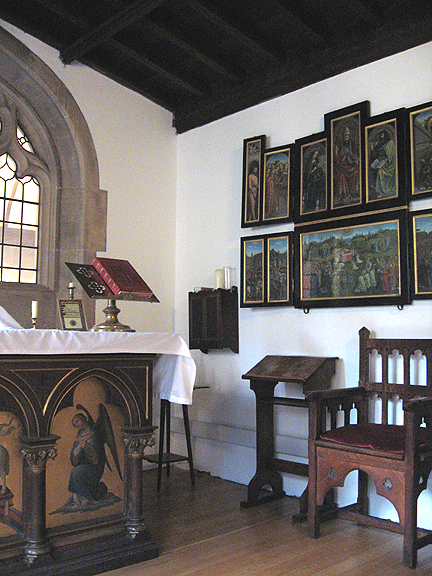


Among the Dominican friars in residence is the well-travelled author Timothy Radcliffe, who once wrote, “One of our deepest needs is to be at home. We need a place in which we may flourish and be ourselves.” This particular homily concludes with his emphasis that “God wishes to gather us from exile into our home.” The plainness and openness of Blackfriars does evoke the impression of a communal home, and I was able to experience gatherings in their sanctuaries, community spaces, classrooms, and the library.


Above: Library
Below: Classroom


Within the quiet spaces, I was able to gather some words of my own, between readings and visits. The Dominicans’ bookcases were as hedgerows around the room, which reminded me of an intimate and verdant garden. When my written words lose their sense of direction, there are wellsprings of ancient words that hold firm and hold forth in their ready volumes. My notes attest to how I’ve learned that along this voyage, my appreciation for the integral aspects of studying to writing has deepened. Even upon the momentum of calloused pilgrim soles, writing dryness indicates there isn’t enough reading and listening. By listening, I also refer to observing- as can be enjoyed on long walks and in art museums.


queen’s college


To advance and develop in mind and spirit, I’ve found it essential to continue pursuing knowledge and learning. Exploration attests to how much more can be explored. Across town eastward from Blackfriars, along the High Street, is Queen’s College. My first time walking the cloister around the college’s courtyard lawn, Wycliffe came to mind, and I marveled at the prospect of matching my footsteps with his, albeit beneath layers of centuries. John Wycliffe thought and wrote much about divine grace, emphasizing that our good works are indications of the Spirit within, originating from beyond us. As my studies and sponsorship emphasized the life and works of Lewis, these opportunities broadened to spectra I could just simply begin exploring. Indeed, studying one topic easily expands into further topics, finding additional interests- sometimes historically connected, or sufficiently connected by the inquiring scholar.
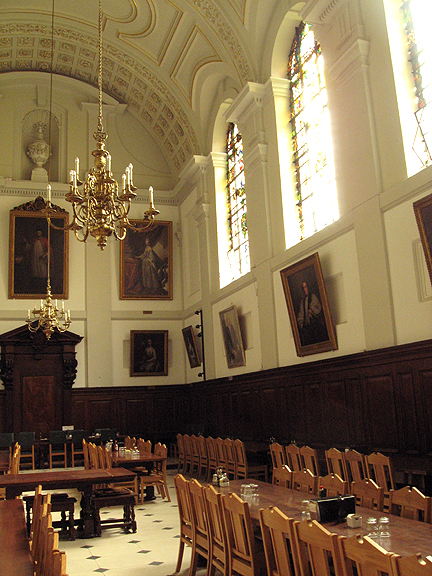


Above: Dining Room
Below: Chapel, with Lectionary Bible


On one occasion, I walked into the Queen’s College chapel, and noticed visitors reading to one another from the large lector’s Bible at the center of the sanctuary. There wasn’t a service in progress. People were simply and casually reading and listening in turn. I read, as well, noticing the acoustic of the space which allowed me to slow and mute my tones. The most enduring proclamations are the gentlest. In this spontaneity of brief oration and lengthened listening, I further saw how spans of time in such places of learning naturally lean toward gathering. My years of intense employment have cultivated a hungered drive for constant productivity. But this learning experience caused me to be immersed, rather than to think too much about projects. The pendulum, however, continues to move between absorption and practice, between note-taking and structured writing. Knowledge is often patient, and so must be its gathering; though far from passive, study is an entirely active pursuit.


instruments and arts


Ashmolean Museum, Oxford


My gratitude for occasions of exploration and instruction found still more inspiration at Oxford’s Ashmolean Museum. The stately edifice presents both permanent collections and rotating exhibits in modernized galleries. Among the levels of installations, perhaps owing to the context of my visits, I was most intrigued by the interpretive displays that show how things are made. I suppose the incurable practitioner relishes technique alongside result. With the Ashmolean’s exhibitions of prints and icons, are narrative displays of the corresponding scribal tools for these manual arts.


Exhibits describing the processes of:
Above: Iconography
Below: Manuscript Illumination
and Intaglio Printmaking (etching).


Amidst intellectual and spiritual speculation is the desire for application. “Lift up your soul,” wrote Richard Baxter, in his essay The Divine Life (17th c), and “oft take occasion from what you see, or hear, or do, for more meditation or discourse.” “A lively spiritual knowledge,” added Baxter, “actuates grace.” Becoming more aware of the gentle pendulum between studying and writing, I also found myself learning about learning processes themselves!


scriptum


From libraries, oratories, and exhibits, my steps returned to my favorite Oxford shop, Scriptum. Stopping in to this- and shops like it- for various odds and ends that helped equip me during my month at Oxford, I saved my last Scriptum errand for their custom-made journal books. The shop’s arrays of quills, inks, and stationery complemented my appreciation for the enduring written words on my immersions in the Bodleian reading rooms. The soaring thoughts of minds such as Eriugena, Wycliffe, and Erasmus, were penned with sharpened feathers. The reams and reams of manuscripts I read among the archives of C. S. Lewis were written by dip pen and his portable Royal typewriter. And across centuries, millennia, and countless writers, words reach our hands and eyes illuminated by this day. The consideration of heritages of written expression must not overwhelm, but rather must inspire continuity. As the far continuum of authors comprises those who could not have predicted their influence, it is not for us to know the full extent of rings resultant from our castings upon the waters.


Below: Scriptum shop window and interior details.


As fellow pilgrims of the written word, I thoroughly enjoyed my chats with the different members of the Scriptum staff. We compared notes about writing materials, travels, and the places we come from. I’m grateful that I can keep myself in their notebooks, by mail, and that we can keep in contact. Inevitably, cultivating learning and writing transcends place and time. Our adventures are chapters in the books we carry with our steps and souls. As we choose to draw upon sojourns near and far, the places of our inspiration are indeed never far from our selves.


Above: Scriptum Oxford journals
Below: Saint Mary's Church (University Church), Oxford.


Tuesday, June 14, 2011

beacon hill


“The reach must always exceed the grasp.
The heart must forever be throbbing for an attainment
that lies beyond any present consummation.
It is the ‘glory of going on,’
the joy of discovering unwon territory
beyond the margin of each
spiritual conquest.”


~ Rufus Jones, The Inner Life


Each day is unique and should be a fresh start. This morning’s front page is not yesterday’s. But do we have distinguishable news items, and is it fair to expect and find ameliorations to our daily stories? Yes, it is; and it is also well worth cultivating a discipline of observation. The way to work has only so many variations on the basic route. But in a real sense, just as the day is unique, it is not the same way through the same places. During the lunch hour of noting words in my journal, I chose an old familiar perch. But the day varies context and backdrop. From the second floor window of the coffeehouse, sheltered from the rain, pedestrians’ umbrellas appeared as twirling spoked mushroom caps. Varying my vantage point permits perception practice. The street below revealed textures I hadn’t noticed at ground level. Looking north between office buildings, I recognized a steeple four neighborhoods away, standing at the horizon.


Discovery isn’t simply finding something entirely unfamiliar: it’s also noticing newness in the usual. Surely terra incognita is immediately in our midst. Perhaps you, too, can pinpoint some of your own historic realizations. Our discoveries are for us to store in our hearts and fuel our fires. Last week I enjoyed the double-privilege of residing with the Quaker community in the Beacon Hill Friends House and studying the 17th century works of Richard Baxter at the Boston Athenaeum nearby. The Friends live in the same building as their sanctuary. When I had my first look at the space, with sunlight and verdant colors streaming in from the back garden, my impression halted my steps. I was immediately reminded of my first-ever visit to TaizĂ©, France- which followed two days of traveling, preceded by months of planning: from dusty summerbaked roads, I entered the TaizĂ© monastery’s church and was swept by the combination of beautiful colors, the ambience of the space itself, and the fact that I had really arrived. Discovery has ways of finding us. The Friends’ environment has a similar eloquent simplicity, however in a much smaller and purposefully unadorned space. A new lived experience in a very familiar place.


A week of new horizons in well-known worlds provided respite and insight alike. Between daily visits to the Athenaeum I could stroll the hilly streets unencumbered, having a neighborhood place to leave bags, books, and typewriter. And I could visit with friends, without calculating a same-day return to Maine. There was plenty of time to listen well. Even my handwriting slowed down. The Athenaeum’s rare books room, open only on weekdays, was yet another place of discovery in a library I’ve known for a dozen years. After reading all I could borrow of Baxter’s in circulating collections, it was time to meet the treasures he published in his own lifetime. Requesting to use the special reading room paralleled my query for staying with the Quakers.


More occasions of quiet wonder, with tomes opened for me by scrupulous curators revealing pages printed more than 350 years ago. From the London printer Thomas Parkhurst’s hands to mine, a 21st century bookbinder from Maine, I could barely imagine the readers in between. And could those writers have imagined what New England would become? How about a Quaker Meeting House sharing a neighborhood with Congregational, Catholic, and Episcopal churches- and a synagogue? All this, and a separation of church and state. Baxter would’ve marveled at that. The books- and a 17th century style of protracted-sentenced English- filled many of my daytime hours. I took numerous notes in permissible pencil. A few of these books are also accessible in scanned form, but I found the originals so much easier to navigate. I could glance quickly between prefatory notes and texts. The paper itself gently reflects light. Another area of fascination is the marginalia; little markers to confirm steps in the forest.


Serendipity manifests in ways such as when we realize new acquaintances share similar friends and affinities. Simultaneously our worlds draw nearer while doors open. The serendipitous can also find its way into the bookbindings of printed words. After a solid week of Baxter’s writing- and sensing more of the spirit in the words- I signaled for the last of the books I’d requested. Recognizing the tome as being a bound collection of pamphlets, I looked for the contents list as a finding-aid for the volume. On my way to the Baxter item, in this bundle of random 17th century items, the item immediately preceding Baxter caught my eye. It was a captivating polemic by one John Alexander, something I’d never have found if not for the serendipity of perusing books. With special permission, I photographed the title page. In fact, Alexander’s words, along with how I began imagining Alexander as a person, upstaged the last Baxter piece, and my last few hours were absorbed by this personal discovery.


Time passes astonishingly quickly on sojourns like these. It seems there is a special time zone we inhabit when we are enthralled, and it runs quite opposite to the ones that prevail in schools and employment. As the week drew to a close, I brought a mutual friend of the Beacon Hill Friends House to visit me there, and another mutual friend back in contact with the Athenaeum. And I took a good long walk, finally away from Beacon Hill, my thoughts filled with all I’d intensely read. Back Bay, the Public Gardens, Copley Square, and Commonwealth Avenue- all well-trodden by my old steps- were suddenly easier to enjoy with my leisurely paces.


Beacon Hill has sent me back to the fray with some new strength. I’ve learned how Valley Street can wend up to higher ground. Places of respite are way-stations. These are places in which it is possible to stop, gather, and rejuvenate so that the pilgrimage of trust on earth may be taken up again. Intermissions seem all-too-brief, but it is consoling to know of many refuges that are easy to reach. Last week reminded me to notice discoveries in all forms. The Quaker community, through many spirited conversations, reminded me of kindred spirits. When you think you may have become as jaded as this culture appears to be, you can discover that it is still possible to experience wonder, and that is helped by seeing wonder in others around you. I’ve found myself reading and writing in silence more than before- and to write more slowly. On the northbound return train, my thoughts turned to friendships, newness and excavated finds in the old and familiar. New directions on the old way home.


Monday, January 10, 2011

already


“Is there, in this place, any relief
for Pilgrims that are weary on the Way?”
The Shepherd replied, “The Lord of these mountains
has given us charge not to be ‘forgetful to entertain strangers,’
so, the good of the country is before you.”


~ John Bunyan, The Pilgrim’s Progress.


It is a turn of a calendar page, and only according to one (albeit predominant) tradition of time-keeping; we are in a new decade. The clean slate of a new year reminds me of how far I’ve already travelled. A new epoch, a newly-marked span of time, provides a new occasion for new ways of thinking. And having only so much time, adopting changed perspectives makes it necessary to discard the obsolete. As difficult as these times have been, there is reason yet to give thanks for new promise. Look forward to the good that is yet to happen. Being able to do this calls for some daring: a combination of boldly anticipating and accurately remembering. Keep sights fixed forward, while experience is preserved and accessible. Just the other day, I thought of the shepherd’s staff of Moses- how the walking stick used to signal and gather a small flock was recast into a directing object to guide numerous human souls in his care. If you will, a workingman’s sceptre. In our own transforming eras, our tools can be recast. The implements of our creativity have potential to be means for the transformation of more that just our selves. What is yet to be discovered may well be already in our midst. As the winter forest, that which is dormant is indeed very much alive.


From beneath the cover of darkness, light can still overcome. Observe what is in your midst, and see what is happening. It is an exercise of vision, to notice and take stock of the good that already is. Writing these words in my local public market-house, my notations are scribed between greetings with friends that pass by, bites of my lunch, and the general activity of a vibrant community space. Much is happening around me, among vendors, customers, visitors, and writers. Each transaction, entrance, exit, written word, and sketched drawing surely has a narrative. An event is real to us when it is immediately before us; its reality ceases when it becomes past, and it is not yet real when it’s in the future. But the ways we perceive and interpret the world are quite tangible as well as intertwined with the moment. Glancing back and gazing ahead provides occasional context to the present.


“Look at what you’ve got going for you,” is often part of the encouragement I give to friends- and ought to be advice for me to internalize. Seeing things as they really are requires wisdom to notice what already exists, ready at hand, to sufficiently and indefinitely sustain the soul. Fleetfootedly bounding across town to my employment, it occurred to me how easily the already can be taken for granted. Past is forgiven, hopefulness opens the future, and potential fuels the day.

The idea of realization is a thread running through our own histories, and we can identify this exemplified in the stories we know. There is that character type that traverses obstacles through a death-defying odyssey, only to realize they already possessed what they sought. A story like The Wizard of Oz takes the point of “no further than your own back yard” quite literally. In A Christmas Carol, the Ebenezer Scrooge character makes the opportunity to change course, but for Charles Foster Kane, in Citizen Kane, it is tragically too late. Envious of what most of us mortals take for granted, the angel Damiel character in Wings of Desire scraps his celestial existence in favor of gritty humanness. In most dramatic fashion, the fable presented in It’s a Wonderful Life begins as the protagonist tries to carry out his suicide attempt. George Bailey is killing himself to find what he unknowingly already has. He wants to see the world, but never gets out of Bedford Falls, and he learns- as these other stories’ characters do- how wealth manifests in more than one form.

The story of The Pilgrim’s Progress provides a vivid example when the protagonist’s travels bring him and his companion to Doubting Castle, where they are captured and tortured by the giant named Despair. In this allegory, Despair takes hold and nearly annihilates the travellers. Beaten to the ground of their dungeon, they ask each other, “shall we be ruled by this giant?” I like to think of the pilgrim’s tone as being one of indignation- as in, ‘are we going to be pushed around by despair?’


True to metaphorical form, the pilgrim has the timely epiphany: “What a fool I am, thus to lie in a stinking dungeon when I may as well walk at liberty!” He realizes he’s had a key in his breast pocket all the while, the key being called “Promise,” and with that a successful escape is made from Despair’s imprisonment.

Our reading and viewing, our lived experience and immediate present, remind us to consider what already is- ground already covered and trials surmounted. Allegorical films and novels teach us over and again how we are actually equipped with the forces we need to fulfill our vocations, assert our voices and abilities, and work on behalf of others. In this seemingly endless valley of dry bones, I must keep in mind that I already have the requisite light to make the passage. The invitation extended to me simply requires my response. By realizing and remembering , we know The Already, and this becomes discerned, reinforcing strength.


When something is already, it has manifested in advance of our cognizance- either shortly beforehand, unwittingly and away from our attention, or before time as we know it. Most nights, I set up my timer-rigged coffeemaker to brew before I wake. Thus, at my pre-dawn ablutions, I cross my cold floors to find hot coffee already made. Then there are other ways to affect alreadiness, such as direct deposits and payments, automatic digital file notifications, highway tollbooth transponders, broadcast downloads, and other such conveniences to answer the persistent wish that things happen by themselves. Indeed, within these means is an implicit degree of trust. Ponder the idea that drives us to want things done ahead of time. We hunger to be ahead of the game, without missing an opportunity. Of course, I want all my efforts to go smoothly and to always be prepared, and of course that is more fantasy than reality.

But do any of us realize the grace and potential we already have at hand? Even some of it? How about just enough without being overwhelmed? In his essay Now or Never, Richard Baxter wrote, “There is more power in you than you use, or than you are well aware of. It wants but awakening to bring it into act.” The 17th century minister echoed the exclamation of the ancient Isaiah’s, “Arise, shine; for your light is come.” These biblical verses are often the meditation for the observance of the Epiphany. And embedded in Isaiah’s illustration of the brilliance and glory within our reach is, “lift up your eyes and look around... your heart will thrill and rejoice.” Do I- or any of us- know what we have working in our favor? What horizons are open before us? In the crepuscule, we crave brilliance. Epiphany is even more powerful than the hardness of our constrictions. The already is subtly apparent, and easily missed. With the legendary pilgrims, I can arrive at the realization that hope and promise are already with me, and have been for a much longer time than I’ve known.


Saturday, November 20, 2010

stay this moment


“Look on eternity as near at hand.

While I am thinking and writing of it,
it hastens near,
and I am entering into it
before I am aware.”

~ Richard Baxter, The Saint’s Everlasting Rest, ch. 12.