


 Posts
All Comments
Posts
All Comments

"I'm a little pencil in the hand of a writing God,
who is sending a love letter to the world."
~ Mother Teresa of Calcutta


“Loneliness is bred of a mind that has grown earthbound.
For the spirit has its homeland,
which is the realm of the meaning of things.”
~ Antoine de Saint-Exupéry, The Wisdom of the Sands, ch. 79.
Every once in a while, I drive along the street of my residence when I was eighteen. I’d rented a room in a small apartment house, after my freshman year in art college, and wound up staying in that living situation for a year- being nearly broke. Since that year, my home has been in the West End of downtown Portland. While parts of the city have gone through major changes, the Rosemont area remains very much as it looked in the 1980s. It was one of my life-crossroads, and those occasional traversals of Woodford Street rarely fail to bring back such references. We all have these: pivotal places as playing fields for pivotal times in a life that is far more complex than it is simple. Occasionally, my paths will glance alongside the campuses which had been forums for my learning, practica, and teaching. These places of development all remain quite recognizable, albeit immersed in time’s air currents, with corresponding successions of souls passing through.
Sites trigger thoughts, transporting our spirits through time, and for us the buildings and streets are suddenly repopulated. But the seeker is the only one that sees depth. And advancing away from reminiscence requires a collocation of meaning from beneath surface. Indeed, I’ve learned the necessity of setting aside habitations in which there is no recognizably relevant life. Sharpness of memory is a two-edged sword. Vivid accuracy can haunt. It begins with musing about personal progress and potential, then memory lanes wind into wondering about missed chances and wrong turns. Tree-lined streets and tidy buildings recede into dark woods as the mulling melts into grousing about unsuccessful efforts, missed opportunities, and bad decisions. Wasted time, unrequited relationships, misbegotten employment, and fears of being out of chances can cloud and divert reality. Am I just a low-rent version of my best aspirations? As with a fine instrument, the wielding of memory must be refined so that the historic positively informs lit paths. A sense of present context identifies the good that is. Turns taken are inevitably less tormenting than wrong ones- or better ones; these are the trails we chose at our crossroads. What might’ve been becomes what we’ve been spared.
From composing replays that could never be staged, my attention is distracted by the living, breathing immediate. The intact wonderer is the spared. I’ll trust that what should have been wasn’t so great after all. This follows some seeking of logic for why things are as present- the madness to the method, the reason for the rhyme. With Pascal, “I see no reason why I should be here and not there, now and not then,” yet have a sneaking conviction that I will yet see a grander and more purposeful view. Perhaps I’ve been spared of plans that fell through, and my absences and failures may have spared others of my self! Then there are the more tangible sparings. During one of many bicycled crossings of New York’s 59th Street Bridge, I had been so nearly grazed by a large truck that a sharp gust of air tilted my balance. When I got to my destination in Manhattan, I said that an angel must have flattened itself into a thin shield. There are countless near-miss experiences to recall from the distant and recent pasts alike. There are the instances in which we know we’ve been spared, but we’ll never know what unmanifested dangers hadn’t reached us.
Between why things hadn’t been and what did materialize, I must inevitably accept a large measure of unknowing. And such acceptance provides the place to set this bewilderment free. Mystery isn’t something to simply tolerate, one must thrive with its possession. “How is this so,” and “why is this so,” becomes this is so, and with that there is life to be tasted and seen. The urgency of the immediate upstages focusing upon what might have been. The latter, whether near or distant past, cannot be known. Questions about how and why must evolve into is statements. Rather than to discouragingly resign to not knowing inner workings, hoping to have altered paths long past, consider that a soul can flourish in accepting things that are, at least as a basis. Today would not be possible if not for what is, even after all the preceding wrong turns. What did not materialize is bygone and long since out of reach. Thus, what clearly is may truly be for some definitive purpose.

In his Enchiridion, Erasmus suggested that we make our present state our chief motivating factor. I can accept that I’ve been spared from circumstances of which I’ll never know. At the same time I must also be convinced of the prospect of being preserved for summits as yet unseen. There is little reason, however, to expect that my tendency will go away that coaxes what won’t sway to my persistence. Being informed and perceptive means identifying which doors to keep trying to open and which ones to simply appreciate from the outside. Human ambition desires the brass rings that will compensate for the missed attempts. From whence come obstacles that conceal our fortunes? Yet it is an unknown measure of good fortune- of providence- to accept having been spared. As this comes to mind, I think of being cared for in excess of my assumptions. An awareness of grace encourages me to look forward. Being attuned to promise awakens me to the immediate, effectively diverting any backward brooding.
This past weekend, I parked near some personal crossroads, deciding to do some walking instead of windshield-musing. A better idea. Just as thoughts can exhume and enshrine, conscious consideration can bury with full civilian honors. And even after the phantoms are ushered away, there remains a knowledge of meaning beneath the surfaces of streets, buildings, and establishments. Perception blended with remembrance does not torment, but is a dignifying blessing. All has purpose and potential to contribute depth to living. In The Wisdom of the Sands, Saint-Exupéry wrote, “Nothing have you to hope for if yours is the misfortune of being blind to that light which emanates not from things but from the meaning of things.” Indeed, it serves us well to make sense and peace with our days and adventures. We become our own discerning historians and archivists. Though we are our own best-qualified rememberers, some light treading is needed to keep things accurate and in context. Inevitably the immediate is sufficient. Of course there is plenty of room for improvement. But living implies an openness to people I will meet who will describe things as yet unknown to me- perhaps providing a key I would not have otherwise found. Such gains represent treasures along the way, advancing from thoughts of what I missed (or what may have missed me). So long as one lives, summations are incomplete at best; the reach of significance still incalculable.


“Two o’clock p.m.
The clock has let me know
I owe it for last week.
I’ve been punching in and out so much
My card is losing its heartbeat...
I underestimate the freedom You have given
in the open bars.
For life and love to play its course
inside the measure
of Your breaking arms
and rest, two, three, four...”
~ Sarah Masen, Break Hard the Wishbone


“The reach must always exceed the grasp.
The heart must forever be throbbing for an attainment
that lies beyond any present consummation.
It is the ‘glory of going on,’
the joy of discovering unwon territory
beyond the margin of each
spiritual conquest.”
~ Rufus Jones, The Inner Life
Each day is unique and should be a fresh start. This morning’s front page is not yesterday’s. But do we have distinguishable news items, and is it fair to expect and find ameliorations to our daily stories? Yes, it is; and it is also well worth cultivating a discipline of observation. The way to work has only so many variations on the basic route. But in a real sense, just as the day is unique, it is not the same way through the same places. During the lunch hour of noting words in my journal, I chose an old familiar perch. But the day varies context and backdrop. From the second floor window of the coffeehouse, sheltered from the rain, pedestrians’ umbrellas appeared as twirling spoked mushroom caps. Varying my vantage point permits perception practice. The street below revealed textures I hadn’t noticed at ground level. Looking north between office buildings, I recognized a steeple four neighborhoods away, standing at the horizon.


Discovery isn’t simply finding something entirely unfamiliar: it’s also noticing newness in the usual. Surely terra incognita is immediately in our midst. Perhaps you, too, can pinpoint some of your own historic realizations. Our discoveries are for us to store in our hearts and fuel our fires. Last week I enjoyed the double-privilege of residing with the Quaker community in the Beacon Hill Friends House and studying the 17th century works of Richard Baxter at the Boston Athenaeum nearby. The Friends live in the same building as their sanctuary. When I had my first look at the space, with sunlight and verdant colors streaming in from the back garden, my impression halted my steps. I was immediately reminded of my first-ever visit to Taizé, France- which followed two days of traveling, preceded by months of planning: from dusty summerbaked roads, I entered the Taizé monastery’s church and was swept by the combination of beautiful colors, the ambience of the space itself, and the fact that I had really arrived. Discovery has ways of finding us. The Friends’ environment has a similar eloquent simplicity, however in a much smaller and purposefully unadorned space. A new lived experience in a very familiar place.

A week of new horizons in well-known worlds provided respite and insight alike. Between daily visits to the Athenaeum I could stroll the hilly streets unencumbered, having a neighborhood place to leave bags, books, and typewriter. And I could visit with friends, without calculating a same-day return to Maine. There was plenty of time to listen well. Even my handwriting slowed down. The Athenaeum’s rare books room, open only on weekdays, was yet another place of discovery in a library I’ve known for a dozen years. After reading all I could borrow of Baxter’s in circulating collections, it was time to meet the treasures he published in his own lifetime. Requesting to use the special reading room paralleled my query for staying with the Quakers.


More occasions of quiet wonder, with tomes opened for me by scrupulous curators revealing pages printed more than 350 years ago. From the London printer Thomas Parkhurst’s hands to mine, a 21st century bookbinder from Maine, I could barely imagine the readers in between. And could those writers have imagined what New England would become? How about a Quaker Meeting House sharing a neighborhood with Congregational, Catholic, and Episcopal churches- and a synagogue? All this, and a separation of church and state. Baxter would’ve marveled at that. The books- and a 17th century style of protracted-sentenced English- filled many of my daytime hours. I took numerous notes in permissible pencil. A few of these books are also accessible in scanned form, but I found the originals so much easier to navigate. I could glance quickly between prefatory notes and texts. The paper itself gently reflects light. Another area of fascination is the marginalia; little markers to confirm steps in the forest.

Serendipity manifests in ways such as when we realize new acquaintances share similar friends and affinities. Simultaneously our worlds draw nearer while doors open. The serendipitous can also find its way into the bookbindings of printed words. After a solid week of Baxter’s writing- and sensing more of the spirit in the words- I signaled for the last of the books I’d requested. Recognizing the tome as being a bound collection of pamphlets, I looked for the contents list as a finding-aid for the volume. On my way to the Baxter item, in this bundle of random 17th century items, the item immediately preceding Baxter caught my eye. It was a captivating polemic by one John Alexander, something I’d never have found if not for the serendipity of perusing books. With special permission, I photographed the title page. In fact, Alexander’s words, along with how I began imagining Alexander as a person, upstaged the last Baxter piece, and my last few hours were absorbed by this personal discovery.

Time passes astonishingly quickly on sojourns like these. It seems there is a special time zone we inhabit when we are enthralled, and it runs quite opposite to the ones that prevail in schools and employment. As the week drew to a close, I brought a mutual friend of the Beacon Hill Friends House to visit me there, and another mutual friend back in contact with the Athenaeum. And I took a good long walk, finally away from Beacon Hill, my thoughts filled with all I’d intensely read. Back Bay, the Public Gardens, Copley Square, and Commonwealth Avenue- all well-trodden by my old steps- were suddenly easier to enjoy with my leisurely paces.

Beacon Hill has sent me back to the fray with some new strength. I’ve learned how Valley Street can wend up to higher ground. Places of respite are way-stations. These are places in which it is possible to stop, gather, and rejuvenate so that the pilgrimage of trust on earth may be taken up again. Intermissions seem all-too-brief, but it is consoling to know of many refuges that are easy to reach. Last week reminded me to notice discoveries in all forms. The Quaker community, through many spirited conversations, reminded me of kindred spirits. When you think you may have become as jaded as this culture appears to be, you can discover that it is still possible to experience wonder, and that is helped by seeing wonder in others around you. I’ve found myself reading and writing in silence more than before- and to write more slowly. On the northbound return train, my thoughts turned to friendships, newness and excavated finds in the old and familiar. New directions on the old way home.


"A box without hinges, key, or lid,
Yet golden treasure inside is hid."
~ J.R.R. Tolkien, The Hobbit
With the return of pleasant weather and more passable surfaces, the new season invites our travelling dreams. Road-trips may be of any duration- an afternoon or several weeks; ten miles or a thousand. For the moment, here is a place just an hour north of Portland, in the coastal town of Wiscasset, Maine- and a fine oasis loved by its customers: Rock Paper Scissors. The locally-owned stationer is now in its 10th year. Stopping in, as I like to do, for pencils and a friendly greeting, I asked the owner's permission to spotlight her shop on this blog. And we begin right here (below) on Wiscasset's Main Street:


Erika Soule (at left in the photo above) is the founder-owner of the shop. A Wiscasset native, her inspiration for opening the shop connects her commitment to making her livelihood in her hometown, her love of paper and art, and- as she says- being surrounded by things she loves. She began by selling bookbinding supplies, and housewares, and finally chose to focus on stationery and writing materials. "Buy what you love," she added, "and hopefully people will show up." Indeed, we do show up. The good word of an unusual, eclectic, and sophisticated inventory combined with the shop's neighborly atmosphere draws customers from hours away. Erika refers to regular customers who "make the pilgrimage." (In the above photo Erika, her customer, and I got into a conversation about typewriters- somehow- and that's my Olympia SF visiting the shop counter during one of my road trips!)

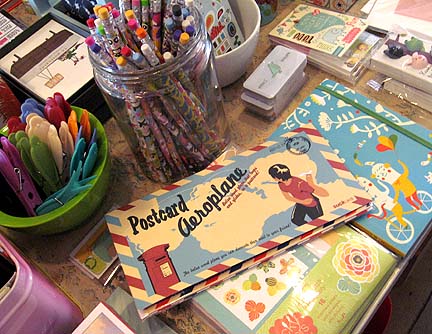
A view of the shop's arrays of journals, handmade papers, ephemera, and writing tools.


I asked Erika about the shop's most popular items. She began with pens such as Microns, LePens, "Aquarollers," by Itoya, and Pilot Varsity disposable fountain pens- all of which she demonstrated. Greeting cards are also very popular with all ages. In the photo above, Erika described the Apica "Twin Ring" journals which have become very popular, along with standby Rhodia and Moleskine blank books of varying sizes and paper styles. Quattro journals are another newly sought-after item.


Not to be missed, there is fuel for the graphite appetite. Erika's shop has long been my source for Craft Design Technology HBs. Pictured below are some amazing sculpted artifacts entirely made of graphite. These are unique items, each hand-carved.

In the photo below, Erika is writing with a graphite "branch." These tools do not smear or stain hands!


More popular items with customers are Japanese masking tapes (above) and journaling binders (below). The decorative tapes have more of the feel of a thick version of Magic Tape, and can be repositioned, and are entirely unlike what many of us know as painters' masking tape. Erika says these fly off the shelves!


Items such as these are enjoyed by all ages. The shop's customers include elementary-school-aged children, and span the generations.

As it may be evident by these pictures I took, people come to the shop looking for creative ideas. Being a longtime customer myself, I can attest to this serendipitous aspect of visiting Rock Paper Scissors. It seems there is always something new to try and people with whom to talk about the tools.
...and there's the shop's mascot and able assistant, Abby...

Along Route 1, just north of Bath, Maine, Rock Paper Scissors is at 68 Main Street (Route 1) in Wiscasset (the Prettiest Village in Maine), and their number is 207.882.9930.
(As yet, there is no web site.)


