


 Posts
All Comments
Posts
All Comments

“Always remember this luminous gospel reality: ‘it was God who loved us first.’
That is a light for your life.”
“What is the source of this hope? It is in God, a God who simply loves and no less, a God who never stops seeking us. Our hope is renewed when we entrust ourselves humbly to God.”
~ Brother Roger of Taizé, The Sources of Taizé
Continuity encourages me to look ahead, yet with a sense of the past. An invitation to venture to the Source is simply too good to resist. A long-anticipated travel was a night away. One of those simple journeys with an overtly spiritual purpose. Regularly traveling like this for some fifteen years now, I routinely stop to write just before leaving. Journal jotting is as necessary as packing provisions. When they occur, launch moments are times to cherish- and that includes a pause upon the return trip. Both ends are points of embarkation, and enough experience has shown me how clumsy it can be to write in transit. Moreso than to write, a time to absorb. Collecting written thoughts before heading out I can preserve impressions to read later that describe how I was before the experience. Preparing for a pilgrimage provides an example for the preparation for life’s journeys of any duration. Part of the readying is the anticipation.
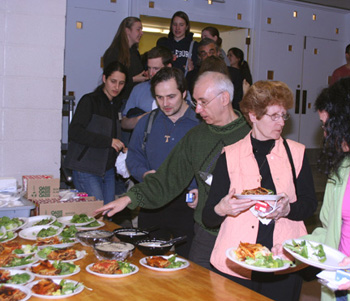
Even after arriving, there is preparation and anticipation. More arrivals will follow, and they will be welcomed by us. By preparing for the event by decorating shared spaces, music practice, setting out and serving food, the welcomed become providers of welcome. Amounting to an instant spectrum of reciprocity, it is yet another privilege to be included. The present becomes a shared home for a vast diversity of pilgrims, seekers, and the boldly curious. We are all bound together in a festive current.

Turning a corner, traversing a borderland, and recognizing a new passage is to discover a season. Distances covered become paths reached. The pilgrim road directs human steps toward the source of the Spirit within. Though material conditions appear unchanging, it is for me to actively detect transition by observing my perspectives. A season, such as the Lenten weeks, can be one of expectation that is itself anticipated. At the culmination of the Lenten season is the intensity of Passover: a looking forward to an extraordinary span of time, including a change in daily life, house-cleaning, and even in what foods to eat or be stored in the cupboard. As though preparing for a voyage, there is a similarly expectant air. Ordinary days can present numinous journeys, windows to our sources. A stretch of eight days, within forty, inside a year is an example.
These short seasons remind me of my acquired taste for the savor of gradual successions of days- or process- more than the single-day emphases. No day is an island. More than to hinge times of renewal upon a season, invitations and beginnings are inherent with daily experiences. Our continued interactions and prayers can lead to a mindfulness of God's presence, to our extension of that presence, and hence a closeness to the source of what is life-giving. As I’ve come to understand, the monastic expression going to the source is really a reference to prayer- and thus continuing to commit one’s life to openness to God. But the action of advancing in steps toward holiness becomes something of a resource itself. A setting forth that remembers the source from which I’ve known goodness in the past and through which I comprehend.

A thirst for advancement becomes intrinsic to an aspiring soul. The clearest expression of this for me- which even encompasses actively helping others- is life as pilgrimage. This is motion especially dedicated to fulfillment, encounter, and expression. Inward harmony to manifest as outward harmony. It implies ever drawing- and remembering to continue- from the wellsprings of trust. Just two weeks ago, I had the privilege of participating in an unusual Taizé gathering- also known as a Pilgrimage of Trust- as a musician. This was my tenth year of traveling to do just this! As a result, with each year, city, and country there are more and more friends to recognize- and vice-versa. The venue this time was a large Eastern Orthodox church in Montréal. For the music ensemble, this was something very new and thus every impression was a first. We were given very little time to tune in advance and get settled. Walking into the expanse of space my first impression was one of quiet wonder, absorbing the bright iconography and the dry aroma of incense. Life-sized frescos and the increasing numbers of gathering humanity amounted to a sum of glowing colors in the grey dusk of the sanctuary.


Acclimating to the space, I began to notice more nuances. Beneath this, my thoughts were occupied with the idea of the sources of trust. The front of the sanctuary had the appearance of a lit settlement with something of a skyline. Numerous shimmering icons populated the area around all of us, and the space around the altar brought to mind gates of prayer. The Brother of Taizé who was with us gave a talk about rejoicing in the thirst God has placed in us. This concept, from the ancient Psalms, was reflected in the chant and music we continued with. De Noche Iremos: “by night we seek the living waters; only our thirst lights us onward.” Following the days together, we all dispersed to resume our lives- in so many different places. Yet it was an advancing forward in great company, each continuing their pilgrimages in new strength. With sore left fingers, I clutched the handles of my guitar case down through the chilled subway. But it could hardly have been more wonderful.
Returning home and to my job, and then looking at the work itself, I thought further about sources. We refer to primary and secondary sources: original manuscripts and published editions. Primary and secondary; destinations and way-stations. The adventures of prayer, gathering together, and divine words become the presence we carry with us. The Source of all life does not draw from yet another source, but creates resources. On the road back, I asked my traveling companions about how their gleanings become sources. We traded stories about artifacts we’ve admired. I remembered seeing Longfellow’s manuscripts- complete with the very pencils he used for writing his epic Evangeline. My flute-playing friend talked about how he owns his grandparents’ engraved tea set which they received at their wedding, and imagined what the festivities might have been like. What do sources look like? What sounds do they create? Indeed, there are the created who can create, as well as created matter that cannot. Experiences of God form our approaches to the Source. Directed to the Source, the voyage is a life’s pilgrimage reaching beyond limitations, driven by thirst.


“It's all making me ready.
It's all doing what you gonna do.
I know "A"
I see my life come shine.”
~ Jeff Lynne, King of the Universe, from On the Third Day
This time of the year has come to be my busiest. Although late winter is conducive to recollection, my routines have been gratefully diversified with travels, playing music, and being among friends along the way. Part and parcel of the pilgrim path is note-taking and photography. Here is a chance to catch up. On a recent sojourn in Paris, an elegant subway poster drew my steps to an enthralling exhibit about the history of written letter forms at the Musée de la Poste (the postal history museum). The venue is familiar to me, but this show was extraordinary in presentation and depth of collections- the galleries filled with artifacts, printed and handwritten works, connected by narrative installations. It was easy to take dozens and dozens of photos, thinking of my fellow writers who might at least enjoy an edited version.

When we are writing, we join with a vast and boundless continuum of thoughts expressed in lettered articulation. Words constructed of typographic elements are shaped into our communication, description- even unspoken narrative. Further, understanding often hinges upon clarity of letter and language. Arrays of individual letter characters, with which thoughts are framed, present their unique graphic balance. The very letters I handwrite- and even type at this very moment- are inheritors of evolved typographic architecture. This museum exhibit reminded me very much of our working legacy of form and function. Indeed, an already existing affinity for the practices of graphic arts and calligraphy kept me in the Musée de la Poste for hours! Yet, all the more after exiting, my appreciation extended further as I noticed letter forms on buildings, in print, and in the city’s adornments. Then I chose a corner café to continue journaling.


Between wall panels displaying very large translucent parchment-like A-to-Z letter murals (as in the top photo) and illuminated manuscript pages, were these books. Just above, in Persian, and below from Ethiopia and China. The Asian displays included collections of ink-grinding tools and lettering brushes.


Moving through history, the galleries turned to displays of writing tools using ink and paper. These French-made materials were also beautifully advertised, reflecting the styles of their times. Note the pen-stands, and glass-pointed pens. There were display cases filled with the tiny boxes in which copper pen-points were packaged and sold.

The sections of a glass-reservoir Waterman fountain pen just below. These pens are still made in France. Fountain pens began to replace dip-pens and inkwells.

Among the impressive variety of inkwells displayed (one resembling a chariot, another in the shape of a coal stove) are these, just below. At right is Voltaire's inkwell and pen stand. Imagine what had been written with these tools!

Indeed, a fine showing of graphite writing tools not to be missed. Sennelier and Caran d'Ache are two brands that are still popular today. Pencils have hardly changed in the past century. Note the crank sharpeners on the right.

Just below is a portion of a large Bic ballpoint display. Some of the memorabilia advertising Bic, also a French company, was loaned by the Musée Carnavalet (the museum of Paris city history).

Though the focus of this history of writing exhibit concentrated on handwritten letters, the concluding gallery displayed letter-press printed pages, a 19th century cast-iron printing press (made in Boston!), and an Underwood typewriter. And, yes, a nod to word-processing. Being the national museum of postal history, there was a great display of antique postcards, and an area for children to write letters. During my visit, a tour guide was teaching a school group the basics of calligraphy.


Resuming my steps along side streets and broad avenues, typographic forms abounded. A large and familiar letter A appropriately met my path.
Just below, miles away from the museum, a calligraphic display in the Sennelier store along the Seine.

Spring is almost here.
Bonne écriture !


“Pourtant ne soyons pas tristes
Pour fleur bleue
J’en ai là toute une liste
C’est bien mieux
Amourettes passagères
Joies peines de coeur légères
Oui fleurs bleues.”
~ Charles Trenet, Fleur Bleue
If you don’t like how you’re feeling, change what you’re doing. That’s a fine gem of wisdom that got me through a perilously lean stretch about six years ago. Now, in times that threaten dead ends in so many directions, I am brought to remember the spirit of those words. While scavenging for hints of treasures in tired territories, I’ve noticed myself turning to trusted mentors. By the end of last week, I realized how I’d been unexpectedly visited by a variety of friends from different spheres of my life- in a nice incidental reciprocity. This made for some surprising lunch company to spice the days. Many tell me how ideally suited I am for what I do. This only contributes to my sense of unsettle, but I can at least take stock in listening to how my friends describe what they see. Indeed, simply attending to sincere perceptions helps me to interpret my context. There is always something to be derived from outside the old teapot tempests. If there are limits to my doing, there needn’t be such hindrances to my listening.
Apparently, turns in the road reveal continued desert stretches. These are without measure, and there will need to be plenty of energy to keep the pace. But, as I wrote last time, recommencing by considering blessings helps provide for a running start. From there, my thoughts have been occupied with the idea of “reprieve mindset.” Being spared a crisis leads to a catharsis of both reprieve and of a liberty to choose other points of attention. How refreshing to be able to look beyond self survival! With the grace to do so, the same old can be viewed anew. Explorations that can leap the dead-end barriers can be reading and observing with renewed vision; tasting and listening with amended senses. Beneath fixed givens, there are variables I can change. Perhaps in such reevaluation is the badge of reprieve.

Discovering the good and constructive amidst cynical and impoverished times is an altering of local colors. Actual in the sense that a fuller spectrum of color is a reminder of vastness. Figurative in the sense that the soul must not dwell long in drab grimness. There must be references beyond genre shades, and perhaps that makes an immersion into dazzling colors something rather daring. Make note of what nourishes above and beyond times of consumptive cynicism. Though gloom and defeat, find unfettered graces. When I cannot remember God’s presence, that surely doesn’t mean I’ve been forgotten. Indeed, finding encouragement in despair is hard enough- yet I don’t give up trying to be the encouragement I seek. In this way, I can help effect my own renewal as well as be an ingredient in that of others. To bloom in the desert is to be able to vary one’s vistas, to see the flowers grow through the ruins. Locate the bright prospects- or listen for them.

So much is made of endurance, that it becomes an end rather than a means toward something greater. Distinguishing between means and ends reveals the purpose of perseverance. It’s easy to be swept into popular perceptions of “survival” as an entire self-enclosed competition. “Hanging on” is often made into a goal. But surely the soul’s destiny is greater than any refinement of coping skills. There are higher aspirations than the sake of movement. But it seems our progress is measured by motion and amassments. I’d rather think of my journals as ships’ ledgers instead. These are testaments of perseverance, reminding me that the times demanding endurance are steps toward a sure yet unseen glory. Abilities to abide and pursue continue to hold great value- both as offerings of support and as ways to help appreciate the present.

For me, to resolutely continue mustn’t be of the gritted teeth variety, but with expectant hope. There is a fine splitting-off between reluctant tolerance and making the best of things. Again, means and ends are distinct. Neither should be exclusive of the other, and both are necessary reminders for each other. Contemplative prayer seems to be both, and it causes me to wonder at praying for guidance (asking for means), given the limited aspects of distance vision. Yet I wouldn’t dream of ceasing to do so.
The indefinite soul and the finite earthbound self interlock as mysterious counterparts. It is necessarily so. Duns Scotus boldly differed from Aquinas when he asserted that soul and body are united for the sake of the soul’s highest aspirations. Creativity is manifested in the composite being. We gaze heavenward, with feet on the ground. The long road does have its consolations and treasures- with diligent navigation, these are continually revealed. This week’s humble example joined two small finds to the sum of an inward grin: an old Boston Globe that was used to interleave some ancient volumes opened to an ad for “Blue Band” pencils. Then, in a later, unrelated circumstance I found a box of these- which must have been made close to the 1929 date of the newspaper fragment. Artifacts from the Great Depression era, yet so scrupulously produced. Small treasures to remind me of my conduits. Inevitably if the ends are as yet imperceptible, perhaps the means can be enjoyable. In a similar sense, I don’t journal with a final entry in mind.


“Always the same underdog stance
under the same happy-sad sky,
eternally crying. Am I still shy?
I am always beginning the world
beginning the world.”
~ The Innocence Mission, Beginning the World
Only in the last couple of days I’ve resumed journaling, after more than a week’s hiatus. A week without assembling words is in itself indicative of a disruption of life’s pace. But with the resumption of narrative is a persistent questioning of the meaning of progress. What are the determinants of the soul’s advancement?
The mystery of real progress is akin to that of time. Mile markers along roads indicate linear distances, yet it is common in many lives to repeatedly pass by the same signs. Even with experiences of bicycle marathons and pool-swimming laps, I wonder if there’s been any tangible progress in the grand scale of my continuum. Or enough. Such pre-occupations become off-putting to me, and I’d prefer to deflect them. The big world is rife with human hardships, revealing an absurdity to worries about the small spaces beneath my feet. They are fleeting, and recognizable by their contexts and connotations. Trying to define self and success is, alas, unavoidable. And if thoughts are to be documented- albeit in passing- even the expressions of obscurity have their places, especially before a re-launch.
Momentum. A fair share of days seem to begin by just showing up. In an effortless perpetual motion, my multitasking flows among objectives, interactions, connecting points of due dates, and even the unscheduled interruptions. Tasks can even be accomplished while other projects are being done. In the broader sense, work demands can weave between reflection, leisure, memory, and aspiration. One motion feeds another. Knowledge from one school or job adds to the sum and solution of an application in another. Sometimes things actually work this way, as though decades of rollers and gears have effortlessly and purposefully joined.

Inertia. Stubborn weeds among the fruitful time periods are those spells of overcoming resistance. Moving out of inactivity (or too much of the same activity) seems to require rebuilding. It’s as though the world must be recommenced from its foundations. A few dependable systems falter, or perhaps become obsolete, and suddenly all seems thrown backwards. A “system” may be mechanical, or internal, or ethereal. And the breach can be mild and unapparent, or overt and stagnating. Stagnation can be so profound that energy must be consumed just to be able to stand- let alone imagining a sustained posture. Navigating through and out of inertia puts the soul in an unusual sensitivity that takes nothing for granted. Through the dark night comes a surrendering of unproductive drives for control, despite the unknowing. While sensing what appears a very fine thread holding everything together, there is a parallel challenge that this may be an effect of impaired perspective. Though it is easy to admit to knowing very little, it is equally difficult to be convinced that nothing essential is lacking. Wondering about being “behind in the game” only invites defeatism. Especially in these times. Inertia and resistance can be overcome with a beginning as basic as counting the blessings of what is good.

A recommencement can retrace the remembrance of momentum. Chroniclers can retrieve journals written in brighter days and revisit the old fighting form that made reaching these shores possible. In yet more adventures of trust, my thoughts must repeat as often as necessary that the unseen Holy Spirit will always hold my footsteps firm. Looking forward through unknowing and material uncertainty is an act of faith. Holding to it is a continuous exercise of trust. There is one direction to go, and that is forward. In so doing, that tension must give way to savored paces that reclaim the airspaces connecting being with environment.
Only a few days ago, I exercised a decision I did not fully realize I had. Hurtled forward by salesmen and financial experts, I very nearly bought a house that I didn’t really like- and could barely afford. Indeed, habitations can be investments, but they must also be worthy places to live. Though a valuable learning experience, the whole episode was one of helpless despair. It began to resemble a perilous conveyor belt rolling my misgivings to a distribution dock of no return (and no savings). In the faces of financiers, I followed the forceful intuition I almost suppressed. If I can possibly help it, faith in the future will trump fear and fatalism. I stopped a process that began in trepidation and the ensuing peace has been palpable.
In my gratitude, few things are taken for granted. Something has indeed changed, and by continuing on I’ll find out. I paid the building inspector, adding a thank-you letter (written on my cursive typewriter), and will pay February’s rent with a relished relief. As I came to see it, all those I met in the process were fine souls. It is in weakness that strength is discovered. I ponder the immortality that happenstance causes me to brush against. It is the heart of God that connects all of us. With this surprise of the freedom already possessed, I happily donated to a few charitable causes. The ability to give is in itself a gift presented to me. I know my steps are guided- even to a threshold of my own some day. But for now I will have to “begin the world” to some extent, though it needn’t be more than simply reconnecting to all I love best.


“You walk into the room with a pencil in your hand...”
~ Bob Dylan, Ballad of a Thin Man
A reprieve of stillness mercifully interrupted the day’s chaos. With notebook and pencil in hand, I sought the quiet sanctuary of an empty office. After having started writing, it became obvious to me that nothing cohesive was materializing. But I kept noting words- even if some of them were about feeling devoid of anything to say. I wanted some new thoughts, but that hour offered no written developments. So that’s exactly what I wrote. After returning home from work that night, those bedraggled words re-appeared as I opened my journal again. It seemed I’d been foraging for glowing embers using a pencil. It happens, ungratifying as that can be. The aspect for which I do express gratitude is for knowing to reach. Even a few scribbled sentences reveals forward motion.
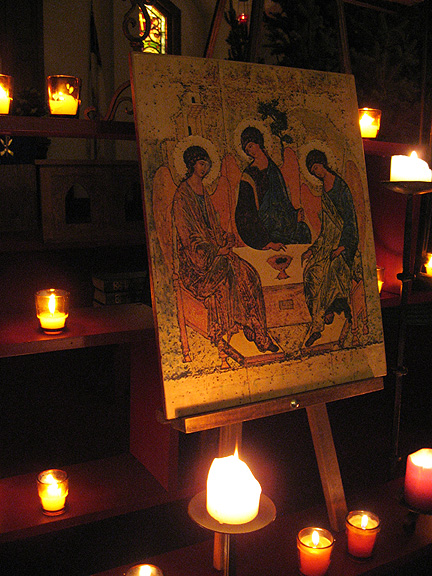
Throughout this recent season of Advent and Epiphany, I’ve travelled to parishes throughout the region, providing music and creating contemplative spaces. Last Sunday night, during the long meditative silence, I glanced up from my sheet music to the front of the sanctuary. Lit only by scattered flickering candles, warm-toned icons met my gaze. These are the same icons that I’ve hefted across thousands of miles, beginning in Taizé, France. Occasionally, I am surprised by the austere mystery on the painted figures and faces. The Spirit invites. Such images are not sources, but brilliant reflections of light that confounds the dark. If darkness is prelude to light, then I must consider my failings and frustrations as prefatory to discovering.
Consider how a physical space appears transformed in our eyes, as our perceptions evolve. The same venue that witnessed anguished desperation can be the setting for elated recognition. Contrasting connotations can be noted anywhere: a café, a busy street, a schoolyard, a workplace, a room in a house. My apartment has been something of a stage for human drama. A downtown diner has been a repeating backdrop for scribing trepidations and for calligraphic catharses alike. Noting how a space is transfigured is to recognize changed realities perceived.
Amidst this reach for understanding is the unfathomable mystery of the origin of light. From there follows the wonder of how a spirit can be re-ignited. If to discover is epiphany, then to arrive is to be present: to alight. The act of alighting is to descend from one place and come to rest in another. Perhaps there is something to note, in my journey, about coming to terms with the Source of life without having seen the Eternal. In Tauler’s exhortation to endure in good cheer, we are to abound in good works for God’s sake. “And then,” he wrote, “shall you be made partakers of overflowing measure that runneth over on all sides.” This alighting touch of grace reaches the brimming human vessel, which “pours itself back again into its Divine source, from whence it has proceeded." In Tauler's description of this mystery, "all knowledge, love, perception are all swallowed up and lost in God, and become one with God." This grandeur challenges my own belief, in that it is more than I think I should ever expect. But perhaps that wouldn't be reaching as I ought. While trying to comprehend these things, why not keep working and keep the pencil moving on the page?

A good friend of mine is a historian of tool-makers and their utilitarian creations. His enthusiasm and expertise has breathed new life into our local Charitable Mechanics' Association- which dates back to Colonial times. Our friendship inspires in both directions. I am becoming attuned to the old ways of production, and he now uses antique typewriters. One day, as I spoke of the "tools of the spiritual life," he quipped, "you've said it all right there. Tools are spiritual." Indeed, we speak in two different senses of the word: implementation of a practice and the physical implements themselves. Surely, the actual tools of the writer (along with the builder and the mechanic) deserve their due. With these writing instruments at our ready, we experience the miraculous- and can create documentation.
As with light, our documenting tools help us liberate our thoughts, our stories, and our voyages. I have seen the worth of keeping the pencil moving- even while reaching and straining for description. And the tools do accommodate, no matter how cold; graphite cannot freeze. These exterior sub-zeroes teach us the value of continual movement. In time, the frozen granite steps will be bathed in spring rains and adorned with ivy.


